
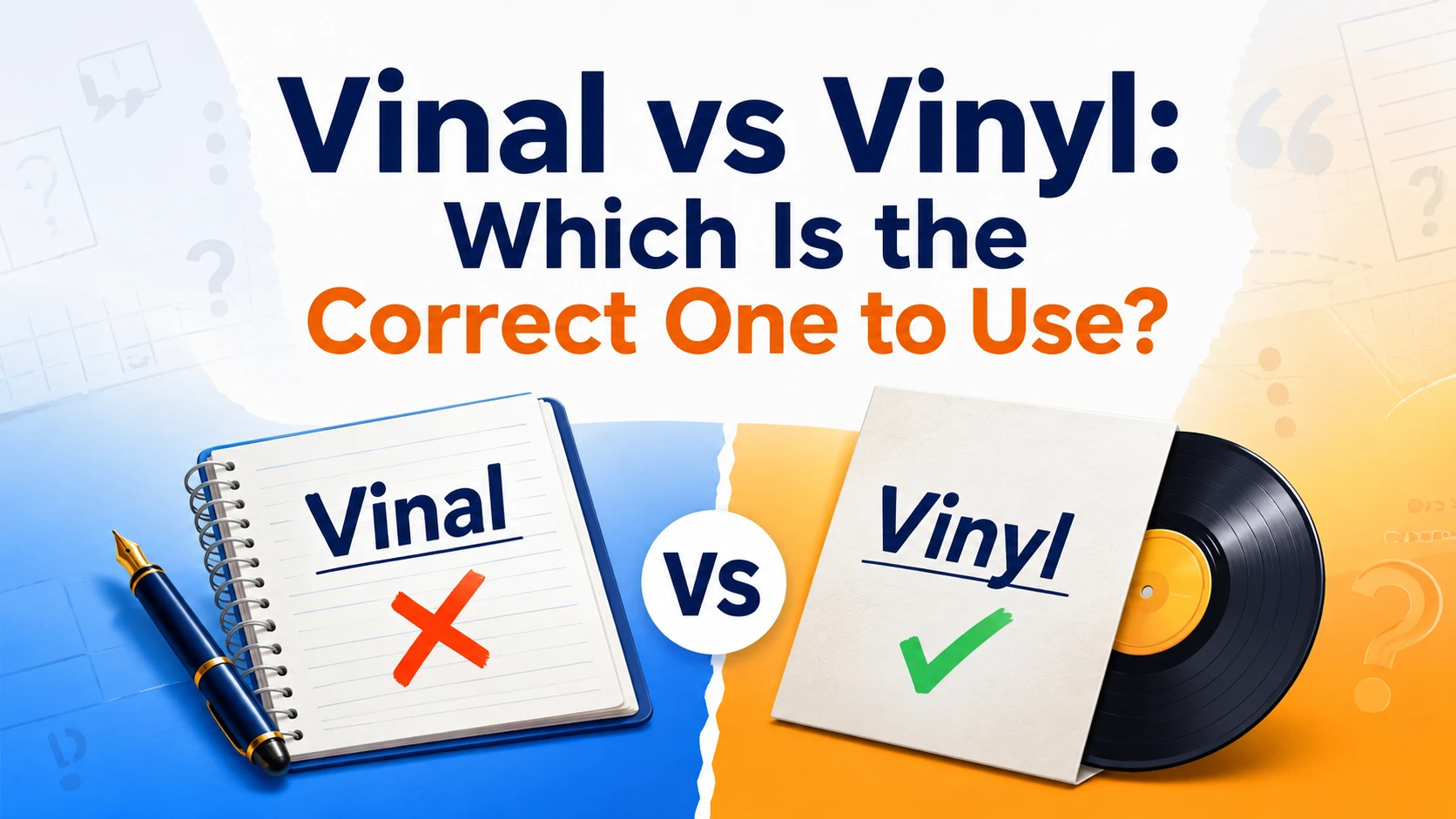
Vinal vs Vinyl is a surprisingly common spelling question because both words sound almost identical when spoken. If you’ve searched for “vinal,” you’re not alone. Thousands of people type this spelling every year while looking for information about vinyl records, vinyl flooring, vinyl wrap, or the plastic material itself. The confusion is understandable but only one spelling is considered correct in standard English for these meanings. Knowing the difference helps you communicate more clearly and prevents embarrassing mistakes in writing, education, and professional settings.
English contains many words that are easy to misspell because pronunciation doesn’t always match spelling. Vinyl belongs to that category. Whether you’re writing a product description, discussing music collections, shopping for home improvement materials, or simply trying to improve your spelling, using the correct form matters. Beyond spelling, understanding what vinyl actually is can also help you choose the right products, recognize industry terminology, and avoid confusing it with related materials such as PVC, laminate, or other plastics.
This guide goes beyond simply telling you that one spelling is right and the other is wrong. You’ll learn why people confuse these words, where the mistake comes from, how professionals use the word vinyl across different industries, and simple memory techniques that make the correct spelling easy to remember. You’ll also see practical examples, comparison tables, and expert tips that help you use the word confidently in everyday writing.
The Short Answer
If you’re looking for the quick answer, here it is:
- Vinyl is the correct spelling when referring to the plastic material, vinyl records, flooring, siding, wraps, crafts, or similar products.
- Vinal is not the correct spelling for these meanings. In almost every case, it is simply a spelling mistake.
- Although Vinal exists as a surname and appears in some business names or place names, it is not the English word for the material known as vinyl.
Quick Tip: If you’re talking about records, flooring, stickers, windows, fences, clothing, or plastic products, the correct word is always vinyl.
What Does “Vinyl” Mean?
The word vinyl has both a scientific meaning and a practical everyday meaning. While chemists use the term in relation to specific molecular structures, most people encounter it when talking about manufactured products made from polyvinyl chloride (PVC) or related vinyl materials.
In everyday English, vinyl generally refers to a durable synthetic material used in countless products because it is affordable, flexible, water-resistant, and long-lasting.
Dictionary Definition of Vinyl
In modern English, vinyl refers to:
- A synthetic plastic material made from vinyl compounds, especially polyvinyl chloride (PVC).
- A phonograph record made from vinyl plastic.
- Products manufactured using vinyl-based materials.
The meaning depends on the context, but the spelling remains the same in every case.
How the Meaning Changes Across Different Contexts
Although the spelling never changes, the meaning of vinyl varies depending on the industry or conversation.
Vinyl as a Plastic Material
Manufacturers value vinyl because it combines durability with flexibility. Unlike many traditional materials, vinyl can resist moisture, chemicals, sunlight, and everyday wear.
Common products include:
- Window frames
- Pipes
- Shower curtains
- Credit cards
- Medical tubing
- Packaging materials
Because of these properties, vinyl has become one of the world’s most widely used synthetic materials.
Vinyl in Music and Records
For music lovers, vinyl almost always means vinyl records.
These records are pressed from PVC and contain tiny grooves that store analog sound. When played on a record player, a stylus follows these grooves to reproduce music.
Although digital streaming dominates today’s music industry, vinyl records have experienced a remarkable resurgence because many listeners appreciate their:
- Warm analog sound
- Large album artwork
- Collectible value
- Nostalgic appeal
- Tangible listening experience
You’ll often hear phrases such as:
- vinyl collection
- vinyl record
- vinyl album
- vinyl pressing
- limited-edition vinyl
Vinyl in Flooring and Home Improvement
Homeowners frequently encounter vinyl while renovating kitchens, bathrooms, or commercial spaces.
Vinyl flooring is popular because it offers several practical advantages:
| Feature | Benefit |
| Water resistance | Suitable for kitchens and bathrooms |
| Affordability | Costs less than many hardwood options |
| Easy maintenance | Requires minimal cleaning |
| Durability | Handles heavy foot traffic |
| Design variety | Mimics wood, stone, and tile realistically |
Modern luxury vinyl flooring has improved dramatically over older products, making it difficult to distinguish from natural materials at first glance.
Vinyl in Crafts, Printing, and Signage
Vinyl also plays a major role in creative industries.
Small businesses, hobbyists, and professional printers use specialized vinyl sheets to create:
- Vehicle decals
- Window graphics
- Custom T-shirts
- Business signs
- Wall decorations
- Personalized gifts
- Labels and stickers
Some common types include:
- Adhesive vinyl
- Heat Transfer Vinyl (HTV)
- Printable vinyl
- Permanent vinyl
- Removable vinyl
Each serves a different purpose, so professionals choose the type based on durability, surface compatibility, and intended use.
Expert Insight: Many beginners mistakenly think all vinyl products are identical. In reality, manufacturers formulate different vinyl materials to meet specific performance requirements such as flexibility, outdoor durability, or heat resistance.
What Does “Vinal” Mean?
Unlike vinyl, the spelling vinal does not represent the common English word for the plastic material or music records.
Most dictionaries do not recognize vinal as a standard English vocabulary word with the same meaning as vinyl.
Is It a Misspelling or a Real Word?
For nearly every grammar, spelling, and product-related context, vinal is simply a misspelling of vinyl.
People usually type it because:
- Both words sound similar.
- English spelling can be unpredictable.
- They have only heard the word spoken.
- Autocorrect doesn’t always catch the mistake.
- They remember the pronunciation but not the spelling.
This makes vinal one of the more common spelling errors associated with consumer products.
Rare Cases Where “Vinal” Appears
Although vinal is incorrect for the material, it does appear elsewhere as a proper noun.
For example, you may encounter:
- A person’s surname
- Family names
- Business names
- Geographic names
- Historical references
These are names rather than dictionary vocabulary words.
This distinction matters because proper nouns follow their own spelling conventions and are not evidence that vinal is an accepted alternative spelling of vinyl.
Why You Should Avoid Using “Vinal”
Using vinal instead of vinyl can create confusion and reduce your credibility, especially in professional or academic writing.
For example:
❌ We installed vinal flooring last week.
✅ We installed vinyl flooring last week.
❌ I collect rare vinal records.
✅ I collect rare vinyl records.
Even a small spelling mistake can affect:
- Search accuracy
- Business communication
- Product listings
- Academic writing
- Marketing materials
- Customer trust
When in doubt, remember that every major manufacturer, retailer, dictionary, and construction professional uses the spelling vinyl.
Vinal vs Vinyl: Side-by-Side Comparison
The easiest way to understand the difference is to compare the two directly.
| Feature | Vinal | Vinyl |
| Standard English word | ❌ No | ✅ Yes |
| Correct spelling for the material | ❌ No | ✅ Yes |
| Found in major dictionaries for this meaning | ❌ No | ✅ Yes |
| Used in construction | ❌ No | ✅ Yes |
| Used in music industry | ❌ No | ✅ Yes |
| Used in product names | ❌ No | ✅ Yes |
| Can appear as a surname | ✅ Yes | Rarely |
| Recommended in formal writing | ❌ Never | ✅ Always |
Spelling
Only vinyl is accepted as the correct spelling when referring to the material, records, flooring, or similar products.
Meaning
Vinyl refers to a synthetic material and the many products made from it. Vinal, by contrast, has no equivalent dictionary meaning in standard English and is generally a misspelling unless it is part of a proper name.
Pronunciation
One reason for the confusion is that both spellings would be pronounced almost the same by many English speakers. Because pronunciation offers few clues, relying on memory rather than sound is essential.
Usage in Everyday English
You’ll find vinyl used across a wide range of contexts, including:
- Home improvement
- Interior design
- Automotive wraps
- Medical equipment
- Music collecting
- Retail packaging
- Fashion accessories
- Graphic design
- Arts and crafts
By contrast, you won’t see reputable manufacturers or dictionaries using vinal to describe any of these products.
Key Takeaway: If you’re referring to the material, records, flooring, wraps, or any consumer product, vinyl is always the correct spelling. Vinal is almost always a simple spelling mistake rather than an accepted English word.
Why Do People Confuse “Vinal” and “Vinyl”?
At first glance, the mistake seems minor—a single misplaced letter. However, there are several reasons why “vinal” appears so often in online searches, emails, product descriptions, and social media posts. Understanding these reasons makes it much easier to avoid the error yourself.
Unlike many spelling mistakes, this one isn’t caused by a lack of vocabulary. Instead, it’s largely the result of English pronunciation, typing habits, and the way our brains process familiar sounds.
Similar Pronunciation
One of the biggest reasons people write vinal instead of vinyl is pronunciation.
In everyday conversation, many speakers pronounce vinyl quickly, making the ending sound less distinct. If someone has only heard the word and never seen it written, they may naturally assume it’s spelled “vinal.”
This happens with many English words because pronunciation doesn’t always reveal the correct spelling.
For example:
- Colonel
- Wednesday
- Rhythm
- Receipt
- Vinyl
Each word contains spelling patterns that aren’t immediately obvious from the way they’re spoken.
Typing and Autocorrect Mistakes
Modern technology doesn’t eliminate spelling errors—it sometimes creates new ones.
When typing quickly:
- Fingers often hit nearby keys.
- People rely on memory instead of checking spelling.
- Search engines may still return results despite mistakes.
- Some spell-check tools don’t flag uncommon misspellings immediately.
If you frequently search for vinyl flooring, vinyl records, or vinyl wrap, typing “vinal” may still produce relevant results, reinforcing the incorrect spelling.
Expert Tip: Never assume that because a search engine understood your query, your spelling was correct. Search engines often correct mistakes silently.
Influence of Regional Accents
English accents vary significantly across countries and even within the same region.
Some accents soften or reduce the final syllable of vinyl, making it sound closer to:
- vinal
- vinul
- vinel
While pronunciation naturally changes, standard spelling does not.
Whether you’re writing American English, British English, Canadian English, or Australian English, the correct spelling remains vinyl.
Memory Tricks That Actually Work
Simple memory techniques often work better than repeatedly checking a dictionary.
Here are a few that professionals use:
✔ Remember the “Y” Rule
Think of the letter Y as standing for “Your Record Collection.”
Vin + Y + l
If you’re talking about records or flooring, keep the Y.
✔ Associate Vinyl with Popular Phrases
You’ll often see expressions like:
- Vinyl record
- Vinyl flooring
- Vinyl siding
- Vinyl wrap
Reading these phrases repeatedly helps reinforce the correct spelling.
✔ Visual Recognition
Your brain becomes familiar with frequently seen words.
The more often you read vinyl, the more obvious vinal begins to look incorrect.
How to Use “Vinyl” Correctly in Sentences
Learning definitions is useful, but applying them correctly is what builds confidence.
Below are practical examples drawn from everyday situations.
Examples Related to Music
Correct:
- She bought a rare vinyl record from the local music store.
- My grandfather owns hundreds of classic vinyl albums.
- Many collectors prefer original vinyl pressings.
Incorrect:
- She bought a rare vinal record.
Examples Related to Flooring
Correct:
- We chose vinyl flooring because it’s waterproof.
- Luxury vinyl plank flooring closely resembles hardwood.
- The contractor recommended commercial-grade vinyl tiles.
Incorrect:
- We installed vinal flooring.
Examples Related to Home Décor
Correct:
- The windows feature durable vinyl frames.
- Their house has attractive vinyl siding.
- The fence is made from weather-resistant vinyl.
Examples Related to Printing and Crafts
Correct:
- She designed custom stickers using adhesive vinyl.
- Heat transfer vinyl works well on cotton shirts.
- Printable vinyl is commonly used for labels.
Professional and Technical Examples
Businesses regularly use the word in technical documentation.
Examples include:
- Vinyl-coated cables
- Vinyl membrane roofing
- Vinyl upholstery
- Vinyl insulation
- Flexible vinyl compounds
Using the correct spelling is especially important in technical writing because product specifications must be precise.
Common Collocations with “Vinyl”
Some words naturally appear together. These combinations, known as collocations, help you recognize correct English usage.
| Common Phrase | Meaning |
| Vinyl record | Music record made from PVC |
| Vinyl flooring | Waterproof synthetic floor covering |
| Vinyl siding | Exterior wall covering |
| Vinyl wrap | Decorative or protective film |
| Vinyl fence | Low-maintenance fencing material |
| Adhesive vinyl | Self-sticking craft material |
| Heat Transfer Vinyl (HTV) | Vinyl applied with heat to fabric |
| Vinyl upholstery | Vinyl-covered furniture or seating |
Learning these combinations makes it easier to remember the correct spelling because you’ll encounter them repeatedly in books, advertisements, and professional documents.
Vinyl Record
One of the most recognizable uses of the word.
Collectors value vinyl records because they offer:
- Analog sound
- Physical artwork
- Limited editions
- Long-term collectible value
Vinyl Flooring
Modern vinyl flooring has become one of the fastest-growing flooring choices due to its:
- Water resistance
- Scratch resistance
- Lower cost
- Easy installation
- Wide variety of designs
Luxury Vinyl Plank (LVP) and Luxury Vinyl Tile (LVT) are especially popular in residential and commercial spaces.
Vinyl Wrap
Vinyl wrap is widely used to customize:
- Cars
- Trucks
- Motorcycles
- Boats
- Laptops
- Furniture
Unlike paint, many wraps can be removed without permanently altering the surface.
Vinyl Siding
Homeowners often choose vinyl siding because it requires relatively little maintenance.
Advantages include:
- Doesn’t require regular painting
- Resists moisture
- Available in numerous colors
- Long service life
- Lower maintenance costs
Heat Transfer Vinyl (HTV)
HTV is commonly used by:
- Small business owners
- Clothing brands
- Hobby crafters
- Sports teams
- Schools
Designs are cut from vinyl sheets and permanently applied to fabric using heat and pressure.
Vinyl in Different Industries
One reason the word vinyl appears so frequently is its versatility. It isn’t limited to one field—it plays an important role across many industries.
Construction and Interior Design
Builders and architects rely on vinyl because it balances cost, durability, and ease of maintenance.
Common applications include:
- Flooring
- Windows
- Siding
- Wall coverings
- Roofing membranes
Its resistance to moisture makes it particularly useful in kitchens, bathrooms, hospitals, and commercial buildings.
Music and Entertainment
Despite the rise of digital streaming, vinyl remains highly valued.
Collectors appreciate:
- Authentic analog playback
- Album artwork
- Limited editions
- Historical significance
- Better tactile experience
Many artists continue releasing albums on vinyl alongside digital formats.
Automotive Wrapping
Instead of repainting a vehicle, businesses often apply vinyl wraps.
Benefits include:
- Faster installation
- Lower cost than custom paint
- Removable designs
- Paint protection
- Branding opportunities for commercial vehicles
Fleet operators frequently wrap delivery vehicles with company logos for mobile advertising.
Advertising and Sign Making
The sign industry relies heavily on specialized vinyl materials.
Examples include:
- Shop signs
- Window graphics
- Vehicle graphics
- Exhibition displays
- Outdoor advertising
Different vinyl formulations are selected depending on weather exposure and expected lifespan.
DIY Crafts and Small Businesses
Many entrepreneurs start home-based businesses using cutting machines and vinyl sheets.
Popular products include:
- Personalized mugs
- Wedding decorations
- Custom T-shirts
- Name decals
- Wall art
- Gift boxes
- Labels
The affordability and versatility of vinyl have made it one of the most accessible materials for small-scale manufacturing.
Professional Insight: Although the word vinyl is commonly associated with music, the construction and manufacturing sectors actually consume far more vinyl material than the entertainment industry.
Is “Vinyl” Countable or Uncountable?
One question that often puzzles English learners is whether vinyl is a countable or uncountable noun. The answer depends on the context.
Most of the time, vinyl refers to a material, so it behaves like other material nouns such as wood, glass, steel, or plastic. However, in certain situations—particularly in music—it can also be used as a countable noun.
Understanding this distinction will make your writing sound much more natural.
When to Say “Vinyl”
Use vinyl as an uncountable noun when you’re talking about the material itself.
Examples:
- This chair is made from vinyl.
- The manufacturer produces high-quality vinyl.
- Waterproof vinyl is ideal for bathrooms.
- Many banners are printed on durable vinyl.
In these sentences, you’re referring to the material in general rather than individual items.
When to Say “Vinyls”
Although vinyls is grammatically acceptable in some contexts, it should be used carefully.
Collectors sometimes say:
- I bought three vinyls yesterday.
- She owns hundreds of vinyls.
However, many editors, musicians, and language experts consider this wording less precise.
Instead, they recommend saying:
- I bought three vinyl records.
- She owns hundreds of records.
- He has an impressive vinyl collection.
These alternatives are clearer and more widely accepted in formal writing.
Why “Vinyl Records” Is Often More Precise
Imagine reading this sentence:
I bought five vinyl yesterday.
Does it mean:
- Five records?
- Five sheets of vinyl?
- Five rolls of vinyl wrap?
The meaning isn’t immediately obvious.
By writing vinyl records, you remove any ambiguity.
Writing Tip: In professional or academic writing, choose vinyl records instead of vinyls whenever clarity matters.
Pronunciation Guide
Correct spelling is important, but proper pronunciation helps you communicate confidently in conversation.
Fortunately, vinyl is pronounced almost the same in major English dialects.
American English Pronunciation
Vinyl
IPA: /ˈvaɪ.nəl/
Approximate pronunciation:
VY-nuhl
The stress falls on the first syllable.
British English Pronunciation
British English uses essentially the same pronunciation:
IPA: /ˈvaɪ.nəl/
Although accents differ slightly, the overall pronunciation remains almost identical.
Phonetic Spelling
If IPA symbols aren’t familiar, this simple pronunciation guide helps:
Vinyl → VY-nuhl
Not:
- vee-nile
- vin-all
- vine-ill
- vinal
Words Commonly Mispronounced Alongside Vinyl
People who misspell vinyl sometimes confuse other English words with unusual spelling patterns.
Examples include:
| Incorrect Assumption | Correct Word |
| Vinal | Vinyl |
| Laminent | Laminate |
| Febuary | February |
| Goverment | Government |
| Enviroment | Environment |
These examples illustrate an important point: English spelling often reflects historical language development rather than modern pronunciation.
Words Commonly Confused with Vinyl
Although vinal is by far the most common spelling mistake, several related terms are also confused with vinyl.
Knowing the distinctions helps you choose the right word in different situations.
Vinyl vs Varnish
These words have completely different meanings.
| Vinyl | Varnish |
| Synthetic material | Protective wood coating |
| Used in flooring, records, wraps | Applied to wood surfaces |
| Manufactured plastic | Transparent finishing product |
Someone might install vinyl flooring, but they would apply varnish to a wooden table.
Vinyl vs PVC
Many people assume these terms are interchangeable.
They’re closely related—but not identical.
PVC stands for polyvinyl chloride, one of the most common forms of vinyl.
In everyday conversation, people often say vinyl when referring to products made primarily from PVC.
However, in technical and manufacturing contexts, professionals distinguish between the chemical compound and the finished product.
Vinyl vs Plastic
Vinyl is a type of plastic, but not every plastic is vinyl.
Think of it this way:
- Plastic = broad category
- Vinyl = specific material within that category
Other plastics include:
- Polyethylene (PE)
- Polypropylene (PP)
- Acrylic
- Polycarbonate
- Nylon
Using the broader word plastic isn’t always incorrect, but vinyl is more precise when referring to vinyl products.
Vinyl vs Laminate Flooring
This is one of the most common home improvement questions.
Although both products can resemble hardwood, they differ significantly.
| Feature | Vinyl Flooring | Laminate Flooring |
| Water resistance | Excellent | Moderate to low (varies by product) |
| Core material | Synthetic | Fiberboard with wear layer |
| Best for bathrooms | Yes | Usually not recommended |
| Comfort underfoot | Softer | Firmer |
| Moisture durability | High | Lower |
For wet environments, vinyl is generally the preferred choice because of its superior moisture resistance.
How to Remember the Correct Spelling
Spelling becomes much easier when you use memorable associations instead of rote memorization.
Here are several techniques that work well.
A Simple Mnemonic
Remember this sentence:
“The Y belongs in vinyl because your favorite records do.”
The letter Y serves as your reminder.
Whenever you think about records, flooring, or wraps, picture the Y in the middle.
Visual Memory Technique
Imagine seeing the word printed on a record sleeve:
VINYL RECORD
After seeing this phrase repeatedly, your brain naturally recognizes the correct spelling.
Visual repetition is one of the strongest tools for improving spelling accuracy.
Spelling Pattern You Can Trust
Break the word into manageable parts:
Vin + yl
While yl isn’t a common English ending, treating it as a fixed pattern helps reinforce the spelling.
Avoid trying to spell the word purely from pronunciation.
Common Mistakes to Avoid
Most people don’t intentionally write vinal. The mistake usually happens because they rely on memory instead of verification.
Here are the most common errors—and how to avoid them.
Using “Vinal” in Formal Writing
Whether you’re writing:
- a school assignment,
- a business email,
- a blog post,
- product documentation,
- or a research paper,
always use vinyl when referring to the material or related products.
Even a small spelling error can affect your professionalism and credibility.
Confusing Product Names with Material Names
A product may contain vinyl without being called simply vinyl.
For example:
- Vinyl flooring
- Vinyl siding
- Vinyl upholstery
- Vinyl banner
- Vinyl wrap
Using the complete product name makes your writing more accurate.
Assuming Every Plastic Material Is Vinyl
Not every plastic product is made from vinyl.
For example:
- Food containers may be polypropylene.
- Water bottles are often PET.
- Safety helmets frequently use polycarbonate.
- Nylon is common in clothing and industrial equipment.
Understanding this distinction improves both technical accuracy and everyday communication.
Expert Recommendation: Before using a material name in professional writing, verify the manufacturer’s specifications. Calling every synthetic product “vinyl” can be just as misleading as misspelling the word itself.
Practice Your Understanding
Reading about the difference between vinal and vinyl is helpful, but the best way to remember it is to practice using the correct spelling. These short exercises reinforce what you’ve learned and help you recognize the correct word automatically.
Choose the Correct Word
Select the correct option to complete each sentence.
- We replaced our old carpet with ______ flooring.
- A. Vinal
- B. Vinyl
- She enjoys collecting classic ______ records.
- A. Vinal
- B. Vinyl
- The company printed the advertisement on adhesive ______.
- A. Vinal
- B. Vinyl
- Our contractor recommended waterproof ______ planks.
- A. Vinal
- B. Vinyl
- The designer used ______ wrap to customize the company vehicle.
- A. Vinal
- B. Vinyl
Answer: Every sentence uses vinyl, because each refers to the material or a product made from it.
Correct the Misspelled Sentence
Identify and fix the spelling mistake.
❌ We installed vinal flooring throughout the house.
✅ We installed vinyl flooring throughout the house.
❌ I bought two vinal records yesterday.
✅ I bought two vinyl records yesterday.
❌ The sign was printed on permanent vinal.
✅ The sign was printed on permanent vinyl.
❌ She decorated the mug with adhesive vinal.
✅ She decorated the mug with adhesive vinyl.
Fill in the Blank
Complete each sentence using the correct word.
- Luxury ______ plank flooring is popular because it resists moisture.
- Answer: vinyl
- Many collectors still prefer listening to ______ records.
- Answer: vinyl
- The business ordered custom window graphics made from ______.
- Answer: vinyl
- The contractor installed white ______ siding on the exterior walls.
- Answer: vinyl
- Heat Transfer ______ is commonly used to personalize T-shirts.
- Answer: Vinyl
Real-Life Editing Challenge
Imagine you’re proofreading the following product description for an online store.
“Our premium vinal flooring offers waterproof protection and comes in realistic wood finishes. This vinal product is easy to install and maintain.”
The corrected version should read:
“Our premium vinyl flooring offers waterproof protection and comes in realistic wood finishes. This vinyl product is easy to install and maintain.”
This type of error is common in product listings, blog posts, and marketing materials. Correcting it improves readability, professionalism, and customer confidence.
Practice Tip: Whenever you finish writing, use your document’s search feature to look for “vinal.” If it appears, replace it with “vinyl” unless it’s part of a person’s name or a business name.
Key Takeaways
| Topic | Essential Point |
| Correct spelling | Vinyl is the correct English word. |
| Incorrect spelling | Vinal is usually a misspelling. |
| Exception | Vinal may be used as a surname or proper noun. |
| Common uses | Records, flooring, siding, wraps, upholstery, crafts, and signage. |
| Best writing practice | Use vinyl in all professional, academic, and everyday contexts involving the material. |
| Memory tip | Remember the “Y” in vinyl by thinking of your vinyl record collection. |
By understanding not only which spelling is correct but also why the confusion exists, you’ll avoid one of the most common spelling mistakes related to this widely used material. Whether you’re writing a product description, discussing home improvement, or talking about music, choosing vinyl ensures your writing is clear, accurate, and professional.
Conclusion
If you’re deciding between vinal and vinyl, the answer is straightforward: vinyl is the correct spelling whenever you’re referring to the synthetic material or products made from it, including vinyl records, vinyl flooring, vinyl wraps, vinyl siding, and countless other everyday applications. Vinal, on the other hand, is generally a misspelling unless it appears as part of a person’s name, a business name, or another proper noun. The easiest way to avoid mistakes is to associate vinyl with familiar phrases you’ll see regularly in stores, articles, and product descriptions. One final actionable tip: whenever you write about flooring, music, crafts, or construction materials, pause for a moment and check that you’ve included the letter “Y” in vinyl. A common mistake to avoid is relying solely on pronunciation, because English spelling often follows patterns that sound alone cannot reveal.
Frequently Asked Questions
Q1. Is “Vinal” ever the correct spelling?
Yes, but only in limited situations. Vinal may appear as a surname, business name, or geographic name. It is not the correct English spelling for the plastic material, flooring, records, or other related products. In standard writing, vinyl is the correct choice.
Q2. Why do so many people spell vinyl as “vinal”?
The mistake usually happens because vinyl and vinal sound similar when spoken. Many people learn the word through conversation before seeing it in writing. Fast typing, regional accents, and memory-based spelling also contribute to this common error.
Q3. Is vinyl the same as PVC?
Not exactly. PVC (polyvinyl chloride) is one of the most common forms of vinyl used in manufacturing. In everyday language, people often use the terms interchangeably, but technical and industrial contexts may distinguish between the chemical material and the finished vinyl product.
Q4. Is it correct to say “vinyls” when talking about records?
While some collectors use vinyls informally, many editors and music enthusiasts prefer vinyl records, records, or a vinyl collection because these expressions are clearer and more widely accepted in formal writing.
Q5. How can I remember the correct spelling of vinyl?
A simple trick is to remember that vinyl always contains the letter “Y.” Think of the phrase “Your vinyl record collection.” Reading common expressions such as vinyl flooring, vinyl siding, and vinyl records also reinforces the correct spelling through repetition.
