
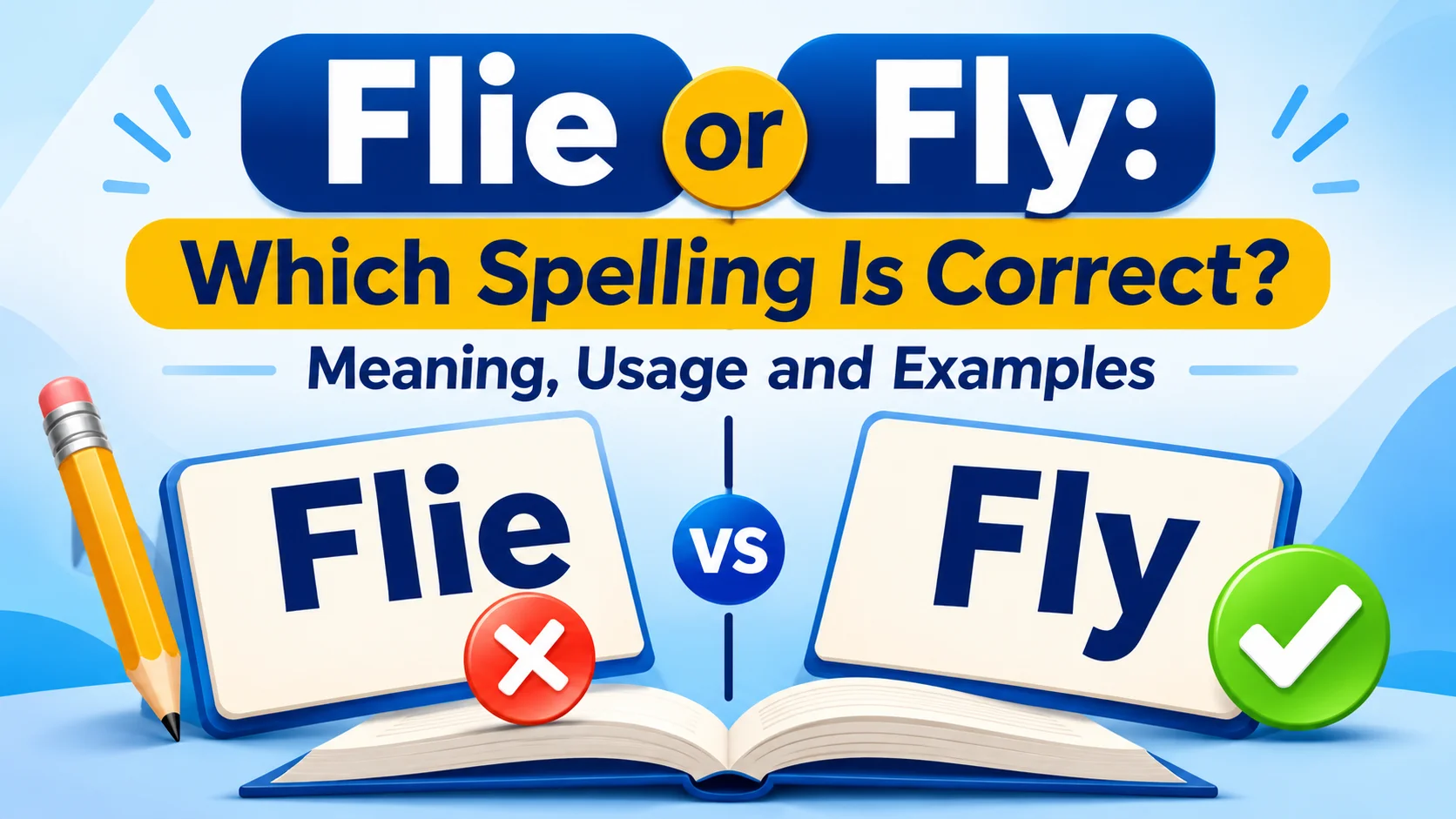
Flie or Fly is a common spelling question, but only one of these forms is the standard English spelling for the familiar word. The correct spelling is fly. Whether you are describing an insect, talking about birds moving through the air, or discussing air travel, fly is the form you need. Flie is not an accepted alternative spelling in ordinary English. The confusion becomes more interesting when you encounter flies, because that spelling is correct in some sentences but not in others. Understanding the difference requires a little attention to grammar.
The difficulty is that fly belongs to several grammatical categories. It can be a noun referring to an insect, a verb describing movement through the air, or part of everyday expressions such as time flies. Its forms also change: flies is used for certain plural nouns and present-tense verbs, while flew and flown express different past-tense meanings. These changes follow recognizable rules, although fly is an irregular verb. Learning how the forms work will help you choose the right spelling without relying on guesswork.
This guide explains why fly is correct, why flie is incorrect, and when to use fly, flies, flew, flown, and flying. You will also learn the difference between flys and flies, understand the spelling rule for nouns ending in consonant plus y, and see how the word works in everyday English. Practical examples, comparison tables, common mistakes, and a short exercise will help you apply the rules confidently in conversations, schoolwork, emails, and professional writing.
Flie vs Fly: The Quick Answer
Fly is the correct standard English spelling. Flie is a misspelling when someone intends to write the word fly.
The correct spelling is:
- F-L-Y: fly
The incorrect spelling is:
- F-L-I-E: flie
Use fly when referring to an insect, the act of moving through the air, or other established meanings of the word.
Examples:
- Correct: Birds fly across the sky.
- Incorrect: Birds flie across the sky.
- Correct: A fly landed on my desk.
- Incorrect: A flie landed on my desk.
There is another spelling worth understanding: flies. It is not a mistake. It is the correct plural of the insect fly and the present-tense form used with singular third-person subjects.
For example:
- One fly is sitting on the window.
- Several flies are sitting on the window.
- The bird flies over the garden.
The key is to understand the sentence rather than treating fly, flies, and flie as interchangeable forms.
Flie vs Fly vs Flies: Comparison Table
| Word | Correct in standard English? | Main use | Example |
| Fly | Yes | Base verb or singular noun | Birds fly. |
| Flie | No, not as the ordinary word | Common misspelling | Incorrect: A flie landed here. |
| Flies | Yes | Plural noun or third-person singular verb | The bird flies. |
| Flew | Yes | Simple past tense | The plane flew yesterday. |
| Flown | Yes | Past participle | The plane has flown. |
| Flying | Yes | Present participle or gerund | The birds are flying. |
| Flys | Generally not the standard plural | Sometimes appears in names or specialized contexts | Use flies for the insects. |
Quick rule: Write fly as the base word. Use flies when the grammatical situation requires it. Do not use flie as an ordinary alternative.
What Does Fly Mean?
The word fly has several meanings in English. Its meaning depends on how it is used in a sentence.
Most commonly, it describes an insect or the movement of something through the air. It also appears in clothing terminology, sports, and everyday expressions.
Fly as a Verb: To Move Through the Air
As a verb, fly means to move through the air using wings, aircraft, or another means of flight.
It can describe natural movement, such as a bird flying, or mechanical movement, such as an airplane traveling between cities.
Examples:
- Birds fly over the lake every morning.
- The airplane will fly to Dubai tonight.
- A butterfly can fly from flower to flower.
- The kite began to fly when the wind became stronger.
- Some insects fly only short distances.
The word can also describe a person traveling by airplane:
- We will fly to London next week.
- She prefers to fly rather than travel by train.
Notice that fly does not always mean using wings. In travel-related sentences, it commonly refers to transportation by aircraft.
Fly as a Noun: The Insect
As a noun, a fly is a small flying insect. The housefly is one familiar example.
The singular form is fly, while the standard plural is flies.
Examples:
- A fly is sitting on the fruit.
- I saw a fly near the kitchen window.
- Several flies were around the outdoor food.
- The children watched a fly moving across the glass.
This meaning is especially important when learning the spelling rule for plural nouns ending in consonant plus y.
Fly as a Noun in Clothing
The word fly also refers to the opening in the front of trousers, usually covered by a zipper or buttons.
Examples:
- His jeans have a button fly.
- The zipper on my trouser fly is broken.
- Check that the fly is closed before leaving.
This meaning is less common in basic vocabulary lessons, but it is useful to recognize because it appears in clothing descriptions and product information.
Fly in Sports
In sports, fly appears in several established terms.
Baseball: A fly ball is a ball hit high into the air. A batter may also be described as having hit a fly ball.
Example: The outfielder caught the fly ball.
Swimming: The butterfly stroke is often informally called the fly.
Example: She specializes in the fly during swimming competitions.
Fishing: Fly fishing is a method of fishing that uses an artificial fly as bait.
Example: They went fly fishing near the river.
These uses share the same spelling, even though the activities and meanings are different.
Fly in Everyday Expressions
Fly also appears in expressions that do not refer to literal flight.
| Expression | Meaning | Example |
| Time flies | Time passes quickly | Time flies when you are enjoying yourself. |
| Fly high | Achieve success or aim high | The young athlete hopes to fly high in her career. |
| On the fly | Done quickly or while handling another task | We made a few changes on the fly. |
| Fly off the handle | Become suddenly angry | He tends to fly off the handle over small problems. |
| Fly under the radar | Remain unnoticed | The small business operated under the radar for years. |
Understanding expressions is useful because a dictionary definition alone may not explain how fly works in natural conversation.
What Is Flie? Is It a Real English Word?
Flie is not the standard spelling of the English word fly. If you are writing about an insect, flight, or the common meanings discussed above, you should use fly.
For example:
- Correct: The bird can fly.
- Incorrect: The bird can flie.
The spelling flie may occasionally appear as a deliberately created name, username, brand, or stylized word. In those situations, it is being used as a proper name or creative spelling, not as the standard English word.
This distinction matters. A company can choose an unusual spelling for its name, but that does not change the spelling rules for ordinary English writing.
Why Do People Confuse Flie and Fly?
Several factors can lead someone to write flie instead of fly.
1. Uncertainty about English spelling
English spelling does not always follow pronunciation perfectly. Writers sometimes remember how a word sounds but become uncertain about which letters represent that sound.
2. Confusion with flies
The correct plural flies contains the letters i-e. Someone may incorrectly transfer that spelling pattern back to the singular form and write flie.
Remember:
- Singular: fly
- Plural: flies
The plural changes because of a spelling rule. It does not mean the singular word should be written flie.
3. Typing errors
Fast typing can produce incorrect letter combinations. A person may type flie accidentally, especially when writing on a phone or keyboard without checking the result.
4. Learning words by sound
People who learn vocabulary mainly through conversation may not immediately recognize the correct written form. Reading the word in different sentences helps build familiarity with its spelling.
5. Incorrect online examples
Seeing a misspelling repeatedly can make it look familiar. However, frequent appearance in informal writing does not make a form standard.
Fly or Flies? The Grammar Rule That Causes the Most Confusion
The distinction between fly and flies is more important grammatically than the difference between flie and fly.
Both fly and flies are correct words, but they perform different functions.
When Should You Use Fly?
Use fly in the following situations.
1. As the singular noun
When referring to one insect, use fly.
Example: A fly is sitting on the wall.
2. With plural subjects
Use the base verb fly when the subject is plural.
Examples:
- Birds fly south during certain seasons.
- Airplanes fly across the ocean.
- My friends fly home every December.
3. With the pronouns I, you, we, and they
Examples:
- I fly to work for business meetings.
- You fly very often.
- We fly to visit our relatives.
- They fly internationally.
4. After modal verbs
Modal verbs such as can, will, should, and might are followed by the base form of the verb.
Examples:
- She can fly an airplane.
- He will fly tomorrow.
- They might fly next week.
Do not add -es after a modal verb.
Incorrect: She can flies.
Correct: She can fly.
When Should You Use Flies?
The word flies has two common grammatical uses.
1. Flies as a plural noun
Use flies when talking about more than one insect.
Examples:
- Two flies are near the window.
- The flies disappeared after we closed the door.
- Several flies gathered around the food.
2. Flies as a third-person singular verb
Use flies with he, she, it, or a singular noun when describing a present-tense action.
Examples:
- He flies to Islamabad every month.
- The bird flies over the trees.
- My uncle flies for an airline.
- The butterfly flies from one flower to another.
Fly vs Flies: Sentence Comparison
| Sentence | Correct form | Reason |
| A ___ is on the table. | Fly | One insect |
| Three ___ are on the table. | Flies | More than one insect |
| Birds ___ over the forest. | Fly | Plural subject |
| The bird ___ over the forest. | Flies | Singular third-person subject |
| She can ___ a plane. | Fly | Base verb after a modal |
| He ___ to work every week. | Flies | Singular third-person verb |
A useful way to decide: Ask whether you are talking about one insect, multiple insects, or an action performed by a subject. The answer determines whether you need fly or flies.
Why Does Fly Become Flies? The Spelling Rule Explained
The plural of fly is flies, not flys. This follows a common English spelling rule for nouns ending in a consonant followed by y.
When a noun ends in a consonant plus y, the usual plural pattern is:
- Remove the final y.
- Add i.
- Add -es.
This changes fly into flies.
The same pattern appears in several familiar words.
| Singular | Plural | Spelling change |
| Fly | Flies | y → ies |
| Baby | Babies | y → ies |
| City | Cities | y → ies |
| Lady | Ladies | y → ies |
| Story | Stories | y → ies |
| Party | Parties | y → ies |
When Do You Keep the Y and Add S?
Not every noun ending in y changes to ies.
When a word ends in a vowel followed by y, the usual plural rule is to keep the y and add s.
Examples:
- Boy → Boys
- Toy → Toys
- Day → Days
- Key → Keys
- Journey → Journeys
Compare the patterns:
| Ending pattern | Singular | Plural |
| Consonant + y | Fly | Flies |
| Consonant + y | Baby | Babies |
| Vowel + y | Boy | Boys |
| Vowel + y | Key | Keys |
The letter before the final y is what matters.
- In fly, the letter before y is l, a consonant. Therefore, the plural is flies.
- In boy, the letter before y is o, a vowel. Therefore, the plural is boys.
This rule helps with many other English nouns, not just fly.
Is Flys Ever Correct?
For ordinary English, flies is the correct plural of the insect fly. Writing flys in this context is generally a spelling error.
However, you may encounter Flys as a deliberately chosen brand name, surname, username, or other proper name. A specialized use may also have its own terminology.
Do not confuse these cases with standard plural formation.
For example:
- Correct: There are several flies in the garden.
- Incorrect: There are several flys in the garden.
When writing ordinary English, follow the standard spelling rule.
The Correct Verb Forms of Fly: Fly, Flies, Flew, Flown, and Flying
Fly is an irregular verb. This means its past forms do not follow the ordinary pattern of adding -ed.
For example, the regular verb walk becomes walked. But fly becomes flew in the simple past and flown as its past participle.
Present Tense: Fly and Flies
The present-tense form depends on the subject.
| Subject | Correct verb | Example |
| I | Fly | I fly regularly. |
| You | Fly | You fly frequently. |
| We | Fly | We fly together. |
| They | Fly | They fly internationally. |
| He | Flies | He flies every month. |
| She | Flies | She flies to work. |
| It | Flies | The bird flies away. |
The main rule is straightforward: use flies with a singular third-person subject and fly with the other subjects.
Simple Past Tense: Flew
The simple past form of fly is flew.
Use it for a completed action in the past.
Examples:
- We flew to another country last summer.
- The bird flew over the house.
- She flew home after the conference.
- The kite flew above the trees.
Do not write flyed in ordinary English when you mean that something traveled through the air.
Past Participle: Flown
The past participle is flown. It is used with helping verbs such as has, have, and had.
Examples:
- I have flown on that airline before.
- She has flown to several countries.
- They had flown home before the storm began.
Compare:
- Simple past: The plane flew yesterday.
- Present perfect: The plane has flown today.
The difference is grammatical, not merely stylistic. The simple past describes a completed past action, while the present perfect connects a past action to the present or its current relevance.
Present Participle: Flying
The -ing form is flying.
It can be used in continuous tenses or as a gerund (a verb form functioning as a noun).
Examples:
- The birds are flying south.
- I am flying to Karachi tomorrow.
- Flying can be an exciting experience.
- The children watched the kite flying above the field.
Complete Verb Forms of Fly
| Verb form | Correct spelling | Example |
| Base form | Fly | Birds fly. |
| Third-person singular | Flies | The bird flies. |
| Simple past | Flew | The bird flew away. |
| Past participle | Flown | The bird has flown away. |
| Present participle | Flying | The bird is flying. |
Is the Past Tense Always Flew?
For ordinary movement through the air, flew is the standard simple past form.
There is a specialized exception in baseball. The expression flied out describes a batter being put out after hitting a fly ball that is caught.
Example:
- The batter flied out to center field.
This is a sports-specific use. It does not replace flew in ordinary sentences about birds, airplanes, or other things traveling through the air.
Common Mistakes People Make With Fly and Flies
Understanding the rules is easier when you can recognize the errors they prevent.
Mistake 1: Writing Flie Instead of Fly
Incorrect: The butterfly can flie.
Correct: The butterfly can fly.
The base word is always spelled fly in standard English. Do not transfer the ie pattern from the plural flies to the singular form.
Mistake 2: Writing Flys Instead of Flies
Incorrect: Several flys are inside the room.
Correct: Several flies are inside the room.
The noun ends in consonant plus y, so its plural changes to ies.
Mistake 3: Using Fly With a Singular Third-Person Subject
Incorrect: The airplane fly over the city.
Correct: The airplane flies over the city.
In the simple present tense, a singular third-person subject normally requires the verb ending -s or -es. In this case, the correct form is flies.
Mistake 4: Using Flies After a Modal Verb
Incorrect: She can flies an airplane.
Correct: She can fly an airplane.
A modal verb is followed by the base form of the main verb. Do not add -s or -es after can, will, should, or might.
Mistake 5: Confusing Flew and Flown
Incorrect: She has flown to London.
Correct: She has flown to London.
Use flew for the simple past and flew with helping verbs such as has, have, and had.
Mistake 6: Assuming Flies Always Refers to Insects
Incorrect assumption: The word flies can only mean more than one insect.
Correct understanding: Flies can be a plural noun or a third-person singular verb.
Examples:
- Noun: The flies are near the window.
- Verb: The bird flies across the field.
The grammatical role depends on the sentence.
Fly in British and American English: Is There a Spelling Difference?
There is no standard British-versus-American spelling difference between fly and flies.
Both varieties use:
- Fly
- Flies
- Flew
- Flown
- Flying
For example:
- American English: The bird flies over the garden.
- British English: The bird flies over the garden.
The spelling remains the same.
This is different from words such as color/colour or center/centre, where recognized regional spelling conventions exist.
If you are writing for an international audience, you do not need to change fly or flies according to the reader’s location.
How to Remember the Correct Spelling of Fly and Flies
A few simple habits can make these spellings easier to remember.
Remember the Base Word: F-L-Y
Start with the simplest form:
Fly = F-L-Y
Use a short sentence to reinforce it:
- Birds fly.
- I can fly.
- A fly landed on the table.
The more you recognize the word in context, the less likely you are to add an unnecessary letter.
Remember the Plural: Fly Becomes Flies
Use the consonant-plus-y rule:
Fly → Flies
Compare it with:
- Baby → Babies
- City → Cities
- Story → Stories
The shared pattern makes the spelling easier to recall.
Learn the Verb Forms as a Sequence
Memorize the forms together:
Fly → Flies → Flew → Flown → Flying
Then use each in a short sentence:
- Birds fly.
- The bird flies.
- The bird flew away.
- The bird has flown away.
- The bird is flying.
This approach helps you remember both spelling and grammar.
A Quick Proofreading Checklist
Before submitting an assignment or sending an important email, check:
- Did I write fly rather than flie?
- Did I use flies for more than one insect?
- Does a singular third-person subject need flies?
- Did I use the base form after a modal verb?
- Did I choose flew or flown correctly?
- Does the sentence communicate the meaning I intended?
A spell-checker can identify many misspellings, but it may not catch a grammatical error involving two correctly spelled words. Checking the sentence structure is just as important.
Practice Exercise: Choose Fly, Flies, Flew, Flown, or Flying
Test your understanding with these sentences. Choose the correct form of the word fly for each blank.
Fill in the Blanks
- A bird can ______ across the valley.
- Several ______ were sitting near the window.
- My brother ______ to Lahore every month.
- The airplane ______ over the mountains yesterday.
- She has ______ to three different countries.
- The children are ______ kites in the park.
- The insects ______ around the garden every summer.
- He can ______ a small aircraft.
Answers and Explanations
| Question | Correct answer | Explanation |
| 1 | Fly | The base verb follows the modal can. |
| 2 | Flies | The sentence refers to more than one insect. |
| 3 | Flies | A singular third-person subject requires flies. |
| 4 | Flew | The sentence describes a completed past action. |
| 5 | Flown | The present perfect uses has plus the past participle. |
| 6 | Flying | The present continuous uses are plus the -ing form. |
| 7 | Fly | The subject insects is plural. |
| 8 | Fly | The base verb follows the modal can. |
If you made a mistake, identify whether it involved plural formation, subject-verb agreement, or verb tense. Understanding the reason is more useful than simply memorizing the answer.
Conclusion
The correct spelling is fly, not flie. Once you understand the difference between the base word and its grammatical forms, the confusion becomes much easier to avoid. Use flies for multiple insects or with a singular third-person subject, flew for ordinary past actions, flown with helping verbs, and flying for continuous actions. Remember that spelling and grammar work together: a word can be correctly spelled but still be wrong for the sentence. One final actionable tip: practice the forms in complete sentences rather than memorizing isolated words. A common mistake to avoid is writing flys as the plural of the insect. The right form is flies—a small spelling detail that makes your writing clearer and more accurate.
Frequently Asked Questions About Flie and Fly
Q1. Is it flie or fly?
Fly is the correct standard English spelling. Flie is a misspelling when referring to an insect or the action of moving through the air. Use fly in ordinary writing, including school assignments, professional documents, emails, and everyday communication.
Q2. Is the plural of fly flys or flies?
The standard plural of the insect fly is flies. Because fly ends in a consonant followed by y, the usual plural rule changes y to i and adds -es. Therefore, write “two flies,” not “two flys.”
Q3. Why does fly become flies?
The change follows the English plural spelling rule for many nouns ending in consonant plus y. Remove the final y, add i, and then add -es. The same pattern appears in baby/babies, city/cities, and story/stories.
Q4. Is flys ever a correct word?
Flys is generally incorrect as the ordinary plural of the insect fly. However, it may appear as a deliberately chosen brand name, surname, or proper name. For normal writing about insects, use flies.
Q5. What is the past tense of fly: flew or flied?
Flew is the standard simple past tense when describing movement through the air. For example, “The bird flew away.” The specialized baseball expression flied out is an exception, referring to a batter being caught out after hitting a fly ball.
