
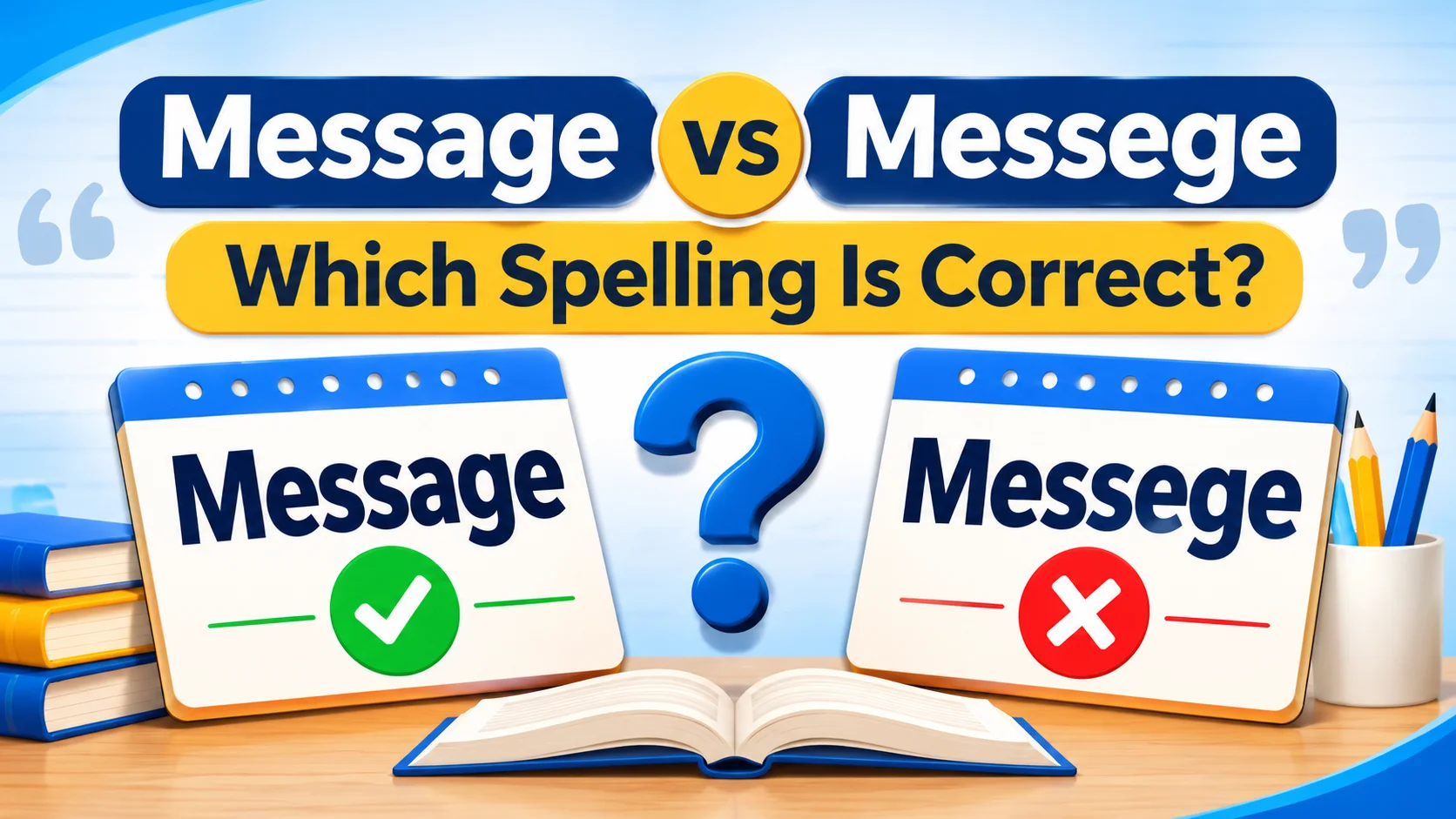
Message vs Messege is a common spelling question, especially when people write quickly or rely on how a word sounds rather than how it is spelled. The correct spelling is message, while messege is a misspelling in standard English. Although the difference is only one vowel, that small error can make an email, school assignment, social media post, or professional document look less carefully edited. Learning the correct letter pattern is straightforward once you understand where the mistake occurs and how the word is formed.
The word message is more versatile than many writers realize. It can describe a text sent to a friend, an instruction from a manager, information delivered during a meeting, or the central lesson of a book or film. It also works as both a noun and a verb. For example, you can receive a message, send a message, or message someone directly. Understanding these uses makes it easier to recognize the correct spelling in different sentences rather than memorizing it without context.
In this guide, you will learn why message is correct, why messege is wrong, and how to remember the spelling without repeatedly checking a dictionary. You will also explore its meaning, pronunciation, grammatical forms, and common variations such as messages, messaged, and messaging. Practical examples will show how the word works in everyday conversation, workplace communication, and digital messages. By the end, you should be able to spell it confidently and avoid related mistakes such as mesage, messeges, and messeged.
Message vs Messege: The Quick Answer
Message is the correct spelling in standard English. Messege is incorrect and should not be used as an alternative.
The correct word contains the letter sequence M-E-S-S-A-G-E. The mistake happens when writers replace the a after the double s with an e.
Compare:
- Correct: Please send me a message when you arrive.
- Incorrect: Please send me a messege when you arrive.
The word message has the same spelling in American, British, Canadian, and other standard varieties of English. Unlike genuine regional alternatives such as colour and color, there is no standard regional spelling rule that makes messege correct.
Message vs Messege comparison table
| Feature | Message | Messege |
| Spelling | Correct | Incorrect |
| Standard English word | Yes | No |
| Meaning | Information communicated to someone | No standard meaning as this word |
| Part of speech | Noun and verb | Not a standard noun or verb |
| Correct plural | Messages | Not applicable |
| Correct past tense | Messaged | Not applicable |
| Correct -ing form | Messaging | Not applicable |
| Formal writing | Appropriate | Avoid |
Remember: If you are writing about communication, information, or contacting someone, use message. Do not use messege in essays, emails, reports, website content, or everyday writing.
What Does Message Mean?
A message is information, an idea, an instruction, or a feeling communicated from one person or source to another. It can be delivered through writing, speech, images, gestures, or digital technology.
The meaning depends on the situation. A message from a friend might be a short text, while the message of a novel might be the larger idea the author wants readers to consider.
For example:
- I received a message from my colleague.
- The teacher gave us an important message about the examination.
- The film’s message is that honesty matters.
- Her facial expression communicated a clear message without words.
The word is useful because it covers both the information being communicated and the act of communicating it.
Message as a noun
As a noun, message refers to the information being delivered. It is usually a countable noun, which means you can use it with numbers and words such as a, one, two, and several.
Examples:
- I left a message for the receptionist.
- She received two messages during lunch.
- The manager shared an important message with the staff.
- His speech contained a powerful message about responsibility.
The noun has several common meanings.
1. Written or digital communication
This is the meaning people use most frequently in everyday digital communication.
Example: I sent you a message last night.
2. Spoken information
A message can also be delivered verbally, either directly or through another person.
Example: The director asked me to deliver a message to the team.
3. An instruction or announcement
A message may communicate something people need to know or do.
Example: The school sent a message explaining the revised timetable.
4. The central idea or lesson
In literature, films, speeches, and advertisements, a message can be the main idea communicated to an audience.
Example: The story carries a message about kindness and forgiveness.
Message as a verb
Message can also function as a verb. It means to send someone a written or digital communication, usually through a phone, computer, or messaging service.
Examples:
- I will message you after work.
- She messaged her teacher about the assignment.
- Please message the customer when the order is ready.
- He is messaging his friend right now.
The verb is especially common in informal conversation and digital communication. It is also widely understood in professional settings.
However, the best word can depend on the tone of the situation. In a formal business report, contact, notify, or send a message to may sound more appropriate than the casual verb message.
Compare:
- Informal: I’ll message you tomorrow.
- More formal: I will contact you tomorrow.
- More specific: I will send you an email tomorrow.
The choice is not simply about correctness. It is about matching the language to the audience and purpose.
Message vs messenger: What is the difference?
These words are related, but they refer to different things.
- Message: The information being communicated.
- Messenger: The person, service, or system that delivers the information.
Examples:
- The message was delivered this morning.
- The messenger brought the message to the office.
- I sent a message through a messaging application.
Think of it this way: the message is what someone wants to communicate; the messenger is who or what carries it.
Why Is Messege Incorrect?
Messege is incorrect because the established spelling of the English word is message, with an a after the double s.
The confusion often comes from the way English vowels sound in unstressed syllables. When people hear a word, they may remember its general sound without remembering the exact letters used to write it. This can lead them to substitute one vowel for another.
However, spelling is not always predictable from pronunciation. The correct form must be learned as a written word.
The correct spelling pattern: M-E-S-S-A-G-E
Break the word into its individual letters:
M – E – S – S – A – G – E
The important part to remember is the final sequence:
A-G-E
The incorrect version changes that sequence:
- Correct: message
- Incorrect: messege
The spelling does not change according to the country, communication platform, or formality of the sentence.
For example:
- I received a message from the bank.
- The book has an important message.
- Please message me later.
All three uses require the same spelling.
Why do people write messege instead of message?
There are several practical reasons this mistake occurs.
1. Uncertainty about the unstressed vowel
The middle vowel may not sound as distinct as a clearly stressed vowel. Someone writing from memory may choose e instead of a.
2. Typing quickly
People often write messages while multitasking. They may press the wrong key or type the word based on an incomplete memory of its spelling.
3. Learning the word through speech
Someone who has heard the word frequently but has not paid attention to its written form may find the vowel sequence difficult to remember.
4. Repeated exposure to online mistakes
If a person repeatedly sees an incorrect spelling in comments, informal posts, or messages, it may begin to look familiar. Familiarity, however, does not make a spelling correct.
5. Trusting autocorrect too much
Spell-checking tools are helpful, but they do not replace proofreading. A tool may overlook an error, particularly when a misspelled form is used as a name or appears in an unusual context.
Is messege ever correct in English?
Not as the standard English word meaning information communicated to someone.
There is an important distinction between an ordinary word and a deliberately created name. Someone could choose Messege as a username, fictional name, or brand spelling. That would be a particular name, not evidence that messege is an accepted spelling of the everyday word message.
For normal communication, use message.
How to Remember the Correct Spelling of Message
The easiest way to remember the spelling is to focus on the part that causes the error: the a before ge.
Instead of trying to guess the vowel from the way the word sounds, learn the written sequence as a single unit.
A simple letter-by-letter memory trick
Use this reminder:
Message has A before G-E: M-E-S-S-A-G-E.
Write the word correctly a few times while saying each letter in order. Then use it in a complete sentence.
For example:
- I sent a message to my friend.
- The teacher received my message.
- Please read the message carefully.
The goal is to build a visual memory of the correct spelling. Repeating the word in meaningful sentences is generally more useful than copying it many times without thinking about its meaning.
Learn the related word forms
Learning the word family also reinforces the correct spelling.
- Message
- Messages
- Messaged
- Messaging
Each form keeps the original spelling recognizable.
For example:
| Word | What it means or does | Example |
| Message | Singular noun or base verb | I sent a message. |
| Messages | Plural noun or present-tense verb | She sends messages. |
| Messaged | Past-tense verb | He messaged me yesterday. |
| Messaging | -ing form of the verb or gerund | She is messaging her friend. |
If you remember the base word message, the other forms become easier to spell correctly.
Message Pronunciation: How Do You Say It?
The word message is commonly pronounced with two syllables:
- IPA: /ˈmes.ɪdʒ/
- The first syllable carries the main stress.
- The final sound is the same consonant sound heard at the end of bridge.
The pronunciation is not a reliable way to decide whether the middle vowel should be written as a or e. English spelling often preserves conventional letter patterns that cannot be worked out from sound alone.
This is why a person may pronounce the word correctly but still write messege. The solution is to remember its standard written form rather than trying to spell it entirely by ear.
Message Examples in Real Sentences
Seeing the word in different situations helps explain how it works. These examples cover ordinary conversation, professional communication, and digital use.
Message as a noun: Everyday examples
- I found a message from my sister on the refrigerator.
- Please leave a message if nobody answers the phone.
- His short message made my day better.
- The teacher sent a message to all the parents.
- Did you receive my message this morning?
- The announcement included a message about road safety.
In these examples, message names the information being communicated.
Message as a verb: Everyday examples
- I will message you when I reach home.
- She messaged her friend about the weekend plans.
- You can message the support team if you need help.
- He is messaging his brother about the appointment.
- Please message me before you leave.
Here, message describes the act of sending communication.
Message in formal and professional communication
The word is not limited to casual texting. It can also describe announcements, instructions, and important workplace information.
Examples:
- The director’s message explained the company’s new priorities.
- Please send your message through the official communication channel.
- The announcement communicated a clear message to employees.
- The customer left a message requesting an update.
- I will message you when the revised schedule is ready.
A professional message should be clear about its purpose. If it contains an instruction, include the action required and any relevant deadline. If it provides an update, identify what has changed.
Message in digital and social communication
Digital communication has made the word especially common.
Examples:
- I sent you a text message.
- Check your direct messages for the updated information.
- She received a voice message from her colleague.
- The customer sent a private message through the website.
- He is messaging his friends in the group chat.
These examples also show that a message does not have to be plain text. It may contain audio, images, video, or other information.
Message, Messages, Messaged, and Messaging: Correct Word Forms
The base word message changes its ending depending on how it is used in a sentence. Understanding these forms helps prevent mistakes beyond the original messege spelling.
Message
This is the singular noun and the base form of the verb.
- I received a message.
- Please message me later.
Messages
Messages is the plural noun form. It is also the present-tense verb form used with a singular third-person subject.
- Noun: I received three messages.
- Verb: She messages her colleague every morning.
Notice that the same spelling can perform two grammatical functions. The surrounding sentence tells you which one is being used.
Messaged
Messaged is the simple past tense and past participle of the verb.
- She messaged me yesterday.
- I have messaged the customer already.
The base word keeps its spelling and takes the ending -d.
Messaging
Messaging is the present participle and gerund form.
- He is messaging his manager.
- Messaging is a convenient way to share short updates.
The spelling uses the base word followed by -ing.
Correct and incorrect message word forms
| Correct form | Incorrect form | Explanation |
| Message | Messege | The middle vowel must be a. |
| Messages | Messeges | The plural keeps the correct base spelling. |
| Messaged | Messeged | The past tense is formed from message. |
| Messaging | Messeging | The -ing form retains the correct spelling. |
| Message | Mesage | The base word requires two s letters. |
Proofreading tip: When checking a document, search for both message and likely misspellings. Looking for only the correct spelling may not reveal every mistake.
Common Misspellings and Confusing Words Related to Message
The original error is not the only spelling or vocabulary problem worth recognizing. Some mistakes involve missing letters, while others involve a different word that has its own meaning.
Message vs mesage
Mesage is incorrect because it contains only one s.
Correct: Please send me a message.
Incorrect: Please send me a mesage.
The correct word contains two consecutive s letters.
Messages vs messeges
The correct plural is messages, not messeges.
Examples:
- Correct: I received several messages.
- Incorrect: I received several messeges.
To form the plural, add -s to the correctly spelled word message. Do not change the vowel.
Messaged vs messeged
The correct past-tense form is messaged.
Examples:
- Correct: She messaged me after the meeting.
- Incorrect: She messeged me after the meeting.
The error occurs because the original misspelling is carried into the past-tense form. Learning the base spelling prevents this mistake.
Message vs massage
Unlike messege, massage is a real English word. However, it has a completely different meaning.
| Word | Meaning | Example |
| Message | Information communicated to someone | I sent a message to my friend. |
| Massage | A treatment involving rubbing or manipulating muscles and soft tissues | She booked a massage after work. |
The words also have different pronunciations. Message refers to communication, while massage refers to a physical treatment or the act of providing one.
Be careful when typing these words. A spelling checker may recognize both, so it may not identify a mistake if you accidentally select the wrong real word.
Message vs messenger
A message is the information being sent. A messenger is the person or system that carries it.
Examples:
- The message arrived late.
- The messenger delivered the information.
- I sent the message using a messaging application.
The words are related, but they cannot be substituted for each other.
Message in Modern Communication: How the Word Is Used Today
The basic meaning of message has remained consistent: information is communicated from one source to another. What has changed is the range of ways people deliver it.
Text messages and SMS
A text message is a written communication sent through a mobile messaging service. SMS is a specific technology used to send short text messages through mobile networks.
For example:
I will send you a text message with the meeting address.
Not every digital message is an SMS. Messages sent through internet-based applications use different delivery systems, even though people commonly call them text messages in everyday conversation.
Direct messages and social media messages
A direct message, often shortened to DM, is a private communication sent through a social media platform or another online service.
Examples:
- Please check your direct messages.
- I sent the details in a private message.
- The customer contacted the company through social media.
A direct message is different from a public comment or post because it is generally intended for a specific person or group rather than the wider audience.
Voice messages and multimedia messages
Messages do not always need to be written. A voice message communicates through recorded speech, while multimedia messages may include photographs, videos, documents, or other attachments.
Examples:
- My colleague sent a voice message explaining the change.
- The group received a message containing the event photographs.
- She shared a video message with her family.
This broader usage demonstrates why message is a flexible communication term rather than simply another word for a text.
Workplace and customer-service messages
In professional environments, messages can provide updates, request information, give instructions, or respond to customers.
A useful workplace message usually answers three questions:
- What is the purpose? State why you are contacting the recipient.
- What information matters? Include the necessary details without unnecessary background.
- What should happen next? Make the requested action or response clear.
For example:
The delivery schedule has changed. Please review the revised timetable and confirm your availability by Thursday.
This message works because it identifies the change, tells the reader what to do, and provides a deadline.
Why Correctly Spelling Message Matters
A spelling error does not always prevent someone from understanding a sentence. Most readers will recognize messege as an attempt to write message. However, using the correct form still matters, particularly when writing for an audience.
Professional presentation
Emails, reports, proposals, and customer communications represent the person or organization sending them. Repeated spelling errors can make a document appear rushed or poorly reviewed.
For example, a customer-support email containing several misspellings may distract the reader from the actual solution.
Academic writing
Students should use standard spelling in assignments, examinations, research papers, and presentations. A correct spelling choice demonstrates attention to written conventions and helps maintain a polished academic style.
Website content and SEO
Website owners should consistently use message in articles, headings, examples, and descriptions. Correct spelling supports readability and editorial quality.
If an article specifically answers a question about message vs messege, it is reasonable to mention the misspelling when explaining the error. However, the incorrect version should not be repeated unnecessarily throughout the page.
Search optimization should never become an excuse for deliberately using incorrect spelling in ordinary sentences.
A practical proofreading routine
Before sending an important document:
- Run a spell-check.
- Search for messege, messeges, messeged, and messeging.
- Check whether you accidentally used massage instead of message.
- Read the sentence in context to make sure the intended meaning is correct.
- Review the final version after making corrections.
Spell-checking is useful, but reading the finished text is still important. A tool may not catch every error, especially when the wrong spelling happens to form another valid word.
Test Yourself: Message vs Messege Spelling Practice
Try these sentences before checking the answers. The exercise includes the singular noun, plural noun, past tense, and present participle.
Choose the correct spelling
- Please send me a ______ before the meeting. (message / messege)
- She ______ her colleague about the schedule. (messaged / messeged)
- I received three ______ yesterday. (messages / messeges)
- He is ______ his manager now. (messaging / messeging)
- The teacher left an important ______ for the class. (message / messege)
- My brother ______ me when he reached home. (messaged / messeged)
Practice answers and explanations
| Question | Correct answer | Reason |
| 1 | Message | Correct singular noun spelling. |
| 2 | Messaged | Correct past-tense form. |
| 3 | Messages | Correct plural form. |
| 4 | Messaging | Correct -ing form. |
| 5 | Message | Correct singular noun spelling. |
| 6 | Messaged | The past tense retains the correct base spelling. |
If you answered all six correctly, you understand the main spelling pattern and its related forms. If you missed one, revisit the word-family table and pay particular attention to the -age sequence.
Conclusion
The correct spelling is message, not messege. Although the difference may seem small, remembering the -age ending prevents mistakes in the base word and related forms such as messages, messaged, and messaging. It is also useful to recognize that message can be both a noun and a verb, with meanings that extend beyond text conversations to instructions, announcements, and ideas. One final actionable tip: save the correct letter sequence in your memory and check it whenever you proofread an important email, assignment, or article. A common mistake to avoid is relying entirely on pronunciation or autocorrect. Accurate writing comes from knowing the word, understanding its use, and checking it in context.
Frequently Asked Questions
Q1. Is message or messege the correct spelling in English?
Message is the correct standard English spelling. Messege is a misspelling, not an accepted American or British alternative. Use message when referring to written communication, spoken information, instructions, or the central idea communicated through a story or speech.
Q2. Why is message spelled with an a instead of an e?
The established spelling uses the letter a in the sequence -age. English spelling is not always predictable from pronunciation, particularly when vowels occur in unstressed syllables. Remembering the complete written form is more reliable than trying to spell the word by sound.
Q3. Is message singular or plural?
Message is singular, while messages is plural. For example, you can say, “I received one message” or “I received four messages.” The word can also function as a verb, as in “She messages her colleague every morning.”
Q4. Is message formal or informal English?
The noun message is appropriate in both formal and informal English. Its tone depends on context. A formal announcement can contain a message, while friends can exchange messages casually. The verb message is more conversational, so contact or notify may suit some formal documents.
Q5. What is the difference between message and messaging?
Message can refer to one piece of communication or the act of sending it. Messaging describes the ongoing activity or method of exchanging messages. For example, “I received a message” refers to one communication, while “Messaging is convenient” describes the activity.
