
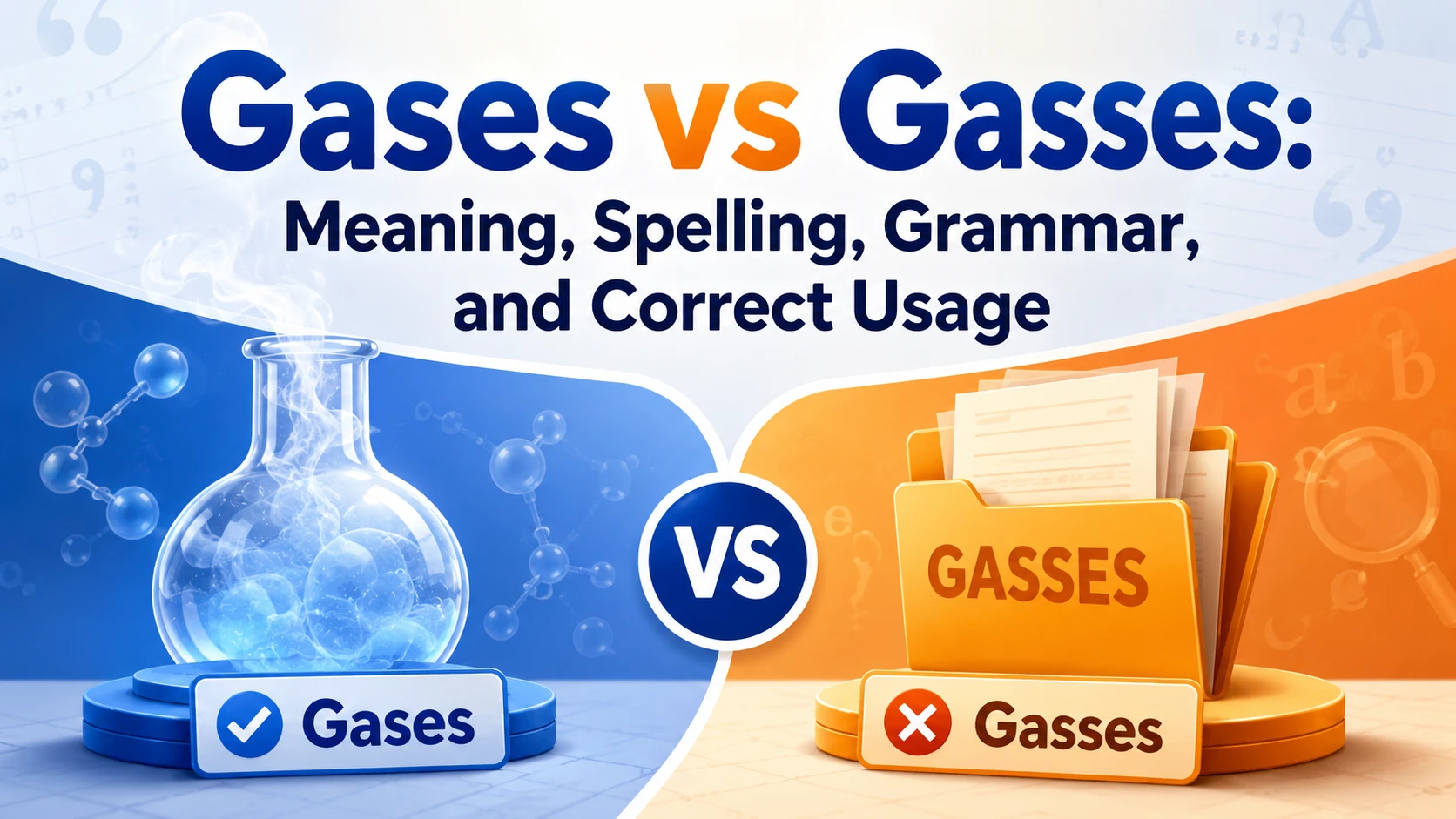
Gases vs. gasses is a deceptively tricky spelling question because both forms are legitimate English words. If you’re talking about more than one gas, gases is the standard and overwhelmingly safer choice, especially in scientific, academic, and professional writing. But gasses isn’t simply a mistake: dictionaries such as Merriam-Webster, Oxford, and Cambridge recognize it as a plural variant, while gasses also functions as the third-person singular form of the verb gas.
That distinction matters because the two spellings can look interchangeable even when their grammatical roles aren’t. Compare “Several gases escaped from the container” with “The workers gasses the material”. In the first sentence, the word is a plural noun. In the second, gasses is a verb form. Once you identify what job the word is doing, the spelling becomes much easier to choose.
This guide goes beyond the usual “one is correct, one is wrong” answer. You’ll learn when to use gases, when gasses is acceptable, how the plural differs from the verb, why scientific writing overwhelmingly favors gases, how American and British usage can differ in context, and which common phrases require gases. You’ll also see practical examples and a decision guide you can use whenever the extra s causes hesitation.
Gases vs. Gasses: The Quick Answer
If you mean more than one gas, use gases as your default.
If you’re using gas as a verb, gasses can be the third-person singular present-tense form.
There is also a third point that often gets left out: gasses is recognized as a plural noun variant. Merriam-Webster lists gases and gasses as plural forms of gas, while Oxford describes gasses as less frequent. Cambridge likewise lists both plural forms.
So the practical rule is:
Use “gases” for the plural by default. Use “gasses” when it is the appropriate verb form or when a particular dictionary or established style permits the less-common plural.
The safest rule
For scientific, academic, technical, and formal writing, choose gases when you mean multiple gases.
For example:
- Oxygen and nitrogen are gases.
- Greenhouse gases affect Earth’s atmosphere.
- Several toxic gases were detected.
This doesn’t mean gasses is universally wrong. It means gases is the clearest conventional choice when you’re writing about substances.
Gases vs. Gasses at a Glance
| Word | Main grammatical role | Meaning | Typical use | Example |
| gases | Plural noun | More than one gas | Scientific, technical, everyday writing | Several gases were detected. |
| gasses | Plural noun variant | More than one gas | Less frequent usage | Different gasses were present. |
| gasses | Verb | Third-person singular of gas | Action involving gas | The equipment gasses the sample. |
| gas | Singular noun | One gas or a substance called gas | General use | Carbon dioxide is a gas. |
| gas | Verb | To supply, treat, poison, or otherwise affect with gas | Various contexts | The process can gas the material. |
The one-second rule for choosing between them
Ask:
Am I counting types or quantities of gas, or am I describing an action?
- More than one gas → gases
- An action performed by he, she, it, or another singular subject → gasses may be the verb form
- A plural noun in a style that accepts the variant → gasses is possible, but gases is usually the better default
That simple grammatical check prevents most errors.
What Does “Gases” Mean?
Gases is the plural of the noun gas. A gas is a form of matter that doesn’t have a fixed shape or volume and can expand to fill its container. In ordinary English, gas has several other meanings too, including fuel, gasoline in American English, and air produced in the digestive system.
Gases as the plural of “gas”
The most common use is straightforward:
Oxygen and hydrogen are gases.
Here, gases refers to more than one substance.
Other examples include:
- Several gases were present in the sample.
- The atmosphere contains many different gases.
- Toxic gases can be dangerous.
- Scientists measured the pressure of the gases inside the chamber.
Gases in chemistry and physics
In scientific writing, gases is the familiar plural form.
You may encounter it when discussing:
- oxygen
- nitrogen
- hydrogen
- carbon dioxide
- helium
- methane
- water vapor
- noble gases
- industrial gases
- atmospheric gases
For example:
The experiment examined how different gases respond to changes in temperature.
The noun is plural because the sentence refers to multiple kinds or samples of gas.
Gases in everyday English
The word isn’t limited to laboratories.
You might say:
The mechanic checked for leaking gases.
Or:
Different gases can produce different odors.
In casual English, however, people often use gas as an uncountable noun when referring to a general substance:
There is gas in the room.
The plural becomes useful when you’re distinguishing types, sources, samples, or separate substances.
What Does “Gasses” Mean?
Gasses has more than one grammatical use, which is why declaring it “wrong” creates unnecessary confusion.
“Gasses” as a plural noun
Several authoritative dictionaries recognize gasses as a plural of gas.
Merriam-Webster explicitly lists gases also gasses, while Oxford gives gases, less frequent gasses. Cambridge’s dictionary entry also identifies gasses as a plural of gas.
So this sentence is not inherently impossible:
Different gasses were detected in the chamber.
However, gases is the more conventional choice for most writers, particularly in scientific and formal prose.
“Gasses” as a verb
This is a separate grammatical matter.
The verb gas has several meanings. Merriam-Webster records meanings including supplying something with gas or gasoline, treating something with gas, and poisoning or adversely affecting something with gas. It also records an intransitive sense involving talking idly.
The third-person singular form can therefore be:
He gasses the material.
The important thing is that gasses here isn’t a plural noun. It’s a verb.
Verb forms of “gas”
The basic pattern is:
| Verb form | Example |
| gas | They gas the material. |
| gases / gasses | The machine gases the chamber. |
| gassed | The material was gassed. |
| gassing | They are gassing the chamber. |
Oxford lists the present-tense forms as I/you/we/they gas and he/she/it gases, followed by gassed and gassing.
Merriam-Webster, meanwhile, gives the verb’s inflected forms as gassed and gassing and recognizes gasses as a present-tense variant.
Gases vs. Gasses: The Grammar Difference That Matters
The biggest mistake is treating these forms as though they were merely two interchangeable spellings.
They can perform different grammatical jobs.
Compare:
The laboratory tested several gases.
Here, gases is a plural noun. It answers the question:
What did the laboratory test?
Now compare:
The machine gasses the chamber.
Here, gasses is a verb. It answers:
What does the machine do?
That difference is more useful than memorizing a spelling rule.
Is the word naming substances or describing an action?
If the word is something you can put after several, many, different, various, these, or those, you’re probably dealing with the plural noun:
several gases
different gases
various gases
If the word follows a singular subject and expresses an action, it may be a verb:
The device gasses the sample.
She gasses the material.
A simple substitution test
Try replacing the word with another obvious plural noun.
Several gases were released.
You could replace it with:
Several chemicals were released.
That confirms gases is functioning as a noun.
Now consider:
The machine gasses the sample.
Replace gasses with another verb:
The machine treats the sample.
The grammatical role is clearly verbal.
How to Spell the Plural of “Gas”
The most useful practical answer is gases.
Oxford lists gases first and describes gasses as less frequent. Merriam-Webster recognizes both.
Why “gases” is so common
The spelling follows a familiar plural pattern:
gas → gases
The ending -es creates the plural form.
You’ll see the same basic spelling behavior in words such as:
- bus → buses
- class → classes
- glass → glasses
- gas → gases
This makes gases the natural form for most general writing.
Why does “gasses” exist?
English spelling sometimes doubles consonants when suffixes are added, especially in verb forms where pronunciation and vowel length can become relevant.
Dictionary.com notes that the ordinary plural gases developed without doubling the final s, while gasses became established particularly in inflected forms of the verb gas.
Modern dictionaries have nevertheless accepted gasses as a plural variant too.
So there are really two stories:
- gases → conventional plural
- gasses → established plural variant and important verb form
That is why simplistic rules such as “double the s whenever you add -es” don’t work here.
When Should You Use “Gases”?
In chemistry and scientific writing
Use gases when referring to multiple gaseous substances:
The reaction produced several gases.
In environmental writing
The standard phrase is:
greenhouse gases
You will also commonly see:
- atmospheric gases
- toxic gases
- exhaust gases
- trace gases
- emissions of gases
In medicine
Medical writing frequently distinguishes among different gases:
The patient received a mixture of medical gases.
In engineering and industry
Technical documents commonly use:
Industrial gases must be stored according to appropriate safety procedures.
In everyday English
You can also use gases outside technical contexts:
Several gases were released after the container broke.
The broader principle is simple: if you’re naming multiple forms, types, or quantities of gas, gases is normally the cleanest choice.
When Should You Use “Gasses”?
When it is the verb form
This is where gasses has a clearly established grammatical role.
For example:
The equipment gasses the material during processing.
Here, gasses is the third-person singular present form of gas.
In specialized processes
Depending on the field, gas can mean to treat something with gas.
Merriam-Webster includes the meaning “to treat chemically with gas” and also the sense of supplying something with gas or gasoline.
Thus:
The process gasses the fibers to remove unwanted material.
The exact technical context matters, but the spelling is grammatically legitimate.
As a plural noun when appropriate
Because major dictionaries recognize gasses as a plural variant, you may encounter it in edited English.
Still, if you’re writing a:
- chemistry paper
- scientific report
- textbook
- technical manual
- professional article
gases is usually the better default unless you’re following a source or style that specifically uses gasses.
Is “Gasses” a Real Word?
Yes.
That’s one of the most important points to get right.
Merriam-Webster lists gasses as a plural variant of gas and also recognizes it as a present-tense verb form. Oxford lists gasses as a less frequent plural. Cambridge has a dedicated entry defining gasses as a plural of gas.
So the statement:
“Gasses is always wrong.”
is inaccurate.
But this statement is also misleading:
“Gasses and gases are always interchangeable.”
They aren’t.
Grammar, register, and context determine which form makes sense.
Can “Gasses” Be a Plural Noun?
Yes.
This is the nuance that many spelling guides omit.
Cambridge explicitly labels gasses as a plural of gas, while Oxford calls it less frequent. Merriam-Webster also gives both forms.
For example:
Several gasses were detected.
That can be grammatically valid.
Why “gases” remains the safer choice
Even though gasses exists as a plural, gases is much more conventional in many formal contexts.
Dictionary.com notes that both forms are acceptable but that gases is much more commonly used and often treated as the standard form.
So if you’re unsure, choose:
gases
rather than:
gasses
when you’re simply forming the plural noun.
Gases in Scientific and Technical Writing
Scientific writing rewards consistency and conventional terminology.
That doesn’t mean every accepted variant is grammatically wrong. It means technical readers benefit when writers use the form most familiar in the discipline.
Consider these established expressions:
- greenhouse gases
- noble gases
- toxic gases
- inert gases
- combustible gases
- industrial gases
- exhaust gases
- atmospheric gases
These phrases are overwhelmingly familiar with gases.
Chemistry
Noble gases have distinctive chemical properties.
Physics
The pressure of the gases was measured at constant temperature.
Environmental science
Several greenhouse gases contribute to atmospheric warming.
Engineering
The system must safely vent excess gases.
The benefit of using gases here isn’t merely grammatical correctness. It is terminological consistency.
Common Collocations With “Gases”
If you’re writing technical or academic content, these combinations will sound natural:
| Collocation | Example |
| greenhouse gases | Greenhouse gases trap heat in the atmosphere. |
| noble gases | Helium and neon are noble gases. |
| toxic gases | Sensors detected toxic gases. |
| inert gases | The reaction was conducted under inert gases. |
| combustible gases | The detector monitors combustible gases. |
| industrial gases | The facility supplies industrial gases. |
| exhaust gases | The system reduces harmful exhaust gases. |
| atmospheric gases | Researchers analyzed atmospheric gases. |
| trace gases | The instrument detects trace gases. |
| dissolved gases | Temperature changes can affect dissolved gases. |
Why these phrases matter
Collocations give you a practical spelling shortcut.
If the phrase belongs to a well-established scientific vocabulary, gases is almost certainly the form you want.
“Gasses” in Automotive and Everyday English
This area deserves care because gas has several meanings in American English.
In North American English, gas commonly means gasoline, the liquid fuel used by cars. Oxford and Cambridge both identify this regional usage.
The usual verb phrase is:
gas up the car
For example:
We need to gas up before leaving town.
Merriam-Webster specifically gives gas up as the verb phrase meaning to fill a vehicle’s tank with gasoline.
This is preferable to forcing gasses into every automotive sentence.
For example:
He gasses up the truck before work.
Here, gasses can be interpreted as the third-person singular form of gas in informal usage, but gases is not the right spelling for the verb simply because it looks like the plural noun.
The larger lesson is important:
Don’t choose the spelling until you know whether “gas” is acting as a noun or verb.
Pronunciation: Do “Gases” and “Gasses” Sound the Same?
Generally, gases and gasses are pronounced the same or very similarly when they’re being used as plural nouns.
Cambridge gives gasses as approximately /ˈɡæs.ɪz/, while the plural gases is also pronounced with an extra syllable.
That creates exactly the problem you’d expect: your ear can’t reliably tell you which spelling to type.
Instead, use grammar.
If you hear:
“The gases escaped.”
The meaning tells you that you’re dealing with multiple substances.
If you hear:
“The machine gasses the material.”
The sentence structure identifies gasses as a verb.
Why Do People Confuse Gases and Gasses?
The words look almost identical
Only one letter separates them.
gases
gasses
That visual similarity makes mistakes easy, especially while typing.
The pronunciation doesn’t provide a reliable clue
Because the plural forms can sound alike, spelling from pronunciation is risky.
“Gasses” is genuinely a word
This is an important source of confusion. A writer may remember seeing gasses in a dictionary or published text and reasonably wonder whether it is actually correct.
It is—but its frequency and grammatical role matter.
English plural patterns aren’t perfectly predictable
Writers sometimes expect gas to behave like words in which consonants are doubled before endings.
But gas → gases is the standard conventional plural, while gasses survives as a recognized variant.
Common Mistakes With Gases and Gasses
Mistake 1: Using “gasses” as the default plural
Several gasses were released.
This may be accepted by dictionaries, but gases is the more conventional choice:
Several gases were released.
Mistake 2: Saying “gasses” is always wrong
It isn’t.
Dictionaries recognize it both as a plural variant and, importantly, as a verb form.
Mistake 3: Assuming “gases” is a verb
In standard present-tense English, gases can be the third-person singular form of the verb gas in some dictionary treatments, while gasses is also used. Oxford specifically lists he/she/it gases for the verb.
Therefore, context matters even more than the spelling alone.
Mistake 4: Treating the forms as identical in every context
They overlap, but they aren’t identical in frequency, grammatical function, or style.
Mistake 5: Writing technical terms inconsistently
If your article uses greenhouse gases in one paragraph and greenhouse gasses in another without a reason, the inconsistency can look careless.
Pick a style and maintain it.
Gases vs. Gasses: Correct and Incorrect Examples
| Sentence | Evaluation | Why |
| Several gases were detected. | Correct | Standard plural noun. |
| Several gasses were detected. | Acceptable, less common | Recognized plural variant. |
| Greenhouse gases affect climate. | Preferred | Standard scientific collocation. |
| Greenhouse gasses affect climate. | Possible but less conventional | Plural variant is recognized. |
| The machine gasses the sample. | Correct in the appropriate verb sense | Third-person singular verb. |
| The machine gases the sample. | Also possible depending on dictionary/style | Verb inflection varies by source. |
| Two gases reacted in the chamber. | Correct | Plural noun. |
| Two gasses reacted in the chamber. | Acceptable | Less frequent plural variant. |
The key takeaway is that “gasses = wrong” is too simplistic.
Gases vs. Gasses in American English
American English uses gases extensively as the plural noun.
At the same time, American dictionaries recognize gasses in both noun and verb contexts. Merriam-Webster lists the noun plural as gases also gasses and the verb with forms including gassed and gassing.
For American professional writing, the practical recommendation remains:
Use gases as your default plural.
That is especially sensible in:
- scientific reports
- school assignments
- technical documentation
- environmental articles
- workplace communication
- educational material
Gases vs. Gasses in British English
British English also recognizes gases, and major dictionaries document gasses as a plural variant.
Oxford’s entry lists:
plural gases, less frequent gasses
Regional vocabulary can differ in other areas. For example, British English normally uses petrol where American English uses gasoline or gas for vehicle fuel. Oxford explicitly marks the vehicle-fuel sense of gas as North American.
But that regional distinction doesn’t change the basic advice about scientific writing: gases is the safest conventional plural.
Gases vs. Gasses Formal, Academic, and Professional Writing
When a spelling variant is accepted but less frequent, professional writers usually have a reason for choosing the more familiar form.
For most formal contexts:
Prefer: gases
Why?
- It is widely recognized.
- It is conventional in scientific terminology.
- It reduces unnecessary reader hesitation.
- It aligns with familiar phrases such as greenhouse gases and noble gases.
- It avoids making a simple plural look like a special spelling choice.
Scientific papers
Use:
The samples contained several gases.
School assignments
Use:
The atmosphere contains several important gases.
Business writing
Use:
The facility monitors emissions of harmful gases.
Technical documentation
Use:
The sensor detects combustible gases.
In all four cases, gases is the cleanest choice.
The Difference Between “Gases,” “Gassed,” “Gassing,” and “Gassy”
These related forms are easy to mix up because they all come from gas, but they don’t perform the same grammatical job.
| Word | Role | Meaning |
| gases | Plural noun / verb form in some usage | More than one gas / third-person verb |
| gasses | Plural noun variant / verb form | More than one gas / third-person verb |
| gassed | Past tense / past participle | Supplied, treated, or affected with gas |
| gassing | Present participle | Supplying, treating, or affecting with gas |
| gassy | Adjective | Containing or producing a lot of gas |
Oxford defines gassy as an adjective with meanings involving excessive gas, including stomach gas in North American English.
Gaseous is another important related adjective. It means like or consisting of gas.
For example:
The substance is in a gaseous state.
That’s different from:
The substance produces several gases.
The History of the Word “Gas”
The word gas has an unusual scientific history.
Oxford traces the word to the mid-17th century, when Belgian chemist J. B. van Helmont coined it for a mysterious principle believed to exist in matter. The term was influenced by Greek khaos, meaning “chaos,” through Dutch spelling conventions.
Merriam-Webster dates its first known English use to 1779 and likewise traces the noun to New Latin, with an alteration related to Latin chaos.
The verb developed later. Merriam-Webster gives 1849 as the first known use of gas as a verb.
That history helps explain why modern English has developed multiple grammatical forms from the same short word.
Are “Gases” and “Gasses” Interchangeable?
Only partly.
As plural nouns, both are recognized by major dictionaries. But gases is more frequent and generally preferred.
As verb forms, both spellings can appear depending on the dictionary, variety, and meaning.
So don’t use a blanket rule such as:
“Always use gases.”
A more accurate rule is:
Use gases as your normal plural. Recognize gasses as an accepted plural variant and as a legitimate verb form. Let grammar and style determine the final choice.
That approach is both accurate and practical.
A Practical Decision Guide: Gases or Gasses?
Step 1: Identify the part of speech
Is the word naming things/substances?
→ Think gases.
Is it describing an action?
→ Check whether you’re using gas as a verb.
Step 2: Look at the words around it
Words such as:
- several
- many
- various
- different
- numerous
strongly suggest a plural noun.
several gases
Step 3: Look at the subject
If the word follows he, she, it, the machine, the process, the device, you’re likely looking at a verb.
The device gasses the material.
Step 4: Consider your writing context
If you’re writing formally about chemistry, physics, ecology, or engineering:
→ Prefer gases for the plural.
Step 5: Check your style guide if consistency matters
If you’re editing a publication or technical document, follow the organization’s established dictionary or style guide.
Mini Case Studies: How Context Changes the Spelling
Case study: A chemistry report
A student writes:
The reaction generated three different gasses.
This isn’t necessarily ungrammatical because gasses is a recognized plural. However, gases is the more conventional choice in scientific prose:
The reaction generated three different gases.
Case study: An environmental article
A writer types:
Greenhouse gasses are a major environmental concern.
Again, the plural variant is documented, but the familiar technical phrase is:
Greenhouse gases are a major environmental concern.
The second version is preferable for clarity and conventional usage.
Case study: A technical process
The machine gasses the material before treatment.
Here, gasses is functioning as a verb. The sentence isn’t talking about multiple gases. It’s describing what the machine does.
That is a completely different grammatical situation.
A Memory Trick You Can Actually Use
Don’t memorize “one s versus two s” as an isolated spelling rule. Memorize the job of the word.
Gases = the things
Think:
Several gases are present.
You’re naming substances.
Gasses = an action or a less-common plural
Think:
The machine gasses the sample.
You’re describing an action.
And if you’re simply forming the plural in normal writing, choose:
gas → gases
That is the form most readers expect.
Practice Exercise: Choose Gases or Gasses
Fill in each blank.
- Oxygen and nitrogen are common ______ in Earth’s atmosphere.
- The machine ______ the material during processing.
- Several toxic ______ were detected.
- The report discusses greenhouse ______.
- Different ______ were present inside the chamber.
- The technician ______ the sample with a chemical gas.
- Scientists analyzed the ______ released during combustion.
- The laboratory compared three different ______.
Answers
- gases
- gasses — when used as the third-person singular verb
- gases
- gases
- gases — the preferred plural
- gasses — when gas is being used as a verb
- gases
- gases
The exercise illustrates the central distinction: noun versus verb first, spelling second.
Gases vs. Gasses: Quick Reference Cheat Sheet
| If you mean… | Best choice |
| More than one gas | gases |
| Several chemical gases | gases |
| Greenhouse gases | gases |
| Noble gases | gases |
| Toxic gases | gases |
| Atmospheric gases | gases |
| A less-common plural accepted by a dictionary | gasses |
| Third-person singular form of gas | gasses can be used |
| Past tense of gas | gassed |
| -ing form of gas | gassing |
| Adjective meaning containing gas | gaseous or gassy, depending on meaning |
Best default: If you’re simply writing the plural of gas, use gases.
Conclusion
The gases vs. gasses question doesn’t have the simplistic answer that one spelling is always right and the other is always wrong. Gases is the standard, safest plural for most situations, particularly when you’re discussing chemistry, physics, environmental science, medicine, or technical subjects. Gasses is also a legitimate plural variant, although dictionaries such as Oxford identify it as less frequent. It can additionally function as a verb form, depending on the sentence. One final actionable tip: when you’re unsure, first decide whether gas is naming a substance or describing an action. If you’re simply talking about multiple gases, choose gases. A common mistake to avoid is treating every appearance of gasses as a spelling error—or assuming that because both forms are accepted, they’re equally natural in every context. Good writing isn’t just about finding a dictionary-approved word. It’s about choosing the form that is grammatically appropriate, conventional for your audience, and clear in context.
Frequently Asked Questions
Q1. Is “gasses” a correct spelling?
Yes. Gasses is a legitimate English form. Major dictionaries recognize it as a plural variant of gas, and it can also function as a third-person singular form of the verb gas. However, gases is more common as the plural noun, especially in formal and scientific writing.
Q2. Which is better: “gases” or “gasses”?
For the ordinary plural noun, gases is usually the better choice. Oxford describes gasses as less frequent, while Merriam-Webster and Cambridge recognize both forms. In technical writing, established terms such as greenhouse gases and noble gases strongly favor gases.
Q3. Is “gasses” only a verb?
No. Gasses can be a plural noun as well as a verb form. As a noun, it is a less frequent variant of gases. As a verb, it can be the third-person singular form of gas. The sentence’s grammatical structure tells you which meaning is intended.
Q4. Why is “greenhouse gases” preferred over “greenhouse gasses”?
Greenhouse gases is the established conventional spelling in environmental and scientific writing. Although dictionaries recognize gasses as a plural variant, gases is much more familiar in technical terminology. Using the conventional form makes the phrase immediately recognizable to readers.
Q5. Are “gases” and “gasses” pronounced the same?
As plural nouns, they are generally pronounced the same or very similarly, so pronunciation isn’t a dependable way to choose the spelling. Cambridge gives gasses as /ˈɡæs.ɪz/. When writing, rely on grammar, context, and conventional usage rather than trying to spell the word from its sound.
