
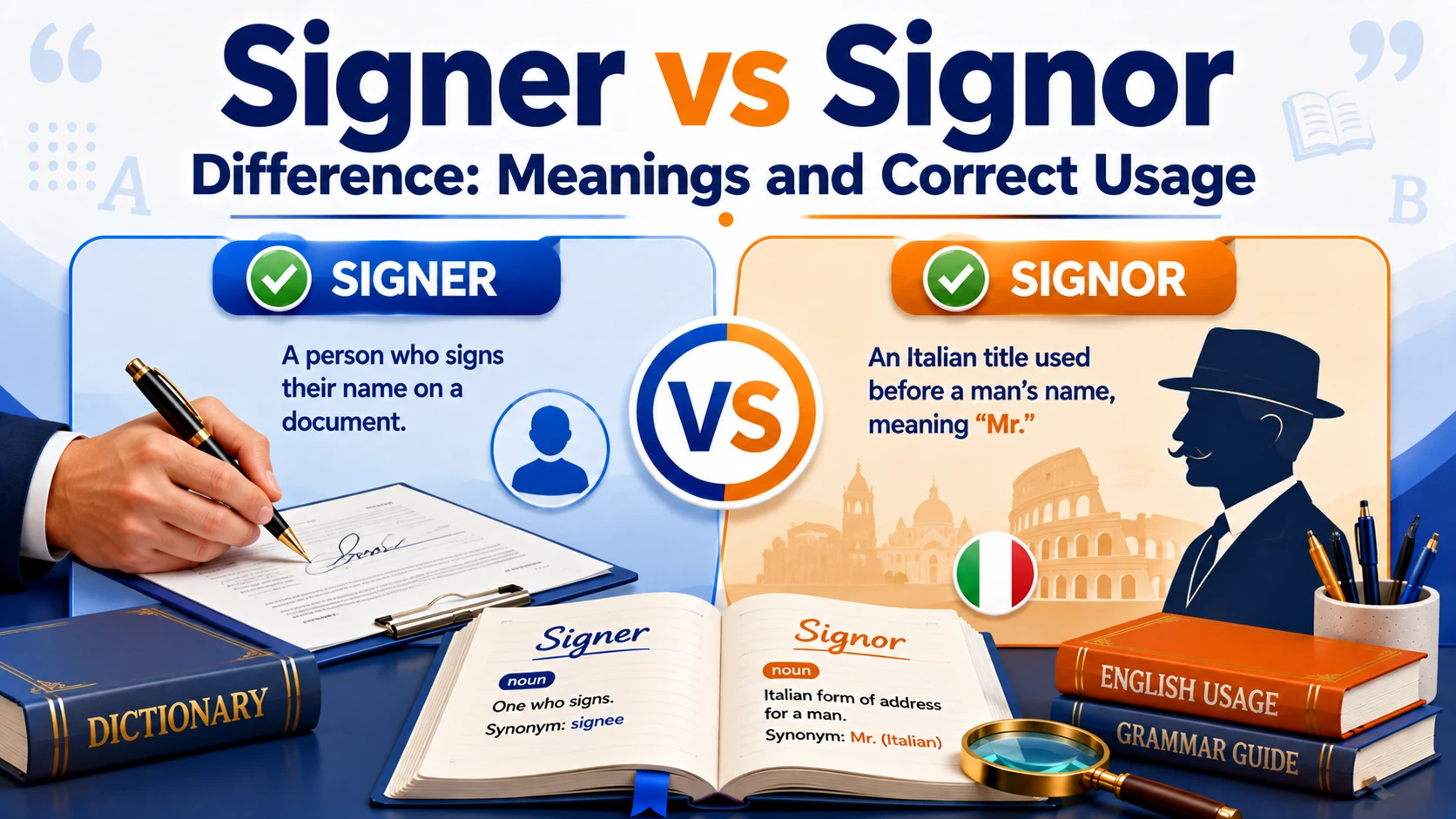
Signer vs signor can be confusing because the two words look and sound somewhat alike, yet they refer to completely different things. A signer is a person who signs a document, agreement, petition, or other written instrument. A Signor, by contrast, is an Italian title roughly equivalent to Mr. Cambridge defines signer as a person, organization, or country that has signed an official document, while signor is the Italian equivalent of “Mister.”
The distinction becomes especially important in legal, business, and professional writing. If you write signor when you mean someone who signed a contract, you’re using an Italian title where an English noun is required. Likewise, calling an Italian man Signer Rossi changes the intended meaning and creates an obvious word-choice error. The spelling difference is small, but the meaning, pronunciation, origin, and grammatical role are not the same. Understanding that difference also helps you choose between signer, signatory, signee, and Signor.
Fortunately, there’s an easy rule to remember: a signer signs; a Signor is a title. This article goes beyond that shortcut. You’ll learn what each word means, how to pronounce them, where they come from, how they’re used in contracts and ordinary conversation, when signatory is more precise, and why Signor should not be treated as a fancy version of signer. By the end, you’ll be able to choose the right word without relying on spellcheck or guesswork.
Quick Answer: Signer vs Signor
The core difference is simple:
- Signer means a person, organization, or country that signs something.
- Signor is an Italian title equivalent to Mr.
- Signer belongs to ordinary English vocabulary.
- Signor comes from Italian and is normally used in an Italian linguistic or cultural context.
- Signer is common in contracts, forms, petitions, and other documents.
- Signor appears before or in reference to an Italian man’s name or as a respectful form of address.
Merriam-Webster defines signer as “one that signs” and also gives it a separate meaning for someone who uses sign language. Cambridge likewise lists both meanings.
Merriam-Webster defines signor as an Italian man and as a title equivalent to Mr. Cambridge’s Italian-English dictionary gives signor as “Mister,” a polite title for a male adult.
| Word | Meaning | Typical context | Example |
| Signer | Someone who signs something | Contracts, forms, petitions, agreements | The signer completed the form. |
| Signor | Italian title equivalent to Mr. | Italian names and address | Signor Rossi arrived early. |
Memory rule: Signer signs. Signor is a title.
Why Do People Confuse Signer and Signor?
The confusion is understandable. The words begin with sign-, contain six letters, and differ mainly in their endings. A hurried reader can easily overlook that final -er and -or produce entirely different words.
There is another trap: English speakers naturally connect signer with the verb sign. That’s correct. But the same visual beginning can make signor look as though it is another form of sign. It isn’t.
Their Meanings Come From Different Word Families
Signer is transparently connected to the English verb sign. The suffix -er commonly forms a noun for someone who performs an action:
- teach → teacher
- drive → driver
- write → writer
- sign → signer
Signor, on the other hand, is an Italian title. Merriam-Webster traces it through Italian signore/signor to Medieval Latin senior, meaning “superior” or “lord.”
So the resemblance is largely superficial.
Spellcheck Won’t Necessarily Catch the Error
This is an important practical point.
A spellchecker may accept both:
The signer approved the agreement.
and:
The signor approved the agreement.
Neither word is inherently misspelled. The problem is context.
That means this is a vocabulary decision, not merely a spelling decision. You need to ask what you actually mean before choosing the word.
What Does “Signer” Mean?
A signer is someone or something that signs a document or other written instrument. The word can refer to an individual, organization, or even a country. Cambridge specifically includes people, organizations, and countries among its possible referents.
For example:
The signer must complete the final section of the contract.
Each signer received a copy of the agreement.
The petition had thousands of signers.
The word is especially useful when the focus is on the act of signing.
Signer in Legal and Contractual Documents
You’ll frequently encounter signer in contexts involving:
- contracts
- agreements
- waivers
- applications
- authorization forms
- petitions
- declarations
- loan documents
- electronic signatures
- consent forms
For example:
Each signer must initial every required page.
That sentence simply identifies the people who sign.
However, signer doesn’t automatically mean authorized signer. Those are different concepts.
Signer vs Authorized Signer
Consider these two sentences:
John was a signer on the agreement.
John was an authorized signer for the company.
The first tells us that John signed. The second adds an important fact: he had authority to sign on the organization’s behalf.
In legal or corporate contexts, that distinction can matter. Don’t assume that every person who physically places a signature on a document has the same authority or legal status.
Signer in Everyday English
The word isn’t limited to contracts.
You can naturally use signer for:
- a petition
- a guest book
- a card
- a permission slip
- an application
- a declaration
- a letter
- a registration form
For example:
The petition organizers thanked every signer.
That is ordinary, natural English.
Signer Has Another Meaning
There’s a second dictionary meaning worth knowing: signer can refer to someone who uses sign language. Cambridge and Merriam-Webster both recognize this sense.
For example:
The interpreter watched the signer carefully.
Here, signer has nothing to do with signing a document. The surrounding context makes the intended meaning clear.
This is one reason context matters when defining vocabulary. A single word can have multiple legitimate meanings.
What Does “Signor” Mean?
Signor is an Italian title corresponding to Mr. in English. Cambridge describes it as a polite title given to a male adult, while Merriam-Webster defines it as a title equivalent to Mr.
It is commonly associated with an Italian man’s name:
Signor Bianchi will speak to the committee.
I met Signor Rossi during my visit to Rome.
The word therefore identifies or addresses a man. It does not identify someone who has signed something.
Signor and Signore
The relationship between signor and signore can cause another layer of confusion.
Cambridge’s Italian-English entry for signore gives several meanings depending on context, including man, gentleman, and the title Mr.
In the title sense:
Buongiorno, signor Bianchi.
means:
Good morning, Mr. Bianchi.
The shortened form signor is used before a name in this type of address.
Signor in English Writing
English writers may retain Signor when the Italian context matters. It can appear in:
- translations
- literature
- historical writing
- travel writing
- discussions of Italian culture
- descriptions of Italian characters
- references to Italian names or institutions
But you don’t normally insert Signor into ordinary English just to make a sentence sound more formal.
If you’re writing standard American English and simply need a title, Mr. is generally the natural choice.
Signer vs Signor: Meaning, Grammar, and Usage
The easiest way to understand the distinction is to compare what each word does in a sentence.
| Feature | Signer | Signor |
| Language | English | Italian |
| Main meaning | Person who signs | Title equivalent to Mr. |
| Part of speech | Noun | Noun/title |
| Refers to an action? | Yes, indirectly | No |
| Refers to a title? | No | Yes |
| Common setting | Documents and agreements | Italian names and address |
| Example | The signer dated the form. | Signor Conti entered the room. |
| Plural | signers | signors / signori |
The important distinction is function.
Signer identifies someone based on an action they perform.
Signor identifies or addresses a man through a title.
That difference is enough to determine the correct word in nearly every ordinary situation.
How to Use “Signer” Correctly
The safest way to use signer is to connect it mentally with sign.
If someone signs a document, that person can be called a signer.
Correct Examples
The signer must provide a valid identification document.
Every signer should review the agreement before signing.
The petition now has more than 5,000 signers.
The final page requires the signer’s initials.
Both signers received electronic copies.
Notice how naturally the word works with possessives and plurals:
- signer
- signers
- signer’s
- signers’
Signer in Formal Writing
Signer is perfectly acceptable in formal English when you simply need to identify a person who signs.
For example:
The signer acknowledges receipt of the document.
However, formal writing sometimes benefits from a more specific term. That’s where signatory becomes useful.
Signer, Signatory, Signee, and Signor: What’s the Difference?
These words overlap enough to cause trouble, but they aren’t interchangeable in every situation.
| Term | Meaning | Register or emphasis | Example |
| Signer | Person or entity that signs | General | The signer completed the form. |
| Signatory | Person, organization, or country that has signed an agreement | Formal | The countries are signatories to the treaty. |
| Signee | Person who signs or is the recipient of something signed | Less common; context-dependent | The signee received a copy. |
| Signor | Italian title equivalent to Mr. | Italian/cultural | Signor Romano greeted us. |
Signer vs Signatory
Signatory is particularly useful for formal agreements involving multiple parties.
Cambridge defines a signatory as a person, organization, or country that has signed an agreement. Merriam-Webster likewise defines it as a signer with another or others.
Compare:
The signer completed the form.
with:
The country is a signatory to the agreement.
The first is general. The second has a more formal, institutional flavor.
Signer vs Signee
Signer is usually the clearer general-purpose term.
If your audience might wonder whether signee refers to someone who signs, receives a signature, or occupies a particular role, signer may be preferable unless the context gives signee a specific established meaning.
Signor vs Signatory
These words have nothing to do with each other.
The signatory signed the treaty.
Signor Bianchi signed the treaty.
In the first sentence, signatory describes Bianchi’s role in the agreement. In the second, Signor is his title.
A single person could be both a signor and a signatory if the context were appropriate.
Signer vs Signor in Legal and Professional Writing
This is where choosing the correct word becomes more than a grammar exercise.
Suppose a contract says:
The signor shall sign below.
That wording would be problematic if the writer intended signor to mean “person who signs.” In English, the appropriate noun is signer, or signatory where the context calls for that formal term.
A clearer sentence would be:
The signer must sign and date the document.
Or, for a formal agreement:
Each signatory must execute the agreement in accordance with its terms.
Why Precision Matters in Contracts
Legal and business documents often distinguish between:
- the person signing
- the person authorized to sign
- the party represented by the signer
- a witness
- a notary
- a signatory organization
Using a title where a role is intended can make a sentence ambiguous or simply incorrect.
For example:
The authorized signer executed the agreement on behalf of the company.
This tells the reader considerably more than:
The signer executed the agreement.
The second identifies an action. The first identifies an action and authority.
Expert tip: In formal documents, don’t choose a word merely because it sounds sophisticated. Choose the term that accurately describes the person’s legal or practical role.
Signer vs Signor in Everyday Situations
The context test works surprisingly well.
On a Form
Use signer:
The signer must enter their full name.
On a Petition
Use signer:
Every signer confirmed support for the proposal.
In a Contract
Use signer or signatory, depending on the level of formality and the relationship being described:
Each signer must complete the signature page.
The signatories agreed to the revised terms.
When Addressing an Italian Man
Use Signor when the Italian title is appropriate:
Signor Romano, may I ask you a question?
In Ordinary American English
If you’re simply addressing a man by his title, use Mr. unless there is a reason to retain the Italian form.
Mr. Romano will join the meeting.
There is no need to replace Mr. with Signor merely to sound more cultured or formal.
Common Mistakes With Signer and Signor
Mistake: Using Signor for Someone Who Signed
Incorrect:
The signor completed the contract.
Correct:
The signer completed the contract.
The person is being identified by the act of signing, so signer is the correct noun.
Mistake: Using Signer as an Italian Title
Incorrect:
Signer Rossi will meet the delegation.
Correct:
Signor Rossi will meet the delegation.
Here, the writer needs an Italian equivalent of Mr., not a noun describing someone who signs.
Mistake: Assuming Signor Means Senior
The words may look vaguely similar, but Signor and senior aren’t interchangeable.
Signor is an Italian title. Senior can indicate greater age, rank, experience, or status depending on context.
Signor Bianchi arrived.
is about a title.
John Smith Sr. arrived.
is about a distinguishing suffix or seniority.
Mistake: Using Signor to Sound Fancy
A foreign title doesn’t automatically make English writing more sophisticated.
If you’re writing:
Dear Signor Davis,
without an Italian reason for doing so, Mr. Davis would normally be more natural in English.
Good writing values precision over decoration.
Mistake: Trusting Spellcheck Alone
Because both signer and signor are valid words, a spelling checker may happily accept either.
The solution is simple:
Check meaning, not just spelling.
How to Pronounce Signer and Signor
The pronunciation difference reinforces the distinction.
Cambridge gives signer as /ˈsaɪ.nər/ in British English and /ˈsaɪ.nɚ/ in American English.
Merriam-Webster gives signor as approximately /sēn-ˈyȯr/.
| Word | Approximate pronunciation | Meaning |
| signer | SY-ner | Person who signs |
| signor | seen-YOR | Italian title |
Don’t worry about reproducing the Italian pronunciation perfectly when you’re simply learning the vocabulary distinction. The key is recognizing that signer and signor are not pronounced as the same word.
Plural Forms: Signers, Signors, and Signori
The plural of signer is straightforward:
signer → signers
For signor, English dictionaries recognize signors and signori as plural forms. Merriam-Webster lists both, with signori reflecting the Italian plural.
Examples:
The three signers approved the agreement.
The two signori were introduced to the guests.
For ordinary English writing, the important point is not to confuse signers with an Italian plural. They belong to different words.
Where Does “Signor” Come From?
The history helps explain why signor has nothing to do with English sign.
Merriam-Webster traces signor to Italian signore/signor, ultimately from Medieval Latin senior, meaning “superior” or “lord.” It records the first known English use of signor in 1539.
Cambridge’s Italian entry for signore also shows the word’s broader meanings, including man, gentleman, and Mr., depending on context.
This historical background explains why signor only looks related to the English verb sign. The two words developed through different linguistic paths.
Regional and Cultural Context: When Does Signor Make Sense?
Signor is most natural when an Italian linguistic or cultural context is actually present.
In Italian
It functions as a polite title corresponding to Mr. Cambridge specifically translates signor as “Mister.”
In English Discussions of Italy
English writers may retain the title when discussing Italian people, history, literature, or culture.
For example:
The novel introduces Signor Ferri as a wealthy merchant.
The title helps preserve the setting and naming convention.
In General American English
Use Mr. unless there is a contextual reason to use Signor.
That distinction is useful for editors. A word can be correct in one linguistic setting and unnecessary in another.
Correct vs Incorrect Examples
| Intended meaning | Incorrect | Correct |
| Person who signed a contract | The signor signed it. | The signer signed it. |
| Person who signed a petition | The signor supported the petition. | The signer supported the petition. |
| Italian equivalent of Mr. | Signer Rossi | Signor Rossi |
| Italian title before a surname | Signer Bianchi | Signor Bianchi |
| Authorized person who signs | The signor approved it. | The authorized signer approved it. |
| Formal party to an agreement | The signor nations agreed. | The signatory nations agreed. |
The table reveals an important lesson: the right word depends on the role you are describing.
If you’re describing an action, signer may be right, If you’re naming a title, Signor may be right. If you’re identifying a formal party to an agreement, signatory may be better.
A Simple Memory Trick: Signer Signs, Signor Is a Title
Here’s the fastest way to remember the distinction:
Signer = signs.
Signor = Mr.
You can turn the rule into a miniature sentence:
The signer signs; Signor Rossi is a title.
If you see a document, petition, or signature line, think signer.
If you see an Italian man’s name and need a title equivalent to Mr., think Signor.
The One-Second Decision Test
Before choosing the word, ask:
Am I talking about someone who signed something, or am I addressing an Italian man?
- If the answer is someone who signed, choose signer.
- If the answer is an Italian title, choose Signor.
- If neither seems quite right, consider whether you actually need signatory, Mr., or another more precise term.
Expert Tips for Choosing the Right Word
A few habits will prevent nearly every signer vs signor mistake.
- Start with meaning, not spelling. Decide what role or person you are describing.
- Use signer for signing. This is the normal English noun for someone who signs.
- Use signatory when formal precision matters. It is especially useful for parties to agreements and treaties.
- Use Signor for the Italian title. Don’t treat it as a synonym for signer.
- Use Mr. in ordinary English when no Italian context requires Signor.
- Preserve official names and quotations. If an organization or source intentionally uses Wholistic—or another unusual form—don’t silently rewrite its established wording.
- Don’t rely on spellcheck. Both signer and signor are legitimate words.
- In legal documents, distinguish “signer” from “authorized signer.” The latter carries an additional claim about authority.
Best practice: The more formal the document, the more important it is to describe the person’s role precisely rather than choosing a word that merely sounds formal.
Conclusion
The signer vs signor difference becomes easy once you stop treating the words as spelling variations. Signer is an English noun for a person or entity that signs something, while Signor is an Italian title corresponding to Mr. Their similar appearance is accidental from the perspective of their meanings. When you’re discussing contracts, forms, petitions, or signatures, signer is the natural choice. When you’re using an Italian title before a man’s name, Signor is the appropriate word. If you’re discussing formal parties to an agreement, signatory may be more precise. One final actionable tip: connect signer with the action sign and Signor with the title Mr. A common mistake to avoid is assuming that spellcheck can distinguish them for you. It usually can’t. The meaning of the sentence has to make the decision. Remember: the signer signs; Signor is a title.
Frequently Asked Questions
Q1. What is the difference between a signer and a Signor?
A signer is someone who signs a document, agreement, petition, or similar item. A Signor is an Italian title equivalent to Mr. The two words aren’t synonyms, despite their similar appearance. The correct choice depends entirely on whether you’re describing signing or using an Italian title.
Q2. Is Signor the same as signer?
No. Signor does not mean a person who signs. It is an Italian title used roughly like Mr. Signer is the English noun for someone who signs something. If someone signs a contract, call that person a signer, not a signor.
Q3. Is “signer” the correct word for someone who signs a contract?
Yes. Signer is a standard English term for someone who signs a document. In especially formal contexts, signatory may be more appropriate, particularly when referring to a party to an agreement. If authority matters, authorized signer provides greater precision.
Q4. What does Signor mean in Italian?
Signor is a polite Italian title corresponding to Mr. Cambridge translates it as “Mister,” while signore has broader meanings that can include man, gentleman, and Mr., depending on context.
Q5. Should I use Signor or Mr. in English?
Use Mr. in ordinary English unless an Italian linguistic, cultural, historical, or literary context makes Signor appropriate. Signor is a legitimate title, but inserting it into otherwise standard English without a reason can sound unnatural or affected.
