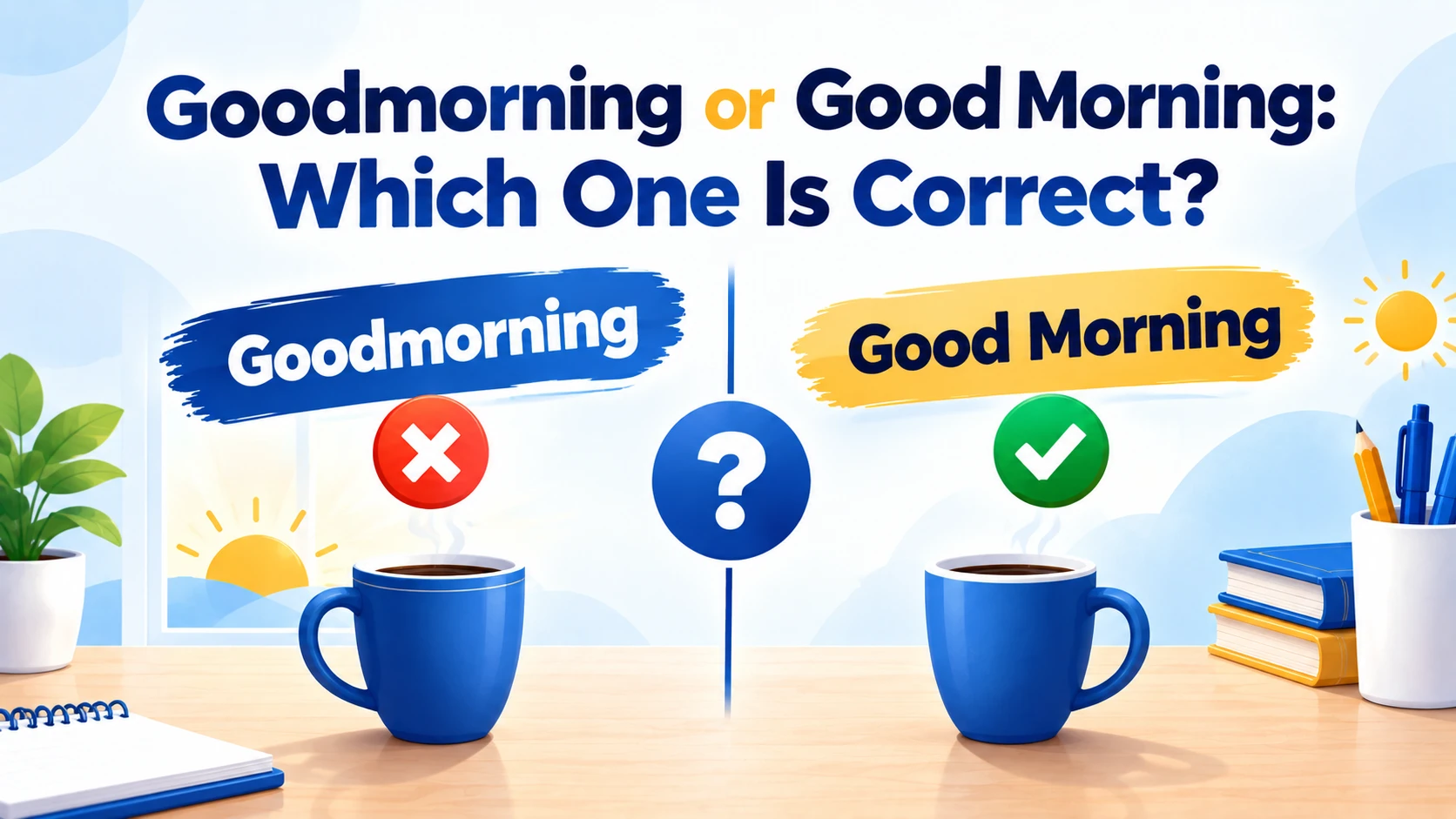
Goodmorning or good morning is a surprisingly common spelling question, but the standard form is clear: good morning is written as two separate words. It is a conventional English greeting used when you meet or address someone in the morning. Goodmorning is not the standard spelling in ordinary English writing. The confusion often comes from fast texting, the existence of other one-word forms such as goodnight, and the natural tendency to combine words that frequently appear together. Understanding the difference helps you get not only the spelling right, but also the capitalization, punctuation, and tone.
The phrase good morning is more than two words that happen to sit next to each other. It functions as an established greeting, and its form is recognized consistently by major English dictionaries. You can use it when greeting a colleague, welcoming a class, addressing an audience, or starting a friendly conversation. In informal speech, people may shorten it to “Morning!”, but that does not turn good morning into goodmorning. The distinction becomes particularly useful in emails, professional messages, school assignments, and edited content, where standard spelling and punctuation matter.
There is also a useful grammar lesson hidden inside this small spelling question. Good morning follows a familiar pattern in English, yet it cannot simply be compared mechanically with goodnight, which has established one-word uses. You also need to know when to capitalize the greeting, when to use a comma, how late in the day it remains appropriate, and when hello may be a better choice. This guide covers those details along with common mistakes, professional examples, informal alternatives, regional considerations, and practical memory tricks, so you can use the expression confidently rather than merely memorize its spelling.
Goodmorning or Good Morning: What Is the Correct Spelling?
The correct standard form is:
Good morning
Not:
Goodmorning
Major dictionaries list good morning as a greeting, with the words written separately. Cambridge defines it as something said to greet someone politely when you meet them in the morning, while Oxford classifies it as an exclamation used to say hello politely in the morning.
Good Morning vs. Goodmorning at a Glance
| Form | Standard English? | Function | Example |
| good morning | Yes | Standard greeting | “Good morning, Sarah.” |
| Good morning | Yes | Capitalized at sentence/greeting opening | “Good morning, everyone.” |
| goodmorning | No in standard prose | Usually a spelling error | “Goodmorning, Sarah.” |
| Morning! | Yes, informal | Shortened greeting | “Morning! How are you?” |
The important distinction is that good morning is not normally a compound word. The two words retain their separate spelling even though they frequently occur together.
Quick rule: When you are using the expression as a morning greeting, write good morning as two words.
What Does “Good Morning” Mean?
Good morning is a conventional greeting used when people meet or address one another during the morning. Cambridge and Oxford both treat it as a greeting rather than simply as an ordinary description of the day’s first part.
For example:
- “Good morning! How are you?”
- “Good morning, everyone.”
- “Good morning, Professor.”
- “Good morning, Mr. Khan.”
The phrase can be friendly, polite, formal, or neutral depending on the situation.
“Good Morning” as a Greeting
When you say:
“Good morning, Lisa.”
you are not merely commenting that the morning is good. You are greeting Lisa.
Historically and grammatically, the expression can be understood as a shortened wish for someone to have a good morning. In modern usage, however, speakers generally treat it as a fixed greeting rather than consciously unpacking its literal meaning every time they say it.
Is “Good Morning” a Complete Sentence?
In everyday communication:
Good morning!
works perfectly well on its own.
Greetings do not need to behave like ordinary declarative sentences. English regularly uses short expressions such as:
- “Hello!”
- “Hi!”
- “Good morning!”
- “Good evening!”
- “Thanks!”
- “Welcome!”
So there is no need to force a subject and verb into every greeting.
Why Is “Good Morning” Written as Two Words?
One reason the spelling feels confusing is that good and morning occur together so frequently.
But frequent combination does not automatically create a compound word.
Consider:
- good morning
- good afternoon
- good evening
- good idea
- good weather
- good news
The fact that two words regularly appear together does not mean they should be joined.
“Good” and “Morning” Have Separate Roles
In the ordinary phrase, good functions as an adjective and morning is a noun.
The underlying idea is similar to:
“Have a good morning.”
Over time, the shorter form became an established greeting:
“Good morning!”
That conventional use does not require the spelling to change.
Why “Goodmorning” Is Not Automatically a Compound
English contains many compound words, but there is no general rule saying:
“If two words are frequently used together, remove the space.”
That would produce countless incorrect forms.
For example, we do not normally turn:
- good idea → goodidea
- good weather → goodweather
- good afternoon → goodafternoon
into single words.
Word formation is determined by established English usage, not by how often two words appear next to each other.
Why Do People Write “Goodmorning”?
The mistake is understandable, particularly in digital communication.
Fast Typing and Texting
People often type quickly on phones and messaging platforms. Spaces may be omitted accidentally, especially in short greetings that are typed repeatedly.
Someone who writes:
“Goodmorning! Hope you’re doing well.”
may simply be typing quickly rather than deliberately choosing a different spelling.
Confusion With One-Word Expressions
One major source of confusion is goodnight.
English has established one-word uses of goodnight, so learners may reason:
good + morning = goodmorning
good + night = goodnight
But English spelling does not work that mechanically.
Words develop independently. The fact that one expression has a one-word form does not mean another expression built from the same first word should also be joined.
Familiarity Can Make an Error Look Correct
If you repeatedly see goodmorning online, the form may begin to look normal.
That is an important lesson for language learners: repeated exposure is not the same as standard usage.
Online writing contains:
- spelling mistakes
- missing spaces
- abbreviations
- usernames
- hashtags
- informal conventions
- intentional stylization
Standard writing should be checked against established language usage rather than frequency alone.
Good Morning vs. Goodnight: Why Is the Spacing Different?
This is one of the most useful comparisons for understanding the issue.
Good morning is normally written as two words.
Goodnight has established one-word uses, while good night is also used as a two-word farewell.
Oxford specifically notes that good night is not used to greet someone; it is used when saying goodbye late in the evening or when someone is going to bed.
Compare the Expressions
| Expression | Typical function | Standard form |
| Good morning | Morning greeting | Two words |
| Good afternoon | Afternoon greeting | Two words |
| Good evening | Evening greeting | Two words |
| Good night | Farewell or bedtime wish | Two words in this use |
| Goodnight | Established one-word uses | One word in certain contexts |
For example:
“Good morning, everyone.”
but:
“Good night. See you tomorrow.”
And:
“She gave her children a goodnight kiss.”
The important lesson is not “all good + time expressions should be two words.” It is:
Learn each established expression according to its actual usage.
That prevents the common mistake of using goodnight as a model for good morning.
How to Capitalize “Good Morning” Correctly
Spelling and capitalization are separate issues.
At the Beginning of a Greeting
When the greeting begins a sentence or message, capitalize Good:
- Good morning, everyone.
- Good morning, Sarah.
- Good morning!
Later in a Sentence
If the expression occurs later within a sentence, lowercase may be appropriate:
She wished everyone good morning before the meeting began.
The capitalization depends on its position and the style of the sentence, not on the fact that it is a greeting.
In Emails
A typical professional email opening might look like:
Good morning, Mr. Ahmed,
Thank you for sending the revised document.
Or:
Good morning, team,
I wanted to share a quick update about today’s schedule.
The greeting is capitalized because it begins the message’s salutation.
In Titles and Headings
A heading may use a capitalization style such as:
Good Morning: A Guide to Correct Usage
or:
Good morning: a guide to correct usage
depending on the site’s editorial style.
This is a title-style decision, not a spelling change. Neither style justifies writing goodmorning.
Punctuation: Should You Write “Good Morning,” With a Comma?
Usually, yes, when you are directly addressing someone.
Direct Address
Use a comma to separate the greeting from the person’s name or the group being addressed:
- Good morning, John.
- Good morning, everyone.
- Good morning, Professor.
The comma helps show that John, everyone, or Professor is the person being addressed.
What Happens Without the Comma?
Consider:
“Good morning Sarah.”
In informal digital communication, readers will understand the meaning. In polished writing, however, the comma is normally preferred:
“Good morning, Sarah.”
This is an example of a punctuation issue rather than a spelling issue.
When the Phrase Is Part of a Sentence
A comma is not automatically required simply because the words good morning appear together.
For example:
“I wished Sarah good morning before leaving.”
Here, good morning is part of the sentence rather than a direct greeting addressed to Sarah.
When Should You Use “Good Morning”?
Face-to-Face Conversation
Good morning works naturally when you meet someone in the morning.
You might say it to:
- A coworker
- A teacher
- A neighbor
- A customer
- A friend
- A family member
- A group of people
Oxford notes that good morning is commonly used when people first see each other in the morning and can also be used in formal situations and on the telephone.
Professional Emails
The phrase is a safe, polite opening in many professional situations:
- Good morning, Ms. Patel,
- Good morning, team,
- Good morning, Dr. Ahmed,
It can sound more polished than an extremely casual opening without becoming excessively formal.
Casual Conversations
You can also use it with friends:
“Good morning! Did you sleep well?”
In very casual speech, Morning! is also natural. Oxford identifies morning as an informal shortened form of good morning.
Presentations and Announcements
The phrase works particularly well when addressing a group:
“Good morning, everyone. Thank you for joining us.”
“Good morning, ladies and gentlemen. Welcome to the conference.”
Here, the greeting establishes a polite opening before the main content begins.
Does “Good Morning” Have a Strict Time Limit?
Not an exact universal one.
The ordinary meaning of morning refers to the early part of the day, generally before midday. Oxford describes it as the part of the day from when people wake up until 12 o’clock or before lunch, while also recognizing broader uses that extend from midnight to midday.
In real conversation, however, people do not normally calculate the exact minute before saying good morning.
Context Matters
At 8:00 a.m.:
“Good morning!” — completely natural.
At 11:30 a.m.:
“Good morning!” — still perfectly natural.
At 12:30 p.m.:
“Good morning!” — potentially unusual, depending on the context.
At 1:30 p.m.:
“Good afternoon!” — generally more natural.
There is no need to turn this into a rigid universal rule. Workplaces, cultures, schedules, and personal habits differ.
International Communication
Time becomes more important when communicating across time zones.
If you send an email to someone in another country, Hello can sometimes be a safer choice when you do not know whether it will arrive in their morning.
For example:
“Hello, David. I wanted to follow up on…”
This avoids tying the greeting to your own local time.
Good Morning in Professional Emails
A correct greeting is only one part of a professional email. The tone of the entire message matters more than whether you chose Good morning instead of Hello.
Good Morning vs. Hi vs. Hello
| Greeting | General tone | Best suited to |
| Good morning, Ms. Ali, | Polite and professional | Clients, formal contacts |
| Good morning, team, | Professional and friendly | Internal teams |
| Hello, James, | Neutral and versatile | Most professional contexts |
| Hi, James, | Friendly and relaxed | Familiar colleagues |
| Morning! | Very informal | Friends and close coworkers |
There is no single “best” greeting for every email.
A good writer considers:
- How well you know the recipient
- Whether the message is formal
- The workplace culture
- The recipient’s expected tone
- The time of day
- Whether the message is part of an existing conversation
Is “Good Morning” Too Formal?
Usually, no.
It is polite without necessarily being stiff.
Compare:
Good morning, Sarah. I’m writing to confirm tomorrow’s appointment.
with:
Hi Sarah, just confirming tomorrow’s appointment.
Both can be appropriate. The choice depends on the relationship and workplace culture.
When “Hello” May Be Better
Use Hello when:
- The recipient may read the message later in the day.
- You are unsure of their time zone.
- The conversation is not specifically tied to morning.
- You want a neutral greeting.
This is especially useful for international business communication.
Good Morning in Different Types of Writing
Formal Writing
The phrase can appear naturally in:
- Speeches
- Presentations
- Formal correspondence
- Public announcements
- Professional emails
Example:
“Good morning, members of the committee. I appreciate your time today.”
Casual Writing
Texts and chats allow more flexibility:
“Good morning! How’s everything going?”
Or simply:
“Morning!”
The spelling of the full phrase remains unchanged.
Fiction and Dialogue
Writers often use good morning to make dialogue sound natural:
“Good morning,” Maya said as she walked into the kitchen.
The expression does not need quotation marks merely because it is a greeting; punctuation follows the normal rules for dialogue.
Academic Writing
If you are discussing the expression itself, you might write:
The phrase good morning is a conventional English greeting.
Here, the words are being discussed as a linguistic expression rather than used to greet the reader.
Common Good Morning Spelling and Grammar Mistakes
Mistake 1: Writing “Goodmorning”
Incorrect:
Goodmorning, everyone.
Correct:
Good morning, everyone.
This is the main spelling error.
Mistake 2: Assuming “Goodmorning” Is a Modern Variant
It is easy to see nonstandard forms repeatedly online and assume they have become acceptable.
They have not.
Standard spelling is still two words.
Mistake 3: Confusing Spelling With Capitalization
These are different questions.
✓Good morning
✓ good morning in appropriate sentence positions
Good Morning may be appropriate under some title-capitalization styles, but it is not necessary simply because the phrase is a greeting.
Mistake 4: Forgetting the Direct-Address Comma
Good morning, Sarah. ✓
rather than:
Good morning Sarah. △
In polished writing, the comma makes the direct address clear.
Mistake 5: Using “Goodmorning” Because “Goodnight” Is One Word
This is a particularly common reasoning error.
English contains many words and expressions whose spelling must be learned individually. Goodnight does not establish a rule that morning greetings should be written as one word.
Mistake 6: Using “Good Morning” at the Wrong Time
This is not a spelling error, but it can still make communication feel awkward.
If the recipient is likely to read your message in the afternoon, Hello may be more practical.
Good Morning, Good Afternoon, and Good Evening
These greetings form a useful comparison because they demonstrate the normal spacing pattern.
| Greeting | Standard spelling | Typical use |
| Good morning | Two words | Morning greeting |
| Good afternoon | Two words | Afternoon greeting |
| Good evening | Two words | Evening greeting |
| Good night | Two words in farewell use | Saying goodbye / bedtime |
| Goodnight | One word in established uses | Certain adjective/interjection uses |
Oxford lists good afternoon as a greeting used when people first see each other in the afternoon, reinforcing the pattern of keeping the words separate.
The broader lesson is important:
Do not create spelling rules by analogy when established usage already determines the form.
Is “Goodmorning” Ever Acceptable?
In standard prose, goodmorning is not the form you should use.
There are, however, situations where you might encounter the letters together without the writer intending to establish a standard English word.
Usernames and Handles
A social media username might contain something like:
@goodmorningworld
That does not make goodmorning a standard English spelling.
Usernames often remove spaces because platforms require or encourage that format.
Hashtags
A hashtag may appear as:
#GoodMorning
Again, this is a platform convention. Hashtags cannot contain ordinary spaces, so words are often joined or separated through capitalization.
Branding and Stylization
A company, campaign, publication, or product may deliberately choose a stylized name such as GoodMorning.
That is a proper name or branding decision, not evidence that ordinary English prose should use the same spelling.
“Morning!” Is Correct Too—but It Is Different
There is another form worth knowing:
Morning!
This is an informal shortened greeting.
Oxford explicitly identifies morning as an informal short form of good morning.
For example:
“Morning! How’s your day going?”
That is perfectly natural in casual conversation.
But notice the distinction:
- Good morning ✓
- Morning ✓ informal
- Goodmorning ✗ standard spelling
The presence of an accepted shortened form does not justify joining the original words together.
A Practical Guide to Using “Good Morning” Correctly
Use this five-step check when writing an email, message, or article.
Step 1: Keep the Words Separate
Write:
good morning
not:
goodmorning
Step 2: Check the Time and Audience
If you know the recipient is receiving the message in the morning, good morning is natural.
If the time is uncertain, hello may be safer.
Step 3: Capitalize the Opening Correctly
At the beginning of a greeting:
Good morning, everyone.
Inside a sentence:
She wished everyone good morning.
Step 4: Use a Comma for Direct Address
Good morning, James.
Good morning, team.
Step 5: Match the Tone
Choose among:
- Good morning — polite and versatile
- Hello — neutral and time-independent
- Hi — friendly and common
- Morning — informal
The goal is not to find one greeting that is universally superior. It is to choose the one that fits the situation.
Real-World Examples of “Good Morning”
Workplace
Good morning, team. The meeting will begin at 9:00 a.m.
Good morning, Ms. Patel. I’ve attached the revised proposal.
School or University
Good morning, Professor. May I ask a question?
Good morning, everyone. Please take your seats.
Casual Conversation
Good morning! Did you sleep well?
Good morning! Ready for breakfast?
Text Message
Good morning! Hope you have a great day.
Morning! Are we still meeting at ten?
Presentation
Good morning, everyone. Thank you for being here.
Incorrect Forms
❌ Goodmorning, everyone.
❌ Goodmorning! How are you?
❌ Good morningSarah.
Better:
✓ Good morning, everyone.
✓ Good morning! How are you?
✓ Good morning, Sarah.
A Note on “Morning” as a Noun
Not every appearance of morning is a greeting.
The word also functions as a regular noun referring to part of the day.
For example:
“I exercise every morning.”
“We have a meeting tomorrow morning.”
“She spent the morning reading.”
Oxford defines morning as the early part of the day and gives common expressions such as tomorrow morning, in the morning, and first thing in the morning.
This matters because good morning and morning are related but grammatically different.
Compare:
“Good morning!” — greeting
with:
“The meeting is tomorrow morning.” — noun referring to a time period
Recognizing the function makes it easier to understand why the phrase behaves differently in different sentences.
Good Morning: Spelling, Grammar, Punctuation, or Style?
The question “Goodmorning or good morning?” looks like a spelling problem, but several separate language issues can be involved.
Spelling
The standard form is:
good morning
Grammar
As a greeting, good morning functions as a conventional expression used when meeting someone in the morning.
Punctuation
When directly addressing someone:
Good morning, Alex.
Capitalization
At the beginning of a sentence or message:
Good morning, Alex.
Later in a sentence:
She wished Alex good morning.
Style
The choice between Good morning, Hello, Hi, and Morning depends on the relationship, medium, formality, and timing.
Separating these issues makes the answer much more useful. A writer can spell good morning correctly and still choose the wrong punctuation or an inappropriate tone.
Quick Reference: Good Morning Checklist
| Question | Correct approach |
| How many words? | Two |
| Correct spelling? | good morning |
| Beginning of greeting? | Good morning |
| Direct address? | Good morning, Sarah. |
| Informal shortened version? | Morning! |
| Professional email? | Good morning, [Name], |
| One-word spelling? | Goodmorning is not standard prose |
| Unsure of recipient’s time? | Consider Hello |
| Similar greeting? | Good afternoon, good evening |
| Does goodnight justify goodmorning? | No |
Conclusion
When choosing between goodmorning or good morning, the standard answer is simple: good morning is written as two words. The expression functions as a conventional morning greeting, while goodmorning is generally a spelling error in standard prose. The more interesting lesson is knowing what surrounds the spelling: capitalization depends on position, commas depend on direct address, and the best greeting depends on context. Good morning works well in conversation, professional emails, presentations, and polite introductions, while Morning! is a natural informal alternative. One final actionable tip: remember the phrase as two words just as you would good afternoon and good evening. A common mistake to avoid is copying goodnight and assuming every “good + time” expression follows the same spelling pattern. In English, established usage decides the form.
Frequently Asked Questions
Q1. Is “goodmorning” one word or two?
Good morning is two words in standard English. The one-word form goodmorning is generally a spelling error when used as the ordinary greeting. Joining the words may appear in usernames, hashtags, or branding, but those special formats do not change the standard spelling.
Q2. Why is “good morning” two words but “goodnight” sometimes one word?
English compounds develop individually rather than according to a universal formula. Good morning remains two words, while goodnight has established one-word uses. The existence of one compound does not automatically determine the spelling of another expression.
Q3. Should “Good Morning” be capitalized in an email?
At the beginning of an email greeting, write Good morning with a capital G: “Good morning, Sarah.” The word morning remains lowercase unless another capitalization convention applies. Capitalization here is determined by sentence or salutation position, not because morning is part of a greeting.
Q4. Should there be a comma after “Good morning”?
Usually, yes, when you directly address someone: “Good morning, David.” The comma separates the greeting from the person’s name or the group being addressed. If good morning occurs as part of a larger sentence rather than direct address, the punctuation can be different.
Q5. Can I write “Morning” instead of “Good morning”?
Yes. Morning! is a recognized informal shortening of good morning and is common in casual speech and messages. It is different from goodmorning, however. The shortened form removes good; it does not combine good and morning into a new standard word.
