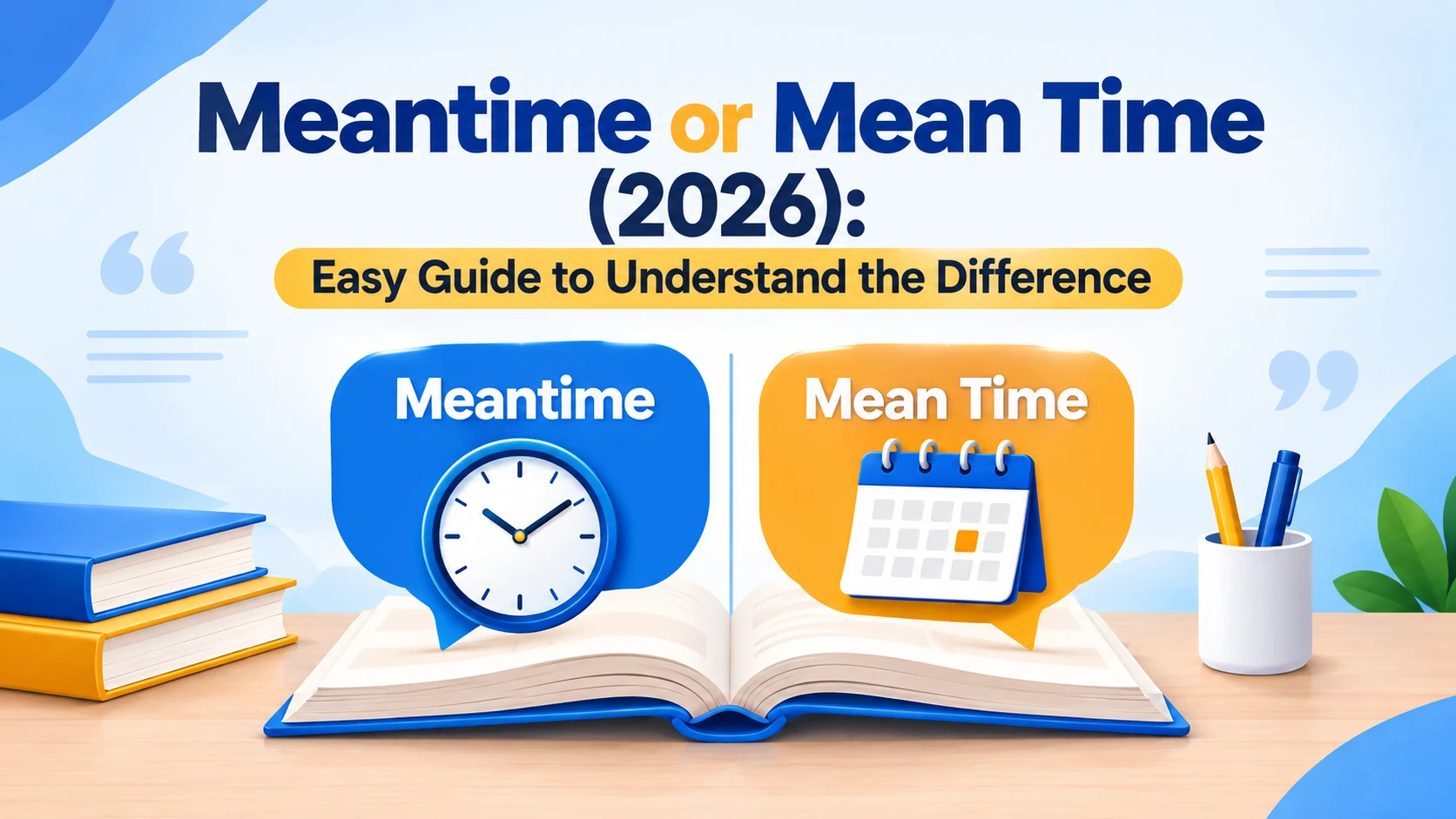
Meantime or mean time can look like a simple spacing question, but the two forms do not always mean the same thing. In everyday English, meantime is the standard one-word form when you mean the period while something else is happening. It appears most often in the familiar expression “in the meantime,” which is similar in meaning to “meanwhile.” By contrast, mean time is a legitimate two-word phrase when mean describes a type of time, particularly an average, calculated, or standardized time in technical contexts. Understanding that difference makes the spelling much easier to remember.
The confusion usually comes from pronunciation and context. When spoken naturally, meantime and mean time can sound almost identical, so listening does not always reveal where the word boundary belongs. The important question is therefore not simply, “Should I add a space?” Instead, ask what the sentence actually means. If you are talking about what happens during a waiting period, you probably need meantime. If you are discussing a calculated or standardized measure of time, mean time may be exactly right. That distinction prevents both common spelling and usage errors.
This guide explains meantime vs mean time from the ground up, including their meanings, grammar, sentence patterns, professional usage, technical applications, and common mistakes. You will also see how “in the meantime” compares with “meanwhile,” why “in the mean time” is usually not the expression you want, and when the separated form is appropriate. By the end, you should be able to choose the correct form based on meaning rather than memorization alone—a much more reliable approach when two English expressions look and sound so similar.
Meantime or Mean Time: The Quick, Accurate Answer
For ordinary English, meantime is the form you normally want when referring to a period between events or to what happens while something else is taking place.
The most common expression is:
In the meantime, we can start preparing dinner.
Here, meantime means roughly “during that intervening period” or “while we wait.”
Cambridge defines meantime as the time until something expected happens or while something else is happening, and Oxford likewise uses it for the period between two events. Both dictionaries connect it closely with meanwhile.
Mean time, however, is not simply an incorrect version of meantime. It can be correct when mean modifies time in a literal or technical sense—for example, when referring to mean solar time or an average time calculated from observations. NIST describes mean solar time as a time scale based on the average length of the solar day.
At a glance
| Form | Main meaning | Typical context | Example |
| meantime | The intervening period; while something else happens | Everyday English | “In the meantime, I’ll call the office.” |
| mean time | A type or average of time | Technical, scientific, timekeeping | “The calculation uses mean solar time.” |
Bottom line: If you mean “meanwhile,” choose “meantime.” If you genuinely mean a mean, average, or standardized kind of time, use “mean time.”
What Does “Meantime” Mean?
Meantime refers to a period between two events or the time during which something else is happening.
It is especially common in the phrase “in the meantime.”
For example:
- “The train arrives at six. In the meantime, we can get some coffee.”
- “The repairs will take two days. In the meantime, the shop will remain closed.”
- “She is finishing the report. In the meantime, I’ll answer the emails.”
In each sentence, meantime identifies an intervening period. It does not describe an average or mathematical property of time.
Cambridge lists meantime as a noun and gives “in the meantime” as its principal expression. Oxford similarly defines in the meantime as referring to the period between two times or events.
Meantime as a Noun
In its standard use, meantime is a noun.
Consider:
“In the meantime, we waited outside.”
The phrase “in the meantime” functions as an adverbial expression. It tells the reader when the action happened.
You can think of the underlying idea this way:
Event A → meantime → Event B
For example:
The doctor will arrive at 3:00 → in the meantime → wait in the reception area.
The word does not specify exactly how long the interval lasts. The duration is supplied by context.
“In the Meantime” and “Meanwhile”
One of the easiest ways to understand meantime is to compare it with meanwhile.
These can often express the same basic idea:
- “The food will be ready in ten minutes. In the meantime, set the table.”
- “The food will be ready in ten minutes. Meanwhile, set the table.”
Cambridge lists meanwhile as a synonym of “in the meantime,” while Oxford identifies meantime as an alternative to meanwhile.
There is, however, a grammatical difference in how they are commonly used.
In the meantime is a fixed phrase containing the noun meantime.
Meanwhile is commonly used as an adverb:
“Meanwhile, the children continued playing.”
That distinction explains why you should not automatically replace one expression with the other word-for-word.
Can “Meantime” Stand Alone?
Yes, although this is less common in everyday formal writing than “in the meantime.”
Oxford records meantime as an adverb in informal usage, equivalent to meanwhile, as in:
“I’ll contact them soon. Meantime, don’t tell them I’m back.”
For most learners, the safest practical pattern is still “in the meantime.”
What Does “Mean Time” Mean?
Mean time is a two-word noun phrase. Here, mean remains a separate adjective modifying time.
The key is that mean can mean “average.”
So mean time may refer to a time value obtained through averaging or to a standardized form of time used in a particular technical system.
For example:
“The researchers calculated the mean time for each trial.”
Here, mean time can naturally be understood as the average time.
That is completely different from:
“In the meantime, the researchers prepared the equipment.”
The first sentence concerns a measurement. The second concerns an intervening period.
Mean Time in Science and Timekeeping
The phrase becomes particularly important in technical discussions of timekeeping.
One established example is mean solar time.
NIST explains that mean solar time is based on the average length of the solar day. It provides a more uniform timekeeping basis than apparent solar time, whose length varies during the year.
This is a genuine technical use of mean time.
Other expressions can include terms such as:
- mean solar time
- local mean time
- Greenwich Mean Time (GMT)
In these expressions, the space is not a spelling error. Mean has a specific descriptive function.
Mean Time as an Average
You do not always need an astronomy textbook to justify the two-word form.
Suppose a laboratory records how long five experiments take:
- 8 minutes
- 10 minutes
- 9 minutes
- 11 minutes
- 12 minutes
If the researcher calculates the average, the resulting figure can be described as the mean time.
In this context, mean has the statistical sense of arithmetic average.
That gives you an excellent test:
If you can replace mean with average, “mean time” may be appropriate.
For example:
“The average time was nine minutes.”
→ “The mean time was nine minutes.”
But you cannot make the same substitution in:
“In the meantime, we’ll wait.”
That sentence does not mean “in the average time.”
Meantime vs Mean Time: The Space Changes the Meaning
The difference between these expressions is important because the space is meaningful.
Compare:
“In the meantime, we’ll continue working.”
with:
“The mean time for the process was 14 minutes.”
The first sentence describes when something happens.
The second describes a measurement.
This is why calling mean time a simple misspelling of meantime is misleading. Sometimes it is a mistake; sometimes it is exactly the intended phrase.
Meaning, Grammar, and Context Compared
| Feature | Meantime | Mean time |
| Number of words | One | Two |
| Basic idea | Intervening period | Average or defined type of time |
| Common grammar | Noun; also informal adverbial use | Noun phrase |
| Most common expression | “In the meantime” | “Mean solar time” |
| Everyday use | Very common | Less common |
| Technical use | Limited | Commoner in specialized contexts |
| Equivalent idea | “Meanwhile” | “Average time” in suitable contexts |
| Example | “In the meantime, call me.” | “The mean time was 12 seconds.” |
Why One Space Matters
English contains many examples where spacing affects meaning:
- every day vs everyday
- a lot vs the incorrect alot
- maybe vs may be
- any more vs anymore in certain usage patterns
Meantime and mean time belong to the same general problem: word boundaries can carry grammatical information.
The solution is not to memorize that “one is right and one is wrong.” The better solution is to identify the intended meaning first.
“In the Meantime” vs “In the Mean Time”
This is probably the most useful distinction for everyday writers.
Why “In the Meantime” Is Usually Correct
Use in the meantime when you mean:
- while waiting
- during the intervening period
- while another event is taking place
- before something expected happens
Examples:
“The technician will arrive tomorrow. In the meantime, please restart the computer.”
“The application is being reviewed. In the meantime, you can prepare the required documents.”
“Dinner won’t be ready for another hour. In the meantime, let’s watch a movie.”
These are all ordinary uses of the standard expression.
When “In the Mean Time” Could Be Correct
The phrase “in the mean time” is not the normal spelling of the everyday idiom.
However, it can theoretically occur when mean time is being used as a genuine noun phrase and the surrounding sentence requires the preposition in.
For example, a highly specialized discussion might refer to a calculation involving a defined “mean time.” In such a case, the words remain separate because mean retains its ordinary modifying role.
That is a very different construction from:
“In the meantime, I’ll wait.”
For normal correspondence, essays, articles, conversations, and messages, in the meantime is overwhelmingly the form you should reach for.
A Simple Substitution Test
When unsure, try replacing the expression with “meanwhile.”
“In the meantime, we’ll review the results.”
→ “Meanwhile, we’ll review the results.”
The meaning remains intact.
Now try:
“The mean time for completion was 17 minutes.”
→ “The meanwhile for completion was 17 minutes.”
That fails completely.
The substitution test is not a universal grammar rule, but it is an extremely useful practical editing tool.
Why Do People Confuse Meantime and Mean Time?
The confusion is understandable because the two forms are visually and phonetically close.
The Words Sound Similar
When people say meantime, it is pronounced as a single unit. When someone says mean time quickly, the boundary between the two words may be difficult to hear.
That creates a common learning problem:
“I know how it sounds, but I don’t know where the space goes.”
In this situation, pronunciation alone cannot settle the question. Meaning has to decide the spelling.
“Mean” Has Several Meanings
The word mean can refer to:
- an intention: “What do you mean?”
- an average: “The mean score was 72.”
- something unkind: “That was a mean comment.”
In mean time, the relevant idea is generally the second one when mean indicates an average, or a specialized technical meaning.
In meantime, however, you should not mentally interpret the word as mean + time in ordinary modern usage. Treat it as the established word meantime.
Spellcheck Is Not Always Enough
Spellcheck can catch obvious misspellings, but it cannot reliably determine what you intended when both forms are legitimate English.
If you type:
“The mean time, we’ll continue.”
a basic spelling checker may not understand that you intended “in the meantime.”
This is a broader lesson for proofreading: grammar software checks forms more easily than meaning.
How to Use “Meantime” Correctly in Real Sentences
The best way to internalize the word is to see the kinds of situations in which native speakers naturally use it.
Everyday Conversation
“The bus should be here in ten minutes. In the meantime, let’s grab some water.”
“She’s finishing her call. In the meantime, I’ll wait outside.”
Workplace Communication
“The final figures won’t be available until Friday. In the meantime, please use the preliminary report.”
“The issue has been escalated to our technical team. In the meantime, try restarting the application.”
This construction is particularly useful in professional writing because it clearly separates the current temporary situation from the expected next step.
Instructions
“Leave the mixture to cool for 20 minutes. In the meantime, prepare the filling.”
Here, in the meantime connects two actions occurring during the same interval.
News and Narrative Writing
“The committee is expected to release its findings next week. In the meantime, officials are reviewing the evidence.”
It can also connect parallel developments:
“The company continued negotiations. In the meantime, employees prepared for a possible strike.”
The expression is useful because it establishes a temporary time relationship without requiring an exact duration.
How to Use “Mean Time” Correctly
The two-word form needs a different approach.
Example 1: Average Duration
“The mean time required to complete the test was 6.4 minutes.”
Here, the writer is talking about an average measurement.
Example 2: Scientific Context
“The experiment recorded the mean time between successive events.”
Again, the phrase describes a calculated quantity.
Example 3: Timekeeping
“The historical records were converted to local mean time.”
Here, mean time belongs to a specialized timekeeping context.
A Useful Technical Test
Ask three questions:
- Is “mean” being used in the sense of average?
- Is time being measured, calculated, or standardized?
- Does the phrase belong to a scientific or timekeeping terminology?
If the answer is yes, mean time deserves serious consideration.
If you simply mean “while something else happens,” you almost certainly want meantime.
Meantime, Meanwhile, and “For the Meantime”
There are a few related expressions worth knowing because learners often encounter them together.
“In the Meantime”
This is the standard everyday expression:
“The new equipment arrives next week. In the meantime, we’ll use the old system.”
It means during the period before or between events.
“Meanwhile”
This can often replace “in the meantime”:
“The new equipment arrives next week. Meanwhile, we’ll use the old system.”
Oxford and Cambridge both recognize the close relationship between these expressions.
“For the Meantime”
For the meantime is also found, particularly in British English, with the sense of a temporary period rather than something permanent. Oxford gives examples such as temporarily continuing to use an old email address.
For most general-purpose writing, however, “in the meantime” is the safest and most familiar choice.
Formal, Academic, and Professional Usage
A useful misconception to avoid is that meantime is too informal for professional writing.
It isn’t.
Consider:
“The contract is currently under review. In the meantime, no changes will be made to the existing arrangement.”
That sounds entirely natural in a workplace or formal document.
The expression works especially well when you need to communicate:
Current status → temporary action → expected future event
For example:
“The replacement parts are expected next Monday. In the meantime, the affected equipment will remain offline.”
That is concise, clear, and professional.
When “Meanwhile” May Be Preferable
Meanwhile can be more economical when you are contrasting two developments:
“The sales team is preparing the proposal. Meanwhile, the legal department is reviewing the contract.”
The choice here is largely about sentence structure and emphasis, not correctness.
British English vs American English
There is no major British-versus-American spelling split in meantime.
The word is standard in both varieties.
Cambridge provides British and American dictionary entries for meantime, and both describe the same core idea: the period while something else is happening.
Likewise, mean time is not an American alternative spelling of meantime. If it appears in American or British English, its meaning still depends on context.
So avoid advice such as:
“Americans write meantime, while British writers use mean time.”
That is not a reliable rule.
The real distinction is semantic and grammatical, not geographical.
Common Mistakes With Meantime and Mean Time
Mistake 1: Writing “Mean Time” for “Meanwhile”
Incorrect for ordinary usage:
“In the mean time, I’ll call her.”
Preferred:
“In the meantime, I’ll call her.”
The writer has mistaken a one-word noun for a two-word phrase.
Mistake 2: Assuming “Mean Time” Is Always Wrong
This goes too far in the opposite direction.
“The mean time between measurements was calculated.”
Here, the two-word phrase can be entirely appropriate because it describes a calculated quantity.
Mistake 3: Forgetting “the”
Many learners write:
“In meantime, we’ll wait.”
The standard expression is:
“In the meantime, we’ll wait.”
The article the is an important part of the familiar phrase.
Mistake 4: Treating “Meantime” and “Meanwhile” as Perfect Substitutes Everywhere
They overlap strongly in meaning, but their grammar is not identical.
For example:
“Meanwhile, she continued working.”
is straightforward.
You would not normally replace it mechanically with:
“In the meantime, she continued working.”
That sentence may still be grammatical, but it changes the structure and emphasis.
Mistake 5: Correcting the Space Without Reading the Sentence
This is the most important proofreading mistake.
Never use a blanket rule such as:
“Always write meantime.”
Instead, ask what the sentence means.
A Quick Decision Guide: Which One Should You Use?
Use this decision process whenever you hesitate.
Use meantime when:
- You mean the period between events.
- You mean while something else is happening.
- You are writing “in the meantime.”
- You could reasonably use “meanwhile.”
Use mean time when:
- You mean average time.
- You are describing a calculated time value.
- You are discussing timekeeping or astronomy.
- Mean is functioning as a separate modifier of time.
The 10-Second Test
| Ask yourself | If yes | Likely choice |
| Can I replace it with “meanwhile”? | Yes | meantime |
| Am I talking about a waiting/intervening period? | Yes | meantime |
| Does “mean” mean “average”? | Yes | mean time |
| Am I calculating a duration? | Yes | mean time |
| Is it part of a technical timekeeping term? | Yes | mean time |
| Am I writing the common phrase “in the ___”? | Intervening period | in the meantime |
Meantime or Mean Time: Side-by-Side Examples
| Sentence | Correct form | Reason |
| “The doctor will arrive soon. In the ___, please wait here.” | meantime | Refers to the waiting period |
| “The average ___ for the experiment was 4.8 seconds.” | mean time | Refers to an average |
| “___, the engineers continued testing.” | Meanwhile | Adverb meaning during the same period |
| “The new software arrives Friday. In the ___, use this version.” | meantime | Temporary intervening period |
| “The researchers calculated the ___ between events.” | mean time | A measured/calculated quantity |
| “The records were converted to local ___ time.” | mean | Part of technical timekeeping terminology |
A Practical Editing Checklist
Before submitting an assignment, sending an email, or publishing an article, run through this short checklist:
- Do I mean “while something else is happening”?
- Would “meanwhile” work in this sentence?
- Am I using the standard phrase “in the meantime”?
- Am I actually referring to an average time?
- Is this a scientific, astronomical, mathematical, or timekeeping context?
- Have I accidentally inserted a space into “meantime”?
- Have I removed a space from a genuine technical phrase?
- Does the complete sentence make sense after the correction?
Expert tip: Don’t proofread meantime by looking at the word alone. Read the entire sentence. The surrounding meaning usually tells you whether the writer is describing an intervening period or a time measurement.
Conclusion
The easiest way to remember meantime or mean time is to stop thinking about the space and start thinking about the meaning. Meantime refers to an intervening period and appears most commonly in “in the meantime,” while mean time describes an average, calculated, or specialized form of time. That distinction works across everyday, professional, academic, and technical writing. One final actionable tip: whenever you are unsure, replace meantime mentally with “meanwhile.” If the sentence still expresses the intended idea, you probably have the right form. A common mistake to avoid is assuming that mean time is always wrong. In technical contexts, the space is deliberate. Good proofreading is not merely about spelling—it is about matching the words to the meaning.
Frequently Asked Questions
Q1. Is “meantime” one word or two?
Meantime is normally written as one word when it refers to the period while something else is happening. The most familiar construction is “in the meantime.” For example, “The package arrives tomorrow; in the meantime, use this one.” The two-word mean time has a different meaning.
Q2. Is “in the meantime” always correct?
In the meantime is the standard expression when you mean “during the intervening period” or “while something else is happening.” It is suitable in casual conversation, professional emails, academic prose, and general writing. A technical sentence may instead require the separate phrase mean time.
Q3. Is “mean time” grammatically correct?
Yes. Mean time can be grammatically correct when mean modifies time, particularly when it means an average or calculated time. It also appears in technical terminology such as mean solar time. Therefore, it should not automatically be treated as a misspelling of meantime.
Q4. What is the difference between “meantime” and “meanwhile”?
They overlap substantially, but their grammatical use differs. Meantime is most familiar in the phrase “in the meantime,” while meanwhile commonly works as an adverb: “Meanwhile, the team continued working.” Both can describe actions occurring during an intervening period.
Q5. Can I use “meantime” in professional writing?
Absolutely. Meantime is standard in professional writing, especially in the phrase “in the meantime.” It can clearly describe a temporary arrangement while a decision, repair, delivery, review, or other event is pending. For example: “In the meantime, please continue using the existing procedure.”
