
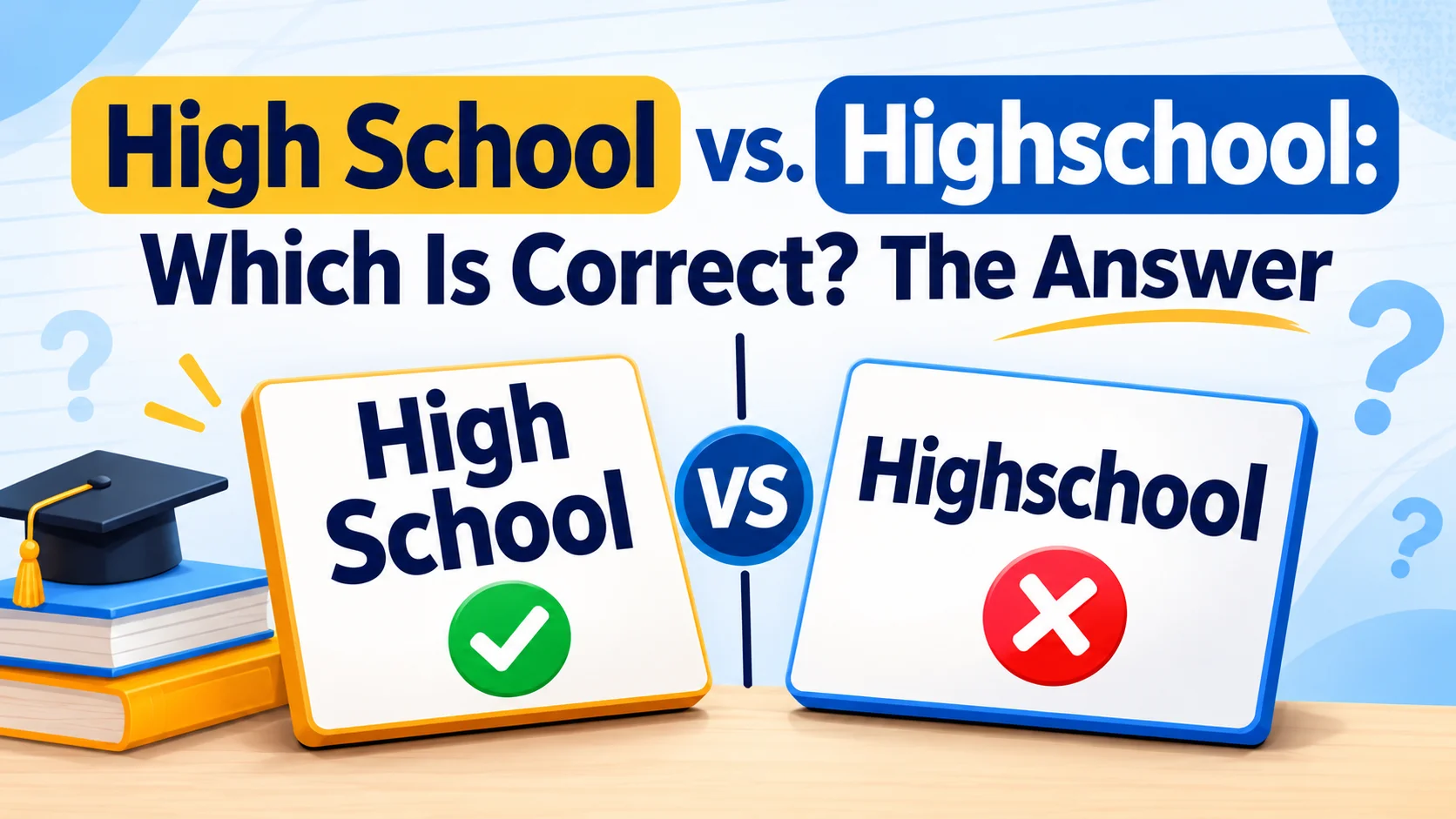
High school vs. highschool is a common spelling question, especially when writing about education, student life, or academic qualifications. The correct standard form is high school, written as two separate words. Although highschool may look reasonable because the phrase describes one concept, joining the words creates a nonstandard spelling. This distinction matters in school assignments, professional documents, résumés, and online articles. A small spacing error can make otherwise polished writing look careless, particularly when the phrase appears repeatedly. Fortunately, the correct form is easy to remember once you understand how English compound expressions work.
The confusion is not entirely surprising. English contains many expressions that began as separate words but are now written together, such as classroom and notebook. Others remain open compounds, including middle school, secondary school, and high school. There is also a hyphenated form, high-school, that occasionally appears in particular editorial contexts. These forms are not interchangeable, and knowing when a hyphen is appropriate can prevent another common mistake. The important distinction is between standard spelling, style-dependent punctuation, and informal typing habits.
This guide explains why high school remains two words, how to use it naturally in sentences, and when capitalization or hyphenation may change. You will also learn how the phrase differs from secondary school, middle school, and college in different education systems. Whether you are preparing an academic assignment, updating your résumé, writing website content, or simply checking a spelling, you will find clear explanations and practical examples to help you choose the right expression confidently.
High School or Highschool? The Quick Answer
High school is the correct standard spelling. Write it as two separate words, not as one.
- Correct: My sister attends high school.
- Incorrect: My sister attends highschool.
The phrase is an established open compound: two words that work together to express one idea while retaining their separate spelling.
| Form | Status | Recommended use |
| High school | <text color=”success” weight=”medium” inline>Standard</text> | Use in general writing |
| Highschool | Nonstandard | Avoid in ordinary English |
| High-school | Style-dependent | Use only when a particular style or context calls for it |
The distinction is straightforward:
- Write high school in essays, emails, articles, applications, and everyday messages.
- Do not combine the words into highschool.
- Do not add a hyphen automatically just because the phrase comes before another noun.
The easiest rule to remember: High school is two words in standard English.
What Does High School Mean?
High school refers to a stage of secondary education or the educational institution where students complete that stage. It is particularly familiar in American English, where it commonly describes the later years of school before college, university, or employment.
However, the exact meaning depends on the country’s education system. Different countries organize secondary education into different stages, use different grade names, and award different qualifications. Therefore, high school should not be treated as a universal label for exactly the same ages or school years everywhere.
High school as a stage of education
In education systems that use the term, high school generally follows an earlier stage such as elementary or middle school.
Students commonly study subjects such as:
- English and other languages
- Mathematics
- Science
- History and social studies
- Arts and technology
- Physical education
Depending on the school system, students may also choose elective subjects, complete vocational courses, prepare for examinations, or earn qualifications required for further education.
For example:
- My brother will start high school next September.
- She completed high school before applying to university.
- High school helped him discover an interest in computer science.
The phrase identifies an educational stage, not a particular subject or qualification.
High school as an educational institution
High school can also refer directly to the school itself.
Examples:
- The high school is located near the public library.
- Our high school has a new science laboratory.
- She teaches mathematics at a local high school.
In these sentences, the phrase functions as a noun phrase. It identifies a place or institution rather than the general experience of secondary education.
High school as part of someone’s background
People often use the expression when discussing their education, qualifications, or past experiences.
Examples:
- He graduated from high school in 2024.
- I met my closest friend in high school.
- Her high school education prepared her for further study.
This use is common in conversations, personal biographies, applications, and professional profiles.
Why Is High School Written as Two Words?
The spelling comes from the way English handles compound words and expressions.
A compound is formed when two or more words work together to express a related idea. However, compounds do not all follow the same spelling pattern. Some remain separate, some are joined, and others use a hyphen.
High school is an open compound, meaning its words remain separate even though they function together as a single expression.
Understanding open, closed, and hyphenated compounds
English compounds generally appear in three written forms.
| Compound type | How it is written | Examples |
| Open compound | Separate words | High school, post office, ice cream |
| Closed compound | Joined as one word | Classroom, notebook, bedroom |
| Hyphenated compound | Connected with a hyphen | Well-known, part-time, decision-making |
The important point is that a phrase does not become one word simply because people use it frequently or because it describes one thing.
For example, ice cream is one familiar concept, but its standard spelling remains two words. Similarly, high school refers to one educational stage or institution without becoming highschool.
Why highschool is not standard English
The spelling highschool combines two words without following the established standard form.
People may type it for several reasons:
- They assume frequently used expressions eventually become one word.
- They confuse it with closed compounds such as classroom.
- They type quickly and omit the space.
- They encounter it in usernames, hashtags, or informal online content.
None of these reasons makes it the accepted spelling.
A search engine may still understand what someone means when they type highschool. Search systems can recognize spelling variations and likely intent. However, search-query recognition is not the same as correct editorial usage.
Expert recommendation: Use the standard two-word form in published content, academic work, and professional communication, even if you occasionally encounter the joined version online.
How to Use High School Correctly in a Sentence
Understanding the spelling is only the first step. You should also know how the phrase fits naturally into different sentence structures.
High school as a noun
The most common use is as a noun phrase referring to an educational institution or stage.
Examples:
- My cousin attends high school in the city.
- The high school recently renovated its library.
- She finished high school last year.
- Several students applied to the same high school.
It can appear with articles and possessive words:
- A high school: A new high school opened in the area.
- The high school: The high school offers several science courses.
- Our high school: Our high school organizes an annual sports event.
- Their high school: Their high school is known for its music program.
The words remain separate in every example.
High school as a modifier before another noun
A phrase can describe another noun without becoming a single word.
Consider these expressions:
- High school student
- High school teacher
- High school education
- High school graduation
- High school diploma
- High school football
In each example, high school identifies the type or context of the noun that follows.
Examples in complete sentences:
- My daughter is a high school student.
- The high school teacher explained the assignment.
- He received his high school diploma last summer.
- High school graduation is an important milestone for many students.
Notice that the phrase remains two words even when it appears directly before another noun.
High school in common expressions
Some combinations appear so frequently that it is useful to learn them as complete expressions.
| Expression | Meaning | Example |
| Attend high school | Study at a high school | She attends high school nearby. |
| Go to high school | Be a high school student | My brother goes to high school. |
| Graduate from high school | Complete high school | He graduated from high school last year. |
| High school diploma | Qualification awarded after completing the required program | She earned her high school diploma. |
| High school years | The period spent in high school | He remembers his high school years fondly. |
| High school student | A student enrolled at a high school | The program supports high school students. |
A useful grammar point is the preposition in graduate from high school. In American English, this is a common construction. You may also see graduate high school in informal American usage. The wording can vary, but the spelling of high school does not.
High School vs. High-School: Do You Need a Hyphen?
This question deserves separate attention because high-school is not the same error as highschool.
The usual standard spelling is high school, without a hyphen. This remains true in common expressions such as high school student, high school teacher, and high school diploma.
However, a hyphenated form may appear in certain publications or editorial styles. Its use is not universally required, so writers should not assume that every phrase placed before a noun needs a hyphen.
High school student or high-school student?
For general writing, use:
High school student
Example:
- My neighbor is a high school student.
You may occasionally encounter:
High-school student
This can reflect a particular publication’s house style or an editor’s approach to compound modifiers. It is not necessary in ordinary usage.
The most important distinction is that the hyphenated form is still different from highschool, which joins the words without a space or hyphen.
When is a hyphen actually helpful?
Hyphens are often used to connect words that work together as a modifier, particularly when the connection prevents ambiguity.
For example:
- A well-known teacher
- A part-time employee
- A long-term project
In these expressions, the hyphen helps readers understand that the words function together.
But not every multiword expression requires one. High school student is clear without a hyphen, so the open form is generally the best choice.
Practical advice: If you are writing for a newspaper, university, publisher, or organization, follow its style guide. Otherwise, use high school as two words without a hyphen.
Should High School Be Capitalized?
The phrase is normally written in lowercase when it refers to a school or educational stage generally. Capitalization changes when it forms part of an official name or follows the capitalization rules of a title.
When to use lowercase high school
Use lowercase when discussing high school as a general concept.
Examples:
- My brother starts high school next year.
- She teaches at a high school.
- High school can prepare students for further education.
- He completed high school in his hometown.
Even when the phrase begins a sentence, only the first letter is capitalized because of its position:
- High school can be challenging for some students.
This does not mean high school is a proper noun.
When to capitalize High School
Capitalize the words when they are part of an institution’s official name.
Examples:
- Central High School
- Lincoln High School
- Northview High School
In these cases, the words form part of a proper name.
Compare:
- She attends Central High School. (Official name)
- She attends a high school in the city. (Generic reference)
When writing the name of a specific institution, use its official spelling and capitalization rather than guessing.
High school in titles and headings
Titles may use different capitalization styles.
Sentence case:
- How to prepare for high school
Title case:
- How to Prepare for High School
The capitalization differs because of the title style, not because the spelling of the compound changes.
Is High School Spelled the Same Way in American and British English?
Yes. High school is normally written as two words in both American and British English.
The more noticeable difference concerns education terminology, not spelling.
High school in American English
In the United States, high school commonly refers to the later stage of secondary education, often covering grades 9 through 12. However, school structures can differ between districts and states.
Common American expressions include:
- High school freshman
- High school sophomore
- High school junior
- High school senior
- High school diploma
- High school graduation
Examples:
- My son is a high school sophomore.
- She earned her high school diploma in June.
- The school organizes activities for graduating high school seniors.
These expressions are widely recognized in American educational contexts.
High school in British English
In the United Kingdom, secondary school is generally the more familiar broad term for the stage of education following primary school.
However, high school is also used in some British communities and in the names of particular institutions. Its use is especially familiar in Scotland and in certain local educational contexts.
Therefore, it would be inaccurate to claim that high school is incorrect in British English. The phrase exists, but its familiarity and precise institutional meaning vary.
High school in other English-speaking countries
Other countries also use different educational labels.
| Country or region | Common terminology | Important point |
| United States | High school | Commonly used for grades 9–12 |
| United Kingdom | Secondary school | Broad term; high school also appears in some contexts and names |
| Canada | High school / secondary school | Terminology varies by province and territory |
| Australia | Secondary school / high school | Usage varies by state and territory |
| New Zealand | Secondary school / high school | Both expressions are used |
These differences matter when writing for an international audience. If the exact educational stage is important, explain the grade level, age range, or qualification instead of assuming every reader understands the local term.
High School vs. Secondary School, Middle School, and College
These expressions are related, but they do not always describe the same educational stage. Choosing the right term helps prevent confusion, particularly in international writing.
High school vs. secondary school
Secondary school is a broad term for education after primary school. In some systems, high school is one part of secondary education; in others, the expressions overlap.
For example, an American writer might use high school for grades 9–12, while a British writer might use secondary school for a broader period of education.
Use the term that matches the school system you are describing.
High school vs. middle school
In many American school systems, middle school comes before high school.
A simplified progression is:
- Elementary school
- Middle school
- High school
- College or university
However, not every school district follows this exact structure. Some use junior high schools or different grade arrangements.
Examples:
- My daughter is finishing middle school.
- My son will enter high school next year.
High school vs. college
In American English, high school and college generally refer to different stages of education.
- High school: Secondary education, commonly grades 9–12.
- College: Education after high school, often leading to an undergraduate degree or other qualification.
However, college has different meanings internationally. In some countries, it can refer to further education, vocational study, or an institution that forms part of a university.
For international readers, the surrounding context matters.
High school vs. senior high school
Senior high school is an established term in some education systems. It often identifies the later portion of secondary education, sometimes following junior high school.
For example, a country may divide secondary education into junior and senior stages.
Do not assume that senior high school is simply a longer spelling of high school. It can describe a more specific stage within a particular national education structure.
Common High School Spelling and Grammar Mistakes
Even when writers know the correct spelling, other small errors can appear in sentences about education.
Mistake 1: Writing highschool as one word
Incorrect:
- She is a highschool student.
Correct:
- She is a high school student.
The two words should remain separate in standard writing.
Mistake 2: Adding an unnecessary hyphen
Less suitable for general writing:
- He is a high-school student.
Preferred general form:
- He is a high school student.
A publication may use a hyphen under its own style rules, but general writers do not need to add one automatically.
Mistake 3: Capitalizing the phrase unnecessarily
Incorrect in ordinary prose:
- My Sister Attends High School.
Correct:
- My sister attends high school.
Use capitals when the words form part of an official name or when title capitalization requires them.
Mistake 4: Treating high school and secondary school as identical everywhere
The expressions overlap, but education systems differ. A writer describing a British school system should not automatically apply American grade labels.
Better approach: Identify the country or educational structure when the distinction matters.
Mistake 5: Using an unofficial school name
If a résumé or application asks for the name of the school attended, use the institution’s official name. Do not turn a generic phrase into a proper name or alter the institution’s published styling.
High School or Highschool in Real-Life Writing
The correct spelling stays the same across writing situations, but the surrounding wording should suit the audience.
In school assignments and academic essays
Use high school when discussing educational experiences, school systems, or qualifications.
Examples:
- High school students often study a range of academic subjects.
- The research examines students’ experiences during high school.
- She completed high school before entering university.
For academic writing, be precise about the country and educational stage. A reader unfamiliar with the local system may not know exactly what high school includes.
In résumés and job applications
Education sections should be clear and factual.
Examples:
- High School Diploma, 2024
- Graduated from Central High School, 2023
- High school education completed
If the application requests a qualification, provide the actual qualification awarded. If it requests an institution, use the school’s official name.
Avoid writing highschool diploma. The correct expression is high school diploma.
In emails and everyday messages
Informal communication does not change the standard spelling.
Examples:
- Which high school did you attend?
- My cousin is starting high school next month.
- We were classmates in high school.
- The high school is organizing a sports competition.
These sentences sound natural without joining or hyphenating the words.
In website content and social media
Writers sometimes encounter highschool in search queries, hashtags, usernames, and web addresses. These formats may omit spaces for technical or stylistic reasons.
That does not mean the joined spelling belongs in a professionally edited article.
For website content, use high school consistently in:
- Article headings
- Main text
- Image alt text
- Captions
- Educational guides
- Page descriptions
A search engine may understand both spellings, but readers should see the standard form in the content itself.
Quick Comparison: High School vs. Highschool vs. High-School
Use this table as a final reference when editing your writing.
| Feature | High school | Highschool | High-school |
| Written form | Two words | One word | Hyphenated |
| Standard status | Accepted standard form | Nonstandard | Style-dependent |
| General recommendation | Use | Avoid | Use only when justified |
| Example | She attends high school. | Nonstandard spelling | May appear in some house styles |
The practical decision is simple: choose high school unless you have a specific editorial reason to follow a hyphenated style. Never use highschool as the ordinary spelling.
Simple Ways to Remember the Correct Spelling
You do not need to memorize a complicated grammar rule to spell this phrase correctly. A few habits are enough.
1. Think of middle school
The expression middle school is also written as two words. Since high school follows the same familiar pattern, remembering the pair can help.
- Middle school
- High school
2. Remember that a compound does not have to be one word
Two words can work together to express a single idea while remaining separate in writing.
Examples:
- Post office
- Ice cream
- Secondary school
- High school
The meaning of a phrase does not determine whether it should be joined.
3. Check the phrase in your proofreading
If you are editing a long document, search for highschool. Replace it with high school where it is being used as the ordinary educational expression.
Also check for inconsistent capitalization and unnecessary hyphens.
4. Keep official names accurate
If you mention a particular institution, check its official name. Some schools have distinctive capitalization or naming conventions that should be preserved.
Conclusion
When choosing between high school vs. highschool, the standard answer is clear: write high school as two separate words. It is an established open compound, and joining it into highschool is not standard English. A hyphenated version may appear in particular editorial styles, but it is not required in ordinary expressions such as high school student or high school diploma. One final actionable tip: check the phrase whenever you proofread an assignment, résumé, or article, especially if it appears several times. A common mistake to avoid is assuming that two words describing one concept must be combined. Good spelling is not about making words look compact; it is about following the form readers recognize and trust.
Frequently Asked Questions
Q1. Is high school one word or two?
High school is two words in standard English. The form highschool is nonstandard and should be avoided in ordinary writing. Use the two-word spelling in essays, emails, résumés, educational articles, and professional documents.
Q2. Is highschool ever an accepted spelling?
Highschool may appear in usernames, hashtags, website addresses, or informal typing, but these uses do not establish it as a standard spelling. In edited English prose, high school is the accepted form.
Q3. Should high school student have a hyphen?
The usual spelling is high school student, without a hyphen. Some publications may follow a house style that hyphenates certain modifiers, but a hyphen is not generally necessary for this familiar expression.
Q4. Do you capitalize high school in a sentence?
Use lowercase for a general reference: She attends high school. Capitalize the words when they form part of an official institution name, such as Lincoln High School. Title capitalization may also affect headings.
Q5. Is high school correct in British English?
Yes. High school is used in British English, although secondary school is generally more familiar as a broad term in much of the United Kingdom. The precise terminology depends on the local education system.
