
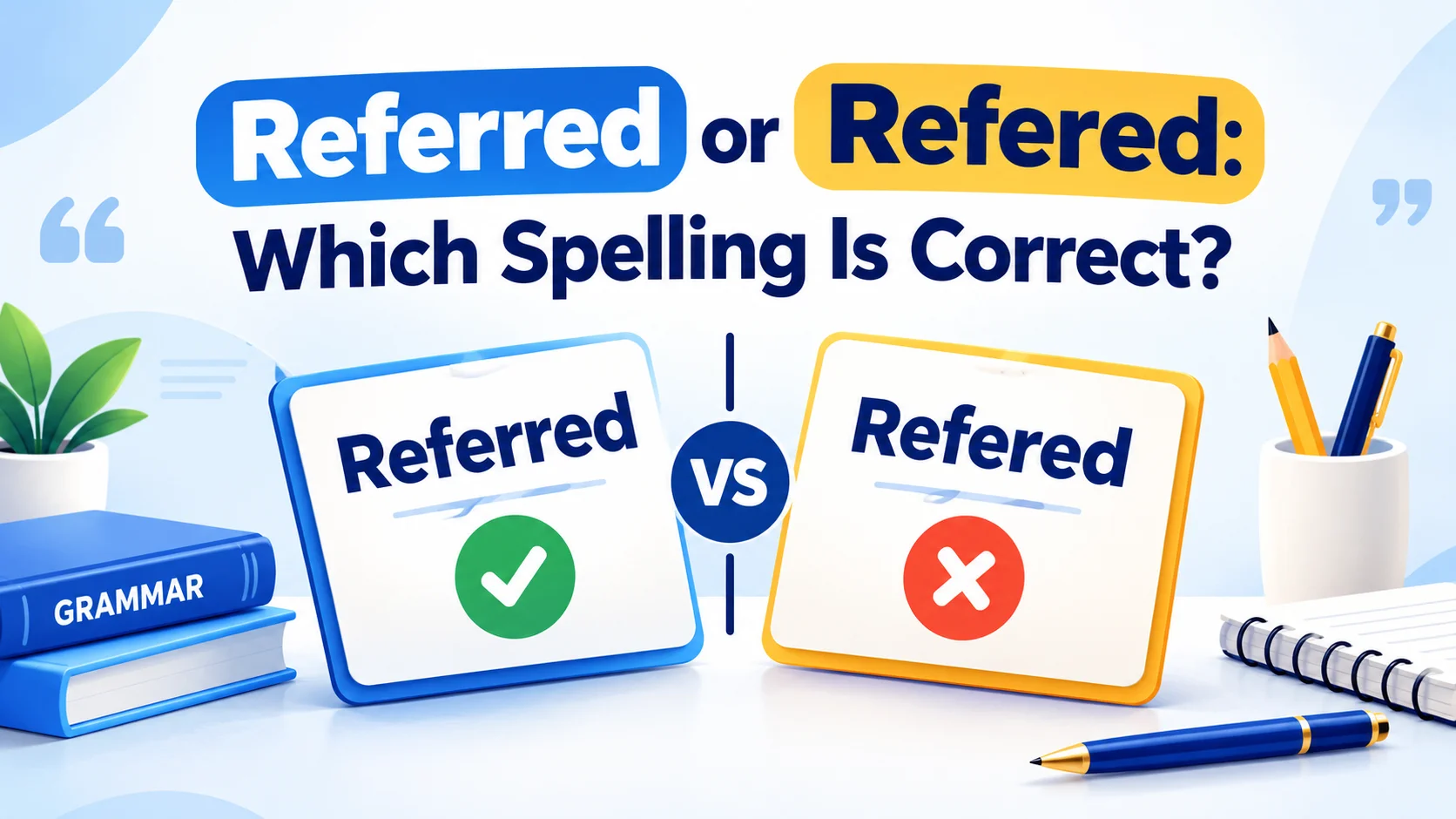
Referred is the correct spelling; refered is a common spelling mistake. If you have ever hesitated over whether refer needs one or two R’s when you add -ed, the confusion is understandable. English spelling does not always preserve the exact appearance of a base word when an ending is added. In this case, however, there is a clear rule behind the extra letter. Understanding it will help you spell referred correctly and recognize the same pattern in words such as preferred, occurred, and transferred.
The word referred also has several meanings, depending on how it is used. A doctor may refer a patient to a specialist, a manager may refer a complaint to another department, and a writer may refer to an earlier study. These sentences describe different situations, but they all use the same correct spelling. Knowing the difference between referred to, referred by, and referred for can make your writing more precise, especially in professional and academic communication.
This guide explains the spelling rule without relying on complicated grammar terminology. You will learn how refer changes into referred and referring, how the word differs from referral and reference, and why refered is not accepted in standard British or American English. You will also find practical examples from healthcare, education, business, and everyday conversation, along with proofreading advice to help you avoid related errors.
Referred or Refered: Which Spelling Is Correct?
Referred is the correct spelling in standard English. Refered, with only one R at the end of the base word before the suffix, is incorrect.
The difference is one letter, but that letter is required by an established English spelling rule.
| Spelling | Correct or incorrect? | Explanation |
| Referred | Correct | Standard past tense and past participle of refer |
| Refered | Incorrect | Misspelling caused by leaving out the second R |
| Reffered | Incorrect | Adds an extra F instead of doubling the R |
| Referring | Correct | Present participle of refer |
| Refering | Incorrect | Leaves out the second R |
| Referral | Correct | Noun related to the verb refer |
Correct: The doctor referred me to a specialist.
Incorrect: The doctor refered me to a specialist.
The same spelling applies whether the word appears in a casual message, a business email, a medical report, or an academic paper. There is no standard British or American variation that makes refered acceptable.
Why Is Referred Spelled With Two R’s?
The reason is the consonant-doubling rule. In English, certain verbs double their final consonant before adding a suffix that begins with a vowel, such as -ed or -ing.
The verb refer follows this pattern:
- Refer + -ed = referred
- Refer + -ing = referring
The final R is doubled to preserve the spelling pattern associated with the stressed final syllable.
Understanding the spelling of refer
The word refer has two syllables:
re-FER
The stress falls on the second syllable. That matters because English commonly doubles the final consonant of a verb when:
- The word ends in a consonant-vowel-consonant pattern.
- The final syllable is stressed.
- The suffix being added begins with a vowel.
In refer, the final syllable contains the consonant-vowel-consonant sequence f-e-r. Because that syllable carries the stress, the final R doubles before -ed and -ing.
This gives us:
- refer → referred
- refer → referring
The extra R is not decorative, optional, or a regional preference. It is part of the standard spelling.
Why the stress pattern matters
Compare refer with visit.
- re-FER → referred
- VIS-it → visited
Both words end in consonants, but their stress patterns differ. The final syllable of refer is stressed, while the final syllable of visit is not. Therefore, refer doubles its final consonant before -ed, whereas visit does not.
Here are more examples:
| Base verb | Stress pattern | Correct past tense | Reason |
| Refer | re-FER | Referred | Final syllable stressed |
| Prefer | pre-FER | Preferred | Final syllable stressed |
| Occur | oc-CUR | Occurred | Final syllable stressed |
| Visit | VIS-it | Visited | Final syllable not stressed |
| Open | O-pen | Opened | Final syllable not stressed |
| Offer | OF-fer | Offered | Final syllable not stressed |
The rule is useful, but it should not be reduced to “double the last letter whenever you add -ed.” Stress and the word’s final spelling pattern both matter.
Other words that follow the same pattern
Learning a few related examples makes the spelling of referred easier to remember.
- Prefer → preferred: She preferred the earlier appointment.
- Occur → occurred: The error occurred during processing.
- Transfer → transferred: The company transferred the employee.
- Admit → admitted: He admitted his mistake.
- Begin → beginning: The meeting is beginning now.
Notice that the doubled letter is not always R. The particular consonant depends on the base word.
Practical tip: If you can remember preferred, you have a useful reminder for referred. Both words stress their final syllable and double the final R before adding -ed.
What Does Referred Mean?
Referred is the past tense and past participle of the verb refer. Its general meaning involves directing attention, sending someone or something to another person or place, mentioning a subject, or recommending a source of help.
The exact meaning depends on the sentence. It does not always mean that someone was physically sent somewhere.
1. Referred means directed someone to another person or place
This is one of the most common uses of the word. Someone refers a person to another individual, department, organization, or service because that destination is better suited to help.
Examples:
- The receptionist referred me to the accounts department.
- My teacher referred me to the academic adviser.
- The customer-service agent referred the issue to a supervisor.
- The company referred the applicant to its recruitment team.
In these examples, the person making the referral is directing someone toward another source of assistance.
There is a practical distinction between advising someone and referring them. Advising may simply involve suggesting what to do. Referring usually means directing the person to a particular individual, organization, or service.
2. Referred means sent someone for medical attention
Healthcare professionals frequently use referred when a patient is directed to another medical professional or service.
For example:
- The general practitioner referred the patient to a cardiologist.
- My doctor referred me for additional tests.
- The child was referred to a speech therapist.
- The patient was referred to a specialist for further assessment.
A referral does not automatically mean that a patient has a serious illness. It may simply indicate that another professional has the expertise, equipment, or facilities needed to assess the situation.
It is also important to distinguish a referral from a confirmed appointment. Being referred means that a healthcare professional has directed the patient toward further care. It does not necessarily mean the appointment has already taken place.
3. Referred means mentioned or talked about something
The phrase referred to can mean mentioned, discussed, or called attention to something.
Examples:
- The manager referred to the previous email.
- The professor referred to an important historical event.
- She referred to the document during her presentation.
- The report referred to several earlier studies.
In this meaning, nobody is necessarily being sent anywhere. The speaker or writer is simply mentioning a person, subject, document, or event.
Compare these sentences:
- The doctor referred me to a specialist.
- The doctor referred to the specialist during our conversation.
The first sentence describes a direction or recommendation. The second says that the doctor mentioned the specialist.
4. Referred means sent a matter for review or consideration
A person can also refer a complaint, application, case, proposal, or question to someone who has the authority or expertise to examine it.
Examples:
- The complaint was referred to the investigation team.
- The committee referred the proposal for further review.
- The application was referred to the admissions department.
- The issue was referred to senior management.
This use is common in administrative, legal, and organizational communication.
The important distinction is that referring something for review is not the same as deciding it. A matter may be passed to another person or department without any final outcome being reached.
5. Referred means recommended someone or something
In business and everyday conversation, referred can describe recommending a person, service, or opportunity.
Examples:
- My colleague referred me to a reliable accountant.
- A customer referred her friend to our company.
- The recruiter referred the candidate for an interview.
- Several clients referred new customers to the business.
A referral may come from a personal recommendation, a professional relationship, or an established referral program.
However, the word does not guarantee that the recommendation is positive or that the person will be accepted. It describes the act of directing someone toward a person or opportunity.
How Referred Is Used in Different Situations
The meaning of referred becomes clearer when you consider the setting. The same verb appears in medical records, workplace emails, academic papers, and ordinary conversations, but the purpose of the referral changes.
Referred in healthcare and medical records
In healthcare, referred often describes a step in a patient’s care pathway.
A general practitioner might refer a patient to a dermatologist because the patient needs an assessment of a skin condition. A doctor may also refer someone for imaging, laboratory testing, or another specialist opinion.
Consider this sentence:
The patient was referred to the orthopedic department for further assessment.
This is a passive construction. It tells us what happened to the patient but does not identify who made the referral.
In medical communication, the distinction between these details matters:
- Referred by: identifies the professional or service making the referral.
- Referred to: identifies the receiving professional or department.
- Referred for: identifies the purpose of the referral.
Accurate wording helps readers understand the patient’s care pathway without assuming a diagnosis or outcome.
Referred in business and the workplace
Businesses use referrals to connect customers, clients, candidates, and internal matters with the right people.
Examples include:
- The sales team referred the client to a technical specialist.
- The employee was referred by a former colleague.
- The complaint was referred to the compliance department.
- The customer referred two friends to the service.
In a workplace email, referred can also describe an earlier communication:
As referred to in yesterday’s meeting, the revised schedule is attached.
Although understandable, this sentence may sound less natural than:
As mentioned in yesterday’s meeting, the revised schedule is attached.
Choosing a simpler verb can improve clarity. Use referred to when it accurately describes the act of pointing someone toward a subject or source; use mentioned when you simply mean that something was discussed.
Referred in education
Schools, colleges, and universities use referrals for academic support, student welfare, counseling, and administrative matters.
Examples:
- The teacher referred the student to the school counselor.
- The student was referred to the learning-support team.
- The lecturer referred to a chapter in the textbook.
- The research paper referred to several earlier publications.
Notice that the last two sentences do not describe a student being sent to a service. They use referred to in the sense of mentioning or drawing attention to a source.
Referred in legal and administrative writing
In legal and administrative settings, referred often indicates that a case or matter has been passed to another authority for action or consideration.
Examples:
- The matter was referred to the relevant authority.
- The appeal was referred to a review panel.
- The complaint was referred for investigation.
- The case was referred to the appropriate court.
The word itself does not tell the reader what decision will follow. It only describes the transfer of the matter to another person, body, or process.
For formal writing, avoid using referred when a more precise verb is available. Depending on what actually happened, words such as submitted, forwarded, escalated, or assigned may communicate the action more accurately.
Referred in academic and research writing
Academic writers use referred to when discussing earlier research, published sources, theories, or parts of a document.
Examples:
- The researcher referred to previous findings.
- The author referred to the theory in the introduction.
- The discussion referred to evidence collected during the study.
- The report referred to Table 3 for additional information.
Do not assume that referred to and cited always mean exactly the same thing. A writer may refer to a study in general discussion, while a formal citation provides the details needed to identify the source. Academic style guides may also require specific citation formats.
Referred in everyday conversation
In ordinary speech, referred often appears when someone recommends a service or mentions something previously discussed.
Examples:
- My friend referred me to a good mechanic.
- I referred to your message when I spoke to the manager.
- She referred him to the website for more information.
- They referred to the restaurant we visited last week.
In casual conversation, people may choose shorter alternatives such as sent me to, mentioned, or recommended. These are not necessarily better or worse; the right choice depends on the intended meaning.
Referred vs Refered: Correct and Incorrect Examples
Seeing the word in complete sentences is one of the easiest ways to recognize the correct spelling. The extra R is required in every standard use of the past tense or past participle of refer.
Everyday examples
| Incorrect sentence | Correct sentence |
| She refered me to a dentist. | She referred me to a dentist. |
| He refered to our conversation. | He referred to our conversation. |
| My friend refered me to that website. | My friend referred me to that website. |
| They refered the question to their teacher. | They referred the question to their teacher. |
Professional examples
| Incorrect sentence | Correct sentence |
| The doctor refered the patient. | The doctor referred the patient. |
| The complaint was refered to management. | The complaint was referred to management. |
| The applicant was refered by an employee. | The applicant was referred by an employee. |
| The report refered to earlier research. | The report referred to earlier research. |
Why the incorrect form does not work
Refered may look reasonable if you simply attach -ed to the written form refer. However, English spelling rules sometimes require a change at the end of a word before a suffix is added.
The same principle explains why preferred is correct rather than prefered. The base verb’s final consonant is doubled before the suffix.
When proofreading, do not judge the spelling by whether it looks familiar. Check the standard written form.
Refer, Refers, Referred, and Referring: All the Verb Forms
The word referred is easier to understand when you see it as part of the complete verb family. Each form has a different grammatical function.
| Verb form | Grammatical use | Example |
| Refer | Base form | Please refer to the instructions. |
| Refers | Third-person singular present | This paragraph refers to the earlier chapter. |
| Referred | Simple past | She referred me to an expert. |
| Referred | Past participle | The patient has been referred for testing. |
| Referring | Present participle / gerund | He is referring to the report. |
Refer: The base form
Use refer after modal verbs, infinitive markers, and certain other constructions.
Examples:
- You should refer to the official policy.
- I need to refer this question to my supervisor.
- Please refer to the attached document.
Refers: The third-person singular form
Use refers with singular third-person subjects in the simple present tense.
Examples:
- The article refers to a recent study.
- The doctor refers patients to specialists.
- This expression refers to an older practice.
Referred: The past tense and past participle
Use referred for a completed action or in perfect and passive constructions.
Examples:
- She referred me to the department manager.
- The manager has referred the matter for review.
- The patient was referred to a specialist.
Referring: The -ing form
Use referring in continuous tenses or when the verb functions as a noun.
Examples:
- The teacher is referring to the course handbook.
- Referring customers to the correct department is part of her job.
- He was referring to the previous version of the document.
Remember: Both referred and referring contain two R’s at the end of the base word. Writing refering is another common spelling error.
Referred vs Referral vs Reference: What Is the Difference?
These three words are related, but they do not serve the same grammatical purpose. Confusing them can make a sentence unclear, particularly in professional communication.
Referred: A verb form
Referred is the past tense and past participle of refer. It describes an action.
Examples:
- The doctor referred the patient to a specialist.
- The manager referred the complaint to the legal team.
- The writer referred to an earlier publication.
Referral: A noun
A referral is the act or result of referring someone or something to another person, organization, or service.
Examples:
- The patient received a referral from her doctor.
- The company has an employee referral program.
- I need a referral before I can access that service.
Common expressions include:
- Medical referral
- Referral letter
- Customer referral
- Employee referral
- Referral program
Reference: A source, mention, or point of information
A reference can identify a source of information, a mention of something, or a person who can provide information about someone’s qualifications or character.
Examples:
- Please include a reference to the original research.
- She provided a professional reference.
- The book contains a useful list of references.
A reference and a referral are not interchangeable. A professional reference may describe someone’s work history or character, while a referral directs that person toward a job, service, or opportunity.
Comparison table
| Word | Part of speech | Main meaning | Example |
| Referred | Verb form | Directed, mentioned, or sent for consideration | The doctor referred the patient. |
| Referral | Noun | The act or result of referring | I received a referral. |
| Reference | Noun | A source, mention, or recommendation | Check the reference in the report. |
Referred To, Referred By, and Referred For: Understanding the Difference
The preposition following referred can change what a sentence tells the reader. These short phrases are particularly useful in professional writing.
Referred to
Referred to commonly identifies the destination of a referral or the subject being mentioned.
Examples:
- I was referred to a specialist.
- The complaint was referred to the manager.
- The author referred to a previous study.
The first two sentences describe where someone or something was directed. The third describes a subject that was mentioned.
Referred by
Referred by identifies the person or organization that made the referral.
Examples:
- I was referred by my family doctor.
- The candidate was referred by an existing employee.
- The client was referred by a business partner.
This construction is particularly useful when the source of a recommendation matters.
Referred for
Referred for usually identifies the purpose or reason for the referral.
Examples:
- The patient was referred for further testing.
- The complaint was referred for investigation.
- The application was referred for additional review.
The phrase explains what the referral was intended to accomplish.
Referred through
Referred through identifies the channel or process used to make the referral.
Examples:
- The candidate was referred through the company’s employee program.
- The case was referred through the official procedure.
- The customer was referred through a partner organization.
Quick comparison
| Phrase | What it tells you | Example |
| Referred to | Destination or subject | Referred to a specialist |
| Referred by | Source of the referral | Referred by a colleague |
| Referred for | Purpose of the referral | Referred for testing |
| Referred through | Channel or process | Referred through a program |
Is Refered Ever Correct?
No. Refered is not an accepted standard spelling of the past tense or past participle of refer.
It is not an alternative spelling used in British English, American English, or another major standard variety of English. The correct form is referred.
You may occasionally encounter refered in a username, a brand name, an informal message, or a text containing a typographical error. Such appearances do not make it a standard spelling.
If you are writing an email, report, assignment, application, or professional document, use referred.
Why Do People Misspell Referred as Refered?
The mistake is understandable, but there are several reasons it persists.
The base word makes the single-R form look plausible
Writers often start with refer and attach -ed without changing anything else. That approach works for many verbs, such as walk becoming walked, but not for every verb.
The spelling of refer changes because its final syllable is stressed and its ending follows the consonant-doubling pattern.
The second R is easy to miss while typing
When someone types quickly, the repeated letter may be overlooked. This is especially likely in longer sentences where the writer is concentrating on meaning rather than spelling.
A quick proofreading search for refered can help identify the error in a document.
Pronunciation does not reveal the spelling
Both refer and referred are pronounced with an R sound at the end of the base word. The doubled written letter does not create an extra spoken syllable.
That means listening to the word is not enough to determine whether it contains one R or two in writing.
Writers apply spelling rules inconsistently
Someone may correctly write preferred and occurred but still hesitate over referred. This happens because English spelling rules are often learned through individual words rather than understood as patterns.
Learning the word family and the stress rule makes the spelling easier to remember.
Common Spelling Mistakes Related to Referred
The same uncertainty can affect other words formed from refer. Here are the errors worth checking.
Refered vs Referred
- Incorrect: refered
- Correct: referred
The incorrect version leaves out the second R.
Reffered vs Referred
- Incorrect: reffered
- Correct: referred
The doubled consonant is R, not F. The base word is refer, so the final R is the letter that doubles.
Refering vs Referring
- Incorrect: refering
- Correct: referring
The same consonant-doubling pattern applies before -ing.
Referal vs Referral
- Incorrect: referal
- Correct: referral
The noun is spelled referral, with a double R. It is common in phrases such as medical referral and employee referral.
Referance vs Reference
- Incorrect: referance
- Correct: reference
The correct noun is reference. Its spelling should be learned as a separate word rather than guessed by attaching an ending to refer.
British vs American English: Is Referred Spelled Differently?
No. Referred is the standard spelling in both British and American English.
Some English words have regional spelling differences, such as colour and color or organise and organize. However, referred is not one of them.
| Variety | Correct spelling | Incorrect spelling |
| British English | Referred | Refered |
| American English | Referred | Refered |
| Canadian English | Referred | Refered |
| Australian English | Referred | Refered |
There may be differences in vocabulary or sentence style between regions, but the doubled-R spelling remains the same.
One point worth remembering: Americans often use line instead of queue in everyday conversation, but that does not affect the spelling of referred. The two words are unrelated in meaning and spelling.
How to Remember the Correct Spelling of Referred
If you regularly forget the second R, use one of these practical methods.
1. Connect referred with preferred
Both words follow the same spelling pattern:
- Prefer → preferred
- Refer → referred
The shared ending makes them easy to remember as a pair.
2. Remember referring
If you know that referring contains two R’s, you can use it to remember referred.
- referring
- referred
Both forms double the final R of the base word.
3. Learn the word family together
Instead of memorizing referred in isolation, remember these related forms:
- Refer
- Refers
- Referred
- Referring
- Referral
- Reference
Be aware that related words do not always follow identical spelling changes. For example, reference has its own established spelling.
4. Use a quick proofreading check
Before submitting a document, search for these common errors:
- Refered
- Reffered
- Refering
- Referal
- Referance
If you find one, check the full sentence before replacing it. You want to correct the spelling without accidentally changing the intended word.
How to Proofread Referred in Professional Writing
Spelling is only one part of clear writing. A sentence can contain the correct word and still communicate the wrong relationship if the verb form or preposition is inaccurate.
Check the tense
Ask whether the sentence describes a present action, a completed action, or an action connected to another tense.
- Present: The doctor refers patients to specialists.
- Past: The doctor referred the patient yesterday.
- Present perfect: The doctor has referred the patient.
- Continuous: The doctor is referring the patient.
Confirm the intended meaning
Before using referred, decide what happened:
- Was someone directed to another person?
- Was a document or subject mentioned?
- Was a case sent for review?
- Was a person recommended for an opportunity?
If you only mean mentioned, that word may be clearer. If you mean sent for review, referred may be more precise.
Review the preposition
Check whether the sentence needs to, by, for, or through. These words provide important information about the referral.
For example:
The patient was referred by the clinic to a specialist for further assessment.
This sentence identifies the source, destination, and purpose of the referral.
Do not rely on spellcheck alone
Spellcheck can catch many typing errors, but automated tools do not always understand the meaning of a sentence. A final human review is useful, particularly in medical, legal, academic, and business documents.
A useful editing habit: Read the sentence aloud, check the verb tense, and confirm that the preposition communicates the intended relationship.
Conclusion
When choosing between referred or refered, always use referred. The second R is required because refer follows the consonant-doubling pattern before the suffix -ed. The same principle explains the spelling of referring, while related nouns such as referral and reference have their own forms and functions. Context also matters: someone can be referred to a specialist, referred by a colleague, or referred for further review. One final actionable tip: remember refer alongside prefer so you can recall referred and preferred together. A common mistake to avoid is assuming that adding -ed never changes a word’s final spelling. A small spelling check can make your writing clearer and more professional.
Frequently Asked Questions
Q1. Is referred spelled with one R or two?
Referred is spelled with two consecutive R’s at the end of the base word before the -ed ending. The spelling refered is incorrect in standard English. The doubled consonant follows the spelling pattern used with verbs such as prefer, which becomes preferred.
Q2. Why does referred have a double R?
The final syllable of refer is stressed, and the word ends in a consonant-vowel-consonant pattern. When the past-tense ending -ed is added, the final consonant doubles. That is why the correct spelling is referred, not refered.
Q3. Is refered ever correct in British or American English?
No. Refered is not a standard regional spelling in either variety. British and American English both use referred. If you see the one-R form in an article, message, or document, it is generally a spelling mistake rather than an accepted alternative.
Q4. Is referring also spelled with two R’s?
Yes. The correct spelling is referring, with two R’s before -ing. The same doubling principle applies to both referred and referring. Writing refering with one R is a common error, particularly in fast typing or informal messages.
Q5. What is the difference between referred and referral?
Referred is a verb form describing an action, while referral is a noun naming the act or result of directing someone to another person or service. For example, a doctor referred a patient, and the patient received a referral.
