
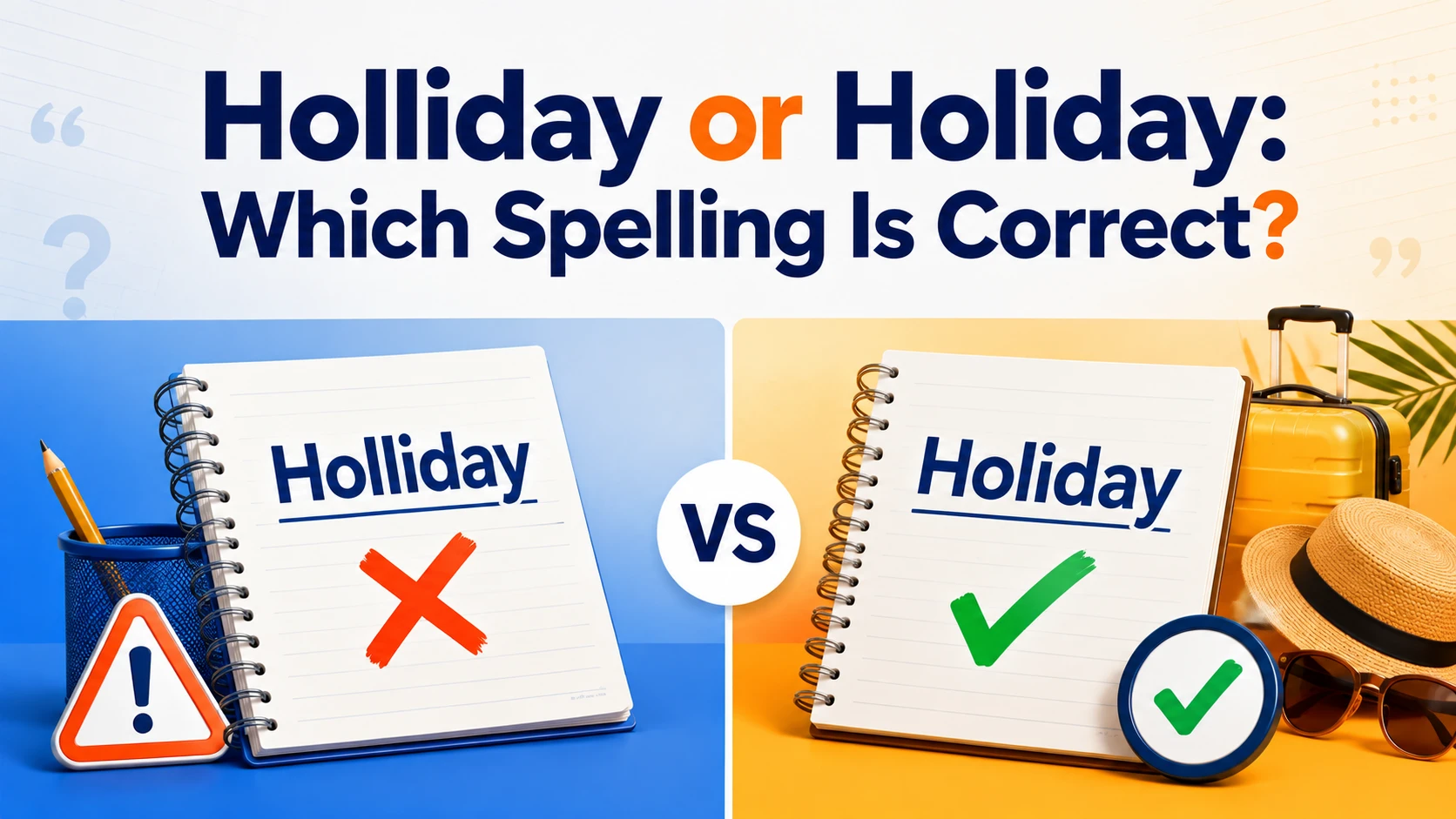
Holliday or holiday is a common spelling question because both words appear in English, yet they don’t mean the same thing. If you’ve ever wondered whether to write “Happy Holiday” or “Happy Holliday,” or questioned why you see Holliday in some names but holiday everywhere else, you’re not alone. The confusion usually comes from the fact that Holliday is a legitimate surname while holiday is the standard English word for a vacation, public holiday, or festive occasion. Knowing the difference helps you write accurately and avoid mistakes in both personal and professional communication.
English is full of words that look alike but serve completely different purposes. Unlike many spelling pairs that reflect regional differences—such as color/colour or organize/organise—holiday and Holliday are not alternative spellings of the same word. One is a common noun found in dictionaries, while the other is primarily a proper noun used as a family name. Understanding this distinction is important whether you’re writing an email, planning a trip, sending holiday greetings, or editing formal documents.
This guide explains more than which spelling is correct. You’ll discover **when to use “holiday,” when “Holliday” is appropriate, why people confuse them, how the word is used in British and American English, and practical ways to remember the correct spelling. You’ll also find comparison tables, real-world examples, grammar tips, and expert advice to help you write confidently in every situation.
The Short Answer
If you’re looking for a quick answer, here’s what you need to know:
- Holiday is the correct English word for a vacation, public holiday, religious celebration, or day off.
- Holliday is not an alternative spelling of holiday. It is primarily a surname or part of a proper name.
- Whenever you’re referring to Christmas, Thanksgiving, summer holidays, or time away from work or school, the correct spelling is holiday.
Examples:
✅ We’re planning a family holiday this summer.
✅ Monday is a public holiday.
❌ We’re planning a family Holliday this summer.
Quick Rule: If you’re talking about a celebration, vacation, or official day off, always write holiday with a single “l.”
Holiday vs Holliday: What’s the Difference?
Although the two spellings differ by only one letter, they belong to completely different categories of English.
Holiday is a common English noun that appears in dictionaries and everyday communication.
Holliday, by contrast, is usually a surname or proper noun. It isn’t used as a substitute for the common word holiday.
Understanding this distinction prevents one of the most common spelling mistakes people make in greetings, travel writing, and business communication.
“Holiday” as a Common English Word
The word holiday refers to a period of leisure, celebration, or official leave from normal work or school.
Depending on the context, it may describe:
- A vacation
- A public holiday
- A religious festival
- A national celebration
- Time away from work
- A school break
Examples:
- We booked our holiday months in advance.
- The office will remain closed during the national holiday.
- Many families travel during the winter holiday season.
“Holliday” as a Surname and Proper Noun
Holliday is most commonly used as a family name.
You may encounter it in:
- Personal names
- Company names
- Historical records
- Street names
- Schools or organizations named after individuals
For example:
- Doc Holliday, the American dentist, gambler, and figure associated with the Old West.
- Individuals whose last name is Holliday.
In these cases, Holliday is spelled with two “l”s because it is part of a proper noun, not because it’s another spelling of holiday.
Why These Two Words Are Often Confused
The confusion usually comes from three simple reasons.
First, the words sound almost identical when spoken.
Second, many people have seen famous names like Doc Holliday before learning the standard spelling of holiday.
Third, English contains many words with double consonants, leading writers to assume that holiday should also have two “l”s.
Fortunately, the rule is simple:
- Holiday = common English word.
- Holliday = proper name.
What Does “Holiday” Mean?
The meaning of holiday depends slightly on where and how it’s used, but the core idea remains the same: it refers to a period when normal routines are interrupted for rest, celebration, or observance.
Dictionary Definition of Holiday
In standard English, holiday commonly means:
- A day officially recognized for celebration or remembrance.
- A period of leave from work or school.
- A vacation or trip taken for leisure.
- A religious or cultural festival.
The exact meaning depends on context, but the spelling is always holiday.
Different Meanings of Holiday in Everyday English
A Public Holiday
Many countries designate certain dates as public holidays, during which government offices, banks, schools, or businesses may close.
Examples include:
- Independence Day
- Labor Day
- New Year’s Day
- Christmas Day
Example sentence:
Government offices will remain closed for the public holiday.
A Vacation or Time Off
In British English, holiday often refers to what Americans typically call a vacation.
Examples:
- We’re going on holiday next month.
- They spent two weeks on holiday in Italy.
In American English, people are more likely to say:
- We’re going on vacation.
However, Americans still use holiday for festive occasions such as Christmas or Thanksgiving.
Religious and Cultural Holidays
Many religions and cultures celebrate important holidays throughout the year.
Examples include:
- Christmas
- Easter
- Eid al-Fitr
- Diwali
- Hanukkah
- Lunar New Year
These holidays often involve traditions, family gatherings, special meals, and cultural observances.
Common Contexts Where “Holiday” Is Used
You’ll encounter holiday in a wide variety of situations.
Common examples include:
- Holiday season
- Holiday travel
- Holiday shopping
- Holiday package
- Holiday greeting
- Holiday schedule
- Holiday pay
- Holiday resort
- Holiday booking
These expressions are widely accepted in both everyday conversation and professional communication.
Expert Insight: Although the meaning of holiday can vary by region, the spelling never changes. Whether you’re writing for readers in the United States, the United Kingdom, Canada, or Australia, holiday remains the correct spelling.
What Is “Holliday”?
Unlike holiday, the word Holliday is not the standard English term for vacations or celebrations.
Instead, it functions almost exclusively as a proper noun.
Is “Holliday” a Dictionary Word?
General English dictionaries list holiday as a common noun.
By contrast, Holliday usually appears only as:
- A surname
- A family name
- A proper noun in biographical or historical references
This distinction explains why spell-checkers often capitalize Holliday when it appears in names.
Famous People and Places Named Holliday
One reason many people recognize the spelling Holliday is its association with well-known individuals.
Examples include:
- Doc Holliday, a famous figure from the American Old West.
- Families with the surname Holliday.
- Schools, businesses, or streets named after people bearing that surname.
These uses are correct because they refer to specific names rather than the common noun holiday.
Why “Holliday” Is Not a Spelling Variant of “Holiday”
Unlike spelling differences such as:
- Theater / Theatre
- Catalog / Catalogue
- Program / Programme
Holiday and Holliday are not regional variants.
The extra “l” doesn’t create another accepted spelling of the common noun.
Using Holliday instead of holiday in normal writing is considered a spelling mistake.
Holiday or Holliday: Side-by-Side Comparison
The easiest way to remember the difference is to compare them directly.
| Feature | Holiday | Holliday |
| Standard English word | ✅ Yes | ❌ No |
| Common noun | ✅ Yes | ❌ No |
| Refers to vacations and celebrations | ✅ Yes | ❌ No |
| Found in dictionaries as a common word | ✅ Yes | ❌ Generally no |
| Used as a surname | Rarely | ✅ Yes |
| Appropriate in formal writing | ✅ Yes | Only when referring to a proper name |
Spelling
Use holiday whenever you’re referring to celebrations, vacations, or official days off.
Use Holliday only when it’s part of someone’s name or another proper noun.
Meaning
Holiday describes leisure, celebration, travel, or public observance.
Holliday identifies a specific person, family, or named entity.
Part of Speech
- Holiday → Common noun
- Holliday → Proper noun
This grammatical difference explains why Holliday is typically capitalized.
Typical Usage
Correct:
- Happy holiday!
- We’re planning a summer holiday.
- The school closes for the winter holidays.
Correct:
- Doc Holliday became one of the best-known figures of the American frontier.
Incorrect:
- Happy Holliday!
When Each Is Correct
| Situation | Correct Word |
| Christmas holiday | Holiday |
| Family vacation | Holiday |
| Public holiday | Holiday |
| Holiday greeting | Holiday |
| Person’s surname | Holliday |
| Historical figure named Holliday | Holliday |
Key Takeaway: If you’re talking about vacations, celebrations, festivals, or days off, always use holiday. Reserve Holliday exclusively for proper names such as a person’s surname.
Is There a Difference Between British and American English?
One reason people search for Holliday or Holiday is because many English words have different spellings in British and American English. Words like colour/color, centre/center, and travelling/traveling often create confusion.
However, holiday is not one of those words.
Whether you’re writing for readers in the United States, the United Kingdom, Canada, Australia, New Zealand, or most other English-speaking countries, the spelling remains exactly the same:
Holiday ✅
There is no accepted spelling variation called Holliday for the common noun.
How “Holiday” Is Used in British English
In British English, holiday has a broader meaning than many people realize. It commonly refers to both official holidays and vacations.
Examples:
- We’re going on holiday to Spain in August.
- The children are on their summer holiday.
- Tomorrow is a bank holiday.
British speakers naturally use holiday in situations where Americans would often choose vacation.
Common British expressions include:
- Summer holiday
- School holiday
- Holiday cottage
- Holiday park
- Holiday destination
- Holiday let
How “Holiday” Is Used in American English
American English uses holiday differently.
In the United States, holiday usually refers to:
- Christmas
- Thanksgiving
- Independence Day
- Memorial Day
- Other nationally recognized celebrations
When Americans talk about leisure travel, they usually say vacation instead of holiday.
Examples:
- We’re going on vacation next week.
- Christmas is my favorite holiday.
- The office is closed for the federal holiday.
Although the meaning changes slightly, the spelling never becomes Holliday.
Why the Spelling Never Changes
Regional English varieties often change vocabulary or pronunciation, but proper spelling remains standardized for many common words.
There are no major dictionaries or style guides that recognize Holliday as an alternative spelling for holiday.
Whether you’re writing:
- Academic papers
- Business emails
- Blog articles
- Greeting cards
- Travel brochures
…the correct word is always holiday.
Expert Insight: The difference between British and American English is usage, not spelling. British English often uses holiday to mean a vacation, while American English generally reserves it for official celebrations and uses vacation for personal travel.
How to Use “Holiday” Correctly in Sentences
Learning the definition is helpful, but seeing the word in realistic contexts makes it much easier to use naturally.
Everyday Conversation Examples
You’ll hear holiday frequently in casual conversations.
Examples:
- We had a wonderful holiday by the beach.
- I’m looking forward to the school holidays.
- Have you planned your summer holiday yet?
- Everyone deserves a relaxing holiday after a busy year.
Notice that holiday can refer to both a single occasion and a longer period away from work or school, depending on the region.
Workplace and Business Examples
Businesses often use holiday in policies, schedules, and employee communications.
Examples:
- Employees receive paid holiday leave.
- The office will reopen after the public holiday.
- Holiday schedules have been published.
- Customer support hours change during the holiday season.
In professional writing, using the correct spelling helps maintain credibility.
Travel and Tourism Examples
The tourism industry frequently uses holiday, especially in countries that follow British English conventions.
Examples:
- Book your dream holiday today.
- Our holiday packages include flights and hotels.
- This island is a popular holiday destination.
- Travel insurance is recommended before your holiday.
Travel websites, airlines, and tour operators commonly use these expressions.
School and Academic Examples
Educational institutions also use holiday in official announcements.
Examples:
- The school closes for the winter holidays.
- Homework is due after the spring holiday.
- Students returned refreshed after the summer holiday.
- The library remains closed during public holidays.
Holiday as an Adjective
The word holiday doesn’t only function as a noun.
It also acts as an adjective modifying another noun.
Examples:
- Holiday shopping
- Holiday decorations
- Holiday music
- Holiday recipes
- Holiday traditions
- Holiday sales
- Holiday gifts
- Holiday schedule
In each case, holiday describes the type or purpose of the following noun.
Common Collocations with “Holiday”
Native English speakers naturally combine holiday with many other words. Learning these combinations improves both your writing and your speaking.
Holiday Season
The phrase holiday season usually refers to the period around major celebrations, particularly near the end of the year.
Example:
- Retail stores become much busier during the holiday season.
Public Holiday
A public holiday is an officially recognized day when many businesses, schools, and government offices close.
Examples:
- Monday is a public holiday.
- Public holidays vary from country to country.
Bank Holiday
This expression is especially common in the United Kingdom and some Commonwealth countries.
Example:
- Traffic is heavy during the bank holiday weekend.
Although Americans understand the phrase, it is used much less frequently in the United States.
Summer Holiday
In British English, summer holiday refers to the long school vacation or a trip taken during the summer months.
Examples:
- We’re planning our summer holiday in Greece.
- The children start their summer holidays next week.
Holiday Destination
This phrase is widely used in travel writing.
Examples:
- Italy remains a popular holiday destination.
- The island has become a luxury holiday destination.
Holiday Package
Travel agencies frequently advertise complete holiday packages.
These may include:
- Flights
- Hotels
- Airport transfers
- Meals
- Excursions
Example:
- We booked an all-inclusive holiday package.
Holiday Spirit
The phrase holiday spirit refers to the cheerful atmosphere associated with festive celebrations.
Example:
- The decorations filled the town with holiday spirit.
Useful Holiday Expressions
Besides common collocations, English includes many everyday expressions featuring the word holiday.
| Expression | Meaning | Example |
| Holiday break | A period away from work or school | We enjoyed a relaxing holiday break. |
| Holiday plans | Arrangements for time off | Have you made your holiday plans? |
| Holiday traffic | Increased travel during holidays | Expect heavy holiday traffic this weekend. |
| Holiday greeting | A seasonal message | She sent holiday greetings to her clients. |
| Holiday tradition | A custom followed during celebrations | Baking cookies is our favorite holiday tradition. |
| Holiday shopping | Buying gifts before major celebrations | Holiday shopping starts early each year. |
Learning these phrases helps your writing sound more natural and idiomatic.
Holiday vs Vacation: A Quick Preview
Many readers also wonder whether holiday and vacation mean exactly the same thing.
The short answer is not always.
| Situation | British English | American English |
| Leisure travel | Holiday | Vacation |
| Christmas | Holiday | Holiday |
| Public celebration | Holiday | Holiday |
| Time off from school | School holiday | School break or vacation |
We’ll explore these differences in greater detail later in the article, along with practical guidance on choosing the right word for your audience.
Writing Tip: If your audience is international, holiday is generally understood by everyone. If you’re writing specifically for an American audience about leisure travel, vacation may sound more natural in many contexts.
Why People Misspell “Holiday” as “Holliday”
At first glance, holiday and Holliday seem almost identical. They sound the same in most accents, differ by only one letter, and both appear in written English. These similarities explain why many people accidentally type Holliday when they really mean holiday.
Fortunately, once you understand the reasons behind the confusion, it’s much easier to avoid.
Influence of Familiar Surnames
One of the biggest reasons for the mistake is simple familiarity.
Many people have seen the surname Holliday in books, films, historical articles, or sports news. Because the name is recognizable, the brain sometimes recalls it instead of the common noun.
For example, someone who frequently reads about Doc Holliday may unconsciously type:
❌ Happy Holliday!
instead of:
✅ Happy Holiday!
This is a memory error rather than a grammar problem.
Double-Letter Spelling Confusion
English contains many words with double consonants, including:
- Address
- Balloon
- Successful
- Committee
- Parallel
Because double letters are common, some writers assume holiday should also contain two “l”s.
However, holiday has always been spelled with one “l” after the opening “Ho.”
Typing and Autocorrect Errors
Fast typing is another common cause.
Many spelling mistakes happen because:
- Fingers accidentally repeat a letter.
- Writers don’t proofread before sending.
- Incorrect spelling is copied from unreliable sources.
- Autocomplete predicts the wrong word based on names stored in a device.
Even experienced writers occasionally make these mistakes, which is why proofreading remains important.
Pronunciation Doesn’t Explain the Spelling
Unlike some spelling mistakes, pronunciation offers very little help here.
Both words are pronounced almost identically.
Because English spelling is not purely phonetic, the correct spelling must be learned rather than guessed from sound alone.
Expert Tip: If the word refers to a celebration, vacation, or official day off, automatically think “holiday” with one “l.” Reserve Holliday for people’s names.
Common Mistakes to Avoid
Most errors involving holiday aren’t complicated. They usually involve confusing a common noun with a proper noun or misunderstanding regional vocabulary.
Here are the mistakes professional editors see most often.
Using “Holliday” Instead of “Holiday”
This is by far the most frequent error.
Incorrect:
- Happy Holliday!
- Summer Holliday
- School Holliday
Correct:
- Happy Holiday!
- Summer Holiday
- School Holiday
If you’re writing about celebrations or vacations, holiday is always correct.
Confusing Common Nouns with Proper Nouns
Remember that holiday is a common noun.
It normally begins with a lowercase letter unless it starts a sentence.
Examples:
- We enjoyed our summer holiday.
- The holiday lasted two weeks.
However, Holliday is a proper noun.
Examples:
- Doc Holliday
- Sarah Holliday
- Holliday Family Reunion
The capitalization helps signal that it’s a name.
Capitalization Rules for “Holiday”
Another common question concerns capitalization.
General rule:
Use lowercase when speaking about holidays in general.
Examples:
- We’re planning a holiday.
- Summer holidays begin in June.
Capitalize the names of specific holidays.
Examples:
- Christmas
- Thanksgiving
- Easter
- Independence Day
- Memorial Day
- Labor Day
Correct:
- We’re traveling during the Christmas holiday.
Incorrect:
- We’re traveling during the Christmas Holiday.
Unless Holiday is part of an official title, it normally remains lowercase.
Misusing “Holiday” and “Vacation”
This isn’t a spelling mistake, but it’s a common usage mistake.
For example:
American audience:
We’re going on vacation.
British audience:
We’re going on holiday.
Both are correct, but choosing the appropriate word makes your writing sound more natural.
Holiday vs Vacation: Are They the Same?
Many English learners assume these words are interchangeable.
Sometimes they are—but not always.
The difference depends largely on your audience.
British English Usage
In British English, holiday commonly refers to:
- Personal travel
- Time away from work
- School breaks
- Public holidays
Examples:
- We’re going on holiday.
- The children are on holiday.
- School holidays start next week.
Here, holiday covers both celebrations and vacations.
American English Usage
American English separates the meanings more clearly.
Holiday usually means:
- Christmas
- Thanksgiving
- Federal holidays
- National celebrations
Vacation usually means:
- Leisure travel
- Trips
- Time off for recreation
Examples:
- We’re taking a vacation in Florida.
- Christmas is my favorite holiday.
Both sentences sound perfectly natural to American readers.
Which Word Fits Your Audience?
If you’re writing for an international audience, consider these guidelines.
| Audience | Better Choice |
| United Kingdom | Holiday |
| Australia | Holiday |
| New Zealand | Holiday |
| Canada | Holiday (most contexts) |
| United States | Holiday for celebrations, vacation for travel |
| Global audience | Use the term that best matches the context |
Knowing your audience is one of the easiest ways to make your writing sound authentic.
How to Remember the Correct Spelling
Simple memory techniques often work better than memorizing grammar rules.
A Simple Memory Trick
Think of this sentence:
Every holiday has only one “l.”
Because the common word contains just one “l,” the spelling becomes much easier to remember.
Visual Association Technique
Imagine a holiday postcard that says:
Happy Holiday!
You’ll rarely see greeting cards printed with:
Happy Holliday!
Repeated exposure to the correct spelling helps train your memory naturally.
Proofreading Tips
Before publishing or sending an important document:
- Search for “Holliday.”
- Ask whether you’re referring to a person or a celebration.
- Replace it with holiday unless it’s someone’s name.
- Use spell-check, but review names carefully because software may not flag surnames.
These small habits eliminate nearly every mistake involving this word.
Quick Editing Checklist
Before finalizing your writing, ask yourself these questions:
| Question | If Yes | If No |
| Am I referring to a celebration or vacation? | Use holiday | Continue checking |
| Am I referring to someone’s surname? | Use Holliday | Use holiday |
| Is this the name of a specific person? | Capitalize Holliday | Use lowercase holiday where appropriate |
| Is my audience American and I’m discussing travel? | Consider vacation | Holiday may still fit depending on context |
Expert Recommendation: When editing, don’t rely only on spell-check. Think about the meaning of the word. If it’s a common noun describing time off, a festival, or a celebration, holiday is almost certainly the correct choice. If it’s identifying a person or family, Holliday may be appropriate.
Practice Exercises
The easiest way to remember the difference between holiday and Holliday is to practice using them in context. These exercises will help reinforce the spelling rule and teach you when each word is appropriate.
Choose the Correct Word
Select the correct word to complete each sentence.
- We booked our summer ______ six months ago.
- A. Holliday
- B. Holiday
- Christmas is my favorite ______ of the year.
- A. Holliday
- B. Holiday
- ______ was a well-known figure of the American Old West.
- A. Doc Holliday
- B. Doc Holiday
- The office will reopen after the public ______.
- A. Holliday
- B. Holiday
- The ______ family has lived here for generations.
- A. Holliday
- B. Holiday
Fill in the Blank
Complete each sentence with the correct word.
- We spent our winter __________ in Switzerland.
- Answer: holiday
- Monday is a public __________.
- Answer: holiday
- __________ was known for his friendship with Wyatt Earp.
- Answer: Holliday
- The children are excited about the summer __________.
- Answer: holidays
- Sarah __________ will lead today’s meeting.
- Answer: Holliday
Correct the Misspelled Sentence
Rewrite each sentence correctly.
❌ Happy Holliday to you and your family!
✅ Happy Holiday to you and your family!
❌ We enjoyed our summer Holliday in Greece.
✅ We enjoyed our summer holiday in Greece.
❌ The school closes for the winter Hollidays.
✅ The school closes for the winter holidays.
❌ The public Holliday falls on Monday.
✅ The public holiday falls on Monday.
Identify the Proper Noun
Decide whether the highlighted word is being used correctly.
- Holiday is my favorite time of the year.
✅ Correct
- We visited Doc Holliday’s museum.
✅ Correct
- Happy Holliday everyone!
❌ Incorrect → Happy Holiday everyone!
- The Holliday family owns the ranch.
✅ Correct
Practice Tip: If replacing the word with vacation, festival, or day off still makes sense, the correct spelling is almost always holiday with one “l.”
Key Takeaways
| Topic | Essential Point |
| Correct common spelling | Holiday |
| Correct surname spelling | Holliday |
| British English | Uses holiday for vacations and public holidays |
| American English | Uses holiday for celebrations and vacation for leisure travel |
| Common mistake | Using Holliday instead of holiday |
| Best memory tip | If it’s a celebration or time off, write holiday. If it’s a person’s name, write Holliday. |
By understanding the difference in meaning, grammar, and usage, you’ll avoid a mistake that appears surprisingly often in emails, greeting cards, travel writing, academic work, and professional documents. Instead of guessing, you’ll know exactly when “holiday” is correct and when “Holliday” belongs only as a proper name.
Conclusion
When comparing Holliday and holiday, the answer is straightforward. Holiday is the correct spelling whenever you’re referring to a vacation, public holiday, festive season, religious celebration, or official day off. Holliday, on the other hand, should be used only as a proper noun, such as a person’s surname or part of an official name. Understanding this distinction helps you avoid one of the most common spelling mistakes involving everyday English vocabulary. One final actionable tip: before using Holliday, ask yourself whether you’re referring to a person or a celebration. If it’s not someone’s name, holiday is almost certainly the correct choice. A common mistake to avoid is assuming the extra “l” represents a British or American spelling difference—it doesn’t. Master this simple rule, and you’ll use both words confidently and correctly in every context.
Frequently Asked Questions
Q1. Is Holliday ever the correct spelling?
Yes. Holliday is correct only when it’s part of a proper noun, such as a person’s surname or the official name of a business or organization. It is not an accepted spelling of the common English word holiday, which refers to celebrations, vacations, or official days off.
Q2. Why do people spell holiday as Holliday?
The confusion usually comes from familiarity with the surname Holliday, the presence of many English words with double consonants, and the fact that both spellings sound almost identical when spoken. Holiday remains the only correct spelling for the common noun.
Q3. Is Holliday a surname?
Yes. Holliday is an established English surname carried by many individuals throughout history and today. It functions as a proper noun, which is why it is typically capitalized. Outside of names, you should use holiday instead.
Q4. What’s the difference between holiday and vacation?
In British English, holiday often refers to both time off and leisure travel. In American English, vacation usually describes personal travel, while holiday refers to public or religious celebrations. Choosing the appropriate word depends on your audience and context.
Q5. Does British English spell holiday differently?
No. British English and American English use exactly the same spelling: “holiday.” The difference lies in meaning and usage, not spelling. Holliday is never considered a regional spelling variant of the common noun.
