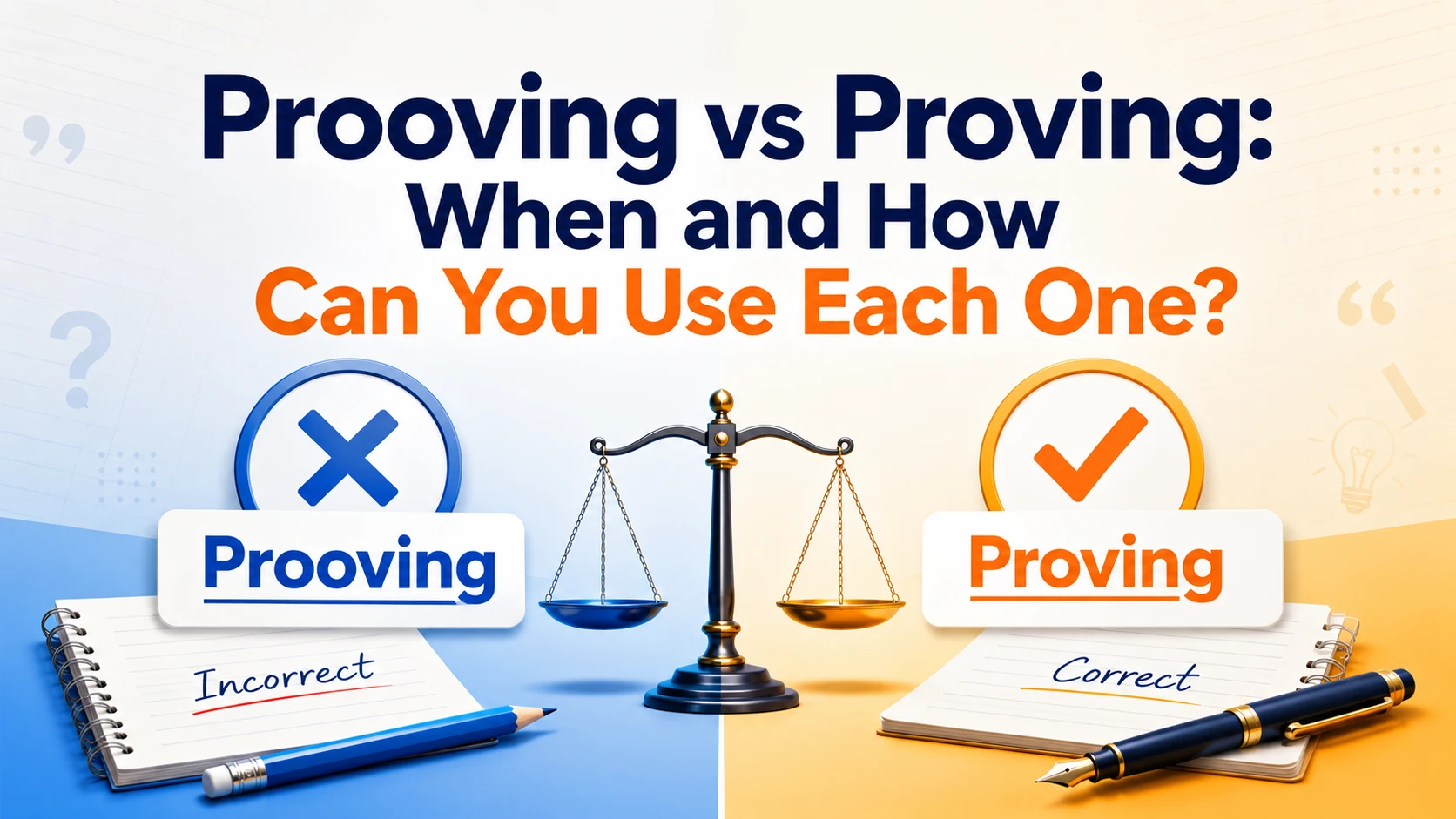
Prooving vs proving is a common spelling question because the two words look similar and sound almost identical when spoken. If you’ve ever paused while typing and wondered whether it should have one “o” or two, you’re not alone. This confusion affects students, professionals, bloggers, and even native English speakers. Fortunately, the answer is straightforward once you understand the spelling rule behind it. Learning the correct form not only improves your writing but also helps you avoid mistakes that can reduce your credibility in academic, business, and everyday communication.
English spelling often follows patterns that aren’t immediately obvious. Words ending in a silent “e” frequently change when suffixes such as “-ing” are added, but not every verb follows the same rule. That’s why many people mistakenly write prooving, assuming the long vowel sound requires a double “o.” Understanding how the verb prove changes into proving will make this word—and many similar ones—much easier to spell correctly. It also gives you a practical spelling rule you can apply to dozens of other English verbs.
This guide does far more than answer which spelling is correct. You’ll learn why “prooving” is considered a misspelling, how English spelling rules work, when to use proving in different contexts, and how to remember the correct form without relying on spell-check. Along the way, you’ll find comparison tables, practical examples, grammar tips, and expert insights designed to help you write with greater confidence and accuracy.
The Short Answer
If you’re looking for the quick answer, here’s what you need to know:
- Proving is the only correct spelling in standard English.
- Prooving is a misspelling and should not be used in formal or informal writing.
- The verb prove drops its silent “e” before adding “-ing,” becoming proving rather than prooving.
For example:
✅ She is proving her point with clear evidence.
❌ She is prooving her point with clear evidence.
Quick Rule: If the base verb ends in a silent “e,” remove the “e” before adding “-ing.” That’s why prove becomes proving.
What Does “Proving” Mean?
Proving is the present participle and gerund form of the verb prove. It refers to the act of demonstrating that something is true, testing whether something works, or showing that a person has a particular ability or quality.
Depending on the context, proving can describe logical reasoning, scientific testing, legal evidence, personal achievement, or practical verification.
Definition of “Proving”
In standard English, proving means:
- Demonstrating that something is true through evidence.
- Testing or verifying whether something works or is accurate.
- Showing one’s abilities, value, or competence.
- Establishing a fact through observation, reasoning, or experimentation.
The exact meaning depends on the sentence, but the spelling always remains proving.
The Different Meanings of “Proving” in English
Although the spelling never changes, the meaning of proving varies slightly depending on the situation.
Demonstrating That Something Is True
This is the most common meaning.
Examples:
- The lawyer is proving the defendant’s innocence.
- Scientists are proving their hypothesis through repeated experiments.
- She is proving that hard work leads to improvement.
In these examples, proving means providing convincing evidence.
Testing or Evaluating Something
Sometimes proving refers to testing whether a product, method, or idea performs as expected.
Examples:
- Engineers are proving the safety of the new bridge design.
- The company is proving its latest software before release.
- Researchers spent months proving the reliability of the equipment.
Here, proving emphasizes careful evaluation rather than simply making a claim.
Showing Your Ability or Worth
In everyday conversation, proving often refers to earning trust or demonstrating personal capability.
Examples:
- She is proving herself as an excellent leader.
- The young athlete keeps proving his talent.
- New employees often spend their first few months proving their skills.
This meaning focuses on performance rather than factual evidence.
Common Grammar Forms of the Verb “Prove”
Understanding the verb forms makes it easier to use proving correctly.
| Verb Form | Example |
| Base form | Prove |
| Third-person singular | Proves |
| Past tense | Proved |
| Past participle | Proven (or proved in some contexts) |
| Present participle / Gerund | Proving |
Notice that prooving never appears in any standard verb form.
Grammar Tip: In American English, proven is commonly used as the past participle (for example, The method has proven effective), while proved is also correct in many contexts, particularly in British English and more formal writing.
Is “Prooving” Ever Correct?
This is one of the most frequently asked questions about the word.
The short answer is no.
If you’re referring to the present participle or gerund of prove, the spelling prooving is always incorrect in standard English.
Why It Is a Misspelling
English spelling follows a consistent rule for most verbs ending in a silent “e.”
When adding “-ing,” the final silent “e” is usually removed.
Examples include:
- Move → Moving
- Improve → Improving
- Remove → Removing
- Approve → Approving
- Prove → Proving
Because the silent “e” disappears, there is no reason to add another “o.”
How the Spelling Mistake Happens
Although prooving is incorrect, it’s easy to understand why people write it.
Common reasons include:
- Assuming the long “oo” sound should be reflected in spelling.
- Confusing prove with words that contain a double vowel.
- Forgetting the silent “e” rule.
- Typing quickly without proofreading.
- Relying on pronunciation rather than spelling patterns.
This mistake is especially common among English learners because spoken English often provides few clues about spelling.
Rare Situations Where You Might See “Prooving”
You may occasionally encounter prooving online, but that doesn’t make it correct.
It usually appears in:
- Typographical errors
- Informal social media posts
- Unedited blog articles
- Online forums
- Student writing
- Draft documents
Unlike some spelling variations that differ between American and British English, prooving is not accepted in either variety of standard English.
Expert Insight: If a spell-checker highlights prooving, accept the correction. Major dictionaries and respected style guides recognize proving as the correct spelling.
Prooving vs Proving: Side-by-Side Comparison
The quickest way to understand the difference is to compare the two spellings directly.
| Feature | Prooving | Proving |
| Standard English spelling | ❌ No | ✅ Yes |
| Recognized by major dictionaries | ❌ No | ✅ Yes |
| Correct present participle of prove | ❌ No | ✅ Yes |
| Suitable for academic writing | ❌ No | ✅ Yes |
| Suitable for business writing | ❌ No | ✅ Yes |
| Used in published English | Rarely (usually an error) | Frequently |
| Recommended by grammar experts | ❌ Never | ✅ Always |
Spelling
The correct spelling is always proving.
The extra “o” in prooving is unnecessary and breaks the standard spelling rule for verbs ending in a silent “e.”
Meaning
Only proving has a recognized meaning in standard English.
It can refer to:
- Demonstrating truth
- Testing an idea or product
- Establishing facts
- Showing ability or competence
Prooving has no separate dictionary definition and conveys the same intended meaning only because readers infer it from context.
Dictionary Status
Major English dictionaries recognize proving as the correct form of the verb prove.
By contrast, prooving does not appear as an accepted spelling. If it appears at all, it is typically identified as a spelling error or a nonstandard variant.
Grammar
Proving functions as:
- A present participle
The scientist is proving the theory. - A gerund
Proving your argument requires strong evidence.
It can also be part of continuous verb tenses.
Example:
- They are proving that the system works.
Correct Usage
Use proving whenever you mean:
- Showing that something is true.
- Demonstrating ability.
- Testing or verifying.
- Establishing facts through evidence.
Never substitute prooving in these situations.
Examples at a Glance
| Incorrect | Correct |
| She is prooving her case. | She is proving her case. |
| They are prooving the results. | They are proving the results. |
| He keeps prooving himself. | He keeps proving himself. |
| We are prooving the concept. | We are proving the concept. |
Key Takeaway: Proving is the only correct spelling in modern English. If you write prooving, you’re making a spelling error, not choosing an alternative or regional variation.
Why “Proving” Has Only One “O”
Many spelling mistakes happen because English pronunciation doesn’t always match English spelling. The word proving is a perfect example. Since “prove” contains the long “oo” sound, some writers assume the “-ing” form should become prooving.
Fortunately, the rule is much simpler than it seems.
How English Spelling Changes When Adding “-ing”
Most English verbs that end in a silent “e” follow the same pattern:
- Remove the silent “e.”
- Add “-ing.”
This keeps the word easy to read while preserving its pronunciation.
Here are a few examples:
| Base Verb | Correct “-ing” Form |
| Prove | Proving |
| Move | Moving |
| Improve | Improving |
| Approve | Approving |
| Remove | Removing |
| Achieve | Achieving |
| Believe | Believing |
Notice that none of these verbs add an extra vowel before “-ing.”
Why “Prove” Becomes “Proving” Instead of “Prooving”
The final “e” in prove is silent. Its main job is to influence the pronunciation of the preceding vowel.
When “-ing” is added, that silent “e” is no longer needed, so it is dropped.
The transformation looks like this:
Prove → Proving
Not:
Prove → Prooving ❌
This spelling pattern appears throughout English and is one of the most reliable rules for verbs ending in silent “e.”
Similar Verbs That Follow the Same Rule
Learning similar examples makes the rule much easier to remember.
Move → Moving
Correct:
- We are moving next month.
- The company is moving its headquarters.
Incorrect:
- We are moveing.
- We are mooving.
Improve → Improving
Correct:
- She is improving every week.
- The software keeps improving.
Incorrect:
- Improveing
- Improoving
Remove → Removing
Correct:
- The technician is removing the damaged part.
- We’re removing unnecessary files.
Incorrect:
- Removeing
- Remooving
Approve → Approving
Correct:
- The committee is approving the proposal.
- The bank is approving qualified applicants.
Incorrect:
- Approoveing
- Approoving
Grammar Insight: Once you understand this spelling rule, you can correctly form hundreds of English verbs ending in -e without memorizing each one individually.
How to Use “Proving” Correctly in Sentences
Knowing the correct spelling is only the first step. Understanding how professionals naturally use the word helps your writing sound more fluent and precise.
Everyday Conversation Examples
In daily life, proving often refers to demonstrating a fact or showing personal ability.
Examples:
- She is proving that patience pays off.
- You’re proving my point.
- He keeps proving everyone wrong.
- They are proving their commitment through action.
These sentences are natural because proving describes an ongoing action.
Academic Writing Examples
In schools and universities, the word frequently appears when discussing research, mathematics, or logical arguments.
Examples:
- The researcher is proving the hypothesis through repeated experiments.
- Students are proving mathematical theorems.
- The evidence is proving the original assumption correct.
- Scientists spend years proving complex theories.
Academic writing emphasizes evidence rather than opinion, making proving a particularly important verb.
Business and Workplace Examples
Managers, executives, and employees regularly use proving to discuss performance and results.
Examples:
- The startup is proving its business model.
- The employee is proving her leadership skills.
- Market data is proving customer demand.
- The new strategy is proving successful.
Business communication often values measurable outcomes, so proving usually involves facts, data, or performance indicators.
Legal and Scientific Examples
Legal and scientific writing relies heavily on precise language.
Examples:
- The prosecution is proving its case beyond reasonable doubt.
- Laboratory testing is proving the material’s durability.
- Experts are proving compliance with industry standards.
- Clinical trials are proving the treatment’s effectiveness.
In these contexts, proving typically means establishing a conclusion through objective evidence.
Idiomatic Expressions with “Proving”
English includes many natural expressions that use proving.
Examples include:
- Proving your worth
- Proving a point
- Proving someone wrong
- Proving yourself
- Proving beyond doubt
- Proving your case
Learning these phrases helps you recognize authentic English usage.
Common Phrases That Use “Proving”
Some expressions appear so frequently that they’re worth learning as complete phrases rather than individual words.
Proving a Point
This means demonstrating that your opinion or argument is correct.
Example:
- She wasn’t trying to argue; she was simply proving a point.
This phrase often appears during debates or discussions.
Proving Someone Wrong
One of the most common motivational expressions in English.
Example:
- Instead of arguing, he focused on proving everyone wrong through hard work.
The emphasis is on actions rather than words.
Proving Yourself
This phrase refers to earning trust, respect, or recognition.
Examples:
- New employees spend time proving themselves.
- Young athletes work hard proving themselves at higher levels of competition.
Professionals often use this expression in career development and leadership discussions.
Proof of Concept vs Proving a Concept
Although these phrases are related, they are not identical.
| Phrase | Meaning |
| Proof of Concept (PoC) | A demonstration that an idea is technically feasible. |
| Proving a Concept | The ongoing process of gathering evidence that the idea works in practice. |
Technology companies frequently begin with a proof of concept before spending significant resources on full-scale development.
Burden of Proving a Claim
This expression appears most often in law, science, and critical thinking.
It refers to the responsibility of supplying enough evidence to support a statement.
Examples:
- In court, the prosecution carries the burden of proving guilt.
- Researchers have the burden of proving their conclusions through reliable data.
Understanding this phrase is useful because it extends beyond legal settings into everyday reasoning and debate.
Expert Tip: Whenever you use proving, ask yourself, “What evidence, actions, or results support this statement?” Doing so will naturally lead to clearer and more persuasive writing.
Why Do People Write “Prooving” Instead of “Proving”?
If proving is the only correct spelling, why do so many people still write prooving?
The answer lies in the way our brains connect sounds, patterns, and memory. Most spelling mistakes aren’t random—they’re predictable. Once you understand why they happen, you’ll be much less likely to make them.
Confusion with the Silent “E” Rule
The most common cause is uncertainty about what happens to a verb ending in a silent “e.”
Many writers know that something changes when “-ing” is added, but they don’t remember the exact rule. Instead of dropping the “e”, they mistakenly keep the pronunciation in mind and insert another “o.”
For example:
- Prove → Proving ✅
- Prove → Prooving ❌
This mistake is especially common among learners who rely more on pronunciation than spelling patterns.
Influence of Pronunciation
English is not a phonetic language, meaning words are not always spelled exactly as they sound.
When people hear the word proving, they may mentally divide it like this:
proo-ving
That makes prooving seem logical—even though English spelling doesn’t work that way.
The same issue occurs with many other words whose pronunciation doesn’t clearly indicate their spelling.
Typing and Autocorrect Errors
Fast typing can easily introduce spelling mistakes.
Common situations include:
- Typing from memory without proofreading.
- Missing spell-check suggestions.
- Copying incorrect spelling from unreliable websites.
- Ignoring grammar software warnings.
Fortunately, most modern spelling tools immediately recognize prooving as an error and recommend proving.
Editing Tip: A spell-checker is helpful, but it shouldn’t replace understanding the spelling rule. Knowing why a word is correct makes you a stronger writer.
Common Mistakes Made by English Learners
English learners often compare prove with words from their native language or with English words that follow different spelling patterns.
Typical beginner mistakes include:
- Adding unnecessary vowels.
- Keeping the silent “e.”
- Spelling according to pronunciation.
- Assuming every long vowel sound requires two vowels.
With regular reading and writing, these mistakes usually disappear because the correct spelling becomes familiar through repetition.
English Spelling Rule Behind “Proving”
The spelling of proving follows one of the most useful rules in English grammar.
Once you understand it, you’ll automatically spell many similar words correctly.
Dropping the Silent “E” Before Adding “-ing”
When a verb ends in a silent “e,” the general rule is:
Drop the final “e” before adding “-ing.”
Examples:
| Base Verb | Correct Form |
| Prove | Proving |
| Make | Making |
| Write | Writing |
| Drive | Driving |
| Save | Saving |
| Live | Living |
| Bake | Baking |
This rule improves readability while maintaining pronunciation.
Verbs That Follow This Rule
Many everyday English verbs behave exactly the same way.
Examples include:
- Achieve → Achieving
- Believe → Believing
- Celebrate → Celebrating
- Create → Creating
- Debate → Debating
- Invite → Inviting
- Operate → Operating
- Translate → Translating
Once you recognize this pattern, spelling becomes much easier because you’re applying a rule rather than memorizing individual words.
Important Exceptions to Know
Like many English grammar rules, this one has a few exceptions.
Some verbs keep the final “e” before adding “-ing.”
Examples include:
- Age → Ageing (common in British English)
- Singe → Singeing (to distinguish it from singing)
- Dye → Dyeing (to distinguish it from dying)
These exceptions exist primarily to avoid confusion with other words.
Fortunately, prove is not one of these exceptions. It always becomes proving.
Similar Misspellings You Should Avoid
The mistake in prooving is part of a broader pattern. People often add extra vowels or keep silent letters when forming “-ing” verbs.
Learning these examples strengthens your overall spelling skills.
Prooving vs Proving
Correct:
- She is proving her argument with facts.
Incorrect:
- She is prooving her argument.
Moveing vs Moving
Correct:
- We are moving next week.
Incorrect:
- We are moveing.
Makeing vs Making
Correct:
- He is making dinner.
Incorrect:
- He is makeing dinner.
Comeing vs Coming
Correct:
- She is coming tomorrow.
Incorrect:
- She is comeing tomorrow.
Hopeing vs Hoping
Correct:
- I’m hoping for good weather.
Incorrect:
- I’m hopeing for good weather.
Pattern Recognition: Most spelling mistakes become easy to avoid once you stop spelling words by sound and start recognizing common English word patterns.
Common Mistakes and How to Avoid Them
Even experienced writers occasionally make spelling errors. The difference is that they know how to catch and correct them.
Doubling Vowels Unnecessarily
One of the most frequent mistakes is inserting extra vowels where they don’t belong.
Incorrect:
- Prooving
- Mooving
- Approoving
Correct:
- Proving
- Moving
- Approving
When in doubt, check the base verb and apply the silent “e” rule.
Confusing Spelling with Pronunciation
English pronunciation can be misleading.
For example:
- Knife
- Honest
- Island
- Receipt
- Proving
Trying to spell every word exactly as it sounds often leads to mistakes.
Instead, learn common spelling patterns and trust them.
Forgetting Standard Editing Checks
Professional writers rarely publish their first draft without reviewing it.
A simple proofreading routine can eliminate most spelling mistakes.
Consider this checklist:
- Read your writing slowly.
- Use spell-check software.
- Search for commonly misspelled words.
- Read important documents aloud.
- Ask someone else to review formal writing.
These habits take only a few minutes but significantly improve accuracy.
Proofreading Tips for Error-Free Writing
Before submitting an assignment, publishing a blog post, or sending an important email, ask yourself:
- Have I checked words ending in -ing?
- Did I accidentally keep a silent “e”?
- Did I add unnecessary letters?
- Would a dictionary confirm this spelling?
Building these habits makes correct spelling almost automatic over time.
Memory Tricks to Remember the Correct Spelling
Sometimes a simple mental shortcut is more effective than memorizing grammar rules.
Here are three practical techniques.
The Silent “E” Rule
Remember this sentence:
“Drop the silent E before adding ING.”
This single rule correctly explains hundreds of English verbs—including proving.
A Simple Mnemonic
Think of the phrase:
“Prove it by proving it.”
Notice that prove loses the “e” before “-ing.”
Repeating this phrase a few times helps reinforce the correct spelling.
Visual Word Association
Imagine seeing this sentence on a classroom whiteboard:
PROVING YOUR POINT
The more often you see the correctly spelled word in books, articles, and emails, the more natural it becomes.
Over time, prooving simply begins to look wrong.
Expert Recommendation: Instead of memorizing isolated spellings, learn the grammar patterns behind them. Pattern recognition improves spelling far more effectively than rote memorization because it applies to hundreds of words, not just one.
Practice Exercises
The best way to remember the difference between prooving and proving is to apply the spelling rule in real examples. These short exercises reinforce what you’ve learned and help you recognize the correct form automatically.
Choose the Correct Spelling
Select the correct word to complete each sentence.
- The scientist is ______ the new theory through careful experiments.
- A. Prooving
- B. Proving
- She keeps ______ her leadership skills every day.
- A. Prooving
- B. Proving
- The lawyer is ______ the client’s innocence.
- A. Prooving
- B. Proving
- We are ______ that the new process saves time.
- A. Prooving
- B. Proving
- The engineer spent months ______ the bridge design.
- A. Prooving
- B. Proving
Answer: Every sentence correctly uses proving, because it is the only accepted -ing form of the verb prove.
Fill in the Blank
Complete each sentence with the correct word.
- The data is __________ the original assumption.
- Answer: proving
- She enjoys __________ herself through hard work.
- Answer: proving
- The company is __________ its product before launch.
- Answer: proving
- They are __________ that the new system is reliable.
- Answer: proving
- __________ your argument requires solid evidence.
- Answer: Proving
Correct the Misspelled Sentence
Rewrite each sentence using the correct spelling.
❌ She is prooving her point with facts.
✅ She is proving her point with facts.
❌ The researchers are prooving the hypothesis.
✅ The researchers are proving the hypothesis.
❌ He keeps prooving everyone wrong.
✅ He keeps proving everyone wrong.
❌ We are prooving the effectiveness of the treatment.
✅ We are proving the effectiveness of the treatment.
Edit a Short Paragraph
Read the paragraph below and correct every spelling mistake.
Incorrect Version
The company is prooving that its technology is reliable. Engineers are prooving the design through extensive testing before the product reaches customers.
Correct Version
The company is proving that its technology is reliable. Engineers are proving the design through extensive testing before the product reaches customers.
Practice Tip: If you’re unsure about a word ending in -ing, look at the base verb first. When it ends with a silent “e,” remove the “e” before adding “-ing.”
Key Takeaways
| Topic | Essential Point |
| Correct spelling | Proving is the only correct spelling. |
| Incorrect spelling | Prooving is a spelling mistake. |
| Grammar rule | Drop the silent “e” before adding “-ing.” |
| Similar examples | Moving, improving, approving, removing, achieving. |
| Best writing practice | Always use proving in academic, professional, and everyday writing. |
| Memory tip | Think: Prove → Remove “e” → Proving. |
By understanding both the correct spelling and the grammar rule behind it, you’ll avoid one of the most common English spelling mistakes. Instead of relying on memory alone, you’ll have a dependable rule that improves your spelling across many other verbs, making your writing clearer, more polished, and more professional.
Conclusion
When comparing prooving vs proving, the choice is simple: proving is the only correct spelling in standard English. It follows the well-established grammar rule that removes a silent “e” before adding “-ing.” Whether you’re writing an academic paper, a business report, a legal document, or a casual email, using proving ensures your writing is both accurate and professional. Understanding why the spelling changes is far more useful than memorizing a single word. Once you learn the rule, you’ll apply it confidently to many similar verbs. One final actionable tip: whenever you add “-ing” to a verb ending in a silent “e,” pause and check whether the “e” should be dropped. A common mistake to avoid is spelling according to pronunciation rather than established English spelling rules. Master this pattern once, and you’ll eliminate dozens of similar spelling errors from your writing.
Frequently Asked Questions
Q1. Is prooving ever a correct spelling?
No. Prooving is not recognized in standard English and should be treated as a spelling mistake. Whether you’re writing for school, work, publishing, or everyday communication, proving is the only correct form of the verb prove when adding -ing.
Q2. Why does prove lose the “e” before adding -ing?
English spelling follows a common rule: when a verb ends in a silent “e,” the “e” is usually dropped before adding “-ing.” That’s why prove becomes proving, just as move becomes moving and achieve becomes achieving.
Q3. Why doesn’t proving have two “o”s?
The pronunciation may make it sound as though there should be two “o”s, but English spelling isn’t based solely on pronunciation. Proving follows the standard spelling pattern for verbs ending in a silent “e,” so no additional vowel is added.
Q4. Is proving a verb, adjective, or noun?
Proving is primarily the present participle and gerund form of the verb prove. Depending on the sentence, it can function as part of a verb phrase or act as a noun describing the process of demonstrating or verifying something.
Q5. What’s the easiest way to remember the correct spelling?
Remember this simple rule: drop the silent “e” before adding “-ing.” Once you apply that pattern consistently, you’ll naturally write proving, moving, making, and many other verbs correctly without relying on guesswork or spell-check.
