
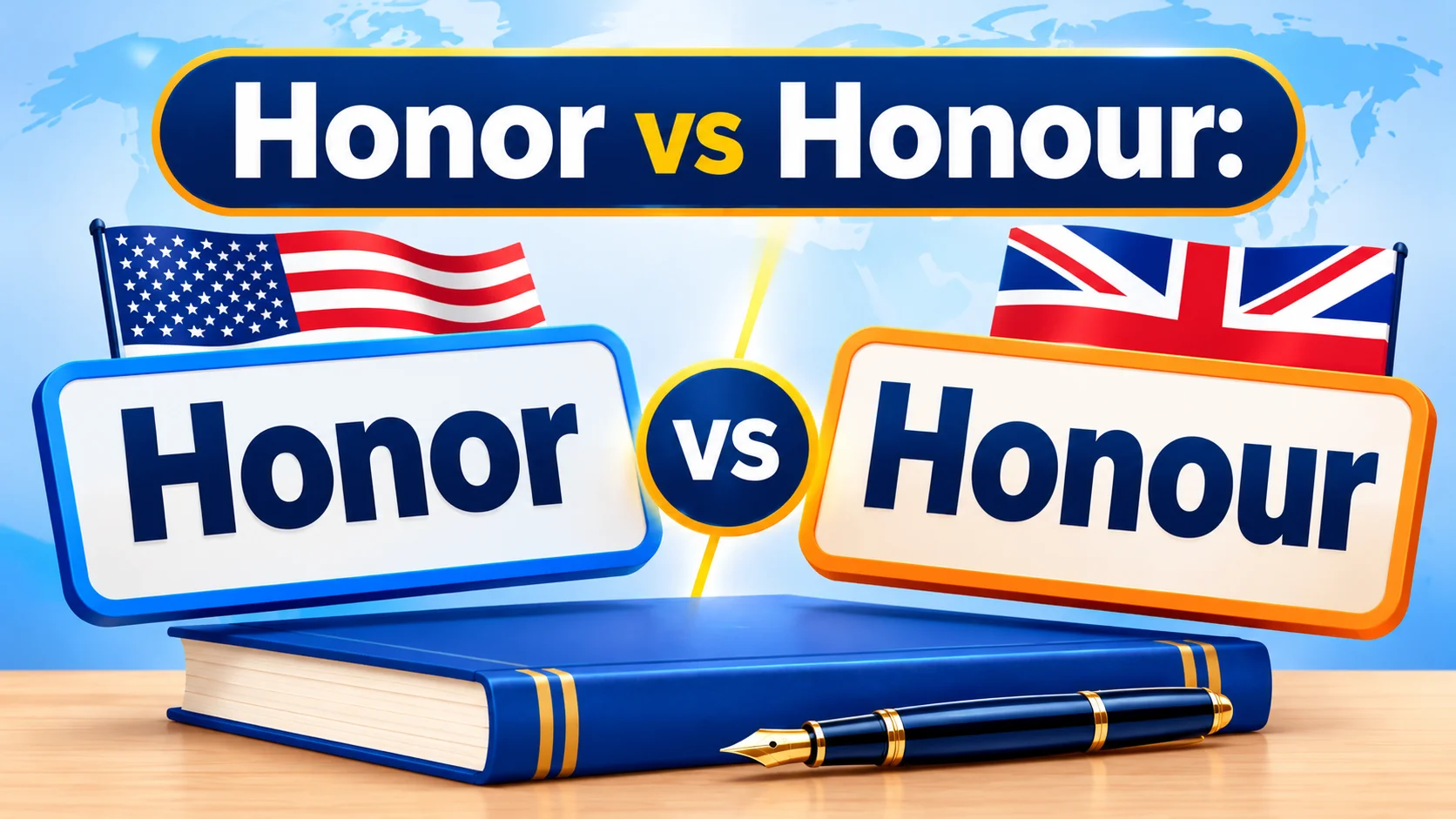
The difference between honor vs honour is a common source of confusion for English learners, international writers, and even experienced professionals. You might see honor in an American article and honour in a British newspaper, then wonder whether one spelling is outdated or grammatically incorrect. The truth is simpler: both spellings are correct, but they belong to different regional English conventions. American English generally drops the u, while British English retains it. Understanding this distinction helps you write confidently without accidentally mixing spelling systems.
Although the difference is only one letter, it appears in several related words, including honored/honoured, honoring/honouring, and honorable/honourable. These variations can affect school assignments, business emails, academic papers, wedding invitations, websites, and professional documents. The spelling you choose should depend on your intended audience and the style guide you are following. A British reader will generally expect honour, whereas an American reader will normally recognize honor as the standard form. Neither version changes the word’s underlying meaning.
There is more to this topic than remembering which country uses which spelling. You also need to understand how the word functions as a noun and a verb, why American spelling developed differently, and which related words do not follow the same pattern. This guide explains honor and honour through clear definitions, regional examples, pronunciation guidance, common expressions, and practical writing situations. It also covers Canadian, Australian, and New Zealand English so that international readers can make informed spelling choices rather than relying on an oversimplified US-versus-UK rule.
Honor vs Honour: The Quick Answer
Honor is the standard spelling in American English, while honour is the standard spelling in British English. Both words have exactly the same basic meaning: respect, integrity, recognition, or a special privilege.
Here is the simplest comparison:
- Honor: American English
- Honour: British English
- Meaning: The same in both varieties
- Pronunciation: Generally the same within a given accent
- Grammar: Both can function as nouns and verbs
Consider these sentences:
American English:
- It was an honor to meet the president.
- We honor people who serve their communities.
- She was honored for her achievements.
British English:
- It was an honour to meet the president.
- We honour people who serve their communities.
- She was honoured for her achievements.
The spelling changes, but the meaning and grammatical function remain the same.
The easiest rule to remember: use honor for American English and honour for British English. Choose one convention and maintain it throughout your writing.
What Do Honor and Honour Mean?
The words honor and honour share the same definition. They describe ideas connected with respect, dignity, honesty, moral principles, recognition, and privilege.
The exact meaning depends on how the word is used in a sentence. It can describe a person’s character, an action, an award, or an opportunity.
1. Honor or Honour as Respect and Admiration
One of the most common meanings is the respect someone receives because of their character, actions, achievements, or position.
For example:
- American: We should honor our teachers.
- British: We should honour our teachers.
In both sentences, the word expresses appreciation and respect.
You might also use it when discussing historical figures, community leaders, parents, teachers, veterans, or people who have made meaningful contributions.
More examples:
- She showed great honor toward her grandparents.
- The community gathered to honour its local heroes.
- We should treat every individual with dignity and honour.
This meaning is especially common in ceremonies, public speeches, memorials, and formal writing.
2. Honor or Honour as a Moral Quality
The word can also describe a person’s commitment to honesty, fairness, responsibility, and ethical behavior.
In this sense, honor is not simply about receiving respect from others. It is about behaving in a way that deserves respect.
For example:
- He is a man of honor.
- She defended her family’s honour.
- A person should act with honor even when nobody is watching.
- The officer was respected for his courage and honour.
This meaning frequently appears in discussions about personal integrity, professional ethics, promises, and responsibility.
A useful distinction is that reputation is what other people think about you, while honor often refers to the principles guiding your behavior. The two can be related, but they are not identical.
3. Honor or Honour as Recognition or an Award
Both forms can describe recognition given to someone for an achievement, service, or contribution.
Examples:
- She received an honor for her scientific research.
- The organization presented an honour to the retired teacher.
- He was given a special honor for his community service.
- The ceremony was held to honour outstanding volunteers.
In this context, the word can refer to an award, distinction, tribute, or formal recognition.
It is particularly common in:
- Graduation ceremonies
- Military recognition
- Professional awards
- Public service events
- Academic achievements
- Memorial ceremonies
4. Honor or Honour as a Privilege
Another important meaning is a special opportunity or privilege that someone feels grateful to receive.
This is why people often say:
- It is an honor to meet you.
- It is an honour to represent my university.
- I had the honor of working with an excellent team.
- It was a great honour to attend the ceremony.
These expressions communicate appreciation rather than simply describing a formal award.
For example, when someone says, “It is an honour to be here,” they usually mean that the opportunity is meaningful and that they feel privileged to participate.
Why Are Honor and Honour Spelled Differently?
The difference between honor and honour comes from the historical development of English spelling and the later standardization of American English.
The additional u in honour is not a grammatical ending. It is part of a traditional spelling pattern that British English generally retained.
The Historical Origin of Honor and Honour
The word has a long history. It ultimately comes from the Latin word honor, which referred to esteem, respect, or public distinction. It entered English through Old French, where spelling traditions helped establish the form honour.
Over time, English spelling developed differently across regions. Before modern dictionaries and standardized education became widespread, spelling could vary considerably between writers and publishers.
The forms honor and honour gradually became associated with different English conventions.
How American English Adopted Honor
American spelling reform played an important role in establishing the shorter spelling.
One influential figure was Noah Webster, whose dictionaries and educational publications helped promote more standardized American spellings.
Webster supported spelling changes that he considered simpler or more consistent. Among the conventions that became established in American English was the removal of the u from certain words ending in -our.
Examples include:
| American English | British English |
| Honor | Honour |
| Color | Colour |
| Favor | Favour |
| Labor | Labour |
| Neighbor | Neighbour |
| Humor | Humour |
| Behavior | Behaviour |
| Rumor | Rumour |
These examples show a recognizable pattern, although not every word containing ou follows it.
Why British English Retained Honour
British English generally retained the traditional -our spelling in these words.
As British dictionaries, schools, newspapers, and publishers developed their own spelling standards, honour remained the conventional form.
This does not mean British spelling is older in every respect or that American spelling is incorrect. Both varieties developed accepted standards, and each is appropriate within its own writing convention.
Important: The difference is historical and regional, not a difference in meaning or grammatical quality.
Honor vs Honour: Main Differences at a Glance
The following table provides a practical reference for the main spelling differences.
| Feature | American English | British English |
| Main spelling | Honor | Honour |
| Meaning | Respect, integrity, recognition | Same |
| Noun | Honor | Honour |
| Verb | Honor | Honour |
| Past tense | Honored | Honoured |
| Present participle | Honoring | Honouring |
| Adjective | Honorable | Honourable |
| Adverb | Honorably | Honourably |
| Common phrase | In honor of | In honour of |
| Academic expression | Graduating with honors | Graduating with honours |
The spelling difference usually carries through related forms, but there are important exceptions, particularly honorary, honorific, and honorarium.
Honor and Honour as Nouns
Both spellings can function as nouns. A noun names a person, place, thing, quality, or idea. In this case, honor or honour can describe respect, integrity, recognition, or a privilege.
Honor as a Noun in American English
American English uses honor in formal and informal contexts.
Examples:
- It was an honor to receive the award.
- He defended his family’s honor.
- The soldier received a medal of honor.
- She graduated with honors.
- It is a great honor to represent our school.
The plural form is honors when referring to multiple distinctions, awards, or expressions of recognition.
For example:
“She received several honors for her work in education.”
Honour as a Noun in British English
British English uses honour in the same situations.
Examples:
- It was an honour to receive the award.
- He defended his family’s honour.
- The ceremony recognized acts of courage and honour.
- She graduated with honours.
- It is a great honour to represent our university.
The plural is honours.
Is Honor Countable or Uncountable?
Both honor and honour can be countable or uncountable, depending on the intended meaning.
Countable use: When referring to a particular privilege, distinction, or award.
- It was an honor to meet the author.
- She received two honors for academic excellence.
- It was a special honour to represent the country.
Uncountable use: When referring to the general quality of integrity, respect, or dignity.
- He acted with honor.
- She believes in personal honour.
- The decision was a matter of honor.
The article is common when referring to a particular privilege: “It is an honor.” It is not normally used when discussing the abstract quality: “He values honor.”
Honor and Honour as Verbs
Both forms also work as verbs. As verbs, they can mean to show respect, recognize someone’s contribution, fulfill an agreement, or observe a commitment.
The spelling follows the same regional pattern.
Honor as a Verb in American English
Use honor in American English when describing an action that demonstrates respect or recognition.
Examples:
- We honor those who protect our communities.
- The university will honor its most successful graduates.
- The organization honors volunteers every year.
- They decided to honor their father’s memory.
It can also mean to fulfill a promise, agreement, or financial obligation.
Examples:
- The company agreed to honor the original contract.
- The store will honor the advertised price.
- The bank refused to honor the payment request.
In these examples, the word means to recognize or fulfill something that should be respected.
Honour as a Verb in British English
British English uses honour in the same grammatical situations.
Examples:
- We honour those who serve our communities.
- The university will honour its outstanding graduates.
- The organization honours volunteers every year.
- They decided to honour their father’s memory.
It also appears in professional and financial contexts:
- The company agreed to honour the contract.
- The retailer will honour the original offer.
- The organization promised to honour its commitments.
Honor a Promise, Agreement, or Commitment
This use deserves particular attention because it is common in business and everyday English.
To honor a promise means to do what you said you would do. To honor an agreement means to respect and fulfill the terms of that agreement.
Compare:
- American: The supplier honored its commitment.
- British: The supplier honoured its commitment.
Both sentences communicate the same thing: the supplier followed through on its promise.
This meaning also appears in expressions such as honor a warranty, honor a reservation, and honor a guarantee.
Honor vs Honour Pronunciation: Do They Sound Different?
The spelling difference does not create a separate pronunciation. Within the same accent, honor and honour are generally pronounced alike.
However, American and British accents may pronounce the word differently.
- American English: Approximately “ON-er,” with a pronounced final r in most rhotic American accents.
- British English: Approximately “ON-uh,” with the final r generally not pronounced in standard non-rhotic British accents when no vowel follows.
The first syllable receives the main stress.
The initial h is pronounced in both forms. The additional u in honour does not create another syllable.
For pronunciation, the International Phonetic Alphabet (IPA) provides a more precise guide. A broad American transcription is often given as /ˈɑːnɚ/, while a standard southern British transcription is commonly represented as /ˈɒnə/. Actual vowel quality varies by accent.
Remember: The difference you hear is usually an accent difference, not a spelling difference.
Honor vs Honour in Related Words and Their Spelling Rules
The regional spelling difference does not stop with the main word. It also appears in several derived forms.
If you use honor in American English, you will generally use honored, honoring, and honorable. In British English, the corresponding forms are honoured, honouring, and honourable.
Honored vs Honoured
Both forms are past-tense and past-participle forms of the verb.
- American: honored
- British: honoured
Examples:
- She was honored for her contribution to science.
- She was honoured for her contribution to science.
- The organization has honored several volunteers.
- The organization has honoured several volunteers.
The meaning remains unchanged.
Honoring vs Honouring
These are present participle and gerund forms.
- American: honoring
- British: honouring
Examples:
- We are honoring our community leaders.
- We are honouring our community leaders.
- The ceremony is dedicated to honoring local heroes.
- The ceremony is dedicated to honouring local heroes.
The difference is the regional spelling of the root word.
Honorable vs Honourable
These are adjective forms describing someone or something deserving respect.
- American: honorable
- British: honourable
Examples:
- He made an honorable decision.
- He made an honourable decision.
- She is known for her honorable conduct.
- She is known for her honourable conduct.
The word can describe a person’s character, an action, or a position.
In some British formal contexts, The Honourable is also used as a title or form of address. Its use depends on established protocol and the person’s position.
Honorably vs Honourably
These are the corresponding adverb forms.
- American: honorably
- British: honourably
Examples:
- The athlete competed honorably.
- The athlete competed honourably.
- He handled the disagreement honorably.
- She behaved honourably throughout the process.
Honorific, Honorarium, and Honorary: Important Exceptions
Not every related word follows the honor/honour pattern. Some established words retain the spelling honor- in both American and British English.
| Word | Meaning | Example |
| Honorific | A title or form of address showing respect | Dr is an honorific used before a name. |
| Honorarium | A payment for a service, often without a fixed fee | The speaker received an honorarium. |
| Honorary | Given as recognition rather than through ordinary appointment or qualification | She received an honorary degree. |
These are important exceptions because writers sometimes assume that British English must change every honor- word to honour-.
That is incorrect.
Write:
- Honorary, not honourary.
- Honorific, not honourific.
- Honorarium, not honourarium.
The spelling is established in both varieties.
Honor vs Honour in Common Expressions
Both spellings appear in familiar English expressions. The phrase generally keeps the regional spelling of the rest of the document.
In Honor Of vs In Honour Of
This expression means that something is done as a tribute or sign of respect.
- American: The event was organized in honor of the volunteers.
- British: The event was organized in honour of the volunteers.
It is frequently used for memorials, ceremonies, celebrations, and public recognition.
It Is an Honor vs It Is an Honour
This phrase communicates gratitude for an opportunity or privilege.
- American: It is an honor to work with you.
- British: It is an honour to work with you.
It is particularly suitable for professional introductions, award speeches, formal invitations, and public addresses.
On My Honor vs On My Honour
This expression emphasizes sincerity and personal integrity.
- American: I promise you, on my honor, that I will return.
- British: I promise you, on my honour, that I will return.
It is often used to make a serious promise or emphasize that someone is telling the truth.
Word of Honor vs Word of Honour
A word of honor or word of honour is a sincere promise that someone intends to keep.
- American: You have my word of honor.
- British: You have my word of honour.
The expression connects personal credibility with keeping one’s commitments.
Code of Honor vs Code of Honour
A code of honor is a set of principles or standards that guide behavior.
Examples:
- The organization follows a strict code of honor.
- The community has a traditional code of honour.
The expression can describe professional ethics, military values, school rules, or community traditions.
Guest of Honor vs Guest of Honour
This phrase describes a special guest who receives particular recognition at an event.
- American: She was the guest of honor at the ceremony.
- British: She was the guest of honour at the ceremony.
Maid of Honor vs Maid of Honour
The spelling also changes in wedding terminology.
- American: Maid of Honor
- British: Maid of Honour
Both refer to the principal attendant traditionally chosen by a bride. Wedding customs and titles vary, so follow the wording preferred by the couple and the relevant tradition.
Honor vs Honour in the United States, United Kingdom, Canada, Australia, and New Zealand
The spelling difference is not limited to two countries. Other English-speaking regions have their own established conventions.
American English: Use Honor
In the United States, honor is the standard spelling.
It is used in:
- School assignments
- Newspapers and magazines
- Business communication
- Government publications
- Academic research
- General online writing
Related American forms include:
- Honor
- Honors
- Honored
- Honoring
- Honorable
- Honorably
If you are writing for an American audience, use the American forms consistently unless an official title or quotation requires a different spelling.
British English: Use Honour
In the United Kingdom, honour is the standard spelling.
British writers generally use:
- Honour
- Honours
- Honoured
- Honouring
- Honourable
- Honourably
These forms appear in schools, universities, newspapers, government documents, and professional publications.
Canadian English: Honour Is Generally Preferred
Canadian English generally follows the British -our convention.
Examples include:
- Honour
- Colour
- Favour
- Labour
- Neighbour
However, Canadian English has its own spelling conventions and should not simply be treated as identical to British English. Canadian institutions and publishers may have specific preferences.
If you are writing for a Canadian university, employer, or publication, follow its style guide.
Australian and New Zealand English: Honour Is Standard
Australian and New Zealand English generally retain the u in words such as honour, colour, and favour.
Examples:
- It was an honour to attend the event.
- The organization honoured its volunteers.
- She received an award for her honourable service.
Writers should still check the requirements of a particular publisher, institution, or organization.
Which Spelling Should International Writers Choose?
If you write for readers in several countries, decide on a consistent English variety before publishing.
Consider these factors:
- Audience: Where are most of your readers located?
- Publisher: Does the publication use American, British, or another English standard?
- Institution: Does your school, university, or employer provide a style guide?
- Consistency: Are related words using the same regional spelling?
- Official terminology: Does a name or title have a fixed spelling?
For example, an international website targeting American readers may choose honor. A UK-based educational website will generally choose honour.
Neither choice is automatically better. The best choice is the one that suits the audience.
Honor vs Honour in Formal, Academic, and Professional Writing
Regional spelling becomes particularly important in formal writing because documents are expected to follow a consistent standard.
A spelling variation may not change the meaning, but switching between conventions can make a document look poorly edited.
Academic Writing in the United States
American academic writing normally uses:
- Honor
- Honored
- Honoring
- Honorable
- Honors
Examples:
- The university honored the researcher’s contribution.
- Students may graduate with honors.
- The award recognizes academic achievement and professional honor.
Students should follow the university’s writing instructions or the style guide required by their course.
Academic Writing in the United Kingdom
British academic writing generally uses:
- Honour
- Honoured
- Honouring
- Honourable
- Honours
Examples:
- The university honoured the researcher’s contribution.
- She graduated with honours.
- The award recognizes academic achievement and professional honour.
Be aware that honours degrees and American honors programs belong to different educational systems. Although the expressions are related, their requirements and structures are not necessarily equivalent.
Business Emails, Reports, and Professional Communication
In business writing, choose the spelling that matches the company, client, or publication’s English convention.
American example:
“ It is an honor to have the opportunity to work with your organization.”
British example:
“It is an honour to have the opportunity to work with your organisation.”
Notice that the second example also uses organisation, another British spelling. The goal is to maintain a consistent regional style across the whole message.
For professional documents, check:
- Company spelling guidelines
- Client preferences
- Country-specific communication standards
- Existing templates
- Official product and organization names
Legal and Government Documents
Legal and official writing requires extra care. Do not change the spelling of a law, government body, award, contract title, or official quotation simply to make it match your preferred regional convention.
For example, Medal of Honor is the official American name of a United States military decoration. It should not be rewritten as Medal of Honour when referring to that specific award.
The same principle applies to the names of organizations, institutions, and official programs.
Wedding Invitations, Speeches, and Ceremonies
Wedding invitations often contain expressions such as:
- It is an honor to invite you.
- It is an honour to invite you.
- Maid of Honor
- Maid of Honour
- Guest of Honor
- Guest of Honour
The spelling should reflect the couple’s preferred style or the English variety being used.
For a formal invitation, consistency is especially important because the wording is part of a carefully prepared document.
Honor vs Honour in Official Names, Awards, and Academic Titles
An important writing principle is that official names should retain their established spelling, even if they differ from the spelling convention used in the surrounding text.
Medal of Honor: The Official American Name
The Medal of Honor is the highest military decoration for valor in action awarded by the United States.
Its official spelling is Medal of Honor, without the u.
A British writer discussing the award should still preserve its official name:
“Several recipients of the Medal of Honor attended the ceremony.”
Do not change the title to Medal of Honour simply because the rest of your article uses British spelling.
Honours Degrees and Academic Distinctions
British universities use terms such as honours degree and honours classification in their academic systems.
American universities also use the word honors, but expressions such as graduating with honors, honors courses, and honors programs can describe different arrangements.
For example:
- British: She completed an honours degree.
- American: She graduated with honors.
The terms are related, but they should not be treated as interchangeable descriptions of identical qualifications.
Official Award Names and Institutional Titles
Some awards, organizations, and historical titles preserve their original spelling.
Before editing an official name:
- Check the institution’s official website.
- Confirm the exact published title.
- Preserve capitalization and spelling.
- Do not regionalize the name inside a quotation.
- Use the official form even if it differs from your document’s general style.
This approach prevents an otherwise correct spelling edit from accidentally changing a proper name.
Common Mistakes When Using Honor and Honour
The spelling rule is simple, but several mistakes can create problems in essays, professional documents, and online content.
Mistake 1: Assuming Honour Is Incorrect
Some American writers believe that honour is a misspelling because it is not the standard American form.
That assumption is wrong.
Honour is correct in British English and is also generally preferred in Canadian, Australian, and New Zealand English.
Mistake 2: Using Honour in Standard American Writing
If you are writing for an American audience, use honor unless an official name or quotation requires another form.
For example:
- American: It was an honor to receive the award.
- British: It was an honour to receive the award.
The issue is not meaning. It is consistency with the intended spelling standard.
Mistake 3: Mixing American and British Spellings
Consider this sentence:
“Our organization honored its employees and celebrated the colour of their achievements.”
The sentence mixes American honored with British colour. Although readers will understand it, the combination may look inconsistent in a document intended to follow one regional style.
Choose a convention and check related spellings before publishing.
Mistake 4: Writing Honourary Instead of Honorary
This is an especially common error.
The correct spelling in both American and British English is:
Honorary
Examples:
- She received an honorary degree.
- He became an honorary member.
- The university appointed her an honorary professor.
Do not write honourary.
Mistake 5: Changing an Official Name
Official names are not always adjusted to match regional spelling conventions.
For example, Medal of Honor must retain its official American spelling. Do not change it when writing a British English article.
Mistake 6: Assuming the Two Spellings Have Different Meanings
Honor and honour do not represent different concepts.
Both can describe:
- Respect
- Personal integrity
- Recognition
- A privilege
- A formal tribute
- The fulfillment of an agreement
The only difference is regional spelling.
Honor vs Honour: Practical Examples in Sentences
The following examples show how the two forms work in everyday and professional communication.
American English Examples Using Honor
- It was an honor to meet such an inspiring teacher.
- The organization will honor its most dedicated volunteers.
- She received an award in honor of her achievements.
- He believes that honesty is a matter of honor.
- The university honored the graduating students.
- We should honor our commitments.
- She graduated with honors in biology.
- The company agreed to honor the original agreement.
- It is a great honor to represent our country.
- The ceremony was held in honor of the veterans.
British English Examples Using Honour
- It was an honour to meet such an inspiring teacher.
- The organization will honour its most dedicated volunteers.
- She received an award in honour of her achievements.
- He believes that honesty is a matter of honour.
- The university honoured the graduating students.
- We should honour our commitments.
- She graduated with honours in biology.
- The company agreed to honour the original agreement.
- It is a great honour to represent our country.
- The ceremony was held in honour of the veterans.
Side-by-Side American and British Sentences
| American English | British English |
| It is an honor to meet you. | It is an honour to meet you. |
| We honor our traditions. | We honour our traditions. |
| She was honored for her work. | She was honoured for her work. |
| He acted honorably. | He acted honourably. |
| The event was held in honor of the veterans. | The event was held in honour of the veterans. |
| The company will honor the agreement. | The company will honour the agreement. |
| She graduated with honors. | She graduated with honours. |
These pairs demonstrate that the grammar and meaning remain the same. Only the spelling convention changes.
How to Choose Between Honor and Honour
If you are unsure which spelling to use, do not start by asking which one looks more correct. First identify the audience and the writing standard.
Use Honor If:
- You are writing for readers in the United States.
- Your school or university requires American English.
- Your employer follows an American style guide.
- You are publishing in an American newspaper or magazine.
- You are using an official American term such as Medal of Honor.
Use Honour If:
- You are writing for readers in the United Kingdom.
- Your school or university follows British English.
- Your Canadian publisher prefers Canadian spelling.
- You are writing for an Australian or New Zealand audience.
- Your employer or publication requires the traditional -our spelling.
A Consistency Checklist Before Publishing
Use this checklist when editing a document:
- Identify the intended audience.
- Choose American, British, Canadian, or another appropriate English convention.
- Check honor/honour.
- Check honored/honoured.
- Check honoring/honouring.
- Check honorable/honourable.
- Remember that honorary, honorific, and honorarium retain their spelling.
- Preserve official names and direct quotations.
- Review the rest of the document for inconsistent regional spellings.
A spelling checker can help identify inconsistencies, but it may not recognize the intended audience. Set the document’s language preference before relying on automated corrections.
Other American and British Words That Follow the Same Spelling Pattern
The difference between honor and honour belongs to a larger pattern in English spelling.
American English removes the u from several words where British English retains it.
| American English | British English |
| Honor | Honour |
| Color | Colour |
| Favor | Favour |
| Labor | Labour |
| Neighbor | Neighbour |
| Humor | Humour |
| Behavior | Behaviour |
| Rumor | Rumour |
| Flavor | Flavour |
| Savor | Savour |
This pattern is useful because recognizing one regional spelling can help you identify others.
However, do not assume that every word containing ou has an American equivalent without the letter. For example, words such as soul, young, and should do not follow this pattern.
Other spelling differences use different conventions:
| American English | British English |
| Center | Centre |
| Theater | Theatre |
| Organize | Organise (also -ize in some British styles) |
| Traveling | Travelling |
| Defense | Defence |
| License (noun and verb) | Licence (noun), license (verb) |
The key is to understand the relevant spelling pattern rather than trying to apply one rule to every word.
Conclusion
The choice between honor vs honour depends on the English variety you are writing in, not on a difference in meaning. American English uses honor, while British English generally uses honour, as do Canadian, Australian, and New Zealand conventions. One final actionable tip: identify your audience before writing, then check related forms such as honored/honoured and honorable/honourable to keep your document consistent. A common mistake to avoid is assuming that one spelling is universally correct or changing an official name to match your preferred style. Both forms are established English spellings, and each has a proper place. Good writing is not about choosing the version that looks familiar; it is about choosing the version your readers expect and using it accurately.
Frequently Asked Questions
Q1. Is honor or honour correct in English?
Both are correct. Honor is the standard spelling in American English, while honour is standard in British English and generally preferred in Canadian, Australian, and New Zealand English. Choose according to your audience or style guide rather than treating either form as universally incorrect.
Q2. Do honor and honour have the same meaning?
Yes. Both words express respect, integrity, recognition, or privilege. The spelling difference does not change their definition, pronunciation within the same accent, or grammatical function. For example, “It is an honor” and “It is an honour” communicate exactly the same idea.
Q3. Does Canada use honor or honour?
Canadian English generally uses honour, following the traditional -our spelling pattern. However, Canadian spelling has its own conventions and may differ from British usage in other areas. For formal documents, follow the spelling guide required by your Canadian school, employer, or publisher.
Q4. Is it honoring or honouring?
Honoring is the standard American spelling, while honouring is the standard British spelling. Both are present participle forms of the verb. Their past-tense equivalents are honored and honoured. The correct choice depends on which regional English convention your writing follows.
Q5. Is it honorary or honourary?
The correct spelling is honorary in both American and British English. It means given as an honor or recognition, rather than through an ordinary appointment or qualification. For example, someone may receive an honorary degree. The spelling honourary is not standard.
