
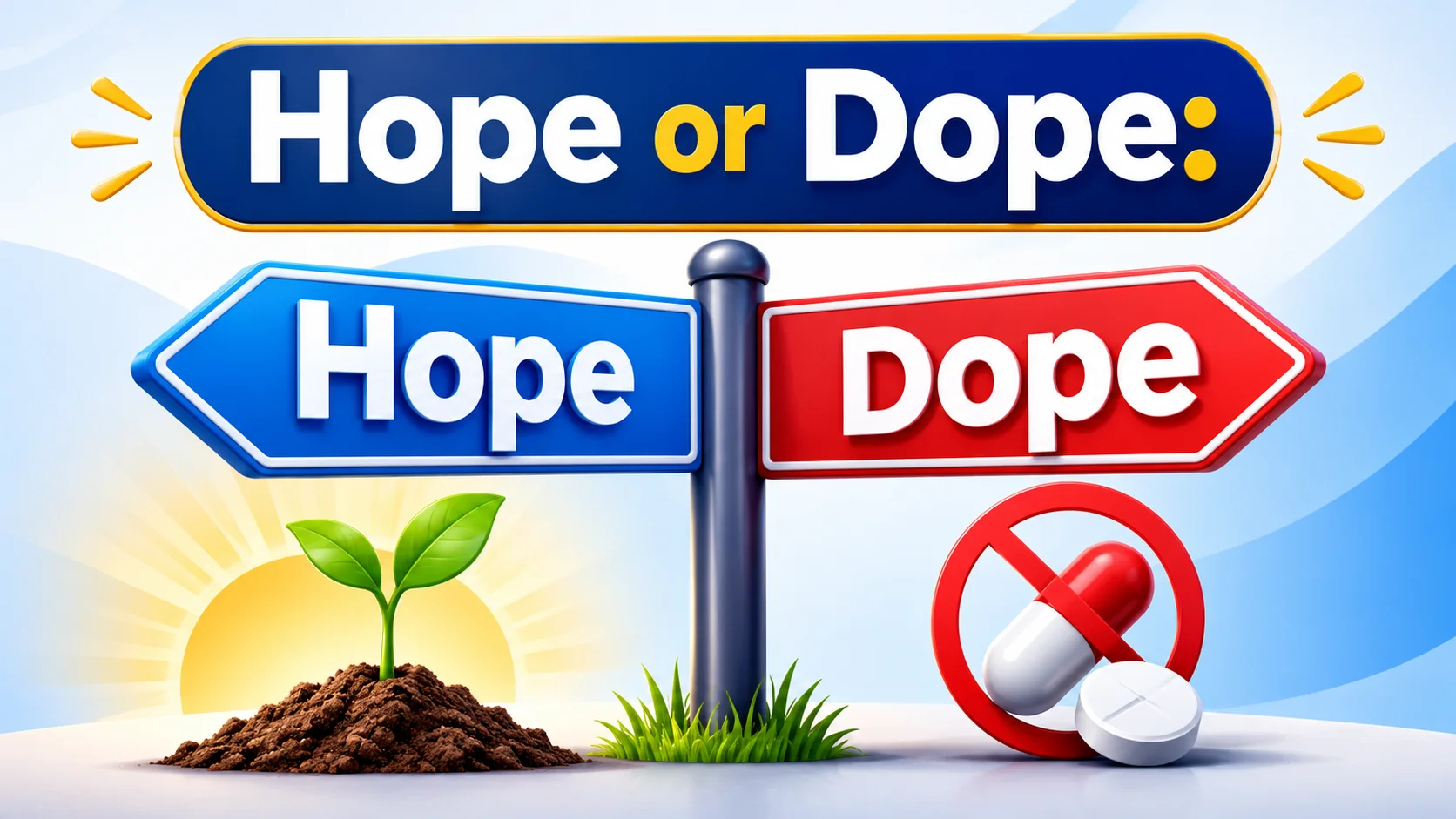
The difference between hope or dope can be confusing when you encounter these words in everyday conversations, text messages, social media posts, or written English. Although they differ by only one letter, their meanings are completely different. Hope expresses a desire or expectation that something good may happen, while dope has several meanings, including something excellent, a foolish person, or a drug-related substance. Understanding this distinction helps you avoid confusing two words that serve very different purposes.
The interesting part is that dope does not always have a negative meaning. In modern informal English, someone might describe a new song, fashionable outfit, impressive performance, or creative idea as “dope.” However, the same word can describe someone behaving foolishly or refer to drugs in another conversation. By contrast, hope generally communicates optimism, expectation, or a desire for a particular outcome. The surrounding sentence often determines exactly how dope should be understood.
In this guide, you will discover the definitions, grammatical functions, differences, and correct usage of both words. You will also learn what dope means in texting, when it is appropriate to use slang, and why certain expressions sound natural while others do not. Practical examples, comparison tables, common mistakes, and useful alternatives will help you choose the right word confidently, whether you are writing an academic assignment, communicating professionally, or chatting casually with friends.
Hope or Dope: Which Word Is Correct?
Both hope and dope are correctly spelled English words. However, they are not interchangeable because they communicate different ideas.
The correct choice depends entirely on what you want to express.
- Hope: A feeling of expectation or desire that something positive will happen.
- Dope: An informal or specialized word that can describe something excellent, a foolish person, or a drug-related substance.
Consider these examples:
- I hope you achieve your goals.
- Your new car looks dope.
The first sentence expresses a positive expectation. The second uses informal slang to compliment someone’s car.
Neither word is a misspelling of the other. If you accidentally type dope when you mean hope, however, you change the entire meaning of your sentence.
Quick Comparison: Hope vs. Dope
| Feature | Hope | Dope |
| Main meaning | Desire or expectation | Depends on context |
| Common usage | Everyday and formal English | Mostly informal or specialized |
| Part of speech | Noun and verb | Noun, verb, and adjective |
| Emotional tone | Generally positive | Positive, negative, or neutral |
| Formal writing | Appropriate | Usually avoid slang meanings |
| Example | I hope everything goes well. | That performance was dope. |
Quick rule: Use hope when discussing something you want or expect to happen. Use dope when referring to something impressive, someone foolish, or a drug-related subject.
What Does Hope Mean? Definition, Meaning, and Usage
Hope is a word used to express a feeling of expectation, desire, or confidence that something desirable may happen.
It is commonly associated with positive possibilities, future plans, personal ambitions, and uncertain situations.
For example:
- I hope you get the job.
- She has hope for a better future.
- We hope the weather improves tomorrow.
- His family never lost hope during difficult times.
In each example, hope communicates a positive expectation rather than a guaranteed outcome.
A person can hope for something even when they do not know whether it will happen.
Hope as a Verb
When hope functions as a verb, it describes wanting or expecting a particular result.
It is especially common when discussing future events, personal wishes, and possible outcomes.
Common grammatical patterns include:
| Pattern | Example |
| Hope + to + verb | I hope to visit London. |
| Hope + that + clause | I hope that you feel better. |
| Hope + for + noun | They hope for success. |
| Hope + present tense clause | I hope she arrives soon. |
| Hope + past tense clause | I hope you enjoyed the event. |
Notice that English often uses the present tense after hope when referring to a future possibility.
For example:
“I hope he comes tomorrow.”
Although the visit is in the future, comes is grammatically correct.
Hope To vs. Hope For: What Is the Difference?
These two constructions are related, but they are not used in exactly the same way.
Hope to is followed by a verb and usually describes an action you want to perform.
- I hope to become a teacher.
- She hopes to travel abroad.
- They hope to complete the project.
Hope for is followed by a noun or noun phrase and identifies the desired outcome.
- I hope for good news.
- She hopes for a promotion.
- They hope for better opportunities.
A useful editing tip is to check what comes immediately after the expression. If you are describing an action, hope to is often appropriate. If you are naming the desired result, hope for is generally the natural construction.
Hope as a Noun
Hope also functions as a noun. In this form, it identifies the feeling or possibility itself rather than the action of expecting something.
Examples:
- There is still hope.
- Her greatest hope is to become a doctor.
- The announcement gave everyone hope.
- His hope of winning the competition remained strong.
Hope can be used as an uncountable noun or as a countable noun when referring to a particular expectation or ambition.
Uncountable use:
“She never lost hope.”
Here, hope describes a general feeling.
Countable use:
“My hopes of studying abroad are growing.”
Here, hopes refers to particular ambitions or expectations.
Common Expressions With Hope
Some expressions containing hope have meanings that go beyond the individual words.
| Expression | Meaning | Example |
| Hope for the best | Expect a positive outcome | We have prepared, so let’s hope for the best. |
| Lose hope | Stop believing something good may happen | Don’t lose hope after one rejection. |
| A ray of hope | A small sign of improvement | The latest news offered a ray of hope. |
| Keep hope alive | Continue believing in a positive possibility | Her family kept hope alive. |
| Hope against hope | Continue hoping despite very little likelihood | He hoped against hope for a recovery. |
| Beyond hope | Having almost no possibility of improvement | The situation seemed beyond hope. |
These expressions appear in everyday conversations, literature, journalism, and professional communication.
What Does Dope Mean? All Major Definitions Explained
Unlike hope, which has a relatively consistent central meaning, dope has several distinct meanings.
Its interpretation depends on the surrounding sentence, the speaker’s intention, and the situation.
The word can function as an informal compliment, an insult, a reference to drugs, or a term associated with specialized activities.
Understanding these meanings is essential because interpreting dope incorrectly can lead to misunderstandings.
Dope as Slang for Something Excellent or Impressive
In informal English, dope commonly means cool, excellent, impressive, or exceptionally good.
This meaning is particularly familiar in conversations about music, clothing, entertainment, technology, and creative work.
Examples:
- That new song is dope.
- Your jacket looks really dope.
- We watched a dope movie last night.
- Her photography is absolutely dope.
- That was a dope idea.
In these sentences, dope communicates admiration.
Someone using this expression is generally complimenting something rather than discussing drugs.
Where Did the Positive Slang Meaning Come From?
The positive slang meaning of dope developed through informal American English and became especially prominent in popular culture, including hip-hop and music communities.
Its popularity expanded through songs, entertainment, street fashion, and social media.
Today, people use it in casual conversations to describe something they genuinely like.
However, its popularity does not make it appropriate in every setting. A comment such as “Your design is dope” may sound natural among friends but too informal in a business presentation.
Dope as Slang for a Foolish or Unintelligent Person
Another established meaning of dope is a foolish, gullible, or unintelligent person.
Unlike the positive slang meaning, this use can be critical or insulting.
Examples:
- Don’t be a dope; read the instructions first.
- I felt like a dope after forgetting my appointment.
- He made a careless mistake and looked like a complete dope.
The severity depends on tone and context.
For example, a friend might jokingly say:
“You’re such a dope! You left your phone at home again.”
This may be playful rather than genuinely offensive.
However, using the same expression toward a colleague, customer, or stranger could sound disrespectful.
Writing advice: If you want to criticize someone’s behavior professionally, describe the mistake rather than labeling the person.
Instead of:
“He was a dope for missing the deadline.”
Write:
“He overlooked the deadline and needs to improve his planning.”
Dope as a Drug or Drug-Related Substance
Dope has also been used as an informal term for drugs, particularly illegal or recreational substances.
The exact substance depends on the context, so the word should not be treated as a precise medical or scientific term.
Examples:
- The police investigated an illegal dope distribution operation.
- The documentary discussed the effects of drug use.
- The article examined the dangers associated with substance misuse.
In these situations, dope is not a compliment or a description of someone’s intelligence.
It refers to a drug-related subject.
For medical, legal, and scientific writing, it is better to identify the specific substance whenever possible.
For example, terms such as opioid, cannabis, or controlled substance provide greater precision when those terms accurately describe the subject.
Dope in Sports and Performance Enhancement
In sports, dope and related words can appear in discussions about prohibited substances and performance enhancement.
The term doping commonly refers to the use of prohibited substances or methods to improve athletic performance.
Examples include:
- The athlete faced a doping investigation.
- The organization introduced stricter anti-doping procedures.
- The competitor was suspended following an anti-doping rule violation.
Organizations such as the World Anti-Doping Agency (WADA) establish international anti-doping standards and maintain the World Anti-Doping Code.
It is important to distinguish this specialized meaning from casual slang.
Calling a song dope has nothing to do with sports doping.
Dope as a Verb and an Adjective
The word dope can also function as a verb and an adjective.
Understanding these grammatical roles helps explain why the word appears in different sentence structures.
Dope as a Verb
As a verb, to dope can mean administering a substance to someone or something, or treating a material with a substance to change its properties.
Examples:
- The athlete was accused of doping.
- Researchers doped the semiconductor material.
- The laboratory studied the effects of doping on the material.
The precise meaning depends on the field.
Dope as an Adjective
In informal slang, dope can describe something impressive or attractive.
Examples:
- That’s a dope outfit.
- She has a dope collection of sneakers.
- They created a dope video.
Here, the word behaves like an adjective because it describes a noun.
Dope as Information: What Does “The Dope” Mean?
There is another expression that deserves attention: the dope.
In informal English, it can mean useful information, facts, or inside details about a situation.
For example:
“Give me the dope on the new project.”
This means:
“Tell me the details about the new project.”
The expression is informal and may sound dated or conversational depending on the audience.
In professional communication, details, information, or background are usually clearer alternatives.
Hope vs. Dope: Key Differences Explained
Now that both words have been examined individually, their differences become easier to understand.
The main distinction is that hope expresses an expectation or desire, whereas dope describes something or someone in several different ways.
Meaning and Definition Comparison
| Category | Hope | Dope |
| Central meaning | Positive expectation or desire | Multiple meanings depending on context |
| Emotional association | Usually positive | Can be positive, negative, or neutral |
| Common role | Noun and verb | Noun, verb, and adjective |
| Formality | Formal and informal | Mostly informal outside specialized contexts |
| Social media use | Wishes and expectations | Compliments and slang |
| Example | I hope you succeed. | Your artwork is dope. |
Difference in Tone and Context
The emotional tone of hope is generally encouraging.
It can communicate support, optimism, sympathy, or anticipation.
For example:
“I hope your interview goes well.”
This sentence expresses goodwill toward another person.
Dope, however, does not have one consistent emotional tone.
Compare:
- “That movie is dope.” — Positive.
- “Don’t be such a dope.” — Critical or teasing.
- “The investigation involved illegal dope.” — Drug-related.
The same spelling appears in all three sentences, but the meanings are entirely different.
This is why readers should consider the entire sentence instead of interpreting a word in isolation.
Hope vs. Dope in American and British English
Both words are understood in American and British English, but their informal usage may vary across communities.
Hope is standard vocabulary in both varieties and does not generally require explanation.
Dope is also widely recognized, especially through music, entertainment, and online communication.
However, the slang meaning of dope may sound more natural in some social groups than others.
For example:
- American informal conversation: “That track is dope.”
- British informal conversation: “That track is dope.”
Both are understandable, although a British speaker might also choose alternatives such as brilliant, great, or class depending on the audience.
There is no strict grammatical rule limiting dope to one variety of English.
Hope or Dope in a Sentence: Practical Examples
The easiest way to recognize the difference is to examine how each word functions in everyday communication.
10 Example Sentences Using Hope
- I hope you achieve everything you have worked for.
- She hopes to study medicine after completing college.
- We hope the weather improves before the weekend.
- His parents never lost hope during the difficult period.
- I hope you enjoy your new job.
- There is still hope that the missing documents will be found.
- They are hoping for better results next semester.
- My biggest hope is to build a successful career.
- The announcement gave the entire team new hope.
- We hope that everyone arrives safely.
These examples show how hope works in different grammatical positions.
10 Example Sentences Using Dope
- That new music video is seriously dope.
- Your sneakers look dope with those jeans.
- The artist created a dope collection of photographs.
- That was a dope performance by the entire team.
- Don’t be a dope; check your email before leaving.
- I felt like a dope when I realized I had forgotten my wallet.
- The documentary investigated illegal dope distribution.
- The athlete faced a suspension following a doping violation.
- Tell me the dope about what happened at the meeting.
- The laboratory studied how researchers doped the semiconductor material.
Notice that these examples demonstrate several meanings rather than repeating the same slang definition.
Hope vs. Dope: Side-by-Side Sentence Comparison
Changing one letter can produce a completely different message.
| With Hope | With Dope |
| I hope you like the gift. | That gift is dope. |
| We hope to win the match. | That match was dope. |
| She has hope for the future. | He acted like a dope. |
| I hope the concert is enjoyable. | The concert was dope. |
| They hope for better results. | The investigation involved dope. |
The first column discusses expectations and desires. The second column demonstrates praise, criticism, and drug-related usage.
How Context Changes the Meaning of Dope
Consider these three sentences:
Example 1: “This jacket is dope.”
The speaker is complimenting the jacket.
Example 2: “He is a dope.”
The speaker is describing someone as foolish.
Example 3: “The police discovered dope.”
The sentence refers to a drug-related substance.
The spelling remains unchanged, but the surrounding words reveal the intended meaning.
This is an example of context-dependent vocabulary, where the same word can communicate different ideas depending on how it is used.
Common Expressions and Phrases With Hope and Dope
Learning common expressions makes it easier to recognize these words outside ordinary dictionary definitions.
Popular Expressions With Hope
| Expression | Meaning | Example |
| Hope for the best | Expect a positive result | We prepared carefully and hope for the best. |
| Keep hope alive | Continue believing in a possibility | The team kept hope alive. |
| Lose hope | Stop believing improvement is possible | She refused to lose hope. |
| A glimmer of hope | A small sign of possibility | The news offered a glimmer of hope. |
| Hope against hope | Continue hoping despite unlikely circumstances | He hoped against hope for good news. |
| Hope springs eternal | People continue hoping despite disappointments | Hope springs eternal among the supporters. |
Popular Expressions With Dope
| Expression | Meaning | Example |
| That’s dope | That is excellent or impressive | That’s dope! |
| Dope stuff | Cool or impressive things | He collects dope stuff. |
| Dope outfit | Attractive or stylish clothing | Your outfit is dope. |
| Dope sick | Experiencing withdrawal associated with certain drugs | The term appears in drug-related discussions. |
| The inside dope | Private or useful information | She gave us the inside dope. |
| Dope dealer | A person who sells drugs | The investigation targeted a suspected dope dealer. |
Some expressions are casual compliments, while others have serious drug-related meanings. Always consider the situation before using them.
What Does Dope Mean on Social Media and in Text Messages?
On platforms such as Instagram, TikTok, Snapchat, and WhatsApp, dope is frequently used as an informal compliment.
Someone might comment:
- “This picture is dope!”
- “Bro, that’s a dope outfit.”
- “Your new editing style is dope.”
- “That performance was absolutely dope.”
In these examples, the word means cool, impressive, or awesome.
It can also appear in direct messages:
Person A: I finally finished my music video.
Person B: Just watched it. That’s dope!
The second person is expressing approval.
One important point: dope is not a standard acronym or abbreviation. When it appears in a casual message, its meaning generally comes from ordinary slang usage.
Is Dope a Bad Word? Can You Use It in Professional Writing?
Whether dope is inappropriate depends on how it is being used.
It is not generally classified as a profanity, but some meanings can be insulting or unsuitable for particular situations.
Is Dope Considered Offensive?
The positive slang meaning is generally harmless in friendly conversations.
For example:
“Your presentation was dope!”
This is a compliment.
However, calling someone a dope can sound disrespectful because it suggests that the person is foolish or unintelligent.
Drug-related uses may also be inappropriate in conversations where the subject requires sensitivity and precision.
The important distinction is between the word itself and the intention behind it.
When Is Dope Appropriate to Use?
The positive slang meaning can work naturally in:
- Conversations with friends.
- Informal social media captions.
- Music and entertainment discussions.
- Casual fashion reviews.
- Personal messages.
- Informal creative discussions.
For example:
“Your photography is dope. I love the way you edited those pictures.”
This sounds natural in an informal conversation.
When Should You Avoid Using Dope?
Avoid relying on slang when communicating with an audience that expects formal or precise language.
Examples include:
- Academic essays and research papers.
- Professional business emails.
- Legal documents.
- Medical reports.
- Official workplace communication.
- Formal presentations.
For instance, instead of writing:
“The company launched a dope new product.”
You could write:
“The company launched an impressive new product.”
The second version communicates enthusiasm without relying on slang.
Better Alternatives to Dope in Formal English
Choose a replacement based on the meaning you intend.
| Intended meaning | Better alternative |
| Dope = excellent | Excellent, outstanding |
| Dope = cool | Impressive, appealing |
| Dope = stylish | Fashionable, sophisticated |
| Dope = foolish person | Careless person, foolish individual |
| Dope = drugs | Specific substance or controlled drug |
| The dope = information | Details, facts, information |
Professional writing tip: Do not replace every instance of dope with excellent. First identify its intended meaning. Otherwise, you may accidentally change the message.
Hope vs. Similar Words: Understanding Related Vocabulary
Some words have meanings close to hope or dope, but they cannot always replace one another.
Understanding these distinctions helps make your English more precise.
Hope vs. Wish
Both words express desire, but they are used differently.
Hope usually relates to something that has a realistic possibility of happening.
Wish can express a desire for something unlikely, imaginary, or contrary to reality.
Examples:
- I hope I pass the examination.
- I wish I could fly.
The first describes a possible future outcome. The second describes an imaginary ability.
However, wish can also express ordinary desires, such as “I wish you a happy birthday.”
Hope vs. Expect
These words are related but emphasize different attitudes.
- Hope: You want something to happen.
- Expect: You believe something is likely to happen.
For example:
“I hope the package arrives today.”
This expresses a desire.
“I expect the package to arrive today.”
This expresses an expectation, possibly based on tracking information.
You can hope for something you do not expect, and you can expect something you do not particularly want.
Hope vs. Optimism
Hope usually refers to a particular desired outcome or possibility.
Optimism describes a generally positive outlook about the future.
For example:
- She hopes to receive a scholarship.
- She remains optimistic about her future.
The first focuses on one specific goal. The second describes a broader attitude.
Dope vs. Cool
Both words can describe something impressive or attractive.
However, cool is generally more versatile and widely accepted in casual and semi-formal communication.
| Dope | Cool |
| More slang-oriented | More widely established in everyday conversation |
| Often sounds informal | Works across more situations |
| Common in music and youth culture | Common across age groups |
| That song is dope. | That song is cool. |
If you are unsure whether your audience understands dope as a compliment, cool is a safer alternative.
Dope vs. Awesome
Both can express enthusiasm and admiration.
- “Your new website is dope.”
- “Your new website is awesome.”
The meanings are similar in these examples, but dope carries a stronger informal slang flavor.
Awesome is generally suitable for a wider range of conversations.
Common Mistakes When Using Hope or Dope
Even familiar words can cause problems when their meanings overlap with informal expressions.
Here are the mistakes worth avoiding.
Using Dope When You Mean Hope
This usually happens because of typing errors or unfamiliarity with the two words.
Incorrect:
“I dope everything goes well tomorrow.”
Correct:
“I hope everything goes well tomorrow.”
The first sentence uses dope incorrectly because the intended meaning is a positive expectation.
Assuming Dope Always Means Something Good
The expression “That’s dope” is positive, but the word does not always carry that meaning.
Compare:
- That painting is dope.
- He is such a dope.
- The report discussed illegal dope.
Each sentence communicates something different.
Never interpret the word without considering the complete sentence.
Using Dope in Formal or Academic Writing
Slang can make a professional message sound less precise.
For example:
“The research findings were dope.”
A more appropriate version would be:
“The research findings were impressive.”
The alternative communicates the same positive reaction in a professional tone.
Confusing Hope With Wish or Expect
These words are related but express different ideas.
Incorrect usage often happens when writers treat all three as interchangeable.
Remember:
- Hope = desire for a possible outcome.
- Wish = desire, sometimes for an unlikely or unreal situation.
- Expect = belief that something is likely to happen.
Choosing the right verb makes your meaning clearer.
Misunderstanding Dope in Text Messages
A message such as “That’s dope” usually communicates approval.
It does not automatically suggest drugs or anything inappropriate.
However, a message discussing drug use may use the same word differently.
Read the conversation before interpreting the expression.
How to Remember the Difference Between Hope and Dope
A simple memory technique can prevent most confusion.
An Easy Memory Trick
Associate the first letter of each word with its central idea:
- H = Hope: Happiness, high expectations, and positive possibilities.
- D = Dope: Different meanings, including cool, foolish, and drug-related.
This is only a memory aid, not a formal linguistic rule.
The most important thing is to remember that hope communicates a feeling or expectation, while dope has several context-dependent meanings.
A Three-Step Method for Choosing the Right Word
Before using either word, ask yourself:
- Am I expressing a desire or expectation? Choose hope.
- Am I describing something impressive, someone foolish, or a drug-related subject? Consider dope.
- Does the complete sentence communicate the intended meaning? Read it again before publishing.
Quick Decision Table
| What you want to express | Correct word |
| A positive expectation | Hope |
| A desire for future success | Hope |
| A wish for a better outcome | Hope |
| Something excellent or impressive | Dope |
| A foolish person | Dope |
| A drug-related substance | Dope |
| Informal information or inside details | Dope |
Quick Practice: Test Your Understanding of Hope and Dope
Try these questions to check whether you can distinguish the two words in different situations.
Question 1: Which Word Expresses a Positive Expectation About the Future?
A. Dope
B. Hope
C. Both
Question 2: Complete the Sentence: “I ______ You Enjoy Your Vacation.”
A. Dope
B. Hope
C. Hoping
Question 3: What Does “That Outfit Is Dope” Mean?
A. The outfit is expensive.
B. The outfit is impressive or stylish.
C. The outfit is damaged.
Question 4: Can Dope Describe Someone Who Behaves Foolishly?
A. Yes
B. No
Question 5: Which Word Is More Appropriate in Formal Business Writing When Expressing a Positive Expectation?
A. Hope
B. Dope
Question 6: What Does Dope Mean in a Drug-Related Context?
A. A positive feeling.
B. A drug-related substance.
C. A future expectation.
Question 7: Complete the Sentence: “We ______ To Win the Championship.”
A. Dope
B. Hopes
C. Hope
Question 8: Is Dope Always a Negative Word?
A. Yes
B. No
Question 9: Which Word Can Function as Both a Noun and a Verb?
A. Hope
B. Dope
C. Both
Question 10: What Is the Best Way to Understand Dope in a Text Message?
A. Always assume it refers to drugs.
B. Always assume it is an insult.
C. Examine the surrounding conversation.
Answer Key and Explanations
| Question | Correct answer | Explanation |
| 1 | B. Hope | It expresses positive expectations. |
| 2 | B. Hope | The sentence expresses a desire. |
| 3 | B. Impressive or stylish | This is the positive slang meaning. |
| 4 | A. Yes | Dope can describe a foolish person. |
| 5 | A. Hope | It is suitable for formal communication. |
| 6 | B. A drug-related substance | This is one of its established meanings. |
| 7 | C. Hope | The subject “we” takes the base verb. |
| 8 | B. No | It can also be a compliment. |
| 9 | C. Both | Both words can function as nouns and verbs. |
| 10 | C. Examine the conversation | Context determines the intended meaning. |
Conclusion
Choosing between hope or dope becomes straightforward when you focus on the message rather than the spelling. Hope expresses desire, optimism, and expectations about possible outcomes, while dope carries several meanings that depend on context, including impressive, foolish, and drug-related. Both words have legitimate places in English, but they suit different situations and audiences. One final actionable tip: read the entire sentence before choosing either word, especially when writing informal messages or professional content. A common mistake to avoid is assuming that dope always means something excellent simply because it is popular slang. Good word choice is not about using complicated vocabulary; it is about communicating exactly what you mean.
Frequently Asked Questions
Q1. Can Hope and Dope Be Used Interchangeably?
No. Hope and dope are not interchangeable because their meanings are different. Hope expresses a desire or expectation, while dope can describe something impressive, a foolish person, or a drug-related substance. Replacing one with the other can completely change your sentence.
Q2. What Does “That’s Dope” Mean in American Slang?
“That’s dope” is an informal American English expression meaning that’s excellent, cool, or impressive. People commonly use it when complimenting music, clothing, artwork, performances, or ideas. It is generally positive and does not automatically refer to drugs.
Q3. Is Hope a Countable or Uncountable Noun?
Hope can be both countable and uncountable, depending on its meaning. In “She never lost hope,” it is uncountable. In “Their hopes were fulfilled,” it is countable because it refers to separate expectations or ambitions.
Q4. What Does It Mean When Someone Calls You a Dope?
When someone calls you a dope, they generally mean you have acted foolishly or made a silly mistake. Depending on the relationship and tone, it may be playful teasing or an insult. Consider the speaker’s intention before interpreting the comment.
Q5. Is Dope Still Used by Younger Generations?
Yes. Dope remains recognizable in informal English, particularly in music, fashion, entertainment, and online conversations. However, slang preferences change over time and vary between communities. Expressions such as fire, cool, and awesome may also be used as compliments.
