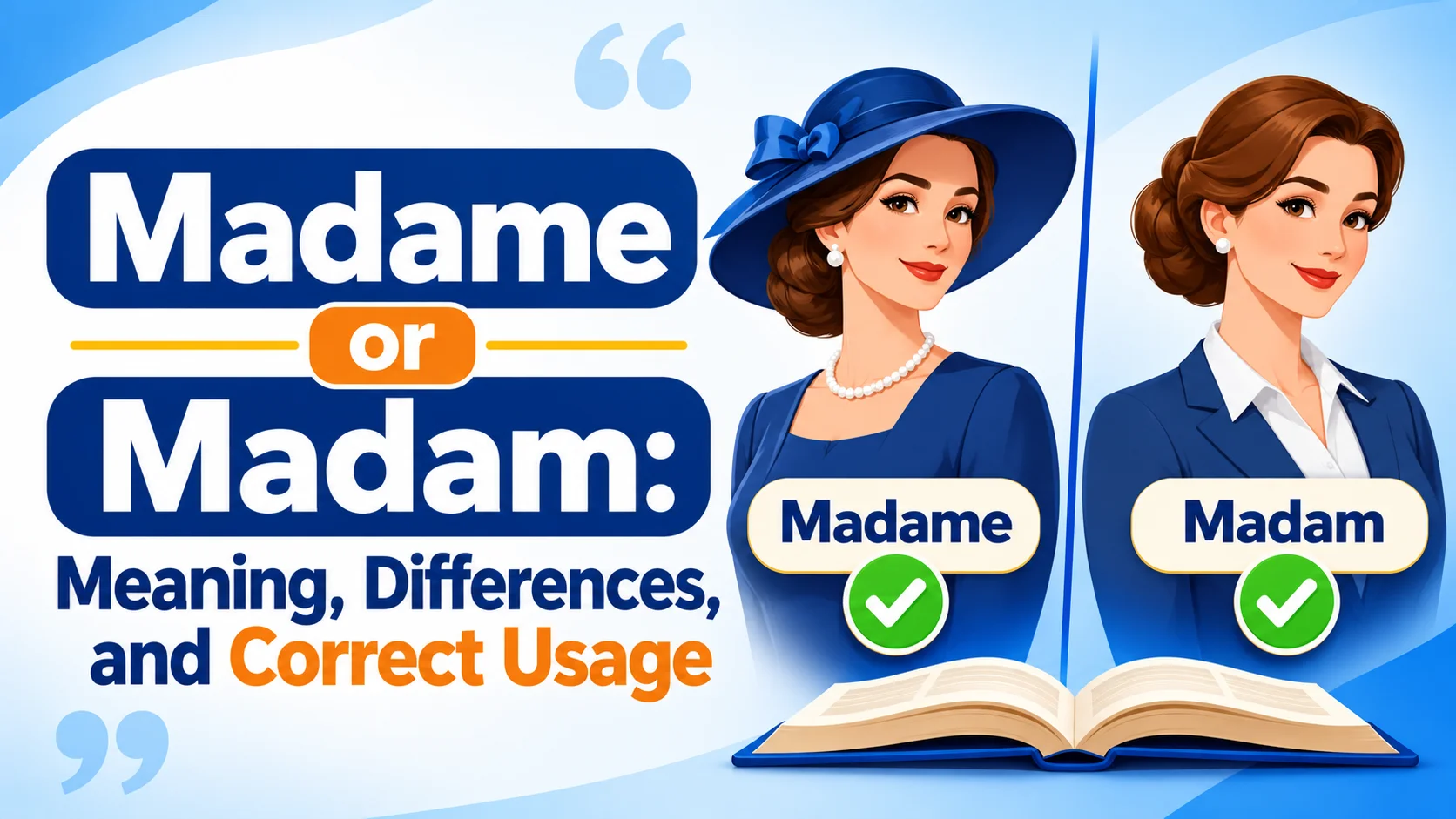
The main difference between madam and madame is their language context. Madam is the usual English spelling for politely addressing a woman or introducing certain official titles, as in “Madam President.” Madame is the French form, commonly used when addressing a woman in French or referring to a French title. Although the words share the same historical roots, they are not always interchangeable. Choosing the right one depends on the language, situation, and tone—not simply on which spelling looks more formal.
The confusion often appears in professional writing. Someone preparing a business letter might wonder whether “Dear Madam” or “Dear Madame” is appropriate. A student may see Madame President in one place and Madam President in another. Others are unsure whether madame refers only to married women, whether madam sounds rude, or how either word differs from ma’am. These are practical questions because a form of address can affect how natural, respectful, and accurate a message sounds.
This guide explains the meanings of both words, their differences in English and French, and the situations in which each form works best. You will also learn how to use them in formal letters, official titles, everyday conversation, and professional settings. Along the way, we will cover pronunciation, capitalization, abbreviations, plural forms, word history, and common mistakes. The aim is simple: help you choose the right form confidently, without relying on guesswork or treating every context as if it followed the same rule.
Madam or Madame: Which Spelling Is Correct?
Both spellings are correct, but they serve different purposes.
Use madam when writing in ordinary English. It is a formal term of address for a woman and appears before certain official positions. Use madame when the French form is appropriate, such as when addressing a woman in French or referring to a French title.
| Word | Main use | Example |
| Madam | Standard English form of address | “May I help you, madam?” |
| Madam | Before an official position | “Madam President, the floor is yours.” |
| Madame | French form of respectful address | “Bonjour, Madame.” |
| Madame | French title before a name | “Madame Dupont will join us shortly.” |
Are Madam and Madame Interchangeable?
Not in every situation. In English, madam is normally the natural choice for a formal address. Madame can appear in English writing, but it usually signals a French-speaking person, a French setting, or a deliberate cultural or stylistic choice.
For example:
- Natural English: “Please take a seat, madam.”
- French context: “Bonjour, Madame Martin.”
- Standard English official title: “Madam Speaker, may I ask a question?”
Writing Madame Speaker in an otherwise standard English parliamentary address may look unusual unless the writer has a specific reason to preserve the French form.
Why the Two Spellings Are Often Confused
The words look almost identical, have related meanings, and come from the same French expression. English borrowed both forms, but madam became the established English spelling for many everyday and official uses.
The final -e in madame is therefore not just an optional decorative letter. It often signals that the writer is using the French form rather than the ordinary English one.
What Does Madam Mean?
Madam is a formal noun used to address a woman politely or respectfully. It can also appear before an official title or position, particularly when the person being addressed holds authority.
The word is more formal than simply saying you. Depending on the setting, it can sound courteous, professional, distant, or old-fashioned.
Madam as a Polite Way to Address a Woman
In customer service, hospitality, formal conversation, and certain official settings, madam is used when speaking directly to a woman whose name is unknown or unnecessary.
Examples:
- “Would you like a receipt, madam?”
- “I’m sorry, madam, but this section is reserved.”
- “Please follow me, madam.”
- “May I speak with you for a moment, madam?”
The term can communicate respect without requiring the speaker to know the woman’s name. However, it is not automatically the best choice in every conversation.
In relaxed modern settings, repeatedly calling someone madam may sound stiff or overly formal. A person’s name, job title, or a simple polite sentence may feel more natural.
Practical advice: Use madam when the situation calls for formal courtesy. If you are unsure whether someone likes being addressed this way, avoid forcing the title into the conversation.
Madam Before an Official Title or Position
One of the most important uses of madam is before an official position. It recognizes the authority of the person holding that role.
Common examples include:
- Madam President
- Madam Speaker
- Madam Chair
- Madam Chairperson
- Madam Ambassador
- Madam Justice
Madam President
Madam President is the standard English form when directly addressing a woman who holds the presidency.
Example:
“Madam President, I would like to raise a point about the proposed policy.”
The word madam functions as part of the form of address. It does not mean that the person has a French title.
Madam Speaker
This form is used when addressing a woman who presides over a legislative assembly or parliamentary chamber.
Example:
“Madam Speaker, I request permission to make a statement.”
Madam Chair or Madam Chairperson
These forms are appropriate when addressing a woman leading a meeting, committee, board, or formal discussion.
Example:
“Madam Chair, could you clarify the next item on the agenda?”
Important distinction: The exact title depends on the institution. If an organization officially uses Chair, Chairperson, or another designation, follow its preferred wording.
Madam in Formal Letters and Emails
Madam can be used as a salutation when writing to a woman whose name is unknown.
For example:
Dear Madam,
I am writing to request further information about the application process.
This is grammatically correct and remains recognizable as a formal letter opening. It can, however, sound traditional or impersonal in modern business communication.
When possible, use the recipient’s name or a more specific title. For example:
- Dear Ms. Ahmed,
- Dear Dr. Khan,
- Dear Customer Support Team,
- Dear Admissions Officer,
If you do not know the recipient’s identity, choose a greeting that fits the organization and the purpose of the message.
Madam as a Common Noun
The word can also refer to a woman who manages a brothel. This is a distinct dictionary meaning and is not the same as the polite form of address.
Example:
“The novel describes the madam who managed the establishment.”
Because this meaning can carry a strong association, context matters. In ordinary conversation, madam used as a direct address is usually understood differently.
What Does Madame Mean?
Madame is the French form of a respectful title used to address or refer to a woman. It is also used in English when the writer is referring to a French woman, preserving a French title, or deliberately using a French expression.
In French, Madame is a standard form of address. It is not simply an extra-formal English spelling of madam.
Madame as a French Title of Respect
In French, Madame is used as a polite title when speaking to a woman or referring to her.
Examples:
- “Bonjour, Madame.” — Hello, madam.
- “Merci, Madame.” — Thank you, madam.
- “Madame, votre table est prête.” — Madam, your table is ready.
The title is used in everyday polite interactions, not only in ceremonies or highly formal situations.
Madame Before a Woman’s Name
The title can appear before a surname or full name.
Examples:
- Madame Martin
- Madame Dupont
- Madame Claire Bernard
In a French-language context, this is a natural way to address or refer to a woman.
In English prose, writers may retain Madame when discussing a French person, a French historical figure, or a title that is conventionally presented in French.
Madame Without a Name
A French speaker may use Madame on its own when addressing a woman respectfully.
For example:
“Madame, vous avez oublié votre sac.”
This means, “Madam, you have forgotten your bag.”
English speakers may also encounter Madame as a standalone title in restaurants, cultural settings, or dialogue involving French-speaking characters. If the surrounding conversation is entirely in English, however, madam is usually the more natural spelling.
Is Madame Used Only for Married Women?
No. This is an important distinction between historical conventions and modern usage.
Traditionally, French Madame was associated with married women, while Mademoiselle was used for unmarried women. Modern usage has moved away from making a woman’s marital status the basis for choosing a respectful title. Madame is now widely used as a general polite form of address for adult women.
The European Parliament’s language guidelines also describe the shift away from titles that indicate marital status.
European Parliament+1
Practical takeaway: Do not assume that a woman must be married to be addressed as Madame in modern French.
Madame in English Writing
English writers sometimes use Madame for a particular effect or context. It may appear in:
- References to French women or French institutions
- Historical writing
- Translations and French dialogue
- Cultural or artistic settings
- Established titles or names
For example:
“Madame Curie’s scientific work changed the history of physics.”
Here, the French title is retained as part of the conventional way the historical figure is identified.
By contrast, an English customer-service employee would usually write:
“Thank you for your patience, madam.”
The choice is based on context, not on a ranking of respect.
Madam vs. Madame: Key Differences Explained
The most reliable way to distinguish the two words is to look at the language and situation in which they appear.
| Feature | Madam | Madame |
| Language association | English | French |
| Main function | Formal English address | French title of respect |
| Official English titles | Common: Madam President | Unusual unless intentionally French |
| French conversation | English equivalent, not the usual French spelling | Standard French form |
| Before a name | Less common in modern English | Common in French contexts |
| Formal letters | “Dear Madam” is correct | Usually used when French context calls for it |
| Plural | Madams | Mesdames in French; also used in English |
| Typical impression | Formal, courteous, sometimes traditional | French, culturally specific, or stylistic |
Difference in Language and Origin
Both words ultimately come from the French expression ma dame, meaning “my lady.” English adopted the form madam earlier, while madame entered English later as a more visibly French form.
Etymology, Origin & Meaning+1
That shared origin explains why the words have similar meanings. Their modern uses, however, developed differently.
Difference in Meaning and Everyday Usage
In ordinary English, madam is the standard polite form of address. In French, Madame is the normal respectful title.
Consider these situations:
- An English-speaking hotel receptionist: “Good evening, madam.”
- A French-speaking hotel receptionist: “Bonsoir, Madame.”
- An English parliamentary debate: “Madam Speaker, I have a question.”
- A French formal address: “Madame la Présidente.”
The language being used is the most useful clue.
Difference in Formality and Tone
Neither spelling is automatically more respectful than the other. Madame is not simply a more elegant or more polite version of madam. It belongs to a different language tradition.
In English, madam can sound courteous in a formal service interaction but stiff in a casual conversation. In French, Madame is a routine respectful form and does not necessarily imply ceremony or social distance.
Madam or Madame President: Which Is Correct?
For standard English, write Madam President.
This is the conventional English form used when directly addressing a woman who holds the office of president.
Example:
“Madam President, the committee is ready to present its findings.”
The same pattern applies to other official English forms of address, such as Madam Speaker and Madam Chair.
When Is Madame President Appropriate?
Madame President may be appropriate when the writer is deliberately using French, quoting French speech, or preserving a French-language title.
For example:
“Madame la Présidente, nous vous remercions.”
That is a French construction. It should not be confused with the standard English form.
Should Madam President Be Capitalized?
When Madam President is used as a direct form of address or as a formal title immediately before a name, capitalization is generally appropriate.
Compare:
- “Madam President, may I begin?”
- “The president addressed the audience.”
- “The president met with the committee.”
The first sentence uses a direct title. The second and third use president as a general noun.
Follow the relevant publication or institutional style guide when writing official material.
Madam, Madame, and Ma’am: What Is the Difference?
These three forms are related in meaning, but they are not identical.
- Madam: A formal English form of address.
- Madame: The French form of respectful address.
- Ma’am: A shortened spoken form of madam, commonly used in English conversation.
What Does Ma’am Mean?
Ma’am is a contraction of madam. It is used as a polite way to address a woman, especially in spoken English.
Examples:
- “Yes, ma’am.”
- “Would you like some assistance, ma’am?”
- “I understand, ma’am.”
The apostrophe marks the shortened form. Writing maam without an apostrophe is generally incorrect in standard English.
Madam vs. Ma’am: When Should You Use Each?
Use madam when a full, formal form is suitable, particularly in written English or official titles. Use ma’am when a shorter spoken form sounds natural.
| Situation | Better choice | Example |
| Formal written address | Madam | “Dear Madam,” |
| Official title | Madam | “Madam President” |
| Polite spoken reply | Ma’am | “Certainly, ma’am.” |
| Casual conversation | Often neither | Use the person’s name if appropriate |
Madame vs. Ma’am: Are They Pronounced the Same?
No. Ma’am is a shortened English form of madam. Madame has French pronunciation conventions, although English speakers may pronounce it in several ways depending on context.
If you are writing an English sentence and want the spoken courtesy form, ma’am is generally the appropriate spelling.
How to Pronounce Madam and Madame
Pronunciation varies slightly by accent, especially for madame. The key is to recognize that the two spellings do not always have identical pronunciations.
How to Pronounce Madam
In standard English, madam is commonly pronounced:
MAD-uhm — /ˈmæd.əm/
The first syllable receives the stress, while the second is usually reduced.
How to Pronounce Madame
In French, madame is commonly pronounced approximately:
mah-DAHM
English speakers may also pronounce it with an English-influenced first syllable. The pronunciation depends on whether the speaker is using the French title or an English adaptation.
Is the Final E in Madame Silent?
In the usual French pronunciation, the final written e is not pronounced as a separate “ee” sound. The word ends with the sound represented by the final consonant.
This is why the spelling may look longer than the spoken word sounds.
How Is Ma’am Pronounced?
Ma’am is generally pronounced as one syllable. Its exact vowel sound varies among English accents, but it is a shortened spoken form rather than a separate French title.
When Should You Use Madam or Madame?
Use the language and the person’s context to guide your choice. The following decision table offers a quick reference.
| Your situation | Recommended form | Reason |
| Writing a formal English letter to an unnamed woman | Dear Madam | Conventional English salutation |
| Addressing a woman president in English | Madam President | Standard English title |
| Speaking French to an adult woman | Madame | Standard French courtesy title |
| Referring to a French woman by her title and surname | Madame Dupont | Preserves the French form |
| Writing English dialogue with a spoken courtesy form | Ma’am | Natural contracted form |
| Writing a casual message to someone whose name you know | Use her name | Usually more natural and personal |
Use Madam When Writing in Standard English
Choose madam for English-language formal address, official titles, and traditional letter openings.
Examples:
- “Madam, your appointment is at three.”
- “Madam Ambassador, the delegation is waiting.”
- “Dear Madam, thank you for your inquiry.”
Use Madame in French or French-Related Contexts
Choose Madame when the language or context calls for the French title.
Examples:
- “Bonjour, Madame.”
- “Madame Laurent will lead the discussion.”
- “The letter was addressed to Madame de Sévigné.”
When Neither Form Is the Best Choice
A title is not always necessary. If you know someone’s name, using it may be warmer and clearer.
For example, instead of:
“Madam, I have sent the report.”
You might write:
“Ms. Ahmed, I have sent the report.”
In a workplace where first names are normal, simply writing “I have sent the report” may be even more natural.
Expert tip: Do not add a formal title just to make a sentence sound respectful. Respectful wording, an appropriate tone, and the person’s preferred form of address matter more than using the longest or most formal-sounding option.
Madam or Madame in Formal Letters and Emails
The choice between Dear Madam and Dear Madame depends on the language of the letter and the recipient.
Is “Dear Madam” Correct?
Yes. Dear Madam is a correct traditional salutation in English when writing to a woman whose name is unknown.
Example:
Dear Madam,
I am writing to request details about the upcoming registration period. Could you please let me know which documents are required?
Cambridge Dictionary identifies Dear Madam as a conventional opening for a formal letter to a woman whose name is not known.
definition in the Cambridge English Dictionary
Is “Dear Madame” Correct?
It can be correct in a French-language letter or in a context where the French title is intentionally retained. It is not usually the default English salutation.
For a standard English business email, Dear Madam is the more conventional choice.
Better Alternatives to “Dear Madam”
Traditional salutations can sound impersonal, especially when the recipient is a customer, colleague, or professional contact. Consider these alternatives:
| Recipient or situation | Suggested greeting |
| You know the recipient’s name | Dear Ms. Ahmed, |
| You know the person’s professional title | Dear Dr. Khan, |
| Writing to a department | Dear Admissions Team, |
| Writing to a customer service team | Dear Customer Support Team, |
| You do not know the recipient’s name or role | Dear Sir or Madam, or a suitable neutral greeting |
The best option is the most specific one you can use accurately. Avoid guessing someone’s title, marital status, or gender.
Sample Formal Letter Opening Using Madam
Dear Madam,
I am contacting you regarding the application submitted to your office last week. I would appreciate an update on its current status and any additional information you may require.
This is grammatically sound. If you later learn the recipient’s name, use it in future correspondence.
Madam and Madame in French
Understanding the French form helps explain why madame is not merely an alternative English spelling.
Madame, Monsieur, and Mademoiselle
These are French forms of address with different uses.
| French term | General meaning | Typical use |
| Madame | Madam / Ms. | Respectful address for an adult woman |
| Monsieur | Sir / Mr. | Respectful address for a man |
| Mademoiselle | Miss | Traditionally used for an unmarried woman; now less common in official contexts |
Historically, Madame and Mademoiselle were more closely connected to marital status. Contemporary French usage increasingly favors Madame as the general respectful title for adult women.
How to Write Madame in French
In French, Madame is commonly abbreviated as Mme before a name. The plural is Mesdames, abbreviated Mmes.
Examples:
- Madame Laurent
- Mme Laurent
- Mesdames Laurent et Martin
- Mmes Laurent et Martin
The Académie française records Madame as the full form, Mesdames as its plural, and Mme and Mmes as abbreviations.
9e édition+1
Should You Translate Madame Into English?
Not always. If you are translating a French letter or conversation, you may translate Madame as madam, Ms., or another suitable English form depending on the context.
If you are writing about a person’s established French title or reproducing a French name, retaining Madame may be more appropriate.
Capitalization, Abbreviations, and Plural Forms
The spelling is only one part of correct usage. Capitalization and plural forms also depend on whether the word is functioning as a title, a direct address, or a general noun.
Should Madam and Madame Be Capitalized?
Capitalize the word when it forms part of a title or is used as a direct form of address according to the style guide being followed.
Examples:
- “Madam President, welcome to the meeting.”
- “Good afternoon, Madam.”
- “The madam of the household greeted the visitors.”
The last example uses madam as an ordinary noun, so it is lowercase.
For French titles, capitalization can depend on position and the conventions of the language. Follow the relevant French style rules when writing in French.
Is There an Abbreviation for Madam or Madame?
The French abbreviation for Madame is Mme. Its plural abbreviation is Mmes.
In English, madam is usually written in full when used as a salutation or form of address. Avoid inventing shortened forms in formal writing.
What Is the Plural of Madam and Madame?
The usual English plural of madam is madams. The French plural of madame is mesdames.
| Singular | Plural | Context |
| Madam | Madams | English |
| Madame | Mesdames | French |
| Mme | Mmes | French abbreviations |
Example:
- “The two madams greeted the guests.”
- “Mesdames, veuillez vous asseoir.” — Ladies, please sit down.
In English writing, mesdames may also appear when referring to multiple women using the French title.
Possessive Forms: Madam’s and Madame’s
To show possession, add an apostrophe and s:
- Madam’s office
- Madame’s invitation
- The madam’s decision
For plural possessives, the form depends on the plural:
- The madams’ meeting
- The mesdames’ reserved seats
Use the form that matches the noun’s number and language context.
Is Calling Someone Madam Polite, Rude, or Outdated?
It depends on the setting, delivery, and expectations of the person being addressed.
In a formal hotel, restaurant, or official interaction, madam can sound courteous, In a casual conversation between colleagues or friends, it may feel unnecessarily stiff, In some situations, a sharp or sarcastic tone can also make the word sound disrespectful.
Why Madam Can Sound Respectful
The term is traditionally used to show courtesy, especially when the speaker does not know the woman’s name.
Example:
“Madam, may I help you with your luggage?”
The wording is polite because the title fits the service setting and is delivered respectfully.
Why It May Sound Stiff or Unnatural
Modern English often favors names, job titles, or neutral wording over repeated formal address.
For example:
“Madam, would you like me to email the document, madam?”
Repeating the title in this way sounds unnatural. A better version would be:
“Would you like me to email the document?”
Is Madame More Respectful Than Madam?
No. The French spelling does not automatically make a person sound more important or deserving of respect.
A French speaker may use Madame naturally in everyday conversation. An English speaker using Madame in an ordinary English exchange may sound affected or may create the impression of a French context.
How to Address Someone Respectfully
When possible:
- Use the person’s preferred name or title.
- Follow the conventions of the language you are speaking.
- Avoid assuming marital status.
- Do not use a title sarcastically.
- If a title is unnecessary, choose clear and courteous wording instead.
Madam vs. Madame in American and British English
Both American and British English recognize madam and madame. The central distinction remains the same: madam is the ordinary English form, while madame is associated with French usage or a French-style title.
There can be differences in how often people use formal address in conversation. However, it is not accurate to treat madame as the standard British spelling or madam as exclusively American.
American English
In American English, madam appears in formal address and official titles. Ma’am is also used in spoken conversation, although preferences vary by region and individual.
Examples:
- “Madam President, thank you for your remarks.”
- “Yes, ma’am. I’ll take care of it.”
British English
British English also uses madam in formal address, customer service, and traditional letter openings. In everyday conversation, the word can sound formal or old-fashioned depending on the situation.
Examples:
- “Can I help you, madam?”
- “Dear Madam, I am writing about your recent enquiry.”
The practical rule: Do not choose the spelling based on whether your audience is American or British. Choose it based on whether you are writing in English or using the French title.
Common Mistakes When Using Madam and Madame
These errors are easy to avoid once you understand the distinction.
1. Writing “Madame President” in Standard English
If you are writing an English speech or formal statement, use Madam President.
Incorrect for standard English usage:
“Madame President, I have a question.”
Preferred:
“Madam President, I have a question.”
Use the French form only when the context specifically calls for it.
2. Treating Madame as a More Respectful Version of Madam
The extra e does not make the word more polite. It signals the French form.
Choose the spelling based on the language and context, not on which one appears more sophisticated.
3. Confusing Madam With Ma’am
Ma’am is the shortened spoken form of madam. It is not another spelling of madame.
- Correct: “Yes, ma’am.”
- Correct: “Madam President.”
- Correct in French: “Bonjour, Madame.”
4. Assuming Madame Is Only for Married Women
That reflects an older distinction and does not describe modern French usage accurately. Madame is widely used as a general respectful title for adult women.
5. Using Madam Too Often in Conversation
Repeating madam in every sentence can sound unnatural.
Instead of:
“Madam, I can help you, madam. Please wait here, madam.”
Write or say:
“I can help you. Please wait here.”
6. Capitalizing Every Use of Madam
A direct title such as Madam President is capitalized in standard title usage. A general noun such as the madam of the household is normally lowercase.
Always consider the word’s function in the sentence.
Madam and Madame in Everyday Sentences
The examples below show how each word works in context.
1. Examples Using Madam
- “Madam, your appointment is scheduled for 10 a.m.”
- “Madam President, the council is ready to begin.”
- “Dear Madam, thank you for contacting our office.”
- “The receptionist asked the madam to wait in the lobby.”
- “Madam Chair, may I add something to the discussion?”
2. Examples Using Madame
- “Bonjour, Madame. Comment allez-vous?”
- “Madame Laurent will speak at the event.”
- “The letter was addressed to Madame Dupont.”
- “Madame, votre commande est prête.”
- “The museum displayed a portrait of Madame de Pompadour.”
3. Examples Using Ma’am
- “Yes, ma’am. I understand.”
- “Would you like a copy, ma’am?”
- “I’m sorry, ma’am, but this entrance is closed.”
- “Thank you, ma’am, for your patience.”
- “No, ma’am. I haven’t received the email.”
Examples Showing the Difference
| Sentence | Why it works |
| “Madam, your table is ready.” | Formal English address |
| “Madame, votre table est prête.” | French address |
| “Madam Speaker, the meeting is in order.” | English official title |
| “Bonjour, Madame Martin.” | French title before a surname |
| “Yes, ma’am.” | Spoken English courtesy form |
Word Origin: Where Do Madam and Madame Come From?
The two spellings share a common history. Both are connected to the Old French expression ma dame, meaning “my lady.”
The expression combines ma (“my”) and dame (“lady”). It was originally a respectful way to address a woman of status or authority.
How Madam Entered English
The English word madam dates back to Middle English and was borrowed from Old French. Over time, it developed into a conventional formal way to address a woman.
Its uses expanded beyond women of high social rank. It became a general term of polite address and later developed other meanings, including the term for a woman who manages a brothel.
Etymology, Origin & Meaning+1
How Madame Retained Its French Spelling
Madame entered English later while retaining a spelling that visibly reflects its French origin. It is still used when the French title or cultural context is relevant.
The history explains why the words look so similar, but modern usage—not their shared origin—should guide your spelling choice.
Quick Rules for Choosing Madam or Madame
If you need a fast decision, use these rules:
- Writing in standard English? Choose madam for formal address.
- Addressing a woman president in English? Write Madam President.
- Speaking or writing in French? Use Madame.
- Referring to a French woman by her title? Retain Madame when appropriate.
- Using a polite spoken contraction? Write ma’am.
- Know the recipient’s name? Consider using the name or preferred professional title instead.
A useful final check is to read the sentence aloud. If the sentence is in English and madame sounds like an unnecessary French insertion, madam is probably the better choice.
Conclusion
The difference between madam and madame becomes straightforward once you consider the language and situation. In standard English, madam is the usual choice for formal address and official titles such as Madam President. Madame belongs primarily to French usage and to English contexts where a French title is intentionally retained. Neither spelling is automatically more respectful; the right choice is the one that fits the person and setting. One final actionable tip: before sending a letter or publishing a formal document, check whether you are following English or French conventions. A common mistake to avoid is adding the final e simply because it looks more elegant. Accurate, natural wording is always more effective than unnecessary formality.
Frequently Asked Questions
Q1. Is “madame” grammatically correct in English?
Yes. Madame is an established word in English, particularly when referring to a French woman or preserving a French title. However, it is not the usual spelling for ordinary English forms of address. In most English situations, madam is the more natural choice.
Q2. Can I call my wife or another woman “madam”?
You can, but whether it sounds affectionate, playful, formal, or awkward depends on your relationship and tone. Madam is not a standard romantic term of endearment. If you are addressing someone personally, use the title or name she prefers.
Q3. Is “Madam” rude when speaking to a woman?
Not inherently. It can be polite in formal service or official settings, but some people find it stiff, impersonal, or old-fashioned. Tone matters too: a sarcastic delivery can make even a traditionally respectful title sound insulting. When uncertain, use the person’s name.
Q4. What is the difference between “madam” and “Mrs.”?
Madam is a general formal form of address, while Mrs. is a title traditionally associated with a married woman and normally appears before her surname. They are not interchangeable in every sentence. If marital status is unknown, Ms. may be a more suitable English title.
Q5. What is the plural of “madame” in English?
The French plural is mesdames, and it is also used in English when retaining the French form. The ordinary English plural of madam is madams. In French writing, the abbreviation for Madame is Mme, while Mmes represents the plural.
