
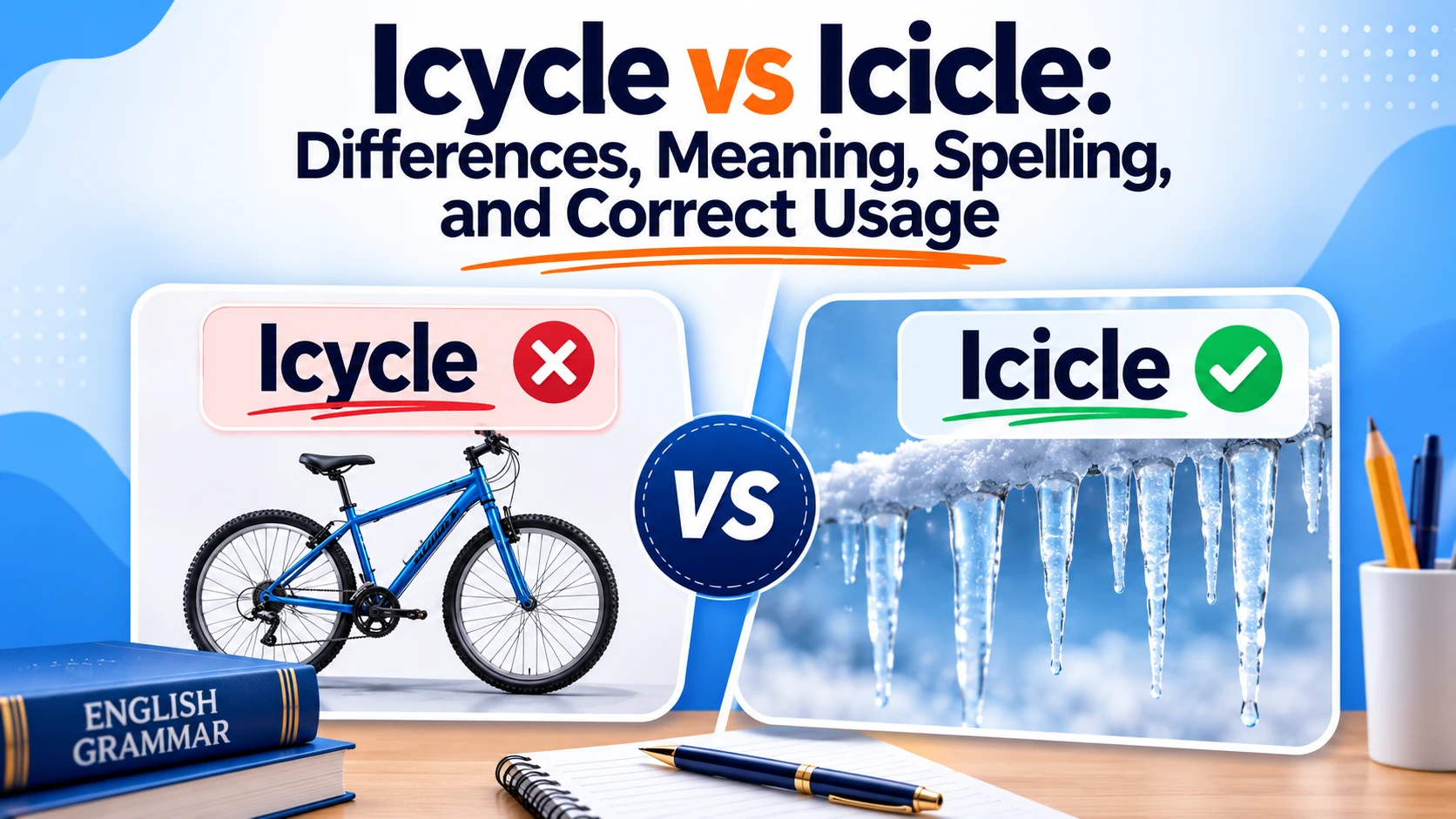
Icycle vs Icicle is a spelling question that surprises many English learners and even native speakers. The two words look almost identical, yet only one is recognized as standard English. If you’ve seen “icycle” online or accidentally typed it yourself, you’re not alone. English contains many words whose pronunciation doesn’t perfectly match their spelling, making mistakes like this surprisingly common. Understanding the correct spelling is important because even a small error can affect the clarity and professionalism of your writing.
Whether you’re writing a school assignment, preparing a weather report, editing a blog, or simply expanding your vocabulary, knowing the difference between icicle and icycle will help you communicate more accurately. Beyond spelling, it’s also useful to understand what an icicle actually is, how it forms, and how the word functions in everyday English. Many people know the object but have never learned its correct spelling or grammatical use.
In this guide, you’ll discover which spelling is correct, why “icycle” appears so often, how to use “icicle” correctly in sentences, common mistakes to avoid, and simple memory tricks that make the spelling easy to remember. You’ll also find practical examples, comparison tables, and expert writing tips that will help you use the word confidently in both casual and professional writing.
Icycle vs Icicle: Which Spelling Is Correct?
The answer is simple:
Icicle is the correct English spelling.
Icycle is not a standard English word and should not be used when referring to the pointed pieces of ice that hang from roofs, tree branches, or other surfaces during freezing weather.
Many people accidentally write icycle because it sounds similar to icicle when spoken. However, dictionaries, grammar references, and professional editors recognize only icicle as the correct spelling.
The Quick Answer
Always write:
- ✅ Icicle
Avoid writing:
- ❌ Icycle
Examples:
Correct
- A long icicle hung from the roof after the snowstorm.
- The children admired the sparkling icicles outside the cabin.
Incorrect
- A long icycle hung from the roof.
- Several icycles melted in the afternoon sun.
If your goal is correct English, icicle is always the right choice.
Why “Icycle” Is Usually Incorrect
Unlike spelling differences such as gray/grey or canceled/cancelled, icycle isn’t an accepted spelling in any major variety of English.
It usually appears because people:
- Spell the word based on its pronunciation.
- Forget that icicle contains two “ic” letter combinations.
- Type too quickly.
- Confuse the word with the phrase ice cycle.
In formal writing—including academic papers, professional emails, books, and news articles—you should never replace icicle with icycle.
When You Should Always Use “Icicle”
Use icicle whenever you’re referring to:
- A hanging piece of frozen water
- A natural ice formation
- Winter weather
- Decorative objects shaped like hanging ice
Examples:
- Thick icicles covered the cabin roof.
- An icicle broke off and landed in the snow.
- The photographer captured beautiful icicles inside the frozen cave.
Expert Tip: If you’re talking about winter, snow, freezing temperatures, roofs, gutters, caves, or frozen waterfalls, the correct spelling is almost certainly icicle.
Icycle vs Icicle at a Glance
Understanding the difference becomes much easier when the two spellings are compared side by side.
| Feature | Icicle | Icycle |
| Correct English spelling | ✅ Yes | ❌ No |
| Found in dictionaries | ✅ Yes | ❌ No |
| Accepted in professional writing | ✅ Yes | ❌ No |
| Used in weather reports | ✅ Yes | ❌ No |
| Standard English noun | ✅ Yes | ❌ No |
Meaning
An icicle is a narrow, pointed piece of ice that forms when dripping water freezes.
Icycle has no accepted meaning in standard English. When it appears, it is almost always the result of a spelling mistake.
Dictionary Status
Major dictionaries list icicle as a common noun with a well-established definition.
In contrast, icycle does not appear as a standard dictionary entry because it has never become an accepted English word. Most spelling tools automatically recommend changing icycle to icicle.
Correct Usage
You should use icicle in:
- Weather forecasts
- School assignments
- Nature articles
- Travel writing
- Scientific discussions
- Everyday conversations
Avoid icycle unless it is intentionally being used as part of a company name, product name, or username.
Example Sentences
Correct examples:
- The roof was covered with thick icicles.
- Every icicle reflected the morning sunlight.
- Be careful of falling icicles during warmer weather.
Incorrect examples:
- The roof was covered with icycles.
- A large icycle formed overnight.
These incorrect forms should always be replaced with icicle.
Is “Icycle” a Real Word?
Many people wonder whether icycle might be an uncommon English word because they see it online. The answer is no.
Icycle is not recognized as a standard English word. It does not have an accepted dictionary definition and is not considered correct in academic, professional, or everyday writing.
Why It Doesn’t Appear in Standard Dictionaries
Dictionary publishers only include words that have gained widespread, accepted use in the language. Since icycle is generally nothing more than a misspelling of icicle, it has not become part of standard English vocabulary.
If you search for icycle in many online dictionaries, you’ll often be redirected to icicle or shown a spelling suggestion instead.
Why So Many People Search for It
The popularity of this misspelling comes from several factors:
- The pronunciation can be misleading.
- English spelling is not always phonetic.
- Mobile typing increases spelling errors.
- Voice-to-text software occasionally produces incorrect spellings.
- People remember the sound more easily than the exact letter pattern.
These factors explain why icycle appears frequently in search engines even though it isn’t correct.
Situations Where “Icycle” May Be Valid
Although icycle isn’t a dictionary word, it may legitimately appear as a proper noun.
Examples include:
- A business name
- A mobile application
- A game title
- A username
- A fictional character
- A marketing campaign
For example:
- Icycle Studios
- Project Icycle
- Team Icycle
In these cases, Icycle is simply a chosen name rather than an English vocabulary word.
What Is an Icicle?
An icicle is one of the most familiar natural ice formations found during cold weather. Although it looks simple, it forms through a fascinating process involving melting and refreezing water.
Dictionary Definition
An icicle is:
A long, narrow, pointed piece of ice that hangs downward after dripping water freezes.
Its characteristic shape develops because fresh water continues flowing over the existing ice before freezing again.
How Icicles Form in Nature
Icicles form when several conditions occur together:
- Snow or ice begins to melt.
- Water drips from an elevated surface.
- Air temperatures remain below freezing.
- Each droplet freezes before falling completely.
- Additional layers of ice build on top of one another.
Over time, this process creates the familiar pointed shape associated with icicles.
Where Icicles Commonly Develop
Icicles commonly appear beneath:
- Roof edges
- Gutters
- Tree branches
- Cliffs
- Bridges
- Rock ledges
- Frozen waterfalls
- Mountain overhangs
Any place where water drips into freezing air can produce an icicle.
Why Icicles Can Become Dangerous
While icicles often create beautiful winter scenery, they can also pose real safety risks.
Large icicles may:
- Fall without warning
- Damage vehicles
- Block sidewalks
- Injure pedestrians
- Signal poor roof insulation or ice dam problems
For this reason, homeowners and building managers often remove large icicles before they become hazardous.
Safety Tip: Never walk directly beneath large hanging icicles during periods of thawing. Even relatively small pieces of falling ice can cause serious injuries.
Why People Misspell “Icicle” as “Icycle”
If you’ve ever typed “icycle” instead of “icicle,” you’re in good company. This mistake is surprisingly common because English spelling doesn’t always match pronunciation. Understanding why the error happens makes it much easier to avoid in the future.
Pronunciation and Sound-Based Spelling
One of the biggest reasons people write “icycle” is that they spell the word the way they hear it.
When spoken naturally, icicle is pronounced:
/ˈaɪ.sɪ.kəl/ (“eye-si-kuhl”)
The repeated “ic” isn’t obvious when listening, so many writers assume the word follows a simpler pattern such as ice + cycle, producing the incorrect spelling “icycle.”
This is common with English words where pronunciation doesn’t fully reflect spelling.
Examples include:
- Wednesday
- Business
- Colonel
- Comfortable
Like these words, icicle must be learned by its written form rather than sound alone.
Confusing “Icicle” with “Ice Cycle”
Another source of confusion is the phrase ice cycle.
Although the words look similar, they have completely different meanings.
- Icicle = a hanging piece of frozen water.
- Ice cycle = two separate words that could describe a repeating freezing process or another context involving cycles of ice.
For example:
Correct:
- An icicle formed beneath the gutter.
Also correct:
- Scientists studied the seasonal ice cycle of the Arctic.
These expressions are unrelated and should never be substituted for one another.
Fast Typing and Visual Memory Errors
Many spelling mistakes occur because the brain recognizes only part of a familiar word.
Instead of recalling:
icicle
the brain remembers something similar and produces:
icycle
This happens especially when:
- Typing on a phone
- Writing quickly
- Not proofreading
- Relying entirely on autocorrect
Professional writers rarely publish a first draft without reviewing it for exactly these kinds of small but noticeable mistakes.
Why English Spelling Makes This Word Tricky
English spelling developed over centuries and borrows words from many different languages.
As a result:
- Some words contain unexpected letters.
- Others preserve older spellings.
- Pronunciation changes faster than spelling.
Because of this history, memorizing correct spelling patterns often works better than relying on pronunciation alone.
Writing Tip
When learning a difficult spelling, read the word several times, write it by hand, and use it in complete sentences. Active practice builds stronger memory than simply reading the definition.
How to Pronounce “Icicle” Correctly
Correct pronunciation helps reinforce the correct spelling, especially for English learners.
Phonetic Pronunciation
The standard pronunciation is:
/ˈaɪ.sɪ.kəl/
It sounds like:
EYE-si-kuhl
Notice that the pronunciation contains three syllables, even though many people hear only two.
Syllable Breakdown
Break the word into manageable parts:
I • ci • cle
Thinking about each syllable separately often makes the spelling easier to remember.
Common Pronunciation Mistakes
Some learners accidentally pronounce the word as:
- Ice-cycle
- Eye-cycle
Although listeners usually understand the intended meaning, these pronunciations encourage incorrect spelling.
Listening to native speakers, weather broadcasts, and educational videos can help reinforce the natural pronunciation.
How to Use “Icicle” Correctly in Sentences
Knowing the definition is only part of using a word well. The following examples show how icicle appear naturally in different kinds of writing.
Everyday Conversation
You’ll often hear icicle during winter or while discussing cold weather.
Examples:
- Watch out for the icicle above the front door.
- That icicle looks ready to fall.
- The children collected photographs of unusual icicles.
These examples sound natural because they describe familiar winter experiences.
Weather Reports
Meteorologists frequently mention icicles when discussing freezing conditions.
Examples:
- Residents should remove dangerous icicles from roof edges.
- Warm afternoon temperatures may loosen large icicles.
- Heavy snowfall followed by sunshine often leads to icicle formation.
Weather reports usually emphasize safety rather than appearance.
Creative and Descriptive Writing
Authors often use icicles to create vivid imagery.
Examples:
- Crystal icicles sparkled beneath the moonlight.
- Every icicle reflected shades of blue and silver.
- The abandoned cabin was hidden behind curtains of icicles.
These descriptions help readers imagine winter scenes more clearly.
Children’s Learning Examples
Simple examples make the word easier for young learners.
Examples:
- The bird sat beside an icicle.
- One icicle melted in the sunshine.
- We counted ten icicles hanging from the roof.
These short sentences reinforce both spelling and meaning.
Grammar Rules for Using “Icicle”
Unlike some English words that serve several grammatical roles, icicle functions as a countable noun.
That means it refers to individual objects that can be counted.
Icicle as a Countable Noun
Examples:
- One icicle
- Two icicles
- Several icicles
- Hundreds of icicles
Because each formation is separate, the word naturally takes singular and plural forms.
Singular and Plural Forms
| Singular | Plural |
| Icicle | Icicles |
Examples:
- An icicle fell from the roof.
- Several icicles melted during the afternoon.
Notice that the plural simply adds -s.
Using Articles with “Icicle”
Articles depend on whether you’re referring to one or more.
Examples:
- An icicle formed overnight.
- The icicle finally melted.
- Some icicles remained after sunrise.
Because icicle begins with a vowel sound, use an, not a.
Correct:
- an icicle
Incorrect:
- a icicle
Common Adjectives That Describe Icicles
Writers frequently pair icicle with descriptive adjectives.
Examples include:
- Long icicle
- Sharp icicle
- Thin icicle
- Thick icicle
- Frozen icicle
- Glittering icicle
- Massive icicle
- Delicate icicle
Using precise adjectives creates stronger imagery.
Compare:
- An icicle hung from the roof.
Versus:
- A glittering, needle-like icicle hung from the roof.
The second sentence paints a much clearer picture.
Common Verbs Used with Icicles
Certain verbs naturally appear alongside icicle.
Examples:
- Form
- Hang
- Melt
- Break
- Fall
- Drip
- Glitter
- Grow
Examples in sentences:
- Icicles formed overnight.
- One large icicle fell onto the driveway.
- The morning sun melted the icicles.
- Water continued to drip from the icicles.
Learning these natural combinations helps your English sound more fluent instead of translated or unnatural.
Expert Tip
Rather than memorizing isolated vocabulary words, learn them together with the verbs and adjectives that native speakers commonly use. This approach improves both writing and speaking accuracy.
Common Collocations and Expressions with “Icicle”
Learning collocations—words that naturally appear together—helps your English sound more fluent. Native speakers rarely choose these combinations consciously because they have become familiar through repeated use.
Hanging Icicles
This is one of the most common collocations because icicles naturally form while hanging from elevated surfaces.
Examples:
- Large hanging icicles lined the roof.
- The hikers admired the hanging icicles inside the cave.
- Workers removed dangerous hanging icicles from the building.
Melting Icicles
As temperatures rise above freezing, icicles begin to melt.
Examples:
- The afternoon sun melted the icicles.
- Water dripped from the melting icicles.
- Be careful around melting icicles, as they may fall unexpectedly.
Giant Icicles
This phrase describes unusually large formations.
Examples:
- The abandoned barn was covered with giant icicles.
- Visitors stopped to photograph the giant icicles hanging from the cliff.
- Some giant icicles can grow several feet long under the right conditions.
Roof Icicles
This collocation commonly appears in weather reports and home maintenance advice.
Examples:
- Remove roof icicles safely before they become hazardous.
- Poor attic insulation often contributes to large roof icicles.
- Heavy snowfall followed by sunshine can produce thick roof icicles.
Sharp as an Icicle
Although not a common idiom, writers sometimes use icicle figuratively to emphasize sharpness or a cold appearance.
Examples:
- His words were as sharp as an icicle.
- The mountain peaks looked like giant icicles reaching into the sky.
In literature, icicles often symbolize:
- Cold weather
- Isolation
- Silence
- Winter
- Fragility
- Beauty
Icicle vs Ice Cycle: Why Spacing Changes the Meaning
Many people mistakenly believe that icicle is simply the words ice and cycle joined together. In reality, they are entirely different expressions with unrelated meanings.
What “Ice Cycle” Could Mean
Ice cycle is a phrase rather than a single dictionary word.
Depending on the context, it may refer to:
- Seasonal freezing and thawing cycles
- Climate patterns involving ice
- A manufacturing or refrigeration process
- A scientific discussion of repeated ice formation
Examples:
- Researchers examined the annual ice cycle in the Arctic.
- Engineers monitored the machine’s ice cycle.
Why It Isn’t the Same as “Icicle”
Although the spellings look similar, the meanings are completely different.
| Icicle | Ice Cycle |
| One word | Two separate words |
| Hanging piece of frozen water | A cycle involving ice |
| Common noun | Noun phrase |
| Used in everyday English | Used in specialized contexts |
Replacing one with the other changes the meaning of a sentence.
Examples Showing the Difference
Correct:
- A beautiful icicle formed beneath the roof.
Also correct:
- Scientists studied the seasonal ice cycle of the glacier.
Incorrect:
- A beautiful ice cycle formed beneath the roof.
The last sentence is grammatically possible but doesn’t express the intended meaning.
Similar Words Commonly Confused with “Icicle”
Many winter-related words describe frozen water, but each has its own meaning.
Icing vs Icicle
Although they share the same root word, icing and icicle are very different.
| Icing | Icicle |
| Thin layer of ice | Hanging piece of ice |
| Also means cake frosting | Natural ice formation |
Examples:
- The road was covered with icing.
- An icicle hung from the tree branch.
Iceberg vs Icicle
These words describe completely different sizes of ice.
| Iceberg | Icicle |
| Massive floating ice | Small hanging ice formation |
| Found in oceans | Forms on roofs, trees, and cliffs |
Example:
- The ship avoided the iceberg.
- An icicle broke off the roof.
Frost vs Icicle
Frost
- Thin crystals of frozen water
- Covers surfaces evenly
Icicle
- Hanging formation
- Produced by dripping water
Frost forms differently than icicles.
Examples:
- Frost covered the grass.
- Icicles formed beneath the gutter.
Hail vs Icicle
Although both involve frozen water, they develop differently.
| Hail | Icicle |
| Falls from storm clouds | Forms from dripping water |
| Round or irregular pieces | Long, pointed shape |
| Weather event | Stationary ice formation |
Knowing these distinctions helps prevent inaccurate descriptions.
Common Mistakes to Avoid
Even experienced writers occasionally make small spelling mistakes. These are the most common errors involving icicle.
Writing “Icycle” Instead of “Icicle”
This is by far the most frequent mistake.
Incorrect:
- A large icycle formed overnight.
Correct:
- A large icicle formed overnight.
Whenever you’re uncertain, remember that icicle contains two “ic” letter groups.
Misspelling the Plural Form
The plural is simply:
Icicles
Not:
- Icicle’s ❌ (unless showing possession)
- Icycles ❌
Examples:
Correct:
- The roof was covered with icicles.
Incorrect:
- The roof was covered with icycles.
Confusing Pronunciation with Spelling
English spelling doesn’t always match pronunciation.
Instead of writing words exactly as they sound, develop the habit of recognizing their standard written forms.
Regular reading naturally improves spelling accuracy.
Using “Icicle” in the Wrong Context
Remember that icicle refers specifically to a hanging piece of frozen water.
Incorrect:
- The lake was covered with icicles.
Better:
- The lake was covered with ice.
Similarly:
- The road was covered with ice.
- The roof was covered with icicles.
Choosing the correct word creates clearer descriptions.
Easy Memory Tricks to Spell “Icicle” Correctly
A few simple techniques can help you remember the spelling permanently.
Break the Word into Familiar Parts
Separate the word like this:
I • ci • cle
Practicing each syllable helps your brain remember the complete spelling rather than relying on sound alone.
Picture a Hanging Piece of Ice
Visual memory is powerful.
Imagine:
- A long, pointed icicle
- Hanging beneath a snowy roof
- Glittering in bright sunlight
Connecting the image with the word reinforces correct spelling.
Use a Mnemonic Sentence
Try this simple reminder:
“Every ICICLE contains extra ICE.”
Notice that icicle repeats the “ic” pattern.
The unusual spelling becomes easier to remember after repeating the sentence several times.
Practice with High-Frequency Phrases
Rather than memorizing the word alone, practice common expressions such as:
- Hanging icicle
- Frozen icicle
- Melting icicle
- Roof icicle
- Giant icicle
- Sharp icicle
Repeated exposure builds long-term spelling confidence.
Expert Tip
Reading quality books, weather articles, and nature magazines exposes you to correct spelling repeatedly. Over time, the correct form becomes familiar enough that the incorrect spelling immediately looks wrong.
Interesting Facts About Icicles
Beyond spelling, icicles are fascinating natural formations.
How Large Can Icicles Grow?
Under the right conditions, icicles can grow several feet long.
Their size depends on:
- Temperature
- Wind
- Water supply
- Duration of freezing conditions
Some unusually large icicles have been documented on cliffs, waterfalls, and buildings in extremely cold climates.
Why Icicles Are Usually Pointed
The pointed tip forms because gravity pulls each droplet downward before it freezes.
As more water freezes over existing ice, the formation gradually extends downward into its familiar cone-like shape.
Can Icicles Be Different Colors?
Yes.
Although most appear clear or white, environmental conditions may produce:
- Blue-tinted icicles
- Cloudy icicles
- Brown or gray icicles (caused by dirt or minerals)
Color variations often depend on the purity of the water and surrounding conditions rather than the freezing process itself.
Quick Practice Quiz
Test your understanding before moving on. These short exercises will help reinforce the correct spelling and usage of icicle.
Choose the Correct Spelling
Select the correct word for each sentence.
- A large (icicle / icycle) fell from the roof.
- The children counted ten (icicles / icycles) hanging outside the cabin.
- We admired the beautiful (icicle / icycle) in the cave.
- Warm sunshine caused the (icicles / icycles) to melt.
- Be careful when walking beneath a large (icicle / icycle).
Answers
- Icicle
- Icicles
- Icicle
- Icicles
- Icicle
Fill in the Blank
Complete each sentence with the correct form of icicle.
- A long __________ formed beneath the gutter overnight.
- The roof was covered with dozens of __________.
- The sunlight reflected beautifully from each __________.
- We photographed a massive __________ hanging from the cliff.
- Rising temperatures caused the __________ to drip steadily.
Suggested Answers
- icicle
- icicles
- icicle
- icicle
- icicle
Identify the Correct Usage
Decide whether the sentence uses icicle correctly.
| Sentence | Correct? |
| An icicle hung from the roof. | ✅ Yes |
| Several icycles formed overnight. | ❌ No |
| The cave contained beautiful icicles. | ✅ Yes |
| An ice cycle fell from the gutter. | ❌ No |
| The melting icicles dripped onto the sidewalk. | ✅ Yes |
Conclusion
The difference between icycle and icicle is simple once you know the spelling rules. Icicle is the only correct English word for the pointed piece of ice that forms when dripping water freezes, while icycle is generally just a misspelling or, in rare cases, a deliberately chosen brand or product name. Understanding the correct spelling, pronunciation, grammar, and usage allows you to write with greater confidence and avoid an error that can easily distract readers. One final actionable tip: whenever you encounter a word that looks unusual, verify it in a trusted dictionary before using it in important writing. Building this habit will improve your spelling far beyond just this single word. A common mistake to avoid: don’t assume English words are always spelled exactly as they sound. Icicle is a perfect example of why visual familiarity and careful proofreading are essential for clear, professional communication.
Frequently Asked Questions
Q1. Is “Icycle” ever the correct spelling?
In standard English, no. The correct spelling is icicle when referring to a hanging piece of frozen water. However, Icycle may be intentionally used as a brand name, product name, business name, or username, where normal dictionary spelling rules do not apply.
Q2. Why is “icicle” spelled with two “ic” letter groups?
The spelling reflects the word’s historical development rather than modern pronunciation. English preserves many older spelling patterns, which is why icicle doesn’t match the way many people expect it to sound. Reading and repeated exposure help reinforce the correct written form.
Q3. What is the plural of “icicle”?
The plural is icicles. Simply add -s to the singular form. Avoid writing icycles, which is based on the incorrect spelling. In both everyday and professional writing, icicles is the only accepted plural form.
Q4. What’s the difference between an icicle and an ice cycle?
An icicle is a single noun referring to a hanging piece of frozen water. Ice cycle is a two-word phrase that may describe a repeating freezing process or another scientific or technical concept involving ice. Although they look similar, their meanings are completely different.
Q5. How can I remember the correct spelling of “icicle”?
A helpful strategy is to associate the word with common phrases like “melting icicle” or “roof icicle.” You can also remember that icicle contains two “ic” letter groups. The more often you read and write the correct spelling, the more natural it becomes.
