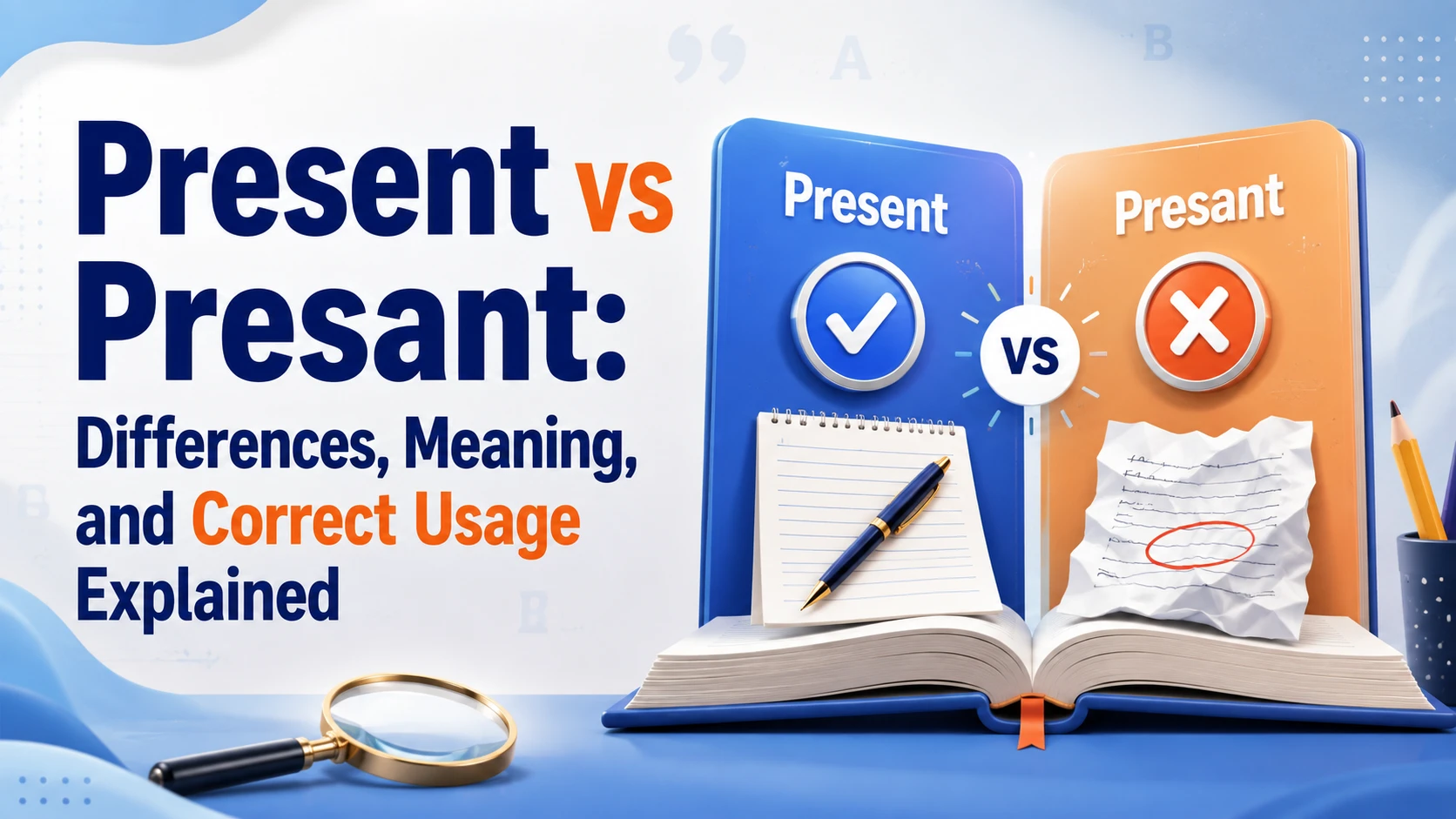
Present vs Presant is a common spelling question because the two words look similar at first glance, yet only one is correct in standard English. Whether you’re writing an email, completing homework, preparing a report, or simply trying to improve your spelling, using the correct form matters. A single misplaced letter can make polished writing appear careless. In this guide, you’ll discover why “present” is the correct spelling, what it means in different contexts, why people often write “presant” by mistake, and how to avoid this error permanently.
English is full of words that challenge even experienced writers. Some mistakes happen because of pronunciation, while others occur because our brains rely on familiar sound patterns instead of correct spelling. “Present” is one of those words with multiple meanings and grammatical roles, making it especially important to understand its proper use. You’ll learn how it functions as a noun, verb, and adjective, when each meaning applies, and how to recognize the correct usage in everyday conversations, professional communication, and academic writing.
By the end of this article, you’ll be able to identify the correct spelling instantly, understand the differences between common meanings of present, avoid frequent spelling mistakes, and use the word confidently in real-life situations. Along the way, you’ll find comparison tables, practical examples, expert writing tips, and memorable spelling techniques that make the correct form easy to remember long after you’ve finished reading.
Present vs Presant: What’s the Correct Spelling?
The short answer is simple:
“Present” is the correct spelling. “Presant” is a misspelling.
Although presant appears frequently in online searches, text messages, and typing errors, it is not recognized as a standard English word. Dictionaries, grammar references, and style guides consistently identify present as the only correct spelling.
Here’s a quick comparison.
| Feature | Present | Presant |
| Correct English spelling | ✅ Yes | ❌ No |
| Found in dictionaries | ✅ Yes | ❌ No |
| Acceptable in academic writing | ✅ Yes | ❌ Never |
| Acceptable in business writing | ✅ Yes | ❌ Never |
| Recognized by spell check | ✅ Yes | ❌ Usually flagged |
The Short Answer
If you’re wondering which word to use:
- Write present every time.
- Avoid presant in emails, essays, reports, resumes, and social media when professional writing matters.
- If you accidentally type presant, treat it as a spelling mistake rather than an alternative spelling.
Why “Presant” Is a Misspelling
Unlike regional spelling differences such as color/colour or center/centre, presant isn’t an accepted variation in American, British, Canadian, or Australian English.
Instead, it usually appears because of:
- Pronunciation-based spelling
- Typing too quickly
- Confusing vowel sounds
- Lack of proofreading
Professional editors immediately recognize presant as an error.
When You Should Always Use “Present”
Use present whenever you mean:
- A gift
- Existing now
- Someone attending a place
- Showing or introducing something
- Delivering information
- Offering evidence
For example:
- She bought me a present for my birthday.
- The manager is present at today’s meeting.
- Scientists present their findings at conferences.
- We should focus on the present rather than the past.
Every example above requires the spelling present.
Expert Tip
If your keyboard suggests presant, double-check before sending your message. Most modern spell checkers correct the mistake automatically, but proofreading remains your best defense.
Present vs Presant Comparison Table
Understanding the difference becomes easier when you compare the two side by side.
| Category | Present | Presant |
| Status | Correct English word | Incorrect spelling |
| Dictionary entry | Yes | No |
| Parts of speech | Noun, adjective, verb | None |
| Professional writing | Appropriate | Incorrect |
| Academic writing | Appropriate | Incorrect |
| Formal documents | Appropriate | Incorrect |
Meaning
Present has several legitimate meanings depending on context. It can refer to:
- A gift
- The current time
- Being in attendance
- Giving or introducing something
Presant has no recognized meaning in English because it is simply a misspelling.
Correctness
Language evolves over time, but not every frequently typed word becomes accepted. While dictionaries occasionally add new words that gain widespread usage, presant has never become part of standard English.
This distinction matters because spelling influences how readers perceive your writing. Correct spelling signals attention to detail, while repeated spelling errors can reduce credibility.
Common Usage
You may encounter presant in:
- Social media comments
- Informal text messages
- Online forums
- Student drafts
- Typing mistakes
However, edited publications, books, newspapers, and professional websites consistently use present.
Example Sentences
Correct:
- The teacher was present during the exam.
- I wrapped the birthday present yesterday.
- Please present your identification.
- We must live in the present.
Incorrect:
- She bought me a presant.
- Everyone was presant today.
- Please presant your passport.
Is “Presant” a Real English Word?
Many people search this exact question because they see presant used online and wonder whether it might be a lesser-known word.
The answer is no.
Presant is not an English word. It does not appear as a standard entry in reputable dictionaries because it has no accepted definition or grammatical function.
Why It Doesn’t Appear in Standard Dictionaries
Major dictionaries include words that meet established standards of usage, evidence, and acceptance. Since presant is simply an accidental spelling of present, it isn’t treated as a separate vocabulary word.
Instead, dictionary searches typically redirect users toward the correct spelling.
This approach helps learners recognize that the issue isn’t vocabulary—it’s spelling accuracy.
Why Spell Check Flags It
Modern spell-check tools compare your writing against extensive language databases.
When they detect presant, they recognize that:
- It isn’t a valid English word.
- A nearly identical correct word exists.
- The intended word is almost certainly present.
That’s why most grammar tools automatically suggest changing:
presant → present
Although spell check is helpful, it isn’t perfect. Writers should still proofread carefully because context matters.
Situations Where You May Encounter “Presant”
You might still see presant in places such as:
- Unedited blog comments
- Informal messaging apps
- Student assignments before revision
- Fast-paced online chats
- OCR (optical character recognition) errors from scanned documents
Seeing the misspelling repeatedly doesn’t make it correct. The internet contains millions of spelling mistakes that continue to circulate simply because content is copied without careful editing.
Writing Insight
Many spelling errors become common online because search engines index user-generated content. Popularity doesn’t determine correctness—standard dictionaries and accepted language conventions do.
Why People Commonly Misspell “Present” as “Presant”
Spelling mistakes rarely happen at random. Most have predictable causes, and understanding those causes makes them easier to avoid.
Pronunciation Confusion
One of the biggest reasons people write presant is that spoken English doesn’t always match written English.
Depending on the speaker’s accent, the second vowel in present may sound closer to an “a” than an “e.” Someone learning English by listening rather than reading may naturally assume the spelling should reflect that sound.
This is a common challenge because English spelling often preserves historical forms rather than matching modern pronunciation.
Typing Too Quickly
Fast typing increases the likelihood of vowel substitutions.
For example:
- present → presant
- believe → beleive
- separate → seperate
These mistakes happen because the fingers move faster than the brain reviews each letter.
Professional writers reduce these errors by proofreading after completing a draft rather than relying solely on autocorrect.
Vowel Confusion in English
English contains many words where similar vowel sounds represent different spellings.
Examples include:
- accept / except
- affect / effect
- principal / principle
- dependent / dependant (regional differences)
Because English doesn’t follow perfectly consistent spelling rules, writers sometimes rely on sound instead of memory, leading to errors like presant.
Influence of Regional Accents
Accents can affect perceived spelling.
For instance, some English dialects soften vowel sounds, making present sound slightly different from its written form. Learners who primarily hear spoken English may unconsciously replace e with a when writing.
Reading regularly helps strengthen visual memory of correct spellings.
Autocorrect and Keyboard Mistakes
Although modern devices often correct presant, autocorrect isn’t foolproof.
Some situations where mistakes slip through include:
- Autocorrect turned off
- Specialized software without spelling assistance
- Copying text between programs
- Voice-to-text transcription errors
Experienced editors recommend reading important documents one final time before sending or publishing them.
What Does “Present” Mean?
One reason present causes confusion is that it serves three different grammatical roles in English. It can function as a noun, an adjective, or a verb, with each use carrying a distinct meaning. Understanding these roles helps you choose the right definition based on context rather than guessing.
Unlike presant, which is simply a spelling error, present is a versatile word that appears in everyday conversations, academic writing, business communication, legal documents, and grammar lessons.
Present as a Noun (A Gift)
As a noun, present refers to something given to another person without expecting payment in return. In everyday English, it is often interchangeable with gift, although “gift” is slightly more common in formal writing.
Examples
- Emma received a beautiful present on her graduation day.
- I bought my father a birthday present last weekend.
- The children couldn’t wait to open their Christmas presents.
When to Use This Meaning
Use present when referring to:
- Birthday gifts
- Holiday gifts
- Wedding gifts
- Anniversary gifts
- Thank-you gifts
- Surprise gifts
Tip: In casual conversation, both gift and present sound natural. However, phrases like birthday present and Christmas present are especially common.
Present as an Adjective (Current or Existing Now)
As an adjective, present describes something happening now or existing at the current time.
Examples
- We should focus on the present situation.
- Technology has changed rapidly in the present century.
- The company’s present policy may change next year.
This meaning contrasts with:
- Past
- Future
For example:
- Learn from the past.
- Live in the present.
- Prepare for the future.
Present as an Adjective (In Attendance)
Another adjective meaning describes someone being physically or officially at a place.
Teachers often use this meaning during attendance.
Examples include:
- All employees were present during the meeting.
- Twenty students were present today.
- The witness was present when the accident occurred.
You’ll frequently encounter this meaning in:
- Schools
- Courtrooms
- Meetings
- Conferences
- Medical records
Present as a Verb (To Give, Show, or Introduce)
As a verb, present means to give, show, introduce, or formally deliver something.
Examples:
- She will present her research tomorrow.
- The lawyer presented new evidence.
- Our manager presented the annual report.
- Allow me to present our keynote speaker.
In professional settings, this verb often implies a formal or organized action rather than simply handing something over.
Every Meaning of “Present” Explained with Real-Life Examples
Many English learners know one meaning of present but overlook the others. Looking at each meaning separately makes it easier to understand how context changes the definition.
Present Meaning: “Gift”
This is probably the first meaning children learn.
Examples:
- Thank you for the lovely present.
- My grandparents always bring thoughtful presents.
- She wrapped every present herself.
Common collocations include:
- Birthday present
- Christmas present
- Wedding present
- Retirement present
- Graduation present
Present Meaning: “Current Time”
Here, present refers to the time happening right now.
Examples:
- We must solve the present problem.
- Nobody knows what the present economy will look like next year.
- The present generation faces different challenges than previous generations.
Common phrases include:
- At present
- Present circumstances
- Present conditions
- Present situation
Present Meaning: “Being Present”
This meaning simply refers to attendance.
Examples:
- Everyone was present except David.
- Please remain present until your name is called.
- Both witnesses were present during questioning.
Notice how this differs from “current.”
Sentence:
She was present during the meeting.
Here, it means she attended, not she exists now.
Present Meaning: “To Present Information”
Professionals frequently use present when sharing ideas with others.
Examples:
- Engineers present project updates every Friday.
- Students present research findings.
- Scientists present new discoveries at conferences.
- Doctors present patient cases during training.
This usage is especially common in:
- Universities
- Businesses
- Government agencies
- Medical fields
- Research institutions
Present Meaning: “To Introduce Someone”
Another formal use involves introducing a person.
Examples:
- I’d like to present our newest team member.
- The host presented the award winner.
- May I present Professor Anderson?
This usage appears frequently during ceremonies and official events.
Present Meaning in Legal and Formal Contexts
Legal English often uses present in specialized ways.
Examples:
- Present evidence
- Present testimony
- Present a case
- Present arguments before the court
Here, the word implies submitting information according to established procedures rather than casually showing something.
How to Use “Present” Correctly in Sentences
Knowing the definition is helpful, but knowing how native speakers naturally use the word is even more valuable.
Everyday Conversation
In daily speech, present most often refers to gifts or being somewhere.
Examples:
- Are you bringing a birthday present?
- Everyone was present at dinner.
- Try to enjoy the present instead of worrying.
These examples sound natural because context immediately tells the listener which meaning applies.
Academic Writing
Schools and universities commonly use present in more formal ways.
Examples:
- The researchers present their findings in Chapter Five.
- The report presents several possible solutions.
- Students must present their projects before graduation.
Academic writing often prefers present over casual alternatives like show because it sounds more precise.
Workplace Communication
Business professionals use present every day.
Examples:
- Please present your proposal by Friday.
- The finance department will present the quarterly report.
- Every employee must be present during safety training.
Notice that these examples emphasize professionalism and organization.
Business Emails
Correct usage improves credibility.
Example:
Please present your recommendations during tomorrow’s meeting.
Another example:
All managers should be present for the client presentation.
These constructions appear naturally in corporate communication.
Formal Documents
Contracts, legal documents, and government paperwork frequently use present.
Examples:
- The applicant shall present valid identification.
- Please present supporting documents.
- The individual was present during the inspection.
Formal writing favors precision, making the correct spelling especially important.
Present in English Grammar
Beyond vocabulary, present also plays a major role in grammar because it names one of the primary verb tenses.
This is where many learners become confused.
The word present can refer to:
- The current time
- A gift
- Attendance
- A grammatical tense
Fortunately, context makes the intended meaning clear.
What Is the Present Tense?
The present tense describes actions, situations, or states that happen now or are generally true.
Examples:
- She works every day.
- Birds fly.
- Water boils at 100°C under standard atmospheric pressure.
- They live in Chicago.
The present tense isn’t limited to actions occurring at this exact second. It also expresses:
- Habits
- Facts
- Routines
- Scheduled events
- Ongoing situations
Why the Word “Present” Has More Than One Grammatical Role
English contains many words that function as multiple parts of speech.
For example:
| Word | Possible Roles |
| Work | Noun, Verb |
| Light | Noun, Verb, Adjective |
| Watch | Noun, Verb |
| Present | Noun, Verb, Adjective |
Rather than memorizing isolated definitions, experienced writers identify the role by looking at the surrounding words.
Consider these examples:
- I bought a present. (noun)
- Everyone was present. (adjective)
- Please present your passport. (verb)
The spelling never changes, but the function does.
Expert Tip
When you’re unsure which meaning of present is intended, ask yourself one question: Is it naming something, describing something, or expressing an action? The answer quickly reveals whether the word is acting as a noun, adjective, or verb.
The Four Types of Present Tense Explained
The term present tense doesn’t refer to a single verb form. In English grammar, it includes four distinct tenses, each used for a different purpose. Choosing the right one helps you express ideas accurately and naturally.
Simple Present Tense
The simple present tense describes habits, routines, facts, general truths, and scheduled events.
Structure
Subject + base verb (or base verb + s/es for third-person singular)
Examples:
- She works from home.
- They study every evening.
- The sun rises in the east.
- My train leaves at 8 a.m.
Common Uses
Use the simple present to express:
- Daily habits
- Permanent situations
- Scientific facts
- Instructions
- Timetables
Example Sentences
- I drink coffee every morning.
- The library opens at nine.
- Water freezes at 0°C under standard conditions.
- He speaks Spanish fluently.
Best Practice: Avoid using the simple present for actions happening right now unless you’re describing a live event or giving instructions.
Present Continuous Tense
The present continuous tense describes actions that are happening now or temporary situations.
Structure
Subject + am/is/are + verb + ing
Examples:
- She is reading a novel.
- We are preparing dinner.
- They are discussing the proposal.
Common Uses
Use it for:
- Actions happening now
- Temporary situations
- Developing trends
- Planned future arrangements
Example Sentences
- I am learning French this year.
- The company is expanding rapidly.
- They are meeting the client tomorrow.
- It is raining outside.
Present Perfect Tense
The present perfect tense connects the past with the present.
Structure
Subject + has/have + past participle
Examples:
- I have finished the report.
- She has visited Japan twice.
- They have completed the project.
Common Uses
Use it to describe:
- Experiences
- Recently completed actions
- Actions with present results
- Unfinished time periods
Example Sentences
- We have already eaten.
- She has never driven a truck.
- The manager has approved your request.
- Scientists have discovered a new species.
Present Perfect Continuous Tense
This tense emphasizes the duration of an action that began in the past and continues into the present.
Structure
Subject + has/have been + verb + ing
Examples:
- She has been studying for three hours.
- I have been working all afternoon.
Common Uses
Use it when focusing on:
- Ongoing activities
- Duration
- Recently finished actions with visible results
Example Sentences
- We have been waiting since noon.
- It has been snowing all morning.
- He has been practicing the piano every day.
- They have been improving their customer service.
Common Collocations with “Present”
A collocation is a natural combination of words that native speakers frequently use together. Learning these combinations helps your English sound more fluent.
Birthday Present
Examples:
- She received a birthday present from her grandparents.
- I still remember my favorite birthday present.
Present Evidence
Common in legal, academic, and professional settings.
Examples:
- The attorney presented evidence to the court.
- Researchers presented evidence supporting the theory.
Present Results
Frequently used in business and education.
Examples:
- Our team will present the results tomorrow.
- Students must present their results clearly.
Present an Argument
Examples:
- Please present your argument respectfully.
- The author presents a convincing argument.
Present a Report
Examples:
- The committee will present its annual report.
- Managers present financial reports each quarter.
Present Yourself Professionally
Examples:
- Dress appropriately to present yourself professionally.
- Your communication skills help present you as a confident employee.
Common Idioms and Expressions Using “Present”
Many English expressions use present in ways that go beyond its literal meaning.
At Present
Meaning: Currently or right now.
Examples:
- At present, we have no additional information.
- The product is unavailable at present.
For the Present
Meaning: For now or temporarily.
Examples:
- We’ll leave things as they are for the present.
- That’s enough discussion for the present.
The Present Day
Meaning: Modern times.
Examples:
- Technology has transformed present-day education.
- Present-day medicine has advanced significantly.
Live in the Present
Meaning: Focus on today’s experiences instead of dwelling on the past or worrying excessively about the future.
Example:
- She tries to live in the present and appreciate every moment.
Present Company Excepted
This polite expression means that a general criticism does not apply to the people currently present.
Example:
Lawyers—present company excepted—often receive unfair criticism.
Although less common today, it still appears in formal conversation and literature.
Present vs Gift: What’s the Difference?
Many learners wonder whether present and gift mean exactly the same thing.
In most situations, they refer to the same thing, but the tone can differ.
| Feature | Present | Gift |
| Basic meaning | Something given to someone | Something given to someone |
| Everyday use | Very common | Very common |
| Formal writing | Less common | Slightly more common |
| Holiday contexts | Extremely common | Common |
| Can be used as a verb | Yes (“present”) | Yes (“gift”), but less common |
Are They Always Interchangeable?
Usually, yes.
For example:
- Birthday present ✔
- Birthday gift ✔
Both are correct.
However, certain expressions strongly favor one word.
More natural:
- Christmas present
- Wedding gift
- Gift card
- Gift shop
Native speakers often choose the word based on convention rather than strict grammar.
Differences in Tone and Context
Present often feels:
- Personal
- Celebratory
- Holiday-related
Gift may sound:
- Slightly more formal
- Generous
- Symbolic
Neither choice is incorrect, but context influences which sounds more natural.
Present vs Current: When Should You Use Each Word?
Although both words can describe something happening now, they are not always interchangeable.
| Present | Current |
| Often broader in meaning | Mainly means existing now |
| Can be noun, adjective, or verb | Primarily an adjective |
| Used in grammar terms | Not used in grammar names |
| Can mean gift | Cannot mean gift |
Similarities
Both words may describe:
- Existing now
- Modern conditions
- Ongoing situations
Examples:
- Present circumstances
- Current circumstances
Both are correct.
Key Differences
“Current” focuses almost exclusively on time.
“Present” has several meanings.
Compare:
- My present job. ✔
- My current job. ✔
But:
- I bought a present for her birthday. ✘
- I bought a present for her birthday. ✔
Example Sentences
- The present policy will remain unchanged.
- The current policy will remain unchanged.
- Please present your ID.
- Please current your ID. ✘
Understanding these distinctions prevents awkward word choices.
Common Mistakes to Avoid
Even experienced writers occasionally misuse present. Recognizing these errors helps you produce clearer, more professional writing.
Writing “Presant” Instead of “Present”
This remains the most common mistake.
Incorrect:
- I bought a presant.
Correct:
- I bought a present.
Always proofread words that contain commonly confused vowels.
Confusing the Noun, Verb, and Adjective Forms
Consider these examples:
Correct:
- I bought a present. (noun)
- Please present your report. (verb)
- Everyone is present. (adjective)
Using the wrong form changes the sentence entirely.
Misusing “Present” in Formal Writing
Sometimes writers choose present when a more specific verb would improve clarity.
Instead of:
- The report presents many things.
Consider:
- The report explains, analyzes, or summarizes the findings.
Choosing precise verbs strengthens professional writing.
Capitalization Errors
The word present is generally lowercase.
Capitalize it only when:
- It begins a sentence.
- It appears in a title following title capitalization rules.
- It forms part of a proper noun.
Examples:
- Present circumstances require caution.
- The Present Study (article title)
Do not capitalize it unnecessarily within ordinary sentences.
How to Remember the Correct Spelling of “Present”
If you often type presant, these memory techniques can help.
The “Present = Gift” Memory Trick
Picture yourself opening a wrapped present with a large letter E printed on the box.
Associating the correct spelling with a vivid image makes it easier to recall.
The “Present Time” Association
Think of the phrase:
Present time
You’ve probably seen it in books, classrooms, and news articles hundreds of times.
The repeated exposure reinforces the correct spelling naturally.
The “Pre + Sent” Visualization Method
Break the word into two familiar parts:
Pre + sent
While this isn’t the word’s historical origin, it serves as a useful spelling reminder because sent is already a familiar English word.
Proofreading Techniques That Catch This Error
Professional editors often use these habits:
- Read slowly instead of scanning quickly.
- Review important documents aloud.
- Run a spelling check before publishing.
- Look specifically for commonly misspelled words.
- Proofread after taking a short break.
These practices catch mistakes that your brain may overlook immediately after writing.
Expert Tip: Don’t rely entirely on autocorrect. It catches many spelling errors, but careful proofreading remains the most reliable way to ensure polished writing.
Practice Exercises
The best way to remember the difference between present and presant is to use the word yourself. These short exercises reinforce the correct spelling and help you recognize the different meanings of present in context.
Choose the Correct Spelling
Select the correct word to complete each sentence.
- She bought her brother a birthday (present / presant).
- All employees must be (present / presant) during the safety meeting.
- The professor will (present / presant) the research findings.
- We should focus on the (present / presant) rather than worrying about the future.
- Please (present / presant) your identification before entering.
Answers
- Present
- Present
- Present
- Present
- Present
Fill in the Blank
Complete each sentence using the correct form of present.
- The CEO will ________ the company’s annual report.
- My grandparents gave me a wonderful birthday ________.
- Everyone was ________ except one student.
- Scientists continue to study the ________ effects of climate change.
- Please remain ________ until your name is called.
Suggested Answers
- present
- present
- present
- present
- present
Identify the Meaning of “Present”
Determine how present is used in each sentence.
| Sentence | Meaning |
| She opened her birthday present. | Noun (gift) |
| Everyone was present at the ceremony. | Adjective (in attendance) |
| We should enjoy the present. | Adjective (current time) |
| Please present your passport. | Verb (show or provide) |
| The host presented the award. | Verb (formally give) |
Frequently Confused Words Related to “Present”
Many spelling and vocabulary mistakes occur because English contains words that look or sound alike. Understanding these differences helps you write more accurately.
Present vs Presence
Although both words share the same root, they serve different purposes.
| Present | Presence |
| Noun, adjective, or verb | Noun only |
| Can mean gift, current, attend, or introduce | Means the state of being somewhere or someone’s influence |
Examples:
- Her presence made everyone feel comfortable.
- She was present during the meeting.
Notice that presence refers to someone’s existence or attendance as an abstract idea, while present can describe the person directly.
Present vs Presenter
A presenter is the person who gives a presentation or introduces information.
Examples:
- The presenter answered audience questions.
- She will present the report tomorrow.
One names the person, while the other describes the action.
Present vs Presentation
A presentation is the speech, report, or demonstration itself.
Examples:
- His presentation lasted twenty minutes.
- He presented the presentation confidently.
Although the sentence is grammatically correct, skilled writers often avoid repeating similar words. A smoother alternative is:
He delivered the presentation confidently.
Present vs Represent
These verbs have different meanings.
| Present | Represent |
| To show, introduce, or give | To act on behalf of or symbolize |
Examples:
- The lawyer presented evidence.
- The lawyer represents the client.
Confusing these verbs can change the meaning of an entire sentence.
Quick Reference Checklist
Use this checklist whenever you’re unsure about the spelling.
Correct if…
- ✔ You mean a gift
- ✔ You mean existing now
- ✔ You mean attending
- ✔ You mean to introduce
- ✔ You mean to show or deliver
Incorrect if…
- ✘ You write presant
- ✘ You assume pronunciation determines spelling
- ✘ You skip proofreading important documents
At-a-Glance Summary
| Question | Answer |
| Is present correct? | ✅ Yes |
| Is presant correct? | ❌ No |
| Is “presant” in standard dictionaries? | ❌ No |
| Can “present” be a noun? | ✅ Yes |
| Can “present” be an adjective? | ✅ Yes |
| Can “present” be a verb? | ✅ Yes |
| Does “present” have multiple meanings? | ✅ Yes |
Conclusion
The difference between present and presant is straightforward once you understand the spelling and the word’s multiple meanings. Present is the only correct spelling, whether you’re referring to a gift, the current time, someone’s attendance, or the act of introducing or showing something. Mastering these distinctions not only improves your spelling but also makes your communication clearer and more professional. One final actionable tip: add present to your personal list of commonly misspelled words and pause for a quick proofreading check whenever you use it in important writing. This simple habit can prevent embarrassing errors before they reach your reader. A common mistake to avoid: assuming that a word’s pronunciation always matches its spelling. English contains many exceptions, and present is a reminder that careful proofreading is just as valuable as knowing the rules.
Frequently Asked Questions
Q1. Is presant ever considered correct in English?
No. Presant is a misspelling, not a regional variation or an alternative spelling. Whether you’re writing in American English or British English, the correct form is always present. Standard dictionaries and style guides do not recognize presant as a valid word.
Q2. Why do so many people type presant instead of present?
The mistake usually happens because of pronunciation, fast typing, or vowel confusion. Some accents make the second vowel sound closer to an “a,” causing writers to spell the word based on how it sounds instead of how it’s written.
Q3. Can present be used as more than one part of speech?
Yes. Present is a versatile English word that functions as a noun, adjective, and verb. Its meaning depends on the sentence. Context tells readers whether you’re referring to a gift, current time, attendance, or the act of introducing or showing something.
Q4. What’s the easiest way to remember the correct spelling of present?
Associate the word with familiar expressions such as birthday present, at present, or present your ID. Reading these common phrases regularly strengthens your visual memory, making the correct spelling much easier to recognize during writing.
Q5. Does using presant affect professional writing?
Yes. Although it’s a small spelling error, it can make emails, résumés, reports, and academic assignments appear less polished. Consistently using the correct spelling present demonstrates attention to detail, which is especially important in professional and educational settings
