
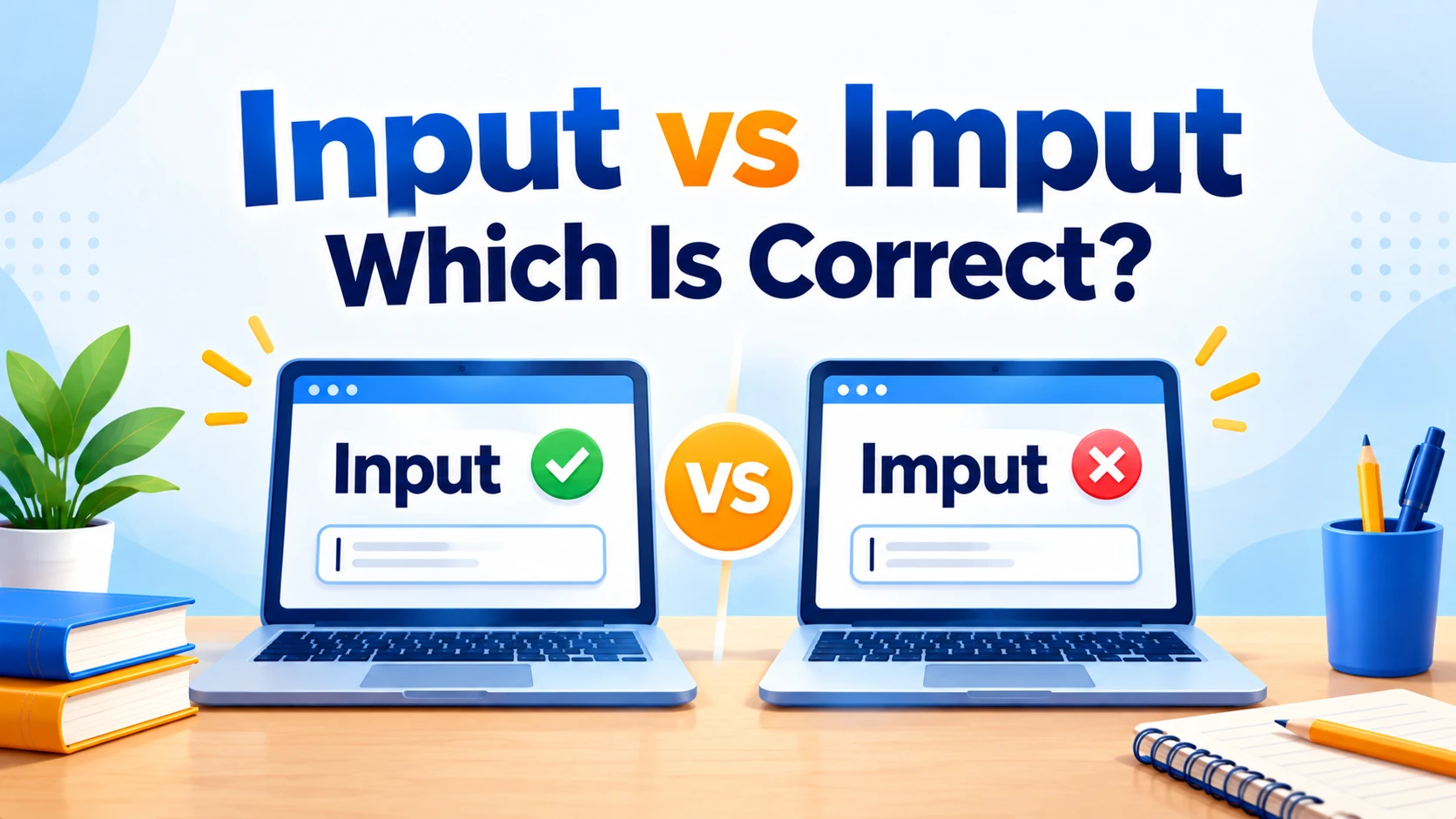
Input vs Imput is a spelling question with a surprisingly simple answer: input is the correct standard spelling, while imput is generally a misspelling. The confusion is understandable because the two forms look and sound close, especially when input is spoken quickly. But in standard English, there is no ordinary spelling choice between them. Dictionaries recognize input as both a noun and a verb, covering everything from advice and feedback to data entered into a computer or system.
The distinction matters because input appears constantly in business writing, technology, education, forms, software, research, and everyday conversation. You might ask for someone’s input on a proposal, enter input into a form, or describe a keyboard as an input device. Writing imput in these contexts can make an otherwise polished sentence look careless. More importantly, the mistake can become harder to spot once you have seen it repeatedly online.
There is also a second source of confusion worth understanding: impute is a genuine English word, but it means something entirely different. It means to attribute something—often responsibility, blame, a quality, or a motive—to a person or cause. This article explains the difference between input, imput, and impute, shows how input works as a noun and verb, covers common word forms such as inputting, and gives practical ways to remember the correct spelling.
Quick answer: Use input. In ordinary standard English, imput is a spelling error, not an alternative spelling.
Input vs Imput: Which Spelling Is Correct?
Input is the correct spelling.
Imput is generally an incorrect spelling of input. If you are writing an email, essay, report, application, technical document, or ordinary message, choose input.
| Word | Correct standard English? | Meaning | Example |
| input | Yes | Information, advice, data, material, or something put into a system | “We need your input.” |
| imput | No, in ordinary standard usage | Usually a misspelling of input | “Please imput the data.” ❌ |
| impute | Yes | To attribute or ascribe something to someone or something | “They imputed the failure to poor planning.” |
The important point is that input and impute are separate words, whereas imput is normally not a third legitimate spelling option.
Merriam-Webster lists input as a noun and a verb. Its noun meanings include advice or opinion, information fed into a computer, energy or material supplied to a system, and other things that are put into a process. As a verb, input means to enter data into a computer or data-processing system.
Is “Imput” Ever an Alternative Spelling?
For normal English writing, no.
You may encounter imput in search queries, social media posts, informal messages, comments, or documents containing typos. Seeing it repeatedly does not turn it into a standard spelling.
There is an important distinction, however. A sequence of letters can appear inside a brand name, username, product name, file name, or other proper label without being a standard English word. That is different from using imput as an ordinary spelling of input.
For general writing, the practical rule is simple:
If you mean information, an opinion, data, or something entered into a system, write “input.”
What Does “Input” Mean?
The word input has several related meanings, but they all share a useful underlying idea: something being put into a person, discussion, process, machine, or system.
Merriam-Webster records input as a noun dating to the 17th century and as a verb dating to the 20th century.
Input as a Noun
As a noun, input can refer to information, advice, opinions, data, energy, material, or another contribution supplied to something.
Consider these examples:
- “I appreciate your input on the proposal.”
- “The computer receives input from the keyboard.”
- “The project requires significant financial input.”
- “The researchers collected input from participants.”
- “The machine converts electrical input into output.”
Notice that input does not always mean computer data.
When a manager says, “I’d like your input,” the person is asking for an opinion, suggestion, or contribution. When a programmer talks about user input, the reference may be information supplied to software.
That flexibility is one reason the word appears across so many fields.
Input as a Verb
Input can also function as a verb meaning to enter data or information into a computer or other system.
Examples:
- “Please input your customer number.”
- “The operator input the readings into the database.”
- “Users can input their answers online.”
- “You need to input the code before continuing.”
This noun-and-verb flexibility is called conversion between word classes, and it is common in English. The spelling does not change simply because the grammatical role changes.
Input as a Contribution
There is another especially common use in professional English:
“We need everyone’s input before we finalize the plan.”
Here, input means ideas, opinions, knowledge, or feedback contributed to a decision.
That meaning is particularly common in:
- Meetings
- Project planning
- Management
- Consulting
- Research
- Policy discussions
- Team collaboration
Merriam-Webster’s thesaurus groups input in this sense with words such as advice, information, guidance, feedback, recommendation, suggestion, and counsel.
Why Do People Spell “Input” as “Imput”?
The mistake is not random. Several features of English make imput look plausible at first glance.
The Word Sounds Different From How Some People Expect It to Look
English spelling cannot always be predicted perfectly from pronunciation. When people encounter a word mainly through conversation, they may construct a spelling from what they hear.
Input is especially easy to misremember because the word is short and the consonants occur close together in speech.
Someone who has rarely seen the word written may mentally represent the sound as imput.
“Im-” Is a Familiar English Pattern
English contains many words beginning with im-, particularly words where im- functions as a prefix or reflects historical word formation:
- impossible
- impatient
- imperfect
- imbalance
- immoral
That visual pattern can make imput seem reasonable.
But input is not spelled with an im- prefix. For modern English spelling purposes, the most useful memory is the transparent combination:
in + put = input
You do not need a complicated linguistic rule to remember it.
“Impute” Adds to the Confusion
There is a real word spelled impute, pronounced differently and used with a different meaning.
Impute means to attribute or ascribe something to a person, cause, or thing. Merriam-Webster also notes its frequent association with assigning blame or responsibility.
For example:
“The report imputed the decline to poor management.”
That similarity in spelling can make imput feel as though it belongs to the same family. It does not.
Fast Typing Makes the Error Easy to Produce
The problem is particularly common when someone is:
- Typing quickly
- Writing from memory
- Using speech-to-text
- Working in a second language
- Switching between technical and everyday vocabulary
- Focusing on ideas rather than proofreading
A short word can be more vulnerable to unnoticed errors than a long unfamiliar one because the writer’s brain may recognize the intended meaning without carefully inspecting every letter.
Input vs Impute: Two Real Words With Different Meanings
One of the most useful distinctions to learn is not input vs imput, but input vs impute.
What Does “Impute” Mean?
Impute is a verb meaning to attribute something to someone or something.
It is relatively formal and commonly appears when discussing responsibility, motives, causes, or blame.
Examples:
- “It would be unfair to impute bad motives to her.”
- “The investigators imputed the failure to inadequate planning.”
- “The criticism was imputed to political pressure.”
The word can carry a stronger sense of attribution than everyday verbs such as say or mention.
Input vs Impute: A Clear Comparison
| Feature | Input | Impute |
| Part of speech | Noun and verb | Verb |
| Main idea | Put in, enter, contribute | Attribute or ascribe |
| Common context | Data, opinions, systems, decisions | Responsibility, motives, causes, blame |
| Example | “Please input the data.” | “They imputed the failure to poor planning.” |
| Related word | Output | Imputation |
A useful test is to ask what action you mean.
If something is being put into a system or discussion, you probably need input.
If you are attributing a quality, cause, motive, or responsibility, you may need impute.
How to Use “Input” Correctly in a Sentence
Examples of “Input” as a Noun
Here are several uses that demonstrate how broad the word can be:
- Opinion: “I’d like your input before I respond.”
- Advice: “Her input helped us improve the proposal.”
- Computer data: “The program processes user input.”
- Material: “The manufacturing process requires several raw-material inputs.”
- Signal: “The device receives an audio input.”
- Contribution: “Community input influenced the final decision.”
The meaning is determined by context.
Examples of “Input” as a Verb
As a verb, input normally refers to entering information:
- “Input your email address.”
- “The clerk input the customer’s details.”
- “Please input the figures carefully.”
- “The researcher input the results into the database.”
In formal instructions, the verb is especially common in software interfaces, forms, databases, spreadsheets, and data-entry procedures.
Common Collocations With “Input”
Natural English frequently pairs input with particular words.
| Collocation | Meaning | Example |
| provide input | contribute information or an opinion | “Please provide input on the draft.” |
| seek input | ask for opinions or advice | “The committee sought input from teachers.” |
| get input | receive advice or information | “We need to get input from the client.” |
| valuable input | useful contribution | “She provided valuable input.” |
| user input | information supplied by a user | “The application validates user input.” |
| input data | data supplied to a process | “Check the input data first.” |
| input field | area where information is entered | “Complete each input field.” |
| input device | hardware used to send information to a computer | “A keyboard is an input device.” |
Learning these combinations is more useful than memorizing the spelling in isolation because they show how native and professional usage actually works.
Input in Technology and Computing
Technology is one of the areas where input appears most frequently.
In a simplified system model:
Input → Processing → Output
Something enters the system, the system processes it, and a result is produced.
For example:
Keyboard input → Computer processing → Information displayed on screen
This is why the word appears in terms such as:
- Input device
- Input field
- Input value
- Input signal
- User input
- Audio input
- Keyboard input
- Input data
Input vs Output
The relationship between input and output provides an excellent spelling aid.
| Concept | Basic meaning | Example |
| Input | Something supplied to a system | A user’s search query |
| Processing | What the system does with it | The software interprets the query |
| Output | The resulting information or action | Search results |
If you remember input/output, the spelling of input becomes much easier to retain.
Memory shortcut: If something goes in, it is input. If something comes out, it is output.
Input in Business, Academic, and Everyday English
The word is not limited to computers.
In Business Communication
Input often means a person’s professional opinion, expertise, or contribution.
“I’d appreciate your input on the revised contract.”
This does not mean the person should type something into a computer. It means their judgment or perspective is wanted.
In Academic Writing
Researchers may use input when discussing information, contributions, or data supplied to a process.
“The researchers incorporated participant input into the final questionnaire.”
In technical or methodological contexts, the word may also describe information supplied to a model, experiment, or analytical process.
In Everyday Conversation
The word can sound completely natural in informal speech:
- “What’s your input?”
- “Can I get your input on this?”
- “Thanks for the input.”
- “We need everyone’s input.”
In some situations, opinion, advice, or feedback may sound more specific. Input is useful when you mean a broader contribution.
Common Mistakes With “Input”
Mistake 1: Writing “Imput”
Incorrect:
“Please imput your information.”
Correct:
“Please input your information.”
This is the central spelling error the article addresses.
Mistake 2: Treating “Imput” as a Pronunciation-Based Variant
A spelling can feel logical because it resembles the sound you hear. That does not make it standard.
When uncertain, rely on the established written form input, not on a spelling reconstructed from pronunciation.
Mistake 3: Confusing “Input” and “Impute”
Incorrect meaning:
“They inputted the blame to the manager.”
If the intended meaning is that blame was attributed to the manager, the appropriate verb is impute:
“They imputed the blame to the manager.”
If information was entered into a system, use input:
“They input the information into the database.”
Mistake 4: Writing “Imputting”
The correct present participle is inputting, not imputting.
The same spelling principle remains visible:
input → inputting
Merriam-Webster lists inputted or input as past-tense/past-participle forms and inputting as the present participle.
Input, Inputs, Inputting, and Inputted: Which Form Should You Use?
The basic forms can cause their own uncertainty.
| Form | Function | Example |
| input | Singular noun / base verb | “We need your input.” |
| inputs | Plural noun / third-person verb | “The system accepts several inputs.” |
| inputting | -ing form | “She is inputting the data.” |
| input | Past tense in some usage | “He input the figures yesterday.” |
| inputted | Past tense/past participle | “She inputted the figures yesterday.” |
There is some variation in how speakers handle the past tense. Input and inputted are both established forms, and Merriam-Webster explicitly lists both.
For practical writing, consistency matters more than trying to force a single form into every context.
If your organization has a house style, follow it. Otherwise, use the form that sounds natural and remains clear.
What About “Inputted”?
Inputted is not the same kind of error as imput.
This distinction is important:
- imput → generally a misspelling of input
- inputted → an established verb form
So don’t “correct” inputted merely because it looks unusual.
A Quick Decision Guide: Input, Imput, or Impute?
When proofreading, this simple decision process can eliminate the confusion quickly.
| If you mean… | Use… | Example |
| Information entered into a system | input | “Input the code.” |
| Advice or an opinion | input | “We need your input.” |
| Data supplied to a process | input | “Check the input data.” |
| Attribution of blame or responsibility | impute | “They imputed the error to poor planning.” |
| The spelling “imput” | Neither | Usually correct it to input |
A Practical Three-Second Check
Before submitting a document:
- Does the word mean something being put in? → input
- Does it mean attributing something to someone or something? → impute
- Did you write “imput”? → Check it; you probably mean input.
This works better than memorizing an abstract spelling rule because it connects the word to its meaning.
How to Remember the Correct Spelling of Input
The “In + Put” Trick
The easiest memory aid is also the most reliable:
IN + PUT = INPUT
Something goes in. It is put in. Therefore:
input
This is particularly useful for learners who instinctively write imput.
The Input/Output Pair
Remember the familiar technical pair:
input ↔ output
Both describe direction.
- Input goes in.
- Output comes out.
The visual relationship can reinforce the spelling without requiring a separate mnemonic.
Don’t Use “Impute” as Your Spelling Model
Although impute is a legitimate word, it should not be used to construct the spelling of input.
Think of them as different vocabulary items:
input = put in
impute = attribute
That distinction is enough for most writers.
Is “Imput” Ever Correct?
For ordinary English prose, use input, not imput.
The fact that a misspelling appears online does not make it an accepted variant. Search engines, social media, user comments, and informal digital communication contain enormous amounts of unedited text, so frequency of appearance is not a reliable test of dictionary status.
There is also no need to “upgrade” imput into an informal spelling simply because readers understand it. In professional communication, correct spelling removes an unnecessary distraction.
If you encounter Imput as part of a specific name, identifier, username, software label, or other deliberately created term, treat that as a proper-name issue rather than evidence that imput is a standard spelling of the English word input.
Five Quick Examples to Test Yourself
Choose input, imput, or impute.
- “Please ___ your phone number into the form.”
- “We would appreciate your ___ on the proposal.”
- “The report ___ the failure to inadequate planning.”
- “The software accepts keyboard ___.”
- “Do not ___ the information manually.”
Answers
- input
- input
- imputed
- input
- input
The pattern is straightforward once meaning is considered.
Conclusion
The correct spelling is input, whether you are talking about computer data, someone’s opinion, a contribution to a discussion, or something supplied to a process. Imput is normally a spelling mistake, not an alternative form. The more important distinction to remember is between input and impute: input means putting in or contributing, while impute means attributing something to a person or cause. One final actionable tip: whenever imput appears in your draft, stop and ask whether you mean in + put. If you do, change it to input. A common mistake to avoid is “correcting” the legitimate form inputted simply because it looks unfamiliar. Good editing is not about making every unusual-looking word simpler; it is about choosing the established word that matches the intended meaning.
Frequently Asked Questions
Q1. Is “imput” a real English word?
Imput is generally not recognized as the standard spelling of the word people mean when they write input. In ordinary English, use input for information, advice, data, or something entered into a system. If you encounter imput online, it is usually a spelling error rather than an accepted variant.
Q2. Why does “imput” look correct?
The spelling can seem plausible because English contains many words beginning with im-, and the pronunciation of input may be interpreted incorrectly when spoken quickly. The presence of the genuine word impute can reinforce the confusion. The simplest solution is to remember in + put = input.
Q3. Is “input” both a noun and a verb?
Yes. As a noun, input can mean information, advice, an opinion, data, energy, or another contribution. As a verb, it means to enter data into a computer or system. This dual grammatical role is why the word appears naturally in both “We need your input” and “Input the data.”
Q4. What is the difference between “input” and “impute”?
Input concerns putting something into a system or contributing information or an opinion. Impute means to attribute something to a person, cause, or thing, often responsibility or blame. For example, you input data but impute a failure to poor planning. They are separate words with different meanings.
Q5. Is “inputting” or “imputting” correct?
The correct form is inputting. The spelling retains the letters in input rather than changing the final consonant to create imputting. Merriam-Webster lists inputting as the -ing form and recognizes input and inputted as past-tense forms.
