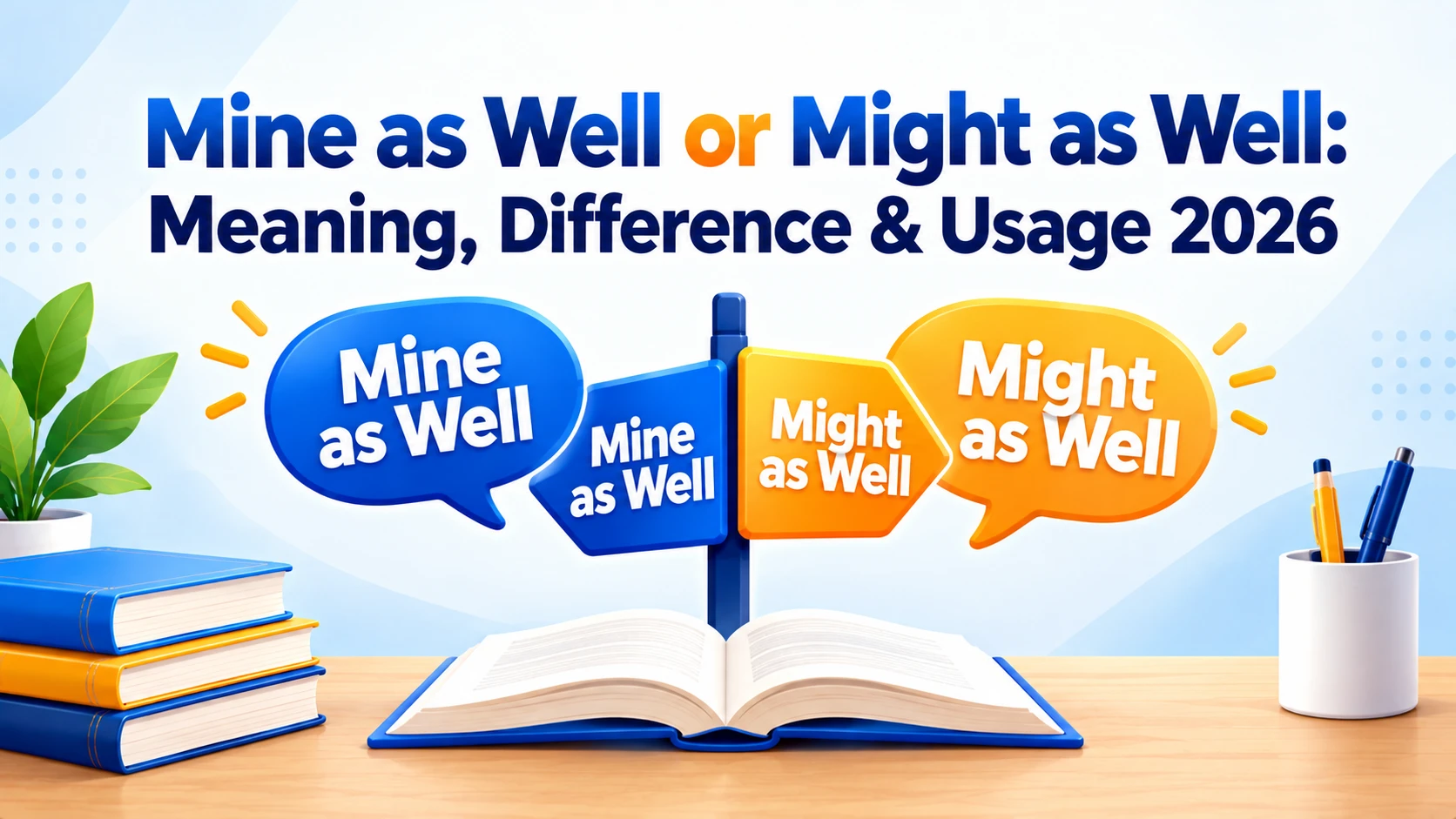
Mine as well or might as well is a surprisingly common English confusion, especially when someone hears the expression in conversation and tries to write it from memory. In most cases, the correct expression is “might as well,” which means that something seems reasonable because there is no better alternative or no good reason not to do it. For example, “We’re already here, so we might as well stay.” But “mine as well” is not automatically wrong: mine is a possessive pronoun, so the phrase can be grammatically correct when it means “belonging to me too.”
The important difference is therefore meaning and grammatical function, not simply spelling. In “I might as well go,” might is a modal verb forming part of an idiomatic expression. In “The responsibility is mine as well,” mine is a possessive pronoun, and as well means “also.” These sentences may sound vaguely similar when spoken quickly, but they perform completely different jobs. Understanding that distinction is much more useful than memorizing that one spelling is “right” and the other is “wrong.”
This guide explains might as well, mine as well, may as well, and mind as well with practical examples. You’ll learn what each expression means, how might as well works grammatically, when mine as well is genuinely correct, why learners confuse the forms, how tone changes the meaning of might as well, and which mistakes to avoid in formal and everyday writing. The goal is simple: by the end, you should be able to choose the correct expression from its meaning and sentence structure, even when pronunciation makes the words sound confusing.
Mine as Well or Might as Well: Which One Is Correct?
If you are trying to express the idea “there is no good reason not to do this,” the correct expression is:
might as well
For example:
We have another hour before the train arrives, so we might as well get some coffee.
Cambridge describes may/might as well as an expression used to suggest doing something when there is often nothing better to do, while Merriam-Webster defines it as saying something should be done or accepted because it cannot be avoided or because there is no good reason not to do it.
By contrast, mine as well has a completely different grammatical structure.
That responsibility is mine as well.
Here, mine means belonging to me, and as well means also.
The fastest way to distinguish them
| Expression | What it means | Example |
| might as well | It is reasonable to do something | We might as well leave. |
| mine as well | Belonging to me too | The decision is mine as well. |
| may as well | Similar to might as well | We may as well start. |
| mind as well | Usually a mistaken version of might as well | ❌ We mind as well leave. |
Quick rule: If you mean “there is no reason not to,” use “might as well.” If you mean “it belongs to me too,” “mine as well” can be correct.
What Does “Might as Well” Mean?
Might as well is an idiomatic construction used when an action seems like the most sensible, practical, or worthwhile option in the circumstances.
It often carries the underlying idea:
“Why not?”
For example:
The restaurant is closing soon, so we might as well order now.
The speaker is not necessarily excited about ordering. The point is that, given the circumstances, ordering now makes sense.
Cambridge notes that might as well and may as well are used to make suggestions when the speaker cannot see a better alternative. Merriam-Webster also gives a second related use: saying that another action could have produced essentially the same result.
Common meanings of “might as well”
Depending on context, it can express:
- Practicality: There is no reason not to do it.
- Suggestion: This seems like a sensible option.
- Resignation: The situation is already this way, so we may as well accept it.
- Lack of a better alternative: Nothing else seems preferable.
- Equal outcome: Another choice would probably have produced the same result.
Examples
We’re already at the store, so we might as well buy some milk.
You’re here now, so you might as well stay for dinner.
The meeting has been delayed, so we might as well wait.
If nobody else wants the last ticket, you might as well take it.
In each sentence, might as well connects the action to the circumstances that make it reasonable.
How “Might as Well” Works Grammatically
One reason people write mine as well is that they recognize the sound but do not recognize the grammatical structure.
Might is a modal verb. Oxford explains that modal verbs such as can, could, may, might, must, should, and would are followed by the base form of another verb, without to.
The basic pattern is:
subject + might as well + base verb
Examples:
- I might as well go.
- You might as well ask.
- We might as well wait.
- She might as well stay.
- They might as well start.
Why there is no “to”
A common learner error is:
❌ We might as well to leave.
The correct form is:
✅ We might as well leave.
This happens because might is already a modal verb. The verb following it remains in its base form.
Compare:
We might go.
and:
We might as well go.
The addition of as well does not change the modal grammar.
Why “might as well going” is wrong
Another common mistake is using the -ing form:
❌ We might as well going home.
Correct:
✅ We might as well go home.
The same rule applies regardless of the subject:
He might as well leave.
Not:
❌ He might as well leaves.
What Does “Mine as Well” Mean?
Mine is a possessive pronoun. Cambridge defines it as referring to something belonging to or connected with the speaker.
For example:
Whose phone is this?
It’s mine.
The word mine can also appear with as well, where as well means “also” or “too.”
For example:
Your responsibility is significant, but the final decision is mine as well.
Here, the meaning is:
The final decision is also mine.
That is a completely grammatical construction.
Examples of legitimate “mine as well”
The responsibility is mine as well.
That concern is mine as well.
The final decision is mine as well as yours.
If the problem affects you, it affects mine as well.
The exact naturalness of the last type depends heavily on what mine refers to. In many situations, mine too, mine also, or repeating the noun will be clearer.
Why “Mine as Well” Is Usually Wrong in “I Might as Well…”
Consider this sentence:
❌ I mine as well go home.
The problem is not that mine is an inherently incorrect English word. The problem is that mine cannot perform the grammatical job that “might” performs in this sentence.
The intended structure is:
I might as well go home.
Here, might is the modal that modifies go.
If you substitute mine, the grammatical relationship disappears:
I mine as well go home.
There is no grammatical construction in standard English in which mine functions as the modal auxiliary in that position.
This is why the correction should not simply be memorized as:
“Mine is wrong.”
The more accurate explanation is:
“Mine” is correct when it functions as a possessive pronoun. It is incorrect when someone uses it as a replacement for the modal “might.”
That distinction prevents overcorrection.
Might as Well vs Mine as Well: The Key Difference
The simplest comparison is grammatical.
“Might as well” is an idiomatic modal construction
In:
We might as well leave.
- might* is a modal verb, and the complete expression communicates a practical suggestion.
“Mine as well” is a possessive construction
In:
The responsibility is mine as well.
mine is a possessive pronoun, and as well adds the meaning “also.”
Detailed comparison
| Feature | Might as well | Mine as well |
| Main word | might | mine |
| Word class | Modal verb | Possessive pronoun |
| Typical following structure | Base verb | A complement or clause element |
| Core meaning | Practical/reasonable action | Belonging to me too |
| Example | We might as well leave. | The choice is mine as well. |
| Can the expressions replace each other? | No | No |
The distinction becomes obvious if you replace as well with too.
The decision is mine too.
This makes sense.
But:
I might too go.
does not express the same idiomatic idea.
The two constructions only look similar on the page.
When Should You Use “Might as Well”?
Use might as well when circumstances make an action seem sensible, unavoidable, or no worse than the alternatives.
1. When there is no good reason not to act
We’re already outside, so we might as well walk.
The speaker has identified no strong reason to choose another option.
2. When you are already committed to something
I’ve already opened the document, so I might as well finish the report.
The first action makes the second action feel efficient or logical.
3. When waiting has no obvious benefit
The doctor is running late, so we might as well wait.
4. When making a casual suggestion
You’re going to the kitchen? I might as well come with you.
5. When accepting an unavoidable situation
We’ve already missed the first bus, so we might as well take the next one.
The phrase does not necessarily mean the speaker likes the situation. It often means the available alternatives are not better.
The Tone of “Might as Well” Can Change
One of the most useful advanced points is that might as well does not have a single emotional tone.
Compare these sentences:
We have some free time, so we might as well explore the city.
This sounds positive or adventurous.
Now:
We’ve waited for two hours, so we might as well wait another ten minutes.
This sounds resigned.
And:
If you’re going to criticize the proposal, you might as well suggest an alternative.
This can sound challenging or slightly confrontational.
The grammar is the same, but context and intonation change the attitude.
Common tones
| Tone | Example |
| Practical | We might as well start now. |
| Casual | We might as well grab lunch. |
| Resigned | We might as well wait. |
| Encouraging | You might as well give it a try. |
| Sarcastic | We might as well spend the whole day here. |
| Challenging | You might as well explain what you mean. |
This is why simply translating might as well as one fixed phrase can sometimes miss the intended meaning.
“Might as Well” Does Not Mean “Might Also”
This is a particularly important distinction.
As well by itself commonly means also, too, or in addition. Cambridge explains this use separately from the idiom might as well.
Compare:
You might also need a jacket.
This means a jacket is an additional possibility or requirement.
But:
You might as well take a jacket.
This suggests that taking the jacket is a sensible option under the circumstances.
Cambridge specifically warns that may/might as well does not mean may/might also in the sense of “possibly in addition.”
Compare these examples
You might also call Sarah.
= Calling Sarah is another possible action.
You might as well call Sarah.
= Given the circumstances, calling Sarah seems reasonable.
That small word as changes the construction significantly.
“Might as Well” vs “May as Well”
Both might as well and may as well are standard expressions.
Cambridge describes both as suggestions and notes that might as well is more common. Both are relatively informal.
Examples:
We might as well start now.
We may as well start now.
The practical meaning is very similar.
When “might as well” is a natural choice
It is especially common in everyday conversation:
We’re already here. We might as well stay.
When “may as well” appears
It can sound slightly more formal or traditional in some contexts:
We may as well begin, since everyone has arrived.
Do not turn this into a rigid British-versus-American rule. Both forms occur in standard English, and the difference is largely one of usage, style, and individual preference.
“Might as Well” vs “Could Just as Well”
These expressions can overlap, but they are not identical.
Might as well
We might as well take the train.
The speaker suggests that taking the train is the sensible choice given the circumstances.
Could just as well
We could just as well take the train.
This emphasizes that the train is equally reasonable as another option.
The second expression often highlights alternatives:
We could take a taxi, but we could just as well take the train.
Meanwhile:
We might as well take the train.
sounds more like a practical decision based on the circumstances.
Common Mistakes With “Might as Well”
Mistake 1: Writing “mine as well” before a verb
❌ I mine as well go home.
✅ I might as well go home.
This is the central spelling and grammar mistake.
Mistake 2: Writing “mind as well”
❌ We mind as well leave.
✅ We might as well leave.
Mind is a completely different word.
It can be a verb:
I don’t mind waiting.
Or it can appear in expressions such as:
Mind the step.
But it does not normally replace might in might as well.
Mistake 3: Adding “to”
❌ We might as well to start.
✅ We might as well start.
Mistake 4: Adding an “s” to the following verb
❌ She might as well goes.
✅ She might as well go.
Modal verbs are followed by the base form of the verb.
Mistake 5: Using “might as well” when you mean “also”
❌ I might as well need some paper.
(if the intended meaning is simply “I might also need paper”)
Better:
I might also need some paper.
The idiom should be used when the circumstances make an action reasonable, not merely because something is an additional possibility.
Why Do People Confuse “Mine” and “Might”?
The confusion is largely phonological and contextual.
In natural speech, words can be reduced, linked, or pronounced quickly. A listener who already knows the phrase only by sound may later reconstruct it incorrectly in writing.
There is also a vocabulary issue. Mine is a very familiar English word, so a learner who hears something resembling mine as well may choose the familiar spelling rather than recognize the established expression might as well.
The best solution is not to memorize pronunciation. It is to recognize the sentence pattern.
might as well + base verb
Once that pattern becomes familiar, the spelling becomes much easier.
“Mind as Well” vs “Might as Well”
Mind as well is usually a mistaken spelling when the writer intends the common idiom.
Compare:
❌ We mind as well leave now.
✅ We might as well leave now.
However, mind itself is perfectly legitimate English.
“Mind” in other constructions
I don’t mind waiting.
Would you mind closing the door?
Mind the gap.
Keep that in mind.
These sentences demonstrate why simply identifying a word as “wrong” can be misleading. Mind is a valid word; it is simply not the word required by the idiom “might as well.”
“Might of as Well” and Other Writing Errors
Another related error is:
❌ might of as well
This often results from confusing the spoken contraction might’ve with the words might of.
But might’ve means might have:
She might’ve forgotten.
That is different from:
She might as well forget it.
The two constructions should not be mixed.
Compare
| Incorrect | Correct | Reason |
| ❌ mind as well | ✅ might as well | Wrong word |
| ❌ mine as well go | ✅ might as well go | Wrong grammatical function |
| ❌ might to go | ✅ might go | Modal + base verb |
| ❌ might as well goes | ✅ might as well go | No -s after modal |
| ❌ might of as well | ✅ might as well | Confusion with might’ve |
“Mine as Well” vs “Mine Too”
Sometimes mine as well is grammatically correct but not the most natural choice.
Compare:
The responsibility is mine as well.
and:
The responsibility is mine too.
Both can mean that the speaker shares responsibility.
In everyday conversation, mine too may be shorter and more direct. Mine as well can sound more deliberate, particularly when it follows another person’s statement.
Example
A: The final decision is yours.
B: It’s mine as well.
This works because mine clearly means my responsibility/decision/choice, and as well means also.
But if the sentence becomes awkward or ambiguous, rewrite it:
I share the responsibility too.
Clear writing is usually better than forcing a particular phrase simply because it contains the target keyword.
“Mine as Well” in Real Sentences
Here are situations where the construction genuinely works.
Shared responsibility
The responsibility is mine as well.
Meaning: The responsibility belongs to me too.
Shared concern
That concern is mine as well.
Meaning: I have the same concern.
Shared ownership
The property is mine as well as theirs.
Meaning: I also have ownership of it.
Shared decision-making
The final choice is mine as well.
Meaning: I have authority over the choice too.
These examples are fundamentally different from:
I might as well make the choice.
The first group concerns possession, responsibility, or connection. The second concerns a practical action.
A Simple Three-Question Test
When you hesitate, ask these questions in order.
Question 1: Do I mean “there is no reason not to”?
If yes:
might as well
Example:
We have nothing else to do, so we might as well watch a movie.
Question 2: Do I mean “belonging to me too”?
If yes:
mine as well
Example:
That responsibility is mine as well.
Question 3: Do I simply mean “also”?
If yes, you may only need:
as well
Example:
Sarah is coming as well.
This third question prevents another common problem: using might as well when ordinary as well would be enough.
Practical Decision Table
| Intended meaning | Best expression | Example |
| There is no reason not to act | might as well | We might as well leave. |
| This is the sensible option | might as well | You might as well ask. |
| Something belongs to me too | mine as well | The responsibility is mine as well. |
| Something happened to me too | to me as well | That happened to me as well. |
| Someone/something is included | as well | She came as well. |
| Another possibility exists | might also | We might also need help. |
| An alternative is equally reasonable | could just as well | We could just as well walk. |
| Asking about tolerance | mind | Would you mind waiting? |
“Might as Well” in Everyday Situations
At work
The report is already open, so I might as well finish it now.
The speaker has already invested time and effort.
While traveling
The museum is only five minutes away, so we might as well walk.
Walking is a practical choice given the distance.
While shopping
We’re already here, so we might as well buy the replacement.
The existing situation makes the additional action reasonable.
During a delay
The flight is delayed for three hours, so we might as well get something to eat.
Eating is a practical response to the delay.
At home
I’ve already cleaned the kitchen, so I might as well clean the dining room too.
The completed work creates a reason to continue.
When “Might as Well” Can Sound Reluctant
Native speakers frequently use the phrase when they are not particularly enthusiastic.
Consider:
We might as well go.
This does not necessarily mean:
“Going sounds fantastic!”
It may instead mean:
“There doesn’t seem to be a better option.”
That distinction is useful for English learners because a dictionary translation such as “may as well” can miss the speaker’s attitude.
Compare
You might as well join us!
Friendly invitation.
Well, we might as well join them.
Possible resignation.
Since we’re already late, we might as well stop for coffee.
Practical acceptance.
The surrounding context supplies the emotional meaning.
Is “Might as Well” Formal or Informal?
Cambridge characterizes may as well and might as well as fairly informal.
That does not mean they are incorrect in professional writing.
They are perfectly grammatical, but a formal document may sometimes benefit from a more precise alternative.
Conversational
We might as well postpone the meeting.
More formal
Given the circumstances, postponing the meeting would be reasonable.
Conversational
You might as well send it today.
More formal
It would be reasonable to send it today.
The choice depends on audience and register, not grammatical correctness.
For a normal email, blog post, message, or conversation, might as well is usually entirely natural.
British vs American English
There is no major British-American split in the core meaning of might as well. The expression is established in both varieties.
The same is true of mine as a possessive pronoun.
The more important distinction is between standard grammar and informal usage, not nationality.
Cambridge’s grammar reference presents may as well and might as well as general English constructions and notes that might as well is more common.
Therefore, avoid rules such as:
“Americans say might as well, but British speakers say mine as well.”
That is simply not an accurate description of the grammar.
Practice: Choose the Correct Expression
Fill in each blank with might as well, mine as well, mind, as well, or might also.
- We are already here, so we ______ stay.
- The responsibility is ______.
- Would you ______ waiting for five minutes?
- Sarah is coming ______.
- We ______ need another copy of the document.
- There is no point waiting, so we ______ leave.
- That decision is ______, not just yours.
- I don’t ______ helping you.
- If we’re ordering food, we ______ order dessert.
- My brother is attending the event ______.
Answers
- might as well
- mine as well
- mind
- as well
- might also
- might as well
- mine as well
- mind
- might as well
- as well
The important lesson is that the correct answer depends on meaning, not simply on which word looks or sounds familiar.
Common Myths About “Mine as Well” and “Might as Well”
Myth 1: “Mine as well” is always wrong
False.
It is wrong when used as a substitute for might as well, but it can be grammatically correct when mine is a possessive pronoun.
The responsibility is mine as well.
Myth 2: “Might as well” means “might also”
False.
Might as well normally suggests that an action is reasonable because there is no better alternative or no strong reason not to do it. Might also simply introduces another possibility.
Myth 3: “Might as well” always means the speaker is reluctant
False.
It can express resignation, but it can also be a neutral practical suggestion or even an enthusiastic invitation.
Myth 4: “Mine as well” is an informal pronunciation of “might as well”
False.
Informal speech can make words harder to distinguish, but mine and might remain different words with different grammatical functions.
Myth 5: “Might as well” is too informal for all professional writing
Not necessarily.
It is grammatical and common, but writers should consider the expected register. A highly formal report may benefit from more explicit wording.
Expert Editing Checklist
Before publishing or submitting your sentence, check the following:
- Do I mean “there is no reason not to”?
- Use might as well.
- Do I mean “belonging to me too”?
- mine as well may be correct.
- Do I simply mean “also”?
- Use as well.
- Am I discussing another possible action?
- Consider might also.
- Am I using a modal followed by a verb?
- Use the base form: might go, not might goes.
- Have I added “to” after might?
- Remove it.
- Did I write “mind as well” by mistake?
- Check whether you mean might as well.
- Does the sentence sound ambiguous?
- Rewrite it rather than forcing mine as well.
Conclusion
The difference between mine as well and might as well becomes straightforward once you stop treating it as a simple spelling question. Might as well is an established modal expression used when an action seems reasonable, practical, or unavoidable under the circumstances. Mine as well, meanwhile, can be perfectly grammatical when mine means “belonging to me” and as well means “also.” One final actionable tip: replace the phrase mentally with “there is no reason not to.” If that meaning fits, write might as well. A common mistake to avoid is assuming that mine as well is always wrong; context determines its validity. Good English depends on recognizing what a word is doing in the sentence, not merely how it sounds.
Frequently Asked Questions
Q1. Is “mine as well” grammatically correct?
Yes, mine as well can be grammatically correct when mine functions as a possessive pronoun and as well means “also.” For example, “The responsibility is mine as well” means that the responsibility belongs to me too. It is not, however, a substitute for might as well.
Q2. Why do people write “mine as well” instead of “might as well”?
The confusion often comes from spoken English, where connected speech can make words harder to distinguish. Writers may remember the sound of the expression rather than its grammatical structure. Recognizing might as well + base verb is a more reliable strategy than spelling the phrase from pronunciation.
Q3. Is “mind as well” ever correct?
Mind as well is normally incorrect when someone intends the idiom might as well. However, mind is a legitimate word in other constructions, such as “I don’t mind waiting” or “Would you mind helping?” The problem is specifically using mind as the modal in might as well.
Q4. Is “might as well” the same as “may as well”?
They are very similar and both are standard. Cambridge notes that both can make suggestions when there is no better alternative, and might as well is more common. They can often be substituted without changing the practical meaning, although individual speakers may prefer one for stylistic reasons.
Q5. Can “might as well” be used in formal writing?
Yes, it is grammatically correct, but it has a fairly informal conversational character. In highly formal or academic prose, a phrase such as “it would be reasonable to” or “given the circumstances” may be more precise. The best choice depends on audience, purpose, and register rather than correctness alone.
