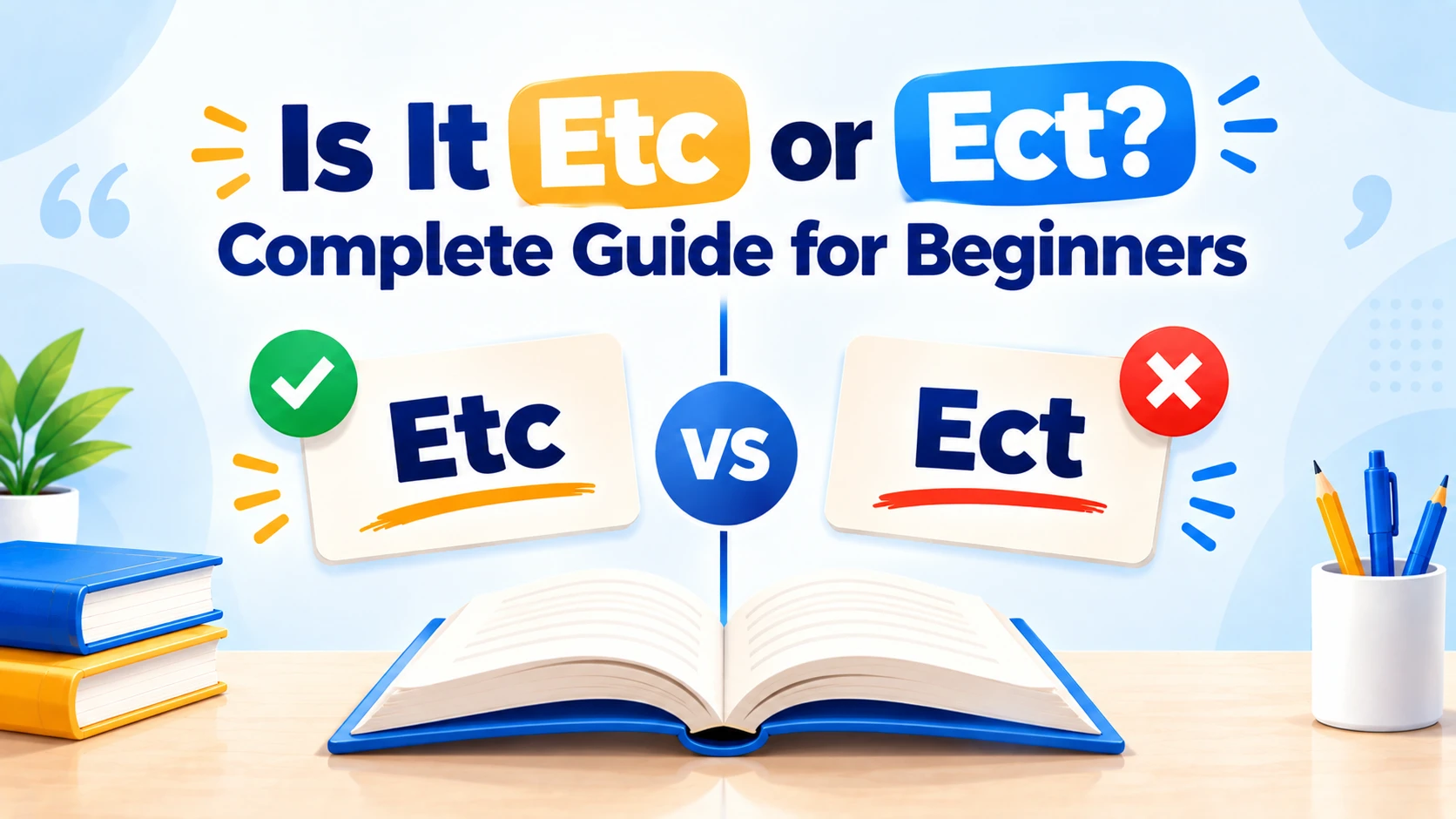
Etc or ect is a surprisingly common spelling question, especially when people hear the expression aloud rather than see it written. If you mean “and other things” or “and so on,” the correct abbreviation is etc. It comes from the Latin phrase et cetera, and major dictionaries define it as an abbreviation used after a list when there are additional similar things that could be mentioned. Ect is not the standard spelling of this abbreviation.
The confusion is understandable because etcetera can sound as though the letters might be arranged differently when spoken quickly. That can lead writers to type ect, ect., or even and etc. But these are not simply alternative styles of the same abbreviation. In this guide, you’ll learn why etc. is correct, how to punctuate it, when it helps your writing, when it makes your meaning vague, and how it differs from related expressions such as et cetera, et al., and so on, and such as.
There is also a useful distinction beginners often miss: etc. is not an ordinary English word that has been shortened at random. It represents a longer Latin expression. Understanding that origin makes the spelling much easier to remember. We’ll also look at formal writing, academic work, business communication, everyday sentences, British and American English, common mistakes, and the separate acronym ECT, so you can recognize the difference rather than memorizing a single rule without understanding it.
Etc or Ect: Which Spelling Is Correct?
If you are using the expression to mean “and other similar things,” write etc.
Correct: Please bring pens, pencils, notebooks, etc.
Incorrect: Please bring pens, pencils, notebooks, ect.
Oxford defines etc. as an abbreviation used after a list to show that there are other things that could have been mentioned. Cambridge gives the same basic meaning and explains that it is used to avoid giving a complete list.
“Etc.” Is the Standard Form
The spelling comes directly from et cetera:
et cetera → etc.
The abbreviation takes the initial letters of the two words:
- et → ET
- cetera → C
- together → ETC
That is why the letters appear in the order E-T-C, not E-C-T.
Why Is “Ect” So Common?
The mistake is usually caused by sound rather than meaning.
When people hear et cetera pronounced naturally, the repeated sounds can run together. Someone who has learned the expression mainly through conversation may remember its pronunciation but never notice the written sequence etc.
There is another reason: ect looks like a plausible English abbreviation. Once someone has typed it several times, autocorrect or habit can reinforce the error.
The important point is simple:
If you mean “and other things,” use etc.
Etc. vs Ect at a Glance
| Form | Correct for “and other things”? | Meaning |
| etc. | ✅ Yes | And other similar things |
| et cetera | ✅ Yes | Full form of etc. |
| ect | ❌ No | Common misspelling of etc. |
| ect. | ❌ No | Incorrect spelling of the abbreviation |
| ETC | ⚠️ Context-dependent | Can represent other acronyms in specialized contexts |
One subtle point matters here: ETC in capital letters can represent something entirely different in a specialized context. That does not make lowercase ect a valid spelling of etc.
What Does “Etc.” Mean?
Etc. is an abbreviation of et cetera. It is used after a list to indicate that other similar items exist but do not need to be named individually. Oxford and Cambridge both describe this list-ending function.
For example:
We bought apples, oranges, bananas, etc.
The writer has named several examples, but the list could continue with pears, grapes, peaches, and other fruits.
The Full Form: Et Cetera
The full expression is:
et cetera
It is a Latin expression traditionally understood as meaning “and other things” or “and the rest.” Cambridge defines et cetera as “and other similar things.”
The abbreviation simply saves space:
et cetera → etc.
You can use either form depending on the context.
What Does Etc. Do in a Sentence?
Its job is to signal continuation without listing every example.
Compare:
The shop sells pens, pencils, rulers, notebooks, folders, staplers, paper clips, and more.
with:
The shop sells pens, pencils, rulers, notebooks, etc.
The second sentence is shorter because the writer expects the reader to understand that the category continues.
Examples of Natural Uses
Objects:
Put the books, folders, notebooks, etc. on the shelf.
Activities:
She enjoys reading, hiking, painting, etc.
Categories:
The course covers grammar, punctuation, vocabulary, etc.
Everyday items:
We need milk, eggs, bread, butter, etc.
The common thread is that the omitted items should belong to a recognizable group.
Is “Ect” Ever a Correct Spelling?
If you are trying to write the abbreviation for et cetera, ect is not the correct spelling.
It is better understood as a common spelling error, not as a competing version of etc.
“Ect” Is Not an Alternative Form of “Etc.”
English has many genuine spelling variants. For example, different dictionaries may recognize alternative forms of some words.
That is not what is happening with ect.
The standard abbreviation is based on the original expression:
et cetera → etc.
Moving the final two letters around does not create another accepted spelling of the abbreviation.
But What About “ECT”?
This is where context becomes important.
ECT can be a legitimate acronym for electroconvulsive therapy, a medical treatment. In that context, the capital letters represent a completely different term.
So these are not equivalent:
“Bring pens, paper, folders, etc.”
and
“The patient received ECT.”
The first uses etc. to mean “and other similar things.”
The second uses ECT as a specialized acronym.
Why Context Matters
Capitalization can signal that a sequence of letters is an acronym rather than an ordinary abbreviation.
Therefore:
ect ≠ etc.
And:
ECT may be a legitimate acronym, but it does not make ect correct for et cetera.
Etc. vs Ect: The Real Difference
There is no meaningful difference in definition because ect is not a standard alternative spelling of etc.
The useful comparison is therefore:
| Feature | Etc. | Ect |
| Represents et cetera | Yes | No |
| Means “and other similar things” | Yes | No |
| Standard abbreviation | Yes | No |
| Used after a list | Yes | No |
| Appropriate in ordinary English writing | Yes | No |
| Common beginner spelling error | No | Yes |
The Difference Comes Down to Letter Order
The easiest way to understand the spelling is to stop treating etc. as a mysterious three-letter word.
Think about the source:
ET CETERA
Take the beginning of each word:
ET + C = ETC
That gives you the correct sequence immediately.
Why “Ect” Can Look Convincing
English readers are accustomed to abbreviations that do not always follow obvious patterns. If someone has never consciously connected etc. with et cetera, ect can look perfectly plausible.
This is why simply saying “remember the spelling” is not the best teaching method.
A stronger memory aid is:
Remember the phrase first; the abbreviation follows automatically.
How to Use “Etc.” Correctly in a Sentence
The best use of etc. is after a list whose category is already clear.
Use Etc. After a Partial List
We sell shirts, jackets, trousers, shoes, etc.
The reader understands that these are examples from a larger range of clothing or related products.
Use Etc. When the Missing Items Are Predictable
Consider:
You can bring a laptop, tablet, phone, etc.
The omitted items are not completely random. They belong to the broad category of electronic devices.
Compare that with:
I like coffee, history, blue cars, etc.
This is weak because the relationship between the items is unclear.
Keep the List Coherent
A good rule for writers is:
The examples before etc. should give the reader a reasonable idea of what comes after it.
You do not need to name every possible item. But you should give enough information for the reader to understand the category.
Etc. Does Not Require a Huge List
There is no universal rule saying that you must provide a particular number of examples before etc.
What matters is clarity.
For example:
The form asks for your name, address, etc.
Two examples can be enough if the context makes the remaining information obvious.
Punctuation Rules for “Etc.”
Punctuation around etc. causes almost as much confusion as the spelling itself.
Does Etc. Need a Period?
In conventional writing, etc. is written with a period because it is an abbreviation.
Cambridge’s punctuation guidance specifically gives etc. as an example of an abbreviation traditionally written with a full stop. It also notes that the use of full stops in abbreviations is becoming less common in some contexts.
So the safest general form is:
etc.
What If Etc. Comes at the End of a Sentence?
You do not normally add a second period.
Correct:
We bought pens, pencils, paper, etc.
The period already present in etc. also serves as the sentence-ending full stop.
What About a Question Mark or Exclamation Mark?
If the sentence ends with a question or exclamation mark, use that punctuation after etc.
Did you buy pens, pencils, notebooks, etc.?
Bring your passport, tickets, identification, etc.!
The question mark or exclamation mark ends the sentence; the period belongs to the abbreviation.
Should You Write “Etc,”?
In ordinary general-purpose writing, etc. is the safest conventional form.
However, punctuation practices for abbreviations vary between style systems. Some modern editorial systems omit periods from certain abbreviations. That does not make ect acceptable; it only means that etc and etc. can reflect different style conventions.
The important distinction is:
etc vs etc. = possible style variation
etc vs ect = spelling error
Why “And Etc.” Is Usually Wrong
One of the most common mistakes is:
❌ “Bring pens, pencils, and etc.”
The problem is built into the expression itself.
Et in et cetera already carries the idea of “and.”
So and etc. unnecessarily repeats that function.
Better Examples
| Incorrect | Better |
| Bring pens, pencils, and etc. | Bring pens, pencils, etc. |
| We sell shirts, shoes, and etc. | We sell shirts, shoes, etc. |
| Study nouns, verbs, and etc. | Study nouns, verbs, etc. |
What About “And So On”?
And so on is different because it is a complete English expression.
We studied nouns, verbs, adjectives, and so on.
That sentence is perfectly natural.
The problem is not the idea of ending a list with a continuation phrase. The problem is combining and with etc. in a redundant way.
When Should You Avoid Using “Etc.”?
Knowing when not to use etc. is just as important as knowing its spelling.
Avoid Etc. When the List Is Complete
If you have deliberately named every relevant item, etc. suggests that more items exist.
For example:
The three states of matter are solid, liquid, and gas.
Adding etc. would weaken the precision because the statement is intended to be complete.
Avoid Etc. When the Missing Information Matters
Imagine a safety instruction:
Wear gloves, protective glasses, etc.
What else is required?
If the omitted equipment matters, the writer should name it.
In instructions, specifications, legal documents, medical guidance, and technical procedures, vague shorthand can create ambiguity.
Avoid It When the Category Is Unclear
This sentence is difficult to interpret:
She bought a laptop, roses, a dictionary, etc.
What connects those items?
If the reader cannot reasonably infer what the omitted examples are, etc. is doing too much work.
Avoid Excessive Use in Academic Writing
There is nothing inherently unprofessional about etc. Academic dictionaries recognize it, and it appears in formal contexts.
The issue is precision.
Instead of:
The study considers age, income, location, etc.
a researcher may need to identify the exact variables if those details affect how the study is understood.
A Useful Editorial Test
Before keeping etc., ask:
“Would the reader understand what I am leaving out?”
If yes, etc. may be useful.
If no, write the information explicitly.
Etc. vs Et Cetera vs “And So On”
These expressions overlap, but they are not identical in style or structure.
| Expression | What it does | Typical feel |
| etc. | Abbreviated continuation of a list | Compact, neutral |
| et cetera | Full form of etc. | More spelled-out/formal |
| and so on | Indicates continued examples or similar things | Natural, conversational |
| and so forth | Similar to and so on | Neutral/formal |
| and more | Indicates additional items or possibilities | Broad, less specific |
| such as | Introduces examples | Specific example-giving |
Etc. vs Et Cetera
These have the same basic function.
Bring pens, pencils, notebooks, etc.
and:
Bring pens, pencils, notebooks, et cetera.
The first is shorter. The second spells out the phrase.
For ordinary writing, etc. is generally the more economical choice.
Etc. vs And So On
These can often substitute for one another:
We discussed grammar, vocabulary, punctuation, etc.
We discussed grammar, vocabulary, punctuation, and so on.
The second sounds slightly more conversational.
Etc. vs Such As
This difference is more important.
Such as introduces examples:
Fruits such as apples, oranges, and pears are available.
Etc. signals that the list continues:
Apples, oranges, pears, etc. are available.
Using such as can be better when you want to make clear that the items listed are examples rather than an exhaustive list.
Etc. vs Et Al.: A Common Academic Confusion
Another expression frequently confused with etc. is et al.
They are not interchangeable.
What Does Etc. Refer To?
Etc. is normally used for things, examples, items, categories, or similar entities.
The report covers costs, staffing, training, etc.
What Does Et Al. Mean?
Et al. comes from Latin and is used especially after names to mean “and other people.” Oxford gives examples such as academic references using a surname followed by et al.
For example:
Smith et al. examined the results.
Here, et al. refers to Smith and the other authors or people.
Compare Them
| Expression | Refers to | Example |
| etc. | Additional things/examples | Books, journals, articles, etc. |
| et al. | Additional people/authors | Smith et al. |
| et cetera | Same idea as etc. | Books, journals, articles, et cetera |
A simple memory rule works well:
etc. → things
et al. → people
There can be nuances in specialist citation styles, but this distinction is sufficient for most beginners.
Etc. in Formal, Academic, Business, and Everyday Writing
Academic Writing
Etc. is acceptable in academic writing, but use it carefully.
Academic prose often needs precision. If the omitted items are central to the argument, list them rather than hiding them behind an abbreviation.
Weak:
The study examined income, education, location, etc.
Stronger when the variables matter:
The study examined income, education, location, employment status, and household size.
The second version tells the reader exactly what was analyzed.
Business Emails
Etc. can be useful for short, familiar lists.
Please send the invoices, receipts, purchase orders, etc.
But if the recipient must provide specific documents, list them explicitly.
Technical Writing
Technical documentation rewards precision over shorthand.
Instead of:
Check the cables, connectors, sensors, etc.
a maintenance procedure may need to identify exactly which components must be inspected.
Everyday Writing
This is where etc. feels most natural.
I need to buy bread, milk, eggs, etc.
She likes reading, cooking, gardening, etc.
There is little reason to spell out every possible item when the category is obvious.
Social Media and Informal Messages
You can use etc. normally:
Weekend plans: coffee, movies, food, etc. 😄
Informality changes tone, not the basic spelling.
British vs American English: Is There a Difference?
Etc. is used in both British and American English.
This is not a spelling contrast like colour/color or centre/center.
Cambridge provides British and American dictionary treatment of etc., and Oxford also provides both general and American entries.
Is “Ect” British English?
No.
Ect is not the British spelling of etc.
Is “Ect” American English?
No.
It is not an American alternative spelling of the abbreviation either.
American readers may encounter ECT as a specialized acronym, but that is unrelated to et cetera.
What About Punctuation?
Punctuation preferences can differ according to the style guide or publication system being followed. Cambridge notes that full stops after abbreviations are becoming less common, while still giving etc. as the conventional example.
So if you are writing for a specific publication, follow its style guide.
For general English learners, however:
etc. is the safest conventional form to learn.
The History Behind “Etc.”
You do not need to study Latin to spell etc. correctly, but its origin makes the abbreviation much easier to understand.
Et Cetera Comes From Latin
Et cetera is a Latin expression meaning approximately “and other things” or “and the rest.” Cambridge and Oxford both identify etc. as its abbreviation.
The two parts can be understood broadly as:
- et = and
- cetera = the other things / the rest
That gives us the basic logic behind the abbreviation.
How Et Cetera Becomes Etc.
Take the first word:
et
Then the initial letter of:
cetera
Put them together:
ET + C = ETC
Add the conventional abbreviation period:
etc.
This is far easier to remember than trying to memorize etc. as an unrelated sequence of letters.
Why the Spelling Has Not Become “Ect”
Because the abbreviation follows the source phrase.
It is not based primarily on how the expression sounds in rapid speech.
That is why:
et cetera → etc.
not:
et cetera → ect
How to Remember “Etc.” Instead of “Ect”
Think “Et Cetera”
The most reliable memory trick is simply to connect the abbreviation with its full form:
ET CETERA → ETC.
If you remember the phrase, you do not need to guess the abbreviation.
Use the Initial-Letter Trick
Think:
ET + C
not:
E + CT
That preserves the correct order.
Remember What It Means
If you mean:
“and other similar things”
think:
et cetera
then shorten it to:
etc.
Do Not Depend on Pronunciation
Pronunciation is one of the reasons the error happens in the first place.
The written form is more reliable:
etc.
rather than trying to reconstruct the spelling from how et cetera sounds.
A Practical Editing Checklist for Etc.
Before publishing a sentence containing etc., check these points:
- Is it spelled E-T-C?
- Does it actually mean “and other similar things”?
- Is the category of omitted items clear?
- Would a reader benefit from seeing the complete list instead?
- Have you accidentally written “ect”?
- Have you unnecessarily written “and etc.”?
- Is the punctuation consistent with your style guide?
- Are you confusing etc. with et al.?
- Does the sentence become vague because of etc.?
- Would “and so on” sound more natural for your audience?
This checklist catches most problems without requiring complicated grammar rules.
Etc. or Ect: Correct and Incorrect Examples
Correct Examples With Etc.
The course covers grammar, vocabulary, pronunciation, etc.
Please bring your passport, tickets, identification, etc.
We sell apples, oranges, bananas, pears, etc.
She enjoys reading, swimming, cycling, etc.
Incorrect Examples With Ect
- ❌ The course covers grammar, vocabulary, pronunciation, ect.
- ❌ Please bring your passport, tickets, identification, ect.
- ❌ She enjoys reading, swimming, cycling, ect.
In all these examples, replace ect with etc.
Examples With “And Etc.”
- ❌ Bring pens, paper, folders, and etc.
- ✅ Bring pens, paper, folders, etc.
- ❌ The shop sells shoes, bags, shirts, and etc.
- ✅ The shop sells shoes, bags, shirts, etc.
Examples Where Etc. Should Be Removed
❌ The four seasons are spring, summer, autumn, winter, etc.
If the writer means exactly those four seasons, etc. is unnecessary.
Better:
✅ The four seasons are spring, summer, autumn, and winter.
The broader lesson is that etc. should indicate genuine continuation, not decorate the end of a list.
Conclusion
Etc or ect is easy to settle once you understand where the abbreviation comes from: et cetera becomes etc., not ect. Use etc. when you want to indicate that a list continues with other similar items, and avoid it when the omitted information is important, unpredictable, or necessary for precision. One final actionable tip: whenever you hesitate, mentally expand the abbreviation to et cetera and check the letters in order—ET + C. A common mistake to avoid is assuming every short list needs etc.; good writing uses it only when the reader can easily understand what has been left unsaid. The goal is not merely to spell the abbreviation correctly, but to use it where it makes your sentence clearer, shorter, and more natural.
Frequently Asked Questions
Q1. Is “ect” ever correct instead of “etc.”?
No, not when you mean et cetera. The standard abbreviation is etc., derived from et cetera. However, ECT can be a legitimate acronym for an unrelated term in specialized contexts. Capitalization and context therefore matter.
Q2. Why do people spell “etc.” as “ect”?
The mistake usually comes from pronunciation and letter-order confusion. People may hear et cetera without noticing its written structure and later reconstruct the abbreviation incorrectly. Remembering et + c = etc. is more reliable than spelling it from sound.
Q3. Does “etc.” always need a period?
Etc. is the conventional form with a period, and major dictionaries use that spelling. However, some editorial style systems omit periods from certain abbreviations. Follow the style guide required for your publication, but never change the spelling to ect.
Q4. Can I use “etc.” in formal or academic writing?
Yes. Etc. is not inherently informal or incorrect, but academic and professional writing often benefits from precision. If the omitted items are important to your argument, identify them specifically instead of using etc. merely to shorten the sentence.
Q5. What is the difference between “etc.” and “et al.”?
Etc. refers to additional things or similar items, while et al. is used especially after people’s names to indicate additional people or authors. For example, “books, journals, etc.” concerns things, whereas “Smith et al.” refers to Smith and other people.
