
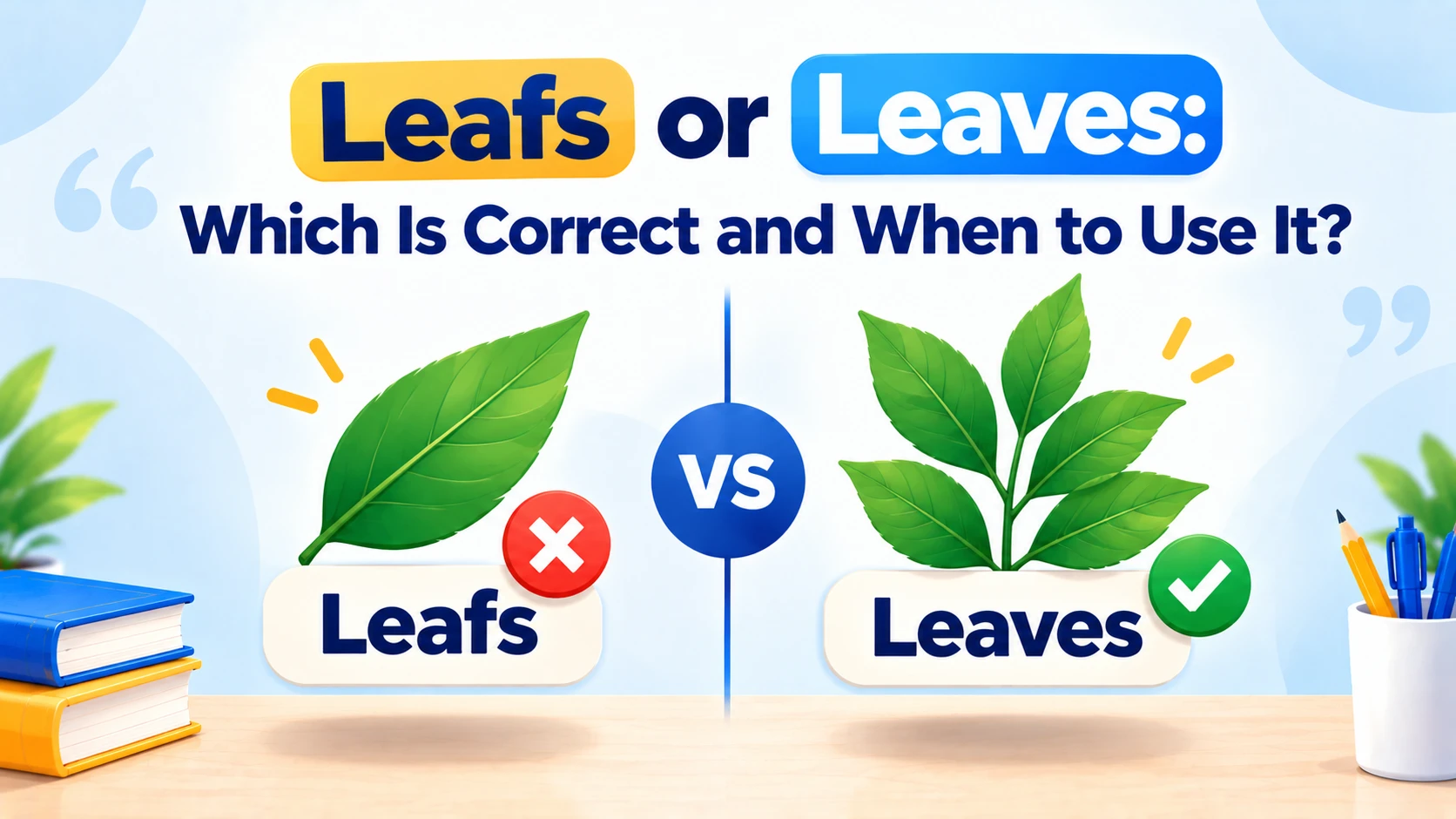
Leafs or leaves can look like a simple spelling question, but the correct choice depends on what the word is doing in the sentence. If you are talking about more than one leaf on a tree, plant, or book, the standard plural is leaves. However, leafs is also a legitimate English word when leaf is used as a verb, particularly in expressions such as “she leafs through a magazine.”
That distinction explains why both spellings appear in dictionaries and published writing, even though they are not interchangeable. One is normally a plural noun; the other is primarily a third-person singular verb form. There is also another source of confusion: leaves can itself be the third-person singular form of leave, as in “He leaves at six.”
In this guide, you will learn when to use leaves, when leafs is correct, why leaf changes to leaves in the plural, and how to avoid common mistakes. You will also see practical examples, comparison tables, and a simple test you can use whenever you are unsure.
Leafs or Leaves: Quick Answer
If you mean more than one leaf, use leaves.
Correct: The leaves are turning yellow.
Incorrect: The leafs are turning yellow.
But leafs can be correct when leaf is functioning as a verb:
Correct: She leafs through the magazine before buying it.
The difference can be summarized simply:
| Form | Grammatical role | Main meaning | Example |
| leaf | Noun | One leaf | A leaf fell from the tree. |
| leaves | Noun | More than one leaf | The leaves are green. |
| leaf | Verb | To turn/look through pages | I leaf through old books. |
| leafs | Verb | He/she/it turns through pages | She leafs through the report. |
| leaves | Verb | Third-person singular of leave | He leaves work at five. |
The simplest rule to remember
Use leaves when you mean multiple leaves.
Use leafs when leaf is a verb and the subject is he, she, or it.
So:
- The tree has many leaves. ✓
- The tree has many leafs. ✗
- She leafs through the book. ✓
- She leaves through the book. ✗
The important point is that leafs and leaves represent different grammatical jobs. This is not simply a choice between two spellings of the same plural.
What Does “Leaf” Mean?
The word leaf has more than one established meaning in English, which helps explain why its forms can become confusing.
Leaf as a noun
The most familiar meaning is the part of a plant that grows from a stem or branch.
For example:
- A leaf fell onto the sidewalk.
- The caterpillar was eating a leaf.
- Each leaf has a different shape.
- The tree has lost almost every leaf.
When there is more than one, the plural is leaves:
One leaf → several leaves
The same noun can also refer to a sheet or page in a book, particularly in formal or technical contexts. A book may contain many leaves, with each leaf potentially having writing on both sides.
Leaf as a verb
English also uses leaf as a verb. To leaf through something means to turn its pages quickly or casually while looking through it.
For example:
I leafed through the magazine while waiting.
In the present tense, the third-person singular form is:
She leafs through the magazine.
This is where leafs becomes correct.
Why the distinction matters
The confusion usually happens when people assume that leafs must be the ordinary plural because many English plurals simply add -s.
That assumption works for words such as:
- book → books
- tree → trees
- flower → flowers
But leaf has a traditional plural form:
leaf → leaves
The spelling has to be learned as part of the word’s standard inflection.
When to Use “Leaves”
“Leaves” as the plural of “leaf”
This is by far the most common situation.
Use leaves whenever you are referring to two or more leaves.
Examples:
- The leaves are falling from the trees.
- Remove the damaged leaves from the plant.
- Wet leaves covered the garden path.
- The autumn leaves changed from green to orange.
- Several leaves were scattered across the lawn.
Here, leaves is a plural noun.
A useful grammatical test is to replace the word with one leaf. If that makes sense, the plural form you need is normally leaves.
One leaf is on the ground.
Several leaves are on the ground.
“Leaves” as a verb
There is another completely different use of leaves.
It can be the third-person singular present form of leave:
- I leave.
- You leave.
- We leave.
- They leave.
- He leaves.
- She leaves.
- It leaves.
Examples:
Sarah leaves the office at 5 p.m.
The train leaves at noon.
He leaves the house early every morning.
In these sentences, leaves has nothing to do with plants.
This creates an interesting three-way distinction:
Leaves can be the plural of leaf.
Leaves can be the verb form of leave.
Leafs can be the verb form of leaf.
Context tells you which meaning is intended.
Common sentences with “leaves”
Here are several natural uses:
Talking about plants:
The dry leaves need to be removed.
Talking about seasons:
The leaves turn red in autumn.
Talking about books:
The old manuscript contains hundreds of leaves.
Talking about departure:
The bus leaves at 8:30.
The spelling stays the same in the last example, but the grammatical meaning changes.
When to Use “Leafs”
“Leafs” as the third-person singular form of “leaf”
Leafs is grammatically valid when leaf is being used as a verb and the subject is third-person singular.
The pattern is:
- I leaf through the book.
- You leaf through the book.
- We leaf through the book.
- They leaf through the book.
- He leafs through the book.
- She leafs through the book.
- The reader leafs through the book.
For example:
Maria leafs through the magazine while drinking coffee.
Here, leafs is not a plural noun. It is a verb.
Why “leafs” is not normally the plural noun
English learners often apply the ordinary plural rule:
noun + s = plural
That works in many cases, but English has numerous irregular plurals.
For leaf, the standard plural is leaves, not leafs.
Compare:
- leaf → leaves
- knife → knives
- wife → wives
- wolf → wolves
- life → lives
The important thing is not to assume that the final -s automatically determines whether a word is plural.
“Leafs through” is the clearest clue
The phrase leafs through is particularly useful because it immediately signals the verb.
He leafs through the newspaper.
Here, he is not producing multiple leaves. He is turning pages or looking through the publication.
You can also use:
- leaf through
- leafed through
- leafing through
- leafs through
Examples:
I leaf through old photo albums sometimes.
She leafed through the catalog.
They were leafing through the documents.
He leafs through the newspaper every morning.
Notice that only the third-person singular present form uses leafs.
Why Is the Plural of “Leaf” “Leaves”?
The spelling leaves reflects a historical pattern in English rather than a modern spelling rule that applies mechanically to every word ending in -f.
Over the development of English, some nouns ending in an f or fe developed plural forms containing -ves. Leaf belongs to this group.
That gives us:
leaf → leaves
Similar familiar forms include:
knife → knives
wolf → wolves
life → lives
For modern English speakers, these forms are generally learned as established plural spellings.
Other words that follow a similar pattern
Some common examples are:
| Singular | Plural |
| leaf | leaves |
| knife | knives |
| wife | wives |
| wolf | wolves |
| life | lives |
| loaf | loaves |
| half | halves |
| calf | calves |
These examples can help you recognize the pattern, but there is an important limitation.
Not every “-f” word becomes “-ves”
English does not have a universal rule saying that every noun ending in f must change to ves.
For example:
- roof → roofs
- chief → chiefs
- belief → beliefs
- chef → chefs
- proof → proofs
So it is safer to learn the plural form of an individual word rather than blindly applying a spelling formula.
Why this matters for learners
If you remember only “words ending in f become ves,” you will eventually produce forms such as rooves or chiefves, which are not standard modern English plurals.
The better lesson is:
Leaf has the established plural leaves. Other -f words must be checked individually when you are uncertain.
Leafs vs. Leaves: Side-by-Side Comparison
The easiest way to understand the distinction is to compare the grammatical roles directly.
| Feature | Leaves | Leafs |
| Can be a plural noun? | Yes | No, not as the standard plural of leaf |
| Can be a verb? | Yes | Yes |
| Plural of leaf? | Yes | No |
| Third-person singular of leave? | Yes | No |
| Third-person singular of leaf? | No | Yes |
| Example | The leaves are falling. | She leafs through the book. |
How meaning changes depending on the word
Consider these three sentences:
The leaves are falling.
Here, leaves means multiple plant leaves.
She leaves the room.
Here, leaves is a form of the verb leave.
She leafs through the book.
Here, leafs is a form of the verb leaf.
The surrounding words provide the grammatical clue.
If leaves follows a determiner such as the, many, several, or these, it may be functioning as a plural noun:
the leaves
many leaves
several leaves
these leaves
If leaves follows a person or thing acting as a subject, it may instead be a verb:
She leaves.
The train leaves.
My brother leaves early.
Likewise, leafs through is a strong indication that leafs is functioning as a verb.
Leafs or Leaves in Real Sentences
Seeing the words in realistic contexts makes the difference much easier to retain.
Examples where “leaves” is correct
Nature:
The leaves on the maple tree are beginning to change color.
Gardening:
Remove the damaged leaves before they affect the healthy growth of the plant.
Autumn:
We spent the afternoon clearing fallen leaves from the driveway.
Botany:
The plant produces broad leaves with prominent veins.
Books:
The antique volume has hundreds of leaves.
In all of these examples, leaves represents more than one leaf.
Examples where “leafs” is correct
Reading:
She leafs through the novel before deciding whether to buy it.
Browsing a magazine:
He leafs through the latest issue while waiting for his appointment.
Checking a document:
The editor leafs through the manuscript looking for the missing page.
The meaning is not “multiple leaves.” Instead, someone is turning or browsing through pages.
Incorrect vs. correct examples
| Common mistake | Correct version | Reason |
| The tree has green leafs. | The tree has green leaves. | Leaves is the plural noun. |
| Autumn leafs covered the ground. | Autumn leaves covered the ground. | More than one leaf. |
| She leaves through the magazine. | She leafs through the magazine. | Leaf through means browse pages. |
| He leafs work at five. | He leaves work at five. | The verb is leave, not leaf. |
| The leaves through the book. | She leafs through the book. | Leafs through is the correct verb construction. |
The most useful correction strategy is not to memorize isolated examples. Identify the base word first.
- If the sentence means leave, use leaves.
- If it means more than one leaf, use leaves.
- If it means browse through pages, leafs may be appropriate.
Is “Leafs” Ever Correct?
Yes. Saying that leafs is always wrong would itself be incorrect.
The word is legitimate as the third-person singular present form of the verb leaf.
For example:
The researcher leafs through the old records.
She leafs through several magazines before choosing one.
The word can therefore appear in perfectly standard English.
The mistake is using leafs as the ordinary plural of the noun leaf.
There can also be specialized contexts in which Leafs appears as part of a proper name. Proper names follow their own naming conventions, so such examples should not be treated as evidence that leafs is the standard plural noun form.
For ordinary English writing, the practical rule remains straightforward:
leaf → leaves
British English vs. American English: Leafs or Leaves?
There is no ordinary American-versus-British spelling difference here.
Both American English and British English use leaves as the standard plural of leaf.
So this is not like some vocabulary or spelling differences where regional English varieties genuinely use different forms. You should not choose leafs simply because you are writing for an American audience, nor should you choose leaves only because you are writing for a British audience.
For example, these are standard in both varieties:
The leaves are falling from the trees.
The plant has broad green leaves.
The verb distinction also remains:
She leafs through the magazine.
Therefore, if you encounter a page claiming that leafs is the American plural and leaves is the British plural, treat that explanation cautiously. The standard plural noun is leaves in both varieties.
How to Remember the Difference
You do not need a complicated grammar rule.
Use this three-question test
When you see leafs or leaves, ask:
1. Am I talking about more than one leaf?
If yes:
leaves
2. Does the sentence mean someone departs or something goes away?
If yes, the verb is leave:
leaves
3. Does the sentence mean someone is turning or browsing through pages?
If yes, the verb can be leaf:
leafs
This produces a simple decision guide:
| What do you mean? | Form to use |
| More than one leaf | leaves |
| He/she/it departs | leaves |
| He/she/it browses through pages | leafs |
| One plant structure | leaf |
| To browse through pages | leaf |
A simple memory trick
Think of leafs through as a special verb phrase.
She leafs through the book.
If you are not talking about someone browsing pages, there is a good chance you need leaves rather than leafs.
The leaves are green.
The contrast between leaves on a tree and leafs through a book is usually enough to prevent the most common error.
Quick tip: Don’t ask only, “Which spelling looks right?” Ask, “What is the word doing in this sentence?” That identifies the correct form much more reliably.
Leafs or Leaves: Quick Reference Table
Keep this table as a quick reference when proofreading.
| Sentence meaning | Correct form | Example |
| Multiple plant structures | leaves | The leaves are dry. |
| Multiple sheets/pages in a formal book context | leaves | The manuscript contains several leaves. |
| Someone departs | leaves | James leaves at six. |
| Something departs | leaves | The train leaves at noon. |
| Someone browses through pages | leafs | She leafs through the catalog. |
| Someone turned pages in the past | leafed | He leafed through the newspaper. |
| Someone is browsing pages now | leafing | They are leafing through the files. |
| One plant structure | leaf | A leaf fell from the branch. |
Common Mistakes with Leafs and Leaves
Mistake: Treating “leafs” as the normal plural
This is the most frequent error.
❌ The leafs are falling.
✓ The leaves are falling.
The reason is simple: leaves is the established plural form of leaf.
Mistake: Assuming every “-f” noun follows one plural rule
English contains several historical plural patterns, but they do not form a perfect modern spelling rule.
So don’t assume:
f → ves every time
Instead, learn established forms individually when needed.
Mistake: Confusing “leafs” with “leaves”
The two forms can both be verbs, but they come from different base words:
leave → leaves
leaf → leafs
Compare:
He leaves the office.
with:
He leafs through the report.
One means departs. The other means browses through pages.
Mistake: Thinking “leafs” is simply an alternative spelling
It is not.
Leafs and leaves have different grammatical functions in standard usage. Treating them as interchangeable can change the meaning or make a sentence grammatically incorrect.
A Practical Proofreading Checklist
Before publishing an article, essay, email, or school assignment, check the sentence rather than the word in isolation.
- Do you mean more than one leaf? Use leaves.
- Does the verb mean depart? Use leaves for he/she/it.
- Does the verb mean browse through pages? Use leafs for he/she/it.
- Are you writing about a proper name? Preserve the official spelling.
- Are you unsure about an -f plural? Check the individual word rather than applying a blanket rule.
- Does “leafs through” fit the meaning? If so, leafs may be correct.
This approach is more reliable than memorizing “leafs is wrong.” That statement leaves out the legitimate verb use.
Conclusion
The safest choice becomes easy once you identify the word’s grammatical role. When you mean more than one leaf, the correct standard plural is leaves. When you mean that someone turns or browses through pages, leafs can be correct as the third-person singular form of the verb leaf. Meanwhile, leaves can also mean that someone departs, because it is the third-person singular form of leave. One final actionable tip: read the whole sentence before choosing the spelling. A common mistake to avoid is treating leafs as an alternative plural of leaf. Remember the practical distinction—leaves are on trees; someone leafs through pages—and the spelling becomes much easier to get right.
Frequently Asked Questions
Q1. Is “leafs” the plural of “leaf”?
No. The standard plural of leaf is leaves. For example, “The leaves are falling.” Leafs is instead used as the third-person singular form of the verb leaf, as in “She leafs through the magazine.”
Q2. Why does leaf change to leaves in the plural?
Leaf → leaves is an established historical plural pattern in English. Several other words show related spelling changes, including knife → knives and wolf → wolves. However, not every noun ending in -f follows this pattern, so individual plurals must sometimes be learned separately.
Q3. Is “leafs through” grammatically correct?
Yes. Leafs through is correct when leaf is being used as a verb meaning to turn or browse through pages. For example, “He leafs through the newspaper every morning.” The form changes according to the subject: “I leaf through” but “she leafs through.”
Q4. Is “leaves” both a noun and a verb?
Yes. Leaves can be the plural noun form of leaf, as in “The leaves are green.” It can also be the third-person singular form of leave, as in “She leaves at five.” Context determines which meaning is intended.
Q5. Do British and American English use different forms?
No. Leaves is the standard plural of leaf in both British and American English. Leafs does not become the ordinary plural simply because of regional English. Its standard grammatical use is primarily as the third-person singular form of the verb leaf.
