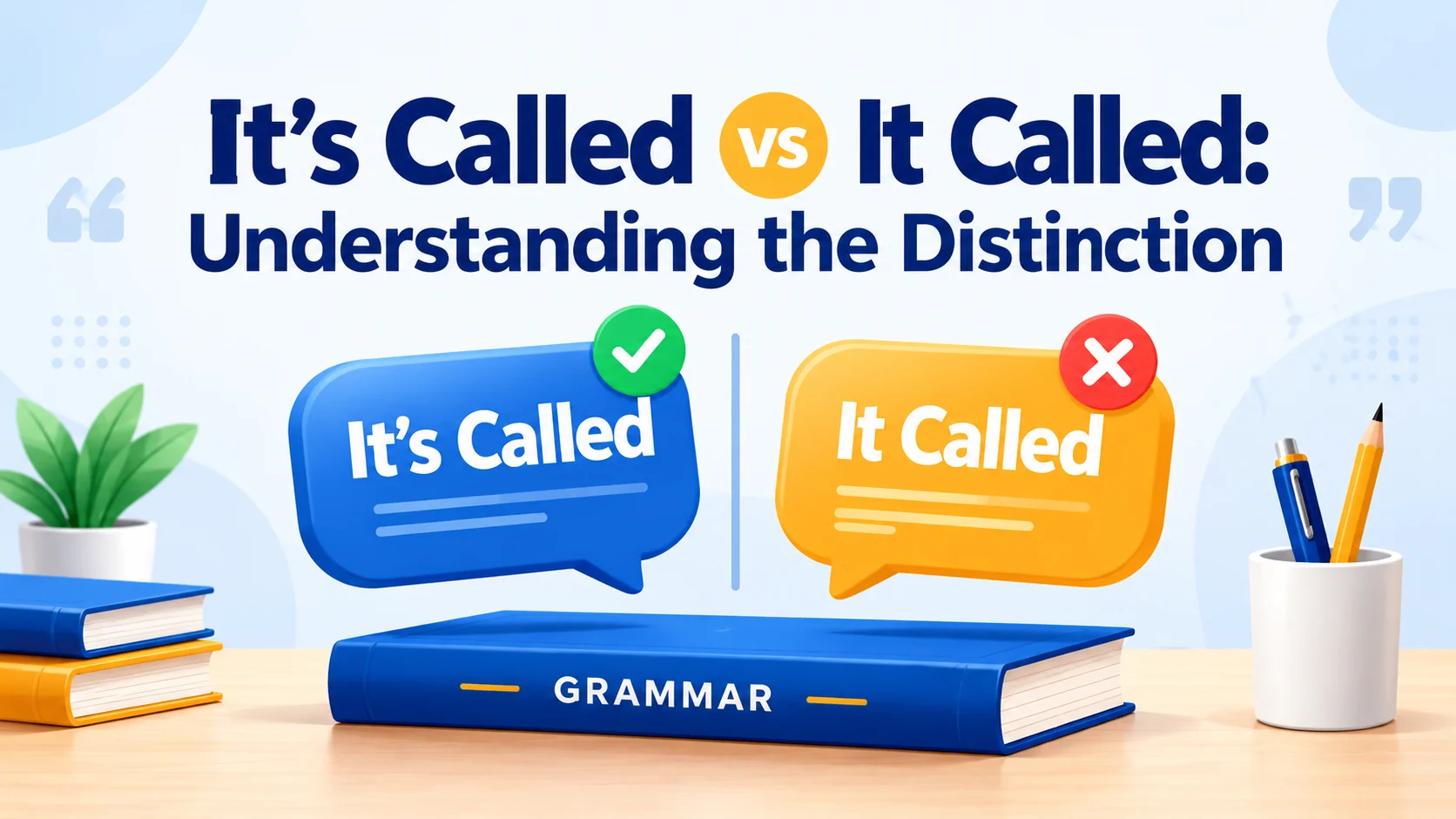
The difference between “it’s called” and “it called” may seem minor, but one small word changes how a sentence works. If you want to explain the name of something, you would normally write, “It’s called a thermostat.” If you mean that a device contacted someone in the past, you might write, “It called the technician.” Both expressions can be grammatically correct, yet they communicate different ideas. Understanding when to use each phrase helps you write more clearly in everyday conversations, school assignments, professional emails, technical explanations, and website content.
The confusion often comes from the contraction “it’s,” which usually means “it is” in the phrase “it’s called.” The word called then forms part of a passive construction that identifies or describes something. By contrast, in “it called,” the word called normally acts as the main verb in the simple past tense. The subject performs an action rather than being identified by a name. Recognizing this difference makes it easier to spot grammatical errors, understand sentence structure, and avoid changing your intended meaning when editing a sentence.
In this guide, you will discover the meaning of “it’s called,” the situations in which “it called” is correct, and the grammatical rule that separates them. You will also find practical examples, a side-by-side comparison, explanations of common mistakes, and a simple method for choosing the right phrase. Special attention is given to confusing cases, including sentences in which called introduces a name after an active subject. By the end, you will be able to distinguish a naming statement from a past action and choose the expression that fits your sentence.
What Is the Difference Between “It’s Called” and “It Called”?
The main difference is that “it’s called” usually identifies or names something, while “it called” usually describes an action that happened in the past.
Consider these examples:
- It’s called a pressure gauge. This sentence tells you the name of an object.
- It called the control center. This sentence says that something, such as an automated device, contacted the control center.
In the first example, it’s means it is. The words is called form a passive construction. In the second, called is the simple past tense of the verb call.
Neither phrase is automatically incorrect. The right choice depends on what you want to say and how the rest of the sentence is structured.
Quick Answer: When Should You Use Each Phrase?
| Situation | Correct phrase | Example |
| Naming or identifying something | It’s called | It’s called a solar panel. |
| Describing a past calling action | It called | The security system called the operator. |
| Giving a definition in a formal tone | It is called | It is called thermal expansion. |
| Referring to a name used in the past | It was called | It was called the Orion project. |
| Describing something that has been named or described | It has been called | It has been called a major breakthrough. |
The simplest rule: If you mean “it is called,” write “it’s called.” If you mean that something performed a calling action in the past, “it called” may be correct.
What Does “It’s Called” Mean?
“It’s called” usually means “it is called.” Writers use it to introduce the name of an object, process, concept, place, or idea.
For example:
- This punctuation mark is called an em dash. → It’s called an em dash.
- This method is called data encryption. → It’s called data encryption.
- The device is called a motion sensor. → It’s called a motion sensor.
The phrase is common in conversation, education, business communication, and technical writing. It allows you to identify something without having to explain who originally gave it that name.
How “It’s Called” Works in a Sentence
The usual structure is:
It + is + called + name or description
For example:
“This scientific process is called sublimation.”
You can shorten the sentence to:
“It’s called sublimation.”
Here is how the construction works:
- It is the subject pronoun referring to the thing being described.
- Is is the present-tense form of the verb be.
- Called is the past participle used in a passive construction.
- Sublimation is the name of the process.
This pattern works for many kinds of information:
- Object: “It’s called a circuit breaker.”
- Scientific concept: “It’s called gravitational potential energy.”
- Grammar term: “It’s called an independent clause.”
- Business arrangement: “It’s called a service-level agreement.”
- Digital feature: “It’s called two-factor authentication.”
The word or phrase after called generally supplies the name, label, or description.
Why Is “It’s Called” Passive Voice?
In an active sentence, the subject performs an action. In a passive sentence, the subject receives the action or is described in terms of what is done to it.
Compare these examples:
- Active: Engineers call this device a regulator.
- Passive: This device is called a regulator.
- Shortened passive form: It’s called a regulator.
The passive construction is useful when the object being explained matters more than the person who gave it its name. If you are defining a technical term, the identity of the person who named it is usually irrelevant.
However, called does not always form a passive construction. In “The engineer called the supplier,” it is a simple past-tense verb. The grammatical role depends on the words around it.
Examples of “It’s Called” in Everyday English
| Context | Example | Purpose |
| Everyday conversation | It’s called a reusable water bottle. | Identifies an object |
| Education | It’s called photosynthesis. | Names a scientific process |
| Technology | It’s called cloud storage. | Introduces a technical term |
| Business | It’s called a confidentiality agreement. | Identifies a document |
| Grammar | It’s called a semicolon. | Names a punctuation mark |
| Health information | It’s called seasonal allergies. | Identifies a condition or concept |
These examples all use it’s called to explain what something is known as. In formal writing, you can use the full form “it is called” if you prefer a slightly more formal tone.
What Does “It Called” Mean?
“It called” uses called as a simple past-tense verb. It generally means that the subject performed an action involving calling at an earlier time.
For example:
- The automated system called me yesterday.
- The device called the control center.
- The company called to confirm the appointment.
In each sentence, called describes an action. The phrase does not automatically tell you what something is named.
When “It Called” Is Grammatically Correct
Use it called when it refers to something capable of performing the action described by called. Depending on the context, that subject might be a machine, a software application, an animal, or an organization.
Examples include:
- The software called the server twice. The software initiated two calls to the server.
- The automated system called my phone. The system made a phone call.
- The company called yesterday. Someone from the company contacted the speaker.
- The bird called from the tree. The bird made a vocal sound.
Notice that the meaning of call varies with the subject and context. It can refer to a telephone call, a request for attention, or a vocal sound.
When “It Called” Does Not Express the Intended Meaning
Suppose you want to tell someone the name of a process.
Incorrect for the intended meaning:
“It called evaporation.”
Correct:
“It’s called evaporation.”
The first sentence does not normally communicate that the process is named evaporation. Instead, it sounds as though it performed the action of calling something or someone named evaporation, which is unlikely to be the intended message.
The problem is not that it called is always ungrammatical. The problem is that the simple past form does not replace the passive naming construction.
Another example:
- Intended meaning: The feature has the name Quick Search.
- Correct: “It’s called Quick Search.”
- Different possible meaning: “It called Quick Search.” This would need a context in which Quick Search is a person, service, or destination being contacted.
Always check what the subject is doing and what the sentence is supposed to mean.
Can “It Called” Be Followed by a Name?
Yes. This is an important exception that helps explain why the two phrases cannot be distinguished by looking at the word after called alone.
Consider:
“The team called the project Phoenix.”
This is a grammatically correct active sentence. The team gave the project the name Phoenix. Here, called is a simple past-tense verb, and the project is its object.
Now compare:
“The project is called Phoenix.”
This is a passive construction that identifies the project’s name.
You can also say:
“It’s called Phoenix.”
The distinction is the grammatical role of the subject:
- The team called the project Phoenix. The team performed the naming action.
- The project is called Phoenix. The project is being identified by its name.
- It’s called Phoenix. The same naming information is expressed more concisely.
Therefore, it called is not the correct substitute for it’s called when you want to identify something, but called can introduce a name in a different sentence structure.
The Grammar Behind “It’s Called” and “It Called”
The difference becomes easier to understand when you examine the contraction, the verb tense, and the role of the subject.
“It’s” vs “It”: Understanding the Contraction
“It’s” is a contraction of “it is” or “it has.” Which meaning applies depends on the sentence.
In “It’s called a sensor,” the contraction means it is:
- It’s called a sensor.
- It is called a sensor.
Both sentences communicate the same idea.
In “It’s been called a breakthrough,” the contraction means it has:
- It’s been called a breakthrough.
- It has been called a breakthrough.
The words that follow the contraction help determine which expansion is correct.
Do not confuse it’s with its, the possessive form of it.
- It’s called a router. The router has that name.
- Its signal is weak. The signal belongs to the router or another previously mentioned device.
A useful test is to replace it with it is or it has. If neither expansion fits the sentence, you may need its instead.
Why “Is” Matters in “It’s Called”
The word helps create the passive construction used to identify something.
Compare:
- The device is called a sensor. This identifies the device.
- The device called the technician. This says the device contacted the technician.
- The technician called the device. This says the technician contacted the device, or called it by phone.
The presence of it changes the grammatical structure. Without it, called normally functions as the main verb in the simple past tense.
This distinction is especially useful when proofreading a sentence in which the subject is not a person. A machine or system can perform a calling action, so it called may make sense in one context but not in another.
Is “Called” a Past Tense or a Past Participle?
The word called can serve as either the simple past tense or the past participle of the regular verb call. The spelling is the same, but the grammatical role differs.
| Sentence | Role of “called” | Explanation |
| It called the operator. | Simple past verb | The subject performed a calling action. |
| It is called a regulator. | Past participle | The phrase forms a passive construction. |
| It has called twice. | Past participle | It appears with has in the present perfect tense. |
| It was called a regulator. | Past participle | It appears with was in a passive construction. |
You cannot determine the function of called from its spelling alone. Look at the helping verb and the rest of the sentence to understand how it is being used.
“It’s Called” vs “It Called”: Side-by-Side Comparison
The following table brings the main differences together.
| Feature | It’s Called | It Called |
| Typical structure | It is + past participle | It + simple past verb |
| Main purpose | Names or identifies something | Describes a past action |
| Usual tense or construction | Present-tense passive | Simple past |
| Role of the subject | Receives the naming or description | Performs the calling action |
| Example | It’s called a thermostat. | It called the technician. |
| Suitable for introducing a term? | Yes | Not usually by itself |
| Always correct? | No; context still matters | No; context still matters |
Correct and Incorrect Examples With Explanations
| Sentence | Assessment | Why |
| It’s called a barcode scanner. | Correct | It identifies the device. |
| It called a barcode scanner. | Incorrect for the intended naming meaning | The sentence does not use the usual passive naming structure. |
| The security system called me. | Correct | The system performed a calling action. |
| The security system is called Sentinel. | Correct | It gives the system’s name. |
| The team called the software Sentinel. | Correct | The team named the software. |
| It’s called me yesterday. | Incorrect for the intended past-action meaning | The contraction and verb structure do not fit the intended meaning. |
| It called me yesterday. | Correct | The sentence describes a past action. |
One subtle point is worth remembering: a sentence can be grammatically correct but still be wrong for the meaning you intend. When editing, do not simply ask whether a phrase is possible English. Ask whether it communicates the right information.
Common Mistakes With “It’s Called” and “It Called”
Leaving Out “Is” When Naming Something
A common mistake is writing “It called a capacitor” when the intended meaning is that the object has that name.
- Incorrect for the intended meaning: “It called a capacitor.”
- Correct: “It’s called a capacitor.”
The writer has omitted the helping verb needed for the usual passive naming construction. When you introduce a name, check whether the sentence means it is called.
Assuming “It Called” Is Always Wrong
Some explanations mistakenly treat it called as universally incorrect. That is not accurate.
These sentences are correct:
- “It called my number.”
- “The system called twice.”
- “The bird called from the branches.”
In each case, called describes an action. Avoid memorizing a rule that rejects the phrase in every context. Instead, determine what the verb means in the sentence.
Confusing “It’s Called” With “Its”
Because the apostrophe changes the meaning, this mistake can affect both grammar and clarity.
- It’s called a thermostat. Here, it’s means it is.
- Its temperature reading is inaccurate. Here, its indicates possession.
Use the expansion test when you are unsure. If “it is” or “it has” fits the sentence, it’s may be correct. If the sentence expresses possession, use its.
Confusing Naming With Calling Someone
The verb call has several meanings, and that is one reason these phrases are easy to confuse.
Compare:
- “It’s called an alarm.” — Identifies the device.
- “It called the operator.” — Describes an action.
- “The operator called it an alarm.” — Describes the operator giving it that name.
Read the sentence for meaning rather than relying on the word called alone.
Using an Incomplete Sentence
Sometimes a sentence is understandable in conversation but does not work as a complete sentence in formal writing.
For example:
- Fragment: “Because it’s called a relay.”
- Complete sentence: “The circuit uses this component because it’s called a relay.”
The first example may work as an informal response to a question, but it is dependent on context. In an assignment, report, or professional explanation, make sure the sentence communicates a complete thought.
How to Choose Between “It’s Called” and “It Called”
Use this four-step process when writing or proofreading.
Step 1: Decide Whether You Are Naming Something or Describing an Action
Ask yourself what information the sentence needs to communicate.
- Naming: “It’s called a black hole.”
- Action: “It called the control center.”
If you are introducing a name or label, start by considering it is called. If you are describing a past action, consider it called.
Step 2: Expand “It’s” to “It Is”
Try replacing the contraction with its full form.
- “It’s called a circuit breaker.”
- “It is called a circuit breaker.”
The sentence retains its meaning, so the contraction is appropriate.
This test is particularly helpful in formal editing because it reveals whether it’s is functioning as a contraction or whether the sentence needs a different structure.
Step 3: Check Whether “Called” Describes an Action
If you are writing it called, ask whether the subject actually performed an action.
- “The software called the server.” The software initiated a call.
- “The bird called loudly.” The bird made a vocal sound.
If your intended meaning is simply to tell readers what something is named, rewrite the sentence using it’s called or another appropriate naming construction.
Step 4: Read the Full Sentence in Context
A phrase may be correct on its own but unsuitable in a particular sentence. Check the tense, subject, object, and intended meaning.
For example:
“The device called the technician because it detected a fault.”
This describes a past action.
“The device is called a fault detector.”
This identifies the device.
Both are grammatical, but they answer different questions.
Quick Editing Checklist
Before publishing, ask yourself:
- Am I giving something a name or describing an action?
- If I use it’s, does it is or it has fit?
- If I use it called, does the subject perform a calling action?
- Have I confused it’s with its?
- Does the full sentence communicate my intended meaning?
Real-World Examples of “It’s Called” and “It Called”
The most effective way to understand the distinction is to see how it works in different situations.
Everyday Conversation
Naming something:
- “What is that kitchen tool?”
- “It’s called a mandoline slicer.”
Describing an action:
- “Why did the phone make a sound?”
- “It called the emergency contact automatically.”
The first exchange identifies an object. The second describes an action by a device.
School and Academic Writing
Naming a concept:
“It’s called the water cycle because it describes the continuous movement of water through the environment.”
Describing a past action:
“The research team called the participants to confirm their availability.”
In academic writing, use the phrase that fits the explanation. If the goal is to define a concept, it is called may be preferable to the contraction it’s called in a formal passage.
Technology and Digital Communication
Naming a feature:
“This security feature is called multi-factor authentication.”
Describing a software action:
“The application called the server to retrieve the latest data.”
These examples show why the subject matters. A software application can initiate a call, while a security feature can be identified by its name.
Business and Professional Writing
Naming a document:
“The document is called a confidentiality agreement.”
Describing an action:
“The sales department called the client after the meeting.”
The first sentence introduces a document type. The second records a business action. Choosing the correct form helps keep instructions, reports, and emails precise.
Explaining Terms, Objects, and Processes
- “It’s called a semicolon.” — Names a punctuation mark.
- “It’s called thermal expansion.” — Names a physical process.
- “The machine called the operator when the temperature rose.” — Describes a machine-triggered call.
- “The company called the new product Horizon.” — Describes the act of naming a product.
The last example is particularly useful because it shows that called can introduce a name in an active sentence. The deciding factor is the sentence structure, not simply whether a name follows the verb.
Practice Quiz: Can You Tell the Difference?
Choose the phrase that best expresses the intended meaning. Pay attention to whether each sentence names something or describes an action.
Choose the Correct Phrase
- This scientific process ___ evaporation.
- The alarm system ___ the security office last night.
- This tool ___ a torque wrench.
- The company ___ me to confirm the booking yesterday.
- This grammatical pattern ___ the passive voice.
Correct the Mistake
Correct each sentence according to the meaning in parentheses.
- “It called a barcode scanner.” (Intended meaning: naming the device.)
- “The automated system it’s called the customer yesterday.” (Intended meaning: the system contacted the customer.)
Answer Key With Explanations
Choose the correct phrase
- is called / it’s called — The sentence identifies a scientific process.
- called — The alarm system performed an action in the past.
- is called / it’s called — The sentence identifies a tool.
- called — The company contacted the speaker in the past.
- is called / it’s called — The sentence names a grammatical pattern.
Correct the mistakes
- “It’s called a barcode scanner.” The intended meaning is naming, so the passive construction is appropriate.
- “The automated system called the customer yesterday.” The sentence describes a past action, so called is the main verb. The extra it’s should be removed.
The goal is not to choose one phrase automatically. It is to identify the intended meaning and select a grammatical structure that expresses it.
Conclusion
Understanding “it’s called vs it called” becomes straightforward when you focus on the meaning of the sentence rather than the spelling alone. Use “it’s called” when identifying something by its name, label, or description. Use “it called” when the subject performed a calling action in the past. Remember that called can also appear in active naming sentences, such as “The team called the project Horizon,” so context and sentence structure always matter. One final actionable tip: When you write “it’s called,” expand it to “it is called” to check whether the sentence still makes sense. Then read the full sentence aloud to confirm that it expresses your intended meaning. A common mistake to avoid is assuming that “it called” is always wrong. Both forms have a place in English; the key is choosing the one that communicates your idea clearly and accurately.
Frequently Asked Questions
Q1. Is “It Called” Grammatically Correct?
Yes. “It called” is grammatically correct when called describes an action in the past. For example, “The automated system called the customer.” However, if you want to identify something by name, you would normally write “It’s called a scanner,” because that construction means “It is called a scanner.”
Q2. Should I Write “It’s Called” or “It Called” in Formal Writing?
Choose the phrase according to its meaning. “It is called” is often suitable for formal definitions, while “it’s called” is a perfectly grammatical contraction that may suit a less formal tone. Use “it called” when describing a past calling action, not as a substitute for the usual naming construction.
Q3. What Is the Difference Between “It’s Called” and “It’s Been Called”?
“It’s called” ordinarily means “it is called” and identifies something by name. “It’s been called” usually means “it has been called,” using the present perfect passive. The latter can describe a name or label applied previously, or a description that people have used over time.
Q4. Can I Say “It Called Me” and “It’s Called Me”?
These sentences have different grammatical meanings. “It called me” describes a past action, such as a device making a phone call. “It’s called me” would normally expand to “it has called me,” which uses the present perfect and may indicate a past action relevant to the present.
Q5. Is “It’s Called” the Same as “It Is Named”?
They are often similar in meaning, but their use can differ slightly. “It’s called a water purifier” identifies what people call the device. “It is named Aurora” may emphasize the specific name given to an individual object, project, or entity. The surrounding context determines which wording sounds most natural.
