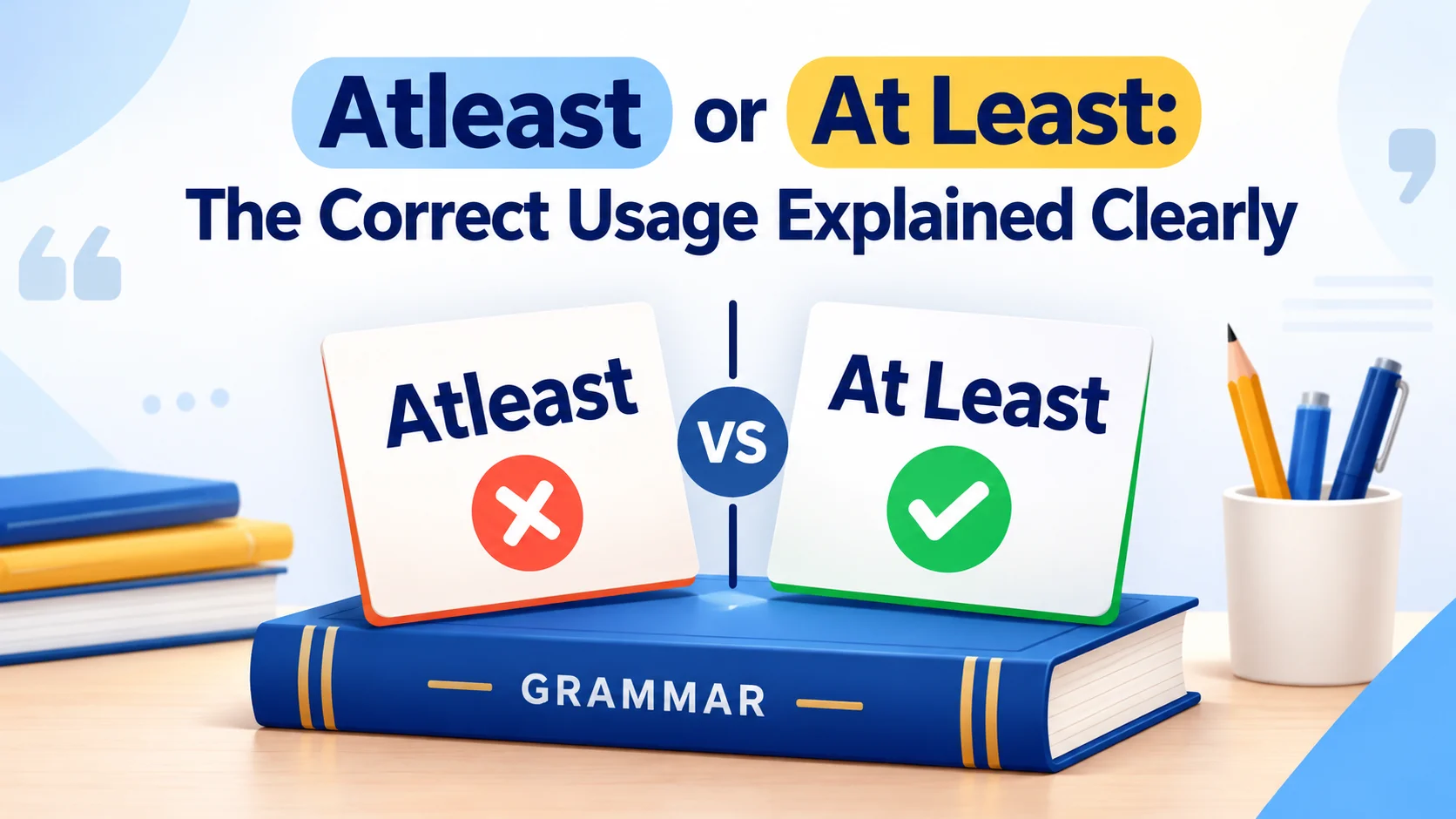
The correct spelling in “atleast or at least” is at least, written as two separate words. Although atleast appears in online messages, comments, and informal writing, it is not the standard spelling in English. The expression at least commonly indicates a minimum quantity, number, amount, or requirement. It can also introduce a positive point when a situation is disappointing or qualify a statement when the speaker wants to be precise. Knowing when and how to use it helps you write clearer sentences, avoid common spelling errors, and communicate confidently in academic, professional, and everyday situations.
The confusion is understandable. When people speak quickly, at least can sound like a single unit, so it may seem natural to combine the words while typing. However, pronunciation does not determine whether a phrase should be written as one word or two. English contains many expressions whose individual words work together without losing their separate spelling. The important distinction is that at least is an established two-word expression, whereas atleast is generally a spelling mistake. Recognizing this difference is especially useful when writing emails, preparing assignments, editing website content, or taking English-language examinations.
This guide explains the meaning, grammar, spelling, and practical usage of at least through clear definitions, natural examples, and useful comparisons. You will learn how to express minimum quantities, use the phrase at different points in a sentence, distinguish it from at most, at last, and at best, and choose suitable alternatives when needed. We will also examine why writers make this mistake and how to catch it during proofreading. By the end, you should be able to use at least correctly and naturally, whether you are chatting with a friend, writing a formal report, or helping someone improve their English.
Atleast or At Least: Which Spelling Is Correct?
At least is the correct spelling. It consists of two separate words: at and least. The combined spelling atleast is not accepted in standard English writing.
The expression is used in several ways, but its most common meaning is “not less than a particular amount or number.” For example, “Please bring at least three copies” means that three copies are required as a minimum, although bringing more is acceptable.
| Spelling or expression | Correct? | Explanation |
| At least | Yes | The standard two-word expression |
| Atleast | No, in standard usage | An incorrect joining of the two words |
| At least three people | Yes | Indicates a minimum of three people |
| At least once | Yes | Indicates one or more occasions |
| At most | Yes | Indicates an upper limit |
| At last | Yes | Means finally, often after waiting |
Why Must “At Least” Be Written as Two Words?
The phrase contains two words that retain their separate written forms even when they work together to express one idea. The word at is a preposition, while least is the superlative form of little in expressions involving quantity or degree.
Together, they form a conventional phrase. The fact that the words are closely connected in meaning does not mean they should be joined.
Compare these examples:
- Correct: We need at least five volunteers.
- Incorrect: We need atleast five volunteers.
- Correct: Try to read at least ten pages each day.
- Incorrect: Try to read atleast ten pages each day.
In each correct sentence, the words remain separate.
Is “Atleast” Ever Correct?
In ordinary English writing, atleast should be corrected to at least. You might encounter the joined form in a username, brand name, web address, file name, or deliberately reproduced error. Such special cases do not make it a standard spelling.
If you are writing an essay, email, article, application, or examination answer, use at least. Do not treat the combined form as an accepted British or American English variant.
What Does “At Least” Mean?
The phrase at least has more than one practical use. Its meaning depends on the sentence, but it often communicates a minimum, a lower limit, or a reassuring point in an otherwise difficult situation.
At Least Means a Minimum Amount or Number
This is the most direct use. When a speaker says at least five, the number five is the minimum; the actual number may be five or greater.
Examples:
- The hall can accommodate at least 200 guests.
- You should drink water regularly and aim for at least eight glasses a day, if that amount suits your needs.
- Each applicant must provide at least two references.
- The journey will take at least 30 minutes.
The phrase does not mean “exactly.” If an event requires at least 20 participants, having 25 participants meets the minimum. Having 18 does not.
At Least Means “If Nothing Else”
Sometimes at least introduces a positive aspect of an unpleasant or disappointing situation.
Examples:
- The match was cancelled, but at least we had time to visit the museum.
- I did not win the competition, but at least I gained valuable experience.
- The bus was late, but at least we arrived safely.
Here, the phrase does not describe a numerical minimum. Instead, it highlights something worthwhile that remains true despite the circumstances.
At Least Can Qualify a Statement
Writers also use at least to make a statement more careful or limited. This is particularly useful when a person wants to distinguish what is known from what remains uncertain.
Examples:
- The document is at least ten years old.
- The plan appears reasonable, at least in theory.
- She is the most experienced candidate, at least among those we interviewed.
In these sentences, the phrase limits the claim or identifies the scope of the statement. It can help prevent a sentence from sounding more certain or universal than the evidence supports.
How to Use “At Least” Correctly in a Sentence
The expression is flexible and can appear in several positions. The best placement depends on what you want to emphasize.
Using At Least With Numbers and Quantities
Place at least before the number or quantity that establishes the minimum.
Examples:
- The library needs at least 50 new books.
- We should allow at least two hours for the journey.
- The recipe requires at least 250 grams of flour.
- The website receives at least 1,000 visits a day, according to the available figures.
Practical rule: If you mean “this amount or more,” at least is usually the appropriate expression.
Be careful not to confuse a minimum with an exact value. “At least 50 books” does not mean that the final number must be 50. It means 50 is the lowest acceptable number.
Using At Least With Time, Age, Distance, and Money
The same principle applies to measurements and limits.
| Context | Example | Meaning |
| Time | Allow at least 15 minutes. | Fifteen minutes or longer |
| Age | Participants must be at least 18 years old. | Eighteen or older |
| Distance | The hotel is at least five kilometres away. | Five kilometres or farther |
| Money | The repair will cost at least $100. | $100 or more |
| Experience | Applicants need at least two years of experience. | Two years or more |
| Frequency | Check your progress at least once a week. | One time or more each week |
These examples are useful because at least often appears in instructions, eligibility criteria, estimates, and minimum requirements.
When the figure is an estimate rather than a confirmed fact, make that clear. For example, “The project will take at least three weeks” communicates a minimum expected duration, not a guarantee that it will finish exactly three weeks later.
Using At Least to Express a Minimum Requirement
In professional and academic settings, at least helps state a requirement without unnecessary complexity.
Examples:
- Applicants must submit at least one reference letter.
- The report should contain at least five credible sources.
- Each team must include at least four members.
- The assignment requires at least 1,500 words.
A minimum requirement establishes a lower boundary. It does not automatically establish an upper boundary, so readers may need additional information about maximum limits.
For example, “Submit at least three examples” allows three or more. If the assignment permits no more than five, write “Submit three to five examples” or state the maximum separately.
Using At Least at the Beginning, Middle, or End of a Sentence
The phrase can appear in different positions, although some placements are more natural than others.
At the beginning:
- At least, we know where the missing file was last seen.
- At least three people must attend the meeting.
In the middle:
- We need at least three volunteers.
- The task will require at least an hour.
At the end:
- We should have enough time to finish, at least.
- She understood the main point, at least.
When at least appears at the end, it often qualifies or softens the statement. This use is more conversational and may sound less precise than placing the phrase beside the specific amount or claim it modifies.
Punctuation When Using At Least
The phrase does not require special punctuation simply because it is at least. Punctuation depends on the sentence structure.
- Correct: We need at least ten chairs.
- Correct: At least, we have a backup plan.
- Correct: The proposal is workable, at least in the short term.
In the second example, the comma separates an introductory comment from the rest of the sentence. In the third, the comma helps set off a qualifying phrase.
Avoid inserting commas automatically. If at least directly modifies a number or quantity, it usually needs no comma.
Atleast vs. At Least: Correct and Incorrect Examples
Looking at errors side by side is an effective way to remember the standard spelling. The following examples show how to correct the joined form in everyday writing.
| Incorrect | Correct | Explanation |
| We need atleast five chairs. | We need at least five chairs. | The expression has two words. |
| Please arrive atleast ten minutes early. | Please arrive at least ten minutes early. | The minimum time is ten minutes. |
| I read atleast three chapters. | I read at least three chapters. | Three is the minimum number. |
| You should practise atleast once a day. | You should practise at least once a day. | One time is the minimum frequency. |
| Atleast we tried our best. | At least we tried our best. | The expression is still written separately at the beginning. |
Examples in Casual Conversation
In everyday conversation, at least can express a minimum or acknowledge a positive point.
- “We need at least two more people to play.”
- “The café is expensive, but at least the food is good.”
- “Call me at least once when you arrive.”
- “I missed the first bus, but at least I caught the next one.”
These examples sound natural because the phrase communicates either a clear minimum or a reasonable consolation.
Examples in Academic and Professional Writing
The expression is equally appropriate in formal writing.
- “The study included at least 150 participants.”
- “Applicants must demonstrate at least three years of relevant experience.”
- “The report identifies at least two possible explanations.”
- “The analysis covers at least four major themes.”
In research writing, however, make sure that numerical claims are supported by the relevant data. Using at least correctly does not make an estimate or finding accurate on its own.
Examples in Emails and Messages
- “Please send me at least two available dates.”
- “Could you give me at least one day’s notice?”
- “We should finish the first draft today, at least.”
- “Please include at least one source for each major claim.”
For business communication, place the phrase near the requirement it describes. This makes instructions easier to follow and reduces ambiguity.
The Grammar Behind “At Least”
Understanding the grammar can make the spelling easier to remember. At least is a fixed expression whose words are conventionally written separately. It often functions adverbially, meaning that it modifies a quantity, degree, statement, or entire clause.
Is At Least an Adverbial Phrase?
In many sentences, yes. An adverbial phrase adds information about degree, quantity, or the scope of a statement.
Consider:
- We need at least six volunteers.
- The journey will take at least an hour.
- At least, nobody was injured.
In the first two examples, the phrase establishes a minimum. In the third, it comments on the situation as a whole.
Grammatical descriptions can vary depending on the framework used, so it is more useful for most learners to understand what the phrase does in a sentence than to memorize a label alone.
Why Do the Words Stay Separate?
English does not join every group of words that expresses a single idea. Many common expressions retain separate spelling, even when they function as a unit.
Examples include:
- At least
- Of course
- In fact
- As well
- At once
These expressions differ in meaning and grammatical function, but they demonstrate the same general point: a phrase can have a unified meaning without becoming one word.
Can At Least Be Used in Formal Writing?
Yes. At least is standard English and is suitable for academic, professional, and everyday writing.
It is especially useful for specifying minimum conditions, reporting lower bounds, and limiting the scope of a claim. For example, “The analysis identified at least three contributing factors” is appropriate when the evidence supports three or more factors but does not justify claiming that three is the exact total.
For formal writing, prioritize clarity and evidence. Do not use at least to make an unsupported estimate appear more authoritative.
At Least vs. At Most: What Is the Difference?
At least indicates a minimum; at most indicates a maximum. These expressions often appear in instructions, deadlines, eligibility rules, and mathematical statements, so confusing them can change the meaning of a sentence.
| Expression | Meaning | Example | What the example allows |
| At least five | Five or more | Bring at least five documents. | Five, six, seven, and so on |
| At most five | Five or fewer | Bring at most five documents. | Zero through five, depending on the context |
| Exactly five | Five and no other number | Bring exactly five documents. | Five only |
| Fewer than five | Less than five | Bring fewer than five documents. | Zero through four, depending on the context |
| More than five | Greater than five | Bring more than five documents. | Six or more when counting whole documents |
Examples That Show the Difference Clearly
Imagine that an event requires participants to register.
- “Register at least two days before the event” establishes a minimum advance period.
- “Register at most two days before the event” allows registration no later than two days before, though the exact intended deadline may need clarification.
- “Register exactly two days before the event” specifies one particular time.
The difference matters in practical instructions. When writing a rule, check whether you intend to set a lower limit, an upper limit, or an exact requirement.
A Simple Decision Rule
Ask yourself:
- Do I mean this amount or more? Use at least.
- Do I mean this amount or less? Use at most.
- Do I mean this exact amount? Use exactly.
This small check can prevent significant misunderstandings in forms, contracts, assignments, and workplace instructions.
At Least vs. At Last, At Best, and At the Least
These expressions look similar, but their meanings differ. Choosing the wrong one can make an otherwise correct sentence confusing.
At Least vs. At Last
At least generally expresses a minimum or a reassuring point. At last means finally, often after a delay or period of waiting.
Examples:
- We need at least ten minutes to prepare.
Ten minutes is the minimum. - The train has at last arrived.
The train has finally arrived.
Memory tip: If the sentence is about a minimum, choose at least. If it describes something finally happening, choose at last.
At Least vs. At Best
At best usually introduces the most favorable possible assessment or outcome, which may still be limited.
Examples:
- The journey will take at least two hours.
Two hours is the minimum. - The journey will take two hours at best.
Two hours is the most optimistic estimate; it may take longer.
The second example can be particularly useful when discussing uncertain outcomes. Do not substitute the expressions without considering whether you mean a lower limit or the most favorable estimate.
At Least vs. At the Least
At the least can appear in English, but it is less common than at least in many everyday contexts. In some constructions, it emphasizes a minimum or the smallest possible amount.
For example:
- “We need at least three people” is a natural way to state a minimum requirement.
- “At the least, we should inform the manager” can emphasize a minimum action that ought to be taken.
For most ordinary sentences, at least is the simpler and more natural choice. Use at the least only when the sentence genuinely benefits from that construction.
Synonyms and Alternatives to “At Least”
The best alternative depends on the meaning you intend. Not every synonym works in every context, so consider whether the sentence expresses a minimum, a positive point, or a qualification.
| Intended meaning | Possible alternative | Example |
| Minimum number or amount | No fewer than | The group needs no fewer than ten volunteers. |
| Minimum quantity | A minimum of | A minimum of three references is required. |
| Minimum requirement | At a minimum | At a minimum, submit the completed form. |
| Positive point in a difficult situation | At any rate | At any rate, we learned something useful. |
| Final qualifying point | In any case | In any case, the report is ready. |
| Most favorable possible outcome | At best | At best, we can finish by Friday. |
Alternatives for Formal Writing
In reports and academic papers, a minimum of and no fewer than can be useful when you want to emphasize a lower boundary.
For example:
- “The survey included at least 200 respondents.”
- “The survey included a minimum of 200 respondents.”
- “The survey included no fewer than 200 respondents.”
These sentences can communicate similar minimum requirements, although their tone and rhythm differ. Choose the version that reads most naturally and matches the precision of your evidence.
When You Should Keep “At Least”
There is no need to replace the phrase simply to make writing appear more sophisticated. In many cases, at least is the clearest and most natural choice.
For example, “Please arrive at least ten minutes early” is direct and easy to understand. Replacing it with an unnecessarily elaborate phrase could make the instruction less accessible.
Good editing is not about avoiding common words. It is about choosing the wording that communicates the intended meaning most clearly.
Why Do People Write “Atleast” as One Word?
The mistake usually occurs because the phrase is familiar in speech and people type it quickly. When two words are frequently used together, a writer may remember the expression as one unit and accidentally join them.
Fast Typing and Autocorrect Habits
Typing quickly on a phone or computer can cause spaces to disappear. Some writers also overlook the error because the combined form remains readable.
Spellcheck tools can help, but they are not perfect. Depending on the application and settings, a joined expression may not always be flagged immediately.
Practical solution: Use a final search for atleast before submitting or publishing your work.
Confusing Spoken English With Written English
In fluent speech, words often run together. That is a normal feature of spoken language, but written English follows conventional spelling rules that do not always mirror how phrases sound.
For example, hearing at least as a connected expression does not mean the two words should be combined. Learn the written form separately from its pronunciation.
Copying Incorrect Usage Online
An error may appear repeatedly in comments, captions, or informal posts. Repetition can make it look familiar, but familiarity is not the same as correctness.
If you are uncertain, check a reputable dictionary or an established English-language reference rather than treating the most common-looking online form as authoritative.
British English vs. American English: Is There a Difference?
There is no standard British-versus-American spelling difference for this expression. Both varieties of English use at least as two words.
| Usage question | British English | American English |
| Standard spelling | At least | At least |
| Joined form accepted in standard writing? | No | No |
| Used for minimum quantities? | Yes | Yes |
| Used in formal writing? | Yes | Yes |
| Example | Please allow at least two weeks. | Please allow at least two weeks. |
Other English words have different British and American spellings, but this expression is not one of them. English learners should therefore use at least regardless of which variety they are learning.
For examinations and formal documents, follow the relevant institution’s language and style requirements. Those requirements may affect other spelling choices, punctuation, or formatting, but they do not make atleast the standard form.
Easy Ways to Remember the Correct Spelling
The most effective spelling reminders are simple enough to use while writing.
The Two-Word Memory Trick
Think of at least as two separate words that work together. When typing the expression, consciously leave a space between at and least.
You can also associate it with familiar phrases such as at most and at last. Each contains separate words, making it easier to recognize that atleast does not follow standard spelling.
The Sentence Replacement Test
Replace the expression mentally with a clearer phrase such as a minimum of.
For example:
- “We need at least four chairs.”
- “We need a minimum of four chairs.”
The second sentence confirms that the first is expressing a minimum. This test helps you check meaning, although it is not a spelling rule by itself.
A Quick Proofreading Check
Before sending an email, submitting an assignment, or publishing an article:
- Search the document for atleast.
- Replace accidental instances with at least.
- Check whether you intended a minimum, maximum, or exact amount.
- Read the sentence once more to make sure the meaning is clear.
This process is especially useful for long documents in which the same error might appear several times.
Practice Quiz: Atleast or At Least?
Test your understanding with the following questions. Choose the correct form or expression before checking the answers.
Choose the Correct Spelling
1. We need ___ three volunteers for the project.
- A. Atleast
- B. At least
2. Please arrive ___ fifteen minutes before the interview.
- A. Atleast
- B. At least
3. The assignment requires ___ four reliable sources.
- A. Atleast
- B. At least
Choose At Least or At Most
4. The container can hold no more than ten litres. It holds ___ ten litres.
5. Every applicant must have two years or more of experience. Applicants need ___ two years of experience.
Correct the Mistake
6. “Atleast we completed the first stage of the project.”
Rewrite the sentence using standard spelling.
Answer Key
- At least — The phrase introduces a minimum number of volunteers.
- At least — Fifteen minutes is the minimum advance arrival time.
- At least — Four sources are required as a minimum.
- At most — The sentence specifies an upper limit of ten litres.
- At least — Two years is the minimum amount of experience.
- “At least we completed the first stage of the project.” — The expression must be written as two words.
If you answered all six correctly, you understand the main spelling rule and the distinction between minimum and maximum limits.
Conclusion
When deciding between atleast or at least, choose at least every time in standard English writing. The expression is written as two separate words, whether it describes a minimum quantity, a requirement, or a positive point in a difficult situation. Understanding its meaning also helps you distinguish it from at most, at last, and at best, which serve different purposes. One final actionable tip: search for atleast during your final proofreading pass and correct every accidental instance. Then check that the sentence expresses the limit you actually intend. A common mistake to avoid is assuming that a familiar-looking spelling must be correct simply because it appears online. Clear writing depends on small, consistent choices. Master this one, and you will use at least confidently in conversations, assignments, emails, and professional documents.
Frequently Asked Questions
Q1. Is “atleast” one word or two?
The correct expression is two words: at least. The joined form atleast is not standard English spelling. Use the separate form in school assignments, professional emails, website articles, and formal documents. If you notice the joined form while proofreading, correct it unless you are reproducing a source exactly.
Q2. Is “at least” grammatically correct at the beginning of a sentence?
Yes. At least can begin a sentence when it introduces a minimum or comments on the situation. For example, “At least five people attended the meeting.” It can also introduce reassurance, as in “At least, we know what went wrong.” Punctuation depends on the sentence structure.
Q3. Does “at least” mean exactly?
No. At least means a minimum, not an exact amount. If a requirement says you need at least four examples, four meets the requirement, but five or six may also be acceptable. Use exactly when only one particular number or amount is intended.
Q4. Can “at least” be used in professional and academic writing?
Yes. At least is appropriate in formal writing when it accurately expresses a minimum, a limitation, or a qualified claim. For instance, a report may state that a survey included at least 100 participants. Ensure that the figure is supported by evidence and that the wording reflects what is actually known.
Q5. What is the difference between “at least” and “at most”?
At least establishes a lower limit, while at most establishes an upper limit. “At least six people” means six or more; “at most six people” means six or fewer. Confusing the two can change a requirement, so check whether the sentence describes a minimum or a maximum.
