
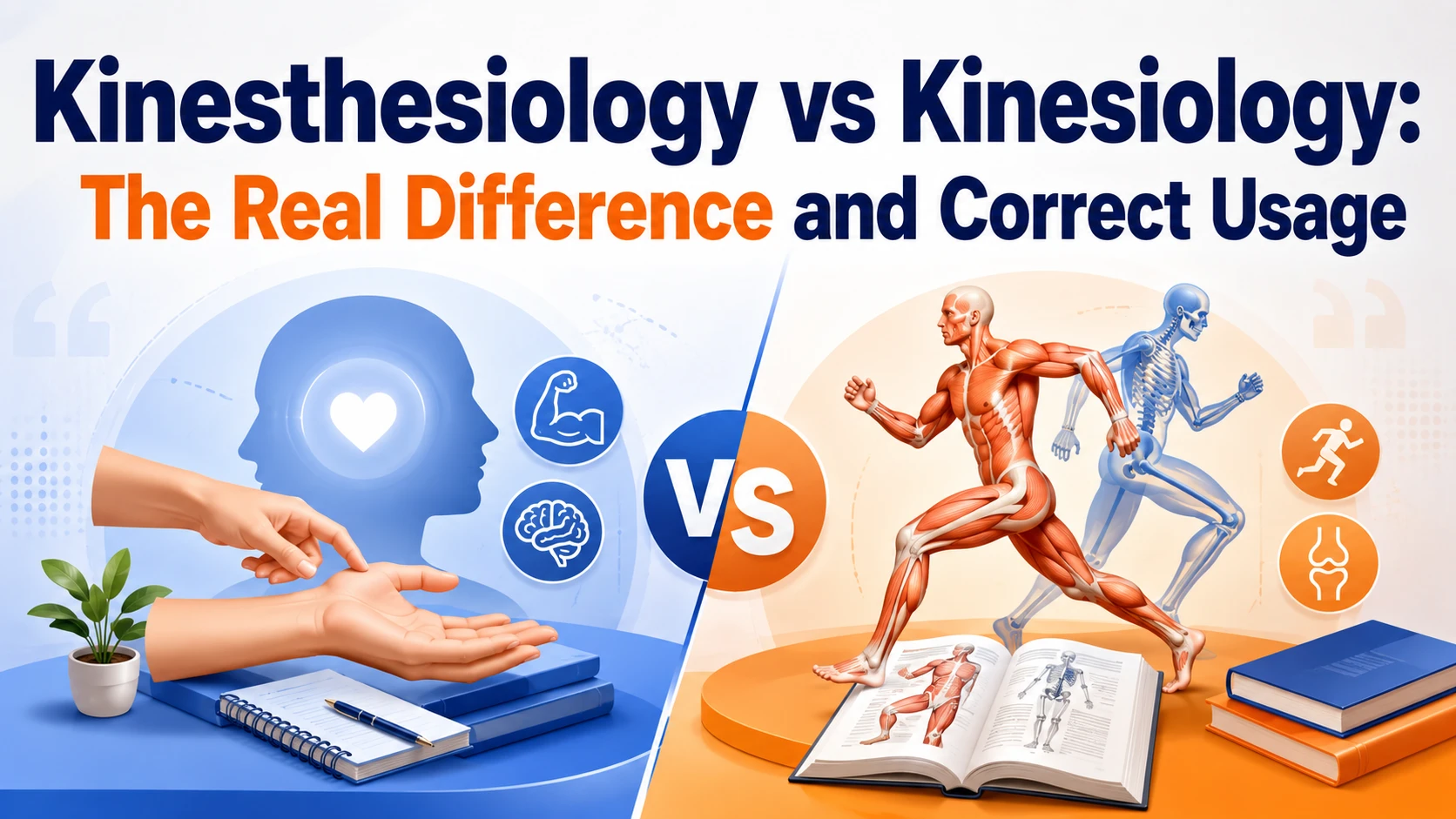
Kinesthesiology vs kinesiology can be confusing because the two terms look similar and both relate to human movement. However, they are not equally common or used in the same way. Kinesiology is the standard academic term for the scientific study of human movement, while kinesthesiology is much less common and may appear in specialized, historical, or nonstandard contexts.
The confusion often comes from related terms such as kinesthetic and kinesthesia, which refer to movement, body awareness, and the perception of body position. Because these words share similar roots, people may assume that kinesthesiology is simply another form of kinesiology. In most modern academic and professional contexts, however, kinesiology is the preferred term.
This guide explains the meaning, usage, grammar, and context of each term. You will learn when to use kinesiology, how it differs from kinesthetic and kinesthesia, and why the context matters when you encounter the word kinesthesiology.
Kinesthesiology vs Kinesiology: Quick Answer
| Term | Meaning | Common Usage |
| Kinesiology | The scientific study of human movement | Standard in universities, research, exercise science, and movement-related fields |
| Kinesthesiology | A rare or specialized term related to movement or kinesthetic concepts | Uncommon in modern mainstream academic usage |
| Kinesthetic | Related to the experience or awareness of movement | Common in education, psychology, and physical activity |
| Kinesthesia | The sense of body movement and position | Used in physiology, neuroscience, and movement studies |
The simplest rule is:
- Use kinesiology when referring to the scientific study of human movement.
- Use kinesthetic when describing movement-based learning or physical awareness.
- Use kinesthesia when discussing the perception of body movement and position.
- Treat kinesthesiology carefully because its meaning and acceptance may depend on the specific field or source.
What Does Kinesiology Mean?
Kinesiology is the scientific study of human movement. It examines how the body moves, how movement is controlled, and how physical activity affects health, performance, and everyday life.
Kinesiology combines knowledge from several areas, including:
- Anatomy
- Physiology
- Biomechanics
- Exercise science
- Neuroscience
- Psychology
- Motor learning
In simple terms, kinesiology studies how people move, why they move in certain ways, and how movement can be improved, supported, or restored.
Kinesiology Definition in Simple English
Think of the human body as a complex movement system. Muscles produce force, joints allow movement, nerves send signals, and the brain coordinates actions.
Kinesiology studies how these systems work together.
Activities such as walking, running, lifting, balancing, reaching, and jumping involve many body systems. Kinesiology helps researchers and professionals understand how those systems interact.
Examples of Kinesiology
Kinesiology may involve studying:
- How muscles work during exercise
- How posture affects movement
- How athletes improve performance
- How people recover movement after an injury
- How physical activity supports health
- How the nervous system controls movement
What Does Kinesthesiology Mean?
Kinesthesiology is not the standard term used for the modern academic study of human movement. It is much less common than kinesiology and may appear in specialized, historical, alternative, or organization-specific contexts.
The word may also result from confusion between:
- Kinesiology
- Kinesthetic
- Kinesthesia
Because these words are closely related, some people assume that kinesthesiology is another name for kinesiology. In most modern university, research, exercise science, and professional settings, kinesiology is the standard term.
Is Kinesthesiology a Misspelling?
Not necessarily.
It is more accurate to describe kinesthesiology as an uncommon or specialized term rather than automatically calling it a misspelling. Its meaning may depend on the source or field in which it appears.
However, if you are writing about:
- A university degree
- Human movement science
- Exercise science
- Biomechanics
- Academic research
You should generally use kinesiology unless a specific institution or source uses kinesthesiology intentionally.
Why Is Kinesthesiology Uncommon?
Modern academic and professional language has largely standardized kinesiology as the name of the discipline that studies human movement.
The word kinesthesiology may sound logical because it combines movement-related ideas. However, it is not the usual term used by universities, researchers, or mainstream movement-science programs.
Why Do People Confuse Kinesthesiology and Kinesiology?
Several factors cause confusion between these terms.
Similar Spelling
Both words begin with kine-, which is associated with movement. Their similar spelling makes them appear interchangeable, even though they are not used equally.
Confusion With Kinesthetic
Many people already know the word kinesthetic, especially from discussions about physical learning and body awareness.
For example:
The teacher used a kinesthetic activity to help students understand the lesson.
Because kinesthetic and kinesiology both relate to movement, people may accidentally combine them and form kinesthesiology.
Related Subject Areas
Kinesiology, kinesthesia, biomechanics, exercise science, and motor learning all involve human movement. Their shared subject matter can make their terminology difficult to distinguish.
The best way to avoid confusion is to identify the exact meaning you want to express.
Kinesiology vs Kinesthetic: What Is the Difference?
| Word | Main Meaning | Typical Use |
| Kinesiology | The scientific study of human movement | Universities, research, exercise science |
| Kinesthetic | Related to movement, body awareness, or physical learning | Education, psychology, and physical activities |
What Does Kinesthetic Mean?
Kinesthetic describes something related to movement, physical experience, or body awareness.
Common examples include:
- Kinesthetic learning
- Kinesthetic awareness
- Kinesthetic activities
- Kinesthetic feedback
A person may learn effectively through movement, touch, or hands-on activities. In that context, kinesthetic describes the method or experience.
Kinesthetic in a Sentence
The lesson included kinesthetic activities that encouraged students to learn through movement.
The athlete developed strong kinesthetic awareness through regular practice.
The instructor used a hands-on, kinesthetic approach.
What Is Kinesthesia?
Kinesthesia is the sense that helps you perceive body movement and position.
It allows you to understand where parts of your body are and how they are moving without watching every action.
For example, you can often touch your nose with your eyes closed because your body can sense the position and movement of your arm.
Kinesthesia is connected to:
- Balance
- Coordination
- Body awareness
- Movement control
- Physical perception
Kinesthesia vs Kinesiology
Although both terms relate to movement, they describe different ideas.
Kinesthesia refers to the awareness or perception of movement and body position.
Kinesiology refers to the broader scientific study of human movement.
Main Areas of Kinesiology
Kinesiology is a broad field that includes several important areas of study.
Anatomy
Anatomy examines the structure of the human body.
In kinesiology, anatomy helps explain:
- How muscles connect to bones
- How joints allow movement
- How body structures support physical activity
Physiology
Physiology studies how the body functions.
Kinesiology may examine how exercise affects:
- Heart rate
- Breathing
- Muscle function
- Energy use
- Physical endurance
Biomechanics
Biomechanics applies principles of mechanics to human movement.
It may involve studying:
- Walking patterns
- Running technique
- Posture
- Jumping
- Lifting movements
Biomechanics can help professionals understand movement efficiency and identify patterns that may affect performance or physical comfort.
Motor Learning
Motor learning examines how people develop and improve movement skills.
Examples include:
- A child learning to ride a bicycle
- An athlete improving a tennis serve
- A patient practicing movement during rehabilitation
Motor learning focuses on how practice, feedback, and experience influence physical skills.
Exercise Science
Exercise science studies how physical activity affects the body.
It may include research on:
- Strength
- Endurance
- Fitness
- Recovery
- Physical health
Exercise science often overlaps with kinesiology, although the relationship may vary between universities and academic programs.
How to Use Kinesiology Correctly
Use kinesiology when referring to the scientific study of human movement or to an academic field related to movement science.
Academic Examples
She earned a degree in kinesiology.
The university expanded its kinesiology program.
Kinesiology research improves our understanding of human movement.
Sports Examples
Kinesiology principles can help athletes analyze movement patterns.
The coach studied kinesiology to improve training methods.
Health and Rehabilitation Examples
Kinesiology provides useful knowledge for movement assessment and rehabilitation.
The course introduced students to anatomy, biomechanics, and kinesiology.
How to Use Kinesthetic Correctly
Use kinesthetic when describing movement-based experiences, body awareness, or physical learning.
Examples
The teacher included kinesthetic activities in the lesson.
The athlete developed strong kinesthetic awareness.
Some students benefit from hands-on and kinesthetic learning experiences.
The activity encouraged physical and kinesthetic engagement.
Common Mistakes to Avoid
Using Kinesthesiology as the Standard Name of the Field
Less appropriate in general academic writing:
She earned a degree in kinesthesiology.
Standard wording:
She earned a degree in kinesiology.
Most universities and academic programs use kinesiology as the name of the discipline.
Confusing Kinesiology With Kinesthetic
Incorrect:
The student used kinesiology learning techniques.
Correct:
The student used kinesthetic learning techniques.
Kinesiology is a field of study. Kinesthetic describes movement-based learning or physical awareness.
Treating the Terms as Exact Synonyms
Kinesiology and kinesthesia are related, but they are not interchangeable.
- Kinesiology = the scientific study of movement
- Kinesthesia = the perception of movement and body position
Using the correct term makes your meaning clearer.
Kinesiology vs Exercise Science
Kinesiology and exercise science overlap, but they are not always identical.
| Kinesiology | Exercise Science |
| Broad study of human movement | Focuses more directly on exercise and physical activity |
| May include biomechanics, motor learning, psychology, and anatomy | Often emphasizes exercise physiology, fitness, and training |
| Can include health, education, rehabilitation, and sports | Commonly focuses on exercise responses and performance |
The exact relationship may vary by university. Some institutions use the terms separately, while others include exercise science within a broader kinesiology program.
Kinesiology vs Physical Therapy
Kinesiology and physical therapy are related but different.
| Kinesiology | Physical Therapy |
| Academic and scientific study of movement | Clinical healthcare profession |
| Examines movement broadly | Evaluates and treats movement-related problems |
| Includes research, education, sports, and exercise | Focuses on patient care and rehabilitation |
| Can prepare students for further study | Requires professional education and licensing |
A kinesiology degree may provide useful preparation for further education in physical therapy. However, a kinesiology degree does not automatically qualify someone to practice as a licensed physical therapist.
Why Correct Terminology Matters
Using the correct term improves clarity in academic, scientific, healthcare, and professional writing.
For example:
The student is studying kinesiology.
This means the student is studying human movement as an academic subject.
The student prefers kinesthetic learning.
This means the student learns effectively through movement or hands-on activities.
Although the words are related, they communicate different ideas.
Easy Way to Remember the Difference
Use this simple memory guide:
Kinesiology = a field of study
Think:
Kinesiology studies movement.
Kinesthetic = movement-based experience or learning
Think:
Kinesthetic activities involve movement.
Kinesthesia = the sense of movement and body position
Think:
Kinesthesia helps you sense where your body is.
Kinesthesiology = an uncommon term
Think:
Check the context before using it.
Quick Practice
Choose the correct word for each sentence.
- She completed a degree in ________.
- Answer: kinesiology
- The teacher used ________ activities that allowed students to learn through movement.
- Answer: kinesthetic
- ________ helps people perceive body movement and position.
- Answer: kinesthesia
- The scientific study of human movement is called ________.
- Answer: kinesiology
Conclusions
The difference between kinesthesiology and kinesiology is mainly about correct usage, standard terminology, and academic acceptance. While both relate to human movement, body mechanics, and sports science, only kinesiology is widely used in modern academic settings, healthcare, and exercise science. Many people get confused because the words look and sound similar, but understanding the real difference, meaning, and contextual usage helps avoid common mistakes. In professional fields like education, clinical writing, and fitness communication, using the correct term improves communication clarity, credibility, and language accuracy. Overall, learning the distinction strengthens vocabulary, knowledge, and language proficiency in real-world and academic environments.
FAQs
Q1. What is the main difference between kinesthesiology and kinesiology?
The main difference is that kinesiology is the widely accepted scientific study of human movement, while kinesthesiology is a less common term linked to sensory movement perception.
Q2. Why do people get confused between these two terms?
People get confused because both terms look almost identical and relate to movement science, health, and fitness, leading to frequent mix-ups in academic and everyday usage.
Q3. Which term is the more correct usage in academics?
The more correct usage in academic writing, sports science, and healthcare is kinesiology, as it is the standard usage in modern education systems.
Q4. How does understanding this difference improve communication clarity?
Understanding the difference improves communication clarity, writing accuracy, and language proficiency, helping avoid common mistakes in professional communication and academic writing.
Q5. Where is kinesthesiology typically used?
Kinesthesiology is rarely used in mainstream education and may appear in niche discussions, while kinesiology dominates exercise science, fitness education, and sports research globally.
