
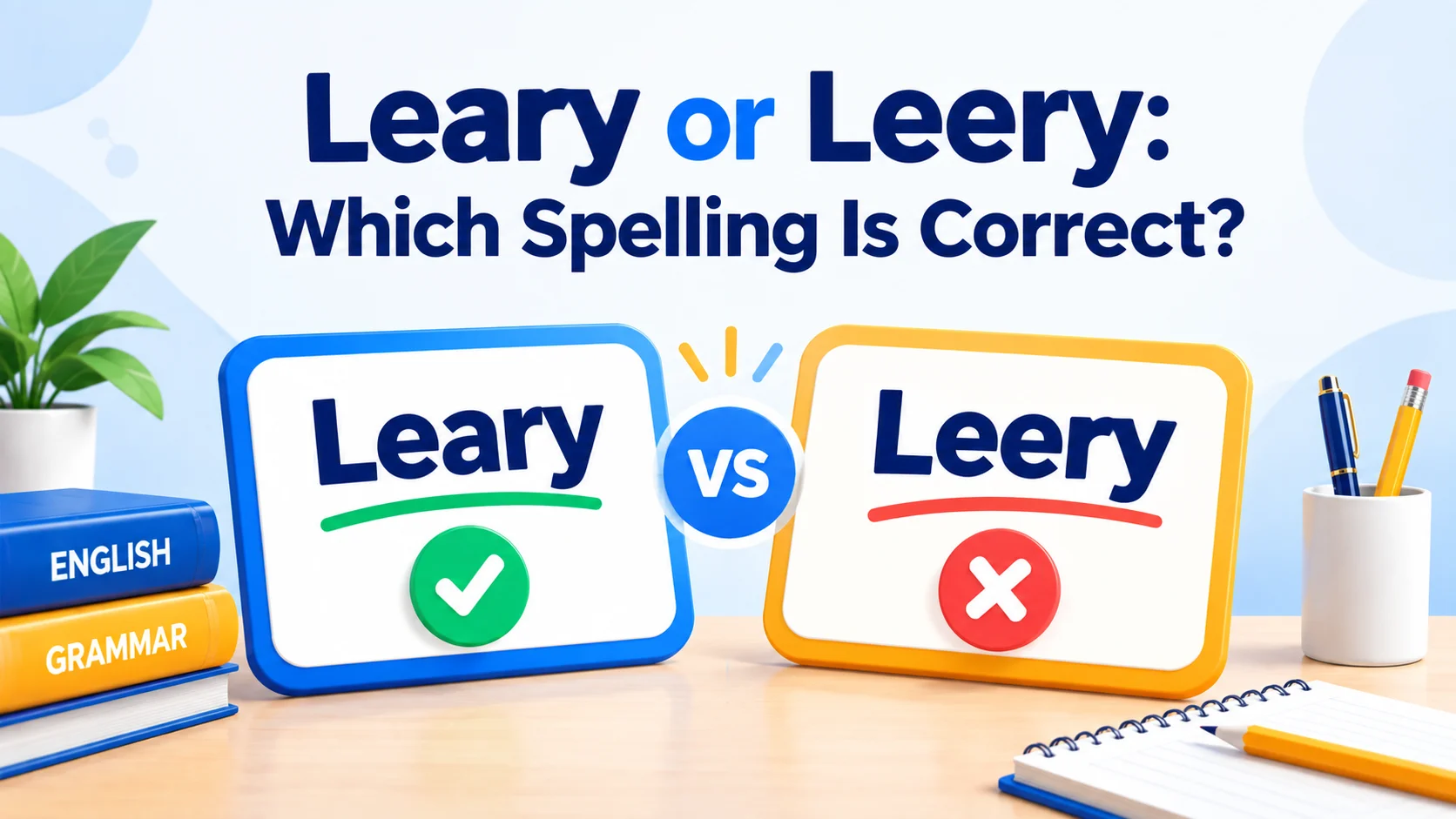
Leary or leery can be confusing because the two forms look and sound remarkably similar, but they do not serve the same purpose in standard English. If you mean cautious, distrustful, or hesitant about something, the correct word is leery. Leary, meanwhile, is most commonly a surname or part of a proper name. That distinction matters in everyday writing, professional communication, and formal documents because substituting one for the other can change the meaning or make an otherwise polished sentence look careless.
The confusion becomes easier to understand once you separate spelling from meaning. Leery is an adjective describing a person’s reservations about someone or something: She was leery of the offer. Leary does not normally function as an alternative spelling of that adjective. It may be perfectly correct when referring to someone whose surname is Leary. So the right choice depends less on pronunciation than on what the word is doing in the sentence.
There is another layer worth knowing. Leery overlaps with words such as wary, cautious, suspicious, and reluctant, but those words are not interchangeable in every context. Choosing between them can subtly change what you communicate. This guide explains the spelling distinction, pronunciation, grammar, origins, common mistakes, regional usage, and practical differences so you can use leery confidently—and recognize when Leary is actually a name.
Leary or Leery: The Quick Answer
If you want to describe someone who is cautious, distrustful, or hesitant because they have reservations, use leery.
Correct: I’m leery of buying a car from an unknown seller.
Incorrect: I’m leary of buying a car from an unknown seller.
Leary is generally a proper noun, most commonly a surname.
Professor Leary gave a presentation at the conference.
This means the two forms should not be treated as British and American alternatives. English does not use “Leary” as the American spelling and “Leery” as the British spelling. The standard adjective is leery in both varieties.
Leery vs. Leary at a Glance
| Form | Standard use | Meaning | Example |
| leery | Common English adjective | Cautious, distrustful, hesitant | She was leery of the proposal. |
| Leary | Proper noun | Usually a surname | Mr. Leary joined the meeting. |
| leary | Usually incorrect when intended as the adjective | Misspelling of leery | I’m leary of that deal. ❌ |
Quick rule: If you could replace the word with cautious or wary, you probably want leery.
What Does “Leery” Mean?
Leery is an adjective describing a person who has reservations about something because they do not fully trust it, understand it, or feel comfortable with it.
It often communicates a middle ground. Someone who is leery is not necessarily convinced that something is dangerous or dishonest. They simply do not feel sufficiently confident to accept it without caution.
For example:
- I’m leery of that investment.
- She was leery of giving a stranger her address.
- The customers were leery of the unfamiliar brand.
- He remained leery after hearing conflicting explanations.
In each case, the person has some reason—or at least some feeling—that makes them hesitant.
Leery Means More Than Simply “Careful”
There is a useful difference between leery and the broader adjective careful.
If you say:
She was careful when crossing the road.
You are describing sensible behavior.
If you say:
She was leery of the empty street.
You are adding an element of distrust, suspicion, or apprehension.
That extra implication is what makes leery useful.
What Does “Leery of” Mean?
The most familiar grammatical pattern is:
be + leery + of + noun/noun phrase
Examples:
- I’m leery of the deal.
- They’re leery of strangers.
- He is leery of making a commitment.
- We were leery of the unusually low price.
The construction works especially well when the writer wants to identify the source of the reservation.
Is “Leery About” Correct?
You will encounter both leery of and leery about, but leery of is the more established and natural construction for many contexts.
Compare:
She is leery of the proposal.
She feels leery about the proposal.
The second sentence can occur naturally, particularly when feel is involved, but leery of is the safer construction when you want conventional, straightforward usage.
For formal writing, leery of is usually the simplest choice.
Is “Leary” a Correct English Word?
Yes—but not normally as another spelling of the adjective leery.
The distinction is important.
Leary as a Surname
Leary is an established surname. When it refers to a person’s name, it is completely correct.
For example:
- Dr. Leary published the study.
- The Leary family moved to the area.
- Ms. Leary will lead the discussion.
Changing Leary to Leery in such sentences would be an error because proper names have their own established spellings.
Why “Leary” Is Not the Normal Adjective
Suppose you want to say that someone is hesitant about accepting an offer.
The sentence should be:
She was leery of the offer.
Writing:
She was leary of the offer.
does not create an alternative form. It is normally just a misspelling of leery.
This distinction is particularly important for editors. A spellchecker or writer should not automatically treat every occurrence of Leary as wrong, because context may reveal that it is someone’s surname.
What About Lowercase “leary”?
When leary appears as a lowercase adjective meaning cautious or distrustful, it is generally considered a misspelling of leery.
The capitalization distinction can help, but it is not the entire test. A person’s name may appear in different grammatical positions while retaining its proper spelling, and names can also be written in unusual ways for branding or creative purposes.
The meaning and context are therefore more reliable than capitalization alone.
Why Do People Confuse Leery and Leary?
The mistake is understandable because the two forms are close in both appearance and sound.
Similar Pronunciation
In ordinary speech, leery and Leary can sound very similar. That makes the spelling difficult to recover from pronunciation alone.
English has many words whose written forms cannot be predicted perfectly from their sounds. If you have mostly encountered leery in conversation, it is easy to hesitate when you eventually need to write it.
The Spelling Is Less Predictable Than the Meaning
A writer usually knows exactly what they mean by leery: cautious or distrustful. The problem is remembering which vowel pattern represents that meaning.
Because Leary is already a familiar surname, it can feel like a plausible spelling when someone is writing quickly.
Names Add to the Confusion
Someone who frequently sees names such as Leary may have that spelling stored in memory. When they later need the adjective, their brain can select the familiar visual pattern even though the intended word is different.
This is a common type of spelling interference: a familiar word or name influences the spelling of a similar-sounding word.
Autocorrect Can Make the Problem Harder to Notice
Typing software can sometimes suggest or preserve a familiar proper name. Since Leary is itself a legitimate name, an automated checker may not flag it as obviously wrong.
That is why context-based proofreading remains important.
How Do You Pronounce “Leery”?
Leery is commonly pronounced like “LEER-ee.”
The important practical point is that its pronunciation can be very close to Leary, depending on the speaker and accent.
That creates a useful lesson for writers:
Similar pronunciation does not mean identical spelling or meaning.
If you are writing rather than speaking, do not try to reconstruct the spelling solely from the sound. Decide first what you mean.
If the sentence means cautious or distrustful, choose leery.
If it identifies a person or family named Leary, preserve Leary.
Leery vs. Wary vs. Suspicious
Understanding these neighboring words gives you a much better command of leery than simply memorizing its spelling.
Leery vs. Wary
Leery and wary overlap heavily. Both can describe someone who is not comfortable trusting a situation.
There is, however, a subtle difference in emphasis.
Leery often highlights reservations or distrust:
I’m leery of signing a contract I haven’t read.
Wary often emphasizes alertness to possible danger or trouble:
She was wary of the aggressive dog.
Either word can work in some situations, but the emotional emphasis can change.
Leery vs. Suspicious
Suspicious usually carries a stronger implication.
If someone is leery of a website, they may simply have doubts about whether it is trustworthy.
If someone is suspicious of the website, they may actively believe that something dishonest or improper is happening.
Compare:
I’m leery of the unusually cheap price.
This suggests hesitation.
I’m suspicious of the unusually cheap price.
This suggests stronger doubt about the seller or offer.
Leery vs. Cautious
Cautious is broader and more neutral.
He was cautious about investing his savings.
This does not necessarily suggest distrust.
He was leery of investing his savings with that company.
Now the sentence suggests that the company itself has caused reservations.
Leery vs. Reluctant
Reluctant focuses primarily on unwillingness.
She was reluctant to sign.
Leery focuses more on the reason behind that hesitation:
She was leery of signing the contract.
The second sentence implies reservations about the contract or circumstances.
Choosing the Most Precise Word
| Word | Main idea | Typical implication |
| Leery | Reservations or distrust | Something feels questionable |
| Wary | Alertness | Possible danger or trouble |
| Cautious | Carefulness | Avoiding unnecessary risk |
| Suspicious | Strong doubt | Something may be wrong |
| Reluctant | Unwillingness | Not wanting to proceed |
The words overlap, but they are not interchangeable in every sentence.
Leery vs. Weary: A Different Kind of Confusion
Another common problem is confusing leery with weary.
These words are unrelated in meaning.
What Does “Weary” Mean?
Weary means tired, exhausted, or worn out.
After the twelve-hour journey, she was weary.
Leery, by contrast, means cautious or distrustful.
She was leery of taking the unfamiliar route.
The difference becomes especially important because the words look similar and can occur in similar grammatical positions.
Compare:
| Word | Meaning | Example |
| leery | Cautious or distrustful | He was leery of the offer. |
| weary | Tired or exhausted | He was weary after the trip. |
A simple meaning-based memory aid is:
Leery → reservations
Weary → tiredness
How “Leery” Works in Real Sentences
The word becomes easier to use once you see the kinds of situations in which native speakers naturally choose it.
In Everyday Conversation
I’m a little leery of going there alone.
She’s leery of buying anything from that website.
They were leery when the plan suddenly changed.
The word often works naturally with a little, still, very, or somewhat, allowing speakers to express different degrees of hesitation.
At Work
Professional situations often involve decisions where complete certainty is impossible.
The finance team was leery of approving the proposal without additional figures.
Several clients remain leery of the new pricing model.
Here, leery communicates concern without necessarily accusing anyone of misconduct.
That makes it useful when a writer wants to sound cautious rather than confrontational.
In Online Safety
Users should be leery of unexpected requests for personal information.
I was leery of downloading the file from an unfamiliar site.
In these examples, leery expresses a sensible reservation. It does not claim that the website or file is definitely malicious.
That distinction matters in responsible writing: being leery is an attitude of caution, not proof that something is unsafe.
In Relationships and Social Situations
After the disagreement, she was leery of trusting him again.
He was initially leery of meeting someone he had only spoken to online.
Here, the word can describe emotional reservations as well as practical concerns.
In Formal Writing
Leery is not inherently informal. It can appear in polished writing when the meaning is appropriate.
For example:
Consumers may be leery of products that make unusually broad claims.
Depending on the subject and audience, however, cautious, skeptical, or concerned may be preferable when a more precise or formal tone is needed.
Common Grammar Patterns With “Leery”
“Leery of” + Noun
This is the most useful pattern to remember.
- leery of the company
- leery of the decision
- leery of the stranger
- leery of the results
“Leery of” + -ing Verb
You can also follow of with a gerund.
She was leery of investing her money.
They were leery of sharing their information.
He was leery of accepting the offer immediately.
The structure is:
leery of + noun or -ing form
“Be,” “Feel,” and “Remain” + Leery
The adjective commonly appears after linking or perception verbs:
- She was leery.
- He felt leery about the arrangement.
- They remained leery of the proposal.
- I became leery after hearing the explanation.
This makes leery particularly flexible in both conversation and prose.
British vs. American English: Is There a Spelling Difference?
There is no standard British-American spelling difference between leery and Leary.
Both British and American English use leery as the adjective meaning cautious or distrustful.
| Variety | Standard adjective |
| British English | leery |
| American English | leery |
| Canadian English | leery |
| Australian English | leery |
This is different from genuine regional spelling pairs such as colour/color or centre/center.
Why the Confusion Persists
Because English has many real regional spelling differences, readers sometimes assume that any two similar spellings must represent different national standards.
That assumption is risky.
When comparing leery and Leary, the issue is not geography. It is primarily word function and meaning.
Where Does “Leery” Come From?
The history of leery is useful because it explains why the word has a somewhat distinctive spelling.
The word developed in English over time and is associated with an older sense connected with alertness, caution, and suspicion. Its modern meaning retains that central idea: someone who does not completely trust a person, situation, or proposition.
How the Meaning Developed
Historical vocabulary often develops gradually rather than acquiring one fixed definition at a particular moment.
With leery, the modern sense of being cautious or distrustful is closely connected to the broader idea of being watchful and unwilling to trust too quickly.
That historical development also helps explain why the word’s meaning sits somewhere between simple caution and outright suspicion.
Does Etymology Explain the Spelling?
Only partly.
Word histories can explain why a spelling exists, but they do not necessarily provide a practical spelling rule for modern writers.
For everyday use, the more useful approach is to associate:
leery → cautious / distrustful
rather than trying to reconstruct the spelling from its historical development.
Common Mistakes With Leery and Leary
Writing “Leary” When You Mean “Leery”
This is the main error.
❌ I’m leary of accepting the offer.
✅ I’m leery of accepting the offer.
If the word describes an attitude of caution, use leery.
Treating Leary as a Regional Variant
Leary is not a standard American alternative to British leery, nor the reverse.
The adjective remains leery in both varieties.
“Correcting” Someone’s Surname
The opposite mistake is also possible.
Mr. Leary attended the meeting.
Here, Leary is correct because it is the person’s surname.
An editor should never change a proper name simply because it resembles a commonly confused word.
Confusing Leery With Weary
Ask yourself what you mean:
- Cautious? → leery
- Tired? → weary
Choosing “Suspicious” When You Only Mean “Cautious”
Words have different strengths.
Calling someone suspicious may suggest that they believe something is dishonest or wrong. If you only mean that they have reservations, leery may be the better choice.
Leery or Leary: A Practical Decision Guide
When proofreading a sentence, use meaning first.
| If you mean… | Use |
| Cautious or distrustful | leery |
| Alert to possible danger | wary |
| Careful about risk | cautious |
| Strongly doubtful | suspicious |
| Unwilling to proceed | reluctant |
| A person’s surname | Leary |
1. Use “Leery” When…
Use leery if the sentence describes someone who:
- Has reservations
- Does not fully trust something
- Is hesitant because something seems questionable
- Wants to proceed carefully
- Feels uncertain about a person, offer, plan, or situation
2. Use “Leary” When…
Use Leary when it is:
- A surname
- Part of an official proper name
- A name that you are reproducing exactly as established
The important exception is simple: proper names can have spellings that differ from ordinary vocabulary.
Leery or Leary in Everyday Examples
At Work
The manager was leery of changing the agreement without reviewing the figures.
While Shopping
I was leery of buying an expensive item from an unfamiliar seller.
Online
She was leery of clicking the link in an unexpected message.
In Personal Relationships
He remained leery of making another commitment so quickly.
In Formal Writing
Consumers may be leery of products that provide limited information about their ingredients.
These examples show that leery can work in casual conversation, professional communication, and formal prose without changing its spelling.
Leery vs. Leary: Final Comparison
| Feature | Leery | Leary |
| Standard adjective? | Yes | No |
| Meaning | Cautious, distrustful, hesitant | Usually a surname |
| Common grammatical role | Adjective | Proper noun |
| Used in British English? | Yes | As a name, yes |
| Used in American English? | Yes | As a name, yes |
| Common phrase | leery of | Depends on the name |
| Example | She is leery of the offer. | Mr. Leary called earlier. |
| Main source of confusion | Similar pronunciation | Familiar surname spelling |
The simplest distinction is therefore:
Leery describes an attitude. Leary identifies a name.
Conclusion
The difference between Leary or leery becomes straightforward once you focus on meaning rather than pronunciation. Use leery when describing someone who is cautious, distrustful, or hesitant because they have reservations. Use Leary when you are referring to a person, family, or other proper name with that established spelling. They may sound similar, but they do different jobs in writing. One final actionable tip: when proofreading, replace the word mentally with cautious. If the sentence still makes sense, leery is probably the form you need. A common mistake to avoid is assuming that Leary represents a British or American spelling variant. In standard English, the adjective is leery—and choosing the right word ultimately depends on context, not sound alone.
Frequently Asked Questions
Q1. Is “leary” ever correct as an adjective?
In standard modern English, leary is not the normal spelling of the adjective meaning cautious or distrustful. If that is your intended meaning, use leery. Leary can still be correct when it functions as a surname or another established proper name.
Q2. Is “leery” a British or American word?
Leery is used in both British and American English. It is not a regional spelling variant. Writers in either variety can use leery to describe reservations, caution, or distrust. Differences may occur in preferred synonyms, but the spelling itself remains the same.
Q3. Is “leery about” grammatically correct?
Leery of is the most established construction, as in She is leery of the proposal. Leery about also occurs, particularly after verbs such as feel, but writers seeking the safest conventional phrasing should generally choose leery of.
Q4. Is “leery” stronger than “cautious”?
Usually, leery adds an element of distrust or reservation that cautious does not necessarily express. Someone can be cautious simply because they want to avoid risk. Someone who is leery often feels that a particular person, offer, or situation deserves extra scrutiny.
Q5. Can “Leary” be a person’s last name?
Yes. Leary is an established surname, so it can be completely correct when referring to a person or family. Context is essential. Never change a person’s surname to Leery merely because you know leery is the standard adjective.
