
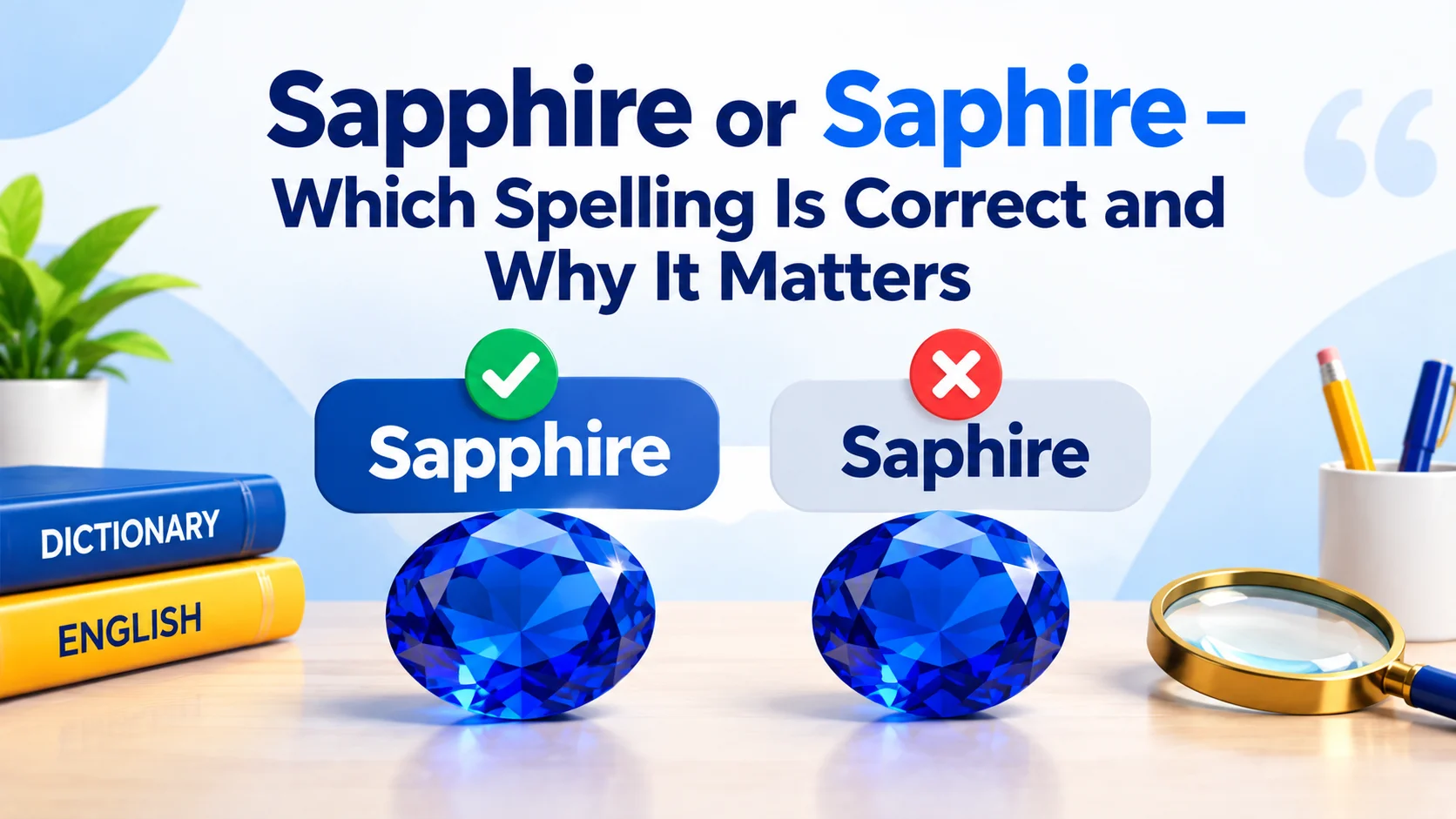
Sapphire or Saphire is a common spelling question, especially because the word does not sound exactly the way its letters suggest. The correct standard English spelling is sapphire, with two Ps and the sequence -phire at the end. Saphire is generally a misspelling, not a British or American English alternative. This distinction matters when you are writing about the gemstone, describing a color, preparing a school assignment, or creating professional product copy. Once you recognize the unusual sapph- beginning, the correct form becomes much easier to remember.
The confusion is understandable. English contains many words whose spelling cannot be predicted reliably from pronunciation, and sapphire has several letter combinations that can make a writer hesitate. Some people drop one of the two Ps, while others assume that saphire might be an accepted regional spelling. It is not. British and American English both use “sapphire.” This guide explains the meaning, history, pronunciation, spelling pattern, common mistakes, and real-world uses of the word so you can choose the correct form confidently.
There is also more to sapphire than simply knowing which spelling wins. The word can refer to a precious gemstone, a color, or part of a descriptive phrase such as sapphire blue. It can appear in jewelry descriptions, fashion writing, literature, marketing, science-related discussions, and everyday conversation. You will also learn when capitalization is appropriate, why saphire looks plausible, whether historical spellings change the answer, and how to remember the correct spelling without relying on pronunciation alone.
Sapphire or Saphire: Which Spelling Is Correct?
The standard modern English spelling is sapphire.
| Spelling | Standard English? | Main use | Recommendation |
| sapphire | Yes | Gemstone, color, descriptions | Use this spelling |
| saphire | No, in ordinary English | Usually a spelling mistake | Avoid it |
| Sapphire | Yes when capitalization is required | Beginning of a sentence or proper name | Context-dependent |
The important point is that saphire is not an alternative spelling used in British English. Nor is it an American variant. Both major varieties of modern English use sapphire.
For example:
- ✅ She received a sapphire ring for her birthday.
- ❌ She received a saphire ring for her birthday.
The same rule applies when the word describes a color:
- ✅ The fabric was a deep sapphire blue.
- ❌ The fabric was a deep saphire blue.
The Correct Spelling Is “Sapphire”
The word is spelled:
S-A-P-P-H-I-R-E
The easiest part to overlook is the pair of Ps:
sapph + ire = sapphire
You do not need to pronounce both Ps separately. English spelling frequently contains letters that are not strongly represented in ordinary pronunciation. The spelling is an established form that should be learned as a whole.
Why “Saphire” Is Usually Wrong
Saphire removes one of the two Ps from sapphire. That makes it look simpler, but simplification does not create a standard spelling.
This is an important distinction because writers sometimes assume that a spelling variation must have a regional explanation. In this case, it does not. If you are writing ordinary modern English and mean the gemstone or the associated color, sapphire is the form to use.
Quick rule: If you mean the gemstone, its color, or something described as sapphire, spell it sapphire.
What Does “Sapphire” Mean?
Sapphire is primarily a noun referring to a gemstone. In ordinary usage, people often associate the word specifically with a rich or vivid blue stone, although sapphires can occur in colors other than blue.
The word can also function descriptively when referring to a particular shade of blue.
Sapphire as a Gemstone
A sapphire is a variety of corundum, the mineral form of aluminum oxide. In gemological terms, the name is associated with corundum gemstones that are not classified as ruby.
Blue sapphires are especially well known, and their color can range from relatively pale blue to deep, saturated shades.
Examples:
- The jeweler showed us a blue sapphire.
- Her engagement ring features a sapphire surrounded by diamonds.
- The museum displayed an impressive collection of sapphire jewelry.
The context usually makes the meaning obvious.
Sapphire as a Color
Sapphire can also describe a strong blue color, particularly when writers want something more evocative than simply saying blue.
Examples include:
- She wore a sapphire dress to the evening event.
- The curtains were a rich sapphire blue.
- The lake appeared sapphire under the clear afternoon sky.
In descriptive writing, sapphire can therefore work as a color term or part of a color phrase.
Sapphire in Figurative and Descriptive Writing
Writers sometimes use sapphire metaphorically to create a visual impression.
For example:
The sapphire sky stretched above the mountains.
Here, the writer is not claiming that the sky is literally made from a gemstone. The gemstone’s familiar color and visual associations are being used to create a vivid image.
This is one reason the word appears outside jewelry and gemology.
Why Is Sapphire Spelled With Two Ps?
The spelling sapphire can look unusual because of the combination pph. A reader who knows the word primarily from speech may naturally wonder why the spelling contains two Ps.
The answer is historical rather than phonetic. The modern English spelling developed through older forms of the word and ultimately reflects the history of the term rather than a simple attempt to spell its modern pronunciation.
That means you should not expect the spelling to be reconstructed perfectly by listening to the word.
The “Sapph-” Beginning Is the Key
The most useful spelling unit to remember is:
SAPPH
Once you know that the word begins with sapph-, the rest is easier:
SAPPH + IRE = SAPPHIRE
This is more reliable than trying to decide whether there should be one or two Ps each time you write the word.
Why “Saphire” Looks Reasonable
Saphire looks plausible because English contains many words in which doubled consonants are not obvious from pronunciation.
A person who hears the word may mentally represent it as something like saf-fire or saf-ire. When they later write it, the second p can disappear.
That is a spelling-memory problem, not evidence that saphire is an accepted variant.
Where Does the Word “Sapphire” Come From?
The history of sapphire helps explain why its spelling does not follow modern English pronunciation perfectly.
The word has a long history connected with terms used for the gemstone in earlier languages, including forms associated with Latin and Greek. English inherited and developed the term through historical linguistic pathways rather than creating the modern word from scratch.
The Greek term sappheiros is traditionally connected with the history of the English word. Related forms appeared in Latin and later European languages before the modern English form developed.
From Historical Forms to Modern English
Historical spelling is not always identical to today’s spelling. Languages change over time, and words can pass between languages while their pronunciation, spelling, or meaning shifts.
That is why it would be misleading to argue that saphire must be correct simply because older texts may contain spelling forms that look different from today’s sapphire.
Modern English spelling is determined by current usage and established dictionaries, not by whether a similar historical form once existed.
Does the History Make “Saphire” Correct?
No.
Historical development explains why the modern spelling looks the way it does, but it does not turn every historical or nonstandard spelling into an acceptable modern alternative.
For contemporary English writing, the practical answer remains:
Use sapphire.
Is Sapphire Spelled Differently in British and American English?
No. Sapphire is spelled the same way in British and American English.
This is worth emphasizing because English has many genuine spelling differences between regional varieties.
For example:
- British colour → American color
- British favour → American favor
- British centre → American center
But sapphire does not follow this pattern.
| Variety of English | Correct spelling |
| British English | sapphire |
| American English | sapphire |
| Canadian English | sapphire |
| Australian English | sapphire |
| Standard international English | sapphire |
Sapphire in British English
British writers use sapphire when referring to the gemstone or its associated color.
Example:
The necklace was set with a blue sapphire.
There is no need to change the spelling to saphire for British readers.
Sapphire in American English
American English uses the same spelling:
The jeweler showed her several sapphire rings.
Again, saphire is not the American alternative.
A Useful Rule for Regional Spelling
When you encounter a word with competing forms, do not automatically assume that one is British and the other American.
Some differences genuinely reflect regional conventions. Others are simply correct versus incorrect spelling.
Sapphire belongs to the second category when compared with saphire.
Why Do People Spell Sapphire as “Saphire”?
Understanding the source of a mistake can make it easier to prevent.
The Second P Is Easy to Forget
The sequence pph is visually unusual. When writing quickly, a person may remember the general shape of the word but omit one consonant.
This happens particularly when the word is familiar in meaning but not frequently written.
People Often Spell Words by Sound
English spelling is not a perfect representation of pronunciation. A writer who relies heavily on phonetic spelling may produce saphire because the second p does not feel prominent in speech.
That approach works for some simple words but becomes unreliable with words containing historical spellings, silent letters, or unusual consonant combinations.
Online Exposure Can Reinforce Errors
A misspelling can look increasingly familiar when it appears repeatedly online. Product listings, user-generated content, social media posts, and informal websites may contain mistakes.
Familiarity, however, is not the same as correctness.
A useful habit is to check the spelling against a reliable dictionary when a word looks unusual rather than deciding based on how often you have seen it.
Similar-Looking Spellings Create False Confidence
Writers sometimes remember a word’s ending correctly while forgetting its middle. With sapphire, the final -ire can be retained while the pph sequence is simplified.
That produces:
saphire
instead of:
sapphire
The solution is to remember the unusual middle rather than treating it as something to reconstruct from sound.
When Should You Use “Sapphire”?
Use sapphire whenever the context calls for the standard English word.
Talking About a Gemstone
Use it when discussing:
- Jewelry
- Gemstones
- Rings
- Necklaces
- Earrings
- Gem collections
- Mineral and gemological descriptions
Example:
The ring contains a natural blue sapphire.
Describing a Color
Use sapphire when a strong blue shade is relevant.
Examples:
- The designer selected sapphire blue for the interior.
- Her sapphire-colored scarf stood out against the white coat.
Professional Writing
Accuracy matters particularly in professional settings where spelling can affect credibility.
For example, a jewelry retailer might write:
This pendant features a natural sapphire set in sterling silver.
Writing saphire in a product description can make the listing look poorly edited and may reduce customer confidence.
Academic and Educational Writing
If you are writing a school assignment, article, report, or presentation, use sapphire.
The same applies to educational materials, examination answers, and formal descriptions.
Casual Writing
Even in a text message or social media caption, sapphire remains the correct spelling.
Informal writing may be less strict about grammar, but the standard spelling does not change simply because the context is casual.
Sapphire in Real Sentences
Seeing the word in different contexts is one of the best ways to understand how it works.
Examples About the Gemstone
- The jeweler inspected the sapphire under a magnifying lens.
- She chose a sapphire instead of a traditional diamond.
- The ring’s central sapphire was surrounded by smaller stones.
- The collection includes several unusually colored sapphires.
Examples About Color
- The room was decorated in shades of sapphire and white.
- A sapphire-blue jacket hung near the entrance.
- The evening sky turned a deep sapphire color.
Examples in Descriptive Writing
- The ocean stretched beneath a sapphire sky.
- Tiny lights reflected across the sapphire surface of the water.
Incorrect and Correct Examples
| Incorrect | Correct |
| She bought a saphire ring. | She bought a sapphire ring. |
| The stone was a beautiful saphire blue. | The stone was a beautiful sapphire blue. |
| I prefer saphire jewelry. | I prefer sapphire jewelry. |
| The necklace contains a blue saphire. | The necklace contains a blue sapphire. |
Common Sapphire Spelling Mistakes to Avoid
“Saphire” Instead of “Sapphire”
This is the main error to avoid.
The correct sequence is:
s-a-p-p-h-i-r-e
Not:
s-a-p-h-i-r-e
The missing p is the key difference.
Forgetting the “Ph”
Another possible error is remembering the doubled P but dropping the h.
The beginning should be:
sapph-
not merely:
sapp-
The combination pph may look strange, but it is part of the established spelling.
Assuming “Saphire” Is British
This is a particularly common misconception.
There is no standard British spelling saphire corresponding to American sapphire. Both use sapphire.
Unnecessary Capitalization
As a common noun, sapphire normally does not need a capital letter in the middle of a sentence.
Correct:
She wore a sapphire necklace.
Not:
She wore a Sapphire necklace.
However, capitalization can be appropriate when Sapphire is part of a proper name, title, business name, product name, or another officially capitalized expression.
Sapphire vs. Saphire: Correct Usage Comparison
The following table provides a quick reference for writers who want a decision without reading the entire article.
| Question | Sapphire | Saphire |
| Is it the standard spelling? | Yes | No |
| Used in British English? | Yes | No |
| Used in American English? | Yes | No |
| Refers to the gemstone? | Yes | Intended meaning, but misspelled |
| Can describe a blue color? | Yes | Not in standard usage |
| Appropriate for formal writing? | Yes | No |
| Appropriate in school assignments? | Yes | No |
| Could appear in a proper name? | Yes | Possibly, if officially spelled that way |
| Should you normally type it? | Sapphire | Avoid |
The Simple Decision Rule
If you are referring to the gemstone or its associated color, write:
sapphire
If you see saphire in ordinary prose, treat it as a likely spelling error.
The only important qualification involves proper names. A company, username, fictional character, product, or surname may deliberately use a spelling that differs from the standard dictionary word. In that case, reproduce the official name accurately rather than silently changing someone’s name.
Sapphire in Everyday Writing
The correct spelling remains useful across many ordinary situations.
Emails and Messages
Suppose you are emailing a jeweler:
Could you send me details about the sapphire in this ring?
Using the standard spelling keeps the message clear and professional.
Social Media
A caption might read:
The sapphire-blue details make this dress unforgettable.
A brand might also use Sapphire as part of its official name. If so, capitalization should follow the brand’s own styling.
Professional Writing
Professional contexts where the spelling may matter include:
- Jewelry catalogs
- Product descriptions
- Fashion articles
- Retail websites
- Gemstone reports
- Marketing materials
- Business presentations
- Editorial content
In commercial writing, spelling errors can have an outsized effect because readers may interpret them as signs of weak editing.
School Assignments
Students may encounter sapphire in subjects such as:
- English
- History
- Art
- Geology
- Science
- Literature
If the word appears in an assignment, use the standard spelling unless you are deliberately discussing an historical spelling or quoting a source.
Is “Saphire” Ever Correct?
In ordinary modern English vocabulary, no: saphire is not the standard spelling of the gemstone.
There is, however, an important distinction between a dictionary word and a proper name.
A person, business, fictional character, username, organization, or product may intentionally use Saphire as its official name. In that situation, changing it to Sapphire would actually make the name inaccurate.
For example, if a fictional company were officially called Saphire Designs, you would preserve that spelling when referring to the company.
That does not mean saphire has become an accepted spelling of the gemstone.
Expert distinction: A nonstandard spelling can be correct as part of a specific name while remaining incorrect as the ordinary English word.
How to Remember the Correct Spelling of Sapphire
The most effective strategy is to memorize the unusual part instead of trying to spell the whole word phonetically.
Use the “SAPPH” Memory Pattern
Think:
SAPPH + IRE
The unusual part is SAPPH.
Once you have that fixed in memory, the full spelling follows naturally:
SAPPHIRE
Don’t Spell It From Pronunciation
If you try to reconstruct the word from its sound every time, you may be tempted to write saphire.
Instead, treat sapphire as a single established spelling.
Use Visual Repetition
Write the word several times:
- sapphire
- sapphire blue
- blue sapphire
- sapphire ring
Repeated exposure to the correct visual pattern makes the unusual pph combination easier to recognize.
A Quick Spelling Checklist
Before publishing or submitting writing that contains this word, check:
- Did I write sapphire?
- Does the word contain two Ps?
- Does it contain ph after the Ps?
- Am I accidentally using saphire because of pronunciation?
- If I wrote Sapphire with a capital S, is capitalization actually required?
- If I used Saphire intentionally, is it part of an official name?
This takes only a few seconds and prevents the most common error.
Common Misconceptions About Sapphire Spelling
Myth 1: “Saphire” Is the British Spelling
False. British English uses sapphire, just like American English.
Myth 2: The Second P Is Optional
False. In the standard word, the spelling includes two Ps.
Myth 3: If People Understand “Saphire,” It Must Be Acceptable
Understanding the intended meaning does not make a spelling standard. Readers can understand many misspellings without those spellings becoming correct.
Myth 4: Every Unusual Spelling Is a Regional Variant
Not necessarily. Some words genuinely differ between English varieties, while others have one standard spelling and several common mistakes.
Sapphire belongs to the latter category.
Myth 5: A Brand Called “Saphire” Proves the Spelling Is Correct
A brand or personal name can have an intentionally unusual spelling. Proper-name spelling and dictionary spelling are different questions.
Quick Reference: Everything You Need to Know
| Topic | Answer |
| Correct spelling | sapphire |
| Incorrect ordinary spelling | saphire |
| Number of Ps | Two |
| British spelling | sapphire |
| American spelling | sapphire |
| Main meaning | A gemstone |
| Color meaning | A rich or vivid blue |
| Main spelling problem | Dropping the second P |
| Best memory aid | SAPPH + IRE |
| Possible exception | An officially spelled proper name |
Conclusion
When choosing between sapphire or saphire, the answer is straightforward: sapphire is the standard English spelling. The same form is used in British and American English, so there is no regional spelling distinction to remember. The unusual SAPPH sequence is the part worth memorizing, particularly the two Ps that are commonly dropped when people spell the word from pronunciation. The word can describe both the gemstone and a rich blue color, while unusual forms may occasionally appear in proper names. One final actionable tip: remember the word as SAPPH + IRE rather than spelling it by sound. A common mistake to avoid is treating saphire as a legitimate UK variant. When you mean the gemstone or its color, sapphire is the dependable choice.
Frequently Asked Questions
Q1. Is “saphire” a correct spelling?
No. Saphire is generally considered a misspelling of sapphire in modern standard English. The correct spelling contains two Ps: s-a-p-p-h-i-r-e. If you are writing about the gemstone or its characteristic color, use sapphire.
Q2. Is sapphire spelled differently in British English?
No. British and American English both use “sapphire.” Unlike words such as colour/color, this word does not have a standard UK/US spelling difference. Writing saphire does not make the spelling more British; it simply introduces a spelling error.
Q3. Why does sapphire have two Ps?
The doubled p is part of the word’s established historical spelling. Modern pronunciation does not necessarily reveal every letter inherited through a word’s linguistic history. The easiest practical solution is to remember the distinctive beginning as SAPPH-.
Q4. How do you spell sapphire correctly?
Spell it S-A-P-P-H-I-R-E. A useful memory trick is to divide it into SAPPH + IRE. The part most likely to be forgotten is the second P, so checking for SAPPH before finishing the word can prevent the common saphire error.
Q5. Can “Saphire” ever be correct?
It can appear as the official spelling of a name, brand, username, fictional character, or other proper noun. In that situation, the spelling should be preserved because names can be unconventional. However, saphire remains nonstandard when used as the ordinary English word for the gemstone.
