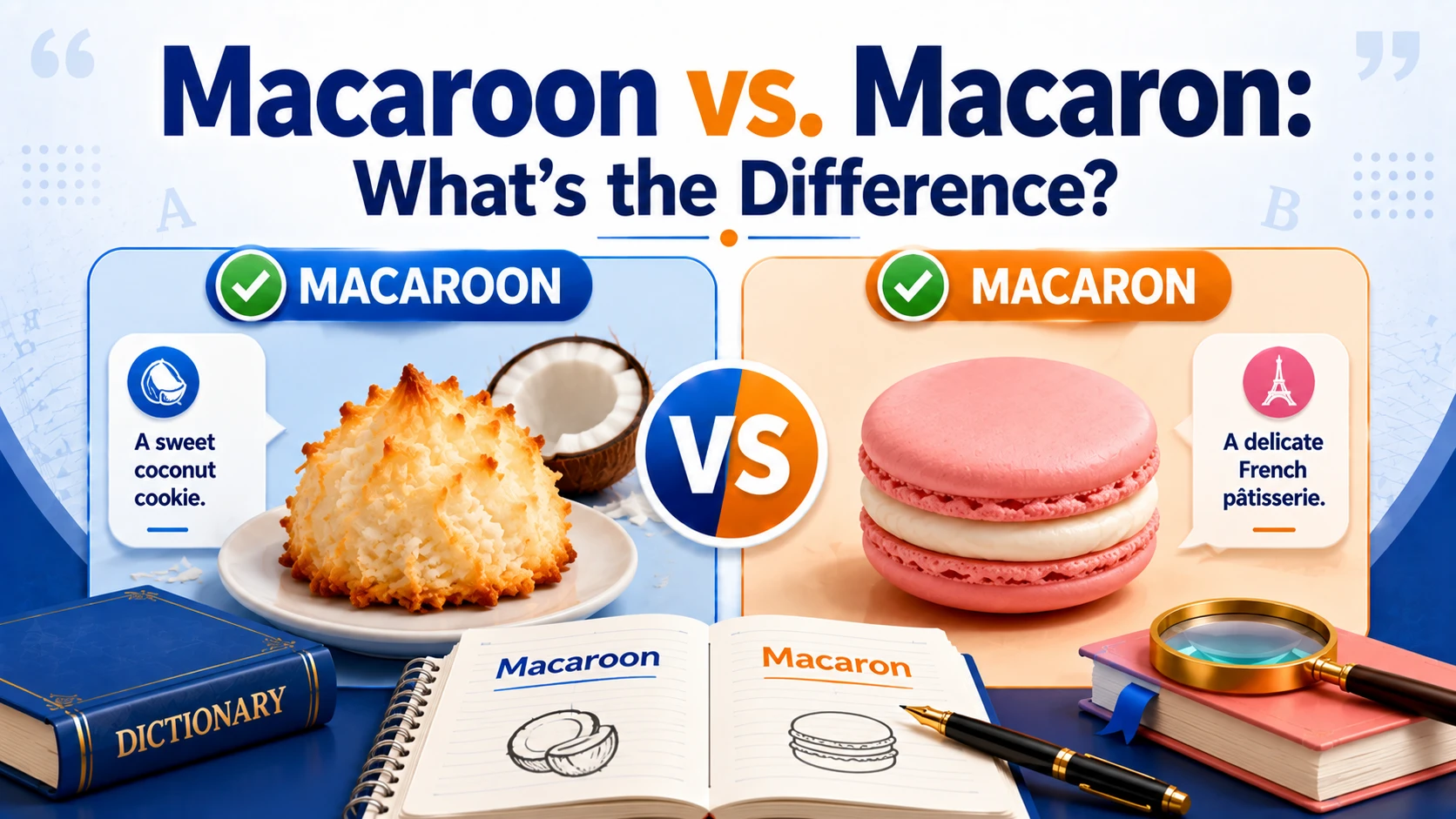
Macaroon vs. macaron looks like a tiny spelling difference, but the two words usually refer to two distinctly different cookies. A macaroon is typically a chewy, coconut-based cookie, often shaped into a rough mound and sometimes dipped in chocolate. A macaron, by contrast, is a delicate sandwich cookie made from almond flour, egg whites, and sugar, with two smooth shells surrounding a filling. The names are close enough to cause confusion, especially on menus and in recipes. Once you know the ingredients, appearance, texture, and pronunciation of each, however, the distinction becomes surprisingly easy to remember.
The confusion isn’t entirely accidental. Macaroon and macaron are historically related words, and their culinary histories overlap. English usage developed differently from French usage, which helped produce the two forms we recognize today. That’s why simply saying that one is “the correct spelling” isn’t accurate. Both words are legitimate. The important question is which cookie you mean. In modern English, macaroon generally points to the coconut cookie, while macaron usually refers to the colorful almond-meringue sandwich associated with French pâtisserie.
This guide breaks down macaroon vs. macaron from every angle that matters: ingredients, preparation, appearance, texture, pronunciation, spelling, history, variations, difficulty, dietary considerations, and everyday usage. You’ll also see practical examples, comparison tables, common misconceptions, and a quick decision test you can use when reading a recipe or ordering dessert. By the end, you won’t have to guess whether you’re looking at a chewy coconut macaroon or a delicate almond macaron.
Macaroon vs. Macaron at a Glance
The quickest distinction is based on what the cookie is made from and how it is constructed.
Macaroon = usually a coconut-based cookie.
Macaron = usually an almond-meringue sandwich cookie.
| Feature | Macaroon | Macaron |
| Typical base | Shredded coconut | Almond flour, egg whites, sugar |
| Structure | Usually one-piece cookie | Two shells joined by filling |
| Appearance | Rustic, uneven mound | Smooth, round, symmetrical |
| Texture | Dense and chewy | Crisp exterior with a softer center |
| Filling | Usually none | Usually buttercream, ganache, jam, or curd |
| Common flavor | Coconut | Wide range of flavors |
| Color | Often white, cream, or golden | Frequently brightly colored |
| Technique | Relatively simple | Technically demanding |
| Common association | Coconut cookie | French-style pâtisserie |
There is an important qualification: recipes vary. A macaroon doesn’t have to look exactly the same in every bakery, and macaron fillings and flavors can vary enormously. The table describes the most common modern forms rather than an unbreakable culinary law.
The one-sentence difference
If you need a fast answer:
A macaroon is usually a chewy coconut cookie, while a macaron is a sandwich cookie made from almond-meringue shells and a filling.
How to know which one someone means
Look for clues.
If you see:
- shredded coconut
- a rough mound
- a dense, chewy texture
- chocolate on the bottom or top
you’re probably looking at a macaroon.
If you see:
- two smooth round shells
- almond flour
- a filling between the shells
- a delicate, colorful appearance
- a smooth outer surface with a ruffled edge
you’re almost certainly looking at a macaron.
What Is a Macaroon?
A macaroon is a small cookie traditionally associated in modern English usage with shredded coconut. Many versions combine coconut with egg whites and sugar. Some recipes also use sweetened condensed milk, depending on the style.
The result is usually much more rustic than a French macaron. The mixture is scooped or shaped into small mounds and baked until the outside becomes lightly golden.
What a traditional coconut macaroon is
A basic coconut macaroon might contain:
- shredded coconut
- egg whites
- sugar
- vanilla
- sometimes sweetened condensed milk
Some recipes add chocolate, nuts, dried fruit, or other flavorings.
Unlike a macaron, a macaroon generally doesn’t depend on creating two perfectly smooth shells. Its appeal is partly its simple, chewy character.
What a macaroon looks and tastes like
A typical coconut macaroon has:
- an irregular or rounded shape
- visible strands of coconut
- a slightly browned exterior
- a moist or chewy interior
- a pronounced coconut flavor
The texture can range from soft and moist to crisp around the edges and chewy in the middle.
That’s one reason macaroons are often considered more forgiving for home bakers. The finished cookie doesn’t need the same degree of visual uniformity expected from a classic macaron.
Why coconut is the defining ingredient
In contemporary American English, coconut is one of the strongest clues that you’re dealing with a macaroon.
For example:
She brought a tray of coconut macaroons to the party.
The phrase immediately suggests small, chewy coconut cookies rather than almond sandwich cookies.
However, coconut isn’t the only ingredient that can appear in recipes called macaroons. Historical and regional recipes have varied considerably. So “macaroon always means coconut” is useful as a modern rule of thumb, but not an absolute historical definition.
Common macaroon shapes and variations
Macaroons can be:
- small domes
- rough clusters
- flattened rounds
- chocolate-coated pieces
- chocolate-drizzled cookies
A bakery may also flavor them with:
- almond
- chocolate
- lemon
- orange
- vanilla
- caramel
The word therefore identifies a style of cookie, not a single standardized recipe.
Chocolate-dipped and flavored macaroons
Chocolate and coconut are a particularly common combination.
A bakery might dip the base of a coconut macaroon in dark chocolate or drizzle chocolate over the top. This changes the flavor profile without changing the fundamental identity of the cookie.
For example:
The bakery sells chocolate-dipped coconut macaroons.
Calling these cookies macarons would generally be incorrect.
What Is a Macaron?
A macaron is a small sandwich cookie made from two delicate shells, typically based on almond flour, egg whites, and sugar.
The shells are piped into smooth rounds, baked, cooled, and then paired with a filling.
That filling might be:
- buttercream
- chocolate ganache
- fruit jam
- fruit curd
- caramel
- flavored cream
The combination creates the characteristic macaron structure: two crisp-to-tender shells surrounding a softer center.
What makes a French macaron different
The modern macaron associated with French pâtisserie is defined by its construction.
A typical macaron has:
- A smooth upper shell.
- A second matching shell.
- A filling between them.
- A characteristic ruffled edge known as the foot or feet.
The shells should generally be relatively smooth and uniform.
That visual precision is one of the reasons macarons are so recognizable.
The almond flour and meringue base
Traditional French-style macarons generally use finely ground almonds or almond flour, powdered sugar, granulated sugar, and egg whites.
The egg whites are whipped into a meringue. The dry ingredients are then incorporated carefully.
This is where the technical challenge begins.
The batter needs to reach an appropriate consistency. If it’s too thick, the shells may remain rough or fail to spread properly. If it’s too loose, the rounds can spread excessively and lose their structure.
The two shells and filling
Unlike a typical macaroon, a macaron isn’t simply one mound of batter.
It’s assembled:
shell + filling + shell
That filling isn’t just decorative. It contributes significantly to the final texture and flavor.
A chocolate macaron, for instance, might combine chocolate-flavored shells with chocolate ganache. A raspberry version might pair neutral or berry-flavored shells with raspberry filling.
What “feet” mean on a macaron
The feet are the slightly ruffled area around the bottom edge of each macaron shell.
They’re a familiar feature of well-made macarons.
The feet form during baking as the shell expands and develops structure. Their appearance can provide useful information to a baker about the batter, drying process, oven conditions, and technique.
However, “perfect feet” shouldn’t be treated as the sole measure of quality. Flavor, texture, filling, and proper baking matter too.
Texture: crisp shell, soft center, and creamy filling
A good macaron typically offers several textures in one bite:
- a delicate outer shell
- a softer, slightly chewy interior
- a creamy or jam-like filling
The cookie should not simply be hard and brittle.
Many macarons also benefit from maturing after assembly. As the filling interacts with the shells, their texture can become more cohesive and tender.
Macaroon vs. Macaron: Ingredients, Shape, and Texture Compared
The names may look nearly identical, but the baking processes are fundamentally different.
| Category | Macaroon | Macaron |
| Main ingredient | Coconut | Almond flour |
| Egg whites | Common | Common |
| Sugar | Common | Essential |
| Flour | Usually no wheat flour | Almond flour rather than wheat flour |
| Shape | Mound or cluster | Flat, round shell |
| Filling | Usually absent | Usually present |
| Surface | Rough or textured | Smooth |
| Texture | Chewy, dense | Crisp outside, tender inside |
| Baking precision | Moderate | High |
| Appearance | Rustic | Highly uniform |
| Flavor | Often coconut-forward | Extremely adaptable |
Ingredient differences
The most useful ingredient distinction is:
Macaroon → coconut
Macaron → almond flour
There are exceptions and recipe variations, but this shortcut works extremely well for modern everyday usage.
Preparation and baking differences
Macaroon batter is usually mixed and shaped with relatively little concern for achieving perfectly smooth surfaces.
Macaron batter is much more sensitive. Bakers need to manage:
- meringue structure
- ingredient ratios
- folding
- batter viscosity
- piping
- drying
- oven temperature
- baking time
A few small differences in technique can noticeably affect the finished shells.
Appearance and structure
A macaroon is usually intentionally rustic.
A macaron is usually intentionally uniform.
That’s why macarons are commonly associated with pastry shops and gift boxes where every piece is expected to look nearly identical.
Texture and mouthfeel
Macaroons tend to be:
- chewy
- moist
- dense
- coconutty
Macarons tend to be:
- delicate
- crisp or slightly crisp outside
- soft or chewy inside
- creamy because of the filling
Flavor profiles
Macaroons often let the coconut remain the star.
Macarons are almost the opposite. Their neutral almond-meringue base provides a platform for many flavors.
Why Do “Macaroon” and “Macaron” Sound So Similar?
The similarity isn’t a coincidence.
The two words are historically related and ultimately trace back to words associated with the Italian maccherone/maccarone family and related culinary terms. Their histories developed across European languages, and modern culinary traditions gradually gave the words more distinct meanings.
This history explains why it’s misleading to say that macaroon is simply a misspelling of macaron. Both are established English words.
The modern distinction is largely culinary and usage-based.
The shared linguistic history
The history of these cookies is complicated. Different European regions developed almond- and meringue-based confections over centuries, and the terminology changed as recipes traveled between languages and countries.
The French word macaron became strongly associated with the sandwich cookie now familiar around the world.
The English word macaroon developed its own usage and became especially associated with coconut-based cookies.
Why the spellings became different
English borrowed culinary vocabulary from other languages while adapting pronunciation and spelling to English conventions.
Over time:
- macaron retained a French-looking form.
- macaroon developed an English form with the -oon ending.
That’s why the spelling itself carries useful information today.
Why English speakers sometimes use “macaroon” for macarons
The confusion is understandable.
The words:
- look similar
- sound similar
- share historical roots
- describe small sweet baked goods
Older culinary references can also use terminology differently from modern bakery menus.
Still, in contemporary English, especially in American usage, the distinction is clear enough that macaron generally means the almond sandwich cookie and macaroon generally means the coconut cookie.
Macaroon vs. Macaron: Pronunciation and Spelling
Spelling isn’t the only difference. Their pronunciation is different too.
How to pronounce “macaroon”
Macaroon is commonly pronounced roughly:
mack-uh-ROON
The final syllable rhymes approximately with moon.
How to pronounce “macaron”
Macaron is commonly pronounced roughly:
mack-uh-RON
The final syllable is shorter and closer to the French pronunciation.
English speakers vary somewhat in how closely they reproduce the French pronunciation, but the important point is that macaron and macaroon aren’t normally pronounced identically.
Common pronunciation mistakes
A common mistake is pronouncing macaron as though it were simply a shortened spelling of macaroon.
Another is assuming that changing the final sound changes nothing about the meaning.
In a bakery conversation, pronunciation can actually help clarify which dessert you mean.
Singular and plural forms
The singular forms are:
- one macaroon
- one macaron
The standard plurals are:
- macaroons
- macarons
For example:
I bought six macaroons.
She ordered six macarons.
How Macaroons and Macarons Are Made Differently
The contrast becomes even clearer when you look at the baking process.
The basic process for coconut macaroons
A simple macaroon generally involves:
- Combining the coconut with the other ingredients.
- Mixing until the ingredients hold together.
- Shaping the mixture into mounds.
- Placing the mounds on a baking sheet.
- Baking until set and lightly browned.
- Cooling before serving or decorating.
There is no requirement to create matching shells.
The basic process for French macarons
Macarons require several more controlled steps:
- Prepare the almond flour and powdered sugar.
- Whip egg whites into a stable meringue.
- Incorporate the dry ingredients.
- Perform the macaronage, or controlled folding of the batter.
- Pipe uniform rounds.
- Allow the shells to rest when the recipe calls for it.
- Bake under controlled conditions.
- Cool completely.
- Pair matching shells.
- Add the filling.
- Allow the assembled macarons to mature when appropriate.
Each stage affects the final product.
Why macaron batter requires more precision
The batter must be neither too stiff nor too fluid.
If you under-mix it, the shells can remain thick and uneven.
If you over-mix it, the batter can become too loose and spread excessively.
This is one reason experienced macaron bakers pay attention to visual cues and batter behavior, rather than relying only on a fixed number of folding strokes.
Why coconut macaroons are generally more forgiving
A macaroon can look rustic and still look correct.
A macaron is expected to look much more controlled.
That difference in visual expectation makes macaroon recipes easier for beginners. You can focus on achieving the right texture and flavor without worrying about perfectly matching every shell.
Why Are Macarons So Difficult to Make?
Macarons have a reputation for being temperamental, and there is a good reason.
The role of meringue stability
The whipped egg whites provide much of the structure of the shells.
If the meringue is weak, the batter may not behave properly.
If it is overworked or damaged during mixing, the final structure can suffer.
Why macaronage matters
Macaronage is the process of folding the almond mixture into the meringue until the batter reaches the right consistency.
This is one of the most important skills in macaron making.
The goal isn’t simply “mix everything together.” The baker needs to control how much air remains in the mixture while achieving a batter that flows appropriately when piped.
How humidity can affect the process
Environmental conditions can matter.
High humidity may affect the drying of the shells and the behavior of the surface before baking.
That doesn’t mean you cannot make macarons in humid weather. It means your recipe and technique may need adjustment.
Why oven temperature matters
A macaron shell is sensitive to heat.
Too much heat can cause excessive browning or structural problems. Too little heat can leave the centers underbaked.
This is why experienced bakers often learn their own oven rather than blindly following a temperature from another kitchen.
Why shell size matters
Uniform piping isn’t merely cosmetic.
Shell size affects:
- baking time
- moisture loss
- filling ratio
- final appearance
- texture
Two shells of dramatically different sizes are difficult to pair evenly.
Common Macaron Problems and What They Mean
Macaron problems can often provide clues about what happened during preparation.
| Problem | Possible causes | What to examine |
| Cracked tops | Batter, meringue, moisture, or oven issues | Mixing, resting, temperature |
| No visible feet | Technique or baking imbalance | Batter consistency and oven |
| Hollow shells | Structural or baking issues | Meringue, macaronage, heat |
| Excessive spreading | Batter too loose | Folding and consistency |
| Rough tops | Incomplete mixing or piping issues | Dry ingredients and batter |
| Sticky centers | Underbaking or excess moisture | Baking time and cooling |
| Excessive browning | Too much heat | Oven temperature and position |
| Fragile shells | Structural or baking problems | Meringue and baking |
These aren’t universal diagnoses. A single symptom can have multiple causes.
A useful beginner principle
Don’t change five variables at once.
If your macarons crack, for example, changing the oven temperature, recipe, flour, mixing technique, and resting time simultaneously makes it difficult to determine what fixed the problem.
Change one major variable at a time.
That’s a much more reliable way to improve.
Popular Macaron Flavors and Pairings
One of the great advantages of macarons is their versatility.
Popular flavors include:
Chocolate
Chocolate shells paired with chocolate ganache create a rich, classic combination.
Vanilla
Vanilla bean macarons are simple but technically revealing because there is nowhere for poor texture to hide.
Pistachio
Pistachio pairs naturally with almond and can be combined with buttercream or white chocolate-based fillings.
Raspberry
Raspberry brings acidity and fruitiness that balance the sweetness of the shells.
Lemon
Lemon curd or lemon buttercream gives the cookie a bright citrus profile.
Salted caramel
The combination of caramel sweetness and salt provides contrast and works particularly well in a rich filling.
Coffee and espresso
Coffee flavors add bitterness and depth, making them a natural match for sweet shells.
Seasonal combinations
Modern pastry shops may experiment with flavors such as:
- passion fruit
- matcha
- rose
- Earl Grey
- hazelnut
- mango
- coconut
- black sesame
These variations still follow the basic macaron structure even when the flavor profile changes dramatically.
Popular Macaroon Variations
Macaroons offer their own range of possibilities.
Classic coconut macaroons
The simplest versions emphasize coconut, egg white, and sugar.
Chocolate macaroons
Chocolate can be incorporated into the mixture or added as a coating.
Chocolate-dipped macaroons
A particularly common presentation involves dipping the bottom of a coconut macaroon in melted chocolate.
Almond or nut variations
Some recipes include additional nuts or nut-based flavoring. However, the presence of almonds alone doesn’t automatically make a cookie a macaron.
The cookie’s overall style and construction matter.
Dairy-free and gluten-free versions
Many traditional macaroon recipes contain no wheat flour or dairy. But you shouldn’t assume that every packaged macaroon is automatically suitable for a particular dietary restriction.
Ingredients and manufacturing conditions vary.
Macaroon vs. Macaron: Which One Is Easier to Make?
If you’re choosing a recipe rather than merely choosing a word, the practical difference matters.
Why macaroons are beginner-friendly
Macaroons generally require:
- fewer delicate stages
- less precise piping
- less structural control
- fewer matching requirements
A slightly irregular macaroon can still look appealing.
Why macarons require more technique
Macarons demand greater control over:
- meringue
- batter consistency
- piping
- drying
- oven conditions
- shell pairing
- filling
That doesn’t mean macarons are impossible for beginners. It means they reward careful technique and repeat practice.
When each cookie makes the better choice
| Situation | Better choice |
| First-time baker | Macaroon |
| Quick homemade treat | Macaroon |
| Rustic dessert | Macaroon |
| Elegant gift box | Macaron |
| Wide range of flavors | Macaron |
| Pâtisserie-style presentation | Macaron |
| Coconut-focused dessert | Macaroon |
| Learning precision baking | Macaron |
Are Macarons and Macaroons Gluten-Free?
Many traditional recipes for both cookies are made without conventional wheat flour.
That doesn’t automatically mean every commercial macaroon or macaron is gluten-free.
Why many traditional recipes contain no wheat flour
Coconut macaroons rely primarily on coconut, sugar, and egg-based ingredients.
French macarons typically use almond flour rather than wheat flour.
As a result, neither cookie inherently requires wheat flour.
Checking packaged products
If gluten avoidance is medically necessary, check:
- ingredient labels
- allergen statements
- bakery handling practices
- cross-contact information
A bakery may prepare multiple products in the same facility.
Why “gluten-free” depends on the specific recipe
A recipe can contain additional ingredients that introduce gluten.
For example, a flavored filling or coating could contain an unexpected wheat-derived ingredient.
So the safe rule is:
Judge the actual recipe or product, not the cookie’s name.
Are Macarons and Macaroons the Same Dessert?
No. Modern culinary usage generally treats them as different cookies.
But their histories are connected.
Why they are considered different cookies today
The modern distinction is clear:
- macaroon → usually coconut-based
- macaron → almond-meringue sandwich
The difference is especially strong in American English.
What they have historically had in common
Both belong to a broader family of almond- and meringue-related confections whose terminology evolved over time.
That shared history explains the similar names.
Why historical definitions can create confusion
Historical recipes don’t always use modern culinary terminology consistently.
A historical source might use a related name for a confection that doesn’t match the exact cookie you would expect from a modern bakery.
That’s why modern context matters when you’re interpreting a recipe or menu.
Why recipes should be judged by ingredients and technique
If you’re unsure what a recipe means by macaroon, don’t rely only on the title.
Look at the ingredients.
If the recipe starts with:
shredded coconut + egg whites + sugar
you’re dealing with a coconut-style macaroon.
If it calls for:
almond flour + egg whites + powdered sugar + filling
you’re dealing with a macaron.
The recipe itself usually resolves the ambiguity.
Macaroon vs. Macaron in Menus, Bakeries, and Everyday Conversation
A bakery menu may occasionally use the terms inconsistently, especially if the writer isn’t familiar with the distinction.
How to order the right dessert
If you want the French sandwich cookie, ask for:
macarons
If you want the chewy coconut cookie, ask for:
coconut macaroons
Adding coconut makes your meaning especially clear.
How bakeries typically distinguish the terms
A modern pastry shop will generally use macaron for the colorful sandwich cookie.
A bakery selling coconut mounds will generally use macaroon.
Why menu descriptions can be more useful than spelling
Suppose a menu says:
“Macaroon — almond shells with raspberry buttercream.”
The description clearly identifies the product as a macaron-style sandwich, even if the menu spelling is nonstandard.
When terminology and description conflict, the actual ingredients and construction tell you what you’re being served.
Common Mistakes About Macaroon and Macaron
Mistake: assuming the two words describe the same cookie
They don’t in modern everyday usage.
Mistake: calling a French macaron a coconut macaroon
The two cookies have different structures and typical ingredients.
Mistake: assuming every macaroon contains almonds
Many modern macaroons are coconut-based. The presence of almond flour is more strongly associated with macarons.
Mistake: assuming every macaron contains coconut
Coconut isn’t a defining ingredient of the French-style macaron.
Mistake: judging the difference only by spelling
Spelling helps, but ingredients and construction are more reliable clues.
Mistake: assuming “macaroon” is simply the wrong spelling of “macaron”
Both words are established English terms.
The issue isn’t correctness in isolation. It’s which cookie you mean.
Mistake: assuming all macarons have the same filling
Macarons can contain many fillings, from buttercream and ganache to fruit-based preparations.
Mistake: overlooking historical variation
The culinary history behind these names is more complicated than the modern two-word distinction suggests.
How to Remember Macaroon vs. Macaron
You don’t need a complicated mnemonic.
Macaroon = coconut
Think:
Macaroon → coconut → chewy mound
Macaron = almond sandwich
Think:
Macaron → almond → two shells → filling
The visual memory trick
Picture a macaroon as a single rough mound.
Picture a macaron as a tiny sandwich.
That visual distinction is often more memorable than the spelling.
The ingredient memory trick
If you see coconut everywhere, think macaroon.
If you see almond shells with buttercream or ganache between them, think macaron.
A one-line rule
Macaroon is usually the chewy coconut cookie; macaron is the delicate almond sandwich cookie.
A Quick Decision Guide
Use this checklist when you’re unsure.
| If you see or hear… | Choose |
| Shredded coconut | Macaroon |
| Rustic mound | Macaroon |
| Chocolate-dipped coconut cookie | Macaroon |
| Almond flour | Macaron |
| Two smooth shells | Macaron |
| Filling between shells | Macaron |
| Ruffled “feet” | Macaron |
| French-style pastry display | Usually macaron |
| A recipe explicitly called a coconut cookie | Macaroon |
If you see shredded coconut, think macaroon
This is your strongest everyday clue.
If you see almond flour and two shells, think macaron
That’s the classic French-style construction.
If it has a creamy filling between shells, think macaron
The sandwich structure is a major identifying feature.
If it is a single rustic mound, think macaroon
Its irregular shape is part of the cookie’s typical appearance.
Conclusion
The easiest way to settle macaroon vs. macaron is to forget the spelling and look at the cookie. A macaroon is usually a chewy coconut cookie, often shaped into a rustic mound and sometimes coated with chocolate. A macaron is typically made from almond flour and meringue, baked as two smooth shells, and joined with a flavorful filling. Their names are historically related, which explains the confusion, but modern English gives them distinct culinary identities. One final actionable tip: when you’re unsure, check the ingredients and structure first. Coconut and a single chewy mound point to macaroon. Almond flour, smooth shells, and a filling point to macaron. A common mistake to avoid is treating macaroon as a misspelling of macaron. Both words are correct when used for the dessert they properly describe. Get the cookie right, and the spelling usually takes care of itself.
Frequently Asked Questions
Q1. Is a macaron the same thing as a macaroon?
No. In modern usage, macarons and macaroons are different cookies. A macaron is typically an almond-meringue sandwich with a filling, while a macaroon is usually a chewy coconut-based cookie. The similar names reflect their related culinary history, not identical modern meanings.
Q2. Which one is made with coconut: macaron or macaroon?
A macaroon is the one typically made with shredded coconut. Coconut macaroons are usually chewy, dense, and shaped into small mounds. A traditional French-style macaron is generally based on almond flour and meringue and is assembled from two shells with a filling.
Q3. Why are macarons spelled differently from macaroons?
The two terms have related historical origins, but they developed differently across European languages and English usage. Macaron retained the French form, while macaroon developed a distinct English spelling and became strongly associated with coconut cookies.
Q4. Are macarons French or Italian?
Modern macarons are strongly associated with French pastry culture, particularly the sandwich-style macaron. However, their deeper culinary history involves related almond-based confections that developed across Europe. So describing the modern macaron as a French pastry is reasonable, but its complete history is more complicated.
Q5. Which is harder to make, a macaron or a macaroon?
A macaron is generally harder to make because its shells depend on precise meringue preparation, batter consistency, piping, drying, and baking. Macaroons are usually more forgiving because their rustic shape and chewy texture don’t require the same degree of structural precision.
