
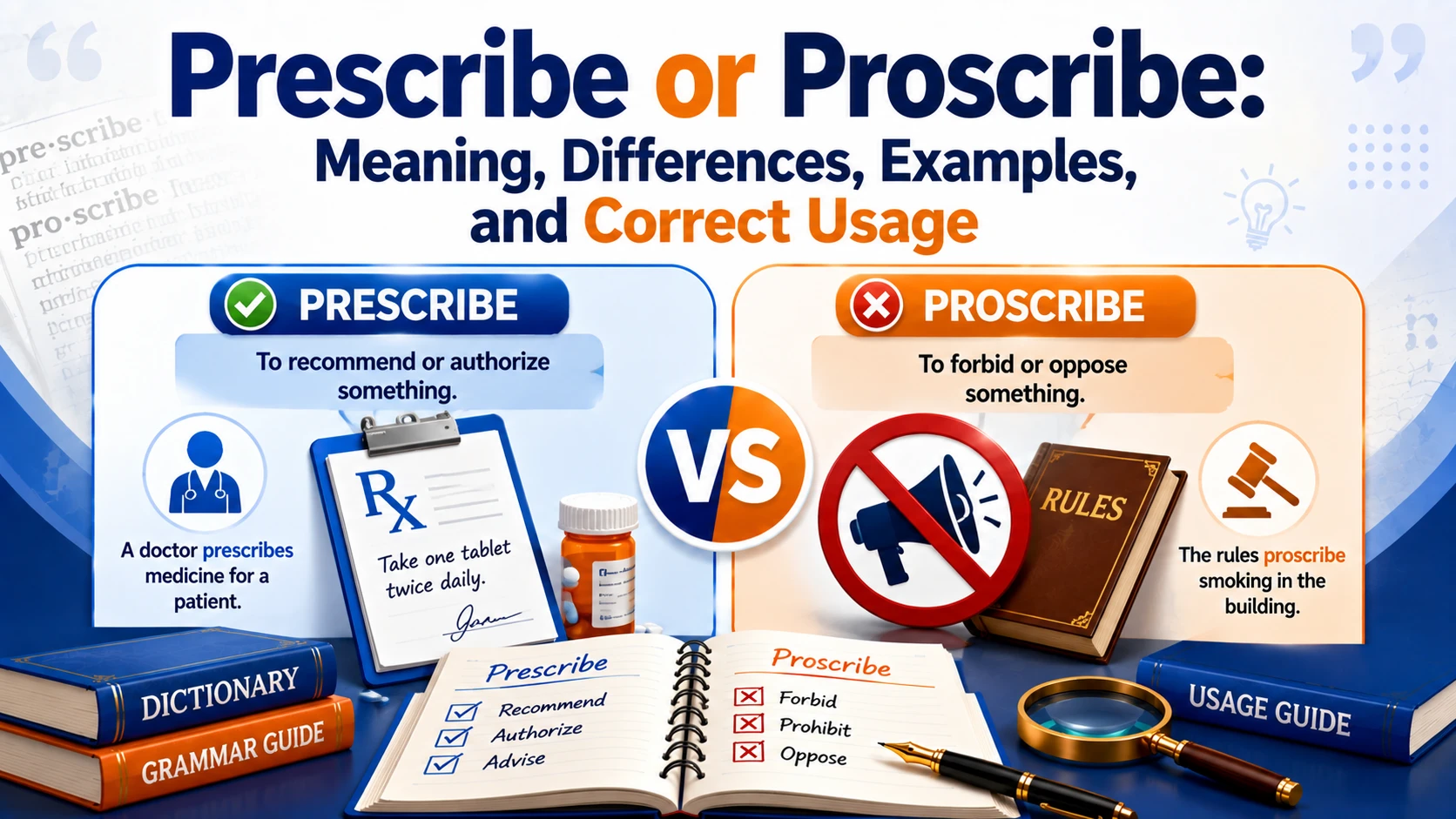
Prescribe or proscribe can be surprisingly difficult to distinguish because the two verbs look similar, sound similar, and share the same Latin root related to writing. Yet their meanings move in very different directions. Prescribe means to recommend, order, or officially specify what should be done. Proscribe means to officially forbid or ban something. One tells you what is required or recommended; the other tells you what is forbidden.
The confusion matters most in medical, legal, academic, and professional writing, where choosing the wrong verb can reverse the intended meaning. A doctor prescribes treatment. A regulation may prescribe a procedure. A law can proscribe certain conduct. The distinction is especially important in phrases such as prescribed behavior and proscribed behavior, because substituting one word for the other can change the meaning of an entire sentence.
This guide explains prescribe vs proscribe from the ground up, including their definitions, grammar, pronunciation, word forms, collocations, register, and real-world usage. You’ll also learn how prescribe differs from recommend and require, why proscribe is more formal than ban or prohibit, and how to spot the mistake quickly when proofreading. The goal isn’t merely to memorize two definitions. It’s to understand when each verb actually belongs in a sentence.
Prescribe vs Proscribe: The Quick Difference
The central distinction is simple:
Prescribe = say what should or must be done.
Proscribe = say what must not be done.
| Word | Core meaning | Typical context | Example |
| prescribe | Recommend, order, or specify | Medicine, rules, procedures | The doctor prescribed antibiotics. |
| proscribe | Officially forbid or ban | Law, government, policy | The law proscribes the practice. |
| prescription | A prescribed treatment, rule, or instruction | Medicine and formal contexts | She received a prescription. |
| proscription | An official ban or prohibition | Legal and formal contexts | The proscription remains in effect. |
The Cambridge Dictionary defines prescribe both in its medical sense and in its rule-making sense: a doctor can prescribe treatment, while a law or rule can prescribe what people must do.
By contrast, proscribe means to officially forbid something. Cambridge labels it formal, while Oxford likewise defines it as officially declaring something banned.
The simplest memory rule
Think of the difference this way:
Prescribe → prescribe something to be done.
Proscribe → prohibit something from being done.
If you can replace the verb with recommend, order, or require, prescribe may be correct.
If you can replace it with forbid, prohibit, or ban, proscribe is probably the right choice.
What Does “Prescribe” Mean?
Prescribe is a verb with two major modern uses. The first is strongly associated with medicine. The second is broader and concerns rules, standards, procedures, and required actions.
Prescribe as a medical verb
In medicine, prescribe means that a qualified medical professional orders or specifies a treatment, medicine, or course of care for a patient.
Examples:
- The doctor prescribed antibiotics.
- Her physician prescribed a different medication.
- The specialist prescribed physical therapy.
- The doctor prescribed rest after the injury.
The important point is that prescribe doesn’t simply mean “suggest.” In a medical context, it generally refers to an authorized treatment instruction.
Cambridge specifically describes the medical use as saying what medical treatment someone should have and gives examples involving prescribed medicine and treatment.
Prescribe as “recommend” or “specify”
Outside medicine, prescribe can mean to specify a particular course of action.
For example:
The manual prescribes a three-step procedure.
The manual isn’t writing a drug order. It is specifying how something should be done.
Other examples:
- The guidelines prescribe a standard procedure.
- The policy prescribes how complaints must be handled.
- The instructions prescribe a specific method.
- The contract prescribes certain reporting requirements.
This sense is more formal than ordinary recommend.
Prescribe as “officially require”
In formal contexts, prescribe can carry a stronger meaning than recommend. It can indicate that an authority, rule, regulation, or system sets out what must happen.
For example:
The regulations prescribe minimum safety standards.
The sentence doesn’t merely say that the regulations think these standards are a good idea. The regulations establish them as requirements.
Cambridge gives the same broader pattern: prescribe can mean telling someone what they must have or do or establishing something as a rule.
Prescribe in rules, procedures, and professional contexts
You’ll often encounter prescribe in language such as:
- procedures prescribed by law
- standards prescribed by regulation
- rules prescribed by the organization
- a prescribed method
- a prescribed procedure
- a prescribed period
These expressions are common in legal, administrative, technical, and professional writing.
For example:
The regulations prescribe how applications must be submitted.
Here, prescribe means establish or specify officially.
How the meaning changes with context
The underlying idea stays remarkably consistent:
Someone or something establishes what should happen.
The subject determines the domain:
| Subject | What is prescribed? | Meaning |
| Doctor | Medicine | Treatment is ordered |
| Therapist | Treatment | A course of care is specified |
| Regulation | Procedure | A required method is established |
| Contract | Conditions | Requirements are specified |
| Policy | Behavior | Expected conduct is established |
| Grammar guide | Usage | A preferred rule is stated |
That shared concept is the key to understanding the word beyond its medical use.
What Does “Proscribe” Mean?
Proscribe means to officially forbid, ban, or declare something unacceptable. Unlike prescribe, it is overwhelmingly associated with prohibition rather than recommendation.
Cambridge defines it as not allowing something, especially when a government or other authority is involved, and explicitly marks the word as formal.
Proscribe as “forbid” or “ban”
Examples:
- The law proscribes discrimination.
- The organization proscribed certain practices.
- The regulations proscribe unauthorized access.
- The government proscribed the activity.
In each sentence, the authority is saying:
Don’t do this.
That’s the central idea.
Proscribe as “officially condemn”
The word can also carry the idea of declaring something unacceptable rather than merely advising against it.
For example:
The organization proscribed conduct that violated its ethical standards.
The word suggests a formal rule, prohibition, or authoritative judgment.
Proscribe in law and government
This is one of the most natural environments for proscribe.
Legal and governmental writing frequently needs a precise verb for conduct that is not permitted under an authority’s rules.
Examples:
- The statute proscribes certain forms of discrimination.
- The regulation proscribes unauthorized disclosure of information.
- International law proscribes particular conduct.
- The policy proscribes conflicts of interest.
However, don’t assume that proscribe is automatically the best word simply because the subject is legal. Prohibit or ban may be clearer for a general audience.
Proscribe in academic and formal writing
Academic writers may use proscribe when discussing:
- prohibited behavior
- banned practices
- institutional restrictions
- ethical rules
- social norms
- legal restrictions
For example:
The institution proscribes discrimination in all forms.
That’s grammatical and precise, but prohibits would usually be more familiar to a broad audience.
Why proscribe is less common in everyday speech
You probably won’t hear many people say:
“The restaurant proscribes outside food.”
They are much more likely to say:
“The restaurant doesn’t allow outside food.”
Or:
“Outside food is prohibited.”
Proscribe belongs more naturally to formal writing, especially where an authority has established a prohibition. Cambridge and Oxford both treat it as a formal word.
Prescribe vs Proscribe: Side-by-Side Comparison
The easiest way to see the relationship is to place the verbs next to each other.
| Feature | Prescribe | Proscribe |
| Basic idea | Establish what should or must be done | Establish what must not be done |
| Main meaning | Recommend, order, specify | Forbid, ban, prohibit |
| Common field | Medicine, regulations, procedures | Law, policy, formal writing |
| Typical object | Treatment, procedure, standard, requirement | Conduct, practice, activity, behavior |
| Register | Neutral to formal | Usually formal |
| Medical use | Very common | Not normally used |
| Legal use | Common | Common in formal legal language |
| Verb forms | prescribed, prescribing | proscribed, proscribing |
| Noun | prescription | proscription |
| Plain-language alternative | recommend, require, specify | prohibit, forbid, ban |
Positive instruction vs prohibition
There’s a useful conceptual contrast:
Prescribe: “This is what you should or must do.”
Proscribe: “This is what you must not do.”
For example:
The policy prescribes annual training.
versus:
The policy proscribes unauthorized disclosure.
The first establishes a required action.
The second establishes a prohibited action.
Why the words are easy to confuse
They share several features:
- both begin with pro-/pre-
- both end in -scribe
- both are formal verbs
- both frequently occur in institutional writing
- both can appear in passive constructions
- both can be associated with rules
That visual similarity is exactly what makes proofreading important.
Prescribe vs Proscribe in Real-World Contexts
Medical context: prescribe treatment
The physician prescribed a new treatment plan.
The doctor is specifying what treatment the patient should receive.
Correct: prescribe
Not: proscribe
Workplace context: prescribe a procedure
The company’s policy prescribes a formal review process.
The policy establishes the procedure.
Correct: prescribe
Legal context: proscribe conduct
The statute proscribes fraudulent reporting.
The statute prohibits the conduct.
Correct: proscribe
Government context: proscribe prohibited activities
The regulations proscribe the unauthorized use of protected data.
Again, the authority is establishing what cannot be done.
Academic context: prescribed vs proscribed behavior
Students are expected to follow the prescribed procedure.
The procedure is required.
Students must avoid proscribed conduct.
The conduct is prohibited.
These two adjectives can appear in the same document while expressing opposite concepts.
Prescribe and Proscribe in Sentences
Examples of prescribe meaning “recommend”
- The doctor prescribed medication for the infection.
- The therapist prescribed daily exercises.
- The physician prescribed additional rest.
Examples of prescribe meaning “specify”
- The manual prescribes a specific testing procedure.
- The regulations prescribe minimum standards.
- The contract prescribes the reporting schedule.
Examples of proscribe meaning “forbid”
- The law proscribes discriminatory practices.
- The rules proscribe unauthorized entry.
- The organization proscribes conflicts of interest.
Examples of proscribe meaning “officially ban”
- The authority proscribed the activity.
- The group was proscribed under the new regulations.
- Certain practices are proscribed by the policy.
Paired sentences that make the contrast clear
The policy prescribes annual training but proscribes unauthorized disclosure.
This is an especially useful sentence because it puts the two verbs together.
Another example:
The treatment plan prescribes daily exercise, while the safety guidelines proscribe certain activities.
The first tells someone what to do.
The second tells someone what not to do.
Passive constructions with prescribed and proscribed
Both verbs are frequently used in passive voice.
Prescribed:
The medication was prescribed by the doctor.
Proscribed:
The conduct was proscribed by the regulation.
Passive voice is particularly common in formal documents because the rule or treatment may matter more than the person who established it.
Prescribe vs Recommend vs Require
These words overlap, but they aren’t always interchangeable.
When prescribe means recommend
In some contexts, prescribe can have a recommendation-like sense:
The doctor prescribed rest.
But medical prescription is stronger and more formal than casually saying:
The doctor recommended rest.
When prescribe is stronger than recommend
Compare:
The consultant recommended weekly meetings.
This presents an expert opinion or suggestion.
The policy prescribes weekly meetings.
This suggests that the policy establishes the requirement.
When prescribe means officially require
In rules and regulations, prescribe can indicate a formal requirement.
The law prescribes the procedure for filing an appeal.
If the writer means a mandatory legal procedure, require may be clearer for a general audience, while prescribe can suit formal legal or administrative prose.
Choosing the most precise verb
Ask what the sentence actually means:
| Intended meaning | Best choice |
| Give an opinion about what would be good | recommend |
| Officially specify a treatment | prescribe |
| Establish a required procedure | prescribe or require |
| State that something is mandatory | require |
| Officially forbid | proscribe or prohibit |
| Completely ban something | ban |
| Prevent something by rule | prohibit |
The best word isn’t necessarily the most sophisticated one. Precision and audience matter more than formality.
Proscribe vs Prohibit vs Forbid vs Ban
Proscribe vs prohibit
These are close in meaning.
The regulation prohibits unauthorized access.
The regulation proscribes unauthorized access.
Both can work, but prohibit is generally more familiar.
Proscribe vs forbid
Forbid is an everyday English verb.
The rules forbid smoking inside.
Proscribe is much more formal:
The regulations proscribe smoking in designated areas.
Choose forbid when conversational clarity matters.
Proscribe vs ban
Ban is short, direct, and widely understood.
The organization banned the practice.
Proscribe emphasizes formal prohibition and often fits institutional or legal writing.
Why proscribe often sounds more formal
The word carries a strong association with authority, regulation, law, and formal prohibition.
That makes it useful in serious prose but unnecessary in many ordinary conversations.
The school bans phones during exams.
is often clearer than:
The school proscribes phones during examinations.
The second isn’t necessarily wrong. It’s simply more formal.
Prescription vs Proscription: The Noun Forms
The same distinction appears in the noun forms.
What prescription means
Prescription can mean:
- a doctor’s written or electronic instruction for medication or treatment
- a recommended or specified course of action
- a formal instruction or rule in some contexts
For example:
The doctor gave me a prescription.
Or:
His prescription for success was simple.
Cambridge recognizes both the medical meaning and the broader sense involving instructions or a course of action.
What proscription means
Proscription means an official prohibition or the act/state of banning something.
Examples:
- The proscription of the practice remains in effect.
- The law contains a proscription against unauthorized disclosure.
- The organization announced the proscription of the activity.
Both Cambridge and Oxford identify proscription as a formal noun connected with officially banning something.
Prescription and proscription in formal writing
Compare:
The regulation contains a prescription for how records should be maintained.
with:
The regulation contains a proscription against unauthorized access.
The first establishes what should be done.
The second establishes what must not be done.
The Prefixes Can Help—but Don’t Rely on Them Alone
It is tempting to create a shortcut from the spelling:
pre- = before
pro- = for
That isn’t enough to determine the modern meanings.
The useful part is actually the shared -scribe element. Both words ultimately relate to Latin scribere, meaning “to write.” Oxford traces proscribe to Latin proscribere, with pro- and scribere as its components.
But etymology is a poor substitute for modern usage.
Don’t try to solve every sentence by dissecting the prefixes. Instead, remember the functional contrast:
Prescribe establishes what should happen. Proscribe establishes what cannot happen.
That’s faster and more reliable.
Common Prescribe vs Proscribe Mistakes
Mistake: using prescribe when you mean prohibit
Incorrect:
The law prescribes unauthorized disclosure.
If the intended meaning is that unauthorized disclosure is forbidden, this reverses the intended direction.
Better:
The law proscribes unauthorized disclosure.
Or, in plainer language:
The law prohibits unauthorized disclosure.
Mistake: using proscribe when you mean recommend
Incorrect:
The doctor proscribed a new medication.
That says the doctor banned the medication.
Correct:
The doctor prescribed a new medication.
Mistake: treating proscribe as a synonym for prescribe
They are not synonyms.
In many contexts, they express almost opposite functions:
- prescribe → establish an action
- proscribe → prohibit an action
Mistake: assuming proscribe means “write a prescription”
This is probably the most misleading spelling association.
Proscribe has nothing to do with writing a medical prescription.
Doctor prescribes medicine.
Authority proscribes an activity.
Mistake: confusing prescribed with proscribed
This error can be particularly serious in formal writing.
Prescribed behavior = behavior that has been specified or required.
Proscribed behavior = behavior that has been prohibited.
One letter can turn required into forbidden.
Mistake: using proscribe when a simpler word would be clearer
A sentence isn’t automatically better because it uses a rarer word.
Instead of:
The policy proscribes visitors from entering this area.
a clearer construction may be:
The policy prohibits visitors from entering this area.
For a general audience, prohibit is often easier to process.
Mistake: overlooking the object of the verb
Look at what follows the verb.
The doctor prescribed medication.
The regulation proscribed the conduct.
The object often reveals the intended meaning immediately.
Prescribed vs Proscribed: A Particularly Important Confusion
The adjective forms deserve special attention because they appear frequently in professional writing.
“Prescribed behavior” vs “proscribed behavior”
Prescribed behavior is behavior that has been specified, required, or established by a rule.
Proscribed behavior is behavior that has been forbidden.
Compare:
Employees must follow the prescribed procedure.
Employees must avoid proscribed conduct.
The first tells employees what to do.
The second tells them what not to do.
Why the two phrases can describe opposite rules
Imagine an employee handbook:
The company has prescribed a process for reporting complaints.
That means the company has established the required process.
Now consider:
The company has proscribed retaliation against employees who report complaints.
That means retaliation is prohibited.
Both verbs can appear in the same policy because rules can simultaneously require some actions and prohibit others.
How one spelling mistake can reverse the intended meaning
Suppose a compliance document says:
“The regulation prescribes the unauthorized disclosure of customer data.”
That sentence suggests the regulation requires or specifies unauthorized disclosure, which is presumably the opposite of the intended meaning.
If the intended meaning is prohibition, the correct sentence is:
“The regulation proscribes unauthorized disclosure of customer data.”
A proofreading technique for catching the error
When you encounter prescribed or proscribed, mentally replace it:
- prescribed → required/specified
- proscribed → forbidden/banned
If the replacement doesn’t make sense, check the spelling.
Grammar and Word Forms
Both verbs follow regular conjugation patterns.
| Form | Prescribe | Proscribe |
| Base | prescribe | proscribe |
| He/she/it | prescribes | proscribes |
| Past | prescribed | proscribed |
| Past participle | prescribed | proscribed |
| -ing form | prescribing | proscribing |
| Noun | prescription | proscription |
Oxford lists the forms proscribe, proscribes, proscribed, and proscribing.
Base forms: prescribe and proscribe
Use the base form after modal verbs:
- Doctors may prescribe treatment.
- Authorities can proscribe the activity.
Third-person singular: prescribes and proscribes
- The doctor prescribes medication.
- The regulation proscribes the practice.
Past tense: prescribed and proscribed
- The doctor prescribed antibiotics.
- The agency proscribed the activity.
Present participles: prescribing and proscribing
- The physician is prescribing a new treatment.
- The authority is proscribing certain practices.
Common grammatical errors
Avoid:
- ❌ He prescribe medication.
- ❌ The law proscribe the activity.
- ❌ The doctor proscribed medicine.
- ❌ The regulation prescribe the procedure.
Correct:
- ✅ He prescribes medication.
- ✅ The law proscribes the activity.
- ✅ The doctor prescribed medicine.
- ✅ The regulation prescribes the procedure.
Collocations: Words That Commonly Follow Each Verb
Collocations are especially useful with easily confused words because natural word combinations give you another clue.
Common collocations with prescribe
Prescribe medication
The physician prescribed medication for the condition.
Prescribe treatment
The specialist prescribed treatment after the examination.
Prescribe a course of action
The committee prescribed a course of action.
Prescribe standards
The regulations prescribe minimum standards.
Prescribe rules
The policy prescribes rules for reporting incidents.
Prescribe requirements
The contract prescribes specific requirements for documentation.
Common collocations with proscribe
Proscribe conduct
The code proscribes unethical conduct.
Proscribe behavior
The policy proscribes discriminatory behavior.
Proscribe practices
The regulation proscribes certain practices.
Proscribe activities
The law proscribes specific activities.
Proscribe discrimination
The statute proscribes discrimination in employment.
Proscribe certain uses
The agreement proscribes certain uses of the material.
One important grammatical pattern emerges: proscribe commonly takes the thing that is being banned as its direct object.
American English vs British English
Are the meanings different?
No significant difference separates American and British English here.
Both varieties use prescribe for medical treatment and formal instructions.
Both use proscribe for formal prohibition.
Cambridge gives both UK and US pronunciation information for the two verbs while maintaining the same core definitions.
Differences in frequency rather than definition
The bigger distinction is register, not geography.
Prescribe is common because medical and regulatory contexts frequently require it.
Proscribe is less familiar in everyday speech because ordinary speakers usually choose ban, prohibit, forbid, or not allow.
Why proscribe may sound especially formal
Oxford explicitly labels proscribe as formal.
That doesn’t make it incorrect or unnecessarily complicated in every situation. In legal, academic, or policy writing, its formal register may be appropriate.
Medical and legal usage across varieties
A US doctor and a British doctor can both prescribe medication.
A US regulation and a British regulation can both proscribe conduct.
The word choice depends mainly on meaning and register, not national variety.
How to Choose the Right Word in Seconds
When you’re stuck between the two, don’t stare at the spelling. Test the meaning.
Ask whether the action is required or forbidden
If the sentence says what someone should or must do, consider prescribe.
If it says what someone must not do, consider proscribe.
Replace prescribe with “order” or “recommend”
Try:
The doctor ___ the medication.
“Ordered” makes sense.
So:
The doctor prescribed the medication.
Replace proscribe with “forbid” or “ban”
Try:
The law ___ the practice.
“Bans” makes sense.
So:
The law proscribes the practice.
Examine the object of the verb
Ask:
What is being prescribed?
Usually a treatment, procedure, standard, or course of action.
Then ask:
What is being proscribed?
Usually conduct, behavior, practices, activities, or something being prohibited.
Check whether the sentence describes permission or prohibition
This is the fastest conceptual test:
Prescribe = permission isn’t the point; instruction is.
Proscribe = prohibition is the point.
The one-question decision test
Ask:
“Is this sentence telling someone what to do or telling them what not to do?”
What to do → prescribe.
What not to do → proscribe.
When “Prescribe” and “Proscribe” Are Not the Best Choice
Knowing the correct word doesn’t mean you must always use it.
When “recommend” is clearer than prescribe
If you’re giving informal advice:
I recommend taking a short break.
This is usually better than:
I prescribe taking a short break.
The latter sounds deliberately formal or metaphorical.
When “require” is more precise than prescribe
If a document is aimed at a broad audience:
The law requires applicants to submit identification.
may be clearer than:
The law prescribes the submission of identification.
When “prohibit” is clearer than proscribe
For general readers:
The policy prohibits unauthorized access.
is often easier than:
The policy proscribes unauthorized access.
When “ban” works better
In ordinary news or conversation:
The city banned the practice.
is direct and natural.
Why clarity should matter more than sounding sophisticated
A professional writer chooses words according to audience, context, precision, and register.
Rare vocabulary isn’t automatically better vocabulary.
Use proscribe when its formal tone fits the context. Otherwise, prohibit may communicate the same idea more efficiently.
Prescribe vs Proscribe: Mini Case Studies
Case study: a doctor’s treatment instruction
Situation: A patient needs medication.
The physician prescribed the medication.
Why?
The physician is specifying treatment.
Not: proscribed
That would suggest the physician banned the medication.
Case study: a company’s internal policy
Situation: Employees must complete annual training.
The policy prescribes annual compliance training.
The policy establishes what employees are expected to do.
Case study: a legal restriction
Situation: A regulation forbids a particular practice.
The regulation proscribes the practice.
Here, the action is prohibited.
Case study: an academic description
Situation: A research paper discusses institutional rules.
The institution prescribes specific research procedures and proscribes undisclosed conflicts of interest.
This sentence demonstrates the distinction particularly well: one verb establishes required behavior, while the other establishes prohibited behavior.
Practical Editing Examples
Correcting a medical sentence
Incorrect:
The doctor proscribed a new treatment.
Correct:
The doctor prescribed a new treatment.
Why: The doctor ordered or specified the treatment.
Correcting a legal sentence
Incorrect:
The statute prescribes unauthorized access.
Correct:
The statute proscribes unauthorized access.
Why: The statute prohibits unauthorized access.
Correcting a workplace policy
Weak:
The policy says employees must use this procedure.
More formal:
The policy prescribes this procedure.
Replacing unnecessarily formal language
Formal:
The regulation proscribes the consumption of food in the laboratory.
Plain:
The regulation prohibits food consumption in the laboratory.
Both communicate the prohibition. The second is easier for most readers.
Fixing a reversed meaning
Incorrect:
Employees must follow the proscribed safety procedure.
If the writer means the required procedure, this should be:
Employees must follow the prescribed safety procedure.
If the procedure itself has been banned, then proscribed could be correct—but the sentence would need a different meaning.
This is why context matters more than memorized word pairs.
Practice: Prescribe or Proscribe?
Fill in the blanks
Choose prescribe, prescribes, prescribed, proscribe, proscribes, or proscribed.
- The doctor ______ a different medication.
- The regulation ______ unauthorized access.
- The policy ______ a standard reporting procedure.
- Certain practices are ______ by law.
- The physician is ______ a new treatment plan.
- The organization ______ discriminatory behavior.
- The guidelines ______ how records must be stored.
- The banned activity was officially ______.
Answers
| # | Answer | Reason |
| 1 | prescribed | A doctor orders treatment. |
| 2 | proscribes | The regulation forbids access. |
| 3 | prescribes | The policy specifies a procedure. |
| 4 | proscribed | The practices are prohibited. |
| 5 | prescribing | The physician is specifying treatment. |
| 6 | proscribes | The organization forbids the behavior. |
| 7 | prescribe | The guidelines establish the procedure. |
| 8 | proscribed | The activity was officially banned. |
Advanced challenge: prescribed vs proscribed
Consider this sentence:
“The code of conduct contains prescribed standards and proscribed behavior.”
This is grammatically possible, but the two words have different roles.
Prescribed standards are standards that have been established or required.
Proscribed behavior is behavior that has been prohibited.
A useful editing habit is to translate both into plain English:
prescribed = required/specified
proscribed = prohibited/banned
If the plain-English replacement changes the intended meaning, revisit the original word.
Conclusion
The difference between prescribe and proscribe becomes much easier when you stop treating them as spelling puzzles and focus on the action each verb describes. Prescribe establishes what should, must, or is recommended to happen. Proscribe establishes what is officially forbidden. Doctors prescribe treatments, regulations prescribe procedures, and laws can proscribe prohibited conduct. One final actionable tip: replace the questionable word with “require” or “recommend” for prescribe, and with “prohibit” or “ban” for proscribe. If the replacement fits the intended meaning, you’ve probably found the right word. A common mistake to avoid is confusing prescribed with proscribed. A prescribed action is established or required; a proscribed action is banned. One describes what belongs inside the rules. The other marks what stays outside them.
Frequently Asked Questions
Q1. Is prescribe the opposite of proscribe?
Not in a strict dictionary sense, but they often express contrasting functions. Prescribe establishes what should or must be done, while proscribe establishes what is forbidden. In a policy, one rule may prescribe required behavior while another proscribes prohibited behavior.
Q2. What is the easiest way to remember prescribe and proscribe?
Use the verbs recommend/require and prohibit as memory checks. If you mean “tell someone what should be done,” choose prescribe. If you mean “officially forbid something,” choose proscribe. This approach is more reliable than trying to remember the prefixes.
Q3. Does proscribe mean prohibit?
Yes. Proscribe means to officially forbid or ban something. It is particularly associated with formal contexts involving governments, laws, regulations, institutions, and authorities. Cambridge and Oxford both identify this meaning and describe the word as formal.
Q4. Can prescribe mean “require”?
Yes. Beyond medicine, prescribe can mean to specify what someone must do or establish something as a rule. For example, “The regulations prescribe minimum safety standards” means the regulations establish those standards as requirements. The exact strength depends on context.
Q5. What is the difference between prescribed and proscribed?
Prescribed means specified, recommended, or required, while proscribed means officially forbidden. For example, a “prescribed procedure” is one you are expected to follow, whereas “proscribed conduct” is conduct you are not allowed to engage in.
