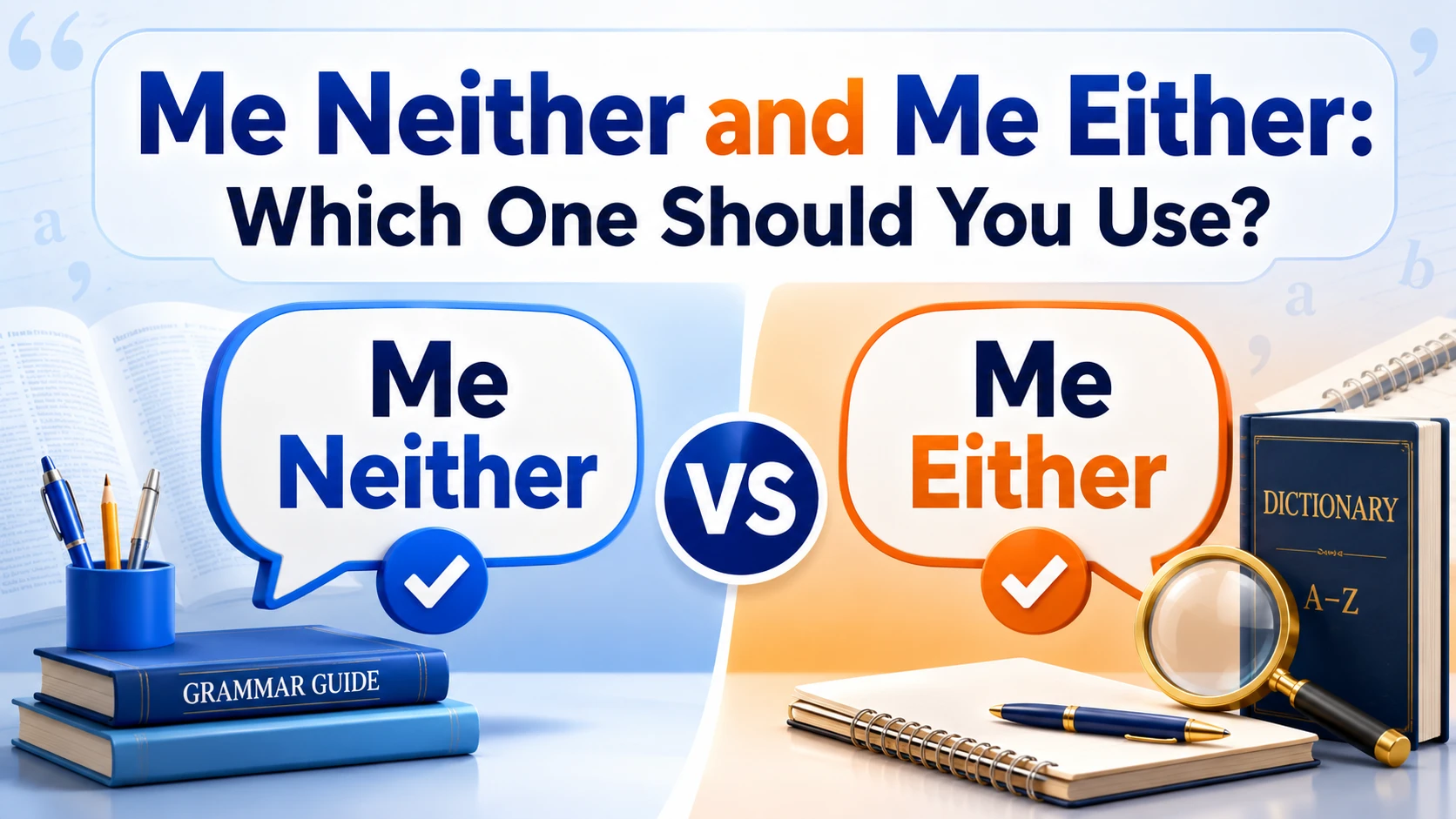
Me neither and me either can both appear when you want to agree with a negative statement, but they aren’t equally standard in every situation. That small difference causes a surprising amount of confusion. You might hear someone say, “I don’t like coffee.” Should you answer “Me neither” or “Me either”? In everyday conversation, you may hear both. In careful standard English, however, “me neither” is the safer choice. There’s also another perfectly natural option: “I don’t either.” The right choice becomes much easier once you understand how either and neither behave in negative agreement.
The confusion usually comes from the fact that either and neither are closely related words. Both can refer to alternatives, but neither already contains a negative meaning, while either does not. That distinction matters when you respond to someone. For example, “I haven’t seen that movie” can be followed naturally by “Me neither.” You can also say “I haven’t either.” The expression “Me either” is heard in informal speech, especially in some varieties of American English, but it is generally less suitable for formal or carefully edited writing.
This guide explains me neither vs. me either from the ground up. You’ll learn when each expression works, why people confuse them, how negative agreement actually functions, and which alternatives sound most natural. We’ll also look at examples involving verbs, tense, modal verbs, conversation, texting, workplace communication, and formal writing. By the end, you’ll have a simple decision rule you can use without stopping to analyze the grammar every time.
The Quick Answer: Me Neither or Me Either?
If someone makes a negative statement and you want to say that the same thing is true for you, “me neither” is the safest standard response.
“I don’t eat seafood.”
“Me neither.”
You can also use:
“I don’t eat seafood.”
“I don’t either.”
Both are standard ways to express agreement with a negative statement.
“Me either” is also used in real-world informal conversation, but it is less widely accepted as the preferred standard form. If you’re writing an essay, business email, academic assignment, or other edited text, choose “me neither” or “I don’t either.”
| Expression | Typical use | Standard in careful writing? | Example |
| Me neither | Agreeing with a negative statement | Yes | “I don’t drive.” “Me neither.” |
| I don’t either | Agreeing with a negative statement | Yes | “I don’t drive.” “I don’t either.” |
| Me either | Informal negative agreement | Common in speech, but less standard | “I don’t drive.” “Me either.” |
| Me too | Agreeing with a positive statement | Yes | “I love jazz.” “Me too.” |
| Neither do I | More formal or emphatic negative agreement | Yes | “I don’t smoke.” “Neither do I.” |
Quick rule: Negative statement → Me neither or I don’t either. Positive statement → Me too.
What Does “Me Neither” Mean?
Me neither means “I don’t either” or “The same is true for me.” It is normally used in response to a negative statement.
For example:
“I don’t like horror movies.”
“Me neither.”
The first speaker says they do not like horror movies. The second speaker agrees that they also do not like them.
The phrase is conversational and concise. It leaves out the complete subject and verb because the meaning is already obvious from the previous sentence.
A fuller version would be:
“I don’t like horror movies.”
“I don’t like them either.”
Or:
“I don’t like horror movies.”
“Neither do I.”
All three communicate essentially the same idea.
Why “Neither” Works Here
The important word is neither, which has a negative sense.
Compare:
- either = one or the other, or also in a negative construction
- neither = not one and not the other
When you say “Me neither,” you are effectively saying:
“Neither do I.”
The phrase sounds natural because the negative meaning is already built into neither.
What Does “Me Either” Mean?
Me either is used by some speakers as an informal way to agree with a negative statement.
For example:
“I don’t watch much television.”
“Me either.”
You may encounter this expression in conversations, text messages, online discussions, movies, and informal American speech.
The issue is not that listeners cannot understand it. They usually can. The issue is standard usage and register.
In carefully edited English, “me neither” is generally the better choice.
If you want to avoid the question entirely, use:
“I don’t either.”
That construction is unquestionably natural in standard English.
Is “Me Either” Wrong?
Calling “me either” simply “wrong” is too absolute.
English usage is more complicated than a classroom correction mark might suggest. Me either exists in actual spoken and informal English. However, its acceptability varies by speaker, dialect, region, and level of formality.
For practical writing, the safest approach is straightforward:
Use “me neither” or “I don’t either” when you agree with a negative statement.
That choice works across casual and formal contexts with little risk of sounding unusual.
The Grammar Behind Negative Agreement
The easiest way to understand these expressions is to separate positive agreement from negative agreement.
Positive Agreement: “Me Too”
Suppose someone says:
“I love Italian food.”
You can respond:
“Me too.”
The original statement is positive:
I love Italian food.
Your response means:
I love Italian food too.
The word too indicates that the same positive situation applies to you.
Negative Agreement: “Me Neither”
Now change the statement:
“I don’t like spicy food.”
A natural response is:
“Me neither.”
This means:
“I don’t like spicy food either.”
The original statement is negative, so your response needs a construction that expresses negative agreement.
That gives you a useful basic pattern:
| First person’s statement | Natural agreement |
| “I like it.” | Me too. |
| “I don’t like it.” | Me neither. |
| “I can swim.” | Me too. |
| “I can’t swim.” | Me neither. |
| “I have seen it.” | Me too. |
| “I haven’t seen it.” | Me neither. |
The key isn’t the particular verb. It is whether the original statement is positive or negative.
Me Neither vs. Me Either: The Core Difference
The difference becomes clearer when you look at what each word contributes.
“Neither” carries negative meaning
Neither means “not one and not the other.”
In “Me neither,” that negative sense is enough to establish the meaning.
“I don’t play tennis.”
“Me neither.”
“Either” commonly appears with a negative verb
In standard constructions, either often follows a negative clause:
“I don’t play tennis either.”
Notice the difference:
- Me neither
- I don’t either
Both express negative agreement, but they organize the grammar differently.
The problem with me either is that the phrase removes the negative verb while retaining either:
“Me either.”
Some speakers use this conversationally. Standard English more commonly chooses neither in the shortened response.
Me neither.
A useful way to remember it
Think of these as two complete patterns:
Positive:
I like it. → Me too.
Negative:
I don’t like it. → Me neither.
Or use the full version:
I don’t like it. → I don’t either.
“Me Too” vs. “Me Neither” vs. “Me Either”
These three expressions are easy to mix up because they can appear in similar conversations.
| Expression | Responds to | Meaning |
| Me too | Positive statement | I do the same / I feel the same |
| Me neither | Negative statement | I don’t do the same / I don’t feel the same |
| Me either | Usually a negative statement in informal speech | Same negative situation for me |
| I don’t either | Negative statement | Same negative situation for me |
Consider this mini-conversation:
“I enjoy hiking.”
“Me too.”
Now change the first sentence:
“I don’t enjoy hiking.”
“Me neither.”
And the full alternative:
“I don’t enjoy hiking.”
“I don’t either.”
This is why me too cannot normally replace me neither when agreeing with a negative statement.
How to Choose the Right Expression Instantly
You don’t need to memorize a complicated grammar chart.
Ask one question:
Is the statement positive or negative?
If it is positive, use “me too”
“I love this song.”
“Me too.”
“I can speak French.”
“Me too.”
“I’ve visited Canada.”
“Me too.”
If it is negative, use “me neither”
“I don’t love this song.”
“Me neither.”
“I can’t speak French.”
“Me neither.”
“I haven’t visited Canada.”
“Me neither.”
If you want a full sentence, use “either”
Instead of:
“Me neither.”
you can say:
“I don’t either.”
Or:
“I can’t either.”
Or:
“I haven’t either.”
This gives you another highly reliable pattern:
Negative auxiliary + either
“I Don’t Either” and “Me Neither” Are Not Identical in Structure
Although they communicate the same basic idea, their grammar is different.
Me neither is a short conversational response.
“I don’t eat meat.”
“Me neither.”
- I don’t either is a complete clause.
“I don’t eat meat.”
“I don’t either.”
The second sentence contains:
- subject: I
- auxiliary: don’t
- implied main verb: eat
- agreement marker: either
The first response is much shorter because the rest can be understood from context.
This distinction becomes useful when you’re writing.
For casual conversation, me neither sounds quick and natural.
For a formal or more explicit sentence, I don’t either may fit better.
How “Neither Do I” Fits Into the Picture
There is another standard expression worth learning:
Neither do I.
For example:
“I don’t understand the instructions.”
“Neither do I.”
It means the same basic thing as “Me neither,” but it has a different grammatical structure.
The word order is inverted:
Neither + auxiliary + subject
Examples:
- Neither do I.
- Neither can I.
- Neither have I.
- Neither will I.
- Neither am I.
The auxiliary must match the original statement.
“I can’t swim.”
“Neither can I.”
Not:
“Neither do I.”
This is an important point that beginners often overlook.
Matching the Verb: A More Advanced Rule
When you use neither do I, neither can I, or similar structures, you must match the auxiliary or verb from the original statement.
| Original statement | Correct agreement |
| “I don’t know.” | Neither do I. |
| “I didn’t know.” | Neither did I. |
| “I can’t drive.” | Neither can I. |
| “I haven’t finished.” | Neither have I. |
| “I won’t go.” | Neither will I. |
| “I’m not ready.” | Neither am I. |
This structure is especially useful when you want to sound polished without becoming overly formal.
Me Neither in Different Tenses
The phrase me neither itself does not change according to tense.
The previous statement provides the tense.
“I didn’t enjoy the movie.”
“Me neither.”
“I haven’t finished the assignment.”
“Me neither.”
“I won’t be attending.”
“Me neither.”
The short response works because the listener reconstructs the missing words from context.
With the full either construction, however, the auxiliary changes:
- I don’t either.
- I didn’t either.
- I haven’t either.
- I can’t either.
- I won’t either.
That is one reason me neither is so convenient in conversation.
Me Neither With Modal Verbs
Negative statements involving modal verbs follow the same basic principle.
“I can’t sing.”
“Me neither.”
“I wouldn’t do that.”
“Me neither.”
“I shouldn’t have eaten so much.”
“Me neither.”
You can also create full responses:
“I can’t sing.”
“I can’t either.”
Or use inverted agreement:
“I can’t sing.”
“Neither can I.”
The meaning remains essentially the same, but the tone changes slightly.
Me neither feels casual and conversational.
Neither can I is more grammatically explicit.
Me Neither in Everyday Conversation
This expression appears naturally in many situations.
Talking About Food
“I don’t eat mushrooms.”
“Me neither.”
“I haven’t tried sushi.”
“Me neither.”
Talking About Movies
“I haven’t seen that movie.”
“Me neither.”
Talking About Travel
“I’ve never been to Australia.”
“Me neither.”
Talking About Skills
“I can’t play the piano.”
“Me neither.”
Talking About Preferences
“I don’t really like crowded restaurants.”
“Me neither.”
The response is useful because it lets you agree without unnecessarily repeating the entire sentence.
Me Neither in Text Messages and Social Media
Informal digital communication often mirrors spoken English.
You might see:
“I haven’t watched the new season yet.”
“Me neither 😂”
Or:
“I don’t understand what’s happening.”
“Me neither.”
In casual messaging, people may also write “me either.” Because texting is less formal and more closely tied to speech, nonstandard or dialectal forms appear more frequently.
That doesn’t mean every form is equally appropriate everywhere.
If you’re chatting with friends, natural conversation matters more than strict formal style.
If you’re posting professional content, writing a public article, or representing a business, me neither is the safer option.
Me Neither in Workplace English
Workplace communication requires a little more judgment.
In a casual team chat:
“I haven’t received the updated schedule.”
“Me neither.”
That’s perfectly natural.
In a formal email, however, a complete sentence may sound more polished:
“I haven’t received the updated schedule either.”
Or:
“Neither have I.”
For example:
“I haven’t received confirmation from the supplier.”
“Neither have I.”
This is concise while still sounding professional.
Best choices by context
| Context | Recommended expression |
| Casual conversation | Me neither |
| Texting friends | Me neither |
| Informal group chat | Me neither |
| Professional conversation | Me neither / Neither do I |
| Business email | I don’t either / Neither do I |
| Academic writing | Neither do I / I don’t either |
| Formal report | Usually rewrite as a complete sentence |
The important point is not that me neither is informal in the sense of being incorrect. It is a conversational elliptical expression. Formal writing often favors fuller structures.
Common Mistakes With Me Neither and Me Either
Mistake 1: Using “me too” after a negative statement
Incorrect for standard negative agreement:
“I don’t like tea.”
“Me too.”
This can create ambiguity or even suggest the opposite meaning.
Better:
“Me neither.”
Mistake 2: Assuming “me either” is the standard alternative
You may hear:
“I don’t like tea.”
“Me either.”
But if you’re choosing the safest standard form, write:
“Me neither.”
Or:
“I don’t either.”
Mistake 3: Saying “me neither” after a positive statement
“I love this restaurant.”
“Me neither.”
That doesn’t work because neither signals negative agreement.
Use:
“Me too.”
Mistake 4: Confusing “either” with “neither”
Remember:
“I don’t like it either.”
The negative word don’t is already present.
But:
“Neither do I.”
The negative meaning comes from neither.
Mistake 5: Forgetting the auxiliary with “neither do I”
If someone says:
“I haven’t finished.”
You shouldn’t respond:
“Neither do I.”
The original uses have, so the response should be:
“Neither have I.”
This is a small detail, but it matters in polished English.
A Simple Decision Table
When you’re unsure, use this:
| What did the first person say? | What should you say? |
| “I like it.” | Me too. |
| “I don’t like it.” | Me neither. |
| “I can do it.” | Me too. |
| “I can’t do it.” | Me neither. |
| “I have seen it.” | Me too. |
| “I haven’t seen it.” | Me neither. |
| “I will go.” | Me too. |
| “I won’t go.” | Me neither. |
| “I am tired.” | Me too. |
| “I’m not tired.” | Me neither. |
If you want to use either, turn the response into a complete negative clause:
- “I don’t like it either.”
- “I can’t do it either.”
- “I haven’t seen it either.”
When “Either” Is Actually the Right Word
Don’t conclude that either is a bad word for negative agreement.
It is completely standard when it appears in the right structure.
For example:
“I don’t like coffee either.”
This is standard English.
So is:
“I can’t go either.”
And:
“I haven’t seen that show either.”
The problem isn’t either itself. The issue is the shortened construction me either.
This distinction is important because learners sometimes overcorrect and assume that neither should replace either everywhere.
That would be wrong.
You shouldn’t write:
“I don’t like coffee neither.”
In standard English, that creates a double-negative-style construction that is generally considered incorrect in formal usage.
Use:
“I don’t like coffee either.”
Or:
“Neither do I.”
Why “I Don’t Either” Works
Consider:
“I don’t eat meat either.”
The word don’t provides the negative meaning.
Either adds the idea that the negative situation applies to another person as well.
The same pattern works with other auxiliaries:
- I can’t either.
- I didn’t either.
- I haven’t either.
- I won’t either.
This makes either particularly useful in complete sentences.
Compare the structures
Short response:
Me neither.
Full negative clause:
I don’t either.
Inverted construction:
Neither do I.
Three structures. One basic meaning.
When “Me Neither” Sounds More Natural
In conversation, people often want a short response rather than a complete grammatical sentence.
Imagine this exchange:
“I don’t want dessert.”
“Me neither.”
It feels effortless.
Saying:
“I don’t want dessert either.”
is also correct, but it repeats more information.
That’s why me neither works so well conversationally. The listener already knows the verb, tense, and topic.
In other words, the phrase relies on context.
When a Full Sentence Is Better
There are situations where repeating the verb improves clarity.
Suppose several people are discussing different subjects:
“I don’t think Sarah approved the proposal.”
“I don’t either.”
Here, the complete structure can be easier to follow.
A formal document may also benefit from explicit wording:
“The first reviewer did not identify the problem, and the second reviewer did not either.”
That is clearer than trying to force a conversational response into formal prose.
Expert writing tip
Don’t judge a sentence only by whether it is grammatically possible. Ask whether it fits the register, audience, and purpose.
That principle is more useful than memorizing isolated “right” and “wrong” labels.
Regional and Informal Variation
English is spoken by hundreds of millions of people across different regions, communities, and speech traditions. Not every conversational construction has the same status everywhere.
Me neither is broadly recognized as the conventional standard response to a negative statement.
Me either also occurs, particularly in informal speech and some varieties of American English.
This creates an important distinction:
- Commonly heard does not always mean preferred in formal writing.
- Less standard does not necessarily mean unintelligible.
- Dialectal usage should not automatically be treated as a universal grammar rule.
For learners who want a dependable form, me neither remains the easiest recommendation.
“Neither” vs. “Either” Outside These Expressions
The words have several other uses, so learning them only through me neither and me either can lead to confusion.
Either
Either can refer to one of two possibilities:
“You can choose either option.”
It can also occur in negative sentences:
“I don’t want either option.”
And it can mean “also” in a negative construction:
“I don’t want it either.”
Neither
- Neither means not one and not the other:
“Neither option is available.”
It can also introduce a negative agreement structure:
“Neither do I.”
Understanding these broader meanings makes the conversational expressions much easier to remember.
Mini Case Study: Choosing the Right Reply
Imagine two coworkers discussing a meeting.
Alex: “I haven’t received the agenda yet.”
You want to say that you haven’t received it either.
You have several choices:
Casual:
“Me neither.”
Complete:
“I haven’t either.”
More polished:
“Neither have I.”
All three work.
Now imagine Alex says:
“I received the agenda this morning.”
Your response changes:
“Me too.”
You wouldn’t use me neither because the original statement isn’t negative.
This simple shift demonstrates the central principle: your response depends on the polarity of the statement you’re agreeing with.
A Practical Error-Prevention Checklist
Before choosing your response, check these points:
- Is the original statement positive?
- Use me too.
- Is the original statement negative?
- Use me neither.
- Do you want a complete sentence?
- Use I don’t either, I can’t either, I haven’t either, and so on.
- Do you want an inverted, polished construction?
- Use Neither do I, Neither can I, Neither have I, etc.
- Are you writing formally?
- Avoid relying on me either.
- Does your response need to match a particular auxiliary?
- Make sure the auxiliary agrees with the original sentence.
Best practical rule: When in doubt after a negative statement, choose “me neither.”
Practice: Choose the Best Response
Try completing each conversation before checking the answers.
Example 1
“I don’t like horror films.”
“_____.”
Answer: Me neither.
Example 2
“I love rainy weather.”
“_____.”
Answer: Me too.
Example 3
“I haven’t finished the report.”
“_____.”
Answer: Me neither.
Another correct answer:
“I haven’t either.”
Example 4
“I can’t drive at night.”
“_____.”
Answer: Me neither.
Or:
“I can’t either.”
Example 5
“I didn’t understand the question.”
“_____.”
Answer: Me neither.
For the inverted construction:
“Neither did I.”
Notice that did is required because the original statement uses the past-tense auxiliary didn’t.
Conclusion
Choosing between me neither and me either becomes simple once you focus on the sentence you are responding to. For a negative statement, me neither is the safest standard choice. You can also use a complete construction such as “I don’t either” or an inverted form such as “Neither do I.” While me either appears in informal speech and is readily understood, it isn’t the best default for formal or carefully edited English. One final actionable tip: when someone says something negative and you agree, reach for me neither first. A common mistake to avoid is using “me too” simply because you’re agreeing. Agreement isn’t always positive; your response has to match the original meaning. Once that distinction becomes automatic, this common English confusion largely disappears.
Frequently Asked Questions
Q1. Is “me neither” or “me either” correct?
Me neither is the safest standard expression for agreeing with a negative statement. Me either occurs in informal speech and some dialects, but it is less suitable for careful writing. In formal contexts, you can also use “I don’t either” or “Neither do I.”
Q2. Can I say “me either” in conversation?
Yes, you may hear and use me either in informal conversation, particularly in some varieties of American English. Most listeners will understand it immediately. However, if you want the broadly accepted standard form, especially as a learner, me neither is the better choice.
Q3. Is “I don’t either” grammatically correct?
Yes. I don’t either is a standard construction used to agree with a negative statement. For example, “I don’t watch much TV.” “I don’t either.” The negative auxiliary don’t carries the negation, while either indicates that the same negative situation applies to you.
Q4. Should I say “me too” after a negative sentence?
Usually, no. If someone says, “I don’t like spinach,” the standard response is “Me neither” or “I don’t either.” Me too normally agrees with a positive statement, such as “I like spinach.” Matching the positive or negative meaning prevents confusion.
Q5. What is the difference between “me neither” and “neither do I”?
They express essentially the same negative agreement but use different structures. Me neither is a short conversational response. Neither do I is an inverted grammatical construction whose auxiliary must match the original sentence: “I can’t.” → “Neither can I.”
