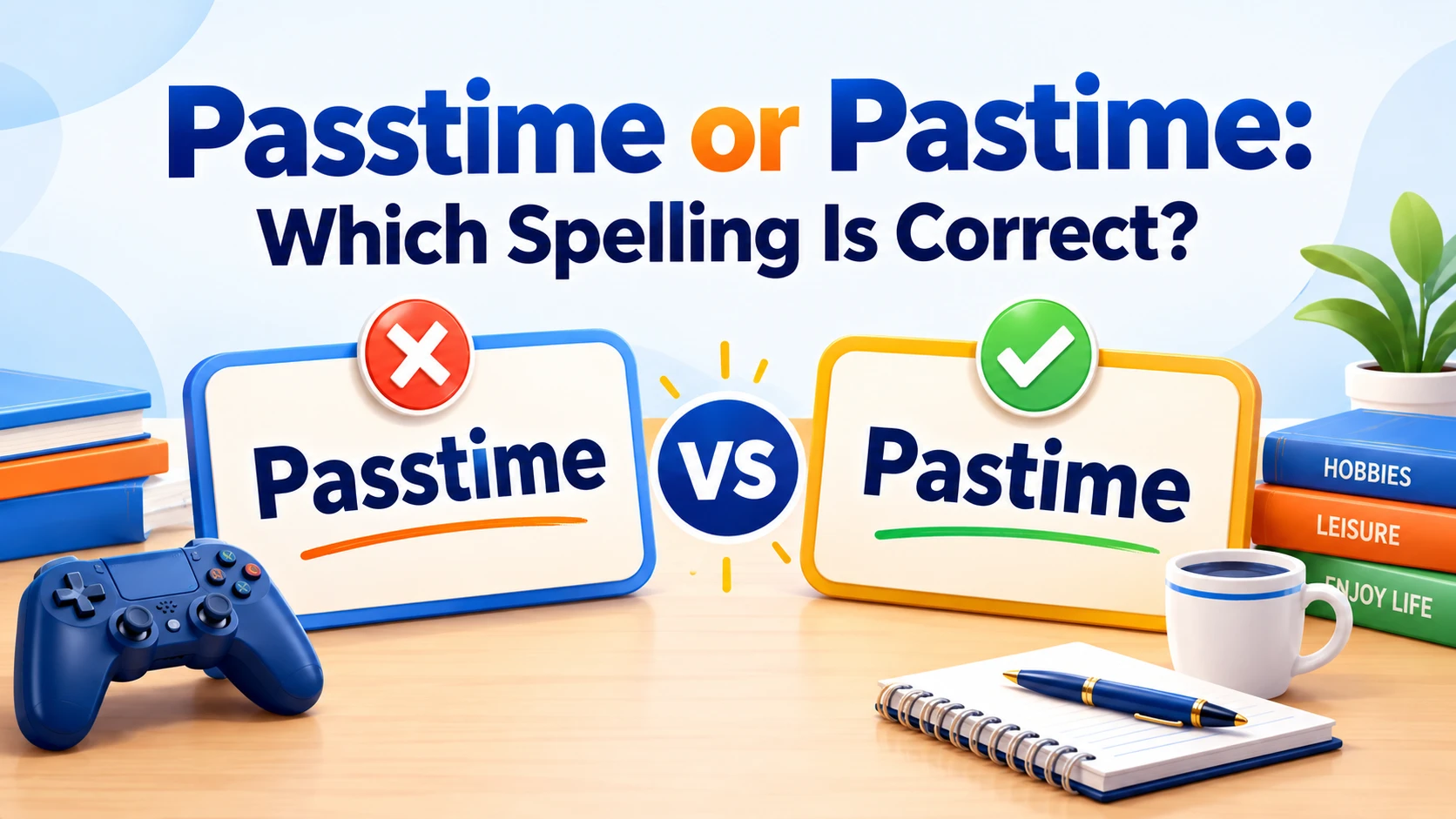
Pastime is the correct spelling when you mean an activity you enjoy during your free time. Passtime is not the standard spelling of this noun. The confusion is understandable because English also has the verb phrase pass time, which means to spend or occupy time. For example, “Reading is my favorite pastime” names an activity, while “I read to pass time on the train” describes what you do with your time. The distinction is small on the page but important in a sentence. Once you separate the noun pastime from the verb phrase pass time, the spelling becomes much easier to remember.
The word pastime is a standard noun in both American and British English. Major dictionaries define it as an activity done for enjoyment or during spare time. Cambridge gives the meaning “an activity that is done for enjoyment,” while Oxford describes it as something you enjoy doing when you aren’t working. That means reading, gardening, fishing, gaming, cooking, and sports can all be pastimes depending on context. The word doesn’t require an activity to be a serious hobby or a long-term commitment.
The real spelling trap appears when pastime sounds closely related to pass time. Both forms are connected conceptually with spending time, so it’s easy to write passtime by combining the two words incorrectly. This guide explains pastime vs. passtime, shows when pass time should remain two words, compares pastime with hobby, and gives practical examples you can use in everyday, academic, and professional writing. By the end, you’ll have a simple test for choosing the right form without relying on guesswork.
Quick Answer: Is It “Passtime” or “Pastime”?
Pastime is the standard correct spelling.
Passtime is generally a spelling mistake when you’re trying to write the noun meaning an enjoyable leisure activity.
There is, however, a legitimate expression that looks very similar: pass time. It is written as two words because pass functions as a verb and time functions as its object.
| Form | Correct? | Grammatical role | Meaning | Example |
| pastime | Yes | Noun | An enjoyable leisure activity | “Reading is my favorite pastime.” |
| passtime | No, in standard usage | — | Usually a misspelling of pastime | “Reading is my favorite passtime.” |
| pass time | Yes | Verb phrase | To spend or occupy time | “I read to pass time.” |
| pass the time | Yes | Verb phrase | To occupy time, often pleasantly | “I read to pass the time.” |
Merriam-Webster defines pastime as something that helps make time pass agreeably and dates its first known use to the 15th century.
Quick rule: If you’re naming the activity, use pastime. If you’re describing the action of spending time, use pass time.
What Does “Pastime” Mean?
Pastime is a noun for an activity someone does for pleasure or enjoyment during free time. Cambridge classifies it as a countable noun and defines it as an activity done for enjoyment.
In plain English, a pastime is something you enjoy doing when you aren’t busy with work or other responsibilities.
For example:
- Reading can be a relaxing pastime.
- Gardening is a popular pastime.
- Chess is an enjoyable pastime.
- Hiking became her favorite pastime.
- Photography is one of his favorite pastimes.
Notice that the word doesn’t tell you exactly how often the person does the activity. A pastime can be a regular interest or simply something enjoyable you do in your leisure time.
Examples of Pastimes in Everyday Life
Common pastimes include:
- Reading books
- Watching movies
- Gardening
- Cooking
- Playing chess
- Playing video games
- Fishing
- Hiking
- Painting
- Photography
- Collecting stamps or coins
- Playing musical instruments
- Doing puzzles
- Watching sports
- Exercising
The important point isn’t the activity itself. Context determines whether you are describing something as a pastime.
For instance, cooking can be a job for a chef, a daily responsibility for a parent, or a relaxing pastime for someone who enjoys experimenting with recipes.
How “Pastime” Works in a Sentence
Because pastime is a noun, it can appear in familiar noun patterns:
- “Gardening is my favorite pastime.”
- “Chess is a popular pastime.”
- “He developed an interest in the pastime.”
- “She enjoys several creative pastimes.”
- “Fishing became his favorite weekend pastime.”
One particularly common expression is favorite pastime.
Another is national pastime, which refers to an activity strongly associated with a nation or widely practiced or admired there.
Why Do People Spell “Passtime” Incorrectly?
The mistake usually isn’t random. There’s a logical reason behind it.
The noun pastime is historically related to the idea of making time pass pleasantly. Modern writers also know the phrase pass time, so the two forms can blend mentally.
That creates a tempting but incorrect construction:
pass + time → passtime
Unfortunately, English spelling doesn’t always work by simply joining familiar words. The established noun is pastime, with one s in the middle.
The relationship becomes clearer when you compare the grammar:
- pastime → one noun
- pass time → verb + noun
- passtime → not the standard spelling of the noun
Pronunciation contributes to the confusion too. Cambridge lists different UK and US pronunciations, but both dictionaries treat pastime as the standard lexical form.
Why the Extra “S” Feels Natural
Consider these familiar words:
- pass
- passing
- passed
- passer
Because pass is such a common word, writers may instinctively preserve its double s when thinking about the meaning of pastime.
But spelling memory should win over that intuition:
pastime = one s
pass time = two words
That’s the distinction worth remembering.
Pastime vs. Pass Time: What’s the Difference?
The difference isn’t merely cosmetic. These forms perform different grammatical jobs.
“Pastime” Is a Noun
When you use pastime, you’re naming an activity.
“Painting is her favorite pastime.”
Here, painting is the activity and pastime identifies it as something enjoyed during leisure time.
You can replace pastime with another noun:
“Painting is her favorite hobby.”
That substitution works because both words can function as nouns describing leisure activities.
“Pass Time” Is a Verb Phrase
Pass time uses pass as a verb.
Merriam-Webster specifically includes the meaning “to cause or permit to elapse” and gives pass time as an example of this use.
For example:
“I read books to pass time during long journeys.”
Here, read describes the activity, while pass time describes what the person is trying to do with the hours.
The expression is also commonly written as pass the time:
“We played cards to pass the time.”
Both constructions can be grammatical depending on the sentence.
Pastime vs. Pass Time Comparison
| Question | Pastime | Pass time |
| What is it? | Noun | Verb phrase |
| What does it describe? | An enjoyable activity | The act of spending time |
| One word or two? | One word | Two words |
| Can it be plural? | Yes: pastimes | No equivalent plural form |
| Example | “Reading is a pastime.” | “I read to pass time.” |
How to Know Which Form You Need
Instead of memorizing dozens of examples, use a meaning-based test.
If You Mean “An Enjoyable Activity,” Use “Pastime”
Ask:
Am I naming something someone enjoys doing?
If yes, pastime is likely the word you need.
Examples:
- “Fishing is a relaxing pastime.”
- “Reading remains a popular pastime.”
- “Gaming has become a common pastime.”
- “Her favorite pastime is gardening.”
If You Mean “Spend Time,” Use “Pass Time”
Ask:
Am I describing what someone does to make time go by?
If yes, use pass time.
Examples:
- “I listened to music to pass time.”
- “They played cards to pass the time.”
- “She browsed her phone to pass time at the airport.”
If You Mean “Passtime,” Stop and Check the Sentence
In most spelling questions involving this pair, the intended word is pastime.
For example:
❌ “Reading is my favorite passtime.”
✅ “Reading is my favorite pastime.”
But:
❌ “I read to passtime.”
✅ “I read to pass time.”
The correction depends on whether you’re naming the activity or describing the action.
Pastime in American and British English
There is no American-versus-British spelling split here.
Both varieties use pastime.
Oxford gives the American English form as pastime, while Cambridge provides UK and US entries under the same spelling.
You therefore don’t need to remember a regional spelling rule such as:
- American English → passtime
- British English → pastime
That would be incorrect.
The same applies when you’re writing for an international audience. Pastime is the safe standard form.
What About “Favourite” and “Favorite”?
This is where regional spelling differences can appear.
British English commonly uses:
“Reading is my favourite pastime.”
American English commonly uses:
“Reading is my favorite pastime.”
The spelling of pastime itself does not change.
That’s an important distinction because writers sometimes see favourite and favorite differences and assume nearby words may have British and American variants too. In this case, they don’t.
Pastime Pronunciation and Why It Can Be Misleading
Pronunciation can make pastime sound close enough to pass time that learners mentally divide it into the wrong words.
Cambridge gives the UK pronunciation as /ˈpɑːs.taɪm/ and the US pronunciation as /ˈpæs.taɪm/.
The useful spelling lesson isn’t to reconstruct the word from its sound. English spelling and pronunciation don’t always map perfectly.
If you hear someone say the word, don’t ask:
“Does it sound like pass time?”
Ask instead:
“Is the sentence naming an activity?”
If it is, pastime is the correct noun.
How to Use “Pastime” Correctly in Sentences
A good way to master a spelling distinction is to see the word working in different environments.
Casual and Everyday Examples
“Reading is my favorite pastime.”
“Gardening became a peaceful pastime after retirement.”
“He spends his weekends fishing, his favorite pastime.”
“Watching old movies is one of her favorite pastimes.”
These examples show the word functioning naturally as a noun.
School and Academic Writing
You can also use pastime in essays and descriptive writing:
“Chess has long been regarded as an intellectual pastime.”
“The students discussed how technology has changed common pastimes.”
“Reading for pleasure is a valuable pastime for students.”
In formal writing, don’t choose pastime merely because it sounds sophisticated. Hobby, activity, or recreation may be more precise depending on your sentence.
Workplace and Professional Contexts
A professional biography might say:
“Outside work, her favorite pastimes include hiking and photography.”
A team introduction might say:
“His main pastime is restoring vintage bicycles.”
Here, pastime works well because the sentence focuses on leisure interests outside professional responsibilities.
Social Media and Informal Writing
The word also works in casual writing:
“Sunday mornings and coffee are my favorite pastime.”
That sentence, however, needs attention to meaning and grammar. If you’re talking about two things, pastimes or a different construction may be more appropriate.
A cleaner version might be:
“Reading and coffee are part of my favorite Sunday pastimes.”
The lesson is broader than spelling: correct word choice doesn’t guarantee correct grammar.
Common Mistakes With “Pastime”
Mistake: Writing “Passtime”
❌ “Gardening is a relaxing passtime.”
✅ “Gardening is a relaxing pastime.”
This is the most direct spelling error.
Mistake: Writing “Pass Time” for the Noun
❌ “Fishing is my favorite pass time.”
✅ “Fishing is my favorite pastime.”
Why? The sentence needs a noun naming an activity, not a verb phrase describing the act of spending time.
Mistake: Combining the Two Forms
❌ “Reading helps me passtime on long flights.”
This incorrectly treats pass time as though it were one noun.
Better:
✅ “Reading helps me pass the time on long flights.”
Or, if you’re naming the activity:
✅ “Reading is an enjoyable pastime during long flights.”
Mistake: Assuming “Passtime” Is a Regional Variant
It isn’t a British spelling of pastime, nor is it the standard American spelling.
Pastime is used in both major varieties of English.
Pastime vs. Hobby vs. Recreation
These words overlap, but they’re not perfectly interchangeable.
Oxford explains that interest, hobby, and pastime can all refer to activities people pursue for pleasure in their spare time. It also notes a useful distinction: hobby often describes an individual’s activity, while pastime is especially common when discussing people more generally.
| Word | Main emphasis | Example | Typical nuance |
| Pastime | Leisure activity | “Fishing is a popular pastime.” | Often broad or general |
| Hobby | Personal activity pursued for pleasure | “Photography is my hobby.” | Often more personal and sustained |
| Recreation | Activity for enjoyment or refreshment | “Swimming is a form of recreation.” | Broader and somewhat more formal |
| Interest | Subject or activity that attracts attention | “History is one of her interests.” | Doesn’t necessarily involve doing the activity |
When “Pastime” Is Better Than “Hobby”
Use pastime when you’re emphasizing an activity as a way people spend leisure time.
“Watching baseball is a popular pastime.”
Use hobby when you’re talking about an individual’s established personal interest:
“Photography is my hobby.”
Neither choice is automatically more correct. The context determines the most natural word.
Is “Pastime” Always a Hobby?
No.
A hobby usually suggests an activity someone actively pursues for pleasure. Oxford makes a similar distinction by describing a hobby as an activity done for pleasure in spare time, while pastime can refer more broadly to an activity people engage in for pleasure.
For example, watching a particular sport may be someone’s pastime without being a hobby in the traditional sense.
Likewise, a person might spend an afternoon solving crossword puzzles. That can be a pastime even if they don’t consider crossword solving their long-term hobby.
This distinction is useful when you’re choosing vocabulary for a specific audience. Pastime is broader; hobby often feels more personal.
Plural, Possessive, and Related Forms of “Pastime”
The plural is straightforward:
- Singular: pastime
- Plural: pastimes
For example:
“Reading and gardening are two of my favorite pastimes.”
The possessive forms follow normal English rules:
- Singular possessive: pastime’s
- Plural possessive: pastimes’
Example:
“The pastime’s popularity increased.”
And:
“The pastimes’ popularity varied by region.”
You shouldn’t add an extra s to the singular noun simply because the word is related to pass.
“National Pastime”: What Does It Mean?
National pastime is a familiar expression for an activity associated strongly with a particular country or its culture.
For example:
“Baseball has often been described as an American national pastime.”
The phrase doesn’t mean that every person in the country participates in the activity. It’s a broader cultural expression.
Cambridge uses national pastime in examples and explains that the phrase can refer to an activity that is especially common or characteristic in a country.
The phrase also demonstrates why pastime doesn’t always mean a private hobby. It can describe a widely shared recreational activity.
How to Remember the Correct Spelling
Memory Trick: Pastime Has One “S”
Write it mentally as:
PASTIME
Not:
PASSTIME
The easiest approach is simply to memorize the standard noun as a single word.
Memory Trick: Separate the Verb Phrase
When you’re using pass as a verb, keep it separate:
pass time
The verb retains its normal spelling with two s letters.
The Fastest Test
Use this two-question test:
| Ask yourself | Use |
| Am I naming an enjoyable leisure activity? | pastime |
| Am I describing the act of spending time? | pass time |
Compare:
“Reading is my pastime.”
versus:
“I read to pass time.”
That distinction solves most cases.
Pastime Synonyms and Near-Synonyms
Depending on context, possible alternatives include:
- hobby
- recreation
- leisure activity
- diversion
- amusement
- pursuit
- entertainment
- interest
Merriam-Webster’s thesaurus lists hobby, recreation, amusement, entertainment, diversion, and related terms among words associated with pastime.
But don’t treat synonyms as interchangeable in every sentence.
For example:
“Photography is my hobby.”
sounds more personal than:
“Photography is a popular pastime.”
Meanwhile, recreation can refer to a wider category of leisure activity and may sound more formal.
The best synonym depends on what aspect of leisure you want to emphasize.
Pastime Antonyms and Contrasting Ideas
There isn’t one perfect opposite of pastime.
Depending on the context, contrasting concepts may include:
- work
- duty
- obligation
- chore
- occupation
These aren’t strict dictionary antonyms. They’re useful conceptual contrasts.
For example:
“Gardening is a pastime for her, not a job.”
The contrast works because one activity is associated with enjoyment and the other with employment.
This matters because forcing an exact antonym onto a word can create misleading vocabulary advice.
A Practical Editing Checklist for “Pastime”
Before submitting an essay, publishing an article, or sending an email, run through this checklist:
- Do I mean an enjoyable leisure activity?
- If yes, have I written pastime?
- Did I accidentally type passtime?
- Am I actually using pass time as a verb phrase?
- Does the sentence need pastime as a noun?
- Does the sentence require pastimes because I’m referring to multiple activities?
- Am I confusing pastime with hobby when a more precise word would help?
- If I’m writing for US English, have I avoided changing pastime unnecessarily?
Quick Editing Examples
| Original | Better version | Why |
| “Reading is my favorite passtime.” | “Reading is my favorite pastime.” | Standard noun spelling |
| “Chess is my favorite pass time.” | “Chess is my favorite pastime.” | The sentence needs a noun |
| “I play chess to passtime.” | “I play chess to pass time.” | Verb phrase |
| “I play chess to pass the time.” | Correct | Natural verb phrase |
| “Hiking is one of my favorite pastime.” | “Hiking is one of my favorite pastimes.” | Plural noun required |
Conclusion
When you’re deciding between passtime or pastime, the answer is straightforward: pastime is the standard spelling for an enjoyable activity done during leisure time. The extra s in passtime usually appears because writers blend the noun with the separate expression pass time. Keeping the grammar in view makes the distinction much easier. Pastime names an activity, while pass time describes an action involving the passage of time.
One final actionable tip: when proofreading, replace passtime with pastime if you’re naming a hobby or leisure activity. If you’re describing what someone does to occupy time, check whether pass time or pass the time fits instead. A common mistake to avoid: don’t assume that passtime is a British or American variant. It isn’t. The standard noun is pastime in both varieties of English. The simplest rule to carry forward is this: one word for the activity, two words for the action. Get that distinction right, and this spelling trap disappears.
Frequently Asked Questions
Q1. Is “passtime” a correct English word?
Passtime isn’t the standard spelling of the noun meaning an enjoyable leisure activity. The accepted spelling is pastime. If you mean the action of spending time, use the separate verb phrase pass time or pass the time, depending on the sentence.
Q2. Is “pastime” one word or two?
Pastime is one word when it means an enjoyable activity done during free time. For example, “Gardening is a relaxing pastime.” Don’t split it into past time unless you’re using those words independently for a different grammatical meaning.
Q3. Should I write “pastime” or “pass time”?
Choose based on grammar. Pastime is a noun that names an enjoyable activity. Pass time is a verb phrase describing the act of making time go by. “Reading is my pastime” and “I read to pass time” demonstrate the difference clearly.
Q4. Is “pastime” spelled differently in British English?
No. Pastime is the standard spelling in both British and American English. Regional differences can appear in surrounding words, such as favourite and favorite, but the noun itself remains pastime in both varieties.
Q5. Is a pastime the same thing as a hobby?
Not always. A hobby is typically a personal activity pursued for pleasure, while pastime can describe leisure activities more generally. Oxford notes that pastime is particularly common when discussing activities people enjoy in general, whereas hobby often sounds more natural for an individual’s regular interest.
