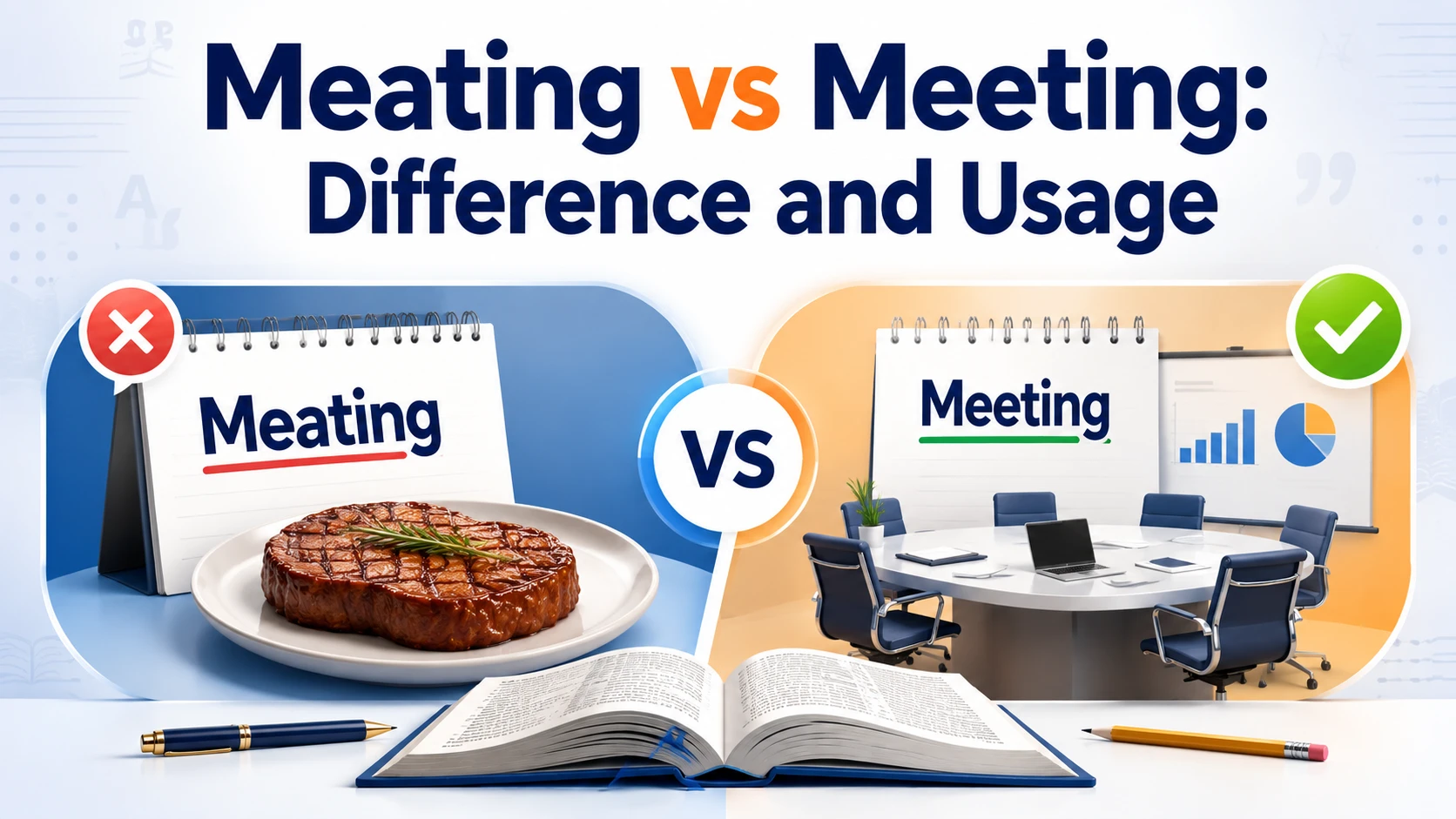
Meating vs Meeting is a common spelling confusion that catches many English learners and even native speakers off guard. At first glance, the two words look almost identical, differing by only one letter. However, that small difference completely changes whether the word is correct in standard English. If you’re writing a business email, scheduling an appointment, preparing meeting minutes, or completing schoolwork, using the wrong spelling can make your writing appear careless and unprofessional.
The confusion usually happens because meeting comes from the verb meet, while the word meat is also a familiar English noun. As a result, some writers accidentally combine the two and create meating, assuming it follows normal spelling rules. In reality, meeting is the standard English word used to describe a gathering, discussion, or appointment, whereas meating has only extremely rare, literal uses and is almost never the word people intend to write.
In this guide, you’ll learn the difference between meating and meeting, discover why meeting is almost always the correct spelling, understand the grammar behind the word, compare it with similar words such as meet, met, meat, and meting, and see practical examples from business, education, and everyday conversations. By the end, you’ll know exactly which spelling to use and why.
Meeting vs Meating: Which Spelling Is Correct?
The simple answer is:
- ✅ Meeting — Correct
- ❌ Meating — Usually incorrect
If you’re referring to a gathering of people, an appointment, a discussion, or the act of coming together, meeting is the only correct spelling in standard English.
| Spelling | Correct? | Typical Usage |
| Meeting | ✅ Yes | Gatherings, appointments, discussions, events |
| Meating | ❌ Usually No | Rare literal use related to meat; almost never intended |
For example:
- We have a meeting at 10 a.m. tomorrow. ✅
- The weekly team meeting lasted two hours. ✅
- I have a meating with my manager. ❌
Why Do People Write “Meating”?
The mistake usually happens for one of three reasons:
- The words meet and meat sound identical in many English accents.
- Writers type quickly and accidentally replace meat with meat.
- English learners assume adding -ing to meat creates the intended word.
Because meet and meat are homophones (words with the same pronunciation but different meanings), this spelling mistake is surprisingly common.
A Quick Rule to Remember
If you’re talking about people getting together, always write “meeting.”
Whether it’s a business meeting, family meeting, online meeting, or school meeting, the spelling never changes.
What Does “Meeting” Mean?
Meeting is primarily a noun that refers to an event where two or more people come together for a specific purpose. That purpose may be to discuss ideas, make decisions, solve problems, exchange information, or simply spend time together.
The word can also function as the present participle or gerund of the verb meet, depending on how it’s used in a sentence.
Definition in Modern English
A meeting is an organized or informal gathering where people communicate face to face or through digital platforms.
Examples include:
- business meetings
- classroom meetings
- committee meetings
- client meetings
- project meetings
- virtual meetings
- family meetings
Although the setting changes, the central idea remains the same: people come together to interact.
Common Meanings in Different Contexts
The meaning of meeting changes slightly depending on where it’s used.
Business and Workplace
In professional environments, a meeting usually involves discussing work-related topics.
Examples:
- weekly staff meeting
- board meeting
- project kickoff meeting
- performance review meeting
- strategy meeting
Example sentence:
Our weekly meeting begins every Monday at 9 a.m.
Education
Schools and universities frequently use the word for scheduled discussions or official gatherings.
Examples:
- parent-teacher meeting
- faculty meeting
- student council meeting
- research meeting
Example:
The principal scheduled a parents’ meeting for Friday evening.
Social Gatherings
Not every meeting is formal.
Friends, relatives, or community members also have meetings.
Examples:
- family meeting
- neighborhood meeting
- reunion meeting
- volunteer meeting
Example:
Our family meeting helped us plan the vacation.
Online and Virtual Meetings
With remote work becoming common, digital meetings have become an everyday part of professional life.
Examples include:
- Zoom meetings
- Microsoft Teams meetings
- Google Meet meetings
- video conferences
- virtual team meetings
Example:
The client requested an online meeting instead of an office visit.
“Meeting” as a Grammar Form
Besides being a noun, meeting also functions as the -ing form of the verb meet.
Consider these examples:
As a noun
The meeting starts at noon.
As a gerund
Meeting new people helps improve communication skills.
As a present participle
We are meeting the new client tomorrow morning.
Although the word looks the same in each sentence, its grammatical function changes according to the context.
Is “Meating” a Real Word?
This question surprises many learners.
The answer is yes—but almost certainly not in the way most people think.
In everyday English, meating is not the correct spelling for a gathering of people.
If you mean:
- business meeting
- class meeting
- project meeting
- online meeting
then meating is incorrect.
Does “Meating” Exist?
Very rarely, meating can appear as a literal form related to meat, particularly in specialized agricultural, culinary, or historical contexts.
For example, someone might describe:
- processing meat
- adding meat to a dish
- preparing animal products
Even in those fields, the word is uncommon. Writers usually choose more precise verbs such as:
- processing
- butchering
- carving
- preparing
- trimming
As a result, most dictionaries either omit meating entirely or note it as an uncommon derivative rather than a standard vocabulary word.
Why You Sometimes See It Online
There are several reasons meating appears on the internet:
- typing mistakes
- autocorrect failures
- speech-to-text errors
- OCR scanning mistakes
- spelling confusion caused by homophones
Search engines may even show thousands of results containing meating, but quantity does not make a spelling correct. Many of those instances are simply repeated typographical errors.
Expert Tip
If your sentence involves people gathering, discussing, or collaborating, use meeting every time.
Why “Meeting” Is the Correct Word
The spelling becomes much easier once you understand where the word comes from.
The base verb is:
meet
When English forms the present participle or gerund, it simply adds -ing.
meet
+ ing
= meeting
No letters are removed or replaced.
Because the base word is meet, not meat, the correct spelling remains meeting.
Understanding the Word Family
Learning related forms together makes spelling easier.
| Word | Part of Speech | Example |
| meet | Verb | Let’s meet tomorrow. |
| meets | Verb | She meets clients daily. |
| met | Past tense | We met last week. |
| meeting | Noun / Gerund / Participle | The meeting begins soon. |
Notice that every form comes from meet, never meat.
Why “Meating” Doesn’t Follow English Spelling Rules
Many spelling mistakes happen because writers substitute one familiar word for another.
Compare these base words:
| Base Word | Meaning |
| meet | Come together |
| meat | Animal flesh used as food |
Adding -ing to each creates completely different meanings.
- meeting → coming together
- meating → relating to meat (rare and highly specialized)
Only one of these matches everyday communication.
Pronunciation Guide
One reason people confuse these spellings is pronunciation.
Both meet and meat are pronounced exactly the same in standard English.
Pronunciation
Meeting
/ˈmiː.tɪŋ/
Sounds like:
MEE-ting
The stress falls on the first syllable.
Syllable Breakdown
Meet • ing
Two syllables:
- meet
- ing
Why Pronunciation Causes Confusion
English contains many homophones—words that sound alike but have different spellings and meanings.
Examples include:
- meet / meat
- see / sea
- right / write
- pair / pear
- flour / flower
Because meet and meat sound identical, writers who rely only on pronunciation may accidentally type meating.
The safest approach is to think about the meaning before you write.
Ask yourself:
Am I talking about people meeting or food?
If the answer is people, the spelling is always meeting.
Easy Memory Trick
Here’s a simple technique that works well:
People MEET at a MEETING.
Both words begin with meet.
If you’re discussing:
- appointments
- conferences
- interviews
- discussions
- classes
- events
you already know the correct spelling starts with meet, not meat.
This small mental connection can eliminate one of the most common spelling mistakes in everyday English.
Meeting vs Meating: Side-by-Side Comparison
Although meeting and meating differ by just one letter, they have very different meanings and levels of acceptance in English. One is a standard word you’ll encounter every day, while the other is rarely appropriate outside a few specialized contexts.
The table below highlights the key differences.
| Feature | Meeting | Meating |
| Correct spelling for gatherings | ✅ Yes | ❌ No |
| Recognized in everyday English | ✅ Yes | ❌ No |
| Used in business communication | ✅ Yes | ❌ Never |
| Used in schools and universities | ✅ Yes | ❌ Never |
| Common in dictionaries | ✅ Yes | Rare or obsolete derivative |
| Refers to people coming together | ✅ Yes | ❌ No |
| Safe to use in formal writing | ✅ Yes | ❌ No |
Quick Decision Guide
Use meeting whenever you’re referring to:
- Business discussions
- Team collaboration
- School events
- Online conferences
- Appointments
- Community gatherings
- Interviews
- Official sessions
Use meating only if you’re writing about a rare, literal action related to meat, which most writers will never need.
Quick Tip
If you can replace the word with conference, appointment, or gathering, the correct spelling is meeting.
How to Use “Meeting” Correctly
Knowing that meeting is the correct spelling is only part of the story. You should also know how to use it naturally in different situations.
As a Noun
This is the most common use.
A meeting is an organized gathering where people discuss, plan, or decide something.
Examples
- The meeting begins at 10 a.m.
- Our monthly meeting lasted an hour.
- Everyone attended yesterday’s safety meeting.
- The annual shareholders’ meeting will be held next week.
This meaning appears in almost every industry.
As the Present Participle of Meet
Here, meeting describes an ongoing action.
Examples
- We are meeting the client this afternoon.
- She is meeting her professor after class.
- They were meeting with investors all morning.
Notice that meeting follows a form of the verb be (is, are, was, were).
As a Gerund
A gerund looks like a verb but functions as a noun.
Examples
- Meeting new people builds confidence.
- He enjoys meeting customers from different countries.
- Meeting deadlines requires careful planning.
Although the spelling is identical, the grammatical role changes depending on the sentence.
Formal vs Informal Usage
The word works equally well in both formal and informal communication.
Formal
- The committee meeting has been rescheduled.
- Please review the meeting agenda before attending.
- The board meeting concluded at 4 p.m.
Informal
- Let’s have a quick meeting after lunch.
- Thanks for meeting me today.
- Our meeting went really well.
This flexibility is one reason meeting is among the most frequently used nouns in English.
Real-Life Examples of “Meeting”
Seeing the word in realistic situations makes its meaning easier to remember.
Business Meetings
In the workplace, meetings help teams exchange information, solve problems, and make decisions.
Example:
A marketing team gathers every Monday morning to review campaign performance, assign tasks, and discuss upcoming deadlines.
The weekly meeting keeps everyone aligned on project goals.
Team Meetings
Large organizations often schedule recurring team meetings.
Typical purposes include:
- progress updates
- workload planning
- brainstorming
- problem-solving
- project coordination
Example:
Our development team holds a sprint meeting every two weeks.
Client Meetings
Companies frequently meet clients to discuss services, contracts, or project requirements.
Example:
The consultant prepared a presentation before the client meeting.
Professional communication often includes phrases like:
- schedule a meeting
- confirm a meeting
- attend a meeting
School Meetings
Educational institutions use meetings for both academic and administrative purposes.
Examples include:
- parent-teacher meetings
- faculty meetings
- student council meetings
- academic advising meetings
Example:
Parents attended the orientation meeting before the new school year.
Government and Public Meetings
Government bodies hold official meetings to discuss policies and make public decisions.
Examples:
- city council meeting
- committee meeting
- public hearing
- planning meeting
These meetings usually follow formal procedures and published agendas.
Virtual Meetings
Remote work has transformed how organizations communicate.
Today, meetings commonly take place through platforms such as:
- Google Meet
- Microsoft Teams
- Zoom
- Cisco Webex
Example:
The international sales meeting was conducted entirely online.
Whether people meet in person or virtually, the spelling remains exactly the same.
Word Forms of “Meet”
Learning words as part of the same family improves both spelling and grammar.
| Word | Part of Speech | Example |
| meet | Verb | Let’s meet tomorrow. |
| meets | Verb | She meets clients every week. |
| met | Past tense | We met at the conference. |
| meeting | Noun | The meeting starts soon. |
| meeting | Gerund/Participle | Meeting customers is part of the job. |
Instead of memorizing isolated words, remember how they connect.
Meet
This is the base verb.
Examples:
- Let’s meet after work.
- I hope to meet your family soon.
- We’ll meet online next week.
Meets
Used with singular subjects in the present tense.
Examples:
- She meets every deadline.
- Our manager meets clients daily.
Met
This is the simple past tense and past participle.
Examples:
- We met in college.
- They met during the interview process.
- I’ve already met the new director.
Meeting
This form has several grammatical functions.
Examples:
As a noun:
The meeting starts at noon.
As a gerund:
Meeting new colleagues can be exciting.
As a present participle:
They are meeting with suppliers today.
Understanding these roles helps you write naturally instead of relying on memorized rules.
Meeting vs Meet vs Met
Many learners confuse these three forms because they all come from the same verb.
Here’s an easy comparison.
| Word | Function | Example |
| Meet | Base verb | We meet every Friday. |
| Met | Past tense | We met yesterday. |
| Meeting | Noun / -ing form | The meeting begins soon. |
When to Use Meet
Use meet for present or future actions.
Examples:
- I’ll meet you outside.
- We meet every Monday.
When to Use Met
Use met for actions completed in the past.
Examples:
- I met her five years ago.
- They met during a training program.
When to Use Meeting
Use meeting when referring to:
- an event
- an appointment
- people gathering
- the ongoing action of meeting
Examples:
- Today’s meeting has been canceled.
- We’re meeting the new customer tomorrow.
Expert Recommendation
If you’re unsure which form to choose, identify when the action happens. Use meet for the present or future, met for the past, and meeting for a gathering or an ongoing action. Thinking about time and function is often easier than memorizing grammar rules.
Meeting vs Meting
Another word that causes confusion is meting. Unlike meating, meting is a real and recognized English word. However, it has a completely different meaning from meeting.
The similarity in spelling leads many writers to assume the two words are related, but they come from different verbs and belong in different contexts.
What Does “Meting” Mean?
Meting is the present participle of the verb mete, which means:
- to measure
- to distribute
- to assign
- to give out, especially rewards or punishments
Although the verb is still correct, it appears mostly in formal, legal, or literary English rather than everyday conversation.
Examples:
- The judge is meting out justice.
- The committee is meting out disciplinary actions fairly.
- The charity is meting out supplies to affected families.
In these examples, meting has nothing to do with people gathering.
Why People Confuse “Meeting” and “Meting”
The confusion usually happens because:
- the words differ by only one letter
- both end in -ing
- many people are unfamiliar with the verb mete
Fortunately, the meanings are easy to separate.
| Word | Comes From | Meaning |
| Meeting | Meet | A gathering or the act of coming together |
| Meting | Mete | Measuring or distributing something |
Once you understand the base verbs, choosing the correct spelling becomes much easier.
Real Examples Showing the Difference
Correct:
- The board meeting begins at noon.
- We’re meeting new clients tomorrow.
- The principal scheduled a parent meeting.
Also correct:
- The court is meting out punishment.
- The organization is meting out emergency supplies.
Incorrect:
- The weekly meting starts at 9 a.m. ❌
- We are meting with investors tomorrow. ❌
Always think about the meaning before choosing the word.
Meeting vs Meat
Because meet and meat are pronounced the same in many English accents, they are often confused in writing.
However, their meanings are completely unrelated.
| Word | Meaning | Example |
| Meet | To come together | Let’s meet tomorrow. |
| Meat | Animal flesh used as food | Chicken is my favorite meat. |
| Meeting | A gathering | We have a meeting today. |
Why the Confusion Happens
English has many homophones, including:
- meet / meat
- right / write
- sea / see
- pair / pear
- flower / flour
These words sound alike but have different spellings and meanings.
Writers who rely only on pronunciation may accidentally type meating instead of meeting.
An Easy Memory Trick
Think about the meaning.
If you’re discussing:
- coworkers
- classmates
- clients
- conferences
- appointments
The word begins with meet.
If you’re talking about:
- beef
- chicken
- lamb
- pork
- food
the word is meat.
This simple association prevents most mistakes.
Common Collocations with “Meeting”
Native speakers rarely use meeting by itself. Instead, it appears with certain verbs, adjectives, and nouns that naturally occur together. These combinations are known as collocations.
Learning them helps your English sound more fluent and natural.
Common Verbs with “Meeting”
You’ll often hear:
- schedule a meeting
- arrange a meeting
- hold a meeting
- attend a meeting
- chair a meeting
- conduct a meeting
- organize a meeting
- postpone a meeting
- cancel a meeting
- wrap up a meeting
Examples:
- We need to schedule a meeting next week.
- She will chair the meeting tomorrow.
- They decided to cancel the meeting because of bad weather.
Common Adjectives with “Meeting”
Frequently used combinations include:
- weekly meeting
- monthly meeting
- annual meeting
- virtual meeting
- formal meeting
- informal meeting
- emergency meeting
- private meeting
- staff meeting
- public meeting
Examples:
- The annual meeting attracted hundreds of shareholders.
- An emergency meeting was called after the system outage.
Common Workplace Expressions
Business English regularly includes phrases such as:
- meeting agenda
- meeting invitation
- meeting minutes
- meeting room
- meeting link
- meeting schedule
- meeting request
- meeting notes
- meeting reminder
- meeting summary
These expressions appear in emails, calendars, project management software, and collaboration platforms every day.
Useful Example Sentences
- Please send the meeting agenda before tomorrow.
- The meeting minutes will be shared this afternoon.
- I accepted your meeting invitation.
- The conference room has been reserved for the team meeting.
- We discussed the budget during yesterday’s meeting.
Building your vocabulary through collocations is one of the fastest ways to sound like a natural English speaker.
Common Mistakes to Avoid
Spelling meeting correctly is only part of writing accurately. Here are the mistakes editors and teachers see most often.
Mistake 1: Writing “Meating”
This is by far the most common error.
❌ We have a meating tomorrow.
✅ We have a meeting tomorrow.
Always remember that the word comes from meet, not meat.
Mistake 2: Confusing Meet, Met, and Meeting
Each form has a different purpose.
Incorrect:
Yesterday we meet the client.
Correct:
Yesterday we met the client.
Incorrect:
We have an important meet tomorrow.
Correct:
We have an important meeting tomorrow.
Choosing the correct form depends on grammar, not pronunciation.
Mistake 3: Using “Meting” Instead of “Meeting”
Because both words exist, spell check may not always identify the mistake.
Incorrect:
The management meting starts at 2 p.m.
Correct:
The management meeting starts at 2 p.m.
Always ask yourself whether you’re talking about people gathering or distributing something.
Mistake 4: Forgetting Capitalization Rules
Generally, meeting is lowercase unless it begins a sentence or forms part of an official title.
Correct:
- weekly meeting
- annual meeting
- board meeting
Also correct:
- Annual General Meeting
- Board of Directors Meeting
Capitalize only when required by official naming conventions.
Mistake 5: Ignoring Context
Words with similar spellings often have completely different meanings.
Before choosing one, think about the sentence rather than relying on sound alone.
A few extra seconds of proofreading can prevent embarrassing mistakes.
Editor’s Checklist
✅ Use meeting for gatherings and appointments.
✅ Use met for past actions.
✅ Use meet for present or future actions.
✅ Use meting only when referring to distributing or assigning something.
✅ Never replace meeting with meating in normal writing.
Tips to Remember the Correct Spelling
Learning one reliable memory trick is often better than memorizing dozens of spelling rules.
Tip 1: Remember the Base Verb
Ask yourself:
What is the original verb?
It’s meet.
So:
meet + ing = meeting
Not:
meat + ing
Tip 2: Think About People
If people are:
- talking
- discussing
- collaborating
- planning
- gathering
The answer is always meeting.
Tip 3: Learn the Entire Word Family
Instead of memorizing individual words, learn them together.
- meet
- meets
- met
- meeting
Your brain recognizes patterns much more effectively than isolated spellings.
Tip 4: Read Professional English
You’ll see meeting thousands of times in:
- business emails
- calendars
- company websites
- university portals
- government notices
- project management software
Frequent exposure reinforces the correct spelling naturally.
Tip 5: Proofread Important Documents
Before sending an email or report, quickly scan for commonly confused words.
Look specifically at:
- subject lines
- calendar invitations
- meeting requests
- presentation titles
- file names
Many spelling mistakes survive because writers focus only on the body of the document.
Expert Insight
Skilled writers don’t rely solely on spell check. They build strong vocabulary by understanding word origins, grammar patterns, and context. When you know why meeting is correct—not just that it is—you become far less likely to make the same mistake again.
Practice Exercises
Try these short exercises to test your understanding.
Choose the Correct Spelling
Select the correct answer.
- We have a ________ with the client tomorrow.
- A. Meating
- B. Meeting
- The weekly team ________ starts at 10 a.m.
- A. Meeting
- B. Meating
- Please accept my calendar ________.
- A. Meeting
- B. Meating
- The department scheduled an emergency ________.
- A. Meating
- B. Meeting
Answers
- B
- A
- A
- B
Fill in the Blanks
Complete each sentence with the correct word.
- We will ________ the new manager tomorrow.
- The project ________ lasted nearly two hours.
- She ________ her classmates during orientation.
- Everyone attended the budget ________.
- We are ________ with the design team this afternoon.
Answers
- meet
- meeting
- met
- meeting
- meeting
Correct the Mistakes
Rewrite each sentence correctly.
❌ We have an important meating this afternoon.
✅ We have an important meeting this afternoon.
❌ Yesterday we meet the new client.
✅ Yesterday we met the new client.
❌ The monthly meting starts at nine.
✅ The monthly meeting starts at nine.
Choose the Correct Word
| Sentence | Correct Word |
| Let’s ________ after lunch. | meet |
| We ________ at last year’s conference. | met |
| The weekly ________ has been postponed. | meeting |
| The judge is ________ out punishment. | meting |
| Please join the online ________. | meeting |
Real-Life Scenario Practice
Scenario 1
Your manager sends a calendar invitation for Monday morning.
Which word belongs in the invitation?
✅ Meeting
Scenario 2
You and a friend arranged to see each other tomorrow.
Which verb fits?
✅ Meet
Scenario 3
You’re describing something that happened last week.
Which past tense should you use?
✅ Met
Scenario 4
A news article says the court is distributing penalties according to the law.
Which word is correct?
✅ Meting
Practice Tip
The best way to remember confusing words is to use them in context. Write five original sentences using meet, met, and meeting. Reading your own examples aloud helps reinforce both spelling and grammar.
Key Takeaways
Before you finish, remember these essential points:
- Meeting is the correct spelling for a gathering, appointment, discussion, or conference.
- Meating is almost always a spelling mistake in everyday English.
- Meeting comes from the verb meet, not the noun meat.
- Meet is the base verb, met is the past tense, and meeting can function as a noun, gerund, or present participle.
- Meting is a completely different word that means distributing or assigning something, usually in formal contexts.
- Understanding meaning and context is more reliable than relying on pronunciation alone.
- Learning word families and common collocations will improve both your spelling and your overall English fluency.
Conclusion
Understanding the difference between Meating vs Meeting is about more than fixing a simple spelling mistake. It’s about choosing the right word so your writing is clear, accurate, and professional in every context. Whether you’re scheduling a business discussion, accepting a calendar invitation, writing an academic assignment, or communicating with clients, meeting is the standard word you should use. Recognizing the differences between meet, met, meeting, meat, and meting also strengthens your grammar and helps you avoid common mistakes that can confuse readers. One final actionable tip: whenever you proofread an important email, report, or invitation, check words that sound alike but have different meanings. A common mistake to avoid is trusting pronunciation instead of context. If people are coming together, the correct spelling is always meeting.
Frequently Asked Questions
Q1. Is meating ever a correct word?
Yes, but only in very rare and specialized contexts. Historically, meating can be the present participle of the obsolete or highly uncommon verb meat, relating to supplying or preparing meat. In modern English, if you’re referring to a gathering, appointment, or discussion, meeting is always the correct choice.
Q2. Why doesn’t my spell checker always catch meating?
Spell checkers mainly look for words that exist or closely resemble valid words. Because meating can appear in historical or specialized dictionaries, some programs may not flag it as an error. That’s why context is just as important as spelling when proofreading your writing.
Q3. Is meeting a noun or a verb?
Meeting can function as both. It is most commonly a noun referring to a gathering (“The meeting starts at 9 a.m.”). It can also be the present participle or gerund of meet (“We are meeting tomorrow” or “Meeting new people is rewarding”).
Q4. What’s the difference between meeting and meting?
Although they look similar, they come from different verbs. Meeting relates to meet, meaning to come together. Meting comes from mete, meaning to distribute, measure, or assign—often in expressions like “meting out justice.” They are never interchangeable.
Q5. How can I remember the correct spelling permanently?
Think of the sentence: “People meet at a meeting.” Both words begin with meet. Another helpful strategy is to learn the complete word family—meet, meets, met, meeting—instead of memorizing individual spellings. This reinforces both grammar and vocabulary.
