Submission vs Submittion is one of those spelling questions that seems simple until you have to type the word in an important email, school assignment, job application, or official document. Many people assume both spellings are acceptable because the verb submit contains a double t, but English spelling doesn’t always follow the patterns we expect. A single misplaced letter can make your writing appear less polished, especially in professional or academic settings. This guide explains the difference, why the confusion happens, and how to avoid making the mistake with confidence.
English is full of words whose spellings change when suffixes are added. Some keep every letter from the original word, while others change according to established spelling patterns that have developed over centuries. Understanding why “submission” is spelled correctly is far more valuable than simply memorizing it. Once you know the underlying rule, you’ll recognize similar patterns in words such as permission, admission, and commission, making it easier to improve your spelling across many related words.
Whether you’re a student submitting coursework, a professional sending reports, a job seeker completing applications, or simply someone who wants to write more accurately, this article will answer every important question about Submission vs Submittion. You’ll learn the correct spelling, discover why the mistake is so common, understand the grammar behind the word, and see practical examples from everyday communication. By the end, you’ll know exactly which spelling to use—and more importantly, why it is correct.
Submission vs Submittion: Which Spelling Is Correct?
The answer is straightforward:
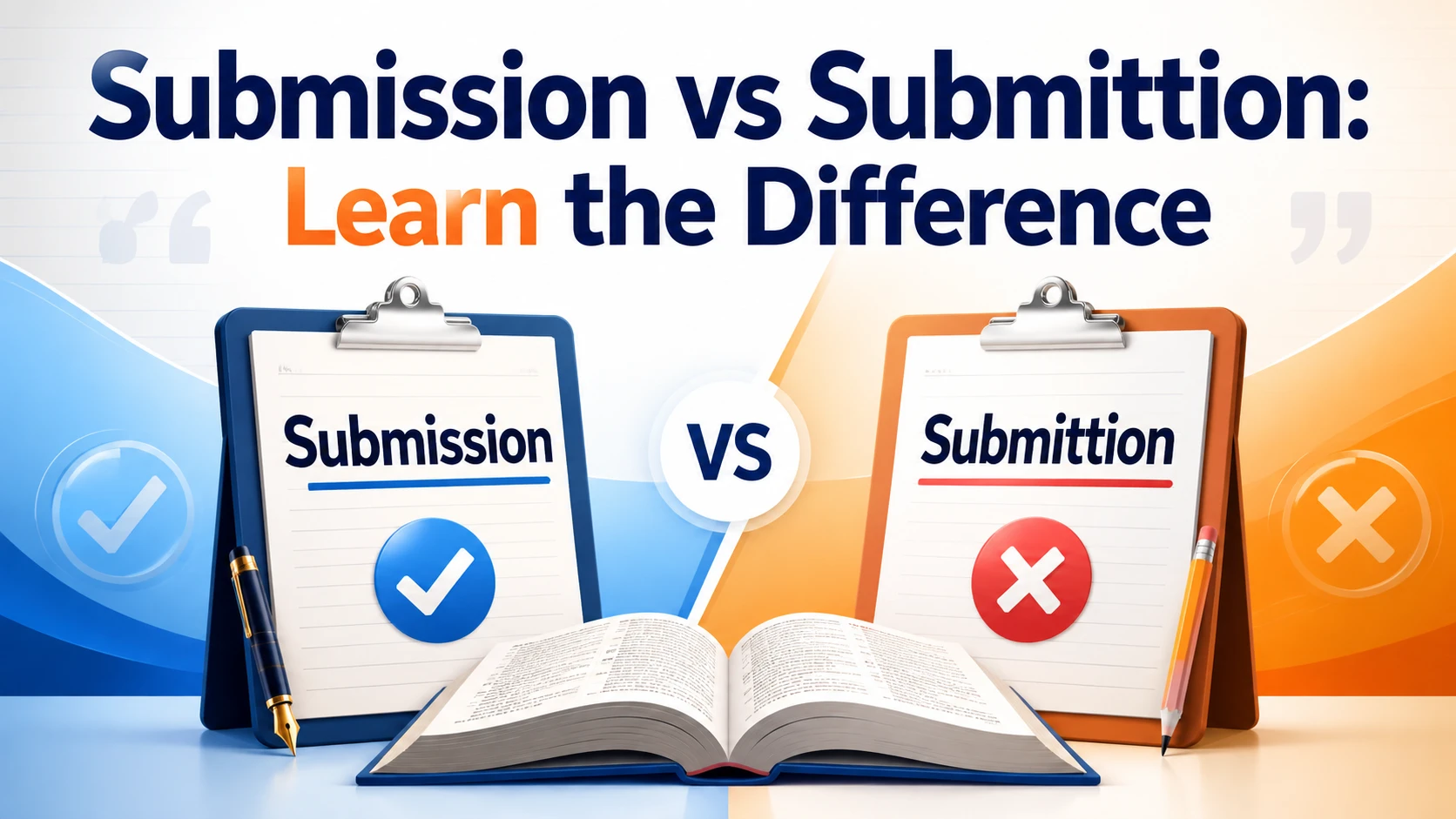
✅ Submission — Correct
❌ Submittion — Incorrect
Although submit ends with two t’s, the noun formed from it is submission, not submittion.
| Spelling | Correct? | Should You Use It? |
| Submission | ✅ Yes | Always |
| Submittion | ❌ No | Never in standard English |
If you’re writing:
- a university assignment
- a scholarship application
- a legal document
- a business proposal
- an online form
- an email
I always write submission.
The Short Answer You Can Remember
If you’re referring to the act of submitting something, the correct noun is always “submission.”
There are no modern exceptions in standard English.
What Does “Submission” Mean?
Submission is a noun that refers to the act of giving, sending, presenting, or delivering something for consideration, approval, review, or decision.
Depending on the context, it can also describe accepting another person’s authority or control, although this meaning is less common in everyday writing.
Definition in Plain English
A submission is something that has been officially presented or sent to another person or organization.
For example:
- You submit your homework.
- Your teacher receives your submission.
- You submit an article.
- The editor reviews your submission.
- You submit an application.
- The employer evaluates your submission.
The noun focuses on the completed act or the material being submitted, while the verb submit describes the action itself.
Common Meanings of “Submission”
Depending on the situation, submission can have several related meanings.
| Context | Meaning |
| Education | Handing in homework, projects, or assignments |
| Business | Sending reports, proposals, or documents |
| Employment | Filing resumes or job applications |
| Publishing | Sending manuscripts or articles to editors |
| Government | Filing official forms or requests |
| Legal | Presenting evidence or legal documents |
| Technology | Uploading online forms or digital files |
| Sports | A technique that forces an opponent to surrender |
Although these meanings differ slightly, they all share the central idea of presenting something for review, acceptance, or consideration.
Word Origin
The word submission comes from the Latin verb submittere, meaning to place under, to yield, or to send forward.
Over time, English adopted the word through French and developed its modern meanings related to:
- presenting documents
- yielding authority
- formally offering something for evaluation
Understanding the word’s history helps explain why its spelling doesn’t perfectly match the modern verb submit.
Is “Submittion” a Real Word?
No.
Submittion is not recognized as a standard English word.
You won’t find it listed as a correct entry in respected dictionaries such as:
- Merriam-Webster
- Cambridge Dictionary
- Oxford English Dictionary
- Collins Dictionary
- Dictionary.com
Instead, dictionaries recognize only:
- submit (verb)
- submitted (past tense)
- submitting (present participle)
- submission (noun)
If you write submittion, spell checkers, grammar tools, editors, and teachers will usually flag it as an error.
Why Do People Write “Submittion”?
The mistake is understandable.
Many writers apply a logical—but incorrect—pattern.
They think:
submit + tion = submittion
At first glance, that seems reasonable because:
- admit → admission
- permit → permission
- commit → commission
However, English word formation doesn’t simply attach -tion to every verb.
Instead, many words undergo historical spelling changes that must be learned as complete word forms.
Why Spell Check Doesn’t Always Catch It
Modern spell checkers are excellent, but they’re not perfect.
Some situations where submittion may slip through include:
- OCR errors after scanning documents
- Mobile keyboards with autocorrect disabled
- Browser extensions that miss certain words
- Internal company software without advanced dictionaries
- User-created dictionaries that accidentally save incorrect spellings
This is why understanding the correct spelling matters more than relying entirely on software.
Expert Tip
Good writers don’t depend exclusively on spell check. They recognize common spelling patterns and understand why words are formed the way they are.
Why “Submission” Is Spelled This Way
Many spelling mistakes disappear once you understand how English forms nouns from verbs.
The verb is:
submit
The noun is:
submission
Notice that the ending changes from -mit to -mission rather than simply adding -tion.
This change developed over centuries through the word’s Latin origins rather than modern English spelling rules.
That’s why writing submittion doesn’t follow the historical pattern of the language.
The Word Family Pattern
Many English words follow the same structure.
| Verb | Correct Noun |
| admit | admission |
| permit | permission |
| commit | commission |
| remit | remission |
| transmit | transmission |
| submit | submission |
Once you recognize this family of words, remembering submission becomes much easier.
Why the Double “T” Doesn’t Stay
A common misconception is that every letter from the verb should remain unchanged.
That’s not how many English nouns work.
Compare these examples:
- decide → decision
- divide → division
- revise → revision
- conclude → conclusion
Notice that several letters change as the noun develops.
English preserves meaning, not always the exact spelling of the original verb.
The Spelling Rule Behind Similar Words
There isn’t a simple classroom rule that says:
“Drop one t and add mission.”
Instead, linguists classify these as historically inherited word forms.
The best approach is to learn the complete word family together:
- submit
- submits
- submitted
- submitting
- submission
Learning words as families improves long-term spelling accuracy much more effectively than memorizing isolated words.
Submission Pronunciation and Syllable Breakdown
Correct pronunciation is:
/səbˈmɪʃən/
It sounds like:
sub-MISH-un
The stress falls on the second syllable.
Syllable Breakdown
sub • mis • sion
Three syllables:
- sub
- mish
- un
The ending -sion is pronounced like “zhun” or “shun”, depending on the word. In submission, it sounds like “shun.”
Common Pronunciation Mistakes
Some learners mistakenly pronounce it as:
- sub-mit-tee-on ❌
- sub-mish-ee-on ❌
- sub-mit-shun ❌
The correct pronunciation remains:
sub-MISH-un
Listening to native speakers, audiobooks, or reputable dictionaries can help reinforce the correct pronunciation.
An Easy Memory Trick
Here’s a simple way to remember the spelling forever:
Think of “mission” inside “submission.”
SUB + MISSION
= SUBMISSION
There is no extra “t” before mission.
This visual association works because many related English nouns share the -mission ending, making it easier to recognize the correct spelling without hesitation.
Submission vs Submittion: Side-by-Side Comparison
At first glance, submission and submittion differ by only one letter. In reality, that single extra t determines whether your writing looks professional or contains a spelling error. The comparison below highlights the differences you should remember.
| Feature | Submission | Submittion |
| Correct spelling | ✅ Yes | ❌ No |
| Recognized by English dictionaries | ✅ Yes | ❌ No |
| Appropriate for academic writing | ✅ Yes | ❌ No |
| Appropriate for business documents | ✅ Yes | ❌ No |
| Accepted in legal documents | ✅ Yes | ❌ No |
| Commonly used by native speakers | ✅ Yes | ❌ No |
| Should appear on a résumé or application | ✅ Yes | ❌ Never |
Quick Decision Guide
If you’re unsure which spelling to use, ask yourself one question:
Am I talking about the act of submitting something?
If the answer is yes, write submission.
There is no situation in standard English where submittion is considered the preferred spelling.
Quick Tip
When in doubt, remember the word mission inside submission. If you can spell mission, you can spell submission.
How to Use “Submission” Correctly in Sentences
Knowing the correct spelling is only the first step. You should also understand how submission functions in different types of writing. Although the core meaning remains the same, the surrounding vocabulary changes depending on the context.
Everyday Communication
In everyday English, submission usually refers to sending something to another person.
Examples
- Your submission has been received successfully.
- Please review my submission before tomorrow.
- The contest accepted online submissions only.
- I completed my submission before the deadline.
- Thank you for your prompt submission.
Notice that the word often appears alongside verbs such as:
- receive
- accept
- review
- complete
- upload
- verify
- acknowledge
Academic Writing
Students encounter the word submission throughout their education. Teachers, universities, and online learning platforms commonly use it when referring to assignments, essays, dissertations, and research papers.
Examples
- Assignment submission closes at midnight.
- Late submissions may lose marks.
- Students should confirm successful submission after uploading files.
- The professor acknowledged receipt of every project submission.
Best Practices for Students
- Submit work before the deadline.
- Keep proof of submission.
- Double-check uploaded files.
- Read submission guidelines carefully.
- Save confirmation emails.
Many academic penalties result from uploading the wrong document rather than missing the deadline itself.
Business and Workplace Communication
Professionals frequently use submission when exchanging reports, proposals, invoices, compliance documents, and project deliverables.
Examples
- Please confirm receipt of my report submission.
- Budget submission is due Friday.
- Proposal submissions will be reviewed next week.
- Vendor submissions must follow company guidelines.
In business settings, precision matters. Using the incorrect spelling submittion may leave an unfavorable impression, particularly when communicating with clients or senior management.
Legal and Government Documents
Government agencies and legal professionals rely on standardized terminology. Here, submission often refers to officially filed documents, evidence, or written arguments.
Examples
- The court accepted the written submission.
- Your visa application submission is complete.
- The agency confirmed electronic submission of the required forms.
- All supporting documents must accompany the original submission.
Because legal writing emphasizes accuracy, spelling errors can reduce the professionalism of otherwise well-prepared documents.
Online Forms and Digital Platforms
Today, many people first encounter the word while completing online forms.
You may see messages such as:
- Submission successful.
- Thank you for your submission.
- Duplicate submission detected.
- Submission failed.
- Submission pending review.
- Submission under evaluation.
These phrases appear across websites, customer support portals, scholarship applications, surveys, and cloud-based systems.
Real-Life Examples of “Submission”
Understanding grammar is easier when you see how the word appears in real situations.
School Assignment Submission
Sarah finishes her history essay two days before the deadline.
Instead of waiting until the last minute, she uploads the document, receives a confirmation email, and saves it for future reference.
Her teacher later says:
“Your submission was received successfully.”
The word refers both to the action of uploading the assignment and the assignment itself.
College Admission Application
A university requires applicants to upload:
- transcripts
- recommendation letters
- personal statements
- test scores
Only after every document has been uploaded does the application portal display:
Submission Complete
Without completing the submission process, the application remains incomplete.
Job Application
David applies for a marketing position.
After attaching his résumé and cover letter, the hiring platform displays:
Thank you for your submission.
Here, submission represents the entire application package rather than a single document.
Publishing an Article
A freelance writer submits an article to an online magazine.
The editor replies:
We received your submission and will review it within two weeks.
Publishing professionals commonly refer to manuscripts, articles, poems, and stories as submissions.
Government Services
Many tax authorities, licensing departments, and immigration agencies process electronic forms.
Applicants often receive notifications like:
- Submission received
- Submission pending verification
- Submission approved
- Submission rejected
Learning this vocabulary helps you understand official correspondence more confidently.
Common Word Forms of “Submit”
One effective way to avoid spelling mistakes is to learn words as part of the same family instead of memorizing them individually.
| Word | Part of Speech | Example |
| submit | Verb | Please submit your assignment. |
| submits | Verb | She submits reports weekly. |
| submitted | Verb | They submitted the application yesterday. |
| submitting | Verb | He is submitting the final version now. |
| submission | Noun | Your submission has been approved. |
| submissions | Plural noun | All submissions were reviewed carefully. |
Understanding the Relationship
The verb describes the action.
Please submit your essay.
The noun names the completed act or item.
Your submission has been received.
This distinction helps you choose the correct word naturally while writing.
Common Grammar Patterns
You’ll frequently encounter these combinations:
Verb + Submission
- receive a submission
- review a submission
- approve a submission
- reject a submission
- upload a submission
- finalize a submission
Adjective + Submission
- final submission
- online submission
- electronic submission
- written submission
- successful submission
- late submission
Learning these common combinations improves both grammar and vocabulary.
Submission vs Submittal: What’s the Difference?
Many writers assume submission and submittal are interchangeable. Although they often overlap, their usage depends on the industry and audience.
| Feature | Submission | Submittal |
| Common in everyday English | ✅ Yes | Less common |
| Academic writing | ✅ Preferred | Rare |
| Business communication | ✅ Preferred | Sometimes used |
| Construction industry | Sometimes | ✅ Very common |
| Engineering documentation | Sometimes | ✅ Frequently used |
| Recognized by dictionaries | ✅ Yes | ✅ Yes |
What Does “Submittal” Mean?
Submittal is a noun that also refers to the act of submitting documents.
However, in industries such as:
- construction
- engineering
- architecture
- manufacturing
A submittal usually refers to a specific package of technical documents provided for review before work begins.
Examples include:
- product specifications
- shop drawings
- equipment data sheets
- material samples
- engineering calculations
In these industries, submittal has become a specialized technical term.
When Should You Use “Submission”?
For most readers and writers, submission is the safer and more natural choice.
Use submission when writing:
- essays
- reports
- resumes
- emails
- blog posts
- scholarship applications
- government forms
- legal documents
Native speakers overwhelmingly use submission in general communication.
When Is “Submittal” Appropriate?
Use submittal only when you’re writing within industries where the term has an established technical meaning.
For example:
- Architects review contractor submittals.
- Engineers approve equipment submittals before installation.
- Construction managers track outstanding submittals throughout the project.
Outside those professional environments, submission usually sounds more natural.
Expert Recommendation
If your audience is broad—or you’re unsure which word fits—choose submission. It is universally understood, widely accepted, and appropriate in almost every form of English writing.
Submission vs Application
Although people sometimes use submission and application interchangeably, they are not synonyms. An application is a specific type of document or request, while a submission is the act of sending something—or the material that has been sent—for review.
Understanding this distinction helps you choose the right word in professional, academic, and official communication.
| Aspect | Submission | Application |
| Primary meaning | The act of submitting or the item submitted | A formal request for something |
| Part of speech | Noun | Noun |
| Can refer to many document types | ✅ Yes | ❌ Usually a request or form |
| Requires evaluation | Usually | Yes |
| Common contexts | Assignments, reports, articles, proposals | Jobs, universities, visas, permits |
When They Overlap
Sometimes an application is also a submission.
For example:
- A job application is a submission.
- A scholarship application is a submission.
- A visa application is a submission.
However, not every submission is an application.
These are submissions but not applications:
- A research paper
- A contest entry
- A project report
- A legal brief
- A manuscript sent to a publisher
Which Word Should You Choose?
Use application when referring to a formal request.
✔ I submitted my job application yesterday.
Use submission when referring to the process or the completed document.
✔ My submission has been received.
Using both words correctly makes your writing more precise.
Submission vs Proposal vs Entry
English contains several words related to sending documents, but each has its own purpose. Choosing the right one depends on what you’re submitting.
| Word | Best Used For | Example |
| Submission | General documents or files | Article submission |
| Proposal | Suggested plans or projects | Business proposal |
| Entry | Competitions or contests | Contest entry |
| Application | Formal requests | College application |
Submission vs Proposal
A proposal attempts to persuade someone to approve an idea or project.
Examples include:
- business proposals
- research proposals
- project proposals
- grant proposals
Every proposal is submitted, but not every submission is a proposal.
Example
The consulting firm submitted a proposal for the new project.
Here, the proposal itself is the submission.
Submission vs Entry
An entry usually refers to participation in a competition, giveaway, survey, or contest.
Examples:
- photo contest entry
- writing competition entry
- raffle entry
- scholarship essay entry
Contest organizers may describe every entry as a submission, but participants usually refer to what they send as an entry.
Choosing the Right Word
Ask yourself:
What are you sending?
- Asking for approval? → Application
- Presenting an idea? → Proposal
- Joining a contest? → Entry
- Sending something for review? → Submission
This simple approach eliminates most vocabulary mistakes.
Common Phrases and Collocations with “Submission”
Native English speakers regularly pair submission with certain words. Learning these combinations helps your writing sound more natural.
Common Adjectives
You’ll often see:
- final submission
- online submission
- electronic submission
- written submission
- successful submission
- complete submission
- late submission
- timely submission
- official submission
- revised submission
Examples
- Please upload your final submission.
- Your electronic submission has been verified.
- The committee accepted the revised submission.
Common Verbs
These verbs frequently appear with submission:
- submit
- receive
- review
- accept
- reject
- approve
- verify
- upload
- complete
- withdraw
Examples
- We received your submission.
- The editor reviewed every submission.
- You may withdraw your submission before publication.
Frequently Used Noun Phrases
Many organizations use these expressions every day:
- submission deadline
- submission portal
- submission guidelines
- submission process
- submission requirements
- submission confirmation
- submission status
- submission receipt
- submission form
- submission history
If you’re writing for an international audience, using these standard phrases improves clarity because readers immediately recognize them.
Common Mistakes People Make
Misspelling submission is only one of several common errors. Here are the mistakes professionals frequently notice.
Mistake 1: Writing “Submittion”
This is by far the most common mistake.
❌ submittion
✅ submission
Remember:
The noun ends with -mission, not -ttion.
Mistake 2: Confusing the Verb with the Noun
Incorrect:
Your submit has been received.
Correct:
Your submission has been received.
Or:
Please submit your assignment.
One is an action, while the other names the completed action or document.
Mistake 3: Mixing Up Submission and Submittal
Outside construction and engineering, submission is usually the better choice.
For example:
✔ Submission of tax documents
✔ Submission of coursework
Using submittal in these contexts may sound unusual to many readers.
Mistake 4: Ignoring Submission Guidelines
The spelling may be perfect, but the process can still go wrong.
Common problems include:
- uploading the wrong file
- missing required documents
- submitting after the deadline
- forgetting signatures
- using unsupported file formats
Many rejected submissions fail because instructions weren’t followed—not because of poor content.
Mistake 5: Assuming Spell Check Catches Everything
Spell check helps, but it isn’t a substitute for careful proofreading.
Before sending important documents:
- Read the title.
- Check file names.
- Verify dates.
- Confirm attachments.
- Review spelling one final time.
These simple habits prevent embarrassing mistakes.
Best Practice Checklist
✅ Use submission, never submittion.
✅ Follow all submission instructions carefully.
✅ Upload the correct document version.
✅ Keep confirmation emails or receipts.
✅ Proofread before clicking Submit.
Easy Tricks to Remember the Correct Spelling
If you’ve typed submittion in the past, don’t worry. A few memory techniques can help you remember the correct spelling permanently.
Trick 1: Think of “Mission”
Notice the ending:
sub + mission
The word mission already exists in English.
There’s no extra t before it.
Visualizing mission inside submission makes the spelling much easier to recall.
Trick 2: Learn the Entire Word Family
Instead of memorizing one word, learn related forms together.
- submit
- submitted
- submitting
- submission
Our brains remember connected information more effectively than isolated facts.
Trick 3: Read More Professional English
You’ll encounter submission frequently in:
- university websites
- government forms
- academic journals
- business documents
- publishing guidelines
Repeated exposure reinforces the correct spelling naturally.
Trick 4: Say It While You Write
Pronounce it slowly:
sub-MISH-un
Notice that you don’t hear a second t sound before -shun.
Speaking difficult words aloud often improves spelling accuracy.
Trick 5: Practice Through Real Sentences
Instead of copying the word repeatedly, use it in meaningful sentences.
For example:
- My assignment submission was successful.
- The editor reviewed my submission.
- Please confirm receipt of my submission.
- Every submission is checked for originality.
Writing naturally builds long-term memory far better than rote repetition.
Expert Insight
Professional writers rarely memorize isolated spellings. They recognize patterns, word families, and common collocations. Developing this habit improves not only your spelling but also your overall command of English vocabulary.
Practice Your Understanding
Test yourself before moving on. If you can answer these questions correctly, you’ll likely never confuse submission and submittion again.
Choose the Correct Spelling
Select the correct word.
- Your ________ has been successfully uploaded.
- A. Submittion
- B. Submission
- Please complete your project ________ before Friday.
- A. Submission
- B. Submittion
- The editor reviewed every article ________.
- A. Submission
- B. Submittion
- Late ________ may not be accepted.
- A. Submittion
- B. Submission
Answers
- B
- A
- A
- B
Fill in the Blanks
Complete each sentence with the correct word.
- Please ________ your assignment before midnight.
- We received your ________ yesterday.
- Every research paper ________ is checked for originality.
- The online portal confirmed successful ________.
- Students should review the ________ guidelines carefully.
Answers
- submit
- submission
- submission
- submission
- submission
Correct the Mistakes
Rewrite these sentences using the correct spelling.
❌ My submittion was rejected because the file was missing.
✅ My submission was rejected because the file was missing.
❌ Please confirm my submittion.
✅ Please confirm my submission.
❌ The submittion deadline has been extended.
✅ The submission deadline has been extended.
Choose the Right Word
Select the best option.
| Sentence | Correct Word |
| I sent my job ________. | Application |
| Please upload your final ________. | Submission |
| The contractor delivered equipment ________. | Submittal |
| She entered the writing competition by sending her ________. | Entry |
| The company presented a new business ________. | Proposal |
Mini Scenario Practice
Read each situation and choose the most appropriate word.
Scenario 1
You’re applying to a university.
Which word describes the completed request?
✅ Application
Scenario 2
You’ve uploaded your completed dissertation.
Which word describes the uploaded document?
✅ Submission
Scenario 3
An architect sends shop drawings for approval.
Which term is commonly used?
✅ Submittal
Scenario 4
A startup presents a marketing plan to investors.
Which word best fits?
✅ Proposal
Practice Tip
Don’t stop after reading the examples. Create five of your own sentences using submit, submitted, submitting, and submission. Applying new vocabulary in realistic situations is one of the fastest ways to remember it.
Key Takeaways
Before you leave, remember these essential points:
- Submission is the only correct spelling in standard English.
- Submittion is always a misspelling.
- Submission is a noun, while submit is the verb.
- The spelling follows the same historical pattern as admission, permission, and transmission.
- Submittal is a specialized term used mainly in construction, architecture, and engineering.
- Learning word families is more effective than memorizing isolated spellings.
- Reading carefully before clicking Submit helps prevent both spelling and document-upload mistakes.
Conclusion
Understanding the difference between Submission vs Submittion is about more than correcting a spelling mistake. It helps you communicate with greater accuracy, confidence, and professionalism in academic, workplace, and everyday writing. Whenever you’re referring to the act of sending something for review or the document you’ve submitted, submission is the correct word to use. Recognizing related terms such as application, proposal, entry, and submittal also makes your writing more precise and contextually appropriate. One final actionable tip: whenever you finish an important document, proofread not only the content but also the title, file name, and any submission-related text before sending it. A common mistake to avoid is relying entirely on autocorrect or assuming a familiar-looking spelling must be correct. Developing the habit of checking key words like submission will strengthen your writing and help you make a consistently professional impression.
Frequently Asked Questions
Q1. Is submittion ever considered a correct spelling?
No. Submittion is a misspelling in standard English. Major dictionaries, educational institutions, publishers, and style guides recognize only submission. Whether you’re writing an email, completing an application, or submitting academic work, always use submission to ensure your writing is accurate and professional.
Q2. Why does submission not keep the double t from submit?
English doesn’t always form nouns by simply adding a suffix to the original word. Submission comes from a historical word pattern inherited from Latin, similar to admission, permission, and transmission. These words evolved over time, which is why the spelling changes instead of becoming submittion.
Q3. Is submission a noun or a verb?
Submission is a noun. It refers to the act of submitting something or the item that has been submitted. The corresponding verb is submit. For example, “Please submit your report before Friday,” but “Your submission has been received.”
Q4. Should I use submission or submittal in business writing?
In most business communication, submission is the preferred choice because it is widely recognized and understood. Submittal is appropriate mainly in industries such as construction, architecture, and engineering, where it refers to a specific package of technical documents submitted for approval.
Q5. How can I remember the correct spelling permanently?
A simple technique is to think of the word mission inside submission: sub + mission = submission. Also, practice using the complete word family—submit, submitted, submitting, and submission. Seeing and using these forms together makes the correct spelling much easier to remember.
