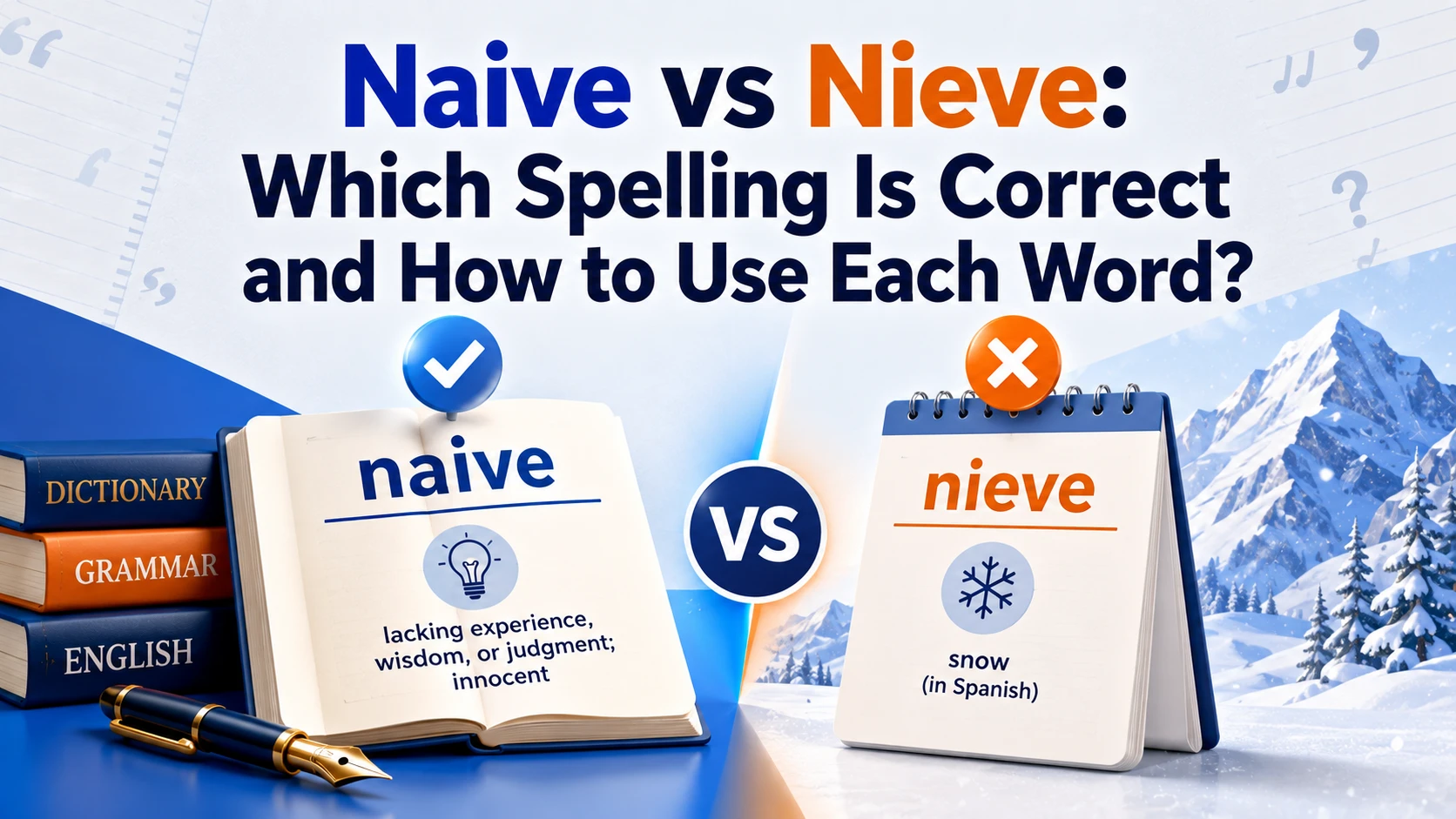
Naive vs Nieve is a common spelling confusion that causes mistakes in everyday writing, professional communication, and academic work. At first glance, these two words look similar, but only one is considered the correct English spelling in most contexts. Understanding the difference helps you avoid embarrassing spelling errors and choose the right word when describing someone’s lack of experience, trust, or knowledge.
The correct word is naive, which means lacking experience, wisdom, or judgment in a particular situation. Many people write “nieve” because the pronunciation of naive does not clearly match its spelling. This confusion becomes even stronger because English contains many words where sounds and letters do not follow predictable patterns. Learning why naive is correct and nieve is usually incorrect makes the spelling much easier to remember.
In this guide, you’ll discover the meaning, pronunciation, origin, usage rules, common mistakes, and differences between naive, innocent, gullible, and inexperienced. You’ll also learn practical examples showing how native English speakers use the word in conversations, workplaces, and formal writing.
The Correct Spelling: Is It Naive or Nieve?
The correct spelling in English is naive. The spelling nieve is not accepted as the standard English spelling when you want to describe someone who lacks experience or judgment.
Although nieve may appear in some languages or specialized contexts, it does not function as the English adjective that means inexperienced or overly trusting. If you are writing an email, essay, article, report, or professional document, naive is the form you should use.
Naive Is the Standard English Word
The word naive is an adjective used to describe:
- A person who lacks experience
- An idea based on unrealistic assumptions
- A belief that ignores important facts
- A decision made without enough understanding
Examples:
- She was naive to believe every promise she heard online.
- The company made a naive assumption about customer behavior.
- His naive approach caused problems during the negotiation.
In each sentence, naive describes something that shows limited experience or understanding.
Nieve Is Usually a Spelling Mistake
Many writers accidentally type nieve because:
- The pronunciation feels closer to “neev”
- English spelling rules are inconsistent
- The word originally came from French, not native English
- People confuse it with other words that contain “ie” or “ei”
A simple correction:
❌ She was nieve about how business works.
✅ She was naive about how business works.
Quick Comparison: Naive vs Nieve
| Feature | Naive | Nieve |
| Correct English spelling | ✅ Yes | ❌ No |
| Word type | Adjective | Usually a misspelling |
| Meaning | Lacking experience or judgment | No standard English meaning for this use |
| Used in formal writing | Yes | No |
| Common mistake | — | Writing “nieve” instead of “naive” |
What Does Naive Mean? A Clear Definition With Examples
The word naive describes someone or something that shows a lack of practical experience, knowledge, or awareness.
A naive person often believes things are simpler than they really are. They may trust others easily, overlook risks, or make decisions without considering possible problems.
However, being naive does not always mean being foolish. A person can be naive simply because they are new to a situation.
For example:
- A teenager starting their first job may be naive about workplace politics.
- A new investor may be naive about financial risks.
- A beginner traveler may be naive about cultural differences.
The key idea is not intelligence. It is experience and understanding.
Expert insight: Naive usually describes a gap in experience, not a lack of ability. Someone can be intelligent and still be naive in an unfamiliar area.
Naive Meaning in Everyday English
In daily conversations, people use naive when someone has an overly simple view of reality.
Consider these examples:
Example 1:
“I was naive when I thought becoming successful would happen overnight.”
Here, the speaker is not saying they were unintelligent. They are admitting they had an unrealistic expectation.
Example 2:
“It was naive of him to trust a stranger with personal information.”
The person made a poor judgment because they lacked awareness of possible risks.
Common Situations Where People Use Naive
You may hear naive used when talking about:
- Relationships
- Money decisions
- Career choices
- Politics
- Business strategies
- Technology
- Social interactions
Examples:
| Situation | Naive Example |
| Career | “Thinking every job will be perfect was naive.” |
| Finance | “It was naive to invest without researching first.” |
| Relationships | “She was naive about his true intentions.” |
| Technology | “Believing every online message is genuine is naive.” |
What Is Naive in a Person? Understanding the Behavior
When someone is described as naive, it usually means they do not yet understand how complicated a situation can be.
A naive person may:
- Trust people quickly
- Expect others to behave honestly
- Ignore warning signs
- Have limited real-world experience
- Believe things will work out without planning
However, context matters.
Calling someone naive can be:
- A gentle observation about inexperience
- A criticism of poor judgment
- A compliment when describing openness or innocence
The meaning depends on the speaker’s intention.
Example: Positive Use of Naive
“Her naive enthusiasm brought fresh ideas to the project.”
Here, naive suggests fresh thinking and freedom from old assumptions.
Example: Negative Use of Naive
“His naive decision caused the team to lose valuable time.”
Here, naive suggests poor preparation and lack of understanding.
Naive Personality Meaning: Traits That Often Define It
A naive personality is not a formal psychological category. Instead, people use the phrase to describe certain behavioral patterns.
Someone who is considered naive may often display these traits:
Trusting Nature
Naive people may assume others have good intentions.
Example:
“He was naive enough to believe every salesperson’s promise.”
The issue is not kindness. The issue is failing to evaluate information carefully.
Limited Experience
A person may appear naive simply because they are new to a situation.
Example:
A college graduate entering their first workplace may not understand office dynamics. Their lack of experience can make them seem naive at first.
Optimistic Thinking
Some naive people focus heavily on positive outcomes while ignoring possible challenges.
Example:
“She had a naive belief that every problem could be solved immediately.”
Optimism can be valuable, but unrealistic optimism may create problems.
Difficulty Recognizing Hidden Motives
Naive individuals may struggle to understand that people sometimes act for personal benefit.
Example:
Someone might believe a dishonest advertisement simply because it sounds convincing.
Is Being Naive Always a Bad Thing?
No. Naivety has both advantages and disadvantages.
Many people associate naive with something negative, but the word can describe qualities that are valuable in certain situations.
Benefits of Being Naive
A certain level of naivety can help people:
- Approach problems with fresh ideas
- Question outdated assumptions
- Stay open-minded
- Maintain curiosity
- Think creatively
For example, a beginner may suggest a solution that experienced professionals overlook because they are not limited by traditional thinking.
Drawbacks of Being Naive
On the other hand, excessive naivety can lead to:
- Poor decisions
- Being easily manipulated
- Unrealistic expectations
- Avoidable mistakes
- Lack of preparation
The goal is not to eliminate curiosity. It is to combine openness with awareness.
Why People Spell Naive as Nieve
The spelling confusion between naive and nieve happens because English pronunciation does not always provide clear clues about spelling. When people hear the word spoken, especially quickly, they may imagine a spelling that matches the sound rather than the actual written form.
The mistake is common among English learners and even native speakers because naive has a less familiar spelling pattern. Unlike many simple English words, it comes from another language and keeps some features from its original form.
Common Reasons People Write Nieve Instead of Naive
Several factors contribute to this spelling mistake:
- Sound-based spelling: People often write words the way they hear them.
- Unfamiliar letter combinations: The “ai” combination in naive is less predictable for some writers.
- Influence from other words: Words like believe, receive, or piece may make people expect “ie” patterns.
- Limited exposure: Someone who has mostly heard the word but rarely seen it written may naturally guess the spelling.
For example:
❌ His nieve attitude caused problems.
✅ His naive attitude caused problems.
The correct spelling becomes easier once you connect the word with its meaning and origin.
What Does Nieve Mean? Understanding the Confusion
In standard English usage, nieve is not the correct spelling of the adjective that means inexperienced or overly trusting.
If you write:
“She was nieve about the risks.”
Most readers will understand what you mean, but they will recognize it as a spelling error.
However, the word nieve can appear in other languages or specialized contexts. For example, in Spanish, nieve means snow. This is completely unrelated to the English adjective naive.
Naive and Nieve Come From Different Language Backgrounds
| Word | Language Connection | Meaning |
| Naive | French origin, used in English | Lacking experience or judgment |
| Nieve | Spanish word | Snow |
This difference explains why the two spellings should not be treated as alternatives.
The Origin of Naive: Why the Spelling Looks Unusual
The history of a word often explains why its spelling does not follow modern English patterns.
The word naive comes from the French word naïf (masculine) and naïve (feminine), which originally meant natural, simple, or inexperienced.
The French word developed from the Latin word nativus, meaning natural or born.
Over time, English adopted the word while keeping much of its original spelling.
How the Meaning Changed Over Time
Originally, the word had a more neutral meaning connected with natural simplicity.
Today, naive usually focuses on a person’s:
- Lack of experience
- Limited understanding
- Unrealistic expectations
- Simple view of complex situations
The meaning shifted from “natural” to “inexperienced” because people began associating simplicity with a lack of worldly knowledge.
Naive vs Naïve: Which Spelling Should You Use?
Many readers notice that the word appears in two forms:
- Naive
- Naïve
Both are correct.
The difference is the diaeresis mark (¨) placed above the letter i.
Why Does Naïve Have Two Dots?
The two dots indicate that the vowels should be pronounced separately.
Without the mark:
naive
With the mark:
naïve
The original spelling helps readers understand that the word is pronounced with two vowel sounds rather than blending them together.
Modern English Preference
In contemporary English, especially in American writing, naive without the dots is more common.
You will often see:
- Websites use naive
- Newspapers use naive
- Academic writing may use either form
- Dictionaries usually list both forms
Example:
✅ It was a naive assumption.
✅ It was a naïve assumption.
Both sentences are correct.
Naive British Spelling vs American Spelling
Unlike some words that change between British and American English, naive does not have a different spelling based on region.
Both American and British English commonly use:
- naive
- naïve
The meaning remains the same.
Regional Usage Comparison
| Variety | Common Form | Example |
| American English | naive | “That was a naive mistake.” |
| British English | naive / naïve | “That was a naive mistake.” |
| Formal writing | naive / naïve | “The proposal was too naive.” |
The choice is mostly a style preference rather than a regional rule.
Professional Recommendation
For general online writing, business communication, and everyday use, naive is the safest choice because it is simple, widely accepted, and easier to type.
Use naïve if:
- You follow traditional spelling styles
- Your publication prefers diacritics
- You want to preserve the original French appearance
Naive Pronunciation Made Simple
The pronunciation of naive often creates spelling confusion because the word does not sound exactly like it looks.
The common pronunciation is:
ny-EEV
It has two syllables:
- ny
- eev
Common Pronunciation Mistakes
Some people incorrectly pronounce it as:
❌ “nave”
❌ “nayve”
❌ “nee-ave”
The correct pronunciation sounds closer to:
✅ “nyeev”
Example sentence:
“Don’t be naive about online security.”
Pronunciation:
“Don’t be nyeev about online security.”
Naive vs Innocent: Understanding the Difference
People often confuse naive and innocent because both words can describe someone who lacks experience.
However, they focus on different qualities.
Innocent usually describes someone’s purity, lack of guilt, or absence of harmful intentions.
Naive describes someone’s lack of knowledge, experience, or realistic understanding.
Comparison: Naive vs Innocent
| Feature | Naive | Innocent |
| Main idea | Lack of experience | Lack of wrongdoing or corruption |
| Focus | Knowledge and judgment | Character and intentions |
| Usually negative? | Sometimes | Often positive |
| Example | “He was naive about business.” | “The child was innocent.” |
Examples Showing the Difference
Naive:
“She was naive and believed the fake advertisement.”
She lacked awareness.
Innocent:
“The child was innocent and did not understand the argument.”
The child lacked knowledge of wrongdoing.
A person can be innocent without being naive, and a person can be naive without being innocent.
Naive vs Gullible: What Is the Difference?
Naive and gullible are closely related words, but they describe different weaknesses in judgment. Many people use them interchangeably, yet the difference matters when choosing the right word.
A naive person usually lacks experience or knowledge about a situation. A gullible person is someone who is too willing to believe things without questioning whether they are true.
For example:
- A young employee who does not understand workplace politics may be naive.
- Someone who believes every fake online story they read may be gullible.
Naivety often comes from lack of exposure, while gullibility is more connected to poor evaluation of information.
Naive vs Gullible Comparison Table
| Feature | Naive | Gullible |
| Main meaning | Lacking experience or understanding | Easily fooled or deceived |
| Cause | Lack of knowledge | Lack of skepticism |
| Focus | Inexperience | Believing false information |
| Example | “He was naive about business risks.” | “He was gullible enough to trust the scam.” |
| Can improve through | Learning and experience | Critical thinking and careful judgment |
Can a Person Be Both Naive and Gullible?
Yes. A person who has little experience may also be easily convinced by false information.
Example:
“Because she was naive about investing, she was gullible enough to trust an unrealistic financial promise.”
However, the two words should not always replace each other.
A beginner learning a new skill is often naive, but they are not necessarily gullible.
Naive vs Inexperienced vs Unsophisticated: Key Differences
Several words can describe someone who does not fully understand a situation. Choosing the right one depends on what you want to emphasize.
Naive vs Inexperienced
Inexperienced simply means someone has not gained enough practice or exposure.
Example:
“The inexperienced driver made a mistake.”
This does not suggest poor judgment. The person may simply need more practice.
Naive suggests that the lack of experience affects someone’s expectations or decisions.
Example:
“The naive driver thought traffic rules were unnecessary.”
Naive vs Unsophisticated
Unsophisticated usually means someone lacks complexity, refinement, or advanced understanding.
It can describe:
- Technology
- Taste
- Methods
- Ideas
- Social skills
Example:
“The company used an unsophisticated marketing strategy.”
This does not necessarily mean the company was naive.
Choosing the Right Word
| If You Mean… | Use This Word |
| Someone is new to something | Inexperienced |
| Someone believes unrealistic things | Naive |
| Someone lacks complexity or refinement | Unsophisticated |
| Someone believes things too easily | Gullible |
How to Use Naive Correctly in a Sentence
The word naive is an adjective, which means it describes a noun. It can describe people, opinions, decisions, assumptions, plans, or approaches.
Naive Examples About People
- She was naive when she started her first business.
- He seemed naive about how competitive the industry was.
- The young player was naive about professional sports.
In these examples, naive describes a person’s limited understanding.
Naive Examples About Ideas and Decisions
Naive does not only describe people. It can also describe thoughts, plans, or expectations.
Examples:
- The proposal was based on a naive assumption.
- Their naive plan ignored several important risks.
- It is naive to think success happens without effort.
Here, the word highlights unrealistic thinking rather than a person’s personality.
Naive Examples in Professional Writing
In professional settings, naive should be used carefully because it can sound critical.
Instead of directly saying:
“Your idea is naive.”
A more constructive approach may be:
“The idea may be too optimistic because it does not consider potential challenges.”
This approach focuses on improving the idea rather than criticizing the person.
Professional Usage Tip
Use naive when you need to describe a genuine lack of awareness, but avoid using it as an insult.
Good professional writing explains why an assumption is unrealistic.
Common Sentence Patterns With Naive
Understanding common structures helps you use the word naturally.
Pattern 1: Naive + About + Topic
Used when someone lacks knowledge about something.
Examples:
- He was naive about online privacy.
- She was naive about the challenges of entrepreneurship.
Pattern 2: It Is Naive to + Verb
Used to describe unrealistic thinking.
Examples:
- It is naive to expect instant results.
- It is naive to believe every source online is reliable.
Pattern 3: Naive + Noun
Used when describing ideas, assumptions, or approaches.
Examples:
- A naive assumption
- A naive belief
- A naive approach
- A naive expectation
Common Mistakes When Using Naive
Even after learning the correct spelling, many writers misuse the word. Understanding these mistakes improves accuracy.
Mistake 1: Writing Nieve Instead of Naive
This is the most common error.
Incorrect:
“His nieve opinion caused confusion.”
Correct:
“His naive opinion caused confusion.”
How to Avoid It
Remember:
Naive contains “AI,” not “IE.”
A simple memory trick:
Naive has AI because a naive person needs AI (awareness and insight) to avoid mistakes.
Mistake 2: Treating Naive as a Synonym for Stupid
A common misconception is that naive means unintelligent.
That is incorrect.
A highly educated person can still be naive about something unfamiliar.
Example:
A successful doctor may be naive about investing because medicine and finance require different knowledge.
The issue is not intelligence. It is experience in a specific area.
Mistake 3: Using Naive as a Direct Insult
Calling someone naive can sound harsh depending on the situation.
Compare:
❌ “You are naive.”
✅ “That assumption may be naive because it overlooks several risks.”
The second sentence discusses the problem without attacking the person.
Mistake 4: Confusing Naive With Innocent
Although these words overlap, they are not identical.
Incorrect assumption:
“A naive person is always innocent.”
Not necessarily.
Someone can be naive because they lack experience, but they may still have harmful intentions.
Example:
A person with no business experience may make a naive financial decision. That does not automatically make them innocent.
Naive Synonyms and Related Words
Using synonyms correctly requires understanding small differences in meaning.
Positive or Neutral Synonyms
| Word | Meaning |
| Innocent | Lacking harmful knowledge or intentions |
| Unsuspecting | Not expecting danger or deception |
| Simple | Not complicated |
| Open-minded | Willing to consider ideas |
More Negative Synonyms
| Word | Meaning |
| Gullible | Easily tricked |
| Credulous | Too willing to believe things |
| Unworldly | Lacking experience of real life |
| Unsophisticated | Lacking refinement or complexity |
Naive Antonyms: Words With the Opposite Meaning
The opposite of naive is usually a word that suggests experience, awareness, or wisdom.
Common antonyms include:
- Experienced
- Knowledgeable
- Wise
- Realistic
- Sophisticated
- Street-smart
- Practical
Examples:
Naive:
“She had a naive understanding of the market.”
Experienced:
“She developed a realistic understanding of the market after years of work.”
A Quick Guide: When to Use Naive
| Situation | Use Naive? | Reason |
| Someone lacks experience | ✅ Yes | Correct meaning |
| Someone is easily tricked | Sometimes | Gullible may be better |
| Someone is morally pure | ❌ Usually no | Innocent fits better |
| Someone lacks intelligence | ❌ No | Not the meaning |
| Someone has unrealistic expectations | ✅ Yes | Correct usage |
Naive vs Nieve: Side-by-Side Comparison Table
Understanding the difference between naive and nieve becomes easier when you compare their spelling, meaning, and usage directly.
| Category | Naive | Nieve |
| Correct English spelling | ✅ Correct | ❌ Incorrect for this meaning |
| Word type | Adjective | Not used as an English adjective for this meaning |
| Meaning | Lacking experience, knowledge, or judgment | No standard English meaning related to inexperience |
| Origin | From French naïf/naïve | Spanish word meaning “snow” |
| Common usage | Everyday, academic, and professional writing | Usually a spelling mistake |
| Example | “His naive assumption caused problems.” | “His nieve assumption caused problems.” ❌ |
The important point is simple: when describing someone who lacks experience or realistic understanding, always choose naive.
How to Remember the Correct Spelling of Naive
Many spelling mistakes happen because people memorize words without understanding their patterns. A strong memory connection makes naive easier to recall.
Memory Trick: Naive Contains “AI”
A helpful reminder:
Naive has “AI” in the middle, not “IE.”
Think:
Na + AI + ve = naive
This separates it from common “ie” spelling patterns.
Connect the Spelling With the Meaning
You can also remember:
A naive person needs more awareness and insight.
The letters AI can remind you of the ideas behind becoming less naive:
- Awareness
- Insight
This is not the origin of the word, but it is a practical memory technique.
Practice Writing the Word Correctly
A simple exercise:
Write three sentences using naive:
- One sentence about a person
- One sentence about an idea
- One sentence about a decision
Example:
- I was naive about how difficult the project would be.
- That was a naive assumption about customer behavior.
- The plan was naive because it ignored possible risks.
Repeated exposure helps the correct spelling become automatic.
Examples of Naive in Different Contexts
The meaning of naive can slightly change depending on the situation. Understanding context helps you use the word naturally.
Naive in Everyday Conversations
In casual conversations, people often use naive to describe unrealistic expectations or a lack of life experience.
Examples:
“I was naive to think everyone would keep their promises.”
The speaker recognizes that they misunderstood how people or situations work.
Another example:
“Don’t be naive. Check the information before sharing it.”
Here, naive means failing to consider possible problems.
Naive in Business and Work Situations
The workplace often requires practical judgment. Someone new to business may have assumptions that seem unrealistic to experienced professionals.
Examples:
“It was naive to believe the project would finish without delays.”
The problem is not the person’s ability. The problem is ignoring common challenges.
Business Areas Where Naive Thinking Often Appears
- Assuming customers will automatically buy a product
- Ignoring competition
- Underestimating costs
- Expecting immediate results
- Trusting agreements without proper review
Professional Alternative
Instead of saying:
“That idea is naive.”
A manager might say:
“That approach needs more research because it does not consider market risks.”
This creates a more productive discussion.
Naive in Relationships
People may describe someone as naive when they have unrealistic expectations about relationships.
Examples:
“She was naive to believe that trust alone could solve every problem.”
A person may enter a relationship with positive intentions but lack experience with communication, boundaries, or conflict.
Important Difference
Being hopeful is not the same as being naive.
Healthy optimism:
“I believe we can solve problems together.”
Naive thinking:
“We will never have problems.”
The difference is whether someone recognizes reality.
Naive in Literature and Storytelling
Writers often use naive characters because their lack of experience creates opportunities for growth.
A naive character may:
- Begin with simple beliefs
- Face difficult experiences
- Learn important lessons
- Develop wisdom
This character type is common because readers can connect with personal growth.
A character becoming less naive often represents:
- Maturity
- Awareness
- Emotional development
- Real-world learning
Practice Exercises: Test Your Understanding of Naive
Testing yourself helps confirm whether you understand both the spelling and meaning.
Fill in the Blank: Naive or Nieve?
Choose the correct word.
- The young entrepreneur had a ______ idea about how quickly the company would grow.
- It was ______ to believe every online review without checking the source.
- His ______ attitude came from having little experience in the industry.
- She was not foolish; she was simply ______ about the situation.
Answers
- naive
- naive
- naive
- naive
Choose the Correct Word
Select the better option.
1. Someone who believes unrealistic promises is:
A) Naive
B) Experienced
Answer: Naive
2. Someone who has never performed a task before is:
A) Innocent
B) Inexperienced
Answer: Inexperienced
3. Someone who believes every rumor they hear is:
A) Gullible
B) Sophisticated
Answer: Gullible
Sentence Correction Practice
Correct these sentences:
Incorrect:
“He had a nieve understanding of the situation.”
Correct:
“He had a naive understanding of the situation.”
Incorrect:
“She was naive because she was unintelligent.”
Correct:
“She was naive because she lacked experience in that area.”
Incorrect:
“The child was naive because he committed no crime.”
Correct:
“The child was innocent because he committed no crime.”
Meaning Match Exercise
Match each word with the correct meaning.
| Word | Meaning |
| Naive | Lacking experience or realistic understanding |
| Gullible | Easily convinced by false information |
| Innocent | Free from wrongdoing |
| Experienced | Having knowledge gained through practice |
Quick Writing Drill
Write your own examples using these sentence patterns:
Pattern 1:
It was naive to ______.
Example:
It was naive to assume the project would succeed without planning.
Pattern 2:
She was naive about ______.
Example:
She was naive about how competitive the job market was.
Pattern 3:
His naive ______ caused ______.
Example:
His naive assumption caused unnecessary confusion.
Conclusion
The difference between naive vs nieve is simple: naive is the correct English spelling, while nieve is generally a spelling mistake when you mean inexperienced or lacking judgment. The word describes a person, idea, or decision that shows limited experience, but it does not mean someone is unintelligent. Understanding the difference between naive, innocent, gullible, and inexperienced helps you choose the right word for each situation. Remember that being naive can sometimes bring creativity and fresh perspectives, but practical knowledge helps prevent avoidable mistakes. One final actionable tip: whenever you are unsure, check whether you mean “lacking experience” or “easily fooled” because the answer determines whether naive or another word fits best. A common mistake to avoid is writing “nieve” based only on pronunciation. Correct spelling becomes easier when you connect words with their meaning, not just their sound.
Frequently Asked Questions
Q1. Is Nieve a correct spelling of naive?
No, nieve is not the correct English spelling when describing someone who lacks experience or judgment. The correct word is naive. The spelling “nieve” is usually a mistake caused by pronunciation confusion or unfamiliarity with the word’s origin.
Q2. Should I write naive or naïve?
Both naive and naïve are correct spellings. The version without the two dots is more common in modern English, especially online and in American writing. The form naïve preserves the original French spelling style.
Q3. Is being naive always a bad thing?
No. Naive can have positive or negative meanings depending on context. It may describe fresh thinking, openness, and creativity. However, it can also suggest poor judgment when someone ignores risks or lacks necessary awareness.
Q4. What is the difference between naive and gullible?
Naive means lacking experience or understanding, while gullible means easily fooled or persuaded. A person may be naive because they are new to a situation, but gullibility focuses more on accepting information without questioning whether it is true.
Q5. Can an intelligent person be naive?
Yes. Intelligence and experience are different things. Someone can be highly educated or skilled in one area while being naive in another. For example, an expert scientist may be naive about investing because they lack financial experience.
