
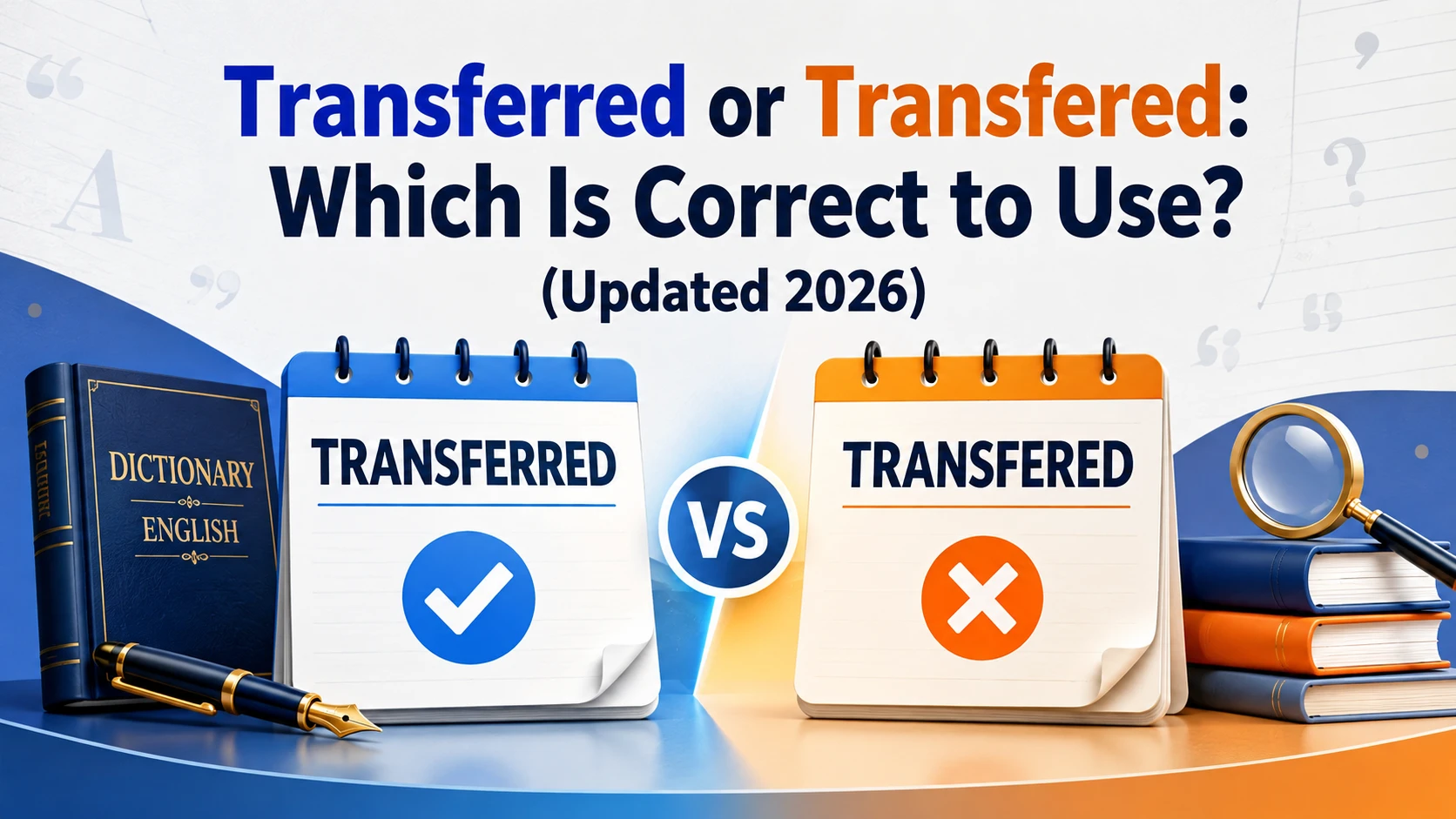
Transferred or transfered is a spelling question that confuses thousands of English learners, students, professionals, and even native speakers every year. Since the only visible difference is an extra “r”, it’s easy to assume both spellings are acceptable. In reality, only transferred is correct in standard English. Using the wrong spelling can make essays, business emails, resumes, reports, and online content appear less polished. Understanding why one form is correct helps you avoid a mistake that spell-checkers don’t always catch in every situation.
The confusion comes from one of English grammar’s most misunderstood spelling rules: doubling the final consonant before adding a suffix. Many writers know that the base verb is transfer, but they hesitate when forming the past tense because they aren’t sure whether another “r” should be added. The uncertainty becomes even greater when comparing words that follow different spelling patterns. Once you understand the rule, however, the correct spelling becomes much easier to remember and apply consistently.
This guide explains the difference between transferred and transfered, why transferred has two r’s, and how to use it correctly in real-world writing. You’ll learn the grammar rule behind the spelling, explore examples from business, education, finance, and everyday conversations, compare the two spellings side by side, and discover practical memory techniques that prevent future mistakes. By the end, you’ll know exactly when to use transferred and why transfered should be avoided in standard English.
Transferred or Transfered: What’s the Correct Spelling?
The simple answer is:
✅ Transferred — Correct
❌ Transfered — Incorrect
If you’re writing in American English or British English, transferred is the accepted spelling for the past tense and past participle of the verb transfer.
Examples:
- She transferred to another university last semester.
- The money was transferred successfully.
- Our files were transferred to the new server overnight.
Using transfered in professional or academic writing is considered a spelling mistake.
Quick Answer
Whenever you need the past tense or past participle of transfer, always write:
- Transferred
Never write:
- Transfered
This rule applies to:
- School assignments
- Business communication
- Government documents
- Academic papers
- News articles
- Professional emails
- Technical documentation
Regardless of the context, transferred is the correct spelling.
Why “Transferred” Is Correct
The spelling follows a well-established English grammar rule.
The verb transfer ends with:
- One vowel (e)
- One consonant (r)
The stress falls on the last syllable:
trans-FER
Because of this stress pattern, English doubles the final consonant before adding -ed.
So the spelling changes like this:
Transfer
↓
Transfer + r + ed
↓
Transferred
The same rule also produces:
- Referring
- Referred
- Preferred
- Occurred
All of these words double their final consonant before adding the suffix.
Is “Transfered” Ever Acceptable?
For standard English, no.
Major dictionaries, grammar references, and style guides recognize only:
Transferred
The spelling transfered usually appears because someone:
- Forgot to double the final r
- Typed too quickly
- Misremembered the spelling rule
- Assumed the base verb simply takes -ed
Unless Transfered appears intentionally as part of a username, filename, or fictional title, it should be corrected.
Key Point
If your sentence describes something that moved, changed ownership, changed location, or was sent elsewhere, the correct past-tense form is always transferred.
Side-by-Side Comparison
| Feature | Transferred | Transfered |
| Standard English spelling | ✅ Yes | ❌ No |
| Found in dictionaries | ✅ Yes | ❌ No |
| Past tense of transfer | ✅ Yes | ❌ No |
| Appropriate for formal writing | ✅ Yes | ❌ No |
| Accepted in US English | ✅ Yes | ❌ No |
| Accepted in UK English | ✅ Yes | ❌ No |
Writing Tip
If your spell checker flags transfered, don’t ignore the warning. Replacing it with transferred immediately improves the accuracy and professionalism of your writing.
Why “Transferred” Has a Double R
Many spelling mistakes disappear once you understand why English doubles certain letters.
Rather than memorizing individual words, learning the underlying rule allows you to spell dozens of similar verbs correctly.
The English Spelling Rule Behind the Double Consonant
One of the most important English spelling rules states:
When a verb ends with one vowel followed by one consonant and the final syllable is stressed, double the final consonant before adding a suffix beginning with a vowel.
Since transfer ends in r and the stress falls on FER, the r must be doubled.
Correct:
- Transfer → Transferred
- Transfer → Transferring
Incorrect:
- Transfered
- Transfering
Learning this rule helps with many other English verbs.
How the Stress Pattern Affects Spelling
Stress plays a major role in English spelling.
Say the word aloud:
trans-FER
Notice how the emphasis naturally falls on the second syllable.
Because the final syllable carries the stress, English doubles the final consonant before adding:
- -ed
- -ing
Compare these examples:
| Base Verb | Past Tense | Present Participle |
| Transfer | Transferred | Transferring |
| Prefer | Preferred | Preferring |
| Refer | Referred | Referring |
| Occur | Occurred | Occurring |
The spelling rule remains consistent across all these verbs.
Why Writers Often Misspell “Transferred”
Even experienced writers occasionally type transfered.
Common reasons include:
- Typing quickly on a keyboard
- Forgetting the doubling rule
- Confusing similar verbs
- Relying entirely on memory
- Assuming every verb simply adds -ed
Fortunately, once you recognize the stress pattern, these mistakes become much less common.
Similar Words That Follow the Same Rule
Several everyday English verbs follow exactly the same pattern.
Examples include:
- Refer → Referred
- Prefer → Preferred
- Confer → Conferred
- Defer → Deferred
- Infer → Inferred
Notice that every one of these words doubles the final r before adding -ed or -ing.
Remembering these examples reinforces the spelling rule far better than memorizing transferred by itself.
Memory Tip
If a verb ends like transfer and the final syllable is stressed, there’s a good chance you’ll need to double the final consonant before adding -ed or -ing.
What Does “Transferred” Mean?
The verb transferred means moved from one person, place, system, or situation to another.
Although the core idea remains the same, its exact meaning depends on the context.
You might transfer:
- Money
- Files
- Employees
- Students
- Ownership
- Responsibilities
- Phone calls
- Patients
- Data
Because the word applies to so many situations, it appears frequently in everyday English.
Definition
Transferred is the past tense and past participle of the verb transfer.
In general, it means:
- To move something.
- To relocate someone.
- To pass ownership.
- To shift responsibility.
- To send information.
- To change positions or locations.
The movement may be physical, digital, legal, educational, or financial.
Common Meanings in Everyday English
Moving Something from One Place to Another
Examples:
- The furniture was transferred to the new office.
- Hospital staff transferred the patient safely.
- Warehouse workers transferred the goods overnight.
Here, the word describes physical movement.
Changing Ownership
Ownership frequently changes through transfers.
Examples:
- The property was transferred to her daughter.
- Ownership of the business was transferred after retirement.
- The copyright was transferred legally.
Legal documents often use transferred in this sense.
Switching Schools, Jobs, or Departments
Many people encounter the word in education or employment.
Examples:
- She transferred to another university.
- He transferred to the marketing department.
- Our manager was transferred overseas.
The person changes locations while remaining within the same larger organization.
Sending Money or Data
Technology and finance rely heavily on this meaning.
Examples:
- The funds were transferred immediately.
- Your photos have been transferred successfully.
- Customer records were transferred to the cloud.
Today, this is one of the most common uses of the word.
Common Collocations with “Transferred”
Learning common word combinations helps your writing sound more natural.
| Collocation | Example |
| Transferred funds | The bank transferred the funds today. |
| Transferred ownership | Ownership was transferred legally. |
| Transferred data | The technician transferred the data securely. |
| Transferred schools | She transferred schools during the semester. |
| Transferred employee | The company transferred an employee to London. |
| Transferred responsibility | Management transferred responsibility to a new supervisor. |
These collocations appear regularly in business writing, legal documents, education, healthcare, technology, and everyday communication.
Expert Writing Tip
Before using transferred, ask yourself whether you’re describing movement, relocation, ownership, or a change from one place or system to another. If the answer is yes, transferred is almost certainly the correct word. More importantly, remember that the correct spelling always includes two R’s, regardless of whether you’re writing in American or British English.
How to Use “Transferred” Correctly in Sentences
Knowing that transferred is the correct spelling is only the first step. You also need to understand how it functions in different contexts. The verb is remarkably versatile because it can describe the movement of people, objects, information, money, ownership, or responsibilities.
The key idea remains the same: something moves from one place, person, or state to another.
Academic Writing Examples
Schools, colleges, and universities frequently use transferred when discussing students, credits, records, or departments.
Examples:
- She transferred to a different university after her first year.
- His academic credits were transferred successfully.
- The department transferred the student’s records electronically.
- Several graduate students were transferred to the new research program.
In academic writing, transferred usually describes an official change rather than a casual move.
Business and Workplace Examples
Companies often use transferred when employees, responsibilities, projects, or departments change.
Examples:
- The company transferred the employee to its New York office.
- Management transferred responsibility to a new project leader.
- Customer support calls were transferred to another team.
- The business transferred inventory between warehouses.
In professional communication, the word emphasizes an organized and authorized change.
Banking and Finance Examples
Banks and financial institutions use transferred every day.
Examples:
- The funds were transferred within minutes.
- The customer transferred money to another account.
- Ownership of the shares was transferred after approval.
- The payment was transferred securely through the banking system.
Because financial documents require precision, using the correct spelling is especially important.
Technology and Data Transfer Examples
Modern technology has made transferred one of the most common verbs in digital communication.
Examples:
- The files were transferred to the cloud.
- Your photos have been transferred successfully.
- The technician transferred the database to a new server.
- The software automatically transferred user settings.
In technology, transferred usually refers to moving digital information from one device or system to another.
Everyday Conversation Examples
Outside formal writing, people use transferred naturally in daily conversations.
Examples:
- We transferred our furniture to the new apartment.
- My doctor transferred me to another specialist.
- They transferred the phone call to customer service.
- She transferred to another gym closer to home.
These examples show that the word fits both formal and informal situations.
Writing Tip
When choosing transferred, ask yourself a simple question:
“Did something move from one place, person, account, or system to another?”
If the answer is yes, transferred is probably the correct verb.
Transferred vs Transfered: Side-by-Side Comparison
Although only one letter separates these spellings, their acceptance in English is completely different.
Spelling
The correct spelling is:
✅ Transferred
The incorrect spelling is:
❌ Transfered
Remember that the final r is doubled before adding -ed.
Grammar
Transferred is the past tense and past participle of transfer.
Examples:
- She transferred yesterday.
- The documents have been transferred.
- Funds were transferred automatically.
Because transfered is not a standard English word, it has no accepted grammatical use.
Dictionary Status
Major English dictionaries recognize:
✔ Transferred
They do not list transfered as the standard spelling.
If you encounter transfered, it is almost always:
- A typing error
- A proofreading mistake
- A misunderstanding of the doubling rule
Usage in Formal and Informal Writing
The spelling transferred is correct in every writing situation.
| Writing Context | Correct Form |
| Academic papers | Transferred |
| Business emails | Transferred |
| Legal documents | Transferred |
| News articles | Transferred |
| Technical writing | Transferred |
| Everyday conversation | Transferred |
There is no context in standard English where transfered is preferred.
Example Sentences Compared
| Incorrect | Correct |
| She transfered schools last year. | She transferred schools last year. |
| The money was transfered yesterday. | The money was transferred yesterday. |
| Files were transfered automatically. | Files were transferred automatically. |
| Ownership was transfered legally. | Ownership was transferred legally. |
Simply adding the second r corrects every sentence.
Common Mistakes Writers Make
The mistake isn’t always about spelling alone. Writers also misuse transferred because they misunderstand the grammar behind it.
Recognizing these common errors helps you avoid them.
Dropping One “R”
This is by far the most common mistake.
Incorrect:
❌ transfered
Correct:
✅ transferred
The error usually happens because writers treat transfer like regular verbs such as:
- Played
- Opened
- Helped
However, transfer follows a different spelling rule.
Confusing the Base Verb with the Past Tense
Some learners correctly spell transfer but make mistakes when changing the verb form.
| Base Verb | Correct Form |
| Transfer | Transfer |
| Past Tense | Transferred |
| Present Participle | Transferring |
Notice that both transferred and transferring require double R.
Applying the Wrong Spelling Rule
English contains many verbs that simply add -ed.
Examples include:
- Walk → Walked
- Call → Called
- Open → Opened
Writers sometimes assume transfer behaves the same way.
It doesn’t.
Because the final syllable is stressed, the r must be doubled.
Relying Too Much on Autocorrect
Spell-check tools are useful, but they shouldn’t replace proofreading.
Some writing environments:
- Don’t check spelling automatically.
- Ignore technical documents.
- Miss copied text.
- Accept customized dictionaries.
Professional writers always review important documents before publishing.
Quick Proofreading Checklist
Before submitting your work, ask yourself:
| Question | Check |
| Did I write transferred with two R’s? | ☐ |
| Did I accidentally type transfered? | ☐ |
| Does the sentence describe movement or relocation? | ☐ |
| Am I using the correct tense? | ☐ |
| Have I proofread the document carefully? | ☐ |
Completing this checklist takes less than a minute but prevents one of the most common spelling mistakes in English.
Expert Recommendation
Instead of memorizing individual spellings, learn the doubling rule behind words like transferred, preferred, referred, and occurred. Understanding the pattern makes it easier to spell dozens of similar words correctly, improving both your writing accuracy and long-term confidence.
Easy Ways to Remember the Correct Spelling
Remembering transferred becomes much easier when you connect the spelling to a simple pattern instead of memorizing it as an isolated word.
Many spelling mistakes happen because writers focus only on how a word looks. A better approach is to understand why the spelling changes.
The extra r is not random. It follows a predictable English spelling rule.
A Simple Memory Trick for “Transferred”
A useful way to remember the correct spelling is:
Transfer has to “run farther” when it moves, so it carries an extra R.
While this is only a memory aid, it helps many learners remember that the past tense is:
✅ Transfer → Transferred
Not:
❌ Transfer → Transfered
Another easy trick is to connect it with related words:
- Transfer
- Transferred
- Transferring
All three forms keep the double r when the suffix is added.
The Stress-and-Double-Consonant Shortcut
The most reliable method is understanding the pronunciation pattern.
Say:
trans-FER
The final syllable receives the strongest stress.
When a verb:
- Ends in one vowel + one consonant
- Has stress on the final syllable
- Adds a suffix beginning with a vowel
the final consonant is usually doubled.
Examples:
| Base Verb | Correct Past Form |
| Transfer | Transferred |
| Refer | Referred |
| Prefer | Preferred |
| Defer | Deferred |
| Occur | Occurred |
This pattern is much more powerful than memorizing individual spellings.
Quick Proofreading Checklist
Before publishing or submitting important writing, check the following:
- ✅ Did I write transferred with two r’s?
- ✅ Am I describing something that moved from one place to another?
- ✅ Did I avoid the incorrect form transfered?
- ✅ Did I use the correct verb tense?
- ✅ Did I review the sentence instead of trusting autocorrect?
A quick review can prevent a small spelling error from reducing the professionalism of your writing.
Words That Follow the Same Spelling Pattern
Understanding transferred also helps you spell many other English words correctly.
The same double-consonant rule appears in several common verbs.
Referred
The verb refer means to direct someone to a source, person, or place.
Because the stress falls on the final syllable:
re-FER
the final r doubles.
Examples:
- The doctor referred the patient to a specialist.
- She referred to the previous report.
- The manager referred the issue to the legal team.
Incorrect:
❌ Refered
Correct:
✅ Referred
Preferred
The verb prefer means to like one option more than another.
The spelling follows the same pattern:
pre-FER → preferred
Examples:
- I preferred the earlier version of the design.
- Customers preferred the updated model.
- She preferred working independently.
Incorrect:
❌ Prefered
Correct:
✅ Preferred
Deferred
The verb defer means to delay or postpone something.
The final consonant doubles:
de-FER → deferred
Examples:
- The payment was deferred until next month.
- They deferred the decision after further discussion.
- The project was deferred because of budget concerns.
Incorrect:
❌ Defered
Correct:
✅ Deferred
Occurred
The verb occur means to happen or take place.
The same spelling principle applies:
oc-CUR → occurred
Examples:
- The accident occurred late at night.
- Several problems occurred during testing.
- The change occurred gradually.
Incorrect:
❌ Occured
Correct:
✅ Occurred
Comparing These Spelling Patterns
| Verb | Incorrect Form | Correct Form | Meaning |
| Transfer | Transfered | Transferred | Move something |
| Refer | Refered | Referred | Direct attention to something |
| Prefer | Prefered | Preferred | Like one option more |
| Defer | Defered | Deferred | Delay something |
| Occur | Occured | Occurred | Happen |
Seeing these examples together makes the pattern easier to recognize.
When “Transfer” Changes Form
The word transfer changes depending on the tense and grammatical role.
Understanding these forms helps you avoid spelling mistakes.
Transfer as the Base Verb
The base form is:
Transfer
Use it when:
- Talking about general actions
- Using modal verbs
- Writing commands
Examples:
- I need to transfer the files.
- We will transfer the payment tomorrow.
- Please transfer the call to another department.
Transfers in the Present Tense
Add -s when the subject is singular in the present tense.
Examples:
- The system transfers data automatically.
- The bank transfers payments every Friday.
- The machine transfers energy efficiently.
Notice that the spelling does not need a second r here because the suffix begins with a consonant sound.
Transferring as the Present Participle
The -ing form is:
✅ Transferring
Not:
❌ Transfering
Examples:
- She is transferring to a new department.
- The software is transferring files.
- They are transferring ownership.
The double r remains because the suffix is added to a stressed final syllable.
Transferred as the Past Tense
The past tense is:
✅ Transferred
Examples:
- He transferred schools last year.
- The money was transferred successfully.
- The files were transferred overnight.
Complete Verb Forms Table
| Verb Form | Correct Spelling | Example |
| Base form | Transfer | I will transfer the data. |
| Third-person singular | Transfers | The system transfers files. |
| Present participle | Transferring | She is transferring departments. |
| Past tense | Transferred | They transferred ownership. |
| Past participle | Transferred | The funds have been transferred. |
This table makes the complete pattern easy to review.
Understanding “Transferred” in Different Contexts
Although the spelling never changes, the meaning can shift depending on the situation.
Context determines exactly what has moved and why.
Employee Transfers
In workplaces, transferred often describes a change in location or department.
Examples:
- Sarah was transferred to the marketing division.
- The employee was transferred to the company’s international branch.
This usually involves an official decision by an organization.
School and University Transfers
Educational institutions use the word when students change schools or programs.
Examples:
- He transferred from a community college to a university.
- Her credits were transferred to the new institution.
Here, the movement involves academic status rather than physical objects.
Financial Transfers
Banks use transferred when money moves between accounts.
Examples:
- The payment was transferred electronically.
- The funds were transferred into the customer’s account.
This usage is common in online banking and financial records.
Digital Transfers
Technology uses transferred for moving information.
Examples:
- The database was transferred to a secure server.
- Images were transferred from the phone to the computer.
This meaning has become increasingly common in modern communication.
Ownership Transfers
Legal documents frequently use transferred when rights or ownership change.
Examples:
- The property was transferred to the buyer.
- The contract rights were transferred to another company.
This context often appears in contracts, agreements, and official records.
Expert Insight
The spelling of transferred never depends on the meaning. Whether you’re transferring money, employees, data, property, or students, the correct form always contains two R’s. The context changes the definition, not the spelling.
Mini Quiz: Can You Spot the Correct Spelling?
Testing yourself is one of the fastest ways to remember the difference between transferred and transfered. Choose the correct option in each sentence.
Question 1
Which sentence is correctly spelled?
A. The files were transfered to the new computer.
B. The files were transferred to the new computer.
C. The files were transferd to the new computer.
D. The files were transferrd to the new computer.
Answer: B
Explanation: The correct past tense of transfer is transferred with two r’s.
Question 2
Choose the correct sentence:
A. She transfered to another department last month.
B. She transferred to another department last month.
C. Then she transfer to another department last month.
D. She transferring to another department last month.
Answer: B
Explanation: When describing a completed action in the past, use transferred.
Question 3
Which spelling is correct?
A. Transfering
B. Transferring
C. Transferingg
D. Transferingg
Answer: B
Explanation: The present participle also doubles the final r: transfer → transferring.
Question 4
Complete the sentence:
“The payment has been ______ successfully.”
A. transfered
B. transferring
C. transferred
D. transfer
Answer: C
Explanation: The sentence uses the present perfect passive form, which requires the past participle transferred.
Question 5
Which statement is true?
A. Transfered is an alternative spelling accepted in English.
B. Transferred is only used in British English.
C. Transferred is the correct spelling in both American and British English.
D. Both spellings have different meanings.
Answer: C
Explanation: Both major varieties of English use transferred as the correct spelling.
Quick Score Guide
| Score | Meaning |
| 5/5 | You fully understand the spelling rule. |
| 3–4/5 | You understand the concept but need more practice. |
| 0–2/5 | Review the double r rule and verb forms. |
Conclusion
Understanding transferred or transfered becomes simple once you recognize the spelling pattern behind the word. The correct form is always transferred because English doubles the final r in verbs like transfer when adding -ed or -ing. Whether you’re writing about money, employees, data, ownership, or education, the spelling remains the same. Transfered is only a common mistake, not an accepted alternative. One final actionable tip: whenever you are unsure, compare the word with similar examples like referred and preferred to check the pattern. A common mistake to avoid is assuming every verb simply adds -ed without considering English spelling rules. A small spelling detail can make a big difference in clear, professional writing.
Frequently Asked Questions
Q1. Is “transfered” ever correct in English?
No, transfered is not considered a correct spelling in standard English. The accepted form is transferred. The incorrect spelling usually happens because writers forget that the final r is doubled before adding -ed or -ing.
Q2. Why does transferred have two R’s?
Transferred has two r’s because the verb transfer follows the English consonant-doubling rule. The final syllable is stressed (trans-FER), so the final consonant is doubled before adding suffixes like -ed and -ing.
Q3. Is transferred spelled the same in American and British English?
Yes. Unlike some words that have different spellings in American and British English, transferred is written the same way in both varieties. Writers in the United States, United Kingdom, Canada, Australia, and other English-speaking regions use the double r spelling.
Q4. What is the difference between transfer and transferred?
Transfer is the base form of the verb, while transferred is the past tense and past participle. Use transfer for current or future actions, and use transferred when the action has already happened or has been completed.
Q5. How can I remember the spelling of transferred?
A simple method is to remember related words such as transferring, referred, and preferred, which also double their final consonants. You can also remember that transfer has a strong ending sound, so it keeps the extra r when the suffix is added.
