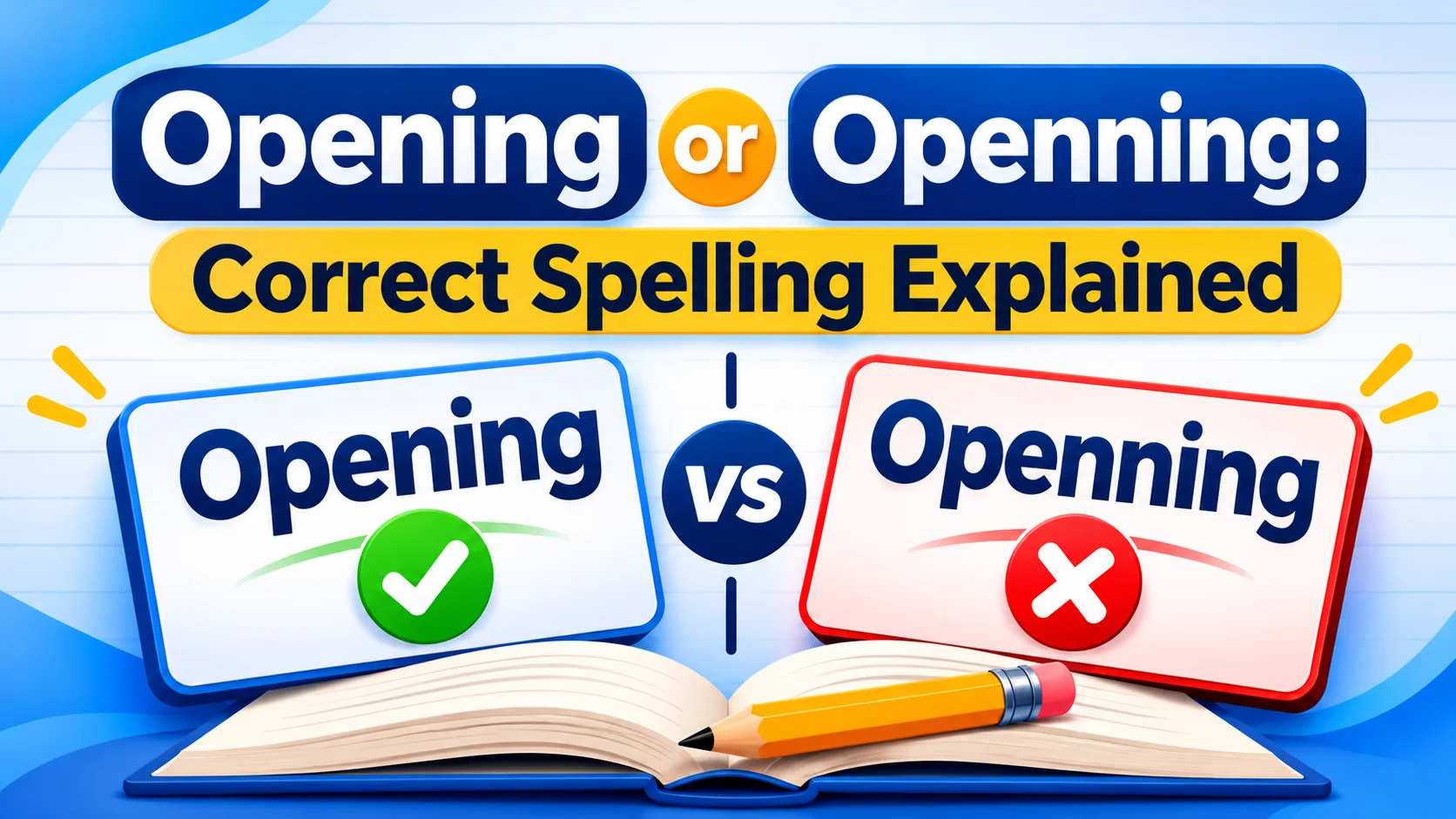
If you have ever hesitated between opening or openning, you are not alone. The correct spelling is opening, with just one n. Although openning may look reasonable, especially when you compare it with words such as running and beginning, it is not an accepted standard English spelling. The confusion usually comes from misunderstanding how English words change when -ing is added. Learning the difference will help you spell this common word correctly and understand a useful spelling rule that applies to hundreds of other English words.
The word opening appears in many everyday situations. You might use it when describing an open door, announcing the beginning of a ceremony, discussing a job opportunity, or writing about the first scene of a film. It can function as a verb form, noun, or adjective, depending on the sentence. That flexibility makes it important to understand more than its spelling. Knowing how opening works grammatically will help you choose the right expression in conversations, emails, reports, applications, and professional documents.
In this guide, you will learn why opening is spelled with one n, why openning is incorrect, and how the English consonant-doubling rule works. You will also see the differences between open, opening, opened, and opens, along with practical examples and common expressions. Whether you are a student, English learner, writer, or professional who wants to avoid spelling mistakes, this explanation will give you a reliable way to remember the correct form—and apply the same principle to other words.
Opening or Openning: Which Spelling Is Correct?
The correct spelling is opening. The spelling openning is incorrect in standard English.
The word comes from the verb open. When you add the suffix -ing, you remove the final silent e and attach -ing:
- Open + ing = Opening
You do not double the letter n. The result is opening, not openning.
The Quick Answer: Opening Is Correct
Use opening in formal writing, informal messages, academic work, business communication, and everyday conversation.
Examples:
- The shop is opening at nine tomorrow.
- We attended the opening of the new library.
- There is an opening for a marketing assistant.
- She is opening the package carefully.
In each sentence, opening is spelled with one n.
Why “Openning” Is a Common Spelling Mistake
The mistake often happens because English has many words that double their final consonant before adding -ing.
For example:
- Run → Running
- Sit → Sitting
- Stop → Stopping
- Begin → Beginning
When learners see these forms, they may assume the same change applies to open. However, English spelling rules depend on the structure and pronunciation of the base word. The final consonant is not doubled automatically.
Opening vs. Openning: Side-by-Side Comparison
| Feature | Opening | Openning |
| Spelling status | Correct | Incorrect |
| Number of n’s | One | Two |
| Base word | Open | Incorrectly formed from open |
| Standard usage | Accepted | Not accepted |
| Example | The store is opening. | The store is openning. |
Remember: If you are writing about the act of opening something, an entrance, or the beginning of an event, use opening.
Is Openning Ever Accepted in British or American English?
No. Opening is the standard spelling in both British and American English.
Unlike words such as colour and color or travelling and traveling, this word does not have a regional spelling difference. Adding an extra n does not make it a British spelling or an American alternative.
If you see openning in a message, website, document, or social media post, it is generally a spelling error.
What Does Opening Mean?
Opening has several meanings, and its exact meaning depends on how it is used. It can describe an action, a physical space, the beginning of something, or an available opportunity.
Understanding these meanings helps you recognize the word in different contexts instead of treating it as only the -ing form of open.
Opening as the -ing Form of the Verb Open
As a verb form, opening describes the action of making something accessible or no longer closed.
Examples:
- He is opening the front door.
- I was opening the email when my computer froze.
- They are opening a new branch in the city.
- She is opening the curtains to let sunlight in.
In these examples, opening describes an action that is happening or was happening.
It commonly appears in continuous verb constructions:
- Present continuous: She is opening the shop.
- Past continuous: She was opening the shop.
- Future continuous: She will be opening the shop.
It can also appear as a gerund, where the verb form functions as a noun:
- Opening the windows made the room cooler.
- Opening a business requires careful planning.
The grammatical role depends on the sentence, not simply on the -ing ending.
Opening as a Noun
As a noun, opening refers to a space, beginning, opportunity, or introductory part of something.
An Entrance, Gap, or Space
An opening can be a hole, passage, or space that allows someone or something to pass through.
Examples:
- There is a small opening in the fence.
- The workers created an opening in the wall.
- Light came through an opening in the curtains.
Here, the word describes a physical space rather than an action.
The Beginning of an Event, Performance, or Activity
An opening can refer to the first part of an event, ceremony, performance, or other organized activity.
Examples:
- The opening of the conference included a welcome speech.
- We watched the opening of the award ceremony.
- The band’s opening performance received enthusiastic applause.
In this sense, opening identifies the beginning or introductory part of an occasion.
A Job Opportunity or Available Position
In employment, an opening means a vacant position that an employer wants to fill.
Examples:
- The company has an opening for a customer service representative.
- I found three job openings on the recruitment website.
- Please contact us if you are interested in the available opening.
A job opening is not necessarily a newly created position. It may exist because an employee has left, a department is expanding, or an employer needs additional staff.
Opening as an Adjective
Opening can also describe something that belongs to or occurs at the beginning of an event, activity, or process.
Examples:
- The opening chapter introduces the main characters.
- Her opening remarks were brief and informative.
- The team scored during the opening minutes of the match.
- We reviewed the opening paragraph before publishing the article.
In these examples, opening modifies a noun and identifies its introductory or initial role.
Opening as a Figurative or Business Term
The word also appears in expressions that have meanings beyond physical spaces or literal actions.
For instance:
- Opening the door to opportunities means creating possibilities.
- An opening in negotiations means a chance to make progress.
- An opening move refers to the first action in a game, discussion, or strategy.
- A window of opportunity describes a limited period when an action is possible.
These expressions are common in business, politics, education, sports, and everyday communication.
Why Is Opening Spelled With One N?
The spelling becomes easier to understand when you look at the base word.
The original verb is open, which ends in the letter n followed by a silent e. To form the present participle, English spelling normally removes that final silent e before adding -ing.
The process is:
- Start with the base word: open.
- Remove the final silent e: op + n.
- Add -ing: opening.
The final n stays single. There is no spelling rule that requires it to be doubled in this word.
The Base Word Is Open, Not Openn
A useful way to avoid the mistake is to identify the original word before adding a suffix.
The base form is open, not openn. Therefore, the additional n in openning has no grammatical justification.
Compare:
- Open → Opening
- Help → Helping
- Visit → Visiting
- Listen → Listening
The base word remains recognizable, and its final consonant is not doubled.
How Adding -ing Changes the Word
The suffix -ing can turn a verb into a present participle or gerund. However, the spelling of the base word may change slightly when the suffix is added.
Consider these examples:
| Base word | Spelling change | Correct form |
| Open | Remove final e, add -ing | Opening |
| Make | Remove final e, add -ing | Making |
| Write | Remove final e, add -ing | Writing |
| Run | Double final n, add -ing | Running |
| Sit | Double final t, add -ing | Sitting |
| Help | Add -ing without doubling | Helping |
The important point is that adding -ing does not always involve the same spelling change. The structure of the base word determines what happens.
Why the Final E Is Dropped but the N Is Not Doubled
The final e in open is silent. In many verbs ending in a silent e, that letter is removed before adding a suffix that begins with a vowel.
Examples include:
- Hope → Hoping
- Bake → Baking
- Dance → Dancing
- Close → Closing
- Open → Opening
Removing the e does not mean that the preceding consonant must be doubled.
This distinction is important because two separate spelling decisions are involved:
- Silent-e rule: Remove the final e before adding -ing in words such as open.
- Consonant-doubling rule: Double the final consonant in certain short-vowel words, such as run → running.
The rules have different purposes and should not be confused.
The Difference Between Dropping a Silent E and Doubling a Consonant
| Spelling feature | What happens | Example |
| Silent-e deletion | Remove the final e before -ing | Hope → Hoping |
| Consonant doubling | Double the final consonant before -ing | Plan → Planning |
| No doubling | Add -ing without repeating the consonant | Open → Opening |
| Two final consonants | Keep the existing consonants and add -ing | Help → Helping |
A common beginner mistake is to treat every verb ending in a consonant as a doubling candidate. English does not work that way. Check the vowel pattern and final letters before deciding.
The English Spelling Rule for Adding -ing
The consonant-doubling rule explains why some words take a repeated final consonant while others do not.
A useful general pattern is that many one-syllable verbs ending in a single consonant after a single short vowel double that final consonant before adding -ing.
For example:
- Run → Running
- Sit → Sitting
- Stop → Stopping
- Plan → Planning
However, this is a pattern, not a rule that applies to every verb. Syllable count, stress, final letter combinations, and spelling conventions can affect the result.
When to Double the Final Consonant Before -ing
A final consonant is commonly doubled when a verb:
- Has one syllable.
- Ends in one consonant.
- Has one short vowel immediately before that consonant.
Examples:
| Base word | Correct -ing form | Why |
| Run | Running | Short vowel + single final consonant |
| Sit | Sitting | Short vowel + single final consonant |
| Stop | Stopping | Short vowel + single final consonant |
| Plan | Planning | Short vowel + single final consonant |
| Swim | Swimming | Short vowel + single final consonant |
Doubling helps preserve the short-vowel sound in the written form.
Short Vowel + Single Final Consonant
Look at the word run. It has a short vowel sound and ends in one consonant. When -ing is added, the final n is doubled:
Run → Running
The same pattern appears in sit → sitting and stop → stopping.
Examples: Run, Sit, and Stop
- The children are running outside.
- She is sitting near the window.
- He is stopping the car.
In each case, the final consonant is doubled before -ing.
When Not to Double the Final Consonant
Not every verb ending in a consonant follows the doubling pattern. In many cases, the final consonant remains unchanged.
Words Ending in Two Consonants
When a word already ends in two consonants, you generally do not double the final one before adding -ing.
Examples:
- Help → Helping
- Jump → Jumping
- Work → Working
- Start → Starting
The base words already contain consonant combinations at the end.
Words Ending in Two Vowels and a Consonant
Words that end in a vowel combination followed by a consonant generally do not double that final consonant.
Examples:
- Read → Reading
- Rain → Raining
- Wait → Waiting
The vowel pattern is different from the short-vowel pattern in run or sit.
Examples: Open, Visit, and Help
- The store is opening soon.
- She is visiting her grandparents.
- They are helping their neighbors.
None of these words requires a doubled final consonant.
Why “Open” Does Not Follow the Doubling Rule
The word open has two syllables: o-pen. It does not have the same one-syllable structure as run or sit.
More importantly, its final e is removed before adding -ing. The result is opening, with one n.
The word open is also an example of a common pattern in which the final syllable is not stressed. Compare it with begin, where the final syllable receives the stress:
- Open → Opening
- Begin → Beginning
The difference in stress helps explain why the words behave differently.
A Quick Comparison of Open, Run, Begin, and Travel
| Base word | Syllables | Correct form | Spelling pattern |
| Open | 2 | Opening | Remove final e; do not double n |
| Run | 1 | Running | Double final n |
| Begin | 2 | Beginning | Double final n because the final syllable is stressed |
| Travel | 2 | Travelling / Traveling | Regional spelling variation |
Travel deserves special attention. British English generally uses travelling, while American English commonly uses traveling. This variation does not apply to opening.
Open, Opening, Opened, and Opens: Understanding the Word Forms
The words open, opening, opened, and opens are different grammatical forms of the same verb. Choosing the correct one depends on the sentence’s subject, tense, and meaning.
| Word form | Grammatical use | Example |
| Open | Base verb; also an adjective | Please open the window. |
| Opening | Present participle or gerund; also a noun or adjective | She is opening the door. |
| Opened | Simple past or past participle | He opened the package. |
| Opens | Third-person singular present | The shop opens at eight. |
Open: The Base Verb and Adjective
As a verb, open means to move something so that it is no longer closed or to make something accessible.
- Please open the door.
- They plan to open a new office.
As an adjective, it can describe something that is not closed or is available.
- The window is open.
- The position is still open.
Opening: The Present Participle and Gerund
As a present participle, opening commonly appears with a form of be:
- She is opening the store.
- They were opening the boxes.
As a gerund, it functions as a noun:
- Opening the store early attracts more customers.
- Opening the letter made him nervous.
It can also be a regular noun or adjective, as explained earlier.
Opened: The Simple Past and Past Participle
Use opened when describing an action that happened in the past or when forming certain perfect and passive constructions.
Examples:
- She opened the window yesterday.
- The company has opened a new branch.
- The building was opened to the public last week.
Opens: The Third-Person Singular Form
Use opens with a singular third-person subject in the simple present tense.
Examples:
- The bank opens at nine.
- This door opens automatically.
- The new restaurant opens next Monday.
A useful editing habit is to identify the subject and time of the action before choosing among these forms.
How to Use Opening Correctly in a Sentence
The easiest way to use opening correctly is to identify what it describes. Is it an action, a thing, or a quality?
Opening as a Verb Form
Use opening when describing an action in progress or when the action itself is the subject or object of a sentence.
Examples:
- The manager is opening the meeting.
- I heard someone opening the front gate.
- Opening the application takes only a few seconds.
Practical tip: If you can place is, was, or are before opening and the sentence makes sense, it may be functioning as a present participle.
Opening as a Noun
Use opening as a noun when referring to a space, opportunity, introductory section, or beginning.
Examples:
- The company announced a new job opening.
- There is an opening between the two buildings.
- The film’s opening was especially memorable.
A simple test is to see whether the word can take an article or be made plural in the intended meaning:
- an opening
- two openings
- several job openings
Opening as an Adjective
Use opening before a noun when it describes the first or introductory part of something.
Examples:
- The opening paragraph explains the main argument.
- We missed the opening ceremony.
- His opening remarks were well received.
Here, opening helps specify which part of the event, document, or activity is being discussed.
Opening in Business and Professional Writing
The word appears frequently in workplace communication. It can describe a vacant role, a business launch, a meeting introduction, or the start of a process.
Examples:
- We currently have an opening in the finance department.
- The store is opening a second location.
- Please prepare the opening statement for tomorrow’s presentation.
- The opening balance is shown at the top of the report.
In a job advertisement, be precise about whether you mean a single vacancy or several positions. For example, write “We have two openings” if the employer is recruiting for two roles.
Opening in Everyday Conversation
In everyday speech, opening is common and usually straightforward.
- What time is the shop opening?
- I am opening the gift now.
- Did you see the opening scene?
- There is an opening in the schedule this afternoon.
The spelling does not change depending on whether the conversation is formal or casual.
Common Expressions and Phrases Using Opening
Because opening can refer to a beginning, an opportunity, or a physical space, it appears in many established expressions.
| Expression | Meaning | Example |
| Opening ceremony | Event that formally begins an occasion | The opening ceremony starts at 10 a.m. |
| Job opening | Available employment position | She applied for a job opening. |
| Opening hours | Times when a business is open | Check the store’s opening hours. |
| Grand opening | Formal launch of a business or venue | The café announced its grand opening. |
| Opening statement | Introductory statement in a discussion or formal proceeding | The lawyer delivered the opening statement. |
| Opening remarks | Initial comments at an event | The host gave brief opening remarks. |
| Opening day | First day of an event, season, or operation | Tickets sold quickly on opening day. |
| Opening scene | First scene of a film or play | The opening scene sets the tone. |
| Opening chapter | First chapter of a book | The opening chapter introduces the setting. |
| Opening balance | Amount in an account at the start of a period | The opening balance appears on the statement. |
| Opening offer | First proposal in a negotiation | Their opening offer was lower than expected. |
These expressions are useful in both everyday and professional English. Pay attention to the context: opening hours describes a schedule, while job opening describes an available position.
Opening vs. Openning: Correct and Incorrect Examples
Seeing the correct spelling in complete sentences is one of the best ways to remember it.
Correct Sentences Using Opening
- The new supermarket is opening next week.
- We attended the opening of the art exhibition.
- The company advertised an opening for a project manager.
- He is opening the door for the visitors.
- The opening chapter introduces the main character.
- Please check the opening hours before visiting.
- Her opening remarks were clear and concise.
- The workers created an opening in the wall.
- The restaurant is opening a new location downtown.
- I noticed an opening in the schedule.
Incorrect Sentences Using Openning
The following examples contain the common spelling error:
- Incorrect: The shop is openning tomorrow.
- Correct: The shop is opening tomorrow.
- Incorrect: She is openning the package.
- Correct: She is opening the package.
- Incorrect: There is a job openning in the company.
- Correct: There is a job opening in the company.
- Incorrect: We attended the grand openning.
- Correct: We attended the grand opening.
Before-and-After Spelling Corrections
| Incorrect sentence | Correct sentence |
| The store is openning at 8 a.m. | The store is opening at 8 a.m. |
| They announced a new job openning. | They announced a new job opening. |
| He is openning the window. | He is opening the window. |
| The openning ceremony was excellent. | The opening ceremony was excellent. |
| I read the openning chapter. | I read the opening chapter. |
How One Extra Letter Can Affect Professional Writing
A single spelling error rarely changes the reader’s understanding of a sentence, but repeated errors can make writing look careless.
Imagine applying for a job and writing, “I am interested in your current job openning.” The employer will probably understand your meaning, but the mistake may distract from the rest of your application.
The same issue can affect:
- Recruitment advertisements
- Business emails
- Website content
- Event announcements
- Academic assignments
- Customer-facing documents
Professional recommendation: Use a spelling checker as a final review, but learn the underlying rule too. Automated tools can miss errors when a misspelled word resembles a valid word or appears in an unusual context.
Why Do People Spell Opening as Openning?
The error is understandable because English spelling contains several patterns that look similar but work differently.
Confusion With Words Like Running and Beginning
Words such as running and beginning contain a doubled consonant before -ing. Readers may copy that pattern when writing opening.
However, the base words have different structures:
- Run → Running
- Begin → Beginning
- Open → Opening
The final syllable of begin is stressed, which helps explain its doubled consonant. Open has a different stress pattern, and its final silent e is removed.
Applying the Consonant-Doubling Rule Incorrectly
Some learners remember the instruction “double the final consonant before adding -ing” but forget that the rule applies only in particular circumstances.
It is not enough for a word to end in a consonant. You need to consider the vowel sound, final letter pattern, syllable count, and stress.
For example:
- Hop → Hopping
- Hope → Hoping
- Open → Opening
These forms demonstrate why checking the base word matters.
Typing Errors and Autocorrect Habits
Sometimes openning is not a misunderstanding of grammar at all. It may simply be a typing mistake.
A person who writes quickly may repeat a letter accidentally. If the error is not caught during proofreading, it can remain in a published document or message.
To reduce these mistakes:
- Read important documents once specifically for spelling.
- Check words that contain repeated consonants.
- Use a reliable dictionary when uncertain.
- Avoid assuming that autocorrect catches every mistake.
Why Pronunciation Does Not Always Reveal the Correct Spelling
English spelling is not always predictable from pronunciation. In many accents, opening and the incorrectly written openning would be pronounced the same way if someone attempted to read both.
That means listening carefully will not reliably solve this particular spelling question.
When pronunciation does not reveal the answer, use the base word and spelling pattern instead.
Does Opening Have a Different Spelling in American and British English?
No. Opening is spelled the same way in standard American and British English.
Both varieties use:
- Opening
- Opened
- Opens
- Open
The spelling openning is not an accepted regional alternative.
Is Opening Spelled the Same in Both Varieties?
Yes. Whether you are writing for readers in the United States, the United Kingdom, Australia, or other English-speaking regions, opening is the standard form.
Examples:
- American English: The store is opening on Monday.
- British English: The shop is opening on Monday.
The vocabulary may vary slightly—store is more common in American English, while shop is common in British English—but the spelling of opening stays the same.
Why the British and American Forms Do Not Differ Here
Some English words have different regional spellings because of historical spelling conventions. For example:
| American English | British English |
| Color | Colour |
| Center | Centre |
| Traveling | Travelling |
| Organize | Organise (common British variant) |
| License (noun and verb) | Licence (noun), license (verb) |
These differences are established spelling variations. Opening does not belong to this group.
Examples of English Words That Actually Have Regional Spelling Differences
It is useful to recognize genuine regional variations so you do not mistake an ordinary spelling difference for an error.
For example, traveling is standard in American English, while travelling is generally used in British English. Both forms are accepted in their respective conventions.
By contrast, openning is not a standard alternative in either variety. When writing for an international audience, use opening.
Common Spelling Mistakes Related to Opening
The extra n is not the only possible mistake involving this word. Writers sometimes choose the wrong grammatical form or apply a spelling rule in the wrong situation.
Writing Openning Instead of Opening
This is the main spelling error. The correct form is always opening in standard English.
Incorrect: The company is openning a new office.
Correct: The company is opening a new office.
Confusing Opening With Opened
These words refer to different time and grammatical patterns.
- Opening: She is opening the letter.
- Opened: She opened the letter yesterday.
Use opening for an action in progress or other meanings of the word. Use opened for the past form or past participle.
Using Opening When Open Is Required
Sometimes writers use opening when the base verb or adjective open is needed.
Incorrect: Please opening the door.
Correct: Please open the door.
Incorrect: The shop is opening now? (when describing its current state rather than the action)
More natural: The shop is open now.
The correct choice depends on whether you mean an action or a condition.
Confusing Opening With Beginning or Start
Opening, beginning, and start can overlap in meaning, but they are not interchangeable in every expression.
- The opening of the ceremony was delayed.
- The beginning of the story is interesting.
- The start of the race was postponed.
Some expressions are more natural than others. For example, opening ceremony is an established phrase; beginning ceremony is not the usual expression.
Applying the Doubling Rule to Every Word Ending in a Consonant
Do not double a final consonant simply because a verb ends in one.
Compare:
- Open → Opening
- Visit → Visiting
- Help → Helping
- Run → Running
- Plan → Planning
Look at the complete spelling pattern before adding the suffix.
Easy Ways to Remember the Correct Spelling
If you frequently hesitate between opening and openning, a few simple habits can make the correct form easier to remember.
Remember the Base Word: Open
Start with the original verb:
OPEN
Remove the final silent e and add -ing:
OPEN → OPENING
There is only one n in the base word, and the spelling does not require another one.
Compare Open → Opening With Run → Running
This comparison helps you remember that different verbs follow different patterns.
- Open → Opening: remove silent e; do not double n.
- Run → Running: double the final n.
Rather than memorizing a rule that says every word doubles its last letter, learn to recognize the word patterns.
Use a Simple Sentence to Check the Spelling
Try placing the word in a sentence you use regularly:
- The door is opening.
- The store is opening tomorrow.
- There is a job opening.
Writing the correct form in different contexts helps reinforce both spelling and meaning.
A Quick Editing Checklist for Writers
Before publishing or submitting a document, check the following:
- Have I written opening with one n?
- Have I removed the final e from open before adding -ing?
- Have I avoided applying the doubling rule automatically?
- Does opening function correctly as a verb, noun, or adjective?
- Have I chosen the right form—open, opening, opened, or opens?
- Have I checked the spelling in headings, captions, and titles as well as the main text?
A quick review is especially useful in job advertisements, business documents, and published website content, where small errors can affect the overall impression.
Conclusion
The correct choice is straightforward: opening is the standard spelling, while openning is a mistake. The key is understanding how the base word changes when you add -ing: remove the silent e from open, then add the suffix without doubling the final n. This distinction also helps you recognize why running and beginning follow different spelling patterns. One final actionable tip: whenever you are unsure about an -ing form, identify the base verb before changing its spelling. A common mistake to avoid is doubling a consonant simply because another familiar word does so. Small spelling decisions build clearer, more confident writing—and remembering open → opening is an easy one to get right.
Frequently Asked Questions
Q1. Is it opening or openning?
Opening is the correct spelling in standard English. The word is formed by removing the final silent e from open and adding -ing. The spelling openning, with two n’s, is incorrect and should not be used in formal or informal writing.
Q2. Why is opening not spelled with two n’s?
The final consonant is not doubled because open does not follow the short-vowel doubling pattern used in words such as run → running. Its final silent e is removed before adding -ing, producing opening with one n.
Q3. What is the spelling rule for adding -ing to open?
Remove the final silent e from open, then add the suffix -ing. This gives opening. The process is similar to make → making and hope → hoping. Do not add another n when forming this word.
Q4. Is openning ever a correct English word?
No. Openning is not a recognized standard spelling in British or American English. It is generally a typing or spelling error. If you mean the action of making something accessible, a physical entrance, or the beginning of an event, write opening.
Q5. Is opening spelled differently in British and American English?
No. Both British and American English use opening with one n. Although some words have regional spelling differences, such as color/colour and traveling/travelling, this word has no accepted British or American alternative.
