
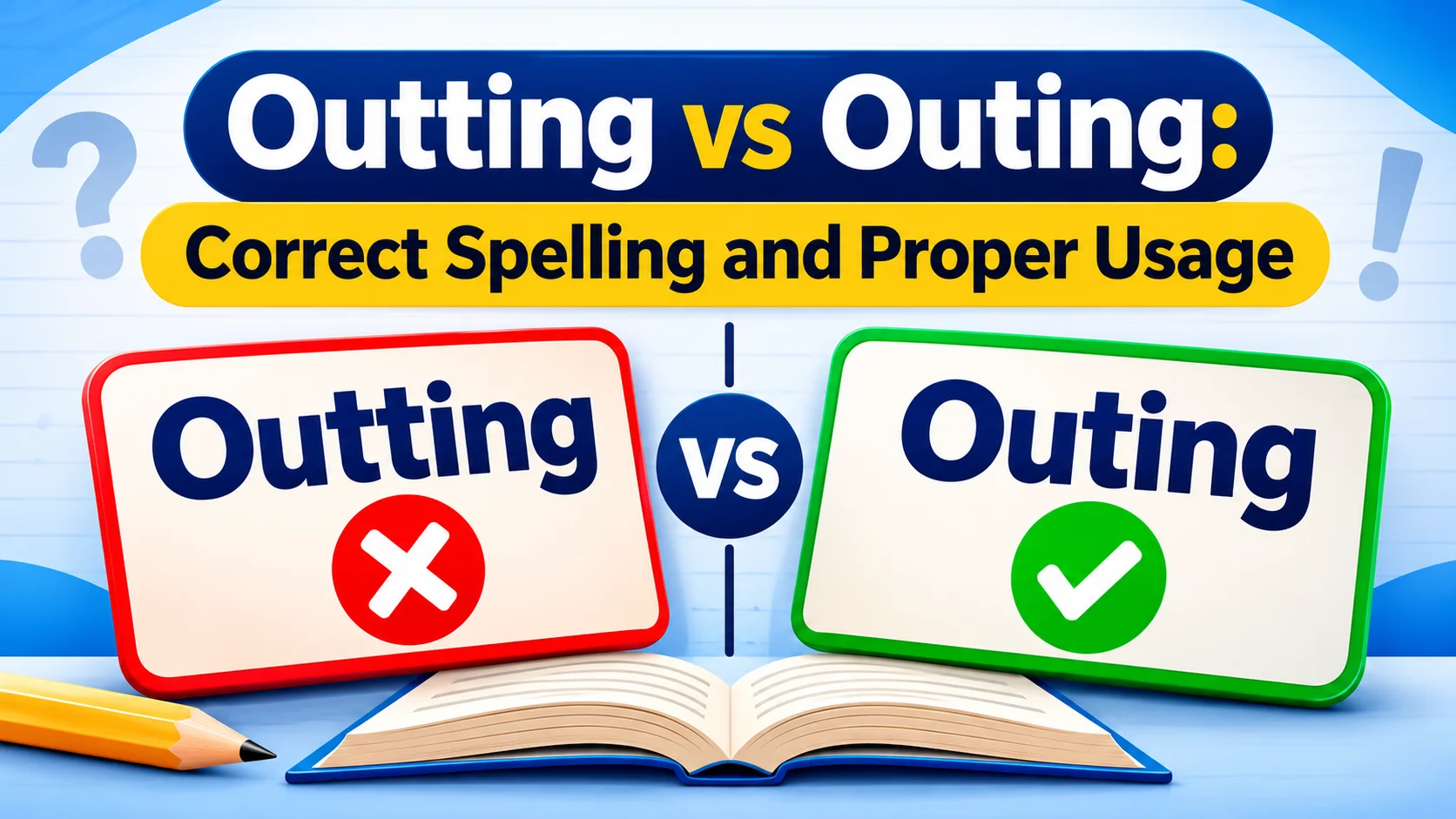
Outting vs outing is a common spelling confusion, but only one form is correct in standard English: outing. The word has one t, not two. It can describe an enjoyable trip with friends or family, a school excursion, or another recreational activity. It also has a more sensitive meaning: revealing someone’s private identity or personal information without their consent. Although the spelling question has a straightforward answer, understanding the word’s different meanings helps you use it accurately. This guide explains the spelling, grammar, pronunciation, and practical usage of outing.
Why do people write outting when the correct spelling is outing? The mistake often comes from applying the English consonant-doubling rule too broadly. Some words double their final consonant before adding -ing, as in running and sitting. However, that pattern does not apply to every word ending in t. Understanding how out + ing forms outing makes the correct spelling easier to remember and helps you avoid similar errors when writing other words.
There is another reason to understand this word carefully: outing has two distinct meanings that appear in different conversations. In everyday English, it usually refers to a short trip or social activity. In discussions about identity and privacy, it can describe the disclosure of information someone has not chosen to share publicly. The surrounding context determines which meaning is intended. By the end of this article, you will know how to recognize both meanings, construct correct sentences, choose suitable alternatives, and avoid common spelling and usage mistakes.
Outting vs Outing: Which Spelling Is Correct?
Outing is the correct standard spelling. Outting is a misspelling when referring to a trip, social activity, or the act of publicly revealing information.
The word is formed by combining out with the suffix -ing:
Out + ing = Outing
You do not double the final t. The correct spelling remains the same in British and American English.
| Feature | Outing | Outting |
| Standard spelling | Correct | Incorrect |
| Number of t’s | One | Two |
| Recognized usage | Established English word | Not the standard spelling |
| Meaning | A trip or an act of revealing private information | No standard meaning in these contexts |
| Example | We planned a family outing. | We planned a family outting. (Incorrect) |
Examples of correct usage:
- Our family enjoyed an outing to the countryside.
- The school organized an outing for its students.
- The unauthorized outing of someone’s private information raised serious concerns.
Incorrect: We are planning a weekend outting.
Correct: We are planning a weekend outing.
The distinction is simple: use outing whenever you mean the standard English word.
What Does Outing Mean?
The word outing has two main meanings. Its more familiar meaning is a short recreational trip or excursion. Its second meaning involves revealing information about someone that they have not publicly disclosed, particularly information about personal identity.
These meanings are different, so it is important to consider the context rather than assume that every use refers to a social activity.
1. Outing Meaning a Trip or Social Activity
An outing is a short trip or activity undertaken for enjoyment, recreation, education, or social interaction. It may involve one person, a family, friends, students, or colleagues.
Unlike a long vacation, an outing is generally a relatively short activity. It might last a few hours or an entire day.
Examples:
- We went on a family outing to the beach.
- The children enjoyed their school outing to the museum.
- Our weekend outing included lunch and a visit to the park.
- The company organized an outing for its employees.
The word is flexible enough to describe both casual plans and organized activities.
2. Outing Meaning the Disclosure of Private Information
In another context, outing means revealing something about a person that they have not chosen to make public.
The term is particularly associated with disclosing someone’s sexual orientation or gender identity without their permission. It can also refer more broadly to exposing other private information, depending on the situation.
For example:
- The public outing of the individual created serious privacy concerns.
- The journalist was criticized for outing someone without consent.
- She decided to share her identity herself rather than risk being outed by another person.
This meaning is sensitive because private information can affect someone’s relationships, personal safety, employment, and well-being.
How Context Changes the Meaning of Outing
The surrounding sentence usually makes the intended meaning clear.
| Sentence | Meaning |
| We enjoyed an outing at the beach. | A recreational trip |
| The school planned an outing for Friday. | An organized excursion |
| The unauthorized outing caused controversy. | Disclosure of private information |
| He was worried about being outed. | Concern about unwanted disclosure |
| She chose to out herself publicly. | Voluntary disclosure of personal identity |
A useful reading strategy is to examine the subject and surrounding words. Terms such as family, school, picnic, and excursion usually indicate the recreational meaning. Words such as privacy, identity, consent, and disclosure often signal the sensitive meaning.
Different Types of Outings in Everyday Life
When outing refers to a recreational activity, it can describe many different experiences. The purpose, participants, and location determine what kind of outing is being discussed.
Family Outing
A family outing is an activity that family members enjoy together outside their usual routine.
Examples include:
- Visiting a zoo or amusement park.
- Spending an afternoon at the beach.
- Having a picnic in a public garden.
- Exploring a nearby town.
- Watching a film together.
Example: We are planning a family outing during the school holidays.
School Outing
A school outing is a trip organized for students, often for educational or recreational purposes.
Examples include:
- Visiting a museum.
- Exploring a historical site.
- Taking a nature walk.
- Visiting a science center.
- Attending an educational exhibition.
Example: The school arranged an outing to the local history museum.
A school outing may also be called a school trip or educational excursion, depending on its purpose and context.
Group Outing With Friends
A group outing is a social activity involving friends or acquaintances.
Examples:
- Going to a restaurant.
- Watching a movie.
- Shopping together.
- Hiking on a nearby trail.
- Attending a concert.
Example: Our group outing turned into an enjoyable evening.
Corporate or Office Outing
A corporate outing is an activity organized by an employer or workplace for employees.
It may be designed to encourage social interaction, strengthen working relationships, or give employees a break from their usual environment.
Examples include:
- Company picnics.
- Team-building activities.
- Group excursions.
- Recreational events.
Example: The company organized an outing to thank its employees for their hard work.
A corporate outing is not necessarily a business trip. A business trip usually involves work-related travel, while an outing is more commonly recreational or social.
Weekend and Day Outings
A weekend outing is a short recreational activity planned for a Saturday, Sunday, or another day off.
A day outing generally takes place within a single day and does not necessarily involve an overnight stay.
Examples:
- We planned a day outing to the countryside.
- Their weekend outing included a boat ride.
- The family enjoyed a short outing to a nearby town.
What Does It Mean to Out Someone?
The phrase to out someone has a specific meaning in discussions about identity and privacy. It means publicly revealing personal information that the individual has not chosen to disclose.
The term is especially common when discussing someone’s sexual orientation or gender identity.
For example:
The celebrity was outed before having the opportunity to share the information personally.
This sentence means that someone else revealed the information before the individual chose to make it public.
What Does Outing Yourself Mean?
Outing yourself means voluntarily revealing private information about your own identity.
The important distinction is personal choice. A person decides when, how, and to whom they want to disclose information.
Example:
After considering her options, she decided to out herself to a small group of trusted friends.
This is different from another person exposing her identity without permission.
What Does Being Outed Mean?
Being outed means that another person or source has disclosed private information about you, usually without your consent.
For example:
He was worried that someone might out him at work.
The sentence describes concern about an unwanted disclosure.
Outing Someone Without Consent: Why It Matters
Revealing someone’s private identity or personal information without permission can have serious consequences.
Depending on the circumstances, it may lead to:
- Unwanted public attention.
- Family or relationship conflict.
- Discrimination or harassment.
- Workplace difficulties.
- Emotional distress.
- Risks to personal safety.
The important principle is that having information about someone does not automatically give you permission to share it.
When writing about this subject, use precise language. Avoid describing an involuntary disclosure as though it were the person’s own decision. The difference between choosing to disclose and being exposed by someone else is meaningful.
Why Is Outting Incorrect? The Spelling Rule Explained
The spelling of outing becomes easier to understand when you look at how English forms words by adding the suffix -ing.
The base word is out. Adding -ing produces outing, without doubling the final consonant.
How the Word Outing Is Formed
The spelling can be broken down into two parts:
- Base word: out
- Suffix: -ing
- Correct result: outing
The extra t in outting is unnecessary.
This is not simply a matter of memorizing one unusual spelling. It follows a broader pattern in English word formation.
When Do English Words Double the Final Consonant?
English sometimes doubles a final consonant before adding a suffix beginning with a vowel, such as -ing.
A common pattern involves a short word ending in a consonant-vowel-consonant (CVC) sequence, where the vowel has a short sound and the relevant syllable is stressed.
Examples:
| Base word | Correct -ing form |
| Run | Running |
| Sit | Sitting |
| Plan | Planning |
| Stop | Stopping |
| Swim | Swimming |
| Begin | Beginning |
The exact rules can depend on syllable structure, stress, and spelling conventions. That is why it is risky to assume that every word ending in a consonant must double that letter.
Why Out Does Not Become Outting
The word out contains the vowel combination ou, which represents a vowel sound different from the short single-vowel pattern in words such as run and sit.
It therefore does not follow the usual CVC consonant-doubling pattern.
Compare:
- Out → Outing
- Shout → Shouting
- Scout → Scouting
- Doubt → Doubting
- Sprout → Sprouting
These examples show why the spelling remains unchanged before -ing.
Practical tip: Do not decide whether to double a consonant just by looking at the final letter. Consider the word’s complete spelling and vowel pattern.
Outing as a Noun and a Verb
Although most people encounter outing as a noun meaning a recreational trip, it can also function as the -ing form of the verb out.
Understanding this distinction helps you recognize its grammatical role in different sentences.
Outing as a Noun
As a noun, outing usually means a short trip or recreational activity.
Examples:
- Our outing was enjoyable.
- The school arranged an outing.
- We are planning two outings this month.
It is a countable noun, which means you can use it with articles and numbers.
For example:
- An outing
- The outing
- Two outings
- Several outings
Outing as the -ing Form of the Verb Out
The verb out can mean to reveal or expose previously private information about someone.
Its -ing form is outing.
Examples:
- The report is outing individuals whose identities were previously private.
- Outing someone without permission can violate their privacy.
- The discussion focused on the consequences of outing people publicly.
In these examples, outing is not a recreational trip. It is an action.
Related Grammatical Forms
| Word form | Grammatical function | Example |
| Out | Base verb | They may out the person involved. |
| Outs | Third-person singular present | The article outs the individual. |
| Outed | Past tense or past participle | The person was outed publicly. |
| Outing | -ing form | Outing someone without consent is harmful. |
| Outings | Plural noun | The school organizes several outings. |
Notice that outings can be the plural of the recreational noun, while outing can function as a noun or as a verb form. The sentence structure tells you which role it plays.
How to Use Outing Correctly in a Sentence
The best way to understand a word’s usage is to see how it works in different writing situations.
Outing in Everyday Conversation
Examples:
- We are planning an outing with our friends this weekend.
- Their family outing was full of enjoyable activities.
- Would you like to join us for a short outing?
- Our outing to the park lasted several hours.
- They canceled the outing because of heavy rain.
These sentences use outing naturally to describe recreational activities.
Outing in School and Educational Writing
Examples:
- The students went on an educational outing to the museum.
- Our teacher organized a school outing for Friday.
- The outing gave students an opportunity to explore local history.
- Parents received a notice about the upcoming outing.
In school communication, school trip and educational excursion can also be suitable alternatives.
Outing in Professional Writing
Examples:
- The company arranged an outing for its employees.
- Our department is organizing a team outing next month.
- The annual staff outing will take place on Saturday.
- Employees can register for the group outing through the company portal.
For formal documents, choose a more specific expression if it communicates the purpose more clearly. For example, team-building event may be more informative than company outing when the activity is designed around workplace collaboration.
Outing in News and Social Discussions
Examples:
- The article examined the privacy implications of outing someone without consent.
- The public discussion focused on the individual’s right to control personal information.
- She spoke about the experience of being outed before she was ready.
In these contexts, avoid unnecessary personal details. The purpose should be to explain the issue accurately, not to expose additional private information.
Outing or An Outing? Understanding the Correct Article
The correct expression is an outing, not a outing.
The reason is pronunciation. The word outing begins with a vowel sound, so it takes the indefinite article an.
Correct examples:
- We planned an outing for Sunday.
- It was an enjoyable outing.
- The children went on an outing.
- She suggested an outing to the countryside.
Outing vs The Outing
Use an outing when referring to an unspecified trip or activity.
Example: We are planning an outing next month.
Use the outing when referring to a particular activity that is already known or has been mentioned.
Example: The outing we planned has been postponed.
The choice between a/an and the depends on whether the reader knows which outing you mean.
Outing Plural Form and Pronunciation
What Is the Plural of Outing?
The plural of outing is outings.
To form the plural, add -s to the singular word. The spelling still contains only one t.
Examples:
- The school organizes several outings every year.
- Our family enjoys weekend outings.
- The company has planned three employee outings.
- All upcoming outings have been listed on the calendar.
Incorrect: The school organized several outtings.
Correct: The school organized several outings.
How Is Outing Pronounced?
The standard pronunciation of outing is:
/ˈaʊ.tɪŋ/
It has two syllables:
- OUT — the stressed first syllable.
- ing — the second syllable.
The word is pronounced with one t. However, pronunciation is not a reliable way to decide the spelling because the incorrect form outting may be pronounced similarly by someone making the spelling mistake.
Related Words
Some useful related forms include:
- Out
- Outing
- Outings
- Outed
- Outs
- Outgoing
- Outside
Not all these words share the same grammatical function or meaning. For example, outgoing often describes someone who is sociable, while outing usually refers to a trip or an act of disclosure.
Outing Synonyms and Related Words
The best synonym depends on which meaning of outing you intend.
Synonyms for Outing as a Recreational Trip
| Word | Meaning and typical use |
| Excursion | An organized or relatively short trip, often for a particular purpose |
| Trip | A general journey from one place to another |
| Day trip | A journey completed within one day |
| Jaunt | A short, usually enjoyable trip |
| Getaway | A short break away from normal surroundings |
| Visit | An occasion when someone goes to a place or person |
| Expedition | A journey undertaken for a specific purpose, often involving exploration |
These words overlap, but they are not always interchangeable.
For example, a family visiting a nearby park might describe the activity as an outing. A planned journey to study wildlife might be better described as an excursion or expedition.
Words Related to Outing as Public Disclosure
When outing refers to revealing private information, related terms include:
- Disclosure
- Exposure
- Revelation
- Identification
- Public revelation
These words have different implications. Disclosure is a broad, relatively neutral term, while exposure can suggest unwanted or damaging revelation. Choose the word that accurately reflects the situation.
Outing vs Excursion vs Trip
| Word | Main emphasis | Example |
| Outing | A short recreational or social activity | We had a family outing. |
| Excursion | A planned trip, often for a particular purpose | The students took an excursion to the museum. |
| Trip | A general journey | We took a trip to another city. |
If you are describing a casual social activity, outing is often natural. If you are emphasizing travel or a specific destination, trip may be more suitable.
Common Mistakes to Avoid When Using Outing
Knowing the correct spelling is important, but a few other errors can affect clarity.
1. Writing Outting Instead of Outing
Incorrect: We enjoyed a family outting.
Correct: We enjoyed a family outing.
The word contains one t. Adding another is an unnecessary spelling change.
2. Confusing the Two Meanings
Incorrect interpretation: Assuming every sentence containing outing refers to a recreational activity.
For example, the outing of a public figure may refer to the disclosure of private information, not a trip.
Always consider the surrounding context.
3. Using Outing When a More Specific Word Is Better
Although outing is a useful general word, it may not communicate the exact purpose of an activity.
Compare:
- We went on an outing. (General recreational activity.)
- We went on a business trip. (Work-related travel.)
- We took an educational excursion. (A trip with a learning purpose.)
Specific vocabulary makes professional and academic writing more precise.
4. Ignoring Consent in Sensitive Contexts
When discussing someone’s private identity, distinguish between voluntary disclosure and unwanted exposure.
For example, she shared her identity and publicly describes a person’s own decision. Someone outed her indicates that another person revealed the information.
These statements should not be treated as interchangeable.
5. Confusing Outing With Outgoing
The words outing and outgoing look similar but have different meanings.
- Outing: A recreational trip or an act of revealing private information.
- Outgoing: Often describes a friendly, sociable person; it can also describe something departing.
Example:
My outgoing friend organized a weekend outing.
Here, outgoing describes the friend, while outing refers to the planned activity.
British vs American English: Is There Any Spelling Difference?
No. Outing is the standard spelling in both British and American English.
| Feature | British English | American English |
| Correct spelling | Outing | Outing |
| Incorrect form | Outting | Outting |
| Plural | Outings | Outings |
| Pronunciation | /ˈaʊ.tɪŋ/ | /ˈaʊ.tɪŋ/ |
There may be differences in preferred vocabulary depending on the situation. For example, excursion or school trip may be preferred in some contexts. However, there is no British-versus-American spelling variation that makes outting correct.
If you are writing for an international audience, use outing consistently.
Practice: Outting vs Outing
Test your understanding by choosing the correct form or identifying the appropriate grammatical word.
Choose the Correct Spelling
Fill in each blank with outing or outting.
- We are planning a family ______ this Sunday.
- The school organized an educational ______.
- The company arranged a group ______ for employees.
- Their weekend ______ was canceled because of the weather.
- The article discussed the risks of publicly ______ someone without consent.
Correct the Mistakes
Rewrite these sentences using standard spelling and grammar.
- We enjoyed a family outting at the beach.
- The students went on an outting to the museum.
- She planned two outtings during the holidays.
- It was a enjoyable outing with friends.
Answers and Explanations
Choose the correct spelling:
- Outing — A family recreational activity.
- Outing — A school excursion.
- Outing — A company social activity.
- Outing — A weekend recreational trip.
- Outing — The -ing form of the verb out.
Correct the mistakes:
- We enjoyed a family outing at the beach.
- The students went on an outing to the museum.
- She planned two outings during the holidays.
- It was an enjoyable outing with friends.
The fourth sentence needs an rather than a because enjoyable begins with a vowel sound.
Conclusion
The correct spelling is outing, with one t. Whether you are describing a family trip, a school excursion, a workplace activity, or the disclosure of someone’s private identity, the spelling remains unchanged. The key is understanding the context and choosing words that communicate your intended meaning accurately. One final actionable tip: remember the simple formation out + ing = outing whenever you are writing the word. A common mistake to avoid is applying the consonant-doubling rule automatically just because a word ends in t. Check the word’s spelling pattern instead. Good writing depends on more than correct letters; it also requires choosing language that is clear, precise, and considerate.
Frequently Asked Questions
Q1. Is It Outting or Outing?
Outing is the correct spelling in standard English. It has one t and is formed by adding -ing to out. Outting is a spelling mistake when referring to a recreational trip or the disclosure of private information.
Q2. What Does Outing Mean in Simple English?
An outing usually means a short trip or activity outside your normal routine, often for enjoyment. It can also mean revealing someone’s private identity or information without their consent. The intended meaning depends on the subject and surrounding context.
Q3. Why Is Outing Spelled With One T?
The word out does not follow the usual consonant-doubling pattern used in words such as run and sit. Its vowel combination prevents that spelling pattern from applying. Therefore, adding -ing produces outing, not outting.
Q4. What Does It Mean to Out Someone?
To out someone means to reveal private information about them, particularly their sexual orientation or gender identity, without their choosing to disclose it publicly. The expression is sensitive because unwanted disclosure can affect privacy, personal relationships, and safety.
Q5. Is It Correct to Say “An Outing”?
Yes. An outing is grammatically correct because outing begins with a vowel sound. For example, you can write, “We planned an outing for Saturday.” Use the outing when referring to a particular trip that readers already know about.
