
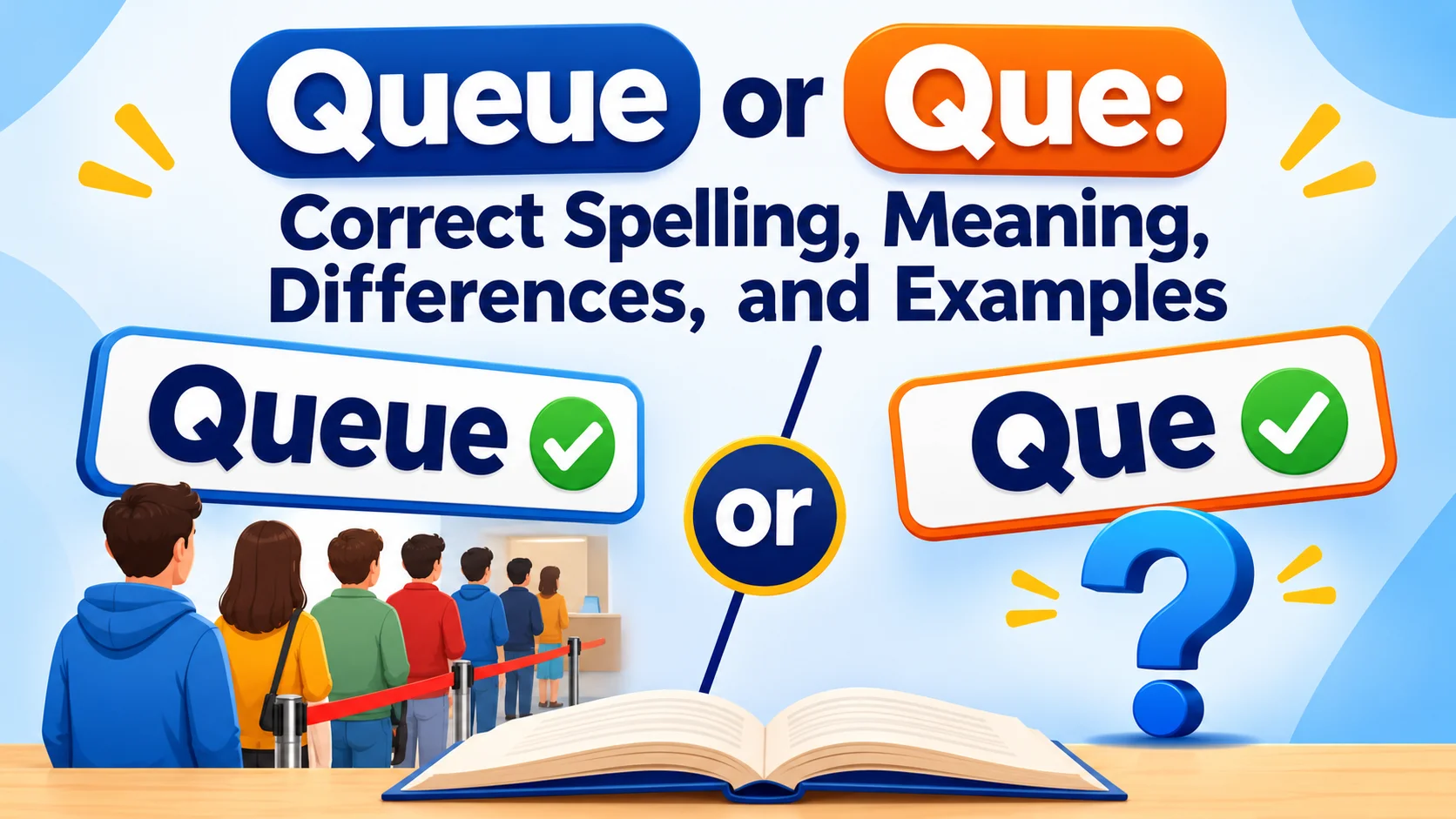
Queue or que is a common spelling question because the two forms look similar, yet only one is correct when referring to a line of people waiting for their turn. The correct English spelling is queue. It describes people, vehicles, documents, or tasks arranged in an order and waiting to be served or processed. The shorter spelling que is not an accepted alternative in this context. However, there is another correctly spelled word worth understanding: cue, which means a signal, prompt, or indication that tells someone when to act.
The confusion becomes more understandable when you hear the words spoken aloud. Queue and cue have exactly the same pronunciation in standard English, even though their meanings are different. Someone might hear a sentence about waiting in a line and assume the word is spelled cue. Another person might write que because the full spelling seems unnecessarily complicated. Both choices are incorrect when the intended meaning is a waiting line. Learning the difference helps prevent mistakes in emails, assignments, workplace instructions, articles, and everyday messages.
This guide explains everything you need to know about queue, que, and cue, from their definitions and grammatical roles to their pronunciation, history, and practical applications. You will see how queue works as a noun and a verb, why it appears so often in computer systems, and how expressions such as “jump the queue,” “on cue,” “cue the music,” and “queue up” are used. We will also examine British and American preferences, common spelling mistakes, and realistic examples so you can choose the right word confidently.
Queue or Que: Which Spelling Is Correct?
The correct spelling for a waiting line in standard English is queue.
A queue is a line of people, vehicles, or objects waiting for their turn. It can also describe an ordered list of tasks or items that are waiting to be handled.
For example:
- We joined the queue outside the restaurant.
- There was a long queue at the airport security checkpoint.
- The customers formed a queue near the ticket counter.
- Your document is waiting in the printer queue.
- I added several songs to my music queue.
In each sentence, queue refers to an organized line or sequence.
The spelling que is incorrect when used as a replacement for queue. It is not an accepted shortened form, alternative spelling, or regional English variant of the word.
However, que does exist in other languages and contexts. For example, Spanish uses que and qué in several grammatical roles. That does not make it correct English spelling for a waiting line.
Quick Comparison: Queue, Que, and Cue
| Word | Correct in English? | Meaning | Example |
| Queue | Yes | A waiting line or ordered sequence | We waited in the queue. |
| Cue | Yes | A signal, prompt, or indication | The actor waited for his cue. |
| Que | Not for a waiting line | Has uses in other languages and contexts | Write queue, not que, when describing a line. |
The easiest way to remember the difference is:
- Queue: A line in which people or things wait.
- Cue: A signal that tells someone what to do.
- Que: Not the standard English spelling for either of those meanings.
Remember: If you are talking about people waiting for their turn, always write queue.
What Does Queue Mean?
A queue is an organized line or sequence in which people, vehicles, or items wait until they can be served, processed, or handled.
The word usually involves three important ideas:
- Order: People or items have positions in a sequence.
- Waiting: They cannot proceed immediately because something is not yet available.
- Turn-taking or processing: Each person or item is handled according to the system’s rules.
Consider a busy bank. Several customers arrive to deposit money, withdraw cash, or speak with an employee. Instead of everyone approaching the counter at once, customers wait in an organized line. This arrangement is a queue.
The same concept appears in less obvious places. When you send a document to a printer, it may wait behind other documents.,When you add songs to a playlist’s upcoming tracks, they wait for playback,When a customer submits a support request, the request may enter a queue until an employee becomes available.
Therefore, a queue does not have to contain people. It can contain almost any items that need to be handled in an organized sequence.
Queue as a Noun
As a noun, queue refers to the waiting line or the ordered collection itself.
It is a countable noun, which means it can be used in singular and plural forms.
Singular examples:
- There is a queue outside the pharmacy.
- I joined the wrong queue at the station.
- The queue is moving slowly.
- A queue has formed near the entrance.
Plural examples:
- There were three queues outside the building.
- The airport has separate queues for different passengers.
- The application manages several processing queues.
- All the customer-service queues are busy.
The choice between a queue and the queue depends on whether you are introducing a line or referring to a specific one.
Compare:
- A queue was forming outside the shop.
- The queue outside the shop was already very long.
The first sentence introduces a queue. The second refers to one that the reader can identify.
Queue as a Verb
The word queue can also function as a verb. It means to join a waiting line, arrange people or things in a sequence, or place an item in a system where it will wait for processing.
Examples:
- We queued outside the theater before the doors opened.
- Passengers queued to board the aircraft.
- Customers are queuing for their tickets.
- The technician queued the documents for printing.
- I queued several videos to watch later.
Notice that the verb can describe both physical and digital actions.
When people queue, they wait in an organized line. When a computer user queues files or songs, they place those items into an ordered list.
Queue: Noun and Verb Forms
| Form | Grammatical use | Example |
| Queue | Base form / noun | Please queue here. |
| Queues | Plural noun / third-person verb | The queue moves slowly. |
| Queued | Past tense / past participle | We queued for tickets. |
| Queuing | Present participle / gerund | They are queuing outside. |
| Queueing | Alternative spelling of the -ing form | The queueing process has started. |
Both queuing and queueing are accepted spellings. The shorter form, queuing, is common in everyday writing, while queueing is also correct.
What Is the Difference Between Queue and Queue Up?
The verb queue and the phrasal verb queue up are closely related, but their emphasis can differ.
Queue can describe joining a line or placing something in a sequence:
- We queued outside the stadium.
- The system queued the requests.
Queue up often emphasizes the act of forming a line or arranging items for later use:
- People queued up outside the stadium.
- I queued up three episodes for the weekend.
- The applications are queued up for review.
Both forms are standard English. Choose the version that sounds natural in the sentence and matches the intended emphasis.
Join a Queue vs Form a Queue
These phrases are related but describe different stages of a waiting line.
- Join a queue: Enter a line that already exists.
- Form a queue: Create or organize a line.
For example, a cinema employee might say, “Please form a queue near the ticket desk.” A customer arriving afterward would say, “I joined the queue.”
This difference is useful when writing instructions for public places, events, transport services, and workplaces.
What Does Que Mean in English?
The spelling que is not a standard English word for a waiting line. If you write that people are standing in a que, you have misspelled queue.
Examples:
- Incorrect: There was a long que at the entrance.
- Correct: There was a long queue at the entrance.
- Incorrect: Please join the que behind the other customers.
- Correct: Please join the queue behind the other customers.
It is important, however, to distinguish between a misspelling in English and a word that belongs to another language.
Does Que Exist as a Word?
Yes. The sequence of letters que appears in other languages and in proper names or specialized terms.
In Spanish, for example:
- Qué is commonly used to mean “what” in questions and exclamations.
- Que has several grammatical uses, including meanings similar to “that” or “which,” depending on the sentence.
Examples:
- ¿Qué quieres? — What do you want?
- Creo que tienes razón. — I think that you are right.
These examples demonstrate why it would be inaccurate to say that que never exists. It simply is not the standard English spelling for a waiting line.
Is Que an Abbreviation of Queue?
No. Que is not a standard English abbreviation for queue.
You might encounter it in a quick text message, social-media post, or informal note. A reader may understand what the writer intended, but that does not make it an accepted spelling.
For professional and educational writing, use the full word:
- Formal: Customers should wait in the queue until called.
- Informal but misspelled: Customers should wait in the que until called.
Even when the intended meaning is obvious, using the correct spelling makes writing clearer and more credible.
Why Do People Write Que Instead of Queue?
Several factors contribute to this mistake.
1. The spelling looks unusual.
The word contains five letters but is pronounced with one syllable. Writers who are unfamiliar with it may assume that some letters are unnecessary.
2. The pronunciation is misleading.
Queue sounds like cue. Someone who has heard the word but has not read it may guess the shorter spelling.
3. People shorten words when typing.
In quick messages, a writer might remove letters to save time. However, que is not an accepted standard abbreviation.
4. Spell-checking does not always identify the intended word.
A spelling checker may recognize cue or a word from another language without understanding that the sentence requires queue.
5. The word is unfamiliar to some learners.
English spelling does not always follow pronunciation predictably. Words such as queue, colonel, and island illustrate why sound alone cannot always determine spelling.
The best solution is to learn the meaning and associate it with the full spelling.
Queue vs Cue: What Is the Difference?
Queue and cue are homophones. This means they have the same pronunciation but different spellings and meanings.
Both are pronounced /kjuː/, but their uses are quite different.
A queue is a waiting line or ordered sequence. A cue is a signal, instruction, or prompt that helps someone know when to act.
| Feature | Queue | Cue |
| Main meaning | Waiting line or ordered sequence | Signal or prompt |
| Part of speech | Noun and verb | Noun and verb |
| Common context | Shops, airports, computing, customer service | Theater, music, presentations, communication |
| Noun example | The queue was long. | The actor received a cue. |
| Verb example | We queued outside. | The director cued the music. |
| Key idea | Waiting for a turn | Knowing when to act |
What Does Cue Mean?
A cue is a signal, prompt, or indication that tells someone when to do something or helps them understand how to respond.
Cues are common in theater, music, television, sports, teaching, and everyday communication.
Examples:
- The actor waited for his cue before entering the stage.
- The teacher gave students a visual cue.
- Her expression was a cue that something was wrong.
- The presenter received a cue to begin speaking.
- The conductor gave the orchestra its cue.
A cue can be spoken or unspoken. It might be a word, gesture, sound, facial expression, movement, lighting change, or written instruction.
For example, a teacher might point toward a diagram to give students a visual cue. A theater director might raise a hand to signal an actor to enter.
The essential idea is that a cue provides information about when or how to act.
Cue as a Noun
As a noun, cue identifies the signal or prompt itself.
Examples:
- The director gave the actor a cue.
- A flashing light served as a visual cue.
- Her silence was my cue to change the subject.
- The referee’s whistle was the cue for the match to begin.
- The speaker waited for a verbal cue.
Cues can be especially important in situations where timing matters. In a live performance, a missed cue can disrupt the entire sequence. In a business presentation, a visual cue can help the next speaker know when to take over.
Cue as a Verb
As a verb, cue means to signal, prompt, or prepare something to begin at the appropriate moment.
Examples:
- The director cued the musicians.
- Please cue the next video.
- The technician cued the recording at the correct point.
- She cued the presenter to begin.
- The stage manager is cueing the next scene.
Its common forms are:
| Form | Example |
| Cue | Cue the opening music. |
| Cues | He cues the performers. |
| Cued | She cued the video. |
| Cueing | They are cueing the next scene. |
How to Remember Queue vs Cue
A simple memory technique can help:
- Queue has several letters because it represents a line or sequence.
- Cue is the shorter word for a signal or prompt.
You can also remember the words through familiar situations:
- People wait in a queue at a supermarket.
- An actor waits for a cue before entering the stage.
Whenever you are uncertain, replace the intended word with its meaning. If waiting line fits, use queue. If the signal fits, use cue.
Cue the Music or Queue the Music: Which Is Correct?
Both cue the music and queue the music are correct expressions, but they describe different actions.
This distinction is particularly important in broadcasting, live events, music production, presentations, and digital playback applications.
Cue the Music
Cue the music means to signal that the music should begin or be ready to start at the appropriate moment.
Examples:
- The director told the sound engineer to cue the music.
- Cue the music when the presenter finishes speaking.
- The stage manager cued the opening song.
- The technician is ready to cue the recording.
The focus is on timing and signaling.
Imagine a television program. The presenter finishes introducing a guest, and the sound engineer receives a signal to start the background music. The engineer is cueing the music.
Queue the Music
Queue the music means to add songs or recordings to an ordered list so they can play later.
Examples:
- I queued five songs for the road trip.
- She queued the next track in the music application.
- The DJ queued the requested song.
- You can queue your favorite tracks before starting playback.
The focus is on arrangement and sequence, not necessarily immediate playback.
Can You Cue and Queue the Same Song?
Yes. The two actions can happen at different stages of the same process.
Suppose a DJ is preparing for a live event:
- The DJ selects several songs.
- The songs are added to the playback queue.
- The DJ checks the next track.
- At the right moment, the DJ cues that track to begin.
The first action is queuing because the song is placed in a sequence. The final action is cueing because the DJ signals or prepares the song to start at the correct moment.
| Situation | Correct expression | Why |
| Adding songs to a playlist’s upcoming tracks | Queue the songs | They are being arranged in order. |
| Signaling the sound engineer to start a track | Cue the music | A signal is being given. |
| Preparing the next recording in a playback system | Queue the recording | It is being placed in a sequence. |
| Telling a technician when to start playback | Cue the recording | The emphasis is on timing. |
Common Expressions and Phrases Using Queue
The word queue appears in several everyday expressions. Learning these phrases helps you recognize how the word behaves in natural English.
| Expression | Meaning | Example |
| Join the queue | Enter a waiting line | Please join the queue at the entrance. |
| Form a queue | Create a waiting line | Passengers formed a queue near the gate. |
| Queue up | Form or enter a line | Fans queued up outside the stadium. |
| Wait in the queue | Remain in line | We waited in the queue for tickets. |
| Jump the queue | Move ahead unfairly | Nobody should jump the queue. |
| At the front of the queue | First in line | She was at the front of the queue. |
| At the back of the queue | Last in line | We stood at the back of the queue. |
| Queue something up | Arrange something for later | I queued up the next episode. |
What Does “Jump the Queue” Mean?
Jump the queue means moving ahead of people who have already been waiting, usually without permission or a fair reason.
Examples:
- It is unfair to jump the queue at a ticket counter.
- The customer complained because someone had jumped the queue.
- The event staff prevented visitors from jumping the queue.
The expression is especially common in British English. In American English, people may say cut in line or cut the line.
Compare:
- British English: He jumped the queue.
- American English: He cut in line.
Both expressions describe someone who unfairly moves ahead of others.
What Does “At the Front of the Queue” Mean?
This expression refers to the first position in a waiting line or sequence.
Examples:
- We arrived early and were at the front of the queue.
- Your application is now at the front of the processing queue.
- The first customer in the queue was served immediately.
It can also be used figuratively to describe priority or a position close to receiving attention.
What Does “At the Back of the Queue” Mean?
This phrase refers to the last position in a waiting line.
Examples:
- We joined the people at the back of the queue.
- New applications are placed at the back of the queue.
- The final passenger was standing at the back of the queue.
In some contexts, being at the back of the queue means having a lower priority or waiting longer.
Common Expressions and Phrases Using Cue
The word cue also appears in familiar English expressions. Most involve signals, timing, or information.
| Expression | Meaning | Example |
| On cue | At the expected moment | He arrived right on cue. |
| Take a cue from someone | Use someone’s behavior as a guide | Take a cue from your manager. |
| Cue someone in | Give someone information or a signal | Please cue me in before the meeting. |
| Visual cue | A signal understood through sight | The red light is a visual cue. |
| Verbal cue | A spoken signal | The teacher gave a verbal cue. |
| Cue the music | Signal the music to begin | Cue the music after the introduction. |
| Miss a cue | Fail to respond to a signal at the right time | The actor missed his cue. |
What Does “On Cue” Mean?
On cue means that something happens at the expected, appropriate, or planned moment.
Examples:
- The lights went out right on cue.
- As soon as we mentioned the manager, he appeared on cue.
- The actor entered the stage on cue.
The expression is established in English. When you mean that something happened at the expected moment, write on cue, not on queue.
What Does “Take a Cue From Someone” Mean?
To take a cue from someone means to use that person’s behavior, actions, or decisions as a guide.
Examples:
- New employees can take a cue from experienced colleagues.
- I took a cue from her calm response.
- The company took a cue from customer feedback.
The expression does not necessarily mean copying someone. It can mean learning from their example or adjusting your behavior based on what they do.
What Does “Cue Someone In” Mean?
To cue someone in means to give them information, background, or a signal so they can understand what is happening or participate appropriately.
Examples:
- Can you cue me in before the meeting?
- The manager cued the new employee in on the project.
- Please cue the next speaker when the previous person finishes.
In workplace communication, this expression is useful when someone needs context before joining a discussion.
Queue Pronunciation: How Do You Say Queue?
The word queue is pronounced /kjuː/ in standard English.
It sounds like the spoken letter Q and rhymes with cue, few, and view.
Despite having five letters, queue is pronounced as one syllable. The spelling contains letters that do not produce separate sounds in its modern pronunciation.
| Word | Pronunciation | Number of syllables |
| Queue | /kjuː/ | 1 |
| Cue | /kjuː/ | 1 |
| View | /vjuː/ | 1 |
| Few | /fjuː/ | 1 |
Why Does Queue Have Five Letters but One Syllable?
The spelling reflects the word’s historical development rather than a simple letter-to-sound pattern.
English borrowed queue from French and retained its spelling. Modern English pronunciation does not sound out every letter separately.
That is why learners sometimes find the word difficult to spell after hearing it. The sound alone cannot tell you whether the intended word is queue or cue.
Is Queue Pronounced Differently in British and American English?
The standard pronunciation is essentially the same in British and American English: /kjuː/.
The main difference between the varieties is often vocabulary preference rather than pronunciation. British speakers commonly say queue for a physical waiting line, while American speakers often say line.
Is Queue British or American English?
Queue is correct in both British and American English. It is not a British-only word.
However, everyday usage differs.
British English commonly uses queue for a line of people waiting to receive a service, enter a building, or purchase something.
American English often uses line in the same situations.
| Context | British English | American English |
| Waiting at a store | Join the queue. | Get in line. |
| Waiting at a restaurant | Wait in the queue. | Wait in line. |
| People moving forward | The queue is moving. | The line is moving. |
| Computer processing | Processing queue | Processing queue |
| Printing documents | Print queue | Print queue |
Should You Use Queue or Line in American Writing?
Both are correct, but the best choice depends on the audience and subject.
Use lines when writing casual American English about people waiting at a store, restaurant, or public event. It will usually sound more natural to American readers.
Use queue when discussing computer systems, processing tasks, organized sequences, or situations where the word is already familiar to your audience.
For international writing, queue is widely understood. There is no need to avoid it simply because your readers may be American.
Is Queueing or Queuing the Correct British Spelling?
Both queuing and queueing are accepted spellings of the verb’s -ing form. You may see either in British or international writing.
If you are following a particular publication’s style guide, use its preferred form consistently. Otherwise, queuing is a familiar and practical choice.
Why Is Queue Spelled That Way? Its Origin and History
The English word queue comes from French queue, meaning “tail.”
The historical connection reflects the idea of something extending behind something else. Over time, the word became associated with lines and sequences, including people waiting for their turn.
English retained the French spelling when it adopted the word. Its modern pronunciation became much shorter than its written form, which explains the unusual combination of letters.
This history is useful because it shows why the spelling cannot be simplified by listening to the pronunciation.
Does Queue Always Mean a Line of People?
No. The meaning has expanded beyond physical lines.
A queue can refer to:
- People waiting to be served.
- Vehicles waiting to move through a restricted area.
- Documents waiting to print.
- Computer tasks waiting to run.
- Customer requests waiting for attention.
- Songs waiting for playback.
- Messages waiting to be processed.
The shared idea is an ordered sequence in which something waits for its turn.
What Is the Difference Between a Queue and a List?
A list is simply a collection of items written or arranged together. A queue is an ordered collection in which items wait to be handled or processed.
For example:
- A shopping list records products you intend to buy.
- A supermarket checkout queue contains customers waiting to pay.
- A list of songs records music you like.
- A playback queue contains songs arranged to play in sequence.
The distinction matters in technology. A list can be organized in many ways, while a queue usually has rules governing how items enter and leave the sequence.
How Queues Work in Everyday Technology
The word queue is especially common in modern technology. You may use digital queues every day without thinking about them.
Understanding the term makes software instructions and technical explanations easier to follow.
1. Print Queue
When you send multiple documents to a printer, the printer may store them in a print queue.
The documents wait until the printer is available. Depending on the software and printer settings, you may be able to pause, cancel, or rearrange jobs.
Example:
“I sent three documents to the printer, but the first one is still waiting in the print queue.”
If printing is delayed, checking the queue can help identify a stuck or paused job.
2. Download Queue
A download queue organizes files waiting to download.
For example, if you select several large files, the application may download them one at a time or according to its available connections.
Example:
“The second file will start downloading when the first item in the queue finishes.”
The order may depend on the application’s settings and available resources.
3. Music and Video Queue
Streaming and media applications often let users queue songs, videos, or episodes.
This means adding content to an upcoming playback sequence without necessarily creating a permanent playlist.
Example:
“I queued the next three episodes so I wouldn’t have to choose another one later.”
A queue is often temporary, while a playlist may be saved and reused. However, the exact distinction depends on the application.
4. Customer-Service Queue
Businesses use customer-service queues to organize incoming calls, messages, and support requests.
A customer might receive a message saying:
“Your request is in the queue. An agent will respond as soon as one becomes available.”
This tells the customer that the request has been received but has not yet been handled.
Some support systems prioritize urgent issues rather than processing every request strictly in arrival order.
5. Processing Queue in Software
Software systems use processing queues to hold tasks until a program or service can handle them.
For example, an online store might receive hundreds of orders. Some tasks, such as sending confirmation emails or preparing reports, can be placed into a queue and processed by background services.
This approach can help systems manage workloads without requiring every task to finish immediately.
What Does FIFO Mean in a Queue?
FIFO stands for first in, first out.
In a basic FIFO queue, the first item added is the first item removed or processed. Think of customers waiting in a single line: the person who arrives first is normally served first.
Example:
- Task A enters the queue.
- Task B enters the queue.
- Task C enters the queue.
- The system processes A, then B, then C.
However, FIFO is not the only possible queueing rule. Some systems use priority queues, where important tasks can move ahead of earlier, lower-priority tasks.
| Queue type | How it works | Example |
| FIFO queue | First item added is handled first | Ordinary customer waiting line |
| Priority queue | Higher-priority items may be handled first | Urgent technical support requests |
| Scheduled queue | Items are handled at planned times | Scheduled email delivery |
| Task queue | Work waits for available processing capacity | Background software jobs |
This distinction is important: the word queue does not automatically mean every item will be processed strictly in the order it arrived. The system’s rules determine the order.
Queue vs Line vs Cue: A Three-Way Comparison
The words queue, line, and cue can overlap in certain situations, but they are not interchangeable.
| Word | Main meaning | Typical use | Example |
| Queue | An ordered waiting line or sequence | British everyday English and technical contexts | We joined the queue. |
| Line | A row or sequence; also a waiting line | Common everyday American English and international contexts | We stood in line. |
| Cue | A signal or prompt | Performance, communication, instructions | That was my cue to speak. |
Queue vs Line
When describing people waiting, queue and line can have the same basic meaning.
- We stood in a queue outside the bank.
- We stood in line outside the bank.
The choice is often regional or stylistic. British speakers commonly use queue, while American speakers frequently use line.
However, queue is especially common in computing, while line can refer to many other things, such as a written sentence, a telephone connection, or a row of objects.
Queue vs Cue
These words are pronounced alike but have different meanings.
- Queue: The passengers waited in a queue.
- Cue: The passengers received a cue to board.
The first describes a waiting arrangement. The second describes an instruction or signal.
Common Queue, Que, and Cue Mistakes to Avoid
Most errors occur because people focus on how the words sound rather than what they mean. The following examples show the correct usage.
Mistake 1: Writing Que Instead of Queue
Incorrect: We waited in a long que outside the store.
Correct: We waited in a long queue outside the store.
Why: The sentence describes a line of people waiting for their turn.
Mistake 2: Using Cue for a Waiting Line
Incorrect: The cue at the ticket counter was very long.
Correct: The queue at the ticket counter was very long.
Why: A waiting line is a queue, not a cue.
Mistake 3: Using Queue When You Mean a Signal
Incorrect: The presenter waited for his queue.
Correct: The presenter waited for his cue.
Why: The presenter needs a signal or prompt to begin.
Mistake 4: Writing “On Queue” Instead of “On Cue”
Incorrect: The lights went out on queue.
Correct: The lights went out on cue.
Why: The established expression on cue means at the expected moment.
Mistake 5: Confusing Cueing and Queuing
Incorrect: The DJ was cueing songs into the playlist.
Correct, if arranging the songs: The DJ was queuing songs into the playlist.
Correct, if signaling their start: The DJ was cueing the songs.
Why: Queuing means arranging items in a sequence; cueing means signaling or prompting.
Mistake 6: Assuming Queue Is Only a British Word
Incorrect assumption: Americans should never use queue.
Correct understanding: Queue is standard in both varieties of English, although Americans often prefer line for everyday waiting situations.
Mistake 7: Treating Every Queue as FIFO
Incorrect assumption: Every queue must process items in the order they arrive.
Correct understanding: FIFO is common, but some systems use priority rules, scheduling, or other processing methods.
Mistake 8: Thinking a Queue Must Be Physical
Incorrect assumption: A queue always contains people standing together.
Correct understanding: A digital queue can contain files, messages, songs, tasks, or requests waiting for processing.
Practical Tips for Using Queue Correctly
If you regularly write emails, articles, reports, instructions, or educational content, these habits can help you avoid confusing queue and cue.
1. Identify the Meaning Before Spelling the Word
Do not begin by asking which spelling looks right. Ask what the sentence is describing.
- Waiting line? Use queue.
- Signal or prompt? Use cue.
- A different language or specialized context? Check that context separately.
2. Replace the Word with a Simple Definition
Try replacing the uncertain word with a synonym.
- “We waited in the ___.” Replace it with “waiting line.” The answer is queue.
- “That was my ___ to speak.” Replace it with “signal.” The answer is cue.
If the sentence still makes sense with the replacement, you have probably selected the correct word.
3. Pay Attention to the Verb
The verb forms also reveal the intended meaning.
- We queued outside the building.
- The director cued the actors.
The first describes joining a line. The second describes giving a signal.
4. Use the Right Word for Digital Actions
Digital contexts often make the distinction clearer:
- Queue a file: Add it to a sequence for processing.
- Cue a recording: Signal or prepare it to start.
- Queue a song: Add it to upcoming playback.
- Cue a song: Signal it to begin at the right time.
5. Check Your Audience
If you are writing for a mainly American audience, line may be more natural than queue in a sentence about customers waiting at a store.
For technical documentation, international writing, and computing, queue is a familiar and precise term.
6. Proofread Homophones Separately
A spell-checker may accept both queue and cue because both are real words. It may not identify that the wrong one has been used in your sentence.
Read the sentence for meaning, not just spelling.
Quick Decision Guide: Which Word Should You Use?
Use this table as a final reference when you are unsure.
| What do you want to describe? | Correct word | Example |
| People waiting for their turn | Queue | Join the queue. |
| Cars waiting on a road | Queue | A queue of cars formed. |
| Files waiting to print | Queue | The file is in the print queue. |
| Songs waiting to play | Queue | Queue your favorite songs. |
| A signal to begin | Cue | Wait for your cue. |
| A prompt during a performance | Cue | The actor missed his cue. |
| Something happening at the right moment | Cue | He arrived on cue. |
| A Spanish question meaning “what” | Qué | ¿Qué pasó? |
| A supposed short spelling for a waiting line | Neither que nor cue | Use queue. |
Test Your Knowledge: Queue, Cue, or Que?
Choose the correct word to complete each sentence. These examples cover everyday English, workplace communication, and technology.
- We joined the long _____ outside the stadium.
- The actor waited for his _____ before entering the stage.
- I added five songs to my playback _____.
- The manager gave me a _____ to begin the presentation.
- Customers were _____ outside the pharmacy.
- The documents are waiting in the printer _____.
- The lights changed right on _____.
- Please _____ the next video when the speaker finishes.
- The driver joined the _____ of vehicles near the toll plaza.
- The correct spelling for a waiting line is not _____.
- The DJ _____ the next song in the playback list.
- The director _____ the music when the scene ended.
Answers and Explanations
| No. | Correct answer | Explanation |
| 1 | Queue | People are waiting in a line. |
| 2 | Cue | The actor needs a signal to enter. |
| 3 | Queue | The songs are being arranged for playback. |
| 4 | Cue | The manager provides a prompt. |
| 5 | Queuing | The customers are joining or forming a line. |
| 6 | Queue | Documents are waiting to be printed. |
| 7 | Cue | The change happens at the expected moment. |
| 8 | Cue | The video should be signaled to begin. |
| 9 | Queue | Vehicles are waiting in an ordered line. |
| 10 | Que | Que is not the standard English spelling for a waiting line. |
| 11 | Queued | The DJ added the song to the playback sequence. |
| 12 | Cued | The director signaled the music to begin. |
If you can explain why each answer is correct, you understand the main distinction. Remember that pronunciation alone cannot settle the question because queue and cue sound the same.
Conclusion
The difference between queue or que is straightforward once you connect spelling with meaning. Queue is the correct word for a waiting line, an ordered sequence, or items waiting to be processed. Cue refers to a signal or prompt, while que is not a standard English substitute for either word. These distinctions matter in ordinary conversation, professional writing, entertainment, and technology. One final actionable tip: whenever you hesitate, replace the word with “waiting line” or “signal” and see which meaning fits your sentence. A common mistake to avoid is choosing a spelling just because it sounds right. Queue and cue are pronounced alike, but accurate writing depends on what you actually mean.
Frequently Asked Questions
Q1. Is queue or que correct when referring to people waiting?
Queue is the correct spelling when referring to people waiting for their turn. For example, “We joined the queue outside the bank.” The spelling que is not an accepted English alternative, even in informal writing. Use the complete spelling in standard English.
Q2. Is queue a real English word or just British slang?
Queue is a standard English word, not slang. It is used in both British and American English. British speakers often use it for everyday waiting lines, while Americans commonly prefer line. In computing, queue is widely used internationally.
Q3. Are queue and cue pronounced the same?
Yes. Queue and cue are homophones, and both are pronounced /kjuː/. Their pronunciation is identical, but their meanings differ. A queue is a waiting line or ordered sequence, whereas a cue is a signal, prompt, or indication that tells someone when to act.
Q4. Is que ever correct in English?
The spelling que can appear in names, specialized terms, or foreign-language expressions, but it is not the standard English spelling for a waiting line. In Spanish, que and qué have grammatical uses. Always consider the language and context before correcting it.
Q5. What is the difference between queuing and cueing?
Queuing means joining a line or arranging items in a sequence. Cueing means giving a signal or prompt, or preparing something to start at the right moment. For example, a DJ queues songs in a playlist but cues a song when it is time to play.
