Placque vs. plaque is a surprisingly common spelling question, especially because both versions look believable at first glance. Yet only one is recognized as a standard English word. Whether you’re writing about a commemorative sign, dental hygiene, or a medical condition, using the correct spelling matters. A single misplaced letter can make your writing appear less credible, confuse readers, or even change how search engines and spell-checkers interpret your text. This guide explains the difference clearly so you can write with confidence every time.
Many spelling mistakes happen because English borrows words from other languages, and plaque is a perfect example. Its unusual letter combination doesn’t match the way it’s pronounced, making it easy to type placque instead. Beginners often rely on pronunciation alone when spelling unfamiliar words, while experienced writers verify words that have silent letters or uncommon letter patterns. Understanding why the mistake happens is just as important as memorizing the correct spelling because it helps you avoid similar errors in the future.
By the end of this guide, you’ll know which spelling is correct, why “placque” is considered a misspelling, how to use “plaque” in different contexts, and how to remember the correct form with simple techniques. You’ll also see practical examples, comparison tables, common mistakes to avoid, and expert writing tips that make this confusing word much easier to master.
Quick Answer: Is It Placque or Plaque?
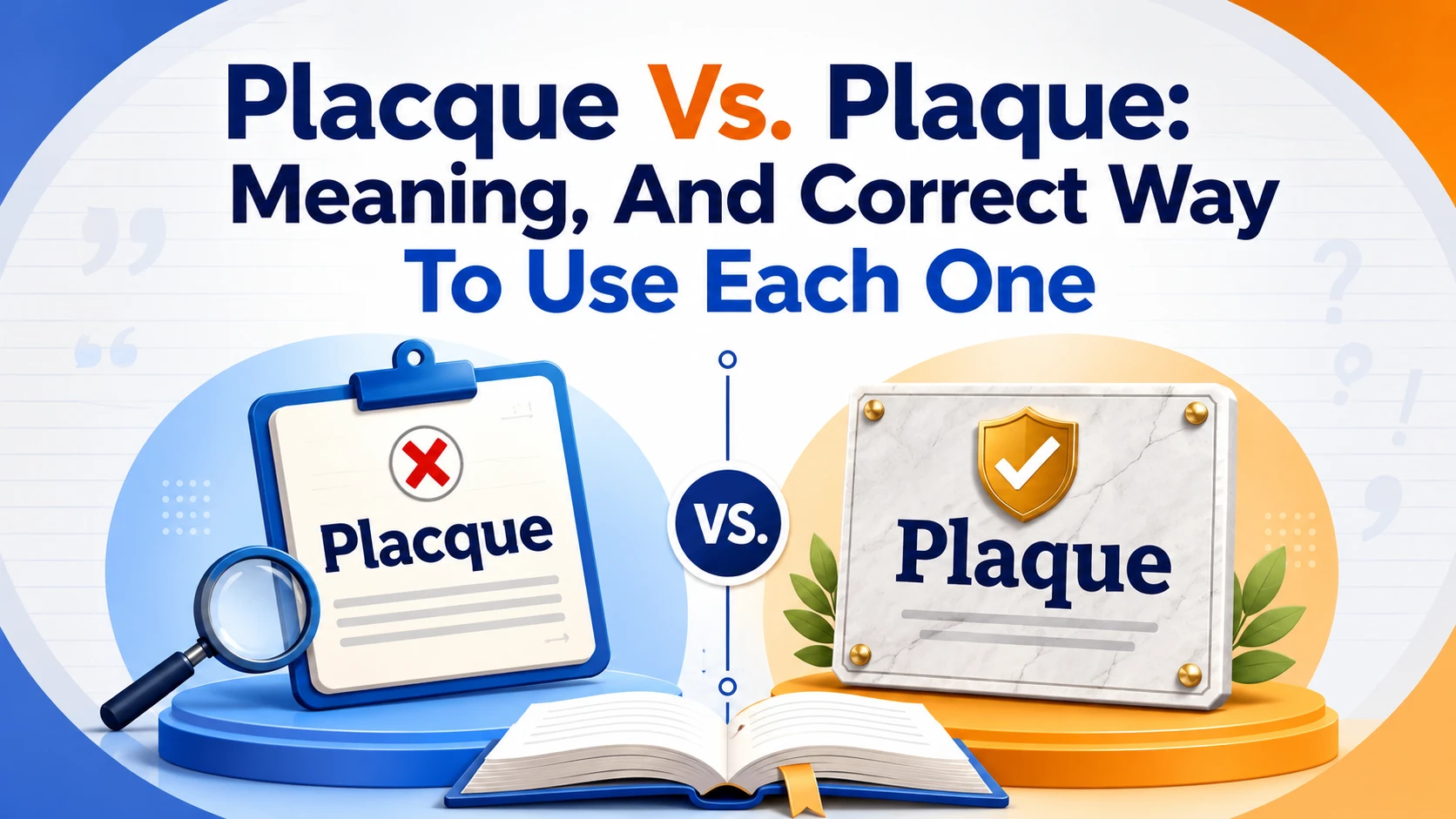
The correct spelling is plaque.
Placque is not a standard English word and does not appear in major dictionaries as an accepted spelling. If you’re writing in academic, professional, or everyday English, you should always use plaque.
At a Glance
| Spelling | Correct? | Meaning | Should You Use It? |
| Plaque | ✅ Yes | A flat sign, dental film, or fatty deposit in arteries depending on the context | Yes |
| Placque | ❌ No | Not recognized as a standard English word | No |
Key Takeaway: If you’re unsure, choose plaque. In standard English, it’s the only correct spelling.
Why Do People Write “Placque”?
Several factors contribute to this mistake:
- The word has an unusual spelling borrowed from French.
- The letters “que” appear in relatively few English words.
- The pronunciation doesn’t clearly reveal the spelling.
- Fast typing and autocorrect sometimes introduce extra letters.
- People assume it follows spelling patterns seen in other words.
Although the error is understandable, it remains a spelling mistake in formal writing.
What Does Plaque Mean?
One reason this word confuses people is that plaque has multiple meanings depending on the subject. Despite these different uses, they all share one spelling.
Definition in Everyday English
A plaque is generally a flat piece of material or a layer that forms on a surface. The exact meaning depends on the context.
For example:
- A bronze plate honoring someone’s achievements
- Sticky bacteria that collect on teeth
- Fatty deposits inside arteries
The context tells readers which meaning is intended.
Different Meanings of Plaque
Memorial or Award Plaque
This is probably the meaning most people recognize first.
A memorial plaque is a flat piece of metal, wood, stone, or another durable material used to commemorate:
- People
- Historic events
- Buildings
- Achievements
- Awards
Examples:
- The city installed a plaque to honor local veterans.
- She received a gold plaque for twenty years of service.
- Visitors stopped to read the historical plaque outside the museum.
These plaques are common in schools, offices, parks, universities, and public monuments.
Dental Plaque
In dentistry, plaque refers to a sticky film of bacteria that naturally forms on teeth.
If it isn’t removed regularly through brushing and flossing, it can contribute to:
- Tooth decay
- Gum disease
- Bad breath
- Tartar buildup
Examples:
- Brushing twice daily helps remove plaque.
- The dentist explained how plaque affects gum health.
- Regular cleanings reduce plaque accumulation.
Practical Tip
Dental plaque develops continuously. Good oral hygiene prevents it from hardening into tartar, which usually requires professional removal.
Medical Plaque
In medicine, particularly cardiology and vascular health, plaque refers to fatty deposits that accumulate inside arteries.
Over time, arterial plaque may reduce blood flow and increase the risk of:
- Heart attacks
- Strokes
- Peripheral artery disease
Examples:
- Doctors found plaque in one of his coronary arteries.
- Lifestyle changes can slow the buildup of arterial plaque.
- High cholesterol contributes to certain types of plaque formation.
Although the medical and dental meanings differ, both refer to material building up on a surface.
Why One Word Has Multiple Meanings
English often extends a word’s meaning when different objects share a similar characteristic.
In every common definition, plaque describes something attached to or formed on a surface:
| Context | Meaning |
| History | A flat commemorative sign |
| Awards | A recognition plate |
| Dentistry | A bacterial film on teeth |
| Medicine | Fatty deposits inside arteries |
Recognizing this shared idea makes the different meanings much easier to remember.
Does the Word Placque Exist?
This is the question many writers ask after seeing different spellings online.
The short answer is no.
Placque is not recognized as a standard English word in modern dictionaries. When it appears online, it’s almost always the result of:
- A typing error
- A spelling mistake
- An uncorrected blog post
- User-generated content
- Confusion with the correct spelling
Professional writers, editors, teachers, publishers, and dictionaries consistently use plaque.
Dictionary Status of Placque
Major English dictionaries recognize plaque, but not placque, as the standard spelling.
That means:
- Spell-checkers typically flag placque as incorrect.
- Editors will usually correct it.
- Academic writing expects plaque.
- Professional publications avoid the misspelling.
If you’re writing for school, work, publishing, or your own website, always choose plaque.
Why the Misspelling Keeps Appearing
Even though placque is incorrect, it still appears online because of several common habits.
Pronunciation Doesn’t Help
The word is pronounced much more simply than it’s spelled.
Many writers instinctively add extra letters to match familiar spelling patterns.
French-Looking Spellings
Since plaque comes from French, its spelling already feels unusual to many English speakers. That makes it easier to accidentally insert another c when typing.
Copying Existing Mistakes
Once a misspelling appears on a website, forum, or social media post, other writers may repeat it without checking a reliable source.
Expert Insight: Seeing a word online doesn’t guarantee it’s correct. Always verify unfamiliar spellings using trusted dictionaries or reputable style references, especially when writing for professional or educational purposes.
Placque vs. Plaque: Side-by-Side Comparison
| Feature | Plaque | Placque |
| Standard English spelling | ✅ Yes | ❌ No |
| Found in major dictionaries | ✅ Yes | ❌ No |
| Accepted in academic writing | ✅ Yes | ❌ No |
| Appropriate in professional documents | ✅ Yes | ❌ No |
| Used in medicine | ✅ Yes | ❌ No |
| Used in dentistry | ✅ Yes | ❌ No |
| Used for awards and memorials | ✅ Yes | ❌ No |
| Recommended spelling | Always | Never (unless intentionally used as a name or stylized branding) |
Remember: If you’re choosing between placque and plaque, the decision is simple—plaque is the only correct spelling in standard English.
Why People Confuse Placque and Plaque
Misspellings rarely happen because people don’t know a word. More often, they happen because English spelling doesn’t always match pronunciation. Plaque is one of those words. It contains a silent letter combination, comes from another language, and appears less frequently than everyday words like book, house, or table. Those factors make it an easy target for spelling mistakes.
Understanding why the confusion happens makes the correct spelling much easier to remember.
Silent Letters Make the Word Look Unusual
The ending -que appears in relatively few English words. Since many writers don’t encounter this pattern often, they naturally question whether another letter belongs in the word.
For example, someone hearing the word might write:
- ❌ Placque
- ❌ Plak
- ❌ Plack
- ❌ Plaqe
Only plaque is correct.
Pronunciation Doesn’t Reveal the Correct Spelling
Plaque is pronounced like “plak.”
Notice that the pronunciation doesn’t clearly indicate the ending -que.
This creates a common spelling challenge because English contains many words whose pronunciation gives only part of the spelling.
Examples include:
| Pronunciation | Correct Spelling |
| nife | knife |
| rait | write |
| kor | choir |
| plak | plaque |
This is why experienced writers verify unfamiliar spellings instead of relying solely on sound.
Typing Habits and Autocorrect
Another reason the error spreads is simple typing behavior.
Many people type quickly and accidentally insert an extra c, producing placque. If the mistake appears on blogs, forums, or social media, others may assume it’s correct without checking a dictionary.
Professional editors recommend reviewing uncommon words before publishing because even small spelling errors can reduce credibility.
Influence of French Spellings
The spelling plaque entered English through French, which explains why it doesn’t follow typical English spelling patterns.
Many borrowed words preserve their historical spellings even after becoming common English vocabulary.
Examples include:
- Boutique
- Antique
- Mosque
- Plaque
Recognizing this pattern helps explain why plaque looks different from most everyday English words.
How to Use Plaque Correctly in Different Contexts
Although plaque has several meanings, the spelling never changes. The context determines which definition readers should understand.
Using Plaque for Awards and Memorials
This is the meaning most people encounter outside healthcare.
A plaque commemorates:
- An achievement
- A person
- A historical event
- A building
- Years of service
Examples
- The school unveiled a plaque honoring its founder.
- Every winner receives a commemorative plaque.
- A bronze plaque marks the entrance to the historic courthouse.
Best Practice
Use plaque whenever referring to a flat object that displays names, dates, achievements, or memorial information.
Using Plaque in Dentistry
Dentists use plaque to describe the sticky bacterial film that forms naturally on teeth.
Good oral hygiene helps prevent plaque from causing:
- Cavities
- Gingivitis
- Gum disease
- Persistent bad breath
Examples
- Daily brushing removes plaque before it hardens.
- Flossing reaches areas where plaque collects.
- The dentist recommended cleaning techniques to reduce plaque.
Expert Tip
Dental plaque begins forming only hours after brushing. Consistent daily cleaning is far more effective than occasional aggressive brushing.
Using Plaque in Medicine
Healthcare professionals also use plaque to describe fatty deposits inside blood vessels.
These deposits may gradually narrow arteries and affect circulation.
Examples include:
- Coronary artery plaque
- Carotid plaque
- Atherosclerotic plaque
Examples
- Imaging showed plaque buildup in the artery.
- Lifestyle improvements may help reduce cardiovascular risk associated with plaque.
- The physician explained how arterial plaque develops over time.
Remember that this medical meaning is entirely different from dental plaque, even though both share the same spelling.
Formal vs. Everyday Writing
Plaque is appropriate in every writing style.
| Writing Type | Appropriate? |
| Academic papers | ✅ Yes |
| Medical reports | ✅ Yes |
| Business writing | ✅ Yes |
| News articles | ✅ Yes |
| Emails | ✅ Yes |
| Everyday conversation | ✅ Yes |
Avoid replacing it with an incorrect spelling simply because it “looks right.”
Real Sentence Examples of Plaque
Seeing words used naturally is often the fastest way to remember them.
Memorial Plaque Examples
- A marble plaque commemorates the town’s first mayor.
- Visitors gathered around the historical plaque to learn about the building.
- She proudly displayed the employee recognition plaque in her office.
- The charity installed a bronze plaque acknowledging its donors.
Dental Plaque Examples
- Brushing twice a day helps control plaque.
- Children should learn how plaque affects their teeth.
- Too much plaque increases the risk of cavities.
- Regular dental checkups help detect excessive plaque early.
Medical Plaque Examples
- The scan revealed arterial plaque in several vessels.
- Doctors monitored the patient’s plaque progression carefully.
- Healthy habits may reduce the long-term impact of plaque buildup.
- Cholesterol management plays an important role in preventing certain types of plaque.
Business and Academic Examples
- The company awarded each retiring employee a commemorative plaque.
- Researchers discussed arterial plaque formation in the report.
- The museum restored the damaged plaque before reopening.
- The report accurately described bacterial plaque development.
Notice that every example uses the identical spelling regardless of meaning.
Common Mistakes to Avoid
Even experienced writers occasionally make spelling mistakes. Fortunately, most errors involving plaque are easy to prevent once you recognize the patterns.
Mistake 1: Writing Placque
This is the most common error.
❌ The hospital discovered arterial placque.
✅ The hospital discovered arterial plaque.
Mistake 2: Choosing the Wrong Meaning
Because plaque has multiple definitions, readers rely on context.
For example:
- Dental plaque belongs in discussions about oral health.
- Memorial plaques belong in discussions about awards or history.
- Arterial plaque belongs in medical contexts.
Mixing these meanings can confuse readers.
Mistake 3: Assuming Spell-Check Catches Everything
Modern spell-checkers are excellent, but they’re not perfect.
Writers should still:
- Proofread carefully.
- Verify uncommon words.
- Confirm technical terminology.
- Review professional documents before publishing.
Good editing habits prevent avoidable mistakes.
Mistake 4: Trusting Every Online Example
Not every webpage uses correct spelling.
If you notice conflicting spellings online:
- Check reputable dictionaries.
- Review educational resources.
- Compare multiple trustworthy sources.
Professional writers verify instead of guessing.
Writing Tip: When researching unfamiliar vocabulary, prioritize authoritative references over random websites or forum posts.
Words Commonly Confused with Plaque
Some words look or sound similar but have completely different meanings.
| Word | Meaning | Example |
| Plaque | Flat sign or biological deposit | The dentist removed plaque. |
| Plague | Widespread disease or serious problem | The plague changed history. |
| Placard | Printed public sign | Protesters carried placards. |
| Plate | Flat dish or metal sheet | She placed food on the plate. |
| Plack (rare) | Primarily a surname or uncommon proper noun | It is not interchangeable with plaque. |
Plaque vs. Plague
These words differ by only one letter but have unrelated meanings.
| Plaque | Plague |
| Dental buildup | Infectious disease |
| Memorial sign | Serious widespread problem |
| Medical deposits | Historical epidemics |
Examples
- The dentist removed plaque from the patient’s teeth.
- Europe experienced the plague centuries ago.
Plaque vs. Placard
Although both can appear on walls, they serve different purposes.
A plaque is usually permanent and commemorative.
A placard is generally temporary and informational.
Examples:
- The museum displayed a bronze plaque.
- Volunteers carried informational placards during the event.
Understanding these distinctions improves both spelling and word choice.
Synonyms of Plaque by Meaning
Because plaque has multiple meanings, its synonyms depend on the context.
Synonyms for a Memorial Plaque
Possible alternatives include:
- Tablet
- Marker
- Nameplate
- Commemorative sign
- Inscription panel
These words may fit different situations, but they are not always interchangeable.
For instance, a nameplate usually identifies a person or office, while a plaque often honors an achievement or commemorates an event.
Synonyms for Dental Plaque
In dental discussions, writers may use descriptive phrases such as:
- Bacterial film
- Biofilm
- Tooth deposits
- Bacterial buildup
Healthcare professionals often prefer biofilm in technical contexts because it more precisely describes the organized layer of microorganisms.
Synonyms for Arterial Plaque
Medical writing may use:
- Fatty deposits
- Atherosclerotic deposits
- Arterial buildup
- Cholesterol deposits (when appropriate in context)
These expressions describe similar concepts, though medical professionals choose terminology based on the exact diagnosis.
When Synonyms Should Not Be Used
Replacing plaque with a synonym isn’t always the best choice.
For example:
- Medical reports require precise terminology.
- Dental instructions should use the standard clinical term.
- Award certificates typically refer to a plaque, not a “tablet.”
Choose the word that matches the audience and context rather than substituting a synonym simply to avoid repetition.
Etymology: Where Did the Word Plaque Come From?
The history of plaque explains why its spelling feels unusual today.
French Origins
The English word plaque comes from the French word plaque, meaning a flat plate, slab, or thin surface. English retained both the spelling and the general idea of a flat object.
How the Word Entered English
As the term became established in English, its meaning expanded beyond physical plates.
Over time, it came to describe:
- Commemorative signs
- Medical deposits
- Dental biofilm
Although the applications changed, the underlying idea of something lying on or attached to a surface remained consistent.
Why the Spelling Stayed the Same
Unlike many borrowed words that gradually adopt English spelling patterns, plaque largely preserved its original French form.
That historical spelling explains why many first-time writers mistakenly produce placque or other incorrect variations.
Pronunciation Guide
Correct pronunciation helps build confidence, even though it doesn’t reveal the full spelling.
How to Pronounce Plaque
Plaque is pronounced:
/plæk/
It rhymes with:
- Back
- Black
- Track
- Stack
The ending -que is not pronounced separately.
Why Pronunciation Doesn’t Match the Spelling
Many English words retain historical spellings from the languages they were borrowed from. As pronunciation changed over time, the spelling often stayed the same.
That’s why hearing the word alone doesn’t reliably tell you how to spell it.
Pronunciation Tips for English Learners
A helpful approach is to separate pronunciation from spelling:
- Say it like “plak.”
- Write it as plaque.
Practicing both together strengthens long-term memory and reduces the chance of repeating the placque mistake.
Memory Tricks to Remember the Correct Spelling
Even after learning that plaque is the correct spelling, some writers still hesitate when typing it. Instead of memorizing the letters mechanically, use memory techniques that connect the spelling with meaning. These methods are especially useful if you don’t encounter the word often.
A Simple Mnemonic
One of the easiest ways to remember the spelling is:
“A plaque is unique, so it ends with -que.”
The unusual -que ending mirrors the word’s uncommon spelling. Whenever you think of an award plaque or a historical marker, remind yourself that it has a distinctive ending too.
Another helpful phrase is:
“Plaque ends like antique.”
Both words share the -que ending and both entered English from French.
Visual Spelling Technique
Visual learners often remember words more easily when they imagine them.
Picture a shiny bronze plaque mounted on a wall with the word PLAQUE engraved across it in large capital letters.
Because plaques are permanent displays, your brain naturally associates the correct spelling with something fixed and lasting.
Break the Word into Chunks
Instead of viewing it as one difficult word, divide it into smaller parts.
Pla + que
Seeing the word in manageable pieces reduces hesitation while writing.
Build the Habit Through Repetition
Research on learning consistently shows that short, repeated exposure is more effective than trying to memorize a word all at once.
Try these exercises:
- Write plaque five times.
- Use it in three original sentences.
- Read those sentences aloud.
- Review the spelling the next day.
This approach strengthens long-term recall.
Proofreading Tips That Catch the Error
Professional editors rarely rely on memory alone.
Before publishing or submitting important writing:
- Search your document for placque.
- Read uncommon words slowly.
- Run spell-check, but don’t depend entirely on it.
- Pay extra attention to borrowed words with unusual spellings.
Editor’s Tip: If a word makes you pause while typing, pause again while proofreading. That brief moment often catches mistakes before your readers do.
Is Placque Ever Correct?
For almost every reader, the answer is no.
In standard English, placque is considered a misspelling rather than an accepted alternative.
Standard English Usage
Whether you’re writing:
- A school assignment
- A blog article
- A business email
- A research paper
- A medical document
- Website content
…the correct spelling is always plaque.
There are no recognized grammar rules or style guides that recommend placque.
Rare Exceptions
Occasionally you may encounter Placque used as:
- A username
- A company name
- A fictional character
- A personal brand
- An artistic project
These are intentional names rather than dictionary words.
For example:
A designer might call a brand Placque Studio because it is distinctive.
That does not make placque a correct English spelling.
Why Professional Writers Avoid It
Editors know that spelling mistakes affect credibility.
Using placque may lead readers to question the accuracy of the rest of your writing.
Professional publications aim for consistency because consistent spelling:
- Builds trust.
- Improves readability.
- Reduces confusion.
- Reflects careful editing.
Expert Tips for Using Plaque Correctly
Experienced writers rarely memorize isolated spellings. Instead, they develop habits that reduce mistakes across all of their writing.
Match the Meaning to the Context
Before choosing the word, ask yourself:
What am I describing?
| Context | Correct Meaning of Plaque |
| Museum | Historical or memorial sign |
| Workplace | Award or recognition plaque |
| Dentist | Sticky bacterial film |
| Doctor | Fatty arterial deposits |
If the context fits one of these situations, plaque is almost certainly the correct word.
Learn the Meaning Before Memorizing the Spelling
Many beginners focus only on spelling.
Experts learn:
- Meaning
- Usage
- Context
- Examples
Once you understand how the word works, the spelling becomes much easier to remember.
Read High-Quality Writing
Exposure matters.
Reading professionally edited materials helps reinforce correct spelling naturally.
Reliable sources include:
- Books
- Newspapers
- University publications
- Professional journals
- Educational websites
The more often you see plaque used correctly, the less likely you are to misspell it.
Create Personal Examples
Instead of memorizing dictionary examples, write your own.
For example:
- The dentist explained how plaque affects gum health.
- Our school installed a memorial plaque near the entrance.
- The employee proudly displayed her retirement plaque.
Personal examples tend to stay in memory longer because they relate to familiar situations.
Best Practices for Writers, Students, and Professionals
Correct spelling is only one part of effective communication.
These best practices help ensure your writing remains accurate and polished.
Before You Publish
Use this checklist:
| Checklist | Yes/No |
| Did you write plaque instead of placque? | ☐ |
| Does the context clearly show the intended meaning? | ☐ |
| Have you proofread uncommon words? | ☐ |
| Did you avoid confusing plaque with plague? | ☐ |
| Did spell-check confirm the spelling? | ☐ |
Even experienced editors benefit from using simple checklists.
For Students
When completing assignments:
- Double-check unfamiliar vocabulary.
- Use trusted dictionaries.
- Don’t rely solely on pronunciation.
- Review teacher feedback on previous spelling mistakes.
Building these habits improves far more than a single word.
For Content Writers
If you’re writing online content:
- Maintain consistent spelling throughout the article.
- Avoid copying errors from unreliable websites.
- Verify technical terms before publishing.
- Remember that readers often judge expertise through attention to detail.
Accurate spelling contributes to both readability and credibility.
Decision Guide: Which Spelling Should You Choose?
When you’re uncertain, this table provides a quick answer.
| If You Mean… | Correct Word |
| A memorial sign | Plaque |
| A recognition award | Plaque |
| Sticky bacteria on teeth | Plaque |
| Fatty buildup in arteries | Plaque |
| A standard English word spelled “Placque” | None—it is a misspelling |
The pattern is simple:
Every standard English meaning uses the spelling “plaque.”
Practical Scenarios
Applying the correct spelling in realistic situations helps reinforce the lesson.
Scenario 1: Writing About an Award
You finish writing:
The company presented her with a beautiful placque.
Something looks wrong.
Correct it to:
The company presented her with a beautiful plaque.
Scenario 2: Writing a Health Article
You write:
Daily brushing removes plaque from your teeth.
Correct.
If you replace it with placque, readers may immediately notice the spelling error.
Scenario 3: Editing Someone Else’s Work
Suppose you’re proofreading a colleague’s report.
You notice:
A commemorative placque was installed outside the library.
As an editor, you should change it to:
A commemorative plaque was installed outside the library.
Small corrections like this improve the professionalism of the entire document.
Common Misconceptions
Several myths continue to circulate online.
Myth: “Placque Is an Older Spelling.”
Reality: There is no evidence that placque has ever been an accepted standard English spelling of plaque.
Myth: “Both Spellings Are Correct.”
Reality: Major dictionaries, educational references, and style guides recognize only plaque.
Myth: “It Doesn’t Matter Because People Understand It.”
Reality: Readers may understand your meaning, but incorrect spelling can reduce confidence in your writing, especially in academic, medical, or professional contexts.
Myth: “Spell-Check Will Always Catch It.”
Reality: Spell-check is helpful, but proofreading remains essential. Depending on the software, custom dictionaries or overlooked errors can still allow misspellings to slip through.
Key Insight: Strong writers don’t just know the correct spelling—they understand why it’s correct and verify it when accuracy matters.
Conclusion
Choosing between placque vs. plaque is much simpler than it first appears. In standard English, plaque is the only correct spelling, whether you’re referring to a memorial marker, dental plaque, or arterial plaque. Understanding its meaning, origin, and common uses helps you avoid a mistake that even experienced writers occasionally make. Instead of relying on pronunciation alone, develop the habit of checking unfamiliar words and paying attention to context. One final actionable tip: whenever you’re unsure, pause and verify the spelling before publishing or submitting your work. A common mistake to avoid is assuming that a spelling you’ve seen online is automatically correct. Careful proofreading and trusted references will help keep your writing accurate, professional, and easy for readers to trust.
Frequently Asked Questions
Q1. Is placque accepted in any English dictionary?
No. Placque is not recognized as a standard English word in major dictionaries. If you see it online, it’s almost always a typo or an uncorrected spelling mistake. For academic, professional, and everyday writing, always use plaque to ensure clarity and credibility.
Q2. Why is plaque spelled differently from how it’s pronounced?
Plaque comes from French, so it retains the distinctive -que ending even though it’s pronounced simply as “plak.” English contains many borrowed words with spellings that don’t perfectly match their pronunciation, making this a common source of confusion.
Q3. Can plaque have more than one meaning?
Yes. Plaque has several accepted meanings depending on the context. It can refer to a commemorative sign, the sticky bacterial film that forms on teeth, or fatty deposits inside arteries. Although the meanings differ, the spelling remains exactly the same.
Q4. How can I quickly remember the correct spelling of plaque?
A useful memory trick is to think of “antique” and “plaque.” Both words end in -que because they entered English from French. Associating the unusual ending with a memorable object, such as an award plaque, makes the spelling much easier to recall.
Q5. Does using placque affect professional writing?
Yes. Even though many readers may guess your intended meaning, using placque can make your writing appear less polished and less trustworthy. Correct spelling demonstrates attention to detail, which is especially important in education, business, healthcare, and published content.
