Togather vs together is a spelling question that confuses thousands of English learners, students, and even native speakers every year. At first glance, both spellings seem reasonable because they sound almost identical when spoken. However, only one is recognized as correct in standard English. Choosing the right spelling matters whether you’re writing an email, completing a school assignment, publishing a blog post, or sending a text message. Understanding the difference helps you communicate more clearly and avoids a mistake that can undermine your credibility.
English spelling isn’t always intuitive, and together is a good example. Many words contain vowel combinations that don’t match their pronunciation exactly, leading writers to rely on sound instead of established spelling rules. That’s why togather appears surprisingly often in online searches and informal writing. The mistake is understandable, but it remains a spelling error. Learning why people make this mistake—and how to avoid it—will strengthen your writing far beyond this single word.
This guide explains which spelling is correct, why “togather” is incorrect, how to use “together” confidently in different situations, and how to remember the proper spelling with simple techniques. You’ll also find practical examples, grammar explanations, comparison tables, proofreading tips, and expert insights that help you avoid common writing mistakes and build stronger English skills.
Quick Answer: Is It Togather or Together?
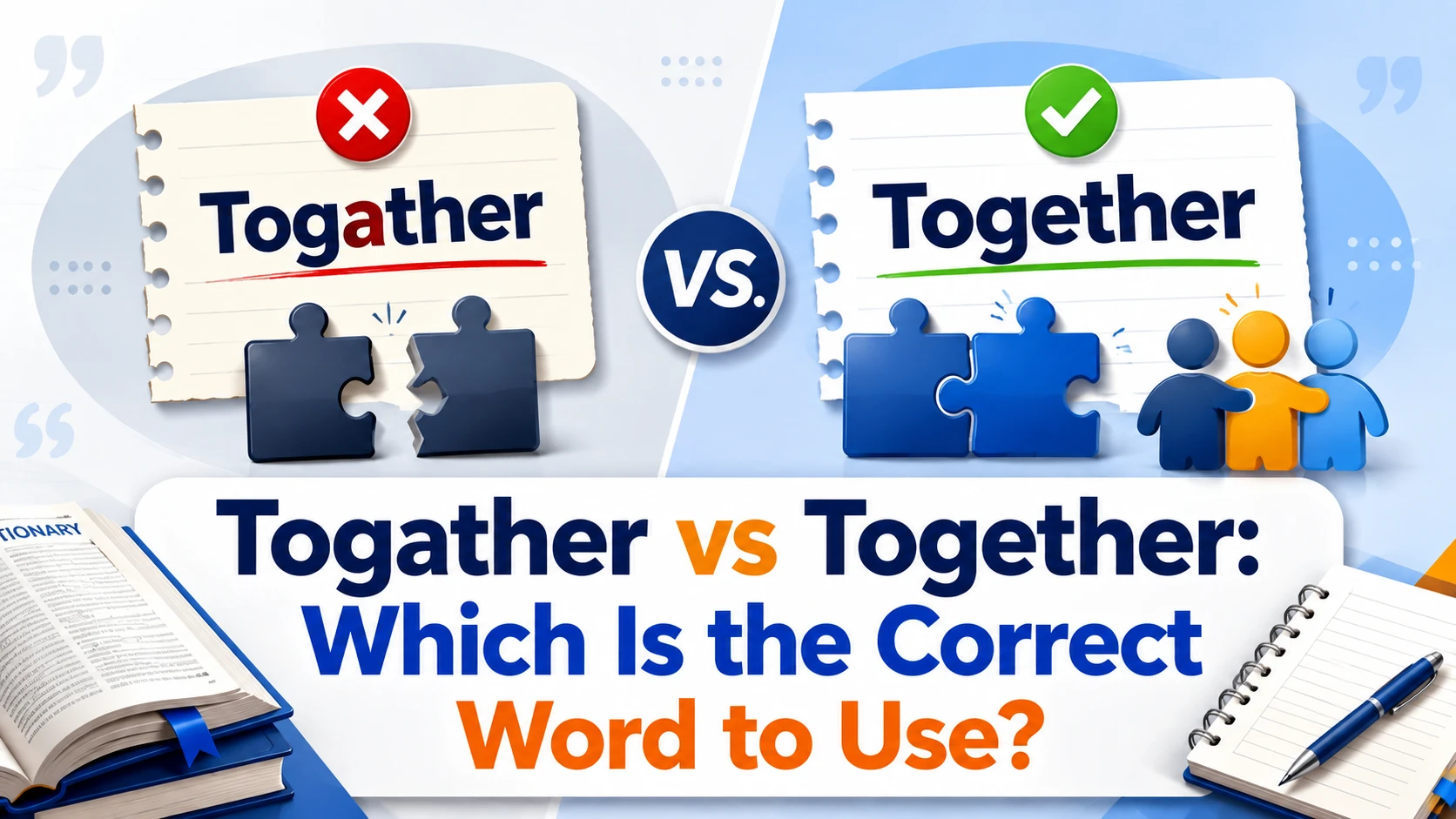
The correct spelling is together.
Togather is not a recognized English word. It is simply a misspelling of together and should be avoided in formal and informal writing alike.
The Quick Rule
If you mean:
- In the same place
- With another person
- Combined into one group
- At the same time
- United or connected
…the correct word is always together.
There are no situations in standard English where togather is considered the correct spelling.
At a Glance
| Spelling | Correct? | Dictionary Word? | Use in Writing |
| Together | ✅ Yes | Yes | Always |
| Togather | ❌ No | No | Never (unless intentionally used as a name or brand) |
Key Takeaway: If you’re choosing between togather and together, always choose together.
What Does Together Mean?
The word together is one of the most commonly used words in English because it describes people, things, actions, and even emotions that are connected in some way.
In everyday English, together generally means with one another, in one place, combined, or acting as a single unit.
Its exact meaning depends on the context.
Being with Other People
This is the meaning most people learn first.
When people are together, they are with one another physically or socially.
Examples
- We studied together before the exam.
- The entire family ate dinner together.
- They traveled together during the summer.
This meaning emphasizes companionship or shared presence.
In One Place or Group
Sometimes together means bringing separate people or objects into one location or collection.
Examples include:
- Gathering documents
- Organizing supplies
- Meeting as a team
Examples
- Please keep all the receipts together.
- She stored the photographs together in one album.
- The teacher placed the projects together on one table.
Here, the word focuses on organization rather than relationships.
At the Same Time
Together can also describe actions happening simultaneously.
Examples
- The audience stood together when the ceremony ended.
- We all laughed together.
- The children began singing together.
Notice that the emphasis is on shared timing rather than physical location.
Joined or Connected
Another meaning refers to separate parts becoming connected.
Examples include:
- Pieces of furniture
- Machine components
- Ideas
- Plans
Examples
- The carpenter glued the wooden pieces together.
- We put the puzzle together in one evening.
- The engineers worked together to solve the design problem.
This meaning often appears in teamwork and construction contexts.
Organized or Emotionally Composed
English speakers sometimes describe someone as together when they appear organized, confident, or emotionally in control.
For example:
- Despite the pressure, she remained together throughout the presentation.
- He seems very together even during stressful situations.
This figurative meaning is common in conversation and informal writing.
Is Together Always an Adverb?
Not always.
Most of the time, together functions as an adverb because it describes how, where, or when an action happens.
Examples:
- We worked together.
- They arrived together.
- Let’s solve this together.
However, it can also function adjectivally in certain expressions.
For example:
- She is remarkably together under pressure.
- He seems calm and together.
In these cases, together describes a person’s condition rather than modifying a verb.
Writing Tip: Don’t worry about memorizing the grammatical label every time. Focus on the meaning first—the grammar usually becomes clear from the sentence.
Is Togather a Real Word?
The simple answer is no.
Togather does not appear as a standard English word in major dictionaries. If you encounter it, it is almost always a spelling mistake.
Professional editors automatically replace togather with together because there is no accepted grammatical distinction between the two.
Dictionary Status of Togather
Major English dictionaries recognize together, but not togather, as the correct spelling.
That means:
- Spell-checkers usually flag togather.
- Teachers mark it as incorrect.
- Editors replace it during proofreading.
- Professional publications avoid it.
Whether you’re writing for school, work, or personal communication, together is always the standard choice.
Why the Misspelling Appears So Often
Despite being incorrect, togather frequently appears online.
Several factors explain why.
People Spell by Sound
The second syllable in together sounds similar to the word gather, causing many writers to replace the e with a.
Fast Typing
Typing quickly increases the likelihood of vowel substitution errors.
Because the mistake still resembles the correct word, writers sometimes overlook it.
Informal Communication
Text messages and social media often contain spelling mistakes that spread through repeated exposure.
Seeing togather online does not make it correct.
Can Togather Ever Be Correct?
In standard English, no.
The only exceptions occur when Togather is intentionally used as:
- A company name
- A product name
- A username
- A fictional title
- A creative brand
These are proper names rather than dictionary words.
For normal writing, always choose together.
Togather vs Together: Side-by-Side Comparison
| Feature | Together | Togather |
| Correct spelling | ✅ Yes | ❌ No |
| Found in major dictionaries | ✅ Yes | ❌ No |
| Standard English word | ✅ Yes | ❌ No |
| Accepted in academic writing | ✅ Yes | ❌ No |
| Appropriate for professional writing | ✅ Yes | ❌ No |
| Used in books and newspapers | ✅ Yes | ❌ No |
| Recommended spelling | Always | Never (except intentional names or branding) |
Expert Insight: When a spelling appears in dictionaries, style guides, educational materials, and professionally edited publications, it becomes the accepted standard. Together meets all of these criteria, while togather does not.
Why Do People Misspell Together as Togather?
Spelling mistakes rarely happen because someone doesn’t understand a word’s meaning. More often, they’re caused by the way English sounds. Together is pronounced quickly in everyday speech, making the middle vowel less noticeable. As a result, many writers instinctively replace the e with an a, producing togather.
Knowing the reasons behind the mistake makes it much easier to avoid.
Pronunciation and Vowel Confusion
The second syllable of together is unstressed in normal speech. Because unstressed vowels often sound like a neutral “uh” sound, many people can’t clearly hear whether the correct letter is e, a, or another vowel.
For example, these incorrect spellings occasionally appear:
- ❌ Togather
- ❌ Together
- ❌ Tugather
Only together is correct.
Expert Tip: English spelling doesn’t always match pronunciation. When you’re unsure, rely on a trusted dictionary rather than the way a word sounds.
The Influence of the Word Gather
One of the biggest reasons people write togather is the familiar word gather.
Because gather is correctly spelled with -ather, writers sometimes assume together follows the same pattern.
Compare them:
| Word | Correct Spelling |
| Gather | ✅ gather |
| Together | ✅ together |
| Togather | ❌ Incorrect |
Although the words are related historically, their spellings are different and shouldn’t be mixed.
Fast Typing and Keyboard Slips
Modern communication encourages speed.
When writing emails, text messages, or social media posts, it’s easy to substitute one vowel for another without noticing.
For example:
- Typing before proofreading
- Mobile keyboards
- Predictive text
- Small touchscreen keys
These factors increase spelling errors, especially in frequently used words.
Autocorrect and Predictive Text Limitations
Autocorrect is helpful, but it isn’t perfect.
Sometimes it:
- Misses uncommon errors.
- Learns incorrect spellings from repeated typing.
- Leaves similar-looking words unchanged.
Professional writers still proofread carefully instead of depending entirely on software.
Challenges for English Learners
People learning English often spell words exactly as they hear them.
This approach works for many words but fails with irregular spellings.
Examples include:
| Pronunciation | Correct Spelling |
| frend | friend |
| sed | said |
| becuz | because |
| togather | together |
Learning spelling patterns—not just pronunciation—is an important step toward fluent writing.
How to Use Together Correctly
Although together is a simple word, it appears in many grammatical patterns. Understanding these patterns helps you write more naturally and confidently.
Together as an Adverb
Most commonly, together functions as an adverb. It describes how, where, or when an action happens.
Examples
- We finished the project together.
- The children played together all afternoon.
- They solved the puzzle together.
In each sentence, together modifies the verb by explaining how the action occurred.
Together as an Adjective
Less commonly, together describes a person’s emotional state or level of organization.
Examples:
- She is remarkably together during emergencies.
- Even under pressure, he remained calm and together.
Here, together means organized, composed, or emotionally balanced.
Common Grammatical Patterns
Certain expressions together appear so frequently that they become fixed patterns.
Together With
Use together with to introduce an accompanying person or thing.
Examples:
- The proposal, together with supporting documents, was submitted yesterday.
- She arrived together with her colleagues.
This expression is common in formal writing.
Work Together
This phrase emphasizes cooperation.
Examples:
- Scientists work together to solve complex problems.
- Successful teams work together toward shared goals.
Live Together
This expression refers to people sharing a home or residence.
Examples:
- The couple has lived together for five years.
- Several students decided to live together near campus.
Come Together
Often used when people unite for a purpose.
Examples:
- Communities came together after the storm.
- The committee will come together next week.
Formal vs. Informal Usage
One advantage of together is its versatility.
| Writing Style | Appropriate? |
| Academic papers | ✅ Yes |
| Business emails | ✅ Yes |
| Research reports | ✅ Yes |
| News articles | ✅ Yes |
| Casual conversations | ✅ Yes |
| Social media | ✅ Yes |
Few English words work comfortably across so many different contexts.
Real-Life Examples of Together in Sentences
Reading natural examples helps reinforce both spelling and meaning.
Everyday Conversations
- Let’s cook dinner together tonight.
- We always exercise together on weekends.
- They walked home together after school.
- Everyone laughed together at the joke.
School and Education
- Students completed the science project together.
- Our class studied together before the final exam.
- The teacher asked everyone to read together.
- We reviewed our notes together in the library.
Workplace and Business
- The departments worked together to improve customer service.
- Managers met together to discuss the budget.
- The design and marketing teams collaborated together on the campaign.
- We solved the client’s problem together.
Relationships and Family
- The family celebrated the holidays together.
- They made an important decision together.
- Parents and children learned together during the workshop.
- Grandparents enjoy spending time together with their grandchildren.
Teamwork and Collaboration
- Volunteers worked together to clean the park.
- Engineers designed the bridge together.
- Doctors from different specialties worked together during the operation.
- Athletes trained together every morning.
Literature and Professional Writing
- The evidence, considered together, supports the conclusion.
- The authors wrote the report together.
- The chapters should be read together for better understanding.
- The researchers analyzed all the data together before publishing.
These examples demonstrate how flexible together is across different writing styles.
Common Expressions and Idioms with Together
Many everyday expressions rely on together. Learning them improves both vocabulary and fluency.
Get Together
Meaning: to meet socially.
Examples:
- Let’s get together next weekend.
- Our classmates get together every summer.
Pull Together
Meaning: to cooperate during a difficult situation.
Examples:
- The entire community pulled together after the flood.
- We must pull together to reach our goal.
Hold It Together
Meaning: to remain calm or emotionally controlled.
Examples:
- She struggled to hold it together during the speech.
- He managed to hold it together despite the stress.
Stick Together
Meaning: to remain united or loyal.
Examples:
- Good friends stick together.
- Families often stick together during difficult times.
Put Together
Meaning: to assemble or organize something.
Examples:
- We put together the new bookshelf.
- She quickly put together a presentation.
Together Forever and Other Fixed Expressions
Other common phrases include:
- Together forever
- Better together
- Together again
- Together as one
- Bring together
- Grow together
Because these are fixed expressions, changing the spelling to togather is always incorrect.
Common Mistakes to Avoid
Most spelling errors involving together are predictable. Recognizing them makes proofreading much easier.
Mistake 1: Writing Togather
This is by far the most common error.
❌ We studied togather every evening.
✅ We studied together every evening.
Mistake 2: Spelling by Sound Instead of Rule
Many writers trust pronunciation more than spelling conventions.
Unfortunately, English contains many words where this approach fails.
Develop the habit of verifying unfamiliar spellings instead of guessing.
Mistake 3: Confusing Together and Altogether
Although they look similar, they have different meanings.
Together usually means with one another.
Altogether generally means completely or in total.
Examples:
- We traveled together.
- The movie was altogether different than expected.
Mistake 4: Confusing All Together with Altogether
These expressions often confuse writers.
| Expression | Meaning | Example |
| All together | Everyone or everything in one place | We sang all together. |
| Altogether | Completely or entirely | The plan was altogether unrealistic. |
Understanding this distinction improves both grammar and clarity.
Mistake 5: Forgetting to Proofread
Even experienced writers occasionally type togather by accident.
Before submitting important writing:
- Read slowly.
- Use spell-check.
- Review commonly misspelled words.
- Pay extra attention to vowels.
Proofreading Tip: Search your document for togather before publishing. One quick search can eliminate the mistake instantly.
Together vs. Similar Words
Some words resemble together in spelling or meaning, while others are confused because they appear in similar contexts. Understanding the differences helps you choose the right word with confidence instead of relying on guesswork.
Together vs. Altogether
Although these words look alike, they serve different purposes.
| Together | Altogether |
| Means with one another or in one group | Means completely, entirely, or in total |
| Often describes people or things acting jointly | Usually emphasizes degree or quantity |
| Refers to unity or connection | Refers to completeness |
Examples
- We solved the problem together.
- The experience was altogether different from what we expected.
Expert Recommendation
If you can replace the word with jointly, use together. If you can replace it with completely, altogether is probably the correct choice.
Together vs. All Together
This pair causes even experienced writers to pause.
All together is a phrase meaning everyone or everything in one place or at the same time.
Examples
- The students stood all together for the school photograph.
- Let’s sing all together.
By contrast, together works independently without the extra word all.
- We traveled together.
- They worked together every weekend.
When in doubt, ask yourself whether all adds necessary meaning. If not, together is usually the better choice.
Together vs. Gather
These words are related but perform different grammatical roles.
| Together | Gather |
| Describes being united | Means to bring people or things together |
| Usually an adverb or adjective | A verb |
| Describes a condition | Describes an action |
Examples
- The family stayed together during the storm.
- Volunteers gathered supplies for relief efforts.
Because gather contains -ather, some writers mistakenly spell together as togather. Remember that the two words have different spellings despite their connection.
Together vs. Jointly
In formal writing, jointly sometimes replaces together, but not always.
Jointly is more common in legal, financial, and business documents.
Examples:
- The companies jointly announced the partnership.
- The committee worked together to improve the proposal.
Although both suggest cooperation, together sounds more natural in everyday English.
Together vs. Collectively
Collectively emphasizes a group’s combined action rather than individuals acting side by side.
Examples:
- Employees worked together to finish the project.
- The board collectively approved the proposal.
The two words overlap in meaning but are not interchangeable in every sentence.
Synonyms and Antonyms of Together
Learning related vocabulary improves both writing variety and precision. However, no synonym replaces together perfectly in every situation.
Synonyms Based on Context
Depending on the sentence, possible alternatives include:
- Jointly
- Collectively
- As one
- Side by side
- In unison
- In cooperation
- Hand in hand
- Simultaneously (for time-related contexts)
- Unitedly (less common)
Examples
- The musicians performed in unison.
- Researchers worked jointly on the study.
- Friends walked side by side through the park.
Always consider the context before replacing together.
Antonyms of Together
Common opposites include:
- Apart
- Separately
- Individually
- Alone
- Independently
- Isolated
- Divided
Examples
- They completed the assignment separately.
- She prefers working independently.
- The family lived apart for several months.
These words emphasize separation rather than unity.
When a Synonym Cannot Replace Together
Some expressions are fixed and should not be rewritten.
For example:
- Work together
- Stay together
- Come together
- Live together
- Pull together
Replacing these with synonyms often sounds unnatural or changes the meaning.
Writing Tip: Prioritize clarity over variety. Repeating together is often better than forcing an awkward synonym.
Word Origin and Etymology
Understanding where a word comes from often makes its spelling easier to remember.
Where Together Comes From
The word together traces its roots to Old English, where earlier forms expressed the idea of being in company, combined, or at the same time.
Unlike many modern English words borrowed from French or Latin, together developed from Germanic roots and has been part of English for centuries.
How Its Meaning Has Evolved
Although English has changed dramatically over time, the core meaning of together has remained remarkably stable.
Historically, it referred to:
- Physical closeness
- Shared action
- Unity
- Cooperation
Today, those meanings still dominate both spoken and written English.
Why the Spelling Has Remained Consistent
While pronunciation naturally evolves, the spelling of together has remained largely standardized.
This consistency explains why togather has never become an accepted alternative spelling.
Once dictionaries and publishers established together as the standard form, it remained the preferred spelling across education, publishing, and professional communication.
Pronunciation and Spelling Tips
Correct pronunciation is useful, but pronunciation alone shouldn’t determine spelling.
Correct Pronunciation
Together is pronounced:
/təˈɡɛðər/
The first vowel is reduced, and the second syllable receives the primary stress.
Although the pronunciation sounds straightforward, the unstressed first vowel often causes spelling uncertainty.
Why Pronunciation Causes Spelling Errors
English speakers naturally reduce unstressed vowels when speaking.
As a result, many people hear something close to:
“tuh-GETH-er”
Since the first vowel is weak, beginners sometimes substitute another vowel when writing.
This explains why togather feels plausible even though it is incorrect.
Easy Ways to Remember the Spelling
Here are several techniques that work well.
Remember the Word Get
Notice that together contains the letters get in the middle:
to + get + her
Although this isn’t the word’s actual origin, it serves as a memorable spelling aid.
Picture People Getting Together
Imagine two friends walking toward each other to get together.
The visual reinforces both the spelling and the meaning at the same time.
Read Professionally Edited Writing
Exposure strengthens memory.
Books, newspapers, and reputable websites consistently use together, helping the correct spelling become familiar through repetition.
Best Practices for Using Together in Writing
Correct spelling is only part of effective communication. These habits will make your writing clearer and more professional.
Academic Writing
In essays and research papers:
- Use together consistently.
- Avoid informal abbreviations.
- Proofread carefully before submission.
- Check spelling even if spell-check finds no issues.
Precision reflects academic credibility.
Business Communication
Professional writing benefits from consistency.
Examples include:
- Emails
- Reports
- Meeting notes
- Presentations
Misspellings such as togather can distract readers and create an impression of carelessness.
Emails and Professional Documents
Before sending important documents:
- Review subject lines.
- Read the message aloud.
- Search for common spelling errors.
- Verify names and technical terms.
Even a single correction improves professionalism.
Creative and Conversational Writing
Novels, blogs, and personal stories allow more flexibility in tone, but standard spelling still matters.
Whether you’re writing dialogue or narration, together should remain correctly spelled unless you’re intentionally representing a character’s spelling mistake.
Quick Proofreading Checklist
A simple checklist catches many common errors before readers see them.
Questions to Ask Before Publishing
| Question | Check |
| Did I write together instead of togather? | ☐ |
| Does the sentence clearly express unity or shared action? | ☐ |
| Have I confused together with altogether? | ☐ |
| Have I proofread the document slowly? | ☐ |
| Has spell-check confirmed the spelling? | ☐ |
Signs You’ve Used Together Correctly
You’re probably correct if:
- The word refers to people or things acting as one.
- The sentence remains natural when read aloud.
- A dictionary confirms the spelling.
- The context matches one of the accepted meanings discussed earlier.
Expert Insight: Skilled writers don’t rely on memory alone. They combine careful proofreading, trusted references, and consistent reading habits to maintain accuracy—even with familiar words.
Conclusion
Choosing between togather vs together becomes easy once you know that together is the only correct spelling in standard English. Whether you’re describing people working as a team, objects grouped in one place, or actions happening at the same time, together is the form you should always use. Developing the habit of checking unfamiliar spellings, understanding common grammar patterns, and proofreading carefully will improve the quality of all your writing—not just this one word. One final actionable tip: create a personal list of words you frequently misspell and review it regularly. A common mistake to avoid is trusting pronunciation more than standard spelling rules. Careful attention to detail helps your writing appear clear, polished, and professional.
Frequently Asked Questions
Q1. Is togather ever considered a correct spelling?
No. Togather is not a recognized English word and does not appear as a standard spelling in major dictionaries. If you encounter it online, it’s almost always a typo or an uncorrected mistake. In professional, academic, and everyday writing, always use together.
Q2. Why do so many people spell together as togather?
The mistake usually happens because English pronunciation can be misleading. The unstressed vowel in together sounds similar to the a in gather, causing many writers to spell the word by sound instead of following the correct spelling pattern.
Q3. Is together one word or two?
Together is a single word when it functions as an adverb or adjective. However, don’t confuse it with all together, which is a two-word phrase meaning everyone or everything in one place or acting at the same time.
Q4. What is the difference between together, all together, and altogether?
Together means with one another or in a unified way. All together refers to everyone or everything assembled, while altogether means completely, entirely, or in total. Choosing the correct form depends on the sentence’s meaning rather than the spelling alone.
Q5. What’s the easiest way to remember how to spell together?
A helpful trick is to think of the phrase “get together.” Notice that get appears in the middle of together. Associating the spelling with this familiar expression makes it easier to remember and reduces the chance of writing togather by mistake.
