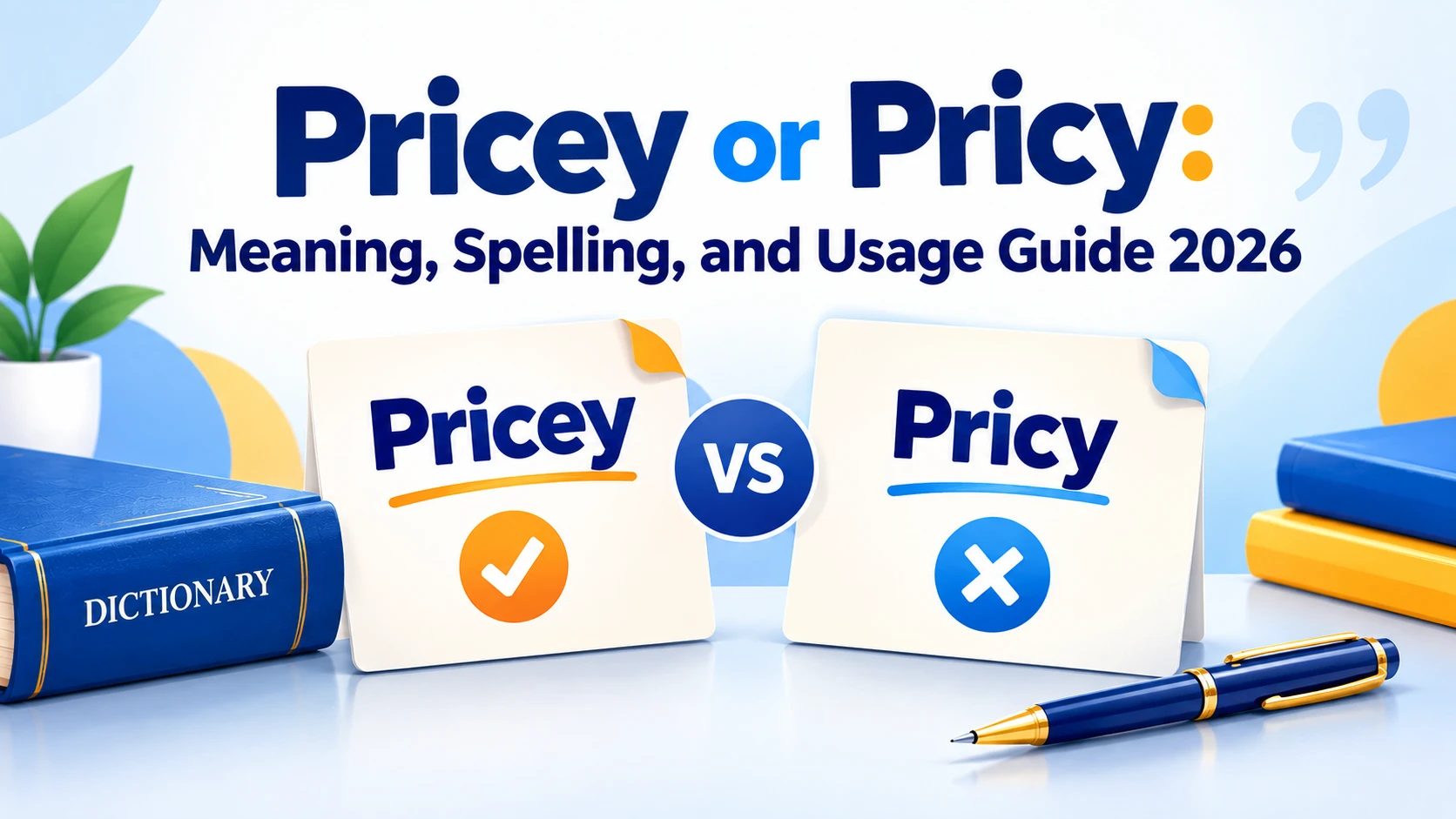
Pricey or pricy can be confusing because both spellings are used in English, yet one is noticeably more familiar. If you are wondering which form to choose, the short answer is that both are correct, and both mean expensive. Cambridge lists pricy as another spelling of pricey, while Merriam-Webster identifies pricy as a less common variant.
The more useful question, then, is not simply “Which spelling is right?” but “Which spelling is the better choice for my audience and context?” Pricey is the more familiar form and is the one readers are most likely to encounter. Major dictionaries also label the adjective informal, which matters when you are deciding whether it belongs in a formal report, academic paper, business document, product review, or everyday conversation.
This guide explains pricey and pricy meaning, spelling, pronunciation, grammar, comparative forms, regional usage, and tone. You will also see how these words differ from expensive, costly, and overpriced, why pricy is not simply a spelling mistake, and when a more formal alternative may communicate your meaning more precisely.
Quick Answer: Is It “Pricey” or “Pricy”?
Both pricey and pricy are correct spellings.
They have the same basic meaning:
pricey / pricy = expensive; costing a relatively large amount of money
Cambridge labels pricey as informal and gives pricy as an alternative spelling. Its Learner’s Dictionary directly defines pricy as “another spelling of pricey.”
Merriam-Webster likewise lists pricey as the main entry and identifies pricy as a less common variant.
The practical recommendation
If you are choosing between the two and have no reason to prefer one, use pricey.
Why?
- It is the more familiar spelling.
- It is the main form used in major dictionary entries.
- Readers are less likely to wonder whether it is a typo.
- It works naturally in everyday and consumer-oriented writing.
- It is the safer default for a broad audience.
That does not make pricy incorrect.
Pricey = standard, familiar spelling
Pricy = legitimate, less common spelling
What Do “Pricey” and “Pricy” Mean?
Pricey Meaning and Definition
Pricey is an adjective meaning expensive or costing a lot of money. Cambridge and Oxford both classify it as an informal adjective.
For example:
That restaurant is pricey.
The hotel looks beautiful, but it is rather pricey.
Those headphones are a little pricey for me.
Importantly, pricey is often relative rather than absolute. Something can be pricey for one person or compared with competing products without being extraordinarily expensive.
A $200 dinner, for example, might be described as pricey in one context but entirely reasonable in another.
Pricy Meaning and Definition
Pricy has the same basic meaning as pricey: expensive.
Cambridge’s Learner’s Dictionary explicitly describes pricy as another spelling of pricey.
For example:
That restaurant is pricy.
The new equipment is fairly pricy.
We found the downtown hotels too pricy.
There is normally no difference in meaning between these two spellings.
Do “Pricey” and “Pricy” Mean Different Things?
No.
Both describe something that costs a relatively large amount of money.
The distinction is primarily one of spelling preference and frequency, not meaning.
| Word | Meaning | Status |
| pricey | Expensive | Main, more familiar spelling |
| pricy | Expensive | Less common alternative spelling |
So this pair does not work like words such as historic and historical, where the forms can have different uses.
Pricey vs Pricy: The Key Difference
The biggest difference is familiarity, not definition.
| Feature | Pricey | Pricy |
| Meaning | Expensive | Expensive |
| Part of speech | Adjective | Adjective |
| Pronunciation | /ˈpraɪsi/ | /ˈpraɪsi/ |
| Dictionary status | Established | Established variant |
| Frequency/familiarity | More common | Less common |
| Register | Informal | Informal |
| Comparative | Pricier | Pricier |
| Superlative | Priciest | Priciest |
| Best default for broad audiences | Yes | Usually no |
| Automatically incorrect? | No | No |
Merriam-Webster calls pricy a less common variant, while Cambridge lists it directly as an alternative spelling.
Why “Pricey” Is Usually the Safer Choice
Suppose you are writing:
The hotel is pricey but worth the money.
Most readers will process the word without hesitation.
With:
The hotel is pricy but worth the money.
The sentence is still correct, but some readers may momentarily wonder whether pricy is a typo.
That does not make the spelling wrong. It simply means reader familiarity can be a useful editorial consideration.
For public-facing content, especially content written for an international audience, choosing the more familiar form often reduces unnecessary friction.
Why Are There Two Spellings?
English has many words with variant spellings, and pricey/pricy is one example.
The base word is price, and the adjective adds the suffix -y.
The familiar spelling is:
price → pricey
The alternative spelling is:
price → pricy
The difference is the treatment of the final e.
Why “Pricy” Looks Logical
Writers may see other words in which a final e disappears before a suffix and apply a similar pattern:
- spice → spicy
- ice → icy
- noise → noisy
That makes pricy look perfectly reasonable.
In fact, dictionaries recognize it.
The important lesson is that English spelling does not always operate according to a single universal suffix rule. Dictionary-established usage ultimately matters more than trying to derive every spelling from a formula.
Why “Pricey” Is More Familiar
Although pricy is legitimate, pricey has become the more recognizable written form.
Merriam-Webster’s entry uses pricey as the main headword and describes pricy as less common.
That distinction is useful for writers because there is a difference between:
- Is this spelling accepted?
- Is this the spelling most readers expect?
For pricy, the answer to the first question is yes. For the second, pricey generally has the advantage.
Is “Pricy” a Real Word?
Yes.
This is one of the most important points to get right.
Pricy is not simply an error made by people who do not know how to spell pricey. Major dictionaries recognize it as a legitimate alternative.
Cambridge’s Learner’s Dictionary defines pricy specifically as another spelling of pricey.
Merriam-Webster lists pricy as a variant and describes it as less common.
Therefore, correcting every occurrence of pricy to pricey as though the former were objectively wrong would be unnecessarily strict.
When Should an Editor Prefer “Pricey”?
An editor may still choose pricey for practical reasons:
- the publication consistently uses the more familiar form;
- the intended audience may be unfamiliar with pricy;
- the site’s style guide specifies pricey;
- consistency with existing copy matters;
- the writer wants the least distracting spelling.
This is style management, not a correction from “wrong” to “right.”
Is “Pricey” Formal or Informal?
Pricey is generally informal.
Cambridge labels it informal, and Oxford also labels it informal.
That does not mean you can never use it in serious writing. It means that the word has a more conversational character than a neutral or formal term such as expensive or costly.
Compare:
The restaurant is pricey.
with:
The restaurant is expensive.
Both are natural. The second is more neutral.
Where “Pricey” Works Well
Pricey fits naturally in:
- conversation;
- product reviews;
- travel writing;
- lifestyle articles;
- blogs;
- consumer advice;
- informal emails;
- social media;
- casual journalism;
- personal recommendations.
For example:
The camera is a little pricey, but the image quality is excellent.
That sounds natural and conversational.
When “Expensive” Is Better
For formal or academic writing, expensive is often the cleaner choice.
Instead of:
The proposed system is too pricey for smaller institutions.
a formal report might say:
The proposed system is too expensive for smaller institutions.
Or, if precision is important:
The proposed system costs approximately $25,000 per year.
The last version is especially useful when readers need objective financial information rather than the writer’s judgment.
Pricey or Pricy in Formal Writing
The spelling question and the register question should be kept separate.
Pricy is not wrong because it is informal. Both spellings represent an adjective that dictionaries classify as informal.
If your concern is formality, changing pricy to pricey does not solve the underlying issue.
Instead, consider changing the vocabulary:
Informal: The software is pricey.
Neutral: The software is expensive.
More formal: The software involves substantial costs.
Precise: The software costs $1,500 annually.
This is a much better editorial decision than treating pricy as an incorrect spelling.
Pricey vs Pricy in American and British English
There is no simple US-versus-UK spelling rule that requires Americans to use one form and British writers to use the other.
Cambridge lists pricey in both its UK and US dictionary information and gives pricy as an alternative spelling.
That means you should not tell readers:
“Pricey is American, while pricy is British.”
That would be misleading.
What Should Writers Do Instead?
Follow the house style and audience expectations of the publication.
If you are writing for:
- a British publication, follow its editorial style;
- an American publication, follow its editorial style;
- an international website, pricey is usually the safest familiar choice;
- a client with an established spelling preference, maintain that preference consistently.
The important distinction is between regional English and individual or editorial spelling preference.
Pricey, Pricier, and Priciest
One useful detail that is sometimes overlooked is what happens when pricey becomes comparative or superlative.
The standard forms are:
- pricey
- pricier
- priciest
Cambridge and Merriam-Webster both give pricier and priciest.
Comparative: Pricier
Use pricier when comparing two things.
This laptop is pricier than the previous model.
The downtown apartments are pricier than those in the suburbs.
Superlative: Priciest
Use priciest when identifying the highest-priced option in a group.
That was the priciest restaurant on our trip.
This is one of the priciest models in the range.
Common Errors
Avoid forms such as:
- priceyer
- priceyest
- pricyer
- pricyest
The established comparative and superlative forms are:
| Degree | Correct form |
| Positive | pricey / pricy |
| Comparative | pricier |
| Superlative | priciest |
Notice something important: regardless of whether you choose the base spelling pricey or pricy, the comparative and superlative are conventionally written pricier and priciest.
Pricey vs Expensive vs Costly vs Overpriced
These words overlap, but they are not interchangeable in every context.
| Word | Core meaning | Tone | Important nuance |
| pricey | Expensive | Informal | Often conversational or subjective |
| pricy | Expensive | Informal | Alternative spelling of pricey |
| expensive | Costing a lot | Neutral | Broadest everyday choice |
| costly | Costing a lot | More formal | Can also describe harmful consequences |
| overpriced | Too expensive for its value | Evaluative | Implies the price is excessive |
| high-priced | Carrying a high price | Neutral/formal | More descriptive and objective |
Oxford makes an especially useful distinction between expensive, costly, overpriced, and pricey. It describes pricey as informal, costly as somewhat formal, and overpriced as meaning too expensive relative to value.
Pricey vs Expensive
The simplest distinction is register.
The restaurant is pricey.
sounds conversational.
The restaurant is expensive.
sounds neutral.
Neither necessarily tells us whether the restaurant offers good value.
Pricey vs Costly
Costly can have meanings beyond the literal price of an item.
For example:
The company made a costly mistake.
Here, costly can mean that the mistake resulted in significant loss or consequences. Oxford explicitly includes this broader use.
You would not normally replace it with pricey:
The company made a pricey mistake. ❌
Pricey vs Overpriced
This distinction matters.
The watch is pricey.
means the watch costs a lot.
The watch is overpriced.
means the speaker believes the watch costs more than it is worth.
Something can be expensive without being overpriced.
For example, a handcrafted instrument might cost $10,000 because it requires exceptional materials and specialist labor. Calling it pricey describes its cost. Calling it overpriced makes an additional judgment about its value.
Does “Pricey” Mean “Too Expensive”?
Not necessarily.
This is a common misunderstanding.
Pricey means expensive, but it does not automatically mean unaffordable or unreasonable.
Consider:
The camera is pricey, but professionals love it.
The speaker acknowledges that the camera costs a lot while still considering it worthwhile.
Now compare:
The camera is too pricey for me.
Adding too changes the sentence. It introduces a judgment about affordability or suitability.
Compare These Three Sentences
The camera is pricey.
It costs a lot.
The camera is quite pricey.
It costs noticeably more than expected or than alternatives.
The camera is too pricey for me.
Its cost exceeds what the speaker is willing or able to pay.
The adjective itself does not automatically carry the stronger judgment.
How to Use “Pricey” Naturally
Before a Noun
They booked a pricey hotel near the airport.
She bought a pricey laptop for her design work.
After a Linking Verb
The hotel was pricey.
The repairs are becoming pricey.
With Degree Adverbs
Pricey commonly combines with words such as:
- very
- quite
- fairly
- rather
- pretty
- too
- surprisingly
- extremely
Examples:
The tickets were surprisingly pricey.
The neighborhood has become quite pricey.
That option is too pricey for our budget.
Oxford specifically gives patterns such as very/too/fairly/quite/pretty pricey.
Real-World Examples: Pricey vs Pricy
Food and Restaurants
The tasting menu is pricey, but the service is excellent.
That café is a little pricy for what it offers.
Travel
Hotels near the beach can be pricey during peak season.
We skipped the pricy resort and booked a smaller hotel.
Technology
The new laptop is pricey, but its battery life is excellent.
Some professional cameras are extremely pricy.
Clothing
The jacket looks great, but it is too pricey for me.
She prefers pricy designer brands.
Services
Hiring a specialist can be pricey.
International shipping can become surprisingly pricy.
In all these examples, changing pricey to pricy or vice versa normally leaves the meaning intact.
When Should You Choose “Pricey” Over “Pricy”?
If you are simply deciding what to type, pricey is the best default.
Choose pricey when:
- you want the most familiar spelling;
- your audience is broad or international;
- you are writing general website content;
- you are unsure which variant your readers expect;
- your publication does not have a specific house style;
- consistency with common dictionary headwords matters.
Choose pricy when:
- your publication already uses it consistently;
- a client or house style prefers it;
- you are maintaining an established author’s spelling;
- you are quoting or reproducing a source where the spelling matters.
The key is not to treat pricy as an error that must always be corrected.
Editorial recommendation: If there is no reason to choose otherwise, use pricey. If there is a deliberate reason to use pricy, it is a legitimate spelling.
Common Mistakes With Pricey and Pricy
Mistake 1: Assuming “Pricy” Is Wrong
This is the biggest misconception.
Major dictionaries recognize pricy. Cambridge explicitly calls it another spelling of pricey, and Merriam-Webster lists it as a less common variant.
Mistake 2: Assuming They Have Different Meanings
They do not normally describe different levels of expense.
pricey = pricy
in ordinary adjective use.
Mistake 3: Calling Them British and American Spellings
There is no reliable rule saying one belongs exclusively to British English and the other to American English.
Mistake 4: Confusing “Pricey” With “Overpriced”
Pricey describes a high price.
Overpriced says the price is too high for what the thing is worth.
That extra judgment matters.
Mistake 5: Assuming “Pricey” Means Unaffordable
A product can be pricey and still be affordable to its intended customer.
Mistake 6: Using “Pricey” When Precision Matters
A financial report should not rely on subjective wording when an exact figure is available.
Instead of:
The project is pricey.
write:
The project is expected to cost $4.8 million.
That is more useful information.
A Simple Decision Guide
| Situation | Best choice |
| General everyday writing | Pricey |
| Consumer review | Pricey |
| Blog article | Pricey |
| Casual email | Pricey or pricy |
| Publication with a house style | Follow the house style |
| Quoting a source | Preserve the source’s wording |
| Academic writing | Usually expensive or a more precise term |
| Technical report | Prefer exact cost terminology |
| Unsure which spelling readers expect | Pricey |
| Want to use pricy deliberately | Acceptable |
A Five-Second Test
Ask:
Am I simply describing something as expensive?
If yes, both spellings can work.
Do I want the most familiar option?
Choose pricey.
Does my publication have a style preference?
Follow it.
Am I writing something highly formal or technical?
Consider expensive, costly, high-priced, or an exact figure instead.
That is a better decision process than asking whether pricy is “wrong.”
Conclusion
When choosing between pricey or pricy, there is no need to label one spelling wrong: both are legitimate, and both mean expensive. The real distinction is that pricey is the more familiar and generally safer default, while pricy is a less common alternative. Both are normally informal, so in highly formal or technical writing, expensive, costly, high-priced, or an exact figure may communicate more effectively. One final actionable tip: if you have no house style or audience preference to follow, choose pricey because readers are more likely to recognize it immediately. A common mistake to avoid is “correcting” every pricy to pricey as though it were a spelling error. In this case, editorial preference and correctness are not the same thing.
Frequently Asked Questions
Q1. Is “pricy” a real word?
Yes. Pricy is a legitimate spelling of pricey, not simply a typographical error. Cambridge’s Learner’s Dictionary defines it as another spelling of pricey, while Merriam-Webster lists it as a less common variant. Both forms mean expensive.
Q2. Which is more common: “pricey” or “pricy”?
Pricey is generally the more familiar and commonly encountered form. Merriam-Webster identifies pricy as less common, while using pricey as its main dictionary entry. For broad audiences, pricey is therefore usually the more recognizable choice.
Q3. Is “pricey” too informal for professional writing?
Not automatically, but dictionaries classify pricey as informal. In a professional document, expensive may sound more neutral, while an exact cost may be better still. The appropriate choice depends on whether you want conversational commentary or precise financial information.
Q4. Are “pricey” and “pricy” pronounced differently?
No. They normally have the same pronunciation, /ˈpraɪsi/. The distinction is written rather than phonetic. Cambridge gives the same pronunciation for pricey and identifies pricy as an alternative spelling, so saying one aloud does not normally reveal which spelling was intended.
Q5. What is the comparative form of “pricey”?
The comparative is pricier, and the superlative is priciest. These forms are used regardless of whether the base adjective is written pricey or pricy. For example: “This model is pricier” and “That was the priciest option.”
