
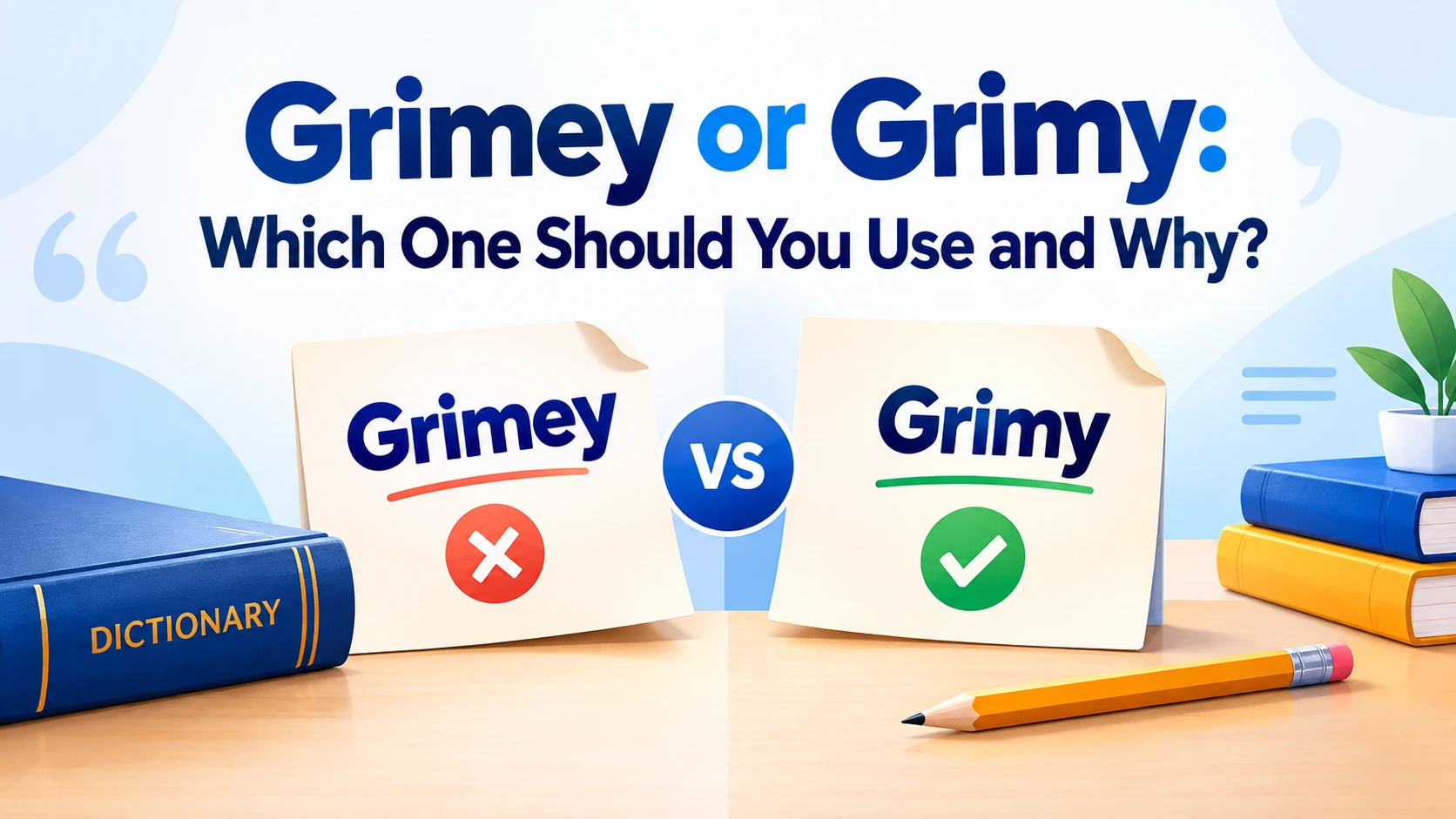
Grimey or grimy is an easy spelling choice once you know how the adjective is formed: grimy is the standard English spelling. If you mean “covered with dirt or grime,” write grimy, not grimey. The confusion is understandable because the noun grime keeps its final e, making grimey look like a logical extension. But standard English drops that final e before adding -y: grime → grimy. This article explains the spelling rule, pronunciation, meaning, comparative forms, regional usage, and situations in which an unusual spelling such as Grimey might legitimately appear.
The distinction matters most when you are writing something that will be edited, published, assessed, or professionally reviewed. A spelling that looks plausible is not automatically a standard dictionary form. Oxford lists grimy as an adjective meaning “covered with dirt” and gives the comparative and superlative forms as grimier and grimiest. Cambridge likewise records grimy as an adjective meaning dirty and gives examples involving faces, clothing, buildings, and other surfaces. So if you are proofreading an article, essay, report, or product description, grimy is the dependable choice.
There is also a useful vocabulary distinction hiding behind the spelling question. Grime is a noun for a layer of dirt, while grimy describes something affected by that dirt. That makes grimy more specific than the broad adjective dirty in many situations. You can describe grimy hands, grimy windows, grimy clothes, or a grimy workshop when accumulated dirt is part of the image. We will also compare grimy with grubby, grungy, and filthy, examine the forms grimier and grimiest, and show exactly when an unusual spelling should—or should not—be corrected.
Grimy or Grimey: The Quick Answer
The standard spelling is grimy.
Correct: The mechanic wiped his grimy hands.
Not the standard spelling: The mechanic wiped his grimey hands.
The word comes from grime, a noun meaning a layer of dirt, and the adjective is formed as:
grime + -y → grimy
The final e is removed before the suffix is added.
Oxford records grimy as an adjective and gives grimier and grimiest as its comparative and superlative forms. Cambridge also records grimy as the standard adjective.
The easiest rule to remember
If you mean covered with grime, use:
grimy
not:
grimey
That rule will handle virtually every ordinary writing situation.
Grimy vs Grimey at a Glance
| Feature | Grimy | Grimey |
| Standard adjective | Yes | No, not the preferred standard form |
| Meaning | Covered with dirt or grime | Usually intended to mean grimy |
| Word formation | grime → grimy | Retains the final e |
| Pronunciation | /ˈɡraɪmi/ | Usually intended to represent the same pronunciation |
| Formal writing | Recommended | Avoid |
| Comparative | grimier | Not grimeyer |
| Superlative | grimiest | Not grimeyest |
| British/American difference | Used in both | Not a standard regional alternative |
| Proper names or stylized forms | Possible | May appear if deliberately chosen |
The important distinction is between ordinary English vocabulary and a spelling being used intentionally as a name, title, quotation, or stylistic creation. A proper name does not have to obey ordinary dictionary spelling conventions.
What Does “Grimy” Mean?
Grimy is an adjective used to describe something that is dirty, particularly when dirt or grime has accumulated on its surface. Oxford defines it as “covered with dirt,” while Cambridge gives dirty as the core meaning.
The word often creates a stronger visual impression than simply saying dirty.
Consider:
- “She had dirty hands.”
- “She had grimy hands.”
Both sentences are grammatical. The second suggests that dirt has built up on the hands, perhaps from work, handling machinery, cleaning, gardening, or another activity.
What Can Be Grimy?
Grimy can describe many things that accumulate visible dirt:
- grimy hands
- grimy fingers
- grimy face
- grimy clothes
- grimy windows
- grimy walls
- grimy floors
- grimy tools
- grimy machinery
- a grimy workshop
- a grimy kitchen
- a grimy old building
Cambridge’s examples and corpus evidence show the word being used for people, clothing, vehicles, rooms, urban environments, equipment, and surfaces.
Grimy Does Not Necessarily Mean Filthy
This is an important vocabulary distinction.
Grimy tells the reader something about the presence or appearance of dirt. It does not necessarily mean the object is extremely dirty.
For example:
“The mechanic’s hands were grimy after repairing the engine.”
That does not necessarily mean his hands were filthy. They may simply have a layer of grease, dust, or accumulated dirt.
Why Is “Grimy” Spelled Without the E?
The spelling becomes much easier when you start with the two components:
grime + -y
The expected-looking form might appear to be grimey. But standard English uses:
grime → grimy
The final e disappears.
The spelling pattern
Compare these forms:
| Base word | Adjective |
| grime | grimy |
| noise | noisy |
| ice | icy |
| spice | spicy |
| shine | shiny |
| haze | hazy |
These examples illustrate a common spelling pattern in which a final silent e is removed before -y is added.
That does not mean every English word follows a perfectly predictable spelling formula. English contains many historical spellings and exceptions. The practical point is narrower: grimy is the established spelling of this particular adjective.
Why “Grimey” Looks So Convincing
The mistake is visually understandable.
A writer already knows:
grime = dirt
It is therefore natural to think:
grime + y = grimey
But English spelling does not always preserve the entire visible form of a base word when suffixes are added.
The same kind of reasoning explains why:
noise → noisy
rather than noisey.
The useful lesson is not simply “memorize that one letter.” It is to recognize that suffix formation can change the spelling of the base word.
Is “Grimey” Ever Correct?
For the ordinary adjective meaning “dirty” or “covered with grime,” grimy is the standard choice.
However, language exists in contexts where spelling can be deliberate rather than dictionary-based. You might encounter Grimey as:
- a personal or stage name;
- a fictional character’s name;
- a username;
- a title;
- a brand or artistic label;
- a deliberately stylized expression;
- part of a quotation.
In those cases, changing the spelling may change the identity of the name or expression.
When You Should Change “Grimey” to “Grimy”
If you are editing ordinary prose and the writer means “covered with grime,” use grimy.
That includes:
- school assignments;
- essays;
- business documents;
- blog articles;
- reports;
- news copy;
- product descriptions;
- instructional writing;
- general nonfiction.
For example:
The workers returned with grimy clothes.
There is no reason to preserve grimey merely because it appeared in an unedited draft.
When You Should Preserve “Grimey”
Suppose a sentence says:
The musician performs under the name Grimey.
Here, Grimey may be a chosen name rather than an adjective. Correcting it to Grimy would alter the person’s name.
The same principle applies to titles and fictional names.
I watched a film called Grimey.
If that is the official title, retain the official spelling.
The spelling exception belongs to the name or title, not to the ordinary adjective.
Is “Grimey” a British or American Spelling?
No. Grimey is not a standard British-versus-American spelling distinction.
This is worth stating clearly because online articles sometimes create a false regional explanation for spelling differences.
Cambridge provides both UK and US pronunciation information for grimy, and Oxford lists grimy as the adjective.
So the practical rule is the same whether you are writing for:
- a British audience;
- an American audience;
- an Australian audience;
- a Canadian audience;
- an international English-speaking audience.
Use grimy.
Why Regional Confusion Happens
Readers can encounter grimey in:
- social media posts;
- forums;
- informal comments;
- usernames;
- unedited websites;
- song titles;
- fictional names;
- user-generated content.
Seeing a spelling repeatedly does not automatically make it a standard regional variant.
For spelling questions, reputable dictionaries and established editorial practice are stronger evidence than isolated online examples.
Grime, Grimy, and the Word Family
Understanding the relationship between the noun and adjective is more useful than memorizing two isolated spellings.
Grime Is the Noun
Grime means a layer of dirt that forms on a surface.
Oxford describes it as dirt that forms a layer on the surface of something.
Examples:
The window was covered in grime.
Years of grime had accumulated on the walls.
The cleaner removed the grime from the tiles.
Grimy Is the Adjective
Grimy describes something affected by that dirt.
The window was grimy.
The walls looked grimy.
His hands became grimy during the repair.
The relationship is straightforward:
grime = the dirt itself
grimy = covered with or marked by that dirt
A Useful Sentence Pair
Compare:
The mechanic’s hands were covered in grime.
and:
The mechanic’s hands were grimy.
The first sentence focuses on the substance. The second focuses on the condition or appearance of the hands.
Grimy, Grimier, and Grimiest: Get All Three Forms Right
The spelling problem does not stop at grimy. Once the adjective becomes comparative or superlative, another spelling trap appears.
Oxford explicitly gives:
- grimy
- grimier
- grimiest
Comparative: Grimier
Use grimier when comparing two things.
This window is grimier than the one upstairs.
His hands were grimier after the second repair.
Do not write:
grimeyer
Superlative: Grimiest
Use grimiest when comparing three or more things or identifying the highest degree.
That was the grimiest workshop I had ever entered.
The basement has the grimiest windows in the building.
Do not write:
grimeyest
The Complete Pattern
| Form | Correct | Incorrect |
| Base adjective | grimy | grimey |
| Comparative | grimier | grimeyer |
| Superlative | grimiest | grimeyest |
Once you remember grimy, the other forms become much easier.
Grimy vs Dirty: Are They Really the Same?
Not quite.
Cambridge groups grimy with several words meaning “not clean,” including dirty, filthy, grubby, grungy, mucky, and soiled. But related words are not always interchangeable.
| Word | Main idea | Typical strength or nuance |
| dirty | Not clean | Broad, neutral |
| grimy | Covered with accumulated dirt or grime | Visual, surface-focused |
| grubby | Rather dirty, often from not being washed | Informal |
| grungy | Dirty or unpleasantly untidy | Informal; can suggest a style |
| filthy | Extremely or unpleasantly dirty | Strong |
| soiled | Made dirty or stained | More formal |
Grimy vs Grubby
Oxford defines grubby as “rather dirty,” often because something has not been washed or cleaned, and gives examples such as grubby hands and grubby clothes.
So:
grimy hands
emphasizes dirt or grime on the hands.
grubby hands
can suggest generally unwashed or rather dirty hands.
Grimy vs Grungy
Grungy is informal and can describe a person who feels dirty as well as something that is dirty. It can also carry associations with the rough or deliberately unpolished aesthetic of grunge culture.
That gives grungy a broader cultural and stylistic range than grimy.
Grimy vs Filthy
Filthy is stronger.
Cambridge defines filthy as “extremely or unpleasantly dirty.”
Therefore, calling something grimy does not necessarily mean it is filthy.
The windows were grimy.
suggests accumulated dirt.
The windows were filthy.
suggests a much more extreme condition.
Choosing the less intense word can make a description more accurate.
How to Use “Grimy” Naturally
The best way to understand an adjective is to see where native English speakers naturally place it.
Describing Hands
After changing the tire, Sam had grimy hands.
She washed her grimy fingers before eating.
This is one of the most natural uses because hands readily collect dirt through physical work.
Describing Clothing
His grimy work clothes were covered with dust and grease.
She threw her grimy jacket into the laundry basket.
Here, grimy communicates more than simply “old” or “worn.”
Describing Windows and Surfaces
The restaurant’s windows were grimy.
He spent the morning cleaning the grimy walls.
The word works particularly well when the dirt is visibly accumulated on a surface.
Describing Places
They entered a grimy workshop filled with old equipment.
The alley looked grimy after years without proper cleaning.
Cambridge’s corpus examples include grimy in descriptions of urban environments, buildings, vehicles, floors, and industrial settings.
When “Grimy” Is the Better Word
Use grimy when you want the reader to picture dirt that has accumulated or coated something.
For example:
The keyboard was dirty.
is perfectly correct but relatively general.
The keyboard was grimy.
creates a more specific visual impression.
This makes grimy useful in:
- descriptive writing;
- fiction;
- journalism;
- product-condition descriptions;
- everyday conversation;
- storytelling.
It is less useful when you need a highly technical description of exactly what substance is present.
For example, a laboratory or maintenance report may need to identify oil residue, soot, dust, grease, corrosion, or contamination rather than rely on the broad descriptive word grimy.
That is an important professional-writing distinction: a vivid adjective is not always the most precise technical description.
Common Mistakes With Grimy and Grimey
Mistake 1: Writing “Grimey” Because the Base Word Is “Grime”
This is the central spelling error.
grime + y = grimey ❌
Use:
grime + y = grimy ✓
The final e is dropped.
Mistake 2: Calling “Grimey” the British Version
There is no standard British rule that changes grimy to grimey.
Grimy works in both British and American English.
Mistake 3: Writing “Grimeyer”
If the base form is grimy, the comparative is grimier.
grimier ✓
grimeyer ✗
Mistake 4: Writing “Grimeyest”
The superlative is:
grimiest ✓
not:
grimeyest ✗
Mistake 5: Treating Every Online Spelling as Standard
Internet frequency is not the same thing as editorial correctness.
A spelling can appear in thousands of posts because people copy one another, type quickly, use informal language, or deliberately choose a nonstandard form.
For ordinary edited English, dictionary evidence and established usage should guide the decision.
Grimy in Formal and Informal Writing
There is nothing inherently unprofessional about the word grimy. Its suitability depends on what you are trying to communicate.
Academic Writing
Use grimy when it accurately describes something in the subject being discussed.
However, academic writing often benefits from specific nouns and measurable descriptions.
Instead of:
The equipment was grimy.
a technical paper might need:
The equipment was covered with a visible layer of oil and dust.
The second sentence tells the reader exactly what was observed.
Professional Writing
In ordinary professional communication, grimy is perfectly usable:
The technician reported that the machine’s exterior had become grimy.
But if the condition affects safety, maintenance, performance, or compliance, a more precise description may be preferable.
Journalism and Creative Writing
Here, grimy can be particularly effective because it is concise and visual.
The city’s old industrial district had a grimy, weather-beaten character.
The adjective gives the reader an immediate impression without requiring a long explanation.
A Simple Decision Test: Which Spelling Should You Use?
When proofreading, ask these questions:
| Question | If the answer is yes | What to write |
| Do you mean covered with dirt or grime? | Ordinary adjective | grimy |
| Are you comparing two dirty things? | Comparative adjective | grimier |
| Are you identifying the most dirty/grimy one? | Superlative | grimiest |
| Is “Grimey” someone’s chosen name? | Proper name | Preserve Grimey |
| Is “Grimey” an official title or brand? | Official styling | Preserve official spelling |
| Is it an ordinary adjective in an essay? | Standard English required | grimy |
| Did you find grimey in an informal online post? | Likely nonstandard usage | Don’t use it as spelling evidence |
This approach is more reliable than simply asking whether grimey “looks right.”
A Quick Proofreading Checklist
Before publishing, check the following:
- You wrote grimy, not grimey, for the ordinary adjective.
- You wrote grimier, not grimeyer.
- You wrote grimiest, not grimeyest.
- You used grimy to describe dirt or accumulated grime.
- You did not incorrectly describe grimey as a British spelling.
- You preserved Grimey if it is intentionally a proper name or title.
- You chose grimy rather than filthy when extreme dirt was not intended.
- You used a more precise technical term if the exact type of residue matters.
Editor’s tip: If the word is an ordinary adjective meaning “covered with grime,” your safest answer is simple: grimy.
Conclusion
When the choice is grimey or grimy, standard English gives you a clear answer: grimy. The word means covered with dirt or grime, and its standard forms are grimy, grimier, and grimiest. The spelling becomes easier to remember when you see the formation as grime → grimy, with the final silent e removed before -y is added. Grimey is not a British or American alternative, although the spelling may legitimately appear as a name, title, or deliberate stylistic choice. One final actionable tip: whenever you mean ordinary dirt-covered condition, choose grimy. A common mistake to avoid is carrying the e from grime into the adjective. In standard writing, that small letter makes the difference between the established form and an unnecessary spelling error.
Frequently Asked Questions
Q1. Is “grimey” accepted in dictionaries?
For ordinary adjective use, grimy is the established dictionary form. Oxford and Cambridge both list grimy and provide its meaning and grammatical forms. An unusual spelling such as Grimey may still occur as a proper name, title, or deliberate styling, which is a different issue.
Q2. How do you pronounce “grimy”?
Grimy is pronounced /ˈɡraɪmi/, essentially “GRY-mee.” Cambridge and Oxford give the same basic pronunciation for the word. The pronunciation does not change between grimy and the commonly encountered nonstandard spelling grimey; the important distinction is the standard written form.
Q3. Can “grimy” describe a person?
Yes. It can describe a person’s face, hands, clothes, or general appearance when they are dirty. For example, “The child came home with a grimy face.” Usually, grimy describes the person’s visible condition rather than their personality or character.
Q4. Is “grimy” a negative word?
Usually, grimy has a negative or unpleasant association because it describes dirt. However, context can soften that effect. In creative writing, a grimy workshop or city street may be used neutrally or atmospherically rather than as direct criticism of a person or place.
Q5. What is the opposite of “grimy”?
The natural opposite depends on context, but clean is the straightforward choice. For a surface, you might say “a clean window” rather than searching for a specialized antonym. In technical contexts, terms such as sanitized, sterile, spotless, or uncontaminated may be more precise.
