
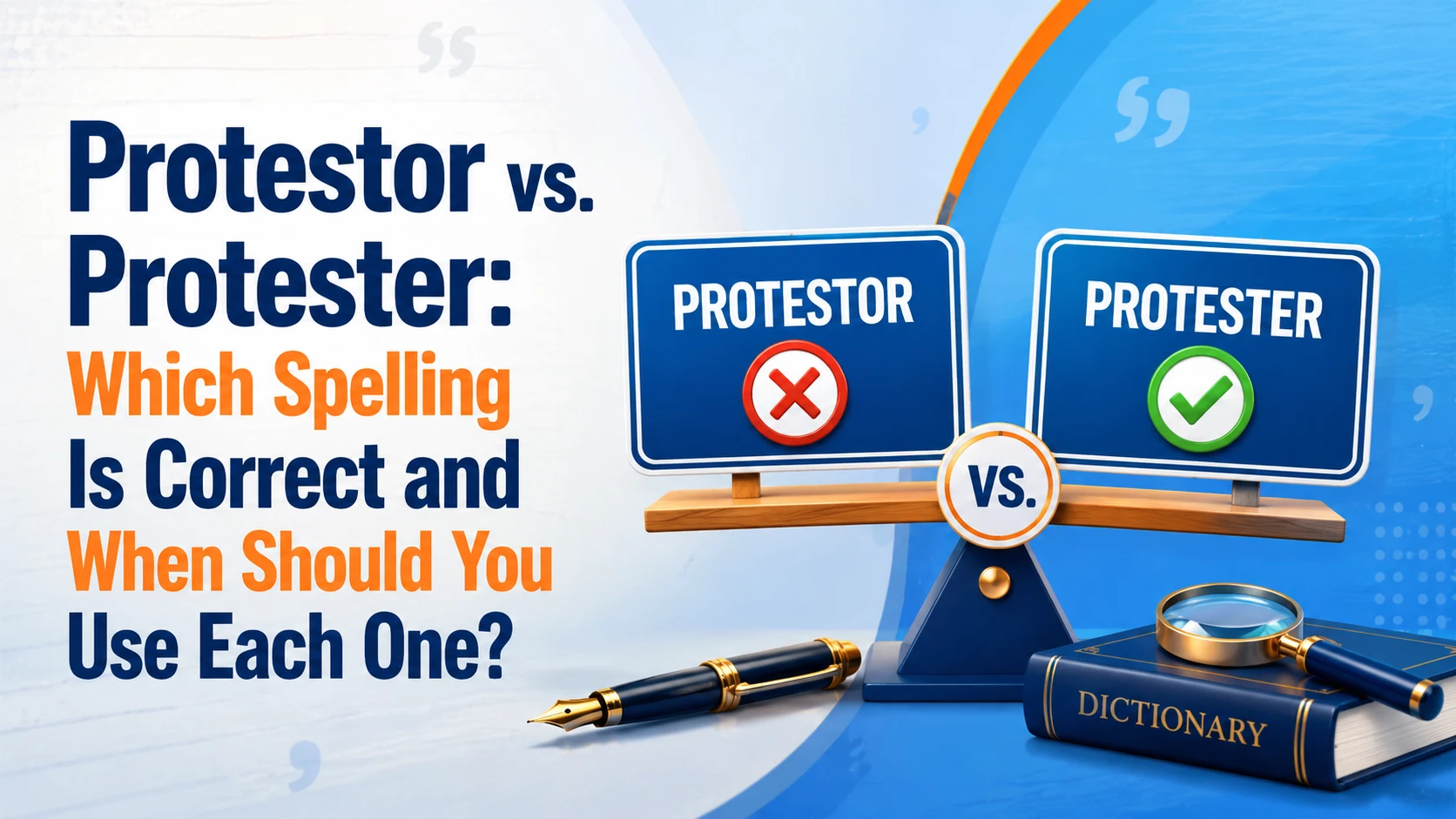
Protestor vs. protester can be confusing because both spellings are valid, sound the same, and refer to a person who takes part in a protest. However, the two forms are not equally common in modern English. Protester is generally the preferred and more widely used spelling, especially in journalism, academic writing, professional communication, and everyday English.
The difference is mainly a matter of spelling preference and usage, not meaning. Both words describe someone who publicly expresses opposition to a policy, decision, action, or social condition. You may see either form in dictionaries, published writing, or historical sources, but protester is usually the safer choice when you want your writing to sound current and familiar.
This guide explains the meaning, spelling, usage, and modern preference behind protestor and protester. You’ll also find examples, a simple comparison table, common mistakes, and practical tips for choosing the right spelling.
Quick Answer
Both protester and protestor are correct.
However, protester is the more common and generally preferred spelling in modern English. Use protester in most articles, essays, reports, news stories, blog posts, and professional documents.
Best choice for most modern writing: protester
What Is the Difference Between Protestor and Protester?
The main difference between protestor and protester is their frequency of use, not their meaning.
| Feature | Protestor | Protester |
| Meaning | A person who takes part in a protest | A person who takes part in a protest |
| Pronunciation | Same | Same |
| Dictionary status | Valid spelling | Valid spelling |
| Modern usage | Less common | More common |
| Journalism | Occasionally used | Usually preferred |
| Academic writing | Less common | Generally preferred |
| Professional writing | Acceptable but uncommon | Recommended |
| Best choice for most readers | Usually avoid | Use |
Both forms communicate the same basic idea. The choice is mostly about modern convention, familiarity, and audience expectations.
What Does Protester Mean?
A protester is a person who publicly expresses opposition to an issue, policy, decision, action, or social condition. Protesters may participate in marches, rallies, demonstrations, strikes, campaigns, or other forms of public action.
The word itself is generally neutral. It does not automatically suggest that a person acted peacefully or violently. The surrounding context provides that information.
Examples of Protester
- Thousands of protesters gathered outside the government building.
- A protester spoke to reporters after the demonstration.
- Student protesters called for changes to university policy.
- Climate protesters organized a peaceful march.
- Several protesters carried signs during the rally.
The word appears frequently in news reporting, political discussions, academic research, and everyday communication.
What Does Protestor Mean?
A protestor has the same meaning as a protester. It also refers to a person who publicly objects to or demonstrates against something.
For example:
- The protestor addressed city officials.
- Several protestors gathered near the courthouse.
These sentences are grammatically correct. However, many modern readers are more familiar with protester, so protestor may look less natural or less current in general writing.
Is Protestor a Real Word?
Yes. Protestor is a real and accepted English word. It is not a misspelling.
However, a word can be correct without being the most common or preferred choice. English often contains spelling variants that differ in frequency. In this case, protester is generally more familiar and more widely used.
A simple way to remember the distinction is:
Correct does not always mean preferred.
You can use protestor without making a grammatical error, but protester will usually be the clearer choice for a modern audience.
Why Is Protester More Common?
The spelling protester follows a familiar English pattern in which -er is added to a verb to form a noun meaning “a person who performs an action.”
Examples include:
- teach → teacher
- write → writer
- speak → speaker
- organize → organizer
- protest → protester
This pattern makes protester easy for readers to recognize and understand.
However, English does not follow one universal rule for choosing -er or -or. Many common nouns use -or, including:
- actor
- editor
- creator
- visitor
- instructor
For that reason, you should not assume that every person-related noun must end in -er. The preferred spelling often depends on the history and established usage of the individual word.
Why Do People Confuse Protestor and Protester?
People often hesitate because both spellings share several important features:
- Both are recognized English words.
- Both have the same pronunciation.
- Both have the same basic meaning.
- Both appear in published writing.
- Both can refer to one person or a group.
The endings also make both forms look believable. English uses -er and -or in many nouns, but the language does not provide a single rule that works in every case.
For example:
| -er Words | -or Words |
| teacher | actor |
| writer | editor |
| speaker | creator |
| organizer | visitor |
Because English uses both endings, writers may naturally wonder whether protestor or protester is the standard form.
Which Spelling Should You Use?
For most modern writing, use protester.
It is usually the best choice for:
- News articles
- Academic essays
- Research papers
- Blog posts
- Business communication
- Professional reports
- Educational content
- Social media posts
- Everyday writing
Example
✅ Thousands of protesters gathered in the city center.
Although this is also correct:
✔ Thousands of protestors gathered in the city center.
The first version is more likely to match modern reader expectations.
Protester in Journalism
News organizations commonly use protester when reporting on public demonstrations, political events, labor disputes, social movements, and civic action.
Examples:
- Protesters gathered outside parliament to demand reforms.
- Police monitored the protesters during the march.
- A protester spoke to journalists after the event.
- Student protesters called for changes to the education policy.
The word is concise, familiar, and easy to understand in headlines and news reports.
Protester in Academic Writing
In academic writing, protester may appear in discussions of politics, history, sociology, law, public policy, or social movements.
Examples:
- Researchers interviewed student protesters about their experiences.
- The study examined how protesters organized public demonstrations.
- Political protesters influenced public debate during the reform movement.
Using the more common spelling can help maintain consistency with modern academic and editorial conventions.
Protester in Everyday English
The word also works naturally in ordinary conversation.
Examples:
- The protesters blocked the road during the demonstration.
- A protester gave me a leaflet.
- Several protesters carried signs.
- The protesters left after the event ended.
You do not need a formal or political context to use the word correctly.
How to Use Protestor Correctly
Although protestor is less common, it can still be used correctly.
You may encounter it in:
- Older books
- Historical documents
- Archived newspaper articles
- Older legal or political writing
- Publications that follow a particular house style
Examples:
- The protestor presented a statement to the committee.
- Several protestors gathered near the courthouse.
If you are quoting a historical source, preserving the original spelling may be important. Otherwise, protester is usually the more practical choice.
Protester vs. Related Words
Several words may appear in discussions about protests and public action. However, they do not always mean the same thing.
| Word | Meaning |
| Protester | A person who publicly expresses opposition to something |
| Demonstrator | A person who takes part in a public demonstration |
| Activist | A person who actively works to support or create social or political change |
| Advocate | A person who publicly supports a cause, policy, or group |
| Dissenter | A person who disagrees with an accepted idea, policy, or authority |
| Organizer | A person who plans or coordinates an event or movement |
| Rioter | A person involved in violent or destructive public disorder |
These words may overlap in some situations, but they carry different meanings and levels of specificity.
For example, an activist may organize a protest without attending it, while a protester may participate in a single demonstration without being an activist.
Do Protester and Rioter Mean the Same Thing?
No. Protester and rioter are not interchangeable.
A protester is someone who participates in a protest or publicly expresses opposition. A rioter is someone involved in violent or destructive public disorder.
A protest can be peaceful, while a riot involves behavior that goes beyond peaceful public demonstration. For accurate and fair writing, use the term that matches the facts and context.
Common Mistakes to Avoid
Thinking Protestor Is Incorrect
Protestor is a valid spelling. The issue is not correctness but modern preference and frequency.
Using Both Spellings in the Same Article
Choose one spelling and use it consistently unless you are discussing the difference between the two forms.
For most modern content, use protester throughout.
Assuming All Action Nouns Use -er
English uses both -er and -or endings. There is no single rule that applies to every noun.
For example:
- teacher
- writer
- actor
- editor
- creator
Learn the established spelling of each word instead of relying on one general rule.
Confusing Protesters With Rioters
A protester is not automatically a rioter. These words describe different types of participation and should not be treated as synonyms.
Using an Uncommon Spelling Without a Reason
Using protestor is not wrong, but it may distract some readers because protester is more familiar. When clarity is the goal, choose the spelling your audience is most likely to recognize.
Easy Way to Remember the Difference
Use this simple rule:
For modern English, choose protester.
You can also connect the word to familiar -er nouns:
- protest → protester
- teach → teacher
- write → writer
- speak → speaker
This memory pattern will help you remember the preferred spelling without treating it as a universal grammar rule.
Quick Comparison Cheat Sheet
| Writing Situation | Recommended Spelling |
| News reporting | Protester |
| Academic writing | Protester |
| Blog posts | Protester |
| Professional communication | Protester |
| Educational content | Protester |
| Social media | Protester |
| Everyday writing | Protester |
| Historical quotations | Keep the original spelling when appropriate |
| A publication with a specific style guide | Follow the required house style |
Conclusion
Both protestor and protester are correct English spellings, and both refer to a person who publicly expresses opposition or takes part in a protest. The difference is mainly one of usage and modern preference, not meaning. For most current writing, protester is the better choice. It is more common, more familiar to readers, and widely used in journalism, academic writing, professional communication, and everyday English. If you are writing a blog post, article, essay, report, or news-style piece, use protester unless a historical source, quotation, or specific style guide requires protestor. Consistent spelling will make your writing clearer, more polished, and easier to read.
Frequently Asked Questions
Q1. Is protester or protestor correct?
Both protester and protestor are correct. However, protester is generally the more common and preferred spelling in modern English.
Q2. Which spelling should I use in professional writing?
Use protester in most professional, academic, journalistic, and business writing because it is more familiar to modern readers.
Q3. Do protester and protestor have different meanings?
No. Both words refer to a person who publicly expresses opposition or participates in a protest. The difference is primarily one of spelling preference and usage frequency.
Q4. Why is protester more common?
Protester follows a familiar English word-formation pattern in which -er identifies a person who performs an action, as in teacher, writer, and speaker. Established modern usage has also made protester the more familiar form.
Q5. Is protester used in both British and American English?
Yes. Protester is widely understood and commonly used in both British and American English. If you are writing for a publication, follow its style guide for consistency.
