
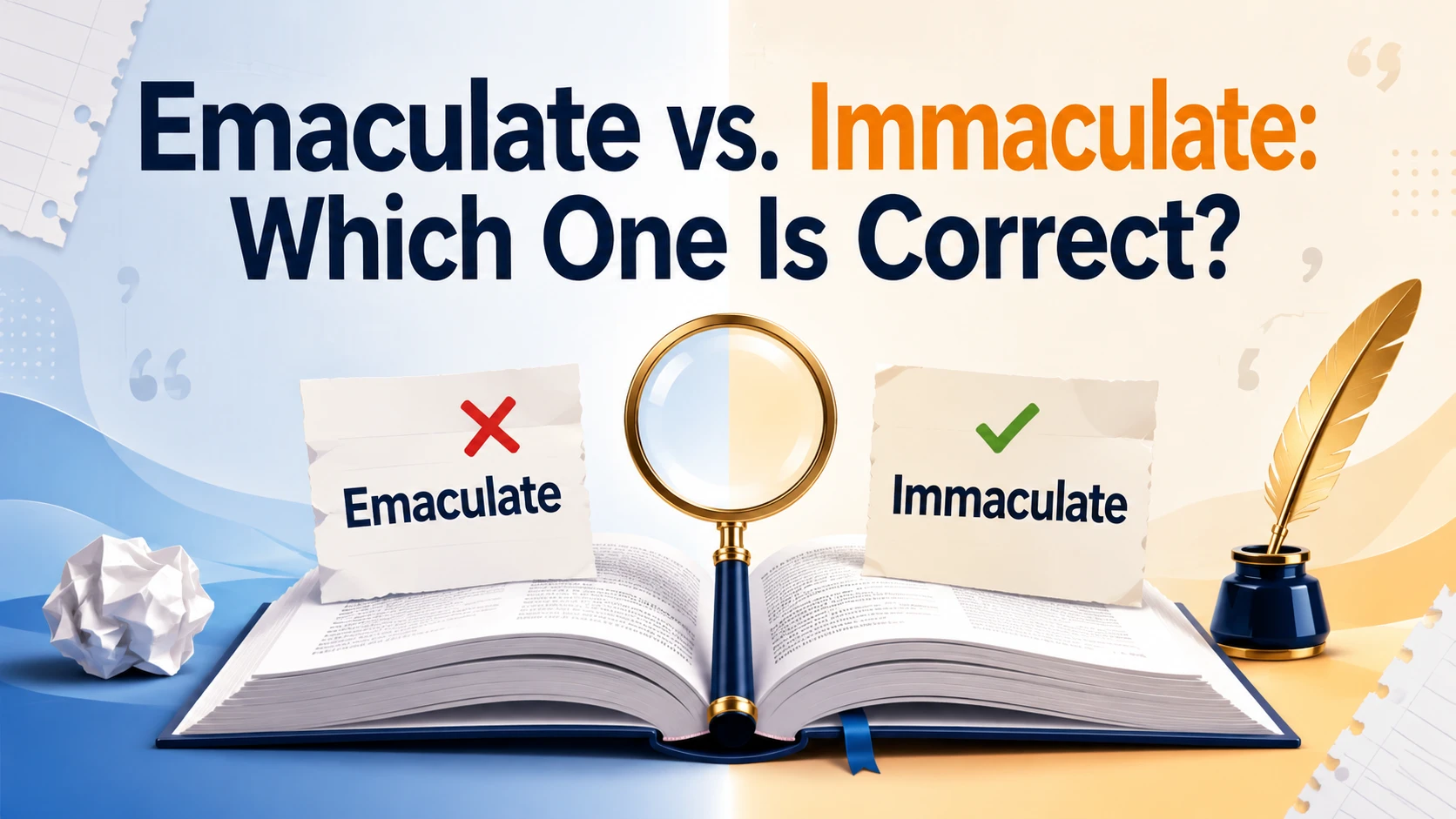
Emaculate vs. immaculate is a common spelling confusion, especially because the two forms can sound similar when spoken quickly. However, immaculate is the correct spelling and an accepted word in standard English. In most cases, emaculate is a misspelling of immaculate rather than a separate English word.
The word immaculate usually describes something that is perfectly clean, spotless, neat, pure, or free from flaws. You can use it for a clean room, a well-maintained car, a polished appearance, or a highly accurate performance. The meaning changes slightly with context, but the word always suggests an exceptional level of cleanliness, care, or quality.
Understanding the difference can improve your spelling, vocabulary, and word choice. This guide explains why people write emaculate, what immaculate means, how to use it correctly, and how to remember its spelling.
Quick Answer
| Word | Correct in Standard English? | Meaning |
| Immaculate | Yes | Perfectly clean, spotless, flawless, or free from errors |
| Emaculate | No | Usually a misspelling of immaculate |
Correct spelling: immaculate
Incorrect spelling: emaculate
Why Do People Confuse Emaculate and Immaculate?
The confusion usually begins with pronunciation. When people hear immaculate without seeing it written, they may not notice the double m. As a result, they may spell the word according to how they think it sounds.
The correct word is pronounced approximately:
ih-MAK-yuh-luht
The spelling is:
im-mac-u-late
The word is also less common in everyday conversation than simpler words such as clean, perfect, or spotless. When people do not see or write a word often, they are more likely to make spelling mistakes.
Other common causes include:
- typing quickly
- forgetting the double m
- relying only on pronunciation
- unfamiliarity with the word
- confusing it with words that begin with em-, such as emulate or emotion
What Does Immaculate Mean?
Immaculate means perfectly clean, very neat, free from flaws, or without mistakes.
The word often describes something that has been carefully maintained or completed to a very high standard.
For example:
“The kitchen was immaculate after the cleaning.”
In this sentence, immaculate means extremely clean and spotless.
Another example:
“She gave an immaculate presentation.”
Here, immaculate means carefully prepared, polished, and free from noticeable mistakes.
Definition of Immaculate
Depending on the context, immaculate can mean:
- perfectly clean
- spotless
- free from stains
- without flaws
- free from errors
- neat and well maintained
- pure or undefiled
The word can describe both physical appearance and the quality of work or performance.
Origin and Etymology of Immaculate
The word immaculate comes from the Latin word immaculatus, meaning unstained or spotless.
It is connected to:
- in- — meaning “not” or “without”
- macula — meaning “spot” or “stain”
Therefore, the original sense of immaculate is without a stain.
This meaning remains clear in modern English, especially when the word describes cleanliness, purity, or an unblemished condition.
Literal and Figurative Meanings of Immaculate
Literal Meaning
When immaculate describes a physical object or place, it usually means perfectly clean or spotless.
Examples:
- “The hotel room was immaculate.”
- “He kept his car immaculate.”
- “The kitchen remained immaculate throughout the event.”
- “She wore an immaculate white dress.”
Figurative Meaning
Immaculate can also describe work, behavior, performance, or presentation that is exceptionally accurate and carefully executed.
Examples:
- “The team delivered an immaculate performance.”
- “Her research notes were immaculate.”
- “The event was organized with immaculate attention to detail.”
- “His timing was immaculate.”
In these examples, the word emphasizes precision, care, and a lack of noticeable mistakes.
Common Uses of Immaculate
Immaculate Appearance
People often use immaculate to describe someone who looks exceptionally neat and well presented.
Examples:
- “He arrived in an immaculate suit.”
- “Her hair and makeup looked immaculate.”
- “The staff maintained an immaculate appearance.”
Immaculate Condition
The word is common in descriptions of homes, vehicles, furniture, and valuable items.
Examples:
- “The car is in immaculate condition.”
- “The house has been kept in immaculate condition.”
- “The watch remained immaculate despite its age.”
Immaculate Performance
Immaculate can describe a performance that is highly accurate, controlled, or free from obvious errors.
Examples:
- “She delivered an immaculate speech.”
- “The musician gave an immaculate performance.”
- “His execution of the plan was immaculate.”
Immaculate Cleanliness
Hotels, restaurants, and property listings may use immaculate to emphasize a high standard of cleanliness.
Examples:
- “Guests praised the immaculate rooms.”
- “The restaurant maintained immaculate facilities.”
- “The property features an immaculate interior.”
Is Emaculate a Real Word?
In standard modern English, emaculate is not the accepted spelling of the word that means spotless, perfectly clean, or free from flaws.
If you mean something that is perfectly clean or flawless, use:
immaculate
Not:
emaculate
For example:
❌ “The house was emaculate.”
✅ “The house was immaculate.”
In most writing, emaculate should be corrected to immaculate.
Why Is Emaculate a Common Misspelling?
The main reason is that spoken English does not always make every letter easy to hear. The double m in immaculate may not sound obvious when the word is spoken quickly.
Writers may also be influenced by familiar words beginning with em-, including:
- emerge
- emotion
- emulate
- embarrass
Because these spelling patterns are familiar, emaculate may look believable even though it is not the standard form.
Emaculate vs. Immaculate: Main Differences
| Feature | Emaculate | Immaculate |
| Standard English spelling | No | Yes |
| Accepted dictionary word for this meaning | No | Yes |
| Meaning | Usually intended as immaculate | Perfectly clean, spotless, or flawless |
| Appropriate in formal writing | No | Yes |
| Recommended spelling | No | Yes |
Which Spelling Should You Use?
You should use immaculate in all standard forms of writing when you mean:
- perfectly clean
- spotless
- flawless
- free from mistakes
- exceptionally neat
- carefully maintained
Use immaculate in:
- essays
- articles
- business writing
- professional emails
- property descriptions
- product reviews
- formal reports
- everyday communication
How to Use Immaculate Correctly in Sentences
Everyday Examples
- “Her apartment looked immaculate.”
- “Please keep the kitchen immaculate.”
- “His shoes were still immaculate.”
- “The garden looked immaculate after the work was finished.”
Professional Examples
- “The company maintained immaculate safety records.”
- “The venue was immaculate before the conference.”
- “She submitted an immaculate report.”
- “The team delivered an immaculate presentation.”
Real Estate Examples
- “The property is in immaculate condition.”
- “This immaculate home features a modern kitchen.”
- “The house has an immaculate interior and a well-maintained garden.”
Business and Hospitality Examples
- “The hotel received positive feedback for its immaculate rooms.”
- “The restaurant maintained immaculate hygiene standards.”
- “The showroom was immaculate before the product launch.”
Common Mistakes When Using Immaculate
Writing Emaculate Instead of Immaculate
This is the most common error.
Incorrect:
“The office was emaculate.”
Correct:
“The office was immaculate.”
Remember that immaculate begins with im- and contains a double m.
Using Immaculate for Something Clearly Damaged or Untidy
The word has a strongly positive meaning. It usually describes something clean, flawless, or exceptionally well maintained.
Incorrect:
“The dirty and damaged room was immaculate.”
Correct:
“The restored room looked immaculate.”
Using the Word Too Often
Immaculate is a strong adjective. Repeating it several times in the same paragraph may make the writing sound exaggerated.
Instead, choose a word that matches the exact meaning:
- spotless for complete cleanliness
- flawless for no defects
- impeccable for excellent quality or behavior
- pristine for an original, fresh, or untouched condition
Easy Ways to Remember the Correct Spelling
Remember the Double “M”
Break the word into parts:
im-mac-u-late
The word contains two m letters:
i-m-m-a-c-u-l-a-t-e
Use a Simple Memory Phrase
Think:
“I’m keeping it immaculate.”
The beginning I’m can remind you that the correct word starts with im-, not em-.
Say the Word Slowly
Pronounce it in parts:
im – mac – u – late
Breaking the word into syllables can make the spelling easier to remember.
Immaculate vs. Similar Words
Immaculate vs. Spotless
Spotless mainly refers to complete cleanliness.
Example:
“The floor was spotless.”
Immaculate can refer to cleanliness, appearance, condition, or excellent quality.
Example:
“The room was immaculate.”
Immaculate vs. Flawless
Flawless means without defects or mistakes.
Example:
“She gave a flawless performance.”
Immaculate can also suggest perfection, but it often carries a stronger sense of cleanliness, care, or polished presentation.
Example:
“The venue looked immaculate.”
Immaculate vs. Impeccable
Impeccable often describes behavior, taste, manners, judgment, or quality.
Example:
“He has impeccable manners.”
Immaculate is more commonly used for cleanliness, appearance, condition, or careful execution.
Example:
“He arrived in an immaculate suit.”
Immaculate vs. Pristine
Pristine often describes something in its original, fresh, or untouched condition.
Example:
“The beach remained pristine.”
Immaculate emphasizes exceptional cleanliness or the absence of flaws.
Example:
“The hotel lobby was immaculate.”
Comparison Table
| Word | Main Meaning | Common Use |
| Immaculate | Perfectly clean, flawless, or carefully maintained | Appearance, rooms, homes, work |
| Spotless | Completely clean and without marks | Floors, clothes, kitchens |
| Flawless | Without defects or mistakes | Performances, designs, results |
| Impeccable | Excellent and without fault | Manners, taste, quality |
| Pristine | Fresh, pure, or in original condition | Nature, objects, collectibles |
Is Emaculate Related to Emaciated?
No. Emaciated is a real English word, but it has a completely different meaning.
Emaciated describes a person or animal that is extremely thin or severely weakened, often because of illness, malnutrition, or a prolonged lack of adequate nourishment.
Example:
“The rescued animal appeared emaciated.”
Although emaculate and emaciated may look somewhat similar, they are not related in meaning.
Immaculate in Religious Contexts
The word immaculate can also have an important religious meaning connected with purity.
One well-known phrase is the Immaculate Conception. In Catholic teaching, this refers to the belief that Mary, the mother of Jesus, was conceived without original sin.
The term does not refer to the conception or birth of Jesus. Because this topic has a specific theological meaning, it should be explained carefully and within its religious context.
Quick Spelling Cheat Sheet
| Situation | Correct Word |
| You mean perfectly clean | Immaculate |
| You mean spotless or flawless | Immaculate |
| You are describing a well-maintained home | Immaculate |
| You are describing a polished performance | Immaculate |
| You typed emaculate | Correct it to immaculate |
Conclusion
The difference between emaculate and immaculate is simple: immaculate is the correct and accepted spelling in standard English, while emaculate is usually a misspelling. Immaculate describes something that is perfectly clean, spotless, flawless, pure, or exceptionally well maintained. You can use it to describe rooms, homes, clothing, vehicles, appearances, work, and performances. To remember the spelling, focus on the beginning im- and the double m: Im-mac-u-late Checking unfamiliar words and proofreading your writing can help you avoid this common spelling mistake and use immaculate with confidence.
Frequently Asked Questions
Q1. Is Emaculate a Real Word?
In standard modern English, emaculate is not the accepted spelling of the word meaning spotless, flawless, or perfectly clean. In most cases, it is a misspelling of immaculate.
Q2. What Does Immaculate Mean?
Immaculate means perfectly clean, spotless, free from flaws, or exceptionally neat. It can also describe work or a performance that is highly accurate and carefully completed.
Q3. Why Do People Confuse Emaculate and Immaculate?
People may confuse the words because immaculate can be difficult to spell from pronunciation alone. The double m, fast typing, and unfamiliarity with the word can lead to the misspelling emaculate.
Q4. Is Emaculate Related to Emaciated?
No. Emaciated is a real word meaning extremely thin or weakened, often because of illness or malnutrition. It is unrelated to the meaning of immaculate.
Q5. What Is the Difference Between Immaculate and Spotless?
Spotless mainly means completely clean. Immaculate can also mean perfectly clean, but it has a broader meaning and may describe appearance, condition, work, or performance.
