
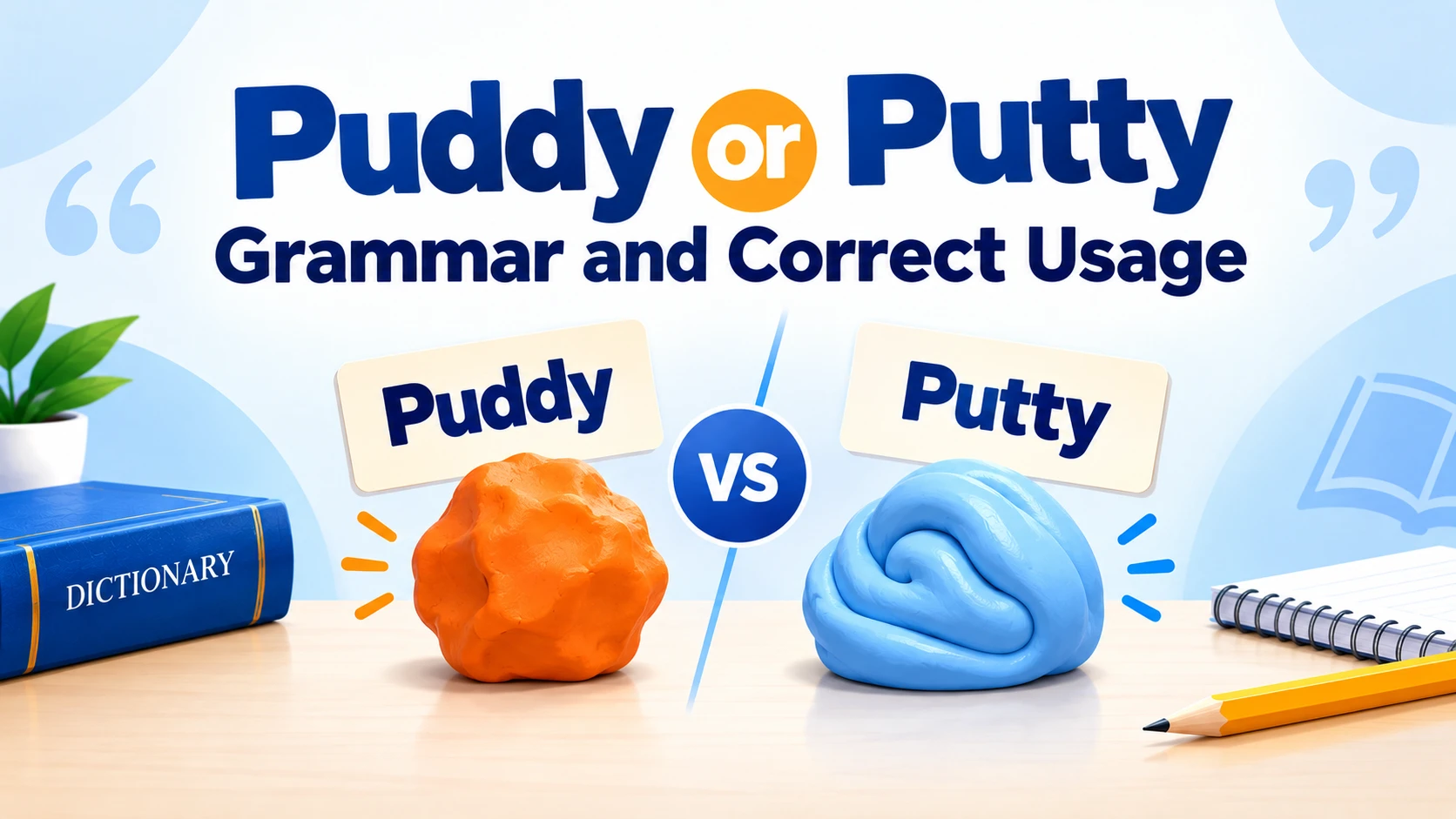
Puddy or putty can be confusing because the two words look almost identical, and puddy may appear in English for reasons that have nothing to do with the material called putty. If you mean the soft substance used for filling, sealing, glazing, repairing, or modeling, the standard spelling is putty. Cambridge defines putty as a soft, clay-like substance used especially for holding glass in window frames or filling small holes in wood.
The complication is that puddy is not simply a nonexistent word. Merriam-Webster records puddy as an adjective meaning “pudgy,” while Collins labels it a rare British adjective meaning “short and podgy.” It can also appear in names, fictional characters, playful expressions, or other specialized contexts. So the right question is not merely “Is puddy a word?” but “Which word fits the meaning I intend?”
For ordinary writing about window repair, woodworking, wall preparation, modeling compounds, or similar materials, choose putty. This article explains its grammar, meanings, common compounds, historical development, and differences from related materials such as filler, paste, caulk, and sealant. It also shows when puddy is a legitimate word and when using it instead of putty would change the meaning or create an avoidable spelling error.
Puddy or Putty: Which Spelling Is Correct?
If you are talking about the repair or sealing material, the correct spelling is:
putty
For example:
The carpenter applied putty to the small holes in the wood.
The old window needs new putty around the glass.
Writing puddy in those sentences would be incorrect because puddy does not function as an alternative spelling of the material.
However, it is too broad to say that puddy is never a real English word. Merriam-Webster defines puddy as an adjective meaning pudgy, and Collins records it as a rare British adjective meaning short and podgy.
So the distinction is:
| Word | Meaning | Use for the repair material? |
| putty | A soft material used for filling, sealing, glazing, modeling, and related purposes | Yes |
| puddy | A rare adjective meaning short/podgy; also found in names and playful expressions | No |
Bottom line: If your intended meaning is the material, write putty.
What Does “Putty” Mean?
Putty is primarily a noun referring to a soft, workable substance. Traditional putty has long been associated with glazing and repairs, while modern products use the word for a much wider range of compounds.
Cambridge classifies putty as an uncountable noun and defines it as a soft substance resembling clay, particularly one used to hold glass in window frames or fill small holes in wood. Its American definition similarly describes a thick, soft material that hardens as it dries.
Putty for window glazing
One of the classic uses is glazing putty.
Traditionally, glaziers used putty to secure glass panes within window frames and create a seal around the glass.
For example:
The restorer removed the cracked putty from the wooden window frame.
Putty for filling wood
Putty is also associated with small repairs in wooden surfaces:
Use wood putty to fill the nail holes before painting.
The important point is that putty is a general material term. Different commercial products can have substantially different formulations and recommended applications.
Putty for walls and surface preparation
In some markets, particularly in construction and home renovation, wall putty refers to a material used to smooth or prepare surfaces before painting or finishing.
The exact composition and application method depend on the product. That is why professional instructions should follow the manufacturer’s specifications rather than assuming every product called putty behaves identically.
Modeling putty
The word also appears in creative and hobby contexts:
- modeling putty
- sculpting putty
- hobby putty
- epoxy putty
These materials may be designed to remain workable for a period and then harden.
They are related by their putty-like consistency and function, not necessarily by identical chemical composition.
Why Do People Write “Puddy” Instead of “Putty”?
The most likely explanation is simple: the words sound similar, and puddy looks like a plausible English spelling.
English contains many words ending in -y, and writers sometimes spell unfamiliar words according to how they hear them. If someone encounters putty mainly in conversation, the double t may not be obvious.
There is another source of confusion: puddy is actually an established word in some dictionary senses. That can make the spelling look more legitimate in a sentence where the writer really intended putty.
The pronunciation can mislead learners
Cambridge gives putty as approximately /ˈpʌt.i/ in British English and /ˈpʌt̬.i/ in American English.
The pronunciation does not reveal the spelling:
putty
contains tt, even though the spoken form does not contain a sound that explicitly tells you “write two t’s.”
That is a normal feature of English spelling.
Typing and autocorrect can add confusion
Modern spelling errors also come from:
- typing quickly
- speech-to-text
- predictive text
- informal messaging
- reading the word incorrectly
- relying on pronunciation rather than an established spelling
If puddy appears in an informal message such as “I need some puddy for the wall,” the intended meaning may be obvious. But clarity of meaning does not make the spelling standard.
Is “Puddy” Ever a Correct English Word?
Yes—but not as the standard spelling of the repair material.
This distinction is worth understanding because an overly simplistic grammar article can create a new misconception.
“Puddy” as an adjective
Merriam-Webster defines puddy as an adjective meaning pudgy.
Collins gives a related rare British-English sense meaning short and podgy.
In that context, puddy has nothing to do with window glazing or wood repair.
So:
The character had a puddy build.
could, in a suitable context, use puddy as an adjective.
That does not mean:
I bought puddy for the window.
is an alternative spelling of putty.
“Puddy” in names and fictional expressions
Puddy can also appear as a surname or character name. There are real people with the surname Puddy, and fictional characters such as David Puddy from Seinfeld.
There are also playful expressions such as “puddy tat”, famously associated with Tweety’s pronunciation of “pussy cat.”
These are proper names or deliberate forms of language. They should not be “corrected” to putty simply because the letters look similar.
Language lesson: A spelling can be legitimate in one context and completely wrong in another. Always identify the intended meaning before correcting a word.
The Grammar of “Putty”
The most common grammatical use of putty is as a noun.
Putty as a noun
Examples:
- The putty is still soft.
- We need more putty.
- The old putty has cracked.
- She applied putty around the frame.
Cambridge labels putty as a noun [U], meaning it is normally treated as an uncountable substance noun.
Putty as an uncountable noun
You would normally say:
We need some putty.
rather than:
We need a putty.
You can quantify it with suitable expressions:
- a small amount of putty
- a layer of putty
- some putty
- a tub of putty
- two kilograms of putty
The exact construction depends on what you are measuring: the substance, a container, or a product.
When “putty” appears in compound terms
English frequently places putty after another noun to specify its purpose:
- wood putty
- wall putty
- glazing putty
- epoxy putty
- modeling putty
- cleaning putty
Here, the first word narrows the meaning of putty.
For example:
The instructions recommend epoxy putty for the repair.
The phrase tells the reader that this is not necessarily the same material as traditional glazing putty.
Can “Putty” Be Used as a Verb?
Yes.
Although the noun is much more common for learners, putty can also function as a verb meaning to apply putty to something.
For example:
The workers puttied the damaged window frame.
He puttied the holes before painting the cabinet.
The verb has related forms such as:
- putty
- putties
- puttied
- puttying
The spelling of the -ing form is particularly worth noticing:
putty → puttying
The final y remains, and the word takes -ing.
Etymonline records the verb putty from the eighteenth century, meaning to cover, mend, or join with putty.
Noun vs. verb
| Form | Example | Function |
| putty | The putty has dried. | Noun |
| putty | They putty the frame. | Verb |
| putties | She putties the holes carefully. | Third-person singular verb |
| puttied | He puttied the damaged surface. | Past tense |
| puttying | They are puttying the frame. | Present participle |
This is a useful grammatical distinction that is often missing from simple spelling articles.
How to Use “Putty” in a Sentence
The word is straightforward once its role is clear.
Home repair
We used putty to fill the small cracks in the wooden frame.
Window maintenance
The old putty around the window has started to deteriorate.
Woodworking
She applied wood putty to the nail holes before sanding the surface.
Modeling
The hobbyist used modeling putty to reshape the miniature.
Technical writing
Apply the specified epoxy putty only after cleaning and drying the repair area.
The last example illustrates an important professional-writing principle: specificity matters more as the technical stakes increase.
A casual conversation might simply say putty. A repair manual may need to identify the exact product type.
Putty, Filler, Paste, Caulk, and Sealant: What’s the Difference?
These terms overlap in everyday conversation, but they should not automatically be treated as synonyms.
| Material | General purpose | Typical characteristic |
| Putty | Filling, glazing, sealing, modeling, or repair depending on type | Usually soft/workable when applied |
| Filler | Filling holes, gaps, dents, or surface imperfections | Broad category; many formulations |
| Paste | Adhesive, coating, or thick substance | Usually soft and spreadable |
| Caulk | Sealing joints and gaps | Designed for joints and often flexibility |
| Sealant | Preventing passage of air, water, or other substances | Broad technical category |
Cambridge defines paste as a thick, soft, sticky substance, particularly one made by mixing liquid and powder for certain adhesive purposes, and lists putty among related materials.
Why the distinction matters
Imagine a homeowner asking:
Can I use putty instead of caulk?
The answer cannot safely be reduced to “yes” or “no.” It depends on:
- the location
- the materials being joined
- movement at the joint
- exposure to water
- temperature
- the manufacturer’s instructions
- the specific product formulation
A language article should not turn a vocabulary definition into a universal repair recommendation.
For technical work, use the product’s specified application rather than choosing a material solely because it has a similar consistency.
Common Types of Putty
Glazing putty
Traditionally associated with securing glass in window frames.
The restorer carefully removed the deteriorated glazing putty.
Wood putty
Used for certain small repairs and surface imperfections in wood.
The woodworker filled the nail holes with wood putty.
Wall putty
A surface-preparation product used in some building and decorating contexts.
The wall was prepared with putty before the final coat of paint.
Modeling putty
Used for shaping, sculpting, crafts, and hobby projects.
She used modeling putty to add details to the miniature.
Epoxy putty
A type of repair compound based on epoxy chemistry.
The technician used epoxy putty for the specified repair.
Cleaning putty
Some products marketed as cleaning putty are soft, tacky compounds designed to pick up dust and debris from difficult-to-clean surfaces.
The common word putty therefore covers a family of materials with different purposes. The adjective or modifier before putty often supplies the information the reader actually needs.
Putty vs. Puddy in British and American English
There is no standard British-American spelling distinction in which American English uses puddy and British English uses putty.
The standard material term is putty in both varieties.
Cambridge provides British and American pronunciations and definitions for putty, but the spelling remains putty.
The more interesting point is that puddy itself has an independent dictionary history.
Collins labels the adjective puddy as rare British English, meaning short and podgy, while Merriam-Webster defines it as pudgy.
So don’t use a supposed “regional spelling rule” to explain puddy when someone means the repair material.
For international English: If you mean the material, use putty.
The History of the Word “Putty”
The word putty has a much longer history than its modern spelling question might suggest.
Etymonline dates the noun to the 1630s, originally referring to a type of plasterer’s fine paste or cement. It traces the word through French potée, associated with a pot-full or its contents.
By the seventeenth century, putty was also used for polishing powder for glass or metals. The specific sense involving a soft paste used to seal window panes is recorded from around 1706.
The word later developed into related technical and figurative uses.
Etymonline also records:
- putty knife from the nineteenth century
- putty as a verb from the eighteenth century
- figurative uses referring to someone easily influenced from the twentieth century
This history explains why putty is now a broader word than simply “window material.”
The Figurative Expression “Putty in Someone’s Hands”
There is a useful idiomatic meaning that has nothing to do with home repair.
To be putty in someone’s hands means to be extremely easy for that person to influence or control.
For example:
He is completely putty in her hands.
The image behind the expression is understandable: putty is soft and easily shaped.
Cambridge lists “be (like) putty in someone’s hands” among the expressions associated with putty.
This is worth learning because someone searching for putty meaning may encounter the idiom and wonder why a repair material appears in a sentence about human behavior.
Common Mistakes With “Puddy” and “Putty”
Writing “puddy” when you mean the material
Incorrect for the intended meaning:
The window needs new puddy.
Standard:
The window needs new putty.
Assuming “puddy” is always meaningless
That goes too far.
Puddy has dictionary-recognized meanings, including the rare adjective puddy = pudgy.
Therefore, context matters.
Treating all putty as one identical product
“Putty” can refer to different materials.
A product called epoxy putty may have different properties and uses from glazing putty or wood putty.
Confusing spelling with pronunciation
The sound of putty does not tell you whether it contains one or two ts.
Learn the established written form:
P-U-T-T-Y
Assuming every similar-looking word is a spelling variant
English contains many pairs that look related but are not:
- putty / puddy
- paste / pasty
- pottery / puttery
- pudding / pudgy
Visual similarity alone does not establish a spelling relationship.
Correct and Incorrect Examples
| If you write… | Use this when you mean… | Better form |
| I need puddy for the window. | Window repair material | I need putty for the window. |
| She applied puddy to the wood. | Material for filling wood | She applied putty to the wood. |
| The puddy is drying. | Repair compound | The putty is drying. |
| He bought wall puddy. | Wall-finishing material | He bought wall putty. |
| The child looked puddy. | Short/podgy appearance | Puddy may be appropriate in the rare dictionary sense |
The final example demonstrates why context is more important than a simplistic “correct/incorrect” label.
If a writer genuinely means pudgy, puddy can be a real adjective. If the writer means the repair substance, the word is putty.
A Practical Decision Guide
Use this quick test whenever you’re unsure.
Step 1: Ask what you mean
Do you mean:
- a repair material?
- a window-sealing compound?
- a wood-filling product?
- a modeling compound?
If yes, use:
putty
Step 2: If you mean “pudgy”
If the word is describing someone or something as short, rounded, or podgy, puddy may occur in its rare dictionary sense.
Step 3: If it is a name
Preserve the established spelling of the proper name.
Step 4: If it is a product
Follow the manufacturer’s official product name, especially in quotations or product descriptions.
Step 5: If it is ordinary English about the material
Choose putty.
Memory rule: PUTTY is the material. PUDDY is a different word with different, much less common uses.
How to Remember the Correct Spelling of Putty
The easiest memory trick is not a complicated grammar rule.
Just associate the word with familiar compounds:
- putty knife
- wood putty
- window putty
- wall putty
- epoxy putty
- modeling putty
Once the word becomes familiar as part of these combinations, the double t becomes easier to remember.
Another useful strategy is to connect the spelling to its verb:
putty → puttied → puttying
That reinforces the identity of the word instead of relying only on pronunciation.
Conclusion
When the subject is the soft material used for filling, glazing, sealing, or certain repair and modeling jobs, the word you want is putty. That is the standard spelling in ordinary English, whether you are writing about window putty, wood putty, wall putty, or another type. Puddy is different: dictionaries record it as a rare adjective meaning pudgy or short and podgy, and it can also occur in names or playful expressions. One final actionable tip: decide what the word means before judging its spelling. A common mistake to avoid is treating every appearance of puddy as a misspelling—or assuming it can replace putty. In precise writing, meaning comes first, and spelling follows it.
Frequently Asked Questions
Q1. Is “puddy” the correct spelling of putty?
No, not when you mean the repair or sealing material. The standard word is putty. However, puddy is independently recorded as a rare adjective meaning pudgy, so it is not accurate to say that the spelling can never occur in English.
Q2. What is the correct spelling: puddy or putty?
Use putty when referring to the soft material used for glazing, filling, repair, modeling, or related purposes. For example, The carpenter used putty to fill the holes. Puddy does not serve as an alternative spelling for this material.
Q3. Is “puddy” a British spelling of “putty”?
No. Putty is the standard spelling of the material in both British and American English. Puddy has separate, rare dictionary uses, including a British adjective meaning short and podgy. It should not be presented as a British spelling variant of putty.
Q4. Is putty a noun or a verb?
Putty is both a noun and a verb. As a noun, it names the material: The putty has dried. As a verb, it means to apply putty: They puttied the frame. The noun is considerably more common in everyday usage.
Q5. Why is putty used around windows?
Traditional glazing putty has been used to hold glass in window frames and create a seal around the pane. Modern window systems may use different glazing technologies and materials, so the appropriate product depends on the particular window and manufacturer’s specifications.
