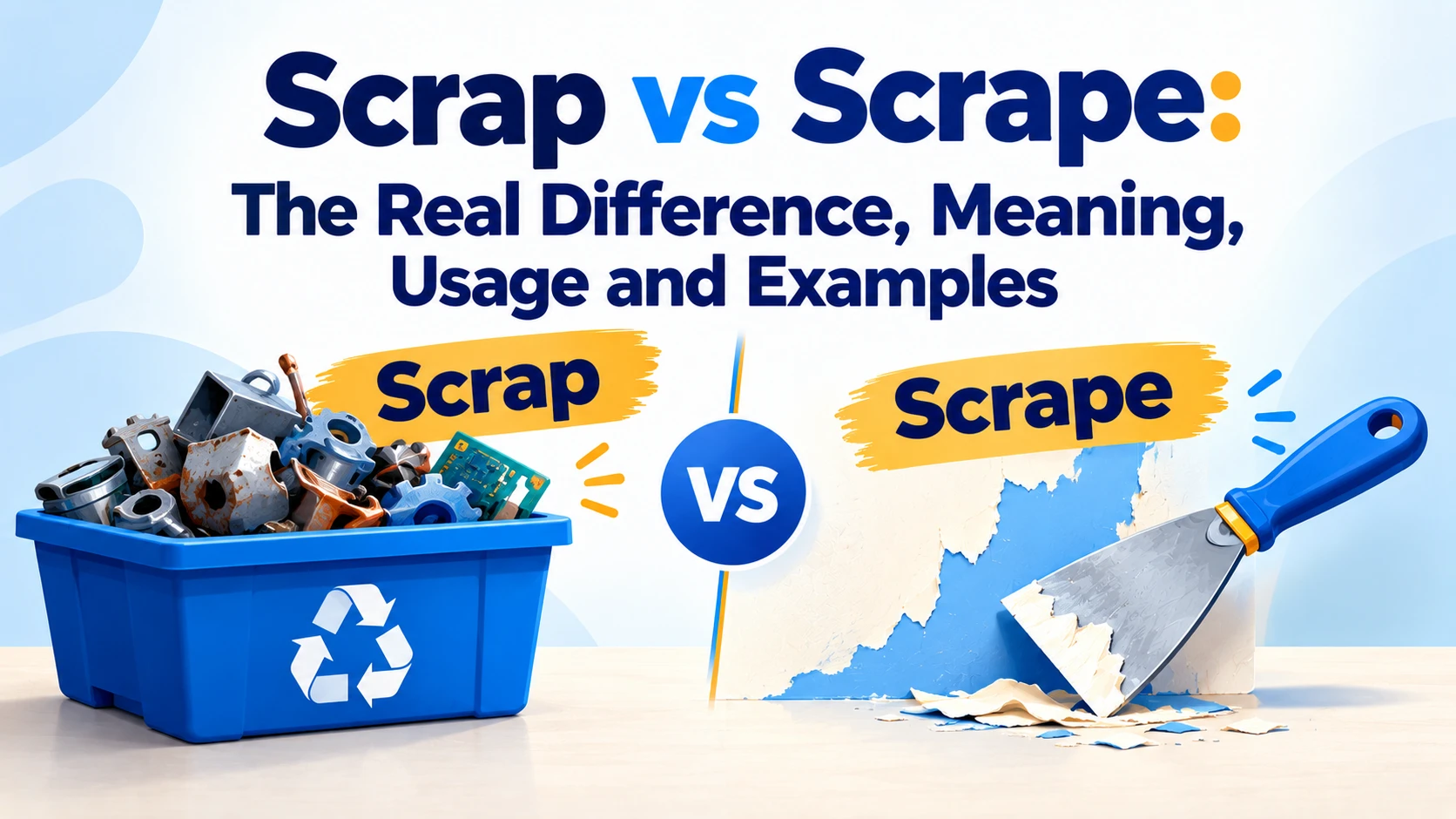
Scrap vs scrape looks like a tiny spelling distinction, but the two words describe noticeably different ideas. Scrap is commonly about something being discarded, abandoned, or left over, while scrape usually involves rubbing, scratching, or removing something from a surface. That difference matters in ordinary writing, workplace communication, technical contexts, and even past-tense forms such as scrapped and scraped. Once you connect each spelling to its central meaning, the choice becomes much easier. This guide explains the definitions, grammar, pronunciation, common collocations, confusing examples, and practical tests you can use when editing your own sentences.
The confusion becomes especially obvious when the words appear in similar-looking sentences. A company can scrap a project, but a worker can scrape paint from a wall. You can sell a damaged machine for scrap, yet you can scrape your knee while moving it. The words can even appear in modern technology: web scraping means collecting information, not throwing a website away. Understanding these distinctions is more useful than memorizing a single synonym because context controls the correct choice. The goal is not merely to spell both words correctly, but to understand why each one belongs where it does.
This article takes a practical, usage-first approach to scrap vs scrape. You will see how each word functions as a noun and verb, how scrapped differs from scraped, and why the final e matters when the words take different grammatical forms. You will also learn where the terms occur in recycling, manufacturing, everyday conversation, injuries, business decisions, and data collection. Along the way, comparison tables and original examples will make the distinction easier to recognize at a glance. By the end, you should be able to choose the right word from meaning rather than relying on guesswork or autocorrect.
Scrap vs Scrape: What Is the Difference?
The simplest distinction is this:
- Scrap usually means discard, abandon, dismantle, or leftover material.
- Scrape usually means rub, scratch, or remove something from a surface.
Cambridge defines scrap as a verb meaning to stop continuing with a system or plan and also uses the noun for old material, especially metal, that can be reused. It also defines scrap as a small piece or amount of something.
Scrape, by contrast, describes a physical action involving rubbing or removing a surface layer. Cambridge gives examples involving scraping snow from a car and scraping a knee against a surface.
| Word | Central idea | Common noun use | Common verb use | Example |
| scrap | Discarding or leftover material | unwanted material or small piece | discard, cancel, dismantle | “They scrapped the proposal.” |
| scrape | Rubbing or removing from a surface | injury, mark, rubbing sound, difficult situation | rub, scratch, remove | “She scraped the paint off.” |
A useful way to think about the difference is destination versus action.
When something becomes unwanted, abandoned, or discarded, scrap is often the right choice. When something is physically rubbed, scratched, or removed from a surface, scrape is usually the right choice.
The fastest way to choose the right word
Ask yourself:
Am I talking about something being discarded or abandoned?
Use scrap.
Am I talking about rubbing, scratching, or removing something from a surface?
Use scrape.
This test handles most everyday cases, although both words have additional meanings that are worth knowing.
What Does “Scrap” Mean?
Scrap has several related meanings, and it can function as both a noun and a verb. Its meanings often revolve around something small, leftover, unwanted, discarded, or abandoned.
“Scrap” as a noun
One common meaning is a small piece or amount of something.
Examples:
- “Write the address on a scrap of paper.”
- “We found a scrap of fabric under the table.”
- “She collected every scrap of information about the case.”
Oxford lists scrap as a countable noun for a small piece of something, particularly materials such as paper or cloth. It also recognizes figurative uses such as scraps of information.
Another important noun meaning is discarded material, especially metal.
- scrap metal
- scrap steel
- scrap machinery
- scrap value
- scrap dealer
For example:
“The damaged vehicle was sold as scrap.”
Here, scrap does not simply mean “trash.” Scrap material may have economic or recycling value because its components can be recovered or reused.
“Scrap” as a verb
As a verb, scrap commonly means to abandon, cancel, or get rid of something.
Examples:
- “The company scrapped the original design.”
- “They decided to scrap the expansion plan.”
- “The government scrapped the old regulation.”
- “We had to scrap our weekend plans.”
Cambridge specifically gives scrap as a verb meaning not to continue with a system or plan. Oxford similarly defines it as canceling or getting rid of something that is no longer practical or useful.
That makes scrap particularly common in business, government, engineering, and project-management language.
Common uses of “scrap”
Scrap materials and recycling
In industrial contexts, scrap often refers to material that is no longer needed in its current form but may still have value.
“The factory sells its excess metal as scrap.”
This is different from ordinary household garbage. Scrap can be collected, processed, recycled, or sold.
Scrapping a plan or project
When a proposed action is abandoned completely, scrap is often more direct than cancel.
“The team scrapped the project after testing revealed serious problems.”
The word suggests that the previous plan is being abandoned rather than merely postponed.
Scrap parts and machinery
A broken machine may be scrapped when repairing it is no longer worthwhile.
“The old generator was scrapped after repeated mechanical failures.”
The physical machine becomes scrap, while the action performed on it is scrapping it.
Small pieces and fragments
Scrap also appears in phrases describing very small amounts:
- a scrap of paper
- a scrap of cloth
- a scrap of evidence
- a scrap of information
- every scrap of food
So the word is broader than “junk.”
Useful expressions with “scrap”
| Expression | Meaning | Example |
| scrap metal | discarded metal collected for reuse/recycling | “The yard buys scrap metal.” |
| scrap paper | paper kept or used as leftover material | “Use scrap paper for rough calculations.” |
| scrap value | value of something based on its recoverable material | “The machine has little scrap value.” |
| scrap heap | pile or collection of discarded material | “The damaged parts went to the scrap heap.” |
| scrap a plan | abandon a plan | “They scrapped the original proposal.” |
| a scrap of information | a small piece of information | “We found one useful scrap of information.” |
What Does “Scrape” Mean?
Scrape is strongly associated with physical contact, rubbing, scratching, or removing material from a surface.
It can also function as both a noun and a verb.
“Scrape” as a verb
The most useful meanings are:
- To remove something from a surface
- To rub against something and cause slight damage
- To collect or gather something by scraping
- In certain expressions, to obtain or manage something with difficulty
Cambridge defines scrape as removing an unwanted covering or top layer, often with something sharp or rough. It also defines the verb as rubbing against a surface in a way that causes slight damage or an unpleasant sound.
Examples:
- “Please scrape the mud off your boots.”
- “He scraped the ice from the windshield.”
- “She scraped her knee on the pavement.”
- “The chair scraped against the floor.”
Notice that the first two examples involve removing something from a surface, while the third and fourth involve rubbing against a surface.
“Scrape” as a noun
A scrape can refer to a small injury or mark caused by rubbing against something rough.
“He had a small scrape on his elbow.”
It can also describe the unpleasant sound produced by rubbing objects together:
“I heard the scrape of a chair across the floor.”
Oxford also records scrape as an informal noun meaning a difficult situation, especially one someone has caused for themselves.
For example:
“He got into another scrape with the law.”
This meaning has nothing directly to do with removing paint or scratching a surface, which shows why memorizing only one definition can be misleading.
Common uses of “scrape”
Scraping paint, dirt, or food
“We need to scrape the old paint off before repainting the door.”
“She scraped the burnt food from the pan.”
The important idea is that material is being removed through friction or a tool.
Scraping an injury
“I scraped my knee when I fell.”
Here, the person is not intentionally removing anything. The skin is damaged through contact with a rough surface.
Scraping against an object
“The car scraped against the wall.”
This means the vehicle rubbed against the wall, potentially leaving a mark or causing damage.
Scraping together resources
In phrases such as scrape together or scrape up, the word takes on a figurative meaning.
“We managed to scrape together enough money for the repair.”
The phrase suggests gathering something with difficulty from limited resources.
Scrap vs Scrape: Side-by-Side Comparison
The clearest way to see the distinction is to compare how the words behave in real sentences.
| Feature | Scrap | Scrape |
| Main concept | Discarding, abandoning, leftover material | Rubbing, scratching, removing |
| Common noun meaning | Small piece; discarded material | Injury, mark, rubbing action/sound |
| Common verb meaning | Cancel, discard, dismantle | Rub, scratch, remove |
| Business use | Scrap a project | Scrape data |
| Industrial use | Scrap metal | Scrape paint |
| Everyday use | Food scraps | Scrape food from a pan |
| Past tense | scrapped | scraped |
| -ing form | scrapping | scraping |
| Example | “They scrapped the plan.” | “They scraped the wall.” |
Examples that make the difference obvious
Compare these pairs:
1. Project
- “The company scrapped the project.”
→ The project was canceled. - “The company scraped the project.”
→ This is generally not the intended meaning.
2. Paint
- “They scraped the paint off the door.”
→ They physically removed it. - “They scrapped the paint off the door.”
→ Incorrect if you mean physically removing paint.
3. Metal
- “The factory sold the damaged parts as scrap.”
→ The parts are unwanted material. - “The worker scraped the metal against the machine.”
→ The metal rubbed against something.
The spelling is close, but the underlying concepts are not.
Scrap vs Scrape in Sentences
Correct examples with “scrap”
- “The mechanic sold the damaged engine for scrap.”
- “We used a scrap of paper to write the measurements.”
- “The board decided to scrap the proposal.”
- “The restaurant separates food scraps for composting.”
- “The old equipment was eventually scrapped.”
Correct examples with “scrape”
- “She scraped the mud off her shoes.”
- “He scraped his elbow during the fall.”
- “The shovel scraped against the concrete.”
- “We had to scrape the ice off the windshield.”
- “They scraped together enough money to replace the part.”
Incorrect vs correct sentences
| Incorrect | Correct | Why |
| “They scraped the old policy.” | “They scrapped the old policy.” | A policy is being canceled. |
| “She scrapped the paint off.” | “She scraped the paint off.” | Paint is being physically removed. |
| “He scraped the broken machine.” | “He scrapped the broken machine.” | The machine is being discarded. |
| “She scrapped her knee.” | “She scraped her knee.” | The skin was injured through rubbing. |
| “The company scraped its expansion plans.” | “The company scrapped its expansion plans.” | The plans were abandoned. |
The best correction is not based on which spelling “looks right.” Identify what happened, then select the verb that expresses that action.
Scrapped vs Scraped: Why the Past-Tense Forms Cause Confusion
This is one of the most common spelling problems involving these words.
When to use “scrapped”
Scrapped is the past tense and past participle of scrap.
Use it when something was:
- canceled
- abandoned
- discarded
- dismantled
- sent for scrap
Examples:
“The company scrapped the plan.”
“The old vehicle was scrapped.”
Oxford lists scrapped as the past form and past participle of scrap.
When to use “scraped”
Scraped is the past tense and past participle of scrape.
Use it when something was:
- rubbed against a surface
- scratched
- removed from a surface
- gathered by scraping
Examples:
“She scraped her knee.”
“He scraped the ice off the car.”
Cambridge identifies scraped as the past simple and past participle of scrape.
Scrapped vs scraped at a glance
| Base verb | Past tense | Meaning | Example |
| scrap | scrapped | discarded/canceled | “They scrapped the plan.” |
| scrape | scraped | rubbed/removed | “They scraped the paint.” |
Why “scrapped” has double P but “scraped” does not
The spelling follows the different base words.
Scrap ends in a consonant, so its final consonant is doubled before -ed:
scrap → scrapped
It is also doubled before -ing:
scrap → scrapping
Scrape, however, already ends in silent e. When -ed is added, the final e remains:
scrape → scraped
Before -ing, the silent e is removed:
scrape → scraping
So:
- scrap → scrapped → scrapping
- scrape → scraped → scraping
This spelling distinction is especially useful when proofreading because scrapped and scraped can completely change the meaning of a sentence.
Scrap vs Scrape and Related Words
Some confusion comes from treating these words as interchangeable with nearby terms.
Scrap vs scratch
Scratch and scrape overlap, but they are not identical.
A scratch is often a narrow mark or superficial injury caused by a sharp object or contact.
A scrape emphasizes rubbing against a surface or removing a layer.
Compare:
“The cat scratched my hand.”
“I scraped my knee on the pavement.”
Both can result in skin damage, but the actions are described differently.
Scrap vs trash vs waste
Scrap does not always mean ordinary garbage, Scrap metal, for example, can have commercial value because it can be recovered and processed. Cambridge’s business definition specifically describes scrap as old material, especially metal, that can be sold and used again.
A useful distinction is:
- Trash/garbage → unwanted material generally regarded as waste
- Waste → material or resources not effectively used
- Scrap → leftover or discarded material that may still be useful, recyclable, or valuable
The boundaries depend on context, so these words should not be treated as perfect synonyms.
Scrape vs peel vs scratch
These words describe different ways of interacting with a surface.
- Scrape → remove by rubbing or using a rough/sharp edge
- Peel → remove a covering or outer layer
- Scratch → mark or injure a surface with something sharp or rough
For example:
“Scrape the burnt food from the pan.”
“Peel the label from the bottle.”
“The key scratched the table.”
Common Scrap vs Scrape Mistakes
Using “scrape” when you mean “discard”
❌ “The committee scraped the proposal.”
✅ “The committee scrapped the proposal.”
The proposal is not being rubbed against a surface. It is being abandoned.
Using “scrap” when you mean “remove by rubbing”
❌ “She scrapped the ice off the windshield.”
✅ “She scraped the ice off the windshield.”
The ice is physically removed through a scraping action.
Confusing “scrapped” and “scraped”
This is particularly easy to miss during proofreading:
❌ “The company scraped its outdated policy.”
✅ “The company scrapped its outdated policy.”
But:
❌ “He scrapped the mud from his boots.”
✅ “He scraped the mud from his boots.”
The surrounding noun does not determine the answer by itself. The action does.
Misunderstanding “scrape” in technology
Web scraping is a well-established technical expression for extracting information from websites or computer screens. Cambridge describes data scraping/web scraping as taking information from a website or screen and transferring it into a structured format such as a spreadsheet.
So:
“The program scraped data from the website.”
does not mean:
“The program deleted the website.”
It means the program collected information from it.
Choosing by sound instead of meaning
The words are pronounced differently:
- scrap /skræp/
- scrape /skreɪp/
The vowel sound changes, but pronunciation alone is not a reliable editing strategy. Context is stronger evidence.
How to Remember Scrap vs Scrape
Scrap = something discarded or abandoned
Think:
Scrap → throw away, cancel, leftover
Examples:
- scrap metal
- scrap paper
- scrap a plan
- scrap an old machine
Scrape = a rubbing or removing action
Think:
Scrape → rub, scratch, remove from a surface
Examples:
- scrape paint
- scrape ice
- scrape your knee
- scrape food from a pan
Use the “What happened?” test
When you are unsure, do not stare at the spelling. Describe the event in plain language.
If the answer is:
“It was canceled or discarded.”
Choose scrap.
If the answer is:
“It was rubbed, scratched, or removed from a surface.”
Choose scrape.
This works better than a mnemonic because it focuses on the actual meaning of the sentence.
Pronunciation and Spelling: Scrap vs Scrape
The final e in scrape is important.
| Word | Pronunciation | Key spelling feature |
| scrap | /skræp/ | short vowel |
| scrape | /skreɪp/ | silent e changes the vowel pattern |
| scrapped | /skræpt/ | double p |
| scraped | /skreɪpt/ | retains the spelling pattern of scrape |
The pronunciation difference helps distinguish the words when speaking, while the spelling difference becomes especially important in written forms.
For learners, the most useful pair to memorize is not simply scrap/scrape, but:
scrap → scrapped
and
scrape → scraped
Those forms appear frequently in real writing and are much more likely to create an editing mistake.
How Scrap and Scrape Work in Different Contexts
Business and project management
Scrap is common when organizations abandon decisions, proposals, systems, or projects.
“The company scrapped its original launch strategy.”
The word is particularly useful when something previously considered viable is deliberately abandoned.
Scrape generally has no role in this sense.
Manufacturing, construction, and repair
Both words can appear in the same workplace, but they describe different things.
“The damaged panels were sent for scrap.”
“The technician scraped the old sealant from the frame.”
The first concerns the status or destination of material. The second describes a physical removal process.
Everyday household situations
Consider a kitchen:
“Put the vegetable scraps in the compost container.”
but:
“Scrape the remaining sauce from the bowl.”
The scraps are the leftover pieces. Scraping is the action used to remove something.
Digital and technical contexts
Modern technology gives scrape another important meaning:
“The application scrapes product information from several pages.”
This is why writers working in technology, SEO, data analysis, and software documentation need to understand the word beyond its physical meaning.
Grammar and Word Forms You Should Know
Forms of “scrap”
| Form | Word |
| Base form | scrap |
| Third-person singular | scraps |
| Past tense | scrapped |
| Past participle | scrapped |
| -ing form | scrapping |
Examples:
- “They scrap outdated equipment.”
- “The company scraps defective units.”
- “They scrapped the proposal.”
- “The equipment has been scrapped.”
- “Workers are scrapping obsolete machinery.”
Forms of “scrape”
| Form | Word |
| Base form | scrape |
| Third-person singular | scrapes |
| Past tense | scraped |
| Past participle | scraped |
| -ing form | scraping |
Examples:
- “They scrape the surface.”
- “He scrapes the residue away.”
- “She scraped her knee.”
- “The paint has been scraped off.”
- “They are scraping the wall.”
The spelling difference is easy to remember when you see the full verb families together.
When Scrap and Scrape Can Appear in the Same Sentence
The two words are not opposites. In fact, a single situation can legitimately involve both.
Consider an old car:
“The mechanic scraped the rust from the panel before deciding to scrap the vehicle.”
Two separate actions are happening.
First, rust is scraped away from a surface.
Later, the entire vehicle is scrapped because it is no longer worth repairing.
Another example:
“Workers scraped the old coating from the machine before sending the damaged unit to scrap.”
Again, the first word describes an action; the second describes the discarded material or destination.
This is a useful advanced distinction because it shows that context does not force you to choose one word for an entire situation. The same object can be scraped during a process and eventually scrapped.
Scrap vs Scrape: A Practical Decision Guide
Choose “scrap” if you mean:
- discard something
- cancel something
- abandon a plan
- dismantle something for its materials
- leftover material
- a small piece or amount
- discarded metal or machinery
Choose “scrape” if you mean:
- rub against a surface
- scratch a surface or skin
- remove material from a surface
- clean something by scraping
- gather something with difficulty
- collect information through web scraping
Five-second editing checklist
Before publishing, ask:
- What actually happened?
- Was something canceled or discarded?
- Was something rubbed or removed from a surface?
- Is the word a noun or a verb?
- If it is a past-tense verb, should it be scrapped or scraped?
That short check catches most errors without requiring a dictionary every time.
Conclusion
Understanding scrap vs scrape becomes straightforward once you stop treating them as two nearly identical spellings. Scrap centers on something being discarded, abandoned, dismantled, or left over, whereas scrape centers on rubbing, scratching, removing, or extracting. That distinction also explains the important past-tense forms: scrapped means canceled or discarded, while scraped means rubbed or removed. One final actionable tip: when proofreading, describe the action in plain English before choosing the spelling. If something was thrown away or abandoned, think scrap; if something was rubbed or removed from a surface, think scrape. A common mistake to avoid is choosing the word because it merely “looks right.” Meaning should make the decision for you.
Frequently Asked Questions
Q1. What is the main difference between scrap and scrape?
Scrap usually refers to something discarded, abandoned, or left over, while scrape usually describes rubbing, scratching, or removing material from a surface. The distinction is semantic rather than merely orthographic, so the surrounding action or situation should determine which word you choose.
Q2. Is it “scrapped” or “scraped” a project?
Use scrapped when you mean the project was canceled or abandoned. For example, “The company scrapped the project.” Scraped would normally suggest a physical action involving rubbing or removing something, so it does not express cancellation in standard usage.
Q3. Is it “scrap” or “scrape” paint off a wall?
Use scrape: “They scraped the paint off the wall.” The sentence describes physically removing a surface layer, which is one of the central meanings of scrape. Scrap would instead suggest discarding or abandoning something.
Q4. What is the difference between scrap metal and scraped metal?
Scrap metal means unwanted or leftover metal that is collected for disposal, recycling, reuse, or sale. Scraped metal is not an equivalent fixed term; it normally describes metal that has been subjected to a scraping action. The two phrases therefore focus on different properties.
Q5. What does “scrape” mean in web scraping?
In web scraping, scrape means to collect information from websites or computer screens, usually for storage or analysis. It is a specialized computing use of the ordinary idea of extracting something from a surface. Cambridge recognizes web scraping and data scraping in this technical sense.
