
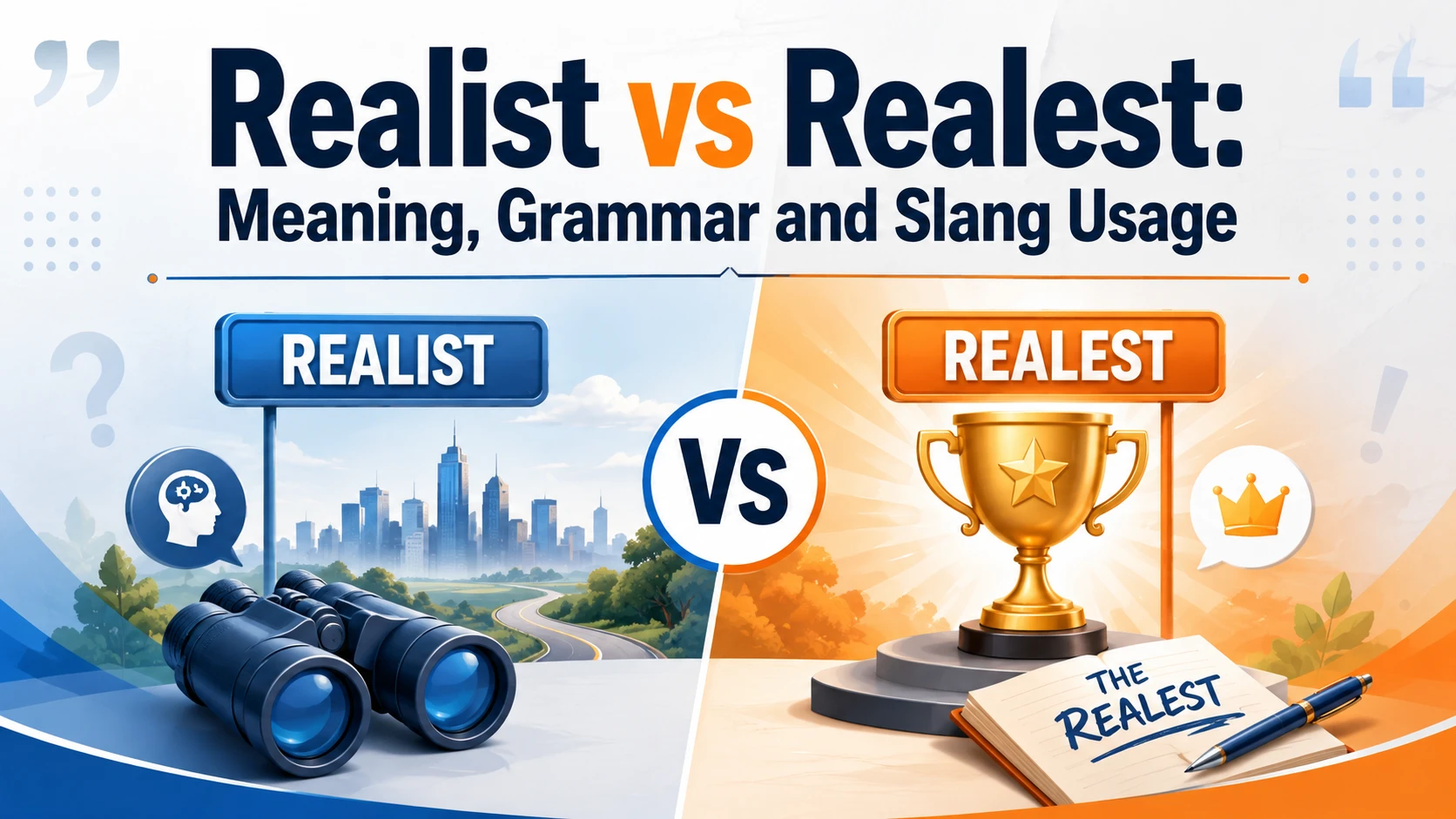
Realist vs realest can be confusing because the words share the same root but have different meanings and grammatical roles. A realist is usually a person who views situations according to facts, reality, and likely outcomes. Realest is the superlative form of real and can mean most real. In modern informal language, it often describes someone who is especially authentic, honest, loyal, or genuine.
The two words are not interchangeable. Realist is primarily a noun and commonly appears in discussions about everyday decision-making, philosophy, art, literature, and politics. Realest is usually used as a descriptive word, especially in casual speech, social media, music, and internet culture. The correct choice depends on what you want to say and the tone you want to create.
This guide explains the meaning, grammar, pronunciation, slang usage, examples, and common mistakes connected with realist and realest. By the end, you will know when to use each word naturally and accurately.
Realist vs Realest — Quick Answer
| Word | Main Meaning | Usual Grammar Role | Typical Tone |
| Realist | A person who focuses on facts and likely outcomes | Noun | Neutral, formal, or academic |
| Realest | Most real; often most authentic or genuine | Superlative adjective | Informal, expressive, or slang-based |
The easiest way to remember the difference is:
A realist is a person who looks at reality.
The realest person is often described as the most authentic or genuine.
For example:
Sara is a realist. She considers the risks before making a decision.
You’re the realest friend I know. You have always been honest and loyal.
What Does “Realist” Mean?
A realist is a person who tends to judge situations according to facts, evidence, and what is likely to happen. A realist does not necessarily expect negative outcomes. Instead, they try to see both opportunities and limitations clearly.
For example:
Omar is a realist. He believes the project can succeed, but he knows it will require time and funding.
In this sentence, Omar is not being pessimistic. He is making a practical assessment.
Simple Definition
A realist is someone who:
- Accepts facts
- Considers practical limits
- Thinks about likely outcomes
- Plans for possible challenges
- Avoids unrealistic expectations
A realist may still be hopeful. The difference is that their hope is usually based on what seems possible.
Realist as a Noun
Realist is primarily a noun. It identifies a person who has a realistic or practical approach.
Examples:
She is a realist when it comes to financial planning.
The team needs a realist who can identify possible risks.
After years of experience, he became more of a realist.
As a realist, she prefers evidence over assumptions.
In each example, realist refers to a person.
Realist in Philosophy, Art, and Politics
The word realist can have specialized meanings in academic fields. Its exact meaning depends on the subject.
Realist in Philosophy
In philosophy, a realist generally supports a form of realism—the view that certain aspects of reality exist independently of individual thoughts, beliefs, or perceptions.
For example:
A philosophical realist may argue that physical objects exist even when nobody is observing them.
Philosophical realism includes several different theories, so the meaning can vary depending on the topic.
Realist in Art and Literature
In art and literature, a realist is associated with realism, a style that represents ordinary life, people, and social conditions without excessive idealization.
Examples:
The painter was known as a realist because of her detailed portrayals of everyday life.
The novelist used a realist style to describe social problems.
Realist in Politics
In political studies, a realist may support an approach that emphasizes power, national interests, security, and practical outcomes.
For example:
The political realist focused on the likely consequences of the policy rather than its ideal goals.
These specialized meanings are related to the idea of reality, but they are not identical to the everyday meaning of a practical person.
Realist vs Optimist
A realist and an optimist can both believe that a situation will succeed. Their approaches are different.
| Mindset | Typical Approach |
| Optimist | Focuses on positive possibilities |
| Realist | Evaluates facts, risks, and likely outcomes |
Example:
Optimist:
“The new business could grow quickly.”
Realist:
“The business could grow, but we will need funding, a strong plan, and time.”
The realist is not automatically less hopeful. They are simply more focused on practical conditions.
Realist vs Pessimist
A pessimist expects negative outcomes, while a realist evaluates what is most likely based on available information.
| Mindset | Typical Approach |
| Pessimist | Expects problems or failure |
| Realist | Considers both opportunities and risks |
Example:
Pessimist:
“The project will fail.”
Realist:
“The project may fail if we do not secure enough funding.”
The realist does not assume failure. They identify a realistic risk.
What Does “Realest” Mean?
Realest is the superlative form of real. It can literally mean most real, although the most natural wording depends on the sentence and intended meaning.
In modern informal language, realest often means:
- Most authentic
- Most genuine
- Most honest
- Most loyal
- Most trustworthy
For example:
You are the realest friend I have ever had.
This usually means:
You are the most genuine and loyal friend I have ever had.
The speaker is not comparing physical reality. They are expressing trust, appreciation, or emotional closeness.
Is “Realest” a Real Word?
Yes. Realest is a valid English word and can function as the superlative form of real.
English commonly forms superlatives by adding -est, especially to short adjectives:
- Fast → fastest
- Strong → strongest
- Smart → smartest
- Real → realest
However, realest may sound more natural in some contexts than others. In formal writing, a more precise word is often clearer.
For example, instead of writing:
She is the realest leader in the organization.
you might write:
She is the most authentic leader in the organization.
or:
She is the most trustworthy leader in the organization.
The best choice depends on the meaning you want to express.
Realest in Slang and Informal Language
In slang, realest is strongly connected with authenticity, honesty, loyalty, and credibility.
Common expressions include:
- You’re the realest.
- She’s the realest one.
- He is one of the realest people I know.
- Realest friend ever.
- Stay real.
- Realest vibes.
These expressions are common in:
- Casual conversations
- Social media captions
- Online communities
- Music culture
- Informal messages
The tone is personal and expressive rather than formal.
What Does “You’re the Realest” Mean?
When someone says:
“You’re the realest.”
they usually mean:
“You are one of the most genuine, honest, loyal, or trustworthy people I know.”
The phrase is often used as praise or appreciation.
Example:
“You supported me when things were difficult. You’re the realest.”
The speaker is thanking someone for being loyal and genuine.
“Keep It Real” and Modern Usage
The phrase keep it real means to remain honest, authentic, or true to yourself.
It can suggest:
- Do not pretend to be someone else
- Be honest about your thoughts
- Stay loyal to your values
- Avoid fake or exaggerated behavior
Example:
“No matter how successful you become, keep it real.”
The phrase has influenced the modern informal meaning of realest.
Realest in Music and Popular Culture
The word realest became especially common in music and popular culture because it communicates authenticity in a short and emotional way.
When a person is called the realest, the speaker may be praising their:
- Loyalty
- Honesty
- Credibility
- Consistency
- Authentic personality
The word is common in informal cultural language, but its meaning can change slightly depending on the community and context.
Is “Realest” Appropriate in Formal Writing?
Realest is grammatically valid, but it may not be the clearest choice in formal writing.
| Context | Is “Realest” Appropriate? |
| Casual conversation | ✅ Yes |
| Text messages | ✅ Yes |
| Social media | ✅ Yes |
| Informal captions | ✅ Yes |
| Song lyrics | ✅ Yes |
| Academic writing | ⚠️ Usually use a more precise word |
| Business reports | ⚠️ Usually use a more specific word |
| Legal documents | ❌ Avoid vague or slang-based wording |
In formal writing, choose the exact quality you mean.
Instead of realest, consider:
- Most authentic
- Most genuine
- Most honest
- Most trustworthy
- Most realistic
- Most significant
These words are not always synonyms, so choose according to context.
Realist vs Realest — Main Differences
| Feature | Realist | Realest |
| Main meaning | A person who focuses on facts or reality | Most real; often most authentic or genuine |
| Grammar role | Primarily a noun | Superlative adjective |
| Refers to | A person or a specialized school of thought | A quality or degree |
| Common tone | Neutral, formal, or academic | Informal, expressive, or slang-based |
| Example | She is a realist. | She is the realest person I know. |
How to Use “Realist” Correctly
Use realist when you are talking about a person or a person’s approach to reality.
Examples:
My father is a realist. He always considers the cost before making a decision.
As a realist, she knew the plan would require more time.
The economist was a realist who focused on measurable outcomes.
The author was known for realist fiction.
Political realists often emphasize national interests and practical consequences.
Notice that the meaning changes slightly depending on the field.
How to Use “Realest” Correctly
Use realest when describing the highest degree of being real or, in informal language, the highest degree of authenticity.
Examples:
You are the realest friend I have ever had.
She is one of the realest people on the team.
His message felt honest and real, but her response felt the realest.
The fans praised the artist for being one of the realest voices in music.
The first two examples are informal and expressive. The last example reflects modern cultural usage.
Realist vs Realistic
Realist and realistic are closely related, but they have different grammatical roles.
| Word | Grammar Role | Meaning |
| Realist | Usually a noun | A person who views situations according to facts or reality |
| Realistic | Adjective | Practical, achievable, or close to reality |
Examples:
She is a realist.
Her plan is realistic.
He is a realist about the risks.
The budget is realistic.
A useful memory trick is:
Realist = person
Realistic = description
Common Mistakes
Mistake 1: Using “Realest” When You Mean “Realist”
Incorrect:
She is the realest person on the financial team.
This means she is the most authentic or genuine person.
If you mean that she is practical, write:
She is the realist on the financial team.
Mistake 2: Using “Realist” as a General Adjective
Unclear:
The company needs a realist plan.
Better:
The company needs a realistic plan.
Use realistic to describe a plan, goal, expectation, or estimate.
Mistake 3: Using “Realest” Without Explaining the Quality
Vague:
He is the realest manager.
Clearer:
He is the most honest manager.
or:
He is the most authentic manager.
In formal writing, a specific adjective is often more effective.
Mistake 4: Assuming a Realist Is Negative
A realist is not automatically pessimistic.
A realist may say:
“The goal is possible, but we need more time and resources.”
This is practical rather than negative.
Quick Practice: Realist or Realest?
Choose the correct word.
She is a ________ and always considers the risks.
Answer: Realist
You supported me when no one else did. You are the ________.
Answer: Realest
The company needs a more ________ budget.
Answer: Realistic
Which sentence is correct?
❌ He is the realest person when discussing financial risks.
✅ He is the realist in the group when discussing financial risks.
Complete the sentence
My brother is the ________ person I know. He is always honest and loyal.
Answer: Realest
Key Takeaways
| Word | Remember This |
| Realist | A person who focuses on facts, reality, or likely outcomes |
| Realest | Most real; often most authentic or genuine in informal language |
| Realistic | Practical, achievable, or close to reality |
The easiest memory rule is:
A realist is a person.
Realest describes the highest degree of being real or authentic.
Realistic describes a practical idea, plan, or expectation.
Conclusion
Understanding Realist vs Realest becomes much easier once you know their distinct roles in English grammar and modern language usage. A realist is a person who views reality through a realistic perspective, while realest is a slang term used to describe someone as the most authentic or most genuine. Although these similar words may sound alike, they have very different meanings, grammar functions, and contextual usage. By learning the difference, improving your word choice, and focusing on correct usage, you can strengthen your writing skills, speaking skills, communication clarity, and overall language proficiency. Whether you are working on academic writing, professional communication, social media captions, or everyday conversations, using the right term helps create more meaningful communication, better readability, and greater confidence in both written and spoken English.
FAQs
Q1. What Is the Main Difference Between Realist and Realest?
The main difference is that realist is a noun that refers to a person who sees things as they truly are, while realest is a superlative form often used in slang to describe the most authentic or most genuine person. This meaning difference is important for correct usage and communication clarity.
Q2. Is Realest a Proper English Word?
Yes, realest is a recognized word because it is the superlative form of real. However, it is more common in informal language, social media, hip-hop slang, song lyrics, and casual conversations than in formal writing or academic writing.
Q3. When Should I Use the Word Realist?
You should use realist when talking about a person who has a realistic perspective or focuses on reality rather than ideal situations. The term frequently appears in philosophy, art, literature, professional writing, and other formal contexts.
Q4. Why Do People Get Confused Between Realist and Realest?
Many people experience confusion because the words share the same root word, look similar, and are connected to the idea of being real. However, they serve different grammar functions, have different meanings, and are used in different contexts, which can lead to common grammar mistakes.
Q5. How Can I Remember the Correct Usage of Realist and Realest?
A simple way to remember the correct usage is to think of realist as a person and realest as a description of the most authentic person or thing. Reviewing usage examples, paying attention to contextual meaning, and practicing word recognition can improve language awareness, writing confidence, and overall communication skills.
