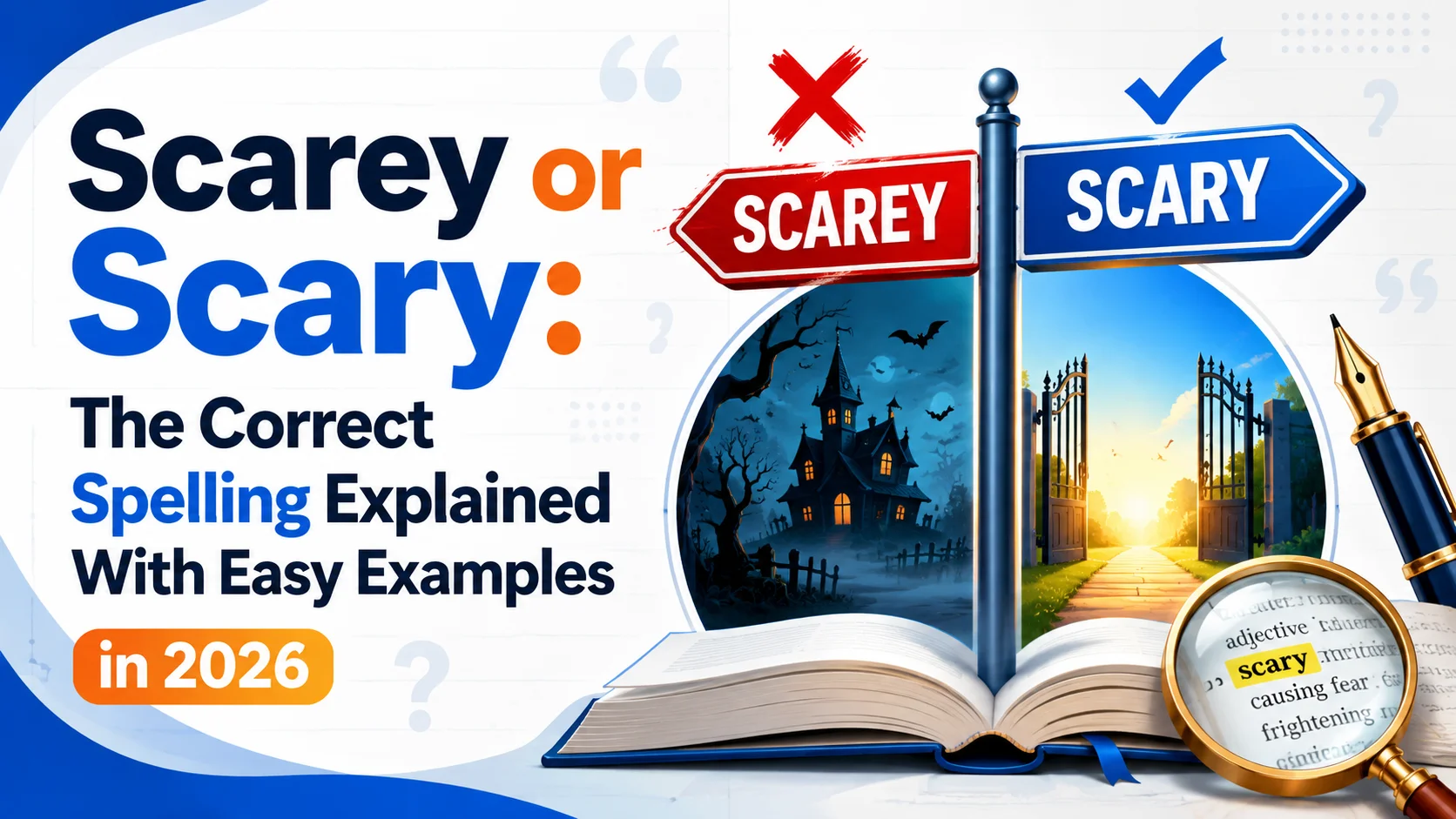
Scarey or scary can look like a simple spelling question until you discover that dictionaries treat the two forms differently depending on English variety and usage. If you’re writing in American English, scary is the form you should normally choose. However, there is an important detail that many quick grammar guides miss: scarey is listed as a variant spelling in major dictionaries, particularly in British English. Cambridge labels it “UK also scarey,” while Collins describes scarey as a variant spelling of scary.
That distinction matters because saying “scarey is never a word” is too absolute. The two spellings have the same basic meaning when scarey is used as the variant. Scary is the familiar form you’ll want in most modern writing, especially in American English, school assignments, business communication, websites, and other situations where conventional spelling matters. Scarey can still appear in British English or historical and informal usage.
So what should you actually type? In nearly every ordinary situation, choose scary. This article explains why the spelling is scary, what scarey means when it appears, how to use scary naturally, and how it differs from words such as scared, creepy, spooky, frightening, and terrifying. You’ll also get practical examples and a simple rule that makes this spelling decision much easier.
Scarey or Scary: Which Spelling Should You Use?
The practical answer is straightforward:
Use scary as your default spelling.
Scary is the standard and widely preferred form in modern English. It is an adjective meaning frightening or causing fear. Cambridge lists scary as an informal adjective meaning “frightening,” while Collins gives the same core meaning and records scarey as a British variant.
| Form | Status | Meaning | Best practical choice |
| scary | Standard and widely preferred | Causing fear or alarm | Yes |
| scarey | Recognized variant, especially British English | Same basic meaning as scary | Usually choose scary |
| scarry | Misspelling in this context | — | No |
| scaryy | Misspelling | — | No |
There is one important qualification. Scarey isn’t simply meaningless or nonexistent. Merriam-Webster lists it as a “variant spelling of scary,” while Collins specifically identifies it as a variant in British English.
That means the best answer depends slightly on what you mean by “correct.”
- For American English, use scary.
- For general modern English, scary is the safest choice.
- In British English, scarey can occur as a recognized variant.
- In formal or professional writing, scary is the better default.
A quick example
Correct and natural:
That was a scary experience.
A British writer may encounter or use:
That was a scarey experience.
The meaning is essentially the same. The spelling preference is different.
What Does “Scary” Mean?
Scary is an adjective used for something that causes fear, alarm, nervousness, or unease. Cambridge defines it as “frightening,” and its American English entry describes it as something that makes you feel frightened.
You can use scary for physical danger:
That dog looks scary.
You can use it for an experience:
Driving through the storm was scary.
You can use it for fiction:
We watched a scary movie last night.
You can even use it for an idea or possibility:
It’s scary to think about what could happen.
The word doesn’t necessarily mean terrifying. Something can be mildly scary without producing extreme fear.
Scary can describe different levels of fear
Consider these sentences:
- The abandoned house was scary.
- The sudden noise was really scary.
- The accident was extremely frightening.
- The experience was terrifying.
All four describe fear. Their intensity and tone differ.
This is useful when choosing vocabulary. Scary is broad and conversational. Frightening is more neutral and often more suitable for formal writing. Terrifying suggests a much stronger emotional reaction.
Is “Scarey” a Word?
Yes, with an important qualification.
Some online grammar pages incorrectly claim that scarey does not exist at all. Major dictionaries show that this is too simplistic. Merriam-Webster lists scarey as a variant spelling of scary, and Collins identifies it as a variant spelling in British English.
Cambridge goes further by labeling its entry “informal (UK also scarey)”.
So there are two different questions:
Is “scarey” found as a recognized English spelling?
Yes.
Is “scarey” the spelling you should normally use?
Usually no. Scary is the safer and more widely familiar choice.
This distinction is especially important for learners. A dictionary may record a variant without making it the preferred spelling for every context.
Why do people think “scarey” is wrong?
The answer is partly about frequency and convention.
Most readers are accustomed to scary. When they see scarey, they may interpret it as a spelling mistake even though dictionaries recognize the variant. That creates a practical problem: a technically recognized spelling isn’t always the best stylistic choice.
For that reason, if your goal is clear modern writing with minimal reader distraction, choose scary.
Why Is It Spelled “Scary” Instead of “Scarey”?
This is where the spelling becomes easier to remember.
The adjective is related to scare and the suffix -y. Historical sources trace scary to scare + -y. The Online Etymology Dictionary dates the adjective to the 1580s and records both scary and scarey historically.
English spelling often changes the appearance of a base word when a suffix is added.
Compare:
- scare → scary
- ice → icy
- spice → spicy
- noise → noisy
- shine → shiny
The useful pattern is not “always remove the final e before -y” because English has exceptions. Instead, remember the established spelling of the individual word:
scare → scary
The easiest spelling rule
If you’re trying to spell the adjective meaning “causing fear,” don’t preserve the final e from scare.
Write:
scary
not:
scarey
This is a spelling pattern worth learning as a complete word rather than trying to reconstruct it every time.
Scary vs Scarey: What Is the Real Difference?
The most important point is that the meaning does not normally change when scarey is used as the recognized variant.
| Feature | Scary | Scarey |
| Basic meaning | Causing fear or alarm | Same |
| Part of speech | Adjective | Adjective |
| Common modern form | Yes | Less common |
| American English | Preferred | Usually avoided |
| British English | Standard form | Recognized variant |
| Formal writing | Recommended | Usually not the best choice |
| Comparative | scarier | scarier |
| Superlative | scariest | scariest |
The practical difference is therefore usage and spelling preference, not a different definition.
When should you choose “scary”?
Choose scary when you’re writing:
- School assignments
- Academic material
- Business emails
- Website content
- News or informational copy
- General American English
- Standard professional communication
When might you encounter “scarey”?
You may encounter scarey in:
- British English
- Older writing
- Informal writing
- Personal writing
- Texts that preserve a particular regional or stylistic spelling
If you’re editing someone else’s British English, don’t automatically treat every occurrence of scarey as a meaningless typo. Check the intended variety of English first.
How to Use “Scary” in a Sentence
Because scary is an adjective, it can describe a noun or appear after a linking verb.
“Scary” before a noun
This is one of its most common patterns:
- We watched a scary movie.
- She heard a scary noise outside.
- It was a scary situation.
- The children told a scary story.
- He had a scary experience on the mountain.
Here, scary directly modifies the noun.
“Scary” after a linking verb
You can also use it after verbs such as be, seem, look, feel, and become:
- The movie was scary.
- That place looks scary at night.
- The situation seems scary.
- The experience felt scary.
- Things became scary when the lights went out.
In each sentence, scary describes the subject.
“Scary” in questions
Natural questions include:
- Was the movie scary?
- Is that dog scary?
- Did you find the experience scary?
- Why does this place look so scary?
- Was it really that scary?
These examples show why scary is useful in everyday conversation. It is short, flexible, and easy to attach to many situations.
Scary vs Scared: Don’t Confuse These Words
This is one of the most important distinctions surrounding scary.
Scary describes something that causes fear.
Scared describes someone or something that experiences fear.
Cambridge defines scared as frightened or worried.
Compare:
The movie was scary.
The movie caused fear.
I was scared.
I experienced fear.
Compare these pairs
| Scary | Scared |
| The storm was scary. | We were scared. |
| The dog looked scary. | The child was scared. |
| That story is scary. | She was scared by the story. |
| The accident was scary. | The driver was scared. |
A useful mental test is:
Does it cause the fear or feel the fear?
If it causes fear, use scary.
If it experiences fear, use scared.
Why “I am scary” can be misleading
Consider:
I am scary.
Grammatically, this can be correct. It means I cause other people to feel afraid.
But if you mean that you’re afraid, say:
I am scared.
This tiny difference can completely change the meaning of the sentence.
Scary vs Creepy vs Spooky vs Frightening
These words overlap, but they aren’t perfect substitutes.
| Word | Main idea | Typical feeling | Example |
| Scary | Causes fear | General fear | A scary movie |
| Creepy | Strange or unsettling | Discomfort or unease | A creepy old house |
| Spooky | Eerily frightening | Ghostly or mysterious feeling | A spooky forest |
| Frightening | Causes fear | Neutral or serious | A frightening accident |
| Terrifying | Causes extreme fear | Very intense fear | A terrifying experience |
| Unnerving | Disturbs confidence or calm | Nervousness | An unnerving silence |
When “scary” is the better choice
Use scary when you don’t need to specify exactly what kind of fear is involved.
That was a scary experience.
It’s natural and broad.
When “creepy” is more precise
Creepy often describes something that feels disturbing or strangely unpleasant:
There was something creepy about the empty building.
The building doesn’t necessarily pose a direct danger. It simply creates an uncomfortable feeling.
When “spooky” fits
Spooky often suggests an eerie atmosphere:
The old cemetery looked spooky in the fog.
It is especially common around Halloween, ghosts, haunted places, and supernatural themes.
When “frightening” is better
Frightening is useful when you want a more formal or neutral tone.
The firefighters faced a frightening situation.
Cambridge lists scary as an informal synonym of frightening.
Scary Synonyms: Choose the Right Level of Fear
A synonym should match the situation rather than simply replace the original word.
- Frightening — neutral and broadly applicable
- Alarming — suggests concern or danger
- Unnerving — causes nervousness or discomfort
- Creepy — strange and unsettling
- Spooky — eerie or ghostly
- Chilling — produces a strong sense of fear or discomfort
- Terrifying — extremely frightening
- Horrifying — deeply shocking and frightening
- Intimidating — creates fear or lack of confidence because of power, difficulty, or threat
For example:
The interview was intimidating.
This doesn’t necessarily mean the interview was terrifying. It means the situation made the person feel nervous or less confident.
That distinction is valuable in professional writing because precise adjectives communicate more than simply saying something was “scary.”
Common Spelling Mistakes With “Scary”
Scarey
❌ The movie was scarey.
✅ The movie was scary.
Remember that scarey does have dictionary recognition as a variant. The issue is that scary is the preferred default for most modern writing.
Scarry
❌ That was a scarry story.
✅ That was a scary story.
The extra r doesn’t belong in the standard spelling.
Scaryy
❌ The situation was scaryy.
✅ The situation was scary.
This usually happens when someone types too quickly.
Scare-y
❌ It was a scare-y situation.
✅ It was a scary situation.
Don’t insert a hyphen simply because the word appears to come from scare plus -y.
Is “Scarey” British English?
It can be.
This is one area where a simple “scarey is wrong” answer fails to tell the whole story.
Cambridge explicitly labels scarey as a UK form, and Collins identifies it as a variant spelling in British English.
That doesn’t mean British writers must use scarey. Scary remains the standard and familiar spelling, including in British English.
The useful distinction is:
Scary is the safe international default. Scarey is a recognized British variant.
If you’re writing specifically for an American audience, use scary. If you’re editing British material, don’t assume scarey is automatically a typographical error.
Scary in American and British English
The spelling situation can be summarized simply:
| English variety | Preferred/default form | Variant encountered |
| American English | scary | scarey may appear |
| British English | scary | scarey is recognized |
| International English | scary | scarey may occur |
| Formal professional writing | scary | Usually avoid scarey |
This is a good example of why dictionary evidence matters more than internet rules stated without qualification.
A grammar article that says “scarey is never a word” misses the dictionary record. An article that says “scarey and scary are equally common everywhere” would also be misleading.
The most useful advice lies between those extremes.
Scary, Scarier, and Scariest
The adjective has regular comparative and superlative forms:
- scary
- scarier
- scariest
Examples:
This movie is scary.
The second movie is scarier.
The final scene is the scariest part.
The spelling changes from scary to scarier because the final y changes to i before -er.
The same pattern appears in the superlative:
scary → scarier → scariest
Collins lists scarier and scariest as the comparative and superlative forms.
A common mistake
Don’t write:
❌ scaryer
Write:
✅ scarier
And don’t write:
❌ scaryest
Write:
✅ scariest
Once you know the base form, these related spellings become much easier.
Why “Scarey” Still Appears Online
Seeing scarey online doesn’t necessarily mean someone made a careless mistake.
There are several possible reasons:
- Regional usage: A British writer may use the recognized variant.
- Historical usage: The spelling has existed alongside scary for centuries.
- Informal writing: People may use less common variants casually.
- Spelling intuition: Writers may preserve the final e from scare.
- Copying: A misspelling can spread when users repeat text from other sources.
This is why search results alone aren’t enough to determine whether a spelling is correct. A word appearing frequently online doesn’t automatically make it standard. Conversely, a less common spelling isn’t necessarily nonexistent.
Dictionary classification and regional context provide better evidence.
A Simple Way to Remember “Scary”
Use this three-word chain:
Scare → Scary → Scarier
Notice what happens to the final e:
scare → scary
not:
scare → scarey
Then remember the comparative:
scary → scarier
Another useful memory group
Compare:
- ice → icy
- spice → spicy
- shine → shiny
- scare → scary
These examples help you remember that the spelling of a base word doesn’t always remain visually unchanged when a suffix is added.
One-second spelling check
Before submitting an article, assignment, email, or post, ask:
Am I describing something that causes fear?
If yes, your default spelling should be:
scary
That tiny check is enough for most situations.
Practical Examples: Correct Usage in Real Life
Everyday conversation
That was a scary drive.
You gave me a scary surprise.
Is that movie really scary?
School writing
The author creates a scary atmosphere through darkness and silence.
The storm becomes increasingly scary as the characters lose contact with the outside world.
Professional communication
The sudden decline in sales was a scary development for the small company.
For a more formal report, however, you might choose:
The sudden decline in sales was alarming.
The second version sounds more professional because alarming is more precise and less conversational.
Descriptive writing
A scary silence settled over the room.
The narrow tunnel looked scary in the weak light.
Personal experience
Falling from the ladder was a scary experience.
I was scared, but I managed to stay calm.
Notice how the last example correctly separates the cause of fear from the person experiencing fear.
A Practical Decision Guide
When you’re uncertain, use this quick guide:
| Your situation | Best choice | Why |
| American English | scary | Standard default |
| School assignment | scary | Familiar and conventional |
| Business writing | scary or a more precise synonym | Clear and professional |
| Formal report | Often frightening, alarming, or another precise term | More formal tone |
| British informal writing | scary or recognized scarey | Both can occur |
| Editing someone else’s British English | Check context before changing scarey | It can be a legitimate variant |
| Unsure which form to choose | scary | Safest general option |
Expert Tips for Choosing the Best Word
Tip 1: Don’t confuse dictionary recognition with preferred usage.
A dictionary can record a variant without making it the best choice for every audience.
Tip 2: Consider your audience.
American readers are most likely to expect scary. British English may contain the variant scarey.
Tip 3: Match the intensity.
Use scary for general fear. Choose terrifying when the fear is extreme. Choose creepy when the feeling is strange or unsettling.
Tip 4: Don’t automatically correct regional English.
If you’re proofreading British material, investigate unusual spellings before labeling them wrong.
Tip 5: Separate spelling from grammar.
Scary and scared are not interchangeable. One describes something that causes fear while the other describes the experience of fear.
Conclusion
Scarey or scary isn’t quite the black-and-white spelling question it first appears to be. Scary is the standard form and the best default for American English, professional writing, education, websites, and most everyday communication. At the same time, scarey is a recognized variant, particularly in British English, so calling it completely nonexistent is inaccurate. The simplest rule remains useful: scare → scary. If you’re describing something that causes fear, scary is almost always the form you want. If you’re describing someone who experiences fear, use scared. And when a more precise word fits the situation, consider creepy, spooky, frightening, alarming, or terrifying instead. One final actionable tip: when in doubt, write scary. A common mistake to avoid is assuming that every dictionary-listed variant is equally suitable for every audience. Good writing isn’t only about whether a form exists. It’s about choosing the form your readers will understand and expect.
Frequently Asked Question
Q1. Is “scarey” considered a correct spelling?
Yes, scarey is recognized as a variant spelling of scary by major dictionaries. Merriam-Webster lists it as a variant, while Cambridge and Collins associate it particularly with British English. For general and especially American writing, scary remains the safer default.
Q2. Should I use “scarey” in American English?
Generally, no. American readers expect scary, so that spelling is the clearest choice for essays, websites, professional documents, and everyday American English. Scarey may be recognized, but its lower familiarity can make your writing look unusual or distract readers from your meaning.
Q3. Why does “scarey” look like a logical spelling?
The spelling feels logical because the adjective is connected to scare, so writers may naturally want to keep the final e. English word formation doesn’t always preserve the exact appearance of the base word. The established modern spelling is scary, although scarey survives as a recognized variant.
Q4. Is “scary” an adjective?
Yes. Scary is an adjective because it describes a person, object, event, experience, or situation. You can say “a scary movie” or “the movie was scary.” Its comparative and superlative forms are scarier and scariest, respectively.
Q5. What is the easiest way to remember scary versus scared?
Think about who causes the fear. Something can be scary because it produces fear. A person can be scared because they experience that fear. For example, “The storm was scary” means the storm caused fear, while “We were scared” describes the people experiencing it.
