
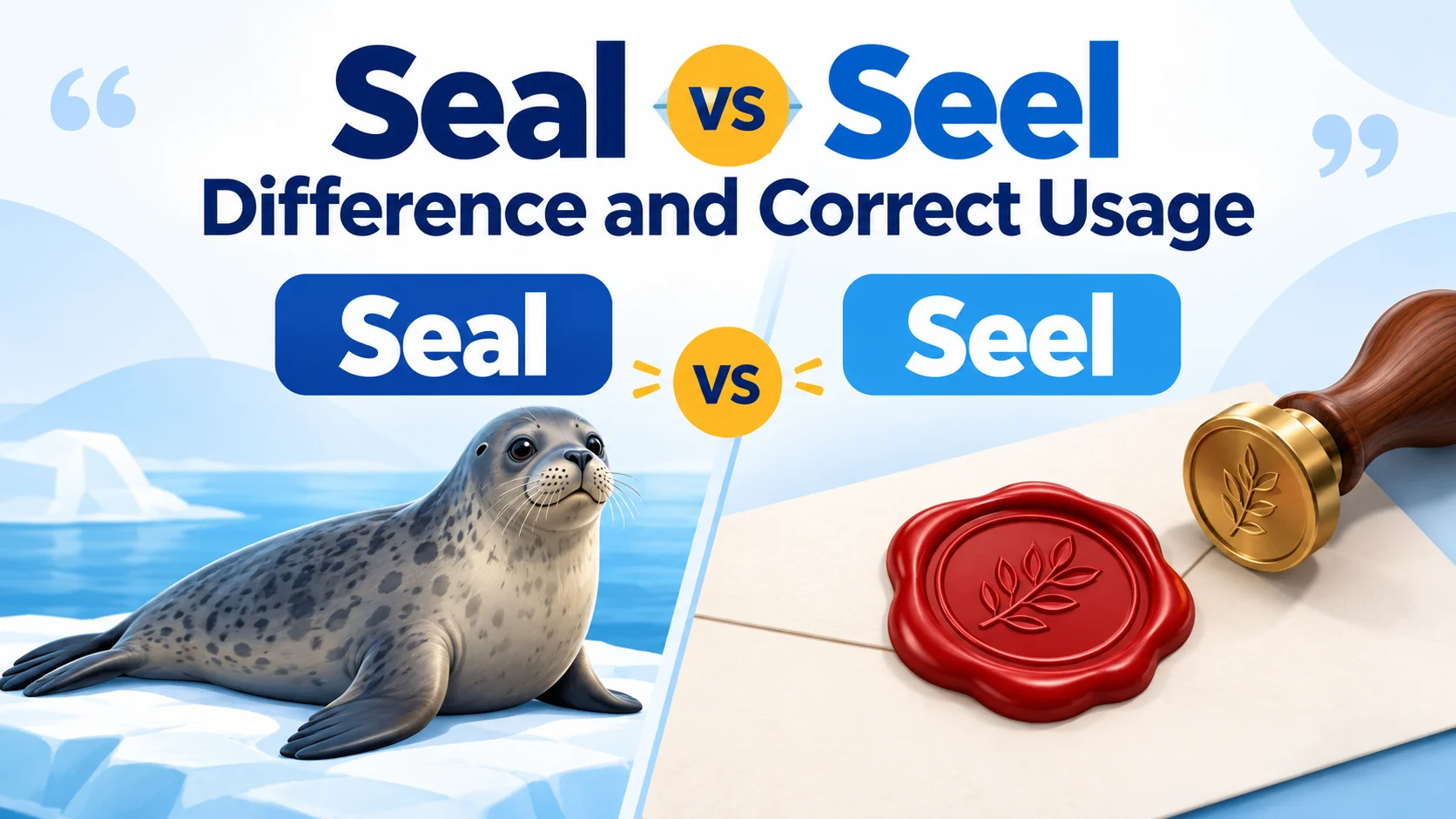
Seal vs seel can be confusing because the two words look almost identical and are pronounced the same in some contexts. However, they are not interchangeable spellings. In modern English, seal is the standard and widely used word, while seel is a rare historical or specialized term that most readers will never need in ordinary writing. Knowing that distinction can prevent an unusual spelling from creeping into an email, assignment, article, or professional document.
The word seal has several everyday meanings. It can describe closing something securely, preventing air or liquid from passing through, officially validating a document, or referring to a marine mammal. It also appears in familiar expressions such as “seal the deal” and “seal of approval.” Because it has so many meanings, context is often more important than spelling alone.
So when should you use each word? For almost every modern situation, the answer is seal. Seel belongs mainly to older English and specialized historical usage, particularly the language of falconry. This guide explains the difference, shows how seal works as both a noun and verb, examines common mistakes, and gives you a practical way to choose the right word without relying on guesswork.
Seal vs Seel: Which Word Is Correct?
If you are writing ordinary modern English, seal is almost certainly the word you need.
| Word | Modern status | Main meaning | Typical use |
| seal | Standard and common | Close, secure, authenticate, or the marine animal | Everyday, professional, technical, legal |
| seel | Rare and historical | A specialized historical verb associated with falconry | Historical or specialized writing |
For example:
- Please seal the envelope before mailing it.
- The technician sealed the crack with adhesive.
- The agreement was sealed by both parties.
- We saw a seal swimming near the shore.
Using seel in these sentences would normally be incorrect.
Quick rule: If you mean close, secure, protect, authenticate, or the marine animal, use seal.
The fact that seel is a genuine English word does not make it a normal alternative spelling of seal. The two words have different histories and meanings.
What Does “Seal” Mean?
Seal is a highly versatile English word. It can function as both a verb and a noun, and its meaning changes according to context.
Seal as a verb
As a verb, seal generally means to close or secure something so that it cannot be opened, entered, or passed through easily.
For example:
- Seal the package with tape.
- The workers sealed the window to prevent drafts.
- She sealed the letter in an envelope.
- The container is sealed tightly.
The idea is usually one of security, closure, protection, or prevention.
But “seal” can also have a figurative meaning.
Consider:
The final goal sealed the team’s victory.
Nothing has physically been closed. Instead, the goal made the result effectively certain.
Likewise:
They sealed the agreement after several weeks of negotiation.
Here, sealed means finalized or formally confirmed.
Seal as a noun
As a noun, seal has several important meanings.
It can refer to:
- A device or material that closes an opening
- An official mark or emblem
- A marine mammal
- A confirmation or sign of approval
- A secure closure
For example:
- Check the rubber seal around the refrigerator door.
- The document carried the organization’s official seal.
- A seal was resting on the rocks.
- The manager’s signature put the final seal of approval on the project.
This range of meanings explains why seal appears in everyday, technical, legal, business, and scientific language.
What Does “Seel” Mean?
Seel is a real English word, but it is extremely uncommon in contemporary everyday English.
Its most recognizable historical use is connected with falconry. In older terminology, seel referred to the practice of sewing or closing a bird of prey’s eyelids, traditionally as part of training or handling.
That historical meaning is very different from the modern meanings of seal.
This distinction matters because dictionaries may contain words that are technically valid but rarely used today. Finding seel in a dictionary does not mean that it can replace seal in ordinary writing.
Why might you encounter “seel”?
You may come across it in:
- Historical texts
- Older literature
- Writing about traditional falconry
- Historical dictionaries
- Reproductions of older terminology
- Specialized discussions of archaic vocabulary
For a modern email, school assignment, website article, report, or business document, seel is generally not the appropriate choice unless you are deliberately discussing its historical meaning.
Important distinction: A word can be legitimate English without being a suitable choice for modern everyday English.
That is exactly the situation with seel.
Seal vs Seel: The Core Difference
The easiest way to understand the difference is to stop treating seel as a spelling variation.
They are separate words.
| Feature | Seal | Seel |
| Part of speech | Noun and verb | Primarily a historical verb |
| Common today? | Yes | No, except in specialized contexts |
| Means “close securely”? | Yes | No |
| Refers to a marine mammal? | Yes | No |
| Used in legal/business writing? | Yes | Generally no |
| Associated with historical falconry? | No | Yes |
| Suitable for ordinary modern writing? | Yes | Usually not |
| Can replace the other word? | No | No |
This is an important distinction from spelling variants such as color/colour or organize/organise, where different spellings represent the same word in different varieties of English.
Seal and seel do not work that way.
A practical test
When you are unsure, ask:
What do I mean?
If the answer is:
- close something → seal
- prevent leakage → seal
- officially authenticate → seal
- finalize something → seal
- refer to the animal → seal
- describe a historical falconry practice → possibly seel
That meaning-based test is more reliable than choosing the spelling that “looks right.”
How to Use “Seal” Correctly
The verb seal is especially useful because it can describe both physical and figurative actions.
Seal something shut
This is one of the most common uses.
Make sure you seal the box properly.
The box has been closed in a way intended to keep its contents secure.
Another example:
The workers sealed the entrance after the inspection.
The focus is not simply on closing the entrance. Sealing suggests that access has been blocked or the opening has been secured.
Seal a leak or opening
In construction, manufacturing, plumbing, and household maintenance, seal often means to close a gap so that air, water, dust, or another substance cannot pass through.
Examples:
- Seal the gap around the pipe.
- The technician sealed the leak.
- Use a suitable material to seal the joint.
- The window needs to be sealed against moisture.
This is why terms such as sealant, weather seal, and watertight seal are common in technical contexts.
Seal an envelope or package
You can also seal something by closing it securely.
She sealed the envelope before putting it in the mailbox.
Here, seal is more precise than simply saying close because the action creates a secure closure.
Seal an agreement or deal
The word also has a figurative business meaning.
The two companies sealed the deal after months of negotiations.
This does not mean that anyone physically closed a container. It means the arrangement was finalized or confirmed.
Seal as a Noun
The noun seal has several meanings that are worth separating.
1. A physical closure
A seal can be a material or component designed to prevent something from passing through an opening.
For example:
The rubber seal around the door is damaged.
This type of seal is common in appliances, machinery, vehicles, plumbing systems, windows, and industrial equipment.
2. An official mark
A seal can also be an emblem or mark associated with an organization, government body, institution, or authority.
For example:
The certificate bears the official seal of the institution.
This meaning explains phrases such as official seal and government seal.
3. A marine mammal
A seal is also an aquatic mammal.
For example:
We watched a seal swimming close to the shoreline.
This meaning has nothing to do with closing an envelope, even though the spelling is identical.
4. A sign of approval
In phrases such as seal of approval, the word means formal or strong confirmation that something has been accepted.
The new design received the director’s seal of approval.
Common Expressions With “Seal”
Some expressions make seal especially easy to recognize.
“Seal the deal”
To seal the deal means to finalize an agreement or arrangement.
The discount helped seal the deal.
It is common in business and everyday conversation.
“Seal of approval”
A seal of approval means an explicit or strong indication that something has been approved.
The safety organization gave the product its seal of approval.
“Seal someone’s fate”
To seal someone’s fate means to make a particular outcome effectively certain.
That final mistake sealed his fate in the competition.
This is figurative rather than physical.
“Seal something shut”
This expression emphasizes secure closure.
The container was sealed shut to prevent contamination.
“Under seal”
In legal contexts, documents or information may be described as being under seal, meaning they are subject to restricted access or are formally sealed by legal authority.
The exact legal meaning depends on jurisdiction and context, so this phrase should not be treated as interchangeable with ordinary “confidential.”
Seal in Legal, Business, and Technical Writing
One reason seal remains important is its usefulness across professional fields.
Legal writing
You may encounter seal in contexts involving:
- Official documents
- Court records
- Formal authentication
- Documents filed under seal
- Institutional seals
For example:
The court ordered the records to remain under seal.
In legal writing, context matters. A legal seal can refer to a formal mark, while under seal has a more specialized procedural meaning.
Business writing
Business professionals commonly use seal in expressions such as:
- seal an agreement
- seal a contract
- seal the deal
- seal a partnership
- seal an arrangement
Example:
Both companies signed the final documents, effectively sealing the partnership.
Technical writing
Technical uses are often literal:
The gasket creates a seal between the two components.
Here, the seal serves a functional purpose: controlling the movement of air, water, pressure, dust, oil, or another substance.
This is an important distinction for technical writers. Seal is not merely a fancy synonym for “close.” It can describe a specific engineering function.
Seal vs Close vs Shut
Learners sometimes assume that seal, close, and shut are interchangeable. They overlap, but they emphasize different things.
| Word | Main idea | Example | What it emphasizes |
| close | Move something into a closed position | Close the door. | Position |
| shut | Close firmly or completely | Shut the window. | Firm/completed closure |
| seal | Secure an opening against access or leakage | Seal the container. | Protection/security |
Consider these three sentences:
- Close the bottle.
- Shut the bottle.
- Seal the bottle.
The first simply describes closing it. The second may suggest a firmer action. The third suggests creating a secure or protective closure, perhaps so the contents cannot leak or become contaminated.
That is why technical instructions often use seal rather than simply close.
Seal vs Sea Lion: Are They the Same Animal?
No. A seal and a sea lion are different types of marine mammals, although they belong to closely related groups.
In everyday language, people sometimes use the terms loosely because both animals live in marine environments. Zoologically, however, they have observable differences.
| Feature | Typical true seal | Typical sea lion |
| External ear flaps | No visible external ear flaps | Visible external ear flaps |
| Movement on land | Often moves awkwardly by wriggling | Can rotate hind flippers underneath body |
| Front flippers | Generally shorter | Generally longer and more prominent |
| Vocal behavior | Usually quieter | Often noticeably vocal |
So seal has an animal meaning, but seel does not mean “seal” in this zoological sense.
Seal Pronunciation and Why “Seel” Looks Confusing
One reason learners confuse these words is their visual similarity.
Seal contains the vowel combination ea, while seel contains ee. Both can be associated with the long e sound.
That makes them easy to confuse when you have only heard the word spoken.
For spelling purposes, however, pronunciation should not be your only guide.
For example:
The container has a broken seal.
If you heard this sentence but had never seen the word written, you might wonder whether it is spelled seal or seel. Context solves the problem: the word refers to a closure, so seal is the correct spelling.
A useful spelling strategy
When you hear a word that sounds like seal, think about its meaning before choosing the spelling.
If it relates to:
- closing
- protection
- authentication
- an animal
- finalizing something
→ seal
If the text is historical and specifically discusses falconry:
→ seel may be intended.
Common Mistakes With Seal and Seel
Mistake 1: Treating “seel” as another spelling of “seal”
This is the most important error.
❌ Please seel the package.
✅ Please seal the package.
The unusual spelling does not become correct simply because seel exists as a historical word.
Mistake 2: Assuming “seel” is a British spelling
Seel should not be treated as the British equivalent of American seal.
Regional spelling differences are common in English, but this is not one of the standard US-versus-UK spelling pairs.
Mistake 3: Thinking every dictionary word is common modern vocabulary
Dictionaries preserve historical and specialized vocabulary. A word can be documented while still being unsuitable for ordinary contemporary writing.
This is particularly important for students and language learners who use dictionaries to check whether a strange spelling “exists.”
Mistake 4: Using “seal” when you actually mean “zeal”
These words sound different, but fast speech can sometimes cause confusion.
- seal = close, secure, authenticate, or marine mammal
- zeal = strong enthusiasm or dedication
She worked with great zeal.
That sentence has nothing to do with sealing something.
Mistake 5: Confusing “seal” with “sale”
These words also sound different in careful pronunciation but can become confused in writing.
- seal = secure/close
- sale = an act of selling or a period when goods are offered at reduced prices
The store is having a sale.
Seal the box before shipping it.
Seal vs Zeal vs Sale vs Seel
When several short words sound or look similar, comparing them side by side can make the distinctions clearer.
| Word | Meaning | Example |
| seal | Close, secure, authenticate; marine mammal | Seal the package. |
| seel | Historical/specialized falconry term | The word appears in historical falconry writing. |
| zeal | Strong enthusiasm or dedication | She approached the project with zeal. |
| sale | Selling activity or reduced-price event | The store is holding a sale. |
The key is not to memorize the spellings in isolation. Attach each spelling to a meaning and context.
When Should You Use “Seel”?
For most writers, the answer is: only when the context specifically requires it.
You might use seel when:
- Writing about historical falconry
- Quoting or analyzing an older text
- Discussing archaic English vocabulary
- Writing a historical or linguistic article
- Reproducing terminology from a specialized historical source
If you are writing a normal sentence about closing, securing, or finalizing something, use seal.
Example of an appropriate historical context
The author uses the old falconry term “seel” in describing the treatment of a trained hawk.
Here, seel is the subject of the discussion itself.
By contrast:
❌ Please seel the envelope.
There is no historical or specialized reason for seel, so the standard word is seal.
Real-Life Examples of “Seal”
The easiest way to build confidence is to see the word across different contexts.
Everyday English
- Seal the bag tightly.
- The jar has a broken seal.
- Please seal the envelope.
- The package was properly sealed.
Workplace English
- The manager’s approval sealed the agreement.
- Both sides hope to seal the contract this week.
- The final payment sealed the transaction.
Technical English
- Replace the damaged seal before operating the machine.
- The gasket creates a watertight seal.
- The technician sealed the opening around the cable.
Figurative English
- That decision sealed their fate.
- The announcement sealed the deal.
- Her performance earned the team’s seal of approval.
Animal-related English
- We saw a seal near the coast.
- The young seal stayed close to its mother.
Notice how the meaning changes while the spelling remains seal.
Examples of “Seel” in Context
Because seel is uncommon, modern readers may find it unfamiliar.
Appropriate contexts are generally historical or specialized:
- The historian explains how the term “seel” was used in traditional falconry.
- The old manuscript contains the verb “seel.”
- Students studying historical English may encounter “seel” in older texts.
These sentences work because the writer is deliberately discussing the unusual word.
That is very different from using it accidentally as a spelling of seal.
A Practical Editing Guide for Seal vs Seel
If you are proofreading your own writing, you can resolve the confusion quickly.
| If your sentence means… | Use |
| Close a package | seal |
| Close an opening against leakage | seal |
| Authenticate something officially | seal |
| Finalize an agreement | seal |
| Refer to the marine mammal | seal |
| Discuss a historical falconry term | seel |
| Discuss an old spelling or vocabulary item itself | seel, if that is the intended term |
For school and academic writing
Use seal for ordinary modern meanings. If you use seel, make sure the historical or linguistic context clearly supports it.
An unexplained seel may look like a spelling mistake to your reader.
For business communication
Prefer seal whenever you mean closing, securing, or finalizing something.
Please seal the documents in the envelope.
Not:
❌ Please seel the documents in the envelope.
For websites and online content
Modern readers generally expect seal when searching for information about:
- packaging
- sealing leaks
- official seals
- seals as animals
- sealing agreements
If you are writing about the historical word seel, identify the specialized meaning clearly so readers do not mistake it for an error.
A Simple Decision Guide: Seal or Seel?
When you encounter the two spellings, use this quick decision process.
Step 1: Identify the meaning
Are you talking about closing, securing, authenticating, finalizing, or a marine mammal?
Yes → seal
Step 2: Check the context
Is the text about historical English or traditional falconry?
Yes → seel may be appropriate.
Step 3: Consider your audience
Are you writing for general modern readers?
If so, an unexplained seel will probably create confusion unless the historical term is the actual topic.
Step 4: Don’t substitute based on sound alone
Hearing a long “ee” sound does not tell you which spelling is correct. Meaning and context are more reliable.
Expert tip: For spelling questions involving rare words, always ask whether the word is merely possible or actually appropriate for the intended context. Those are not the same thing.
Common Misconceptions About Seal and Seel
“Seel is just an old spelling of seal.”
Not exactly. Although the words look related, seel has its own historical meaning and should not simply be treated as an old-fashioned spelling of modern seal.
“If a dictionary lists seel, I can use it anywhere.”
No. Dictionaries document vocabulary; they do not mean every entry is equally common or appropriate in every context.
“Seel must be the British version.”
No. It is not a standard British spelling variant of seal.
“Seal only means the animal.”
Definitely not. Seal has major verb and noun meanings involving closure, security, authentication, and figurative finality.
“Close and seal always mean the same thing.”
Not quite. Close describes bringing something into a closed position, while seal often adds the idea of making the closure secure or preventing passage.
Practice: Seal or Seel?
Choose the word that best completes each sentence.
- Please ___ the package before shipping it.
- The damaged rubber ___ was replaced.
- The two companies finally ___ the agreement.
- We watched a ___ swimming near the rocks.
- The historian discussed the old falconry term ___.
- The workers need to ___ the opening around the pipe.
- The director gave the proposal her ___ of approval.
- The student accidentally wrote “seel” when referring to closing the envelope.
Answers
- seal
- seal
- sealed
- seal
- seel
- seal
- seal
- seal would be correct in the intended meaning.
The pattern is straightforward: seal dominates modern English, while seel requires a specific historical or specialized context.
How to Remember the Difference
A useful memory trick is to connect seal with the idea of security.
Think:
Seal = secure
You seal:
- a package
- an envelope
- a leak
- a container
- an agreement
You can also encounter a seal as:
- an official mark
- a closure
- a marine animal
- a sign of approval
By contrast, think of seel as a specialized historical word rather than a spelling option.
That distinction is more useful than trying to memorize an isolated spelling rule.
Conclusion
Understanding seal vs seel becomes much easier once you separate spelling from meaning. Seal is the standard modern word for closing or securing something, authenticating something, finalizing an arrangement, or referring to the marine mammal. Seel, by contrast, is a rare historical term that belongs mainly to specialized or older contexts. It is not a British spelling variant and should not replace seal in everyday writing. One final actionable tip: whenever you hesitate, identify what the sentence actually means before choosing the spelling. If you are talking about closure, security, approval, finality, or the animal, choose seal. A common mistake to avoid is assuming that a dictionary-listed word is automatically an everyday alternative. In modern English, context determines whether an unusual word belongs on the page.
Frequently Asked Questions
Q1. Is “seel” a misspelling of “seal”?
Not always. Seel is a genuine but rare historical English word, particularly associated with falconry terminology. However, if you mean “close,” “secure,” “authenticate,” or the marine animal, seal is the correct modern spelling.
Q2. Should I write “seal” or “seel” for an envelope?
Use seal. The standard expression is “seal the envelope” because the verb means to close it securely. Seel does not mean “close an envelope” in modern English and would normally be treated as an error.
Q3. Is “seel” an alternative British spelling of “seal”?
No. Seel is not the standard British equivalent of seal. British and American English do have many spelling differences, but seal/seel is not one of them. The two forms represent different words rather than regional spellings of the same word.
Q4. Why does “seal” have so many different meanings?
The modern word seal developed several related uses over time. Physical closure, official authentication, and figurative finalization share the broad idea of making something secure, fixed, or confirmed. The animal meaning is a separate vocabulary sense.
Q5. Is “seal” the same as “close”?
They overlap, but they are not identical. Close generally describes putting something into a closed position, while seal often emphasizes making that closure secure or preventing air, liquid, or access from passing through.
