
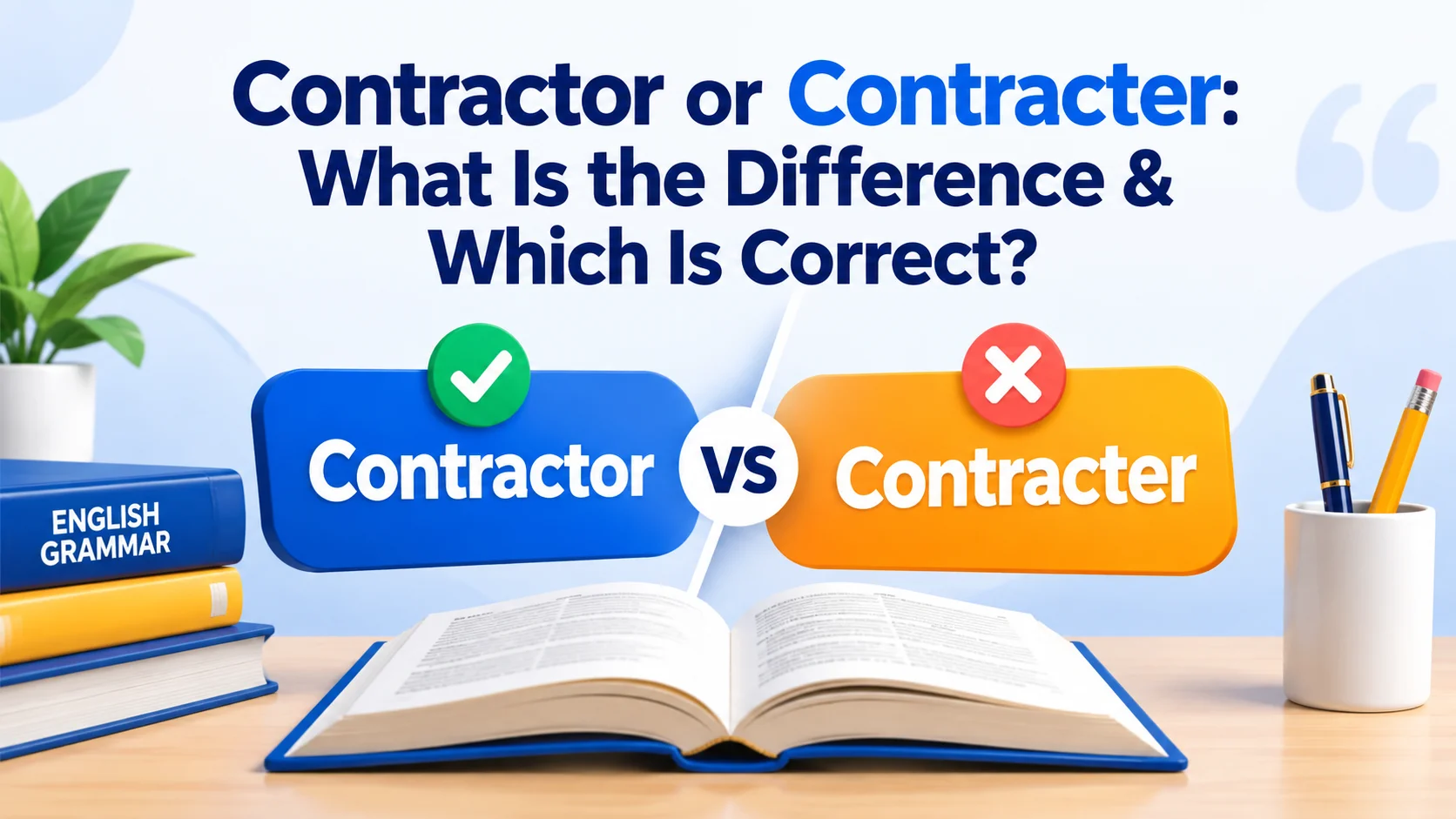
Contractor is the correct spelling when you mean a person or company hired to perform work under a contract. Contracter is generally a misspelling in standard modern English. The confusion is understandable because English often forms nouns for people with the suffix -er, as in worker, writer, and designer. It is easy to assume that someone who contracts must therefore be a “contracter.” English spelling, however, does not always follow such a straightforward pattern.
The word contractor appears across construction, technology, consulting, maintenance, government services, and many other professional fields. It can describe an individual, a business, or a specialized service provider. Understanding the word matters because it frequently appears in resumes, job descriptions, contracts, proposals, invoices, websites, and business communication. A spelling mistake in one of these contexts can make otherwise professional writing look careless.
This guide explains contractor vs contracter from several angles: meaning, spelling, pronunciation, word formation, grammar, professional usage, related terms, and common mistakes. You will also see real-world examples and a practical comparison with words such as employee, freelancer, subcontractor, consultant, contract, and contractee. By the end, the distinction should be simple: when referring to someone hired to perform contracted work, contractor is the form you want.
Contractor vs Contracter: Quick Answer
The short answer is straightforward:
Contractor is the standard and correct spelling. Contracter is generally an incorrect spelling when you mean a person or business that performs work under a contract.
| Word | Standard spelling? | Typical meaning | Recommended use |
| Contractor | Yes | Person or company hired to provide work or services under a contract | Use it |
| Contracter | Generally no | Usually an attempted spelling of contractor | Avoid it |
Consider these examples:
- Correct: We hired a contractor to renovate the kitchen.
- Incorrect: We hired a contracter to renovate the kitchen.
Another example:
- Correct: The software contractor will begin work next Monday.
- Incorrect: The software contracter will begin work next Monday.
The important point is that contracter is not simply an alternative spelling of contractor. In ordinary contemporary English, replacing the -or ending with -er creates a spelling error.
What Does “Contractor” Mean?
A contractor is a person or organization that agrees to perform work or provide services under the terms of a contract.
The word is strongly associated with construction, but its meaning is much broader. A contractor can provide physical labor, technical expertise, consulting services, maintenance, software development, engineering, or other specialized work.
For example:
The homeowner hired a contractor to remodel the bathroom.
Here, contractor identifies the professional responsible for carrying out the agreed project.
A company can also be a contractor:
The government awarded the project to a large engineering contractor.
In this sentence, the contractor is not necessarily one individual. It is an organization that has entered into an agreement to provide specified services.
Contractor as a Person
A contractor may work independently rather than as a permanent employee of the organization hiring them.
For example:
Maria works as an independent contractor for several technology companies.
The word independent adds useful information because it distinguishes her working arrangement from a conventional employee relationship.
Contractor as a Business
The word can also refer to an entire company:
The construction contractor submitted a revised project estimate.
Here, the contractor is a business rather than an individual worker.
This flexibility is one reason the word appears so frequently in professional writing.
Contractor in Construction
Construction is probably the context most people associate with the word contractor.
A contractor may organize workers, materials, schedules, equipment, permits, and other aspects of a project. The exact responsibilities depend on the agreement and the type of contractor involved.
Common terms include:
- General contractor
- Building contractor
- Electrical contractor
- Plumbing contractor
- Roofing contractor
- Mechanical contractor
- Specialty contractor
- Subcontractor
For example:
The general contractor coordinated the electricians, plumbers, and carpenters.
A subcontractor, meanwhile, may be hired by another contractor to perform a specific portion of the project.
That distinction becomes important in large construction projects because several businesses can participate in the same contract structure.
Contractor Beyond Construction
The word is not limited to people who build or repair things.
Modern workplaces use contractor across many industries.
Technology
A technology company might hire a software developer for a six-month project.
The company hired a software contractor to help migrate its database.
Consulting
A business may bring in an outside specialist for a particular project.
The company hired a marketing contractor to develop its new campaign.
Maintenance
A property manager might hire an outside company to maintain elevators, heating systems, or electrical equipment.
Government Services
Governments frequently work with private organizations that provide services under formal agreements.
Creative and Professional Services
Writers, designers, photographers, engineers, analysts, and other specialists may work under contracts.
The key idea remains the same: contractor describes the professional or business relationship, not one particular industry.
Is “Contracter” Ever Correct?
For ordinary modern English, contracter should not be used as the spelling of the professional term contractor.
If you are writing a resume, business document, website, invoice, proposal, job description, or professional email, choose contractor.
The temptation to write contracter usually comes from English spelling patterns rather than from a meaningful difference in pronunciation or definition.
For example:
- teach → teacher
- work → worker
- write → writer
- design → designer
Because contract is a verb, it may seem logical to form the person noun by adding -er:
contract + er = contracter
But English does not create every agent noun in exactly the same way. Contractor is the established form.
Why This Matters
A spelling that looks logical is not necessarily a standard English word.
This is a useful lesson for English learners: word formation can help you guess a word, but it cannot always determine its accepted spelling.
Why Is It “Contractor” Instead of “Contracter”?
The spelling contractor is an established English noun formed with the -or ending.
English has many nouns ending in -or that identify people or entities performing a role or action, including:
- operator
- administrator
- instructor
- supervisor
- investigator
- translator
- contractor
This does not mean that every verb automatically takes -or. English vocabulary has developed through different historical influences, and many word forms became established long before modern speakers began applying simple spelling rules to them.
That is why trying to construct contractor entirely from a modern “verb + suffix” formula can be misleading.
A better approach is to recognize contractor as the established lexical form.
Contract → contractor
Not contract → contracter
Contractor vs Contracter: Why People Get Them Mixed Up
The spelling error has several understandable causes.
The Familiar “-er” Pattern
The -er ending is extremely common for people who perform an action.
- Someone who teaches is a teacher.
- Someone who drives is a driver.
- Someone who paints is a painter.
So it is natural for a writer to wonder why someone who contracts is not a contracter.
The answer is simply that English contains established word forms that do not always follow the most obvious productive pattern.
Pronunciation Can Be Misleading
When spoken quickly, the ending of contractor may not make the spelling immediately obvious to someone learning English.
If a writer has mainly encountered the word in conversation rather than in writing, contracter can appear plausible when they later try to spell it.
Fast Typing
Professional writers can make this mistake too. Typing quickly, relying on phonetics, or writing from memory can produce contracter even when the writer knows the intended meaning.
Visual Familiarity
Because contracter looks like a conventional English agent noun, it may pass through a quick visual check unnoticed.
This is particularly common when proofreading one’s own writing.
Contractor vs Contracter Spelling Difference
The difference is small but significant.
| Feature | Contractor | Contracter |
| Ending | -or | -er |
| Standard professional form | Yes | No |
| Commonly used for a hired professional/business | Yes | No |
| Suitable for a resume | Yes | No |
| Suitable for a contract | Yes | No |
| Suitable for business writing | Yes | No |
| Common spelling mistake | No | Yes |
The two forms are especially easy to confuse because their first eight letters are almost identical.
The safest visual memory aid is:
CONTRACT + OR = CONTRACTOR
Do not let the familiar -er pattern override the established spelling.
How to Use “Contractor” Correctly in a Sentence
Contractor is a countable noun, so it can appear in singular and plural forms.
Singular
The contractor arrived at the property early.
We hired a contractor to repair the roof.
The company is looking for an experienced contractor.
Plural
Several contractors submitted bids for the project.
The contractors completed the work ahead of schedule.
The plural is formed normally:
contractor → contractors
With Adjectives
You may see expressions such as:
- independent contractor
- general contractor
- government contractor
- electrical contractor
- construction contractor
- software contractor
- specialist contractor
For example:
She works as an independent software contractor.
The adjective tells the reader more about the contractor’s role or field.
Contractor in Professional Writing
Correct spelling becomes especially important when the word appears in documents that represent a person or organization professionally.
Common examples include:
- Resumes and CVs
- Job advertisements
- Business websites
- Project proposals
- Procurement documents
- Invoices
- Service agreements
- Project reports
- Company profiles
- Professional emails
Imagine a construction company describing its services online:
We are an experienced contractor specializing in residential renovations.
That sentence immediately sounds professional.
Now replace the spelling:
We are an experienced contracter specializing in residential renovations.
The meaning is still understandable, but the error is visible. For a company competing for customers, small language errors can undermine confidence.
Correct terminology is part of professional presentation.
Contractor vs Employee: Are They the Same?
Not necessarily.
A contractor and an employee can both perform work for an organization, but the nature of their working relationship may differ.
An employee is generally part of an organization’s employment structure, while a contractor is typically engaged under a contract for specified services or work.
However, the exact legal distinction is not determined by the label alone. Employment and contractor classifications can depend on factors such as:
- The actual working relationship
- Degree of control
- Responsibilities
- Payment arrangements
- Duration of the engagement
- Applicable laws
- Contract terms
So it is better not to assume that calling someone a “contractor” automatically makes them legally independent.
Writing tip: Use contractor when describing the professional relationship, but do not treat the word itself as a complete legal classification.
Contractor vs Subcontractor
These words are related but not identical.
A contractor may have a direct agreement with a client. A subcontractor is generally hired by another contractor to handle a specific part of the work.
Consider a building project.
The property owner hires a general contractor. The general contractor then hires an electrician.
The relationship might look like this:
Property owner → General contractor → Electrical subcontractor
The electrician is still performing contracted work, but subcontractor provides additional information about the structure of the project.
Example
The general contractor hired a subcontractor to install the electrical system.
Calling both parties simply “contractors” would not necessarily be wrong in a broad sense, but subcontractor is more precise.
Contractor vs Contractee
Another potentially confusing word is contractee.
A contractor is generally the party undertaking work or services under a contract.
A contractee can refer to the party with whom the contractor has contracted, although the exact use can depend on the contractual context.
For simple understanding, imagine:
A homeowner hires a contractor to remodel a kitchen.
The contractor performs the agreed work. The homeowner is the other party to the arrangement.
The important point is that contractor and contractee describe different roles. They should not be treated as interchangeable.
Contractor vs Contract vs Contractual
These words belong to the same broader vocabulary family, but they perform different grammatical jobs.
| Word | Part of Speech | Basic Meaning | Example |
| Contract | Noun/verb | Agreement; or to enter into an agreement | We signed a contract. |
| Contractor | Noun | Person or business performing contracted work | The contractor started today. |
| Contractual | Adjective | Related to a contract | They have contractual obligations. |
| Contractually | Adverb | In accordance with a contract | The company is contractually obligated to respond. |
| Subcontractor | Noun | Contractor engaged by another contractor | The subcontractor handled the wiring. |
Understanding these relationships makes the spelling easier to remember because contractor has a specific role within the word family.
Contractor vs Freelancer
The terms can overlap, but they are not perfect synonyms.
A freelancer usually emphasizes how a person works: independently, often serving multiple clients.
A contractor emphasizes the contractual arrangement under which services are provided.
One professional might accurately be described as both.
For example:
Daniel is a freelance graphic designer who works as a contractor for several companies.
Here, freelancer describes his independent work style, while contractor describes his contractual relationship.
This distinction is useful when choosing precise language.
Contractor vs Consultant
A consultant is generally a specialist brought in to provide expertise, advice, analysis, or recommendations.
A contractor may perform a broader range of services, including hands-on work.
For example:
The company hired a consultant to recommend a cybersecurity strategy.
versus:
The company hired a contractor to implement the cybersecurity system.
In real business environments, a professional can sometimes function as both. The terms describe different aspects of the person’s role.
Contractor or Contracter in American and British English
The spelling contractor is standard in both American and British English.
There is no normal British spelling rule that changes contractor into contracter.
| English variety | Standard spelling |
| American English | contractor |
| British English | contractor |
| Canadian English | contractor |
| Australian English | contractor |
Some English words genuinely differ between varieties, such as color/colour and organize/organise.
Contractor is not one of those words.
So if you are writing for an American, British, Canadian, or Australian audience, contractor remains the safe standard form.
Contractor Pronunciation
The pronunciation of contractor can vary slightly depending on accent, but the word is generally pronounced with the stress on the first syllable when referring to the professional noun:
CON-trac-tor
The final -or sound is another useful clue when hearing the word, although pronunciation alone should not be relied upon to reconstruct spelling.
For English learners, it is helpful to learn the word as a complete unit:
contractor = a person or business hired to perform contracted work
Rather than trying to build the spelling every time from contract, memorize the established written form.
Common Mistakes With Contractor
Mistake 1: Writing “Contracter”
❌ The contracter will arrive tomorrow.
✅ The contractor will arrive tomorrow.
This is the most direct spelling error.
Mistake 2: Assuming “-er” Must Be Correct
English has many agent nouns ending in -er, but that does not mean every person noun follows that pattern.
Mistake 3: Confusing Contractor and Contractee
These terms can refer to different parties in a contractual relationship.
Mistake 4: Treating Contractor and Employee as Perfect Synonyms
A person may perform work for a company without being its employee. The exact classification depends on the working arrangement and applicable rules.
Mistake 5: Using an Informal Description When Precision Matters
Calling someone simply a “worker” may be understandable, but contractor provides more information when the contractual relationship is relevant.
How to Remember Contractor vs Contracter
If you frequently forget which spelling is correct, use one simple association:
Think “Contract + OR”
CONTRACT → CONTRACTOR
The ending is -or, not -er.
You can also remember it through a sentence:
A contractor works under a contract.
Both words begin with contract, and the professional noun ends in -or.
A Second Memory Trick
Think of several familiar professional nouns:
- operator
- supervisor
- administrator
- contractor
Seeing these together can make the -or pattern more familiar.
Just remember that this is a memory aid, not a universal English spelling rule.
Practical Proofreading Tips
If you are editing a document and see contracter, do not automatically assume it is a specialized term.
Ask three questions:
1. Does the word mean a person or company performing contracted work?
If yes, contractor is almost certainly the form you need in ordinary modern English.
2. Is the word being used professionally?
Check carefully in:
- resumes
- proposals
- contracts
- invoices
- websites
- reports
Professional documents deserve particular attention because spelling errors are highly visible.
3. Does the sentence contain another related term?
Look for words such as:
- contract
- contractual
- subcontractor
- contractee
This can help you understand the intended meaning and choose the correct word.
Proofreading tip: Do not rely solely on how a word sounds. When a spelling looks plausible but unfamiliar, check the established form before publishing.
Real-World Examples: Contractor or Contracter?
Here are several examples showing how the correct word works in different contexts.
Construction
The contractor gave us an estimate for the roof replacement.
Technology
The company hired a software contractor to improve its internal application.
Consulting
We brought in a contractor with experience in supply-chain management.
Maintenance
The building manager contacted an electrical contractor.
Government
The contractor was selected to provide the required services.
Business Writing
All contractors must submit their documentation before the project begins.
In every example, contractor is the correct form.
Contractor vs Contracter: A Practical Decision Guide
| If you mean… | Use |
| A person hired to perform work under a contract | Contractor |
| A construction professional | Contractor |
| An independent professional engaged for a project | Contractor |
| A company providing contracted services | Contractor |
| A person working under a subcontract | Subcontractor |
| The agreement itself | Contract |
| Something relating to an agreement | Contractual |
| The other party in a contractual relationship | Contractee, where appropriate |
| “Contracter” as an ordinary spelling of the professional term | Do not use it |
This makes the decision much easier: contractor is the standard answer whenever you are talking about the professional or business performing contracted work.
Quick Practice: Choose the Correct Form
Try filling in each blank before checking the answers.
- The company hired an independent ______ to manage the project.
- The electrical ______ inspected the building.
- Several ______ submitted proposals.
- The website incorrectly spelled the word as “______.”
- We need to contact the main ______ before making changes.
Answers
- contractor
- contractor
- contractors
- contracter
- contractor
The fourth sentence deliberately contains the incorrect form because it is describing the spelling mistake itself.
Contractor vs Contracter: Final Comparison
| Question | Contractor | Contracter |
| Is it the standard spelling? | Yes | No, generally |
| Refers to a person performing contracted work? | Yes | No |
| Used in construction? | Yes | No |
| Used in technology and consulting? | Yes | No |
| Appropriate in professional writing? | Yes | No |
| Common spelling mistake? | No | Yes |
| Used in American English? | Yes | No |
| Used in British English? | Yes | No |
| Plural form | Contractors | — |
Conclusion
When deciding between contractor or contracter, the answer is clear: contractor is the standard spelling in modern English. It refers to a person or business engaged to perform work or provide services under a contract, and it is used across construction, technology, consulting, maintenance, government services, and many other fields. The incorrect form contracter is easy to understand because English often uses -er to form nouns for people who perform actions, but spelling patterns do not always work that neatly. One final actionable tip: remember the phrase “contract + or = contractor.” A common mistake to avoid is assuming that every professional noun must end in -er. When accuracy matters—especially in a resume, proposal, contract, or business website—choose the established spelling and write contractor.
Frequently Asked Questions
Q1. Is “contracter” a real word?
Contracter is generally not the standard modern spelling when referring to a person or company that performs contracted work. In ordinary professional English, use contractor. If you encounter contracter, it will usually be an error rather than a legitimate alternative spelling.
Q2. Why is it “contractor” and not “contracter”?
Contractor is the established English form. Although -er is a common ending for nouns describing people who perform actions, English also uses -or in many established words. The spelling must therefore be learned as contractor, rather than generated mechanically from contract.
Q3. Is “contractor” correct in British English?
Yes. Contractor is standard in British English as well as American English. Unlike words such as colour/color, it does not normally change spelling between these varieties. Writing contracter does not become correct simply because the audience uses British English.
Q4. What is the difference between a contractor and a subcontractor?
A contractor may have a direct agreement with the client, while a subcontractor is generally engaged by another contractor to perform a particular part of a larger project. A subcontractor can therefore be a contractor in the broad sense while having a more specific role.
Q5. Is a contractor the same as an employee?
Not necessarily. Contractor and employee describe different types of working relationships, although the exact legal distinction depends on the circumstances and applicable rules. A contractor may provide services independently under an agreement rather than occupying a conventional employee position within an organization.
