
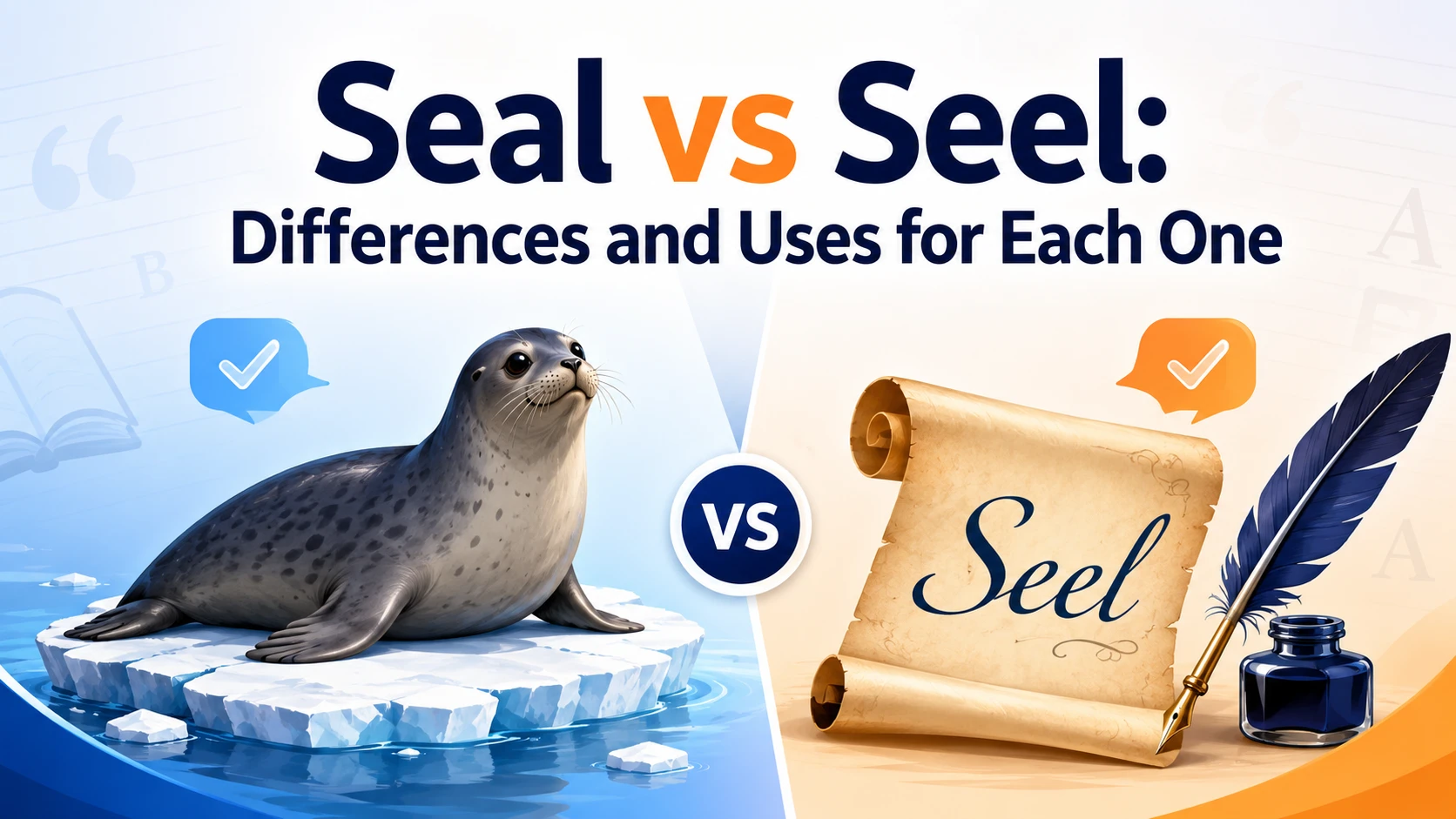
Seal vs Seel is a comparison that often appears when people are unsure whether “seel” is simply a misspelling of “seal” or a legitimate English word with its own meaning. At first glance, the two words look almost identical, and depending on your accent, they may even sound alike. However, they are far from interchangeable. Seal is a common word used in everyday English, while seel is an uncommon term that survives mainly in historical, literary, and specialized contexts. Knowing the difference helps you avoid spelling mistakes and write with greater confidence.
For most writers, seal is the word you’ll need almost every time. It can refer to a marine mammal, an official stamp, a watertight closure, or the act of closing or confirming something securely. Seel, by contrast, is an archaic English verb that historically meant to close or sew a bird’s eyes, usually in falconry. Because modern English rarely uses this meaning, many people have never encountered the word outside dictionaries or classic literature.
This guide explains the meanings, pronunciation, grammar, history, examples, and correct usage of both words. You’ll also learn when seel is appropriate, why it is frequently mistaken for seal, how to avoid common writing errors, and how these words appear in real-world contexts. By the end, you’ll understand not only which spelling is correct but also why context is the key to choosing the right word.
Seal vs Seel: The Quick Answer
For nearly all modern writing, seal is the correct word.
Use seal when referring to:
- A marine mammal
- Closing something tightly
- An official stamp or emblem
- Confirming or finalizing an agreement
- Protecting something from air, water, or contamination
Use seel only in historical, literary, or falconry-related contexts where its original meaning is intended.
Quick Rule: If you’re writing about closing, protecting, confirming, or the animal, choose seal. If you’re discussing historical falconry or quoting older English texts, seel may be correct.
Which Spelling Is Correct in Modern English?
In modern English, seal is overwhelmingly the correct choice.
You’ll find it in:
- Newspapers
- Academic writing
- Business documents
- Legal contracts
- Product instructions
- Everyday conversations
Examples:
- Please seal the envelope before mailing it.
- The diver photographed a seal resting on the rocks.
- The company used a rubber seal to prevent leaks.
- The contract was officially sealed yesterday.
By contrast, seel appears so rarely that many spell-checkers flag it or readers assume it is a typo.
When Is “Seel” Actually Correct?
Although uncommon, seel is a real English word.
Historically, it meant:
To close the eyelids of a bird by stitching or fastening them temporarily during falconry training.
This practice is centuries old and is no longer common. As a result, the word survives mostly in:
- Historical documents
- Literature
- Dictionaries
- Discussions of medieval hunting practices
Example:
- The falconer chose to seel the hawk before transport.
Outside these specialized contexts, using seel instead of seal is almost always incorrect.
A Simple Rule to Remember
Ask yourself one question:
“Am I talking about closing, protecting, confirming, or the marine animal?”
If the answer is yes, the correct spelling is seal.
If you’re reading an old historical text about birds of prey or falconry, seel might be the intended word.
Seal vs Seel Comparison Table
The table below highlights the key differences at a glance.
| Feature | Seal | Seel |
| Standard modern English word | ✅ Yes | Rare |
| Commonly used today | ✅ Frequently | ❌ Very rarely |
| Part of speech | Noun and verb | Verb (archaic) |
| Dictionary status | Current | Historical/archaic |
| Typical context | Everyday English | Falconry and historical texts |
| Often mistaken for the other? | Yes | Yes |
Meaning
Seal has several meanings, including:
- A marine mammal
- A device that prevents leaks
- An official mark of authenticity
- The act of closing or securing something
Seel refers to an old falconry practice involving birds.
Part of Speech
Seal
Functions as both:
- Noun
- Verb
Seel
Functions primarily as:
- Verb
Its grammatical role is much narrower because of its limited modern use.
Modern Usage
Professional editors, teachers, dictionaries, and style guides all recognize seal as the standard spelling for nearly every contemporary situation.
Examples include:
- Food packaging
- Building construction
- Legal documents
- Wildlife
- Sports
- Business agreements
Meanwhile, seel appears almost exclusively in historical discussions.
Common Contexts
Seal appears in:
- Marine biology
- Engineering
- Packaging
- Government
- Law
- Medicine
- Manufacturing
- Everyday conversation
Seel appears in:
- Falconry
- Medieval history
- Classical literature
- Historical dictionaries
Example Sentences
Correct:
- Please seal the package carefully.
- The harbor seal rested on the beach.
- The official applied the company seal.
Historical:
- The trainer decided to seel the falcon according to traditional methods.
Incorrect:
- Please seel the envelope.
- The rubber seel prevents leaks.
What Does “Seal” Mean?
One reason seal causes confusion is that it has several completely different meanings. Despite sharing the same spelling, each meaning is connected by the broader idea of protection, closure, or identification.
Understanding these meanings makes it easier to recognize the word in different contexts.
Seal as a Noun
As a noun, seal has multiple accepted definitions.
A Marine Mammal
Perhaps the most familiar meaning is the seal, a semi-aquatic marine mammal belonging to the pinniped family.
These animals are known for:
- Streamlined bodies
- Flippers instead of legs
- Thick layers of blubber
- Excellent swimming abilities
- Life in cold and temperate oceans
Examples:
- We watched a group of seals swimming near the coastline.
- The young seal rested on the ice.
This meaning is common in wildlife documentaries, textbooks, and environmental discussions.
An Official Stamp or Emblem
A seal may also refer to an official mark used to indicate authenticity, authority, or approval.
Examples include:
- Government seals
- University seals
- Corporate seals
- Court seals
- Notarial seals
Examples:
- The diploma carried the university’s official seal.
- The certificate displayed the organization’s gold seal.
Official seals help verify that a document is genuine.
A Tight Closure That Prevents Leaks
In engineering and manufacturing, a seal is a component that prevents liquids, gases, dust, or contaminants from passing through an opening.
Examples include:
- Door seals
- Window seals
- Rubber seals
- Mechanical seals
- Oil seals
Examples:
- Replace the damaged seal to stop the leak.
- The refrigerator door seal keeps cold air inside.
A properly functioning seal improves efficiency and prevents damage.
Seal as a Verb
As a verb, seal generally means to close, secure, confirm, or make something final.
To Close Something Securely
This is the most common everyday meaning.
Examples:
- Seal the envelope before posting it.
- The technician sealed the container tightly.
- Workers sealed the crack to prevent water damage.
Whether using tape, glue, heat, or another method, the goal is to create a secure closure.
To Confirm or Finalize an Agreement
In business, law, and everyday conversation, seal often means making something official or irreversible.
Examples:
- They sealed the partnership with a signed contract.
- The team sealed the victory in the final minutes.
- A handshake sealed the agreement.
Here, seal conveys the idea of completing something successfully.
What Does “Seel” Mean?
Unlike seal, which appears in everyday English, seel is an archaic verb that most modern writers will never need to use. Its rarity often leads people to assume it is simply a misspelling. However, seel has a genuine place in the history of the English language.
Understanding its original meaning helps explain why it still appears in older books, dictionaries, and discussions of historical falconry.
Dictionary Definition
Traditionally, seel means:
To close or stitch together the eyelids of a hawk or other bird temporarily during training.
The practice was intended to calm birds of prey while they adjusted to captivity and handling.
Today, the word is considered archaic and is rarely used outside historical discussions.
Historical example:
- The falconer chose to seel the hawk before beginning its training.
Although the sentence is grammatically correct, most readers would only encounter this usage in historical or literary works.
Historical Origin of “Seel”
The word seel has roots in Middle English, where it referred specifically to falconry—a highly respected sport among European nobility during the Middle Ages.
Falconers developed specialized vocabulary for training birds of prey, and seel became one of those technical terms.
As falconry declined as an everyday practice, many of its unique words gradually disappeared from common English. While falcon, hawk, and perch remain familiar, seel became increasingly rare.
Why “Seel” Is Rare in Modern English
Several factors explain why most people never encounter seel today:
- Falconry is now a specialized activity.
- Modern animal welfare standards have replaced many historical training methods.
- Contemporary English favors simpler, more widely understood vocabulary.
- Writers rarely need the specific meaning of seel.
Because of this, seal replaced seel in the minds of many learners, even though the two words are unrelated.
Literary and Historical Uses of “Seel”
Although uncommon, seel occasionally appears in:
- Historical novels
- Shakespearean studies
- Medieval literature
- Falconry manuals
- Historical dictionaries
When reading older texts, you’ll often find unfamiliar words like seel, which reflect the language of their time rather than modern English usage.
Expert Tip
If you encounter seel in a classic work of literature, don’t automatically assume it’s a typo. Check the historical context before correcting it.
Is “Seel” a Misspelling of “Seal”?
This is one of the most common questions readers ask.
The answer depends entirely on context.
If someone writes:
“Please seel the package.”
then seel is almost certainly a spelling mistake.
However, if a historical book states:
“The falconer would seel the bird.”
the word is being used correctly.
Why People Confuse the Two Words
Several factors contribute to the confusion.
Similar Spelling
Only one letter separates the two words.
- Seal
- Seel
Small spelling differences often lead to typing errors, especially when writing quickly.
Similar Pronunciation
In many English accents, the two words sound nearly identical.
Because English spelling is not always phonetic, people often write the version that looks most familiar rather than the historically correct one.
Lack of Exposure
Almost everyone learns the word seal in childhood.
Very few people ever study:
- Falconry
- Medieval English
- Historical dictionaries
As a result, seel remains unfamiliar to most readers.
Common Typing and Pronunciation Errors
Some frequent mistakes include:
Incorrect:
- Please seel the envelope.
- The rubber seel is damaged.
- They used a waterproof seel.
Correct:
- Please seal the envelope.
- The rubber seal is damaged.
- They used a waterproof seal.
These errors usually occur because writers rely on pronunciation instead of meaning.
How Dictionaries Treat “Seel”
Modern dictionaries generally classify seel as:
- Archaic
- Historical
- Literary
- Falconry-related
By contrast, seal is listed as an active vocabulary word with numerous modern definitions.
This difference explains why spell-check software sometimes questions seel even though it is technically a real word.
How to Use “Seal” Correctly in Different Contexts
Because seal has several meanings, context determines how readers interpret it.
Fortunately, native speakers rarely confuse these meanings because each appears in a different situation.
Everyday Conversation
This is the most common use.
Examples:
- Please seal the food container.
- Make sure you seal the envelope.
- The jar won’t stay fresh unless you seal it tightly.
In everyday English, seal almost always means close securely.
Business and Legal Writing
Professionals often use seal when discussing official approval or final agreements.
Examples:
- Both parties sealed the contract yesterday.
- The board placed its official seal on the certificate.
- The merger was sealed after months of negotiation.
The word conveys authority, completion, and authenticity.
Packaging and Manufacturing
Manufacturers rely on seals to protect products from contamination and damage.
Examples include:
- Heat seals
- Vacuum seals
- Mechanical seals
- Rubber seals
Examples:
- Every package receives a tamper-proof seal.
- Replace the worn seal before restarting the machine.
Proper seals improve safety, product quality, and efficiency.
Wildlife and Nature
In biology, seal refers to the marine mammal.
Examples:
- Harbor seals are excellent swimmers.
- A young seal followed its mother into the water.
- Conservation efforts have helped several seal populations recover.
The meaning is immediately clear because of the surrounding wildlife vocabulary.
Sports and Achievement (“Seal the Victory”)
English frequently uses seal figuratively.
Instead of literally closing something, it means to guarantee or complete success.
Examples:
- The striker’s final goal sealed the victory.
- Her outstanding presentation sealed the promotion.
- That late touchdown sealed the championship.
These expressions appear regularly in sports journalism and business writing.
How to Use “Seel” Correctly
Although modern writers rarely need seel, understanding its proper usage prevents accidental corrections when reading historical works.
Historical Texts
Historical writing may preserve the original terminology of its period.
Example:
- The manuscript explained how experienced falconers seeled young hawks.
In this context, replacing seel with seal would actually introduce an error.
Literary Examples
Some authors intentionally use archaic vocabulary to create an authentic historical atmosphere.
Example:
- The old falconer prepared to seel the restless bird before beginning its training.
Readers unfamiliar with historical English may mistake this for a typo, but it accurately reflects older language.
Why It Rarely Appears in Modern Writing
Most modern publications avoid archaic vocabulary unless discussing history directly.
Reasons include:
- Better readability
- Wider audience understanding
- Simpler communication
- Modern editorial standards
Unless you’re quoting a historical source or writing about falconry, seal will almost always be the correct choice.
Writing Tip
If your audience is unfamiliar with historical English, consider explaining the meaning of seel the first time you use it. A brief clarification improves readability without sacrificing accuracy.
Seal vs Seel: Side-by-Side Usage Examples
One of the easiest ways to understand the difference between seal and seel is by comparing them in real sentences. Context immediately reveals which word is appropriate.
Correct Examples Using “Seal”
These examples reflect modern English usage.
As a verb
- Please seal the package before shipping it.
- The technician sealed the leaking pipe.
- Remember to seal the envelope before mailing it.
- The company sealed the agreement after weeks of negotiations.
- The final goal sealed the team’s victory.
As a noun
- The harbor seal rested on the rocky shoreline.
- The official document carried the government’s seal.
- The damaged rubber seal caused the machine to leak.
- Every container has a safety seal.
- The aquarium cares for rescued seals.
Correct Examples Using “Seel”
Because seel is an archaic verb, its correct use is limited to historical or literary contexts.
Examples:
- The medieval falconer would seel the hawk before training.
- Historical records describe how trainers seeled birds of prey.
- The old manuscript explained when to seel a hunting falcon.
- Scholars discussed the historical practice of seeling hawks.
- The novel accurately used seel to reflect medieval falconry.
Although these sentences are correct, they represent a highly specialized context rather than everyday English.
Incorrect Examples and Their Corrections
Writers often confuse these words because of their similar spelling.
| Incorrect Sentence | Correct Sentence | Why? |
| Please seel the envelope. | Please seal the envelope. | Modern English uses seal. |
| Replace the broken seel. | Replace the broken seal. | Refers to a mechanical component. |
| The seel was swimming offshore. | The seal was swimming offshore. | Refers to the marine mammal. |
| They seeled the contract yesterday. | They sealed the contract yesterday. | Means finalized the agreement. |
| The falconer sealed the bird’s eyes. | The falconer seeled the bird’s eyes. | Historical falconry term. |
Key Takeaway
If your sentence isn’t about historical falconry, seal is almost certainly the correct spelling.
Common Phrases and Idioms with “Seal”
The word seal appears in many well-known English expressions. Learning these idioms helps you recognize how naturally the word fits into everyday communication.
Seal the Deal
This idiom means to finalize or successfully complete an agreement.
Examples:
- A friendly conversation helped seal the deal.
- Their final presentation sealed the deal with the client.
It is especially common in business and sales.
Seal of Approval
A seal of approval represents official acceptance, endorsement, or recognition.
Examples:
- The product received the organization’s seal of approval.
- Parents gave their seal of approval to the plan.
The phrase is used both literally and figuratively.
Signed, Sealed, and Delivered
This expression means something has been fully completed and officially finalized.
Examples:
- The contract is signed, sealed, and delivered.
- Once the paperwork was signed, sealed, and delivered, construction began.
Break the Seal
Depending on the context, this phrase may mean:
- Opening a sealed package
- Breaking an official security seal
- Opening a container for the first time
Examples:
- Don’t break the seal until you’re ready to use the product.
- The inspector confirmed nobody had broken the seal.
Seal Someone’s Fate
This idiom means to make an outcome unavoidable.
Examples:
- His final mistake sealed his fate.
- The unexpected injury sealed the team’s chances of defeat.
It often appears in journalism, literature, and sports reporting.
Grammar Tips for Using “Seal”
Understanding how seal functions grammatically helps you write with greater accuracy.
Singular and Plural Forms
As a noun:
| Form | Example |
| Singular | The seal barked loudly. |
| Plural | Several seals rested on the beach. |
The plural simply adds -s, following regular English spelling rules.
Verb Tenses of “Seal”
| Tense | Example |
| Base | Seal the envelope. |
| Present | They seal every package. |
| Past | She sealed the box yesterday. |
| Present Participle | They are sealing the containers. |
| Past Participle | The agreement has been sealed. |
The verb follows standard regular conjugation patterns.
Common Collocations
Native speakers frequently combine seal with certain words.
Examples include:
- Seal an envelope
- Seal a package
- Seal a deal
- Seal a document
- Seal a container
- Rubber seal
- Mechanical seal
- Official seal
- Waterproof seal
- Safety seal
Learning these natural combinations makes your writing sound more fluent.
Choosing the Correct Article and Preposition
Notice how seal behaves with common articles and prepositions.
Examples:
- A seal was swimming nearby.
- The package has a seal.
- Place the seal on the document.
- The fish escaped through the damaged seal.
- The letter remained secure inside the sealed envelope.
Correct article and preposition usage improves clarity and grammatical accuracy.
Common Mistakes to Avoid
Although seal is a familiar word, writers still make several predictable mistakes.
Using “Seel” Instead of “Seal”
This remains the most frequent error.
Incorrect:
- Please seel the package.
Correct:
- Please seal the package.
Unless you’re discussing historical falconry, seal is almost always correct.
Confusing the Animal with the Verb
The spelling stays the same even though the meaning changes.
Examples:
- We watched a seal swimming offshore. (noun)
- Please seal the envelope. (verb)
Readers determine the intended meaning from the surrounding sentence.
Misusing Idiomatic Expressions
English idioms always use seal, never seel.
Correct:
- Seal the deal
- Seal of approval
- Seal someone’s fate
Incorrect:
- Sell the deal
- Seal of approval
Remember these expressions as fixed phrases.
Assuming Every Rare Word Is Incorrect
Although seel is uncommon, it is still a legitimate historical word.
If you’re editing historical documents or literature, verify the context before changing it to seal.
Good editing requires understanding meaning, not simply choosing the most familiar spelling.
Memory Tricks to Remember the Difference
Simple memory techniques make confusing these words much less likely.
Think of the Seal on an Envelope
Almost everyone has sealed an envelope.
Visualize:
- Folding the flap
- Applying adhesive
- Closing it securely
That familiar image reinforces the correct spelling.
Connect “Seal” with Security
Both words begin with S:
- Seal
- Secure
Since sealing protects something, linking these ideas creates an easy memory shortcut.
Remember That “Seel” Belongs Mostly to Historical English
When you see seel, think:
- Medieval history
- Falconry
- Old literature
If your topic isn’t one of these, you probably need seal instead.
Practice with Real-Life Sentences
Frequent exposure strengthens long-term memory.
Try writing sentences like:
- Seal the package carefully.
- The rubber seal needs replacing.
- The harbor seal swam gracefully.
- The contract was sealed yesterday.
Reading and writing correct examples helps the spelling become automatic.
Words Commonly Confused with “Seal”
Many English learners confuse seal with other similar-looking or similar-sounding words.
Seal vs Sale
- Seal = close securely or a marine mammal.
- Sale = the exchange of goods or a discounted event.
Examples:
- Please seal the container.
- The store is having a weekend sale.
Seal vs Ceil
Ceil is a verb meaning to provide or cover with a ceiling. It is uncommon in everyday English.
Examples:
- Workers will ceil the new room tomorrow.
- The damaged seal caused a leak.
Seal vs Sealed
- Seal = base form.
- Sealed = past tense or adjective.
Examples:
- Seal the package.
- The package is sealed.
Seal vs Sign
Although both may appear in legal contexts, they have different meanings.
- Sign means to write your name.
- Seal means to authenticate, finalize, or secure.
A document may be both signed and sealed, but the actions are not identical.
Expert Tip
When proofreading, ask yourself whether you’re describing closure, protection, authenticity, or a marine animal. If so, seal is almost certainly the correct choice. Reserve seel exclusively for historical references where its original meaning applies.
Mini Quiz: Test Your Understanding
Test yourself to see if you can confidently distinguish seal from seel.
Choose the Correct Word
Select the correct answer.
- Please ______ the package before shipping it.
- a) seal
- b) seel
- The diver photographed a ______ resting on the rocks.
- a) seal
- b) seel
- The medieval falconer decided to ______ the hawk before training.
- a) seal
- b) seel
- The official document carried the organization’s ______.
- a) seal
- b) seel
Fill in the Blank
Complete each sentence with the correct word.
- The mechanic replaced the damaged __________ to stop the oil leak.
- Every agreement should be signed and __________ before it becomes official.
- Historical records explain how trainers would __________ young hawks.
- We watched several __________ swimming near the shoreline.
Identify the Incorrect Sentence
Decide whether each sentence is correct.
| Sentence | Correct? |
| Please seel the envelope before mailing it. | ❌ Incorrect |
| The harbor seal rested on the beach. | ✅ Correct |
| The company seal appeared on every certificate. | ✅ Correct |
| The falconer planned to seel the bird. | ✅ Correct (historical context) |
| The rubber seel prevented water from leaking. | ❌ Incorrect |
Answer Key with Explanations
- Seal — You close or secure a package.
- Seal — Refers to the marine mammal.
- Seel — Correct in historical falconry.
- Seal — Means an official stamp or emblem.
If you answered every question correctly, you now understand when each spelling is appropriate.
Conclusion
Although Seal vs Seel looks like a simple spelling comparison, understanding the distinction helps you write with greater precision. Seal is the standard modern English word used for closing something securely, confirming agreements, official emblems, mechanical components, and the well-known marine mammal. Seel, by contrast, is an archaic verb preserved mainly in discussions of historical falconry and older literature. When you’re unsure which word to choose, rely on the context rather than the pronunciation. One final actionable tip: if your sentence involves security, closure, protection, or authentication, choose seal with confidence. A common mistake to avoid: don’t replace seal with seel simply because they look or sound similar. Remembering that seel belongs to historical English will help you avoid nearly every error.
Frequently Asked Questions
Q1. Is “seel” a real English word?
Yes. Seel is a genuine English word, but it is archaic and rarely used today. Historically, it referred to the practice of temporarily closing a bird’s eyelids during falconry training. Outside historical or literary contexts, most writers will never need to use it.
Q2. Why do people accidentally write “seel” instead of “seal”?
The confusion usually comes from their similar spelling and pronunciation. Many people have never encountered seel before, while others type it by mistake because English contains many words with similar letter patterns. In modern writing, seal is almost always the intended word.
Q3. Can “seel” be used in modern writing?
Yes, but only when discussing historical falconry, medieval practices, or older literary works. If you’re writing emails, reports, articles, or everyday content, using seel instead of seal will generally be considered a spelling mistake.
Q4. What does the phrase “seal the deal” mean?
Seal the deal is an idiom meaning to successfully finalize an agreement or secure a positive outcome. It commonly appears in business, negotiations, sales, and everyday conversations. The expression always uses seal, never seel.
Q5. Is “seal” both a noun and a verb?
Yes. Seal functions as both a noun and a verb. As a noun, it can refer to a marine mammal, an official emblem, or a device that prevents leaks. As a verb, it means to close, secure, authenticate, or finalize something.
