Comming vs Coming is a common spelling question that affects students, professionals, job seekers, and anyone who writes in English. At first glance, adding an extra “m” may seem harmless, but it turns a correct English word into a spelling error. Because coming appears in emails, business communication, school assignments, websites, and everyday conversations, using the wrong spelling can make your writing appear less polished. Understanding why “coming” is correct and “comming” is not will help you write with greater confidence and accuracy in every situation.
English spelling follows patterns, but those patterns are not always obvious. Many learners mistakenly assume that because words like running, swimming, and beginning double the final consonant before adding -ing, come should become comming. Fortunately, English has a different rule for verbs ending with a silent e. Once you understand that rule, the confusion disappears. This guide explains the grammar behind the spelling, highlights common mistakes, and provides memorable techniques that make the correct form easy to remember.
Whether you’re proofreading an important document, preparing for an English exam, or simply trying to improve your writing, this article will answer every major question about comming vs coming. You’ll learn how the spelling rule works, why people commonly make this mistake, how to use “coming” correctly in different contexts, and which similar verbs follow the same pattern. By the end, you’ll have practical strategies that help you avoid this error permanently.
Comming vs Coming: The Quick Answer
The answer is simple:
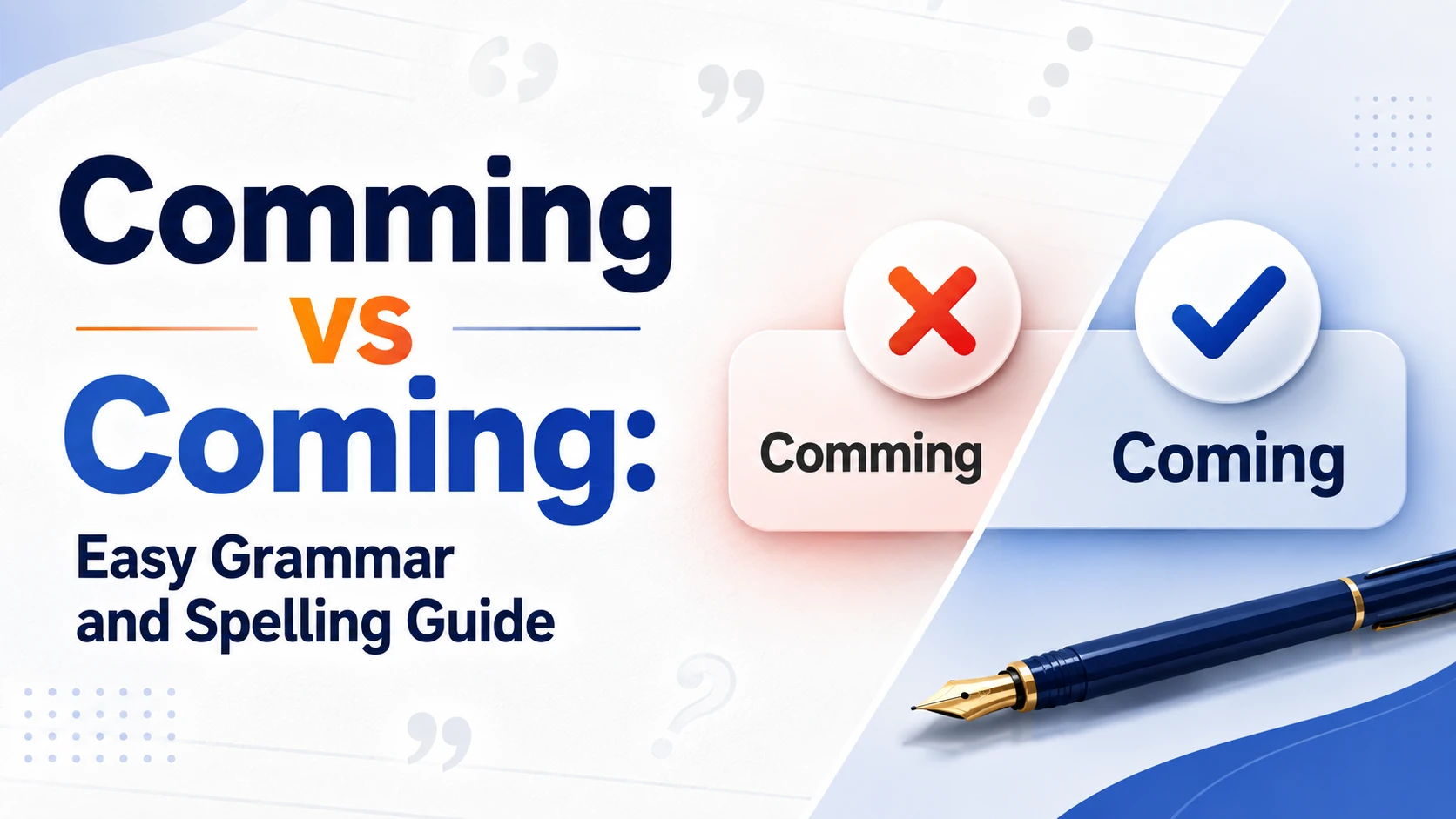
- ✅ Coming is the correct spelling.
- ❌ Comming is incorrect in standard English.
The word coming is the present participle and gerund form of the verb come.
Examples:
- She is coming home now.
- Thank you for coming to the meeting.
- Winter is coming earlier this year.
The spelling comming does not appear in standard English dictionaries because it violates the normal spelling rule for verbs ending in a silent e.
Quick Rule
Drop the silent e from come, then add -ing.
Come → Coming
Never add another m.
Which Spelling Is Correct?
Whenever you need the -ing form of come, the correct spelling is always coming.
Correct:
- I’m coming with you.
- The guests are coming tomorrow.
- Spring is coming soon.
Incorrect:
- I’m comming with you.
- The guests are comming tomorrow.
- Spring is comming soon.
No modern English style guide recognizes comming as an acceptable spelling.
Why “Comming” Is Wrong
The mistake happens because many writers apply the wrong spelling rule.
English has two common patterns when adding -ing to verbs:
- Drop the silent e.
- Double the final consonant.
The verb come follows the first rule—not the second.
Correct transformation:
- Come → Coming
Incorrect transformation:
- Come → Comming
Understanding which rule applies is the key to avoiding this mistake.
A Simple Rule You Can Remember
Think of the base verb first.
If the word is:
Come
then simply remove the final e and add -ing.
Come
⬇
Drop e
⬇
Coming
There is never a reason to insert an extra m.
Is “Comming” Ever a Real Word?
Many people wonder whether comming might be an accepted alternative spelling, a regional variation, or an older English form.
The answer is no.
In modern English, comming is considered a spelling mistake rather than a separate word.
Why Standard English Rejects “Comming”
Major English dictionaries recognize:
- come
- comes
- came
- coming
They do not list comming as a standard spelling.
Professional editors, teachers, publishers, and proofreading software all treat comming as an error.
If you use it in:
- academic writing,
- business emails,
- resumes,
- websites,
- articles,
it will likely be marked as incorrect.
Why You Still See “Comming” Online
Despite being incorrect, comming appears frequently on the internet.
Common reasons include:
- Fast typing
- Mobile keyboard mistakes
- Lack of proofreading
- Confusion about doubling consonants
- Writers learning English as a second language
Search engines often display pages containing comming because they index user-generated content, not because the spelling is correct.
Does Autocorrect Always Catch It?
Not always.
Modern spell-checkers usually suggest coming, but errors can still slip through.
This happens when:
- Spell check is turned off.
- A website lacks proofreading.
- Someone ignores the correction.
- The software fails to review every field.
For important writing, manual proofreading remains one of the best ways to catch spelling errors.
Writing Tip
Read your work aloud before submitting it. Although coming and comming sound similar, seeing the word in context often makes the spelling mistake easier to spot.
What Does “Coming” Mean?
The word coming serves several grammatical purposes in English. While its spelling remains the same, its meaning changes depending on the sentence.
Understanding these uses helps you write more naturally.
Coming as the Present Participle of “Come”
Most often, coming functions as the present participle of the verb come.
It describes movement toward a place, person, or event.
Examples:
- She is coming home.
- My parents are coming this weekend.
- The train is coming into the station.
This is the most common use in everyday English.
Coming as a Gerund
Sometimes coming acts as a noun.
Examples:
- Coming early helped us avoid traffic.
- Thank you for coming.
- His coming surprised everyone.
In these sentences, coming refers to the action itself rather than describing ongoing movement.
Coming as an Adjective
The word can also describe something that is about to happen.
Examples:
- the coming year
- the coming election
- the coming season
- the coming generation
Here, coming means upcoming, approaching, or next.
Example:
- The coming holidays are expected to be busy.
Why the Correct Spelling Is “Coming”
Many spelling mistakes disappear once you understand the grammar rule behind them.
Fortunately, coming follows one of English’s most consistent spelling patterns.
The Silent “E” Rule
When a verb ends with a silent e, English usually drops that e before adding -ing.
Examples:
| Base Verb | Correct -ing Form |
| Come | Coming |
| Make | Making |
| Give | Giving |
| Take | Taking |
| Write | Writing |
| Leave | Leaving |
Notice that none of these verbs double the final consonant.
The silent e simply disappears.
Why the Final “M” Is Not Doubled
Many learners confuse come with verbs that double their last consonant.
Compare the difference:
| Verb | Correct Form | Why? |
| Come | Coming | Drop silent e |
| Run | Running | Double final consonant |
| Swim | Swimming | Double final consonant |
| Sit | Sitting | Double final consonant |
| Begin | Beginning | Double final consonant |
The important distinction is that come already ends with a silent e, so it follows an entirely different spelling rule.
Trying to combine both rules creates the incorrect form comming.
Similar Verbs That Follow the Same Pattern
Once you understand coming, many other English verbs become easier to spell.
Examples:
- bake → baking
- smile → smiling
- move → moving
- arrive → arriving
- believe → believing
- drive → driving
Each follows the same principle:
- Remove the silent e.
- Add -ing.
- Do not double the consonant.
Recognizing this pattern helps eliminate one of the most common spelling mistakes made by English learners and native speakers alike.
Why People Mistakenly Write “Comming”
Although coming is the only correct spelling, comming appears surprisingly often in emails, social media posts, text messages, and even professional documents. The mistake isn’t usually caused by carelessness. Instead, it stems from applying the wrong spelling rule or relying on pronunciation instead of grammar.
Understanding why people make this error makes it much easier to avoid.
Confusion with Double-Consonant Spelling Rules
One of the biggest reasons people write comming is that they remember words like:
- Run → Running
- Swim → Swimming
- Sit → Sitting
- Begin → Beginning
These verbs double their final consonant before adding -ing, so learners naturally assume come should follow the same pattern.
However, come belongs to a different group of verbs because it ends with a silent e.
Compare the patterns:
| Verb Pattern | Example |
| Drop the silent e | Come → Coming |
| Double the consonant | Run → Running |
Learning to identify these two patterns is more useful than memorizing individual words.
Pronunciation Can Be Misleading
Another reason for the confusion is pronunciation.
When spoken naturally, coming doesn’t emphasize whether there is one m or two.
For example:
- I’m coming.
- They’re coming tomorrow.
Since English spelling isn’t perfectly phonetic, pronunciation alone cannot tell you how many letters belong in a word.
That’s why spelling should always be based on the base verb, not on how the word sounds.
Fast Typing Creates Errors
Many spelling mistakes happen because people type quickly.
Common situations include:
- Sending text messages
- Replying to emails
- Posting on social media
- Live chatting
- Taking classroom notes
When writing at speed, fingers sometimes repeat a letter accidentally.
For example:
- comming
- commitee
- adress
- recieve
These aren’t grammar mistakes—they’re spelling mistakes that proofreading usually catches.
Influence of Similar-Looking Words
English contains many words with doubled consonants.
Examples include:
- common
- commit
- commission
- committee
- communicate
Because these words contain mm, some writers subconsciously insert another m into coming.
Recognizing that coming comes from come—not common or commit—helps eliminate this habit.
Comming vs Coming Comparison Table
The following table summarizes the most important differences.
| Feature | Coming | Comming |
| Correct English spelling | ✅ Yes | ❌ No |
| Found in dictionaries | ✅ Yes | ❌ No |
| Used in academic writing | ✅ Yes | ❌ No |
| Accepted in business writing | ✅ Yes | ❌ No |
| Derived from “come” | ✅ Yes | ❌ Incorrect formation |
| Recommended by grammar guides | ✅ Always | ❌ Never |
Quick Reminder
If you’re writing the -ing form of come, there is only one correct spelling: coming.
How to Use “Coming” Correctly in Sentences
Knowing the spelling rule is helpful, but using coming naturally in different contexts is equally important.
Below are practical examples that reflect real-world English.
Everyday Conversation Examples
In daily speech, coming often describes movement toward a person or place.
Examples:
- I’m coming home after work.
- Are you coming with us tonight?
- Dinner is coming soon.
- She’s coming back next week.
- The children are coming inside because it’s raining.
These sentences sound natural because coming expresses ongoing or expected movement.
Academic Writing Examples
Students frequently use coming in essays and classroom discussions.
Examples:
- The coming chapters explain the theory in greater detail.
- Researchers predict significant changes in the coming decades.
- The professor discussed the coming examination schedule.
- More evidence is coming from recent studies.
Notice that coming sometimes refers to future events rather than physical movement.
Business and Professional Examples
In workplace communication, coming appears in emails, presentations, and reports.
Examples:
- Thank you for coming to today’s meeting.
- Our new product is coming next month.
- Additional updates are coming soon.
- The finance team is coming to inspect the project.
- We appreciate everyone coming prepared.
Using the correct spelling helps maintain professionalism.
Everyday Digital Communication
The word also appears frequently in informal writing.
Examples:
- I’m coming now.
- Is everyone coming?
- Your order is coming tomorrow.
- The update is coming soon.
- Thanks for coming!
Although these messages are informal, the spelling rule remains the same.
Common Grammar Patterns That Use “Coming”
Learning common sentence patterns helps you use coming more fluently.
Be + Coming
This structure describes an action currently in progress.
Examples:
- She is coming home.
- They are coming later.
- We were coming back when it started raining.
Coming to + Place
Use this pattern when someone is moving toward a destination.
Examples:
- Are you coming to school tomorrow?
- We’re coming to your house this evening.
- She’s coming to London next month.
Coming from + Place
This structure identifies the starting point of movement.
Examples:
- He’s coming from the airport.
- The package is coming from Germany.
- Our guests are coming from Canada.
Coming for + Purpose
This pattern explains why someone is coming.
Examples:
- She’s coming for dinner.
- They’re coming for the conference.
- We are coming for the interview.
Coming with + Person
This structure identifies who accompanies someone.
Examples:
- Are you coming with us?
- She’s coming with her parents.
- I’m coming with my coworkers.
Recognizing these common patterns makes your writing more natural and improves sentence variety.
Popular Expressions That Use “Coming”
English contains many fixed expressions built around coming.
Learning them expands your vocabulary and prevents awkward phrasing.
Coming Soon
This phrase announces something that will happen in the near future.
Examples:
- New features coming soon.
- A sequel is coming soon.
- More updates are coming soon.
Coming of Age
This expression refers to reaching adulthood or emotional maturity.
Examples:
- The novel is a classic coming-of-age story.
- The film explores a teenager’s coming of age.
Coming Full Circle
This idiom means returning to the place or situation where something originally began.
Examples:
- After years abroad, her career has come full circle.
- The discussion eventually came full circle.
What’s Coming Next
This phrase introduces future developments.
Examples:
- Let’s look at what’s coming next.
- Nobody knew what was coming next.
It frequently appears in presentations, articles, and instructional writing.
Expert Tip
Many expressions using coming are fixed phrases. Memorizing them naturally reinforces the correct spelling, making it much less likely that you’ll accidentally write comming.
Common Mistakes to Avoid When Writing “Coming”
Even experienced writers occasionally make spelling mistakes when working quickly. Fortunately, the error comming is easy to avoid once you recognize the patterns that cause it.
Below are the mistakes editors encounter most often and practical ways to prevent them.
Writing “Comming” Instead of “Coming”
This is by far the most common mistake.
❌ Incorrect:
- I am comming home now.
- Thanks for comming today.
- Winter is comming soon.
✅ Correct:
- I am coming home now.
- Thanks for coming today.
- Winter is coming soon.
Always remember that the base verb is come, not comm.
Forgetting to Drop the Silent “E”
Some learners know they need to add -ing, but forget to remove the final e.
❌ Incorrect:
- Comeing
✅ Correct:
- Coming
When a verb ends in a silent e, English usually drops that e before adding -ing.
Examples:
- Make → Making
- Take → Taking
- Give → Giving
- Come → Coming
Applying the Wrong Spelling Rule
Many learners mix two different spelling rules.
They think:
- Run → Running
- Swim → Swimming
Therefore:
- Come → Comming ❌
The problem is that come belongs to a different spelling pattern.
Understanding the rule is much more effective than memorizing individual words.
Trusting Spell Check Too Much
Grammar tools are helpful, but they aren’t perfect.
For example:
- Some online editors don’t check every text field.
- Browser extensions may be disabled.
- AI writing tools occasionally overlook simple typos.
Professional writers still proofread manually before publishing.
Editing Tip
During proofreading, search your document for “comm”. This simple search often catches accidental spellings like comming immediately.
Words That Follow the Same Spelling Rule
Learning similar verbs helps reinforce the pattern behind coming.
Each of the following verbs ends with a silent e, which disappears before -ing is added.
| Base Verb | Correct -ing Form |
| Come | Coming |
| Give | Giving |
| Make | Making |
| Take | Taking |
| Write | Writing |
| Drive | Driving |
| Move | Moving |
| Smile | Smiling |
| Bake | Baking |
| Leave | Leaving |
Notice that none of these verbs double their final consonant.
Why These Verbs Behave the Same Way
These verbs share an important feature:
They all end with a silent e.
English spelling generally follows this pattern:
Verb + silent e
⬇
Remove e
⬇
Add -ing
Once you recognize this rule, dozens of words become easier to spell correctly.
Words That Double the Final Consonant Instead
Not every verb follows the silent e rule.
Some require the final consonant to be doubled before adding -ing.
| Base Verb | Correct Form |
| Run | Running |
| Swim | Swimming |
| Sit | Sitting |
| Begin | Beginning |
| Stop | Stopping |
| Plan | Planning |
These verbs usually follow the consonant-vowel-consonant (CVC) pattern and have stress on the final syllable.
This explains why:
- Run → Running ✅
- Come → Coming ✅
They belong to different spelling categories.
A Quick Comparison
| Rule | Example |
| Drop silent e | Come → Coming |
| Double consonant | Run → Running |
Keeping these rules separate prevents many common spelling mistakes.
Memory Tricks to Never Misspell “Coming” Again
Simple memory techniques can help you remember the correct spelling long after you’ve finished reading this guide.
Remember the Base Word
Whenever you’re unsure, go back to the original verb.
Ask yourself:
“What is the base verb?”
Answer:
Come
Now apply the spelling rule.
Come
→ remove e
→ Coming
This takes only a few seconds and works every time.
Think: “Drop the E, Don’t Add Another M”
A short rhyme is often easier to remember than a grammar rule.
Drop the E.
Don’t double the M.
Many teachers use this reminder because it’s simple and memorable.
Associate It with Familiar Expressions
You’ll regularly encounter these phrases:
- Coming soon
- Coming home
- Coming back
- Coming tomorrow
- Thank you for coming
Seeing the correct spelling repeatedly helps build automatic recognition.
Read More Carefully
Professional editors rarely rely on memory alone.
Instead, they:
- Read slowly.
- Review one sentence at a time.
- Look for commonly misspelled words.
- Use spell check as a final review—not the only review.
Developing this habit improves every aspect of your writing, not just spelling.
Quick Practice: Can You Spot the Correct Spelling?
Try these exercises before moving on to the FAQs.
Exercise 1: Choose the Correct Word
Select the correct spelling.
- She is (coming / comming) home tonight.
- Thank you for (coming / comming).
- More information is (coming / comming) soon.
- Are you (coming / comming) with us?
Exercise 2: Fill in the Blank
Complete each sentence.
- Winter is __________ earlier than expected.
- My parents are __________ tomorrow morning.
- We appreciate everyone __________ to the meeting.
- The train is __________ into the station.
Exercise 3: Correct the Mistake
Rewrite these correctly.
- I’m comming later.
- Thanks for comming today.
- The guests are comming tonight.
- Summer is comming quickly.
Answer Key
- Exercise 1:
- Coming
- Coming
- Coming
- Coming
- Exercise 2:
- Coming
- Coming
- Coming
- Coming
- Exercise 3:
- I’m coming later.
- Thanks for coming today.
- The guests are coming tonight.
- Summer is coming quickly.
If you answered all of these correctly, you’ve mastered the spelling rule that causes one of the most common English writing mistakes.
Expert Recommendation
Don’t memorize coming as an isolated word. Instead, understand the silent-e spelling rule behind it. Once you know the rule, you’ll automatically spell dozens of similar English verbs correctly.
Final Takeaways
| Question | Answer |
| Which spelling is correct? | Coming ✅ |
| Is “comming” a real English word? | No |
| Why is “coming” correct? | Drop the silent e before adding -ing |
| Should you ever double the m? | No |
| Does it matter in professional writing? | Yes—correct spelling improves credibility. |
Conclusion
Understanding comming vs coming is less about memorizing a single word and more about recognizing the spelling pattern behind it. Once you know that verbs ending with a silent e usually drop the e before adding -ing, the correct form becomes easy to remember. This same rule applies to many everyday verbs, making your overall spelling stronger and more consistent. Whenever you write emails, essays, reports, or social media posts, take a moment to proofread words that commonly cause confusion. One final actionable tip: if you’re unsure, trace the word back to its base verb—come—and then apply the silent e rule. A common mistake to avoid is assuming every verb doubles its final consonant before -ing. By understanding the rule instead of relying on guesswork, you’ll write with greater confidence, accuracy, and professionalism every time.
Frequently Asked Questions
Q1. Why is “coming” spelled with one m instead of two?
The word coming comes from the base verb come, which ends with a silent e. English spelling rules require you to drop the silent e before adding -ing, resulting in coming. Unlike verbs such as run or swim, come does not double its final consonant.
Q2. Is “comming” ever correct in English?
No. Comming is considered a misspelling in modern English. It is not recognized as the standard present participle or gerund form of come by major dictionaries or style guides. In formal writing, always use coming.
Q3. Why do so many people accidentally write “comming”?
Most people confuse two different spelling rules. They see verbs like running, planning, and swimming, where the final consonant doubles, and mistakenly apply that rule to come. Others simply type too quickly or rely on pronunciation instead of remembering the spelling rule.
Q4. Can using “comming” affect professional writing?
Yes. Although readers will usually understand your meaning, comming can make emails, reports, resumes, assignments, and website content appear less professional. Correct spelling improves credibility, demonstrates attention to detail, and creates a stronger first impression.
Q5. What’s the easiest way to remember the correct spelling?
The easiest way to remember the correct spelling is to think of the pattern come → coming: drop the final “e” and add “-ing.” A simple reminder is, “Drop the E, don’t double the M.” You can reinforce this rule with similar verbs, such as make → making and give → giving.
